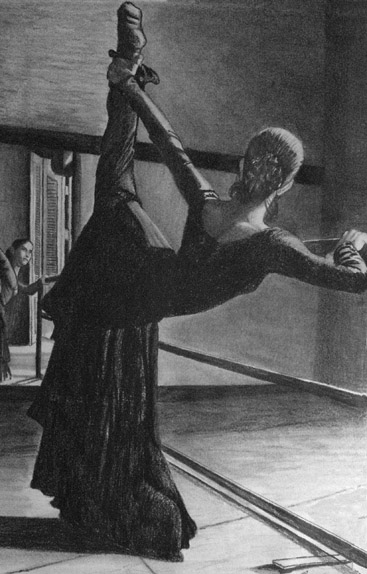
The elegance and base allure of this pencil drawing appealed to my impure heart. The drawing appeared as shown above in the Art for Justice section of Washington’s finest paper, Street Sense. But the drawing had been accidentally cropped on the left. In the original drawing, the full reflection of the dancer is visible to the left, as well as further to the left the right side of a piano.
The artist, Thomas, is a prisoner in the Wende Correctional Facility in New York State. That’s a maximum security prison that imprisons only men. On the back of the drawing, he explained it this way:
different points of view, back view, and reflection in mirror, front view, also, exercise in light and darkness (value scale) and shadows!
That, for most of us, is a true depiction of the human psyche.

Beautiful drawing. The value scale is very well used to express the mood of the scene and the femininity of the ballerina. The shading contrasts represent the one between the softness of the dancer and the difficulty at task. Thomas well placed the orthogonals taking the viewer into the picture with the barre, looking at the reflection and up the leg (sort of like down, back, and up). Different shades are used to create the cascade look of the dress. The light coming from the bottom right engages the viewer to the beginning of the barre. The reflection of the young woman is a contradiction to the feeling the viewer has of the main figure from the back. If that is how the ballerina sees herself, it surely is not as tall and graceful is she appears from the back. The reflected young woman looks smaller and less elegant. Even her face seems tense. Is it from the strenuous position or because she is unhappy of what she sees?
Patricia, thanks for your insightful appreciation of the drawing. Given the circumstances of its production, its psychological depth is astonishing.