
transversal poetics confronts modern art
The Corkinhorn Gallery’s current exhibition, Painting Transversally, rides the frontiers of literary criticism and literary theory to raise profound questions for modern art. Painting Traversally violently interrogates modern arts’ failure to become post-modern. It complicates the relationship between art object and art consumer and implicates mass media and corporate America in the symbolic commercialization and dissignification / dissemination of art impulses.
I found this marvelous little gallery just south of the Phillips Collection. I would describe it further, but I don’t have time right now. Here’s my favorite piece, Masterwork in Bluish.

visitor information kiosks in a smartphone era
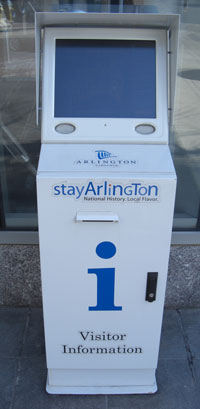 Public touch-screen visitor information kiosks provide information and directions for local businesses and local attractions. However, by providing access to highly developed, commonly used web services, smart phones now offer better, more up-to-date, local information and directions. To serve visitors and to promote local economic development, public kiosks must offer something that smart phones don’t.
An obvious possibility is a much larger screen and fancier interactive technology. The Official NYC Information Center in Midtown Manhattan has large Interactive Map Tables. The Center’s website explains:
By moving the disc across the touch-screen tables, you can explore a large interactive map of the five boroughs. When categories of interest like “Museums & Galleries” or “Dining” are selected, flags pop up all over the map with relevant matches. Flags can then be touched to open up a box with a description, info and photos for each place. You can also browse special sections, like “Free Attractions” or Just Ask The Locals,™ which gives recommendations from famous New Yorkers. Save your favorite sites to the disc, and then take it over to the Disc Reader for the Video Wall, where you can use a custom itinerary flyover to virtually soar above an incredibly detailed three-dimensional Google Earth map of the City highlighting the spots you’ve picked out. [see also video demonstration]
The Center seems designed to be a tourist attraction in itself. Whether the Center is a complement or substitute for a real-life tour isn’t quite clear. But surely its technology is too expensive and spatially infeasible to duplicate across many kiosk locations. Moreover, for the practical task of getting local information and directions, even this technology probably isn’t as useful as a smart phone in hand.
While persons use smart phones to get information that they seek, public tourist kiosks could seek attention from passers-by. Public tourist kiosks could function as digital signage showing text, images, and short videos. Such public tourists kiosks would be designed not for walk-up viewing, but to communicate at a distance. Commercial digital signage typically has a narrow range of content serving a specific interest. Public tourist kiosks could be digital signage with a wider mix of content serving a wider range of purposes, including furthering the style and symbolic tone of the local area.
A good community process for generating content for public tourist kiosks would help to give them public authority. Residents could continually vote online to select among items in a time-stream of events, business promotions, and entertainment to be offered on the public tourist kiosks. Tools for decentralized submission and rating of content, along with technologies for authenticating, validating, and moderating use, are rapidly being developed on the web. Appropriately connected to the Internet, public tourist kiosks could draw upon such technology to determine on an ongoing basis the content that they display.
subsidizing high-cost telephone lines stimulates growth
From its beginnings, the U.S. telephone industry has included many small telephone companies. Over time government programs have been established to subsidize small, high-cost telephone companies.[1] Under the High-Cost Loop Support program, about $1 billion in subsidies were given in 2007 to incumbent local-exchange telephone companies (ILECs) that had relatively high-cost loops.[2] The subsidy to a telephone company is proportional to the number of high-cost loops that the telephone company operates. Subsidizing high-cost loops provides a greater incentive for their growth than would otherwise exist.
Growth in telephone company loop counts across the study-area loop-size distribution is generally consistent with subsidies stimulating loop-count growth. Study areas typically contain the loops that a telco serves in a particular state.[3] In 2007, the 50th, 70th, and 90th percentiles in the study-area loop-size distribution were study areas with about 3000, 10000, and 57000 working loops, respectively.[4] Loop counts at these percentiles grew about 80% and -15% from 1988 to 2001 and 2001 to 2007, respectively. Loop growth at the 99th percentile was 52% and -30% from 1988 to 2001 and 2001 to 2007, respectively. The 99th percentile represented a study-area size of about 2 million loops in 2007. Hence loop counts in the largest study areas grew considerably less than loop counts in much smaller study areas. In 2007, the larger study areas received no high-cost loop subsidy, while those smaller study areas received roughly $100 in high-cost subsidy per loop in 2007. A similar difference in subsidy levels existed back to 1988. Hence these data are consistent with an economically plausible effect: subsidizing high-cost loops stimulates growth of relatively more of them.[5]
* * * * *
Data: trends in ILEC study-area loop count distribution, 1988-2007 (Excel version); dataset containing loop counts for every ILEC study area, as well as other cost data, 1988-2007
Notes:
[1] These subsidies tend to be associated with universal service; in particular, providing service in rural areas. However, any telephone telephone company that provides telephone exchange service to fewer than 100,000 lines is defined under U.S. law to be a “rural telephone company” even if it provides service only in urban areas. See definition of “rural telephone company” in 47 CRF 51.5.
[2] Summed from the NTS Cost Dataset, annual support pay, 2007. This figure is lower than Federal-State Joint Board’s Monitor Report’s figure for High-Cost Loop Support primarily because the NTS Cost Dataset does not include subsidies to competitive local-exchange telephone companies (CLECs).
[3] The NTS Cost Dataset description provides further information about study areas. Study areas are the basis for the calculation of high-cost loop subsidies.
[4] Data are currently available through 2008. However, AT&T did not report after 2007. Growth rates are compared relatively to 2007, rather than 2008, to avoid effects from this reporting change.
[5] The growth pattern at the 10th and 25th percentiles is more varied. Loop growth from 1988 to 2001 at the 10th and 25th percentiles was similar to that at the 99th percentile. However, from 2001 to 2007, the reduction in loop counts at the 10th and 25th percentiles was similar to that at the 50th through 90th percentiles, and only about half as much as at the 99th percentile. The smallest telephone companies may be less oriented to profit maximization than larger telephone companies and may be more capable of stabilizing their income streams. Study areas with size less than or equal to the 25th percentile in the loop-size distribution served about 0.7% of all loops in 2007.
Wednesday's flowers
