voice and video calling

Skype’s recent filing with the U.S. Securities and Exchange Commission (SEC) states that, in the last three months of 2010, video-enabled calls accounted for 42% of Skype’s within network communication minutes.  In October, 2009, Skype described video calls as accounting for “more than a third” of its total communication minutes.  Given that description, Skype’s video call share probably has risen over the past year.

Other Skype actions are consistent with the increasing importance of video communication.  Skype recently acquired Qik.  Qik offers live video calls from mobile phones as well as a wide range of options for video sharing.  In January, 2011, Skype officially launched a group video calling feature.  This paid service allows a social video call among up to nine persons at a time. Group video calling requires more expensive product development than rebranding “speaker phone” as “social mode”, but it serves a similar need.  In addition to these developments, Skype reportedly is negotiating with Facebook to establish a video-calling partnership.

The sensory form of communication offer a propitious field for service innovation.  Mobile network operators are slowly integrating voice and data communications under LTE mobile networking technology. Will they finally produce a show-and-tell communicator?  How about a Twitter-like service using photos?  Like Skype’s SEC filing, the U.S. Federal Communications Commission’s Order in the Matter of Preserving the Open Internet (adopted Dec. 21, 2010) refers to “voice and video telephony”. Expect communication services of different sensory forms to gain importance in the future.

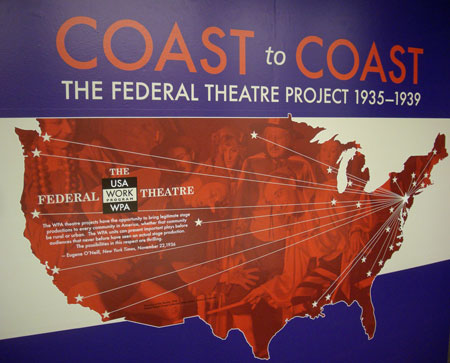
U.S. Federal Theatre Project: theater for all Americans

From 1935 to 1939, the U.S. Federal Theatre Project (FTP) created jobs for out-of-work theater professionals.  It organized and funded a wide range of productions — “from productions of sacred plays of the Middle Ages to classic plays by William Shakespeare and Richard Brinsley Sheridan and modern works by George Bernard Shaw, Gerhard Hauptmann, Lillian Hellman, Eugene O’Neill, and Anita Loos. ”  The legendary “voodoo Macbeth“, vaudeville, puppet shows, and dramatic productions in Yiddish, French, Russian, Italian, Spanish, and German all occurred under the FTP.

Exactly how different interests — racial, ethnic, geographic, and cultural — were balanced isn’t clear.  In 1937, the FTP formed a National Service Bureau from its Play Bureau and Play Policy Board. The National Service Bureau was based in New York City.  It provided research services on American theater to FTP units spread across the U.S.  Concern about New York City’s financial and cultural domination has been an important strand in American history from the early nineteenth century.  That concern doesn’t seem to have registered with the FTP.

Federal Theatre Project covers the U.S from coast to coast

In 1936, the famous and highly honored U.S. playwright Eugene O’Neill strongly endorsed the FTP.  He declared:

The WPA theatre projects have the opportunity to bring legitimate stage productions to every community in America, whether that community be rural or urban.  The WPA units can present important plays before audiences that never before have seen an actual stage production.  The possibilities in this respect are thrilling.[*]

The distinction between legitimate theater and illegitimate theater was rooted in a theater licensing act enacted in England in 1737. In Europe, state-sanctioned theater engaged in fierce political battles with popular theater.  O’Neill associated “legitimate stage productions,” “important plays,” and “actual stage productions.”  Many persons in many different communities across the U.S. probably had experience of popular theatrical productions that O’Neill did not recognize.  The goal of bringing theater to all Americans presupposed an exclusive definition of theater.

* * * * *

[*] “O’Neill Turns West to New Horizons,” New York Times, Nov. 22, 1936.


humans and animals complementary

Human domestication of other animals has shaped human history.  Dogs, which have been domesticated for at least 10,000 years, have provided humans with guards, hunting aids, carrying aids, and sources of meat and fur.  The domestication of sheep, goats, pigs, cows, and other animals enabled humans to live as herders.  Living in close proximity to domestic animals probably stimulated the development of the human immune system.  The domestication of the horse had a huge impact on human warfare.

dog's nose

Pets today tend to be associated with the human desire for companionship. However, the share of U.S. households with a pet actually rises with household size.  For example, 38% of two person households had a dog in 2006, while 54% of households containing five or more persons had a dog.  The importance persons attach to using the Internet for social communication also rises with household size.  More opportunities for communications of various types seem to be positively correlated.  That’s consistent with the success of online social networks for pets. More generally, despite the obvious difficulties of traditional media, communication is not a zero-sum business.

*  *  *  *  *

Data:  U.S. Statistical Abstract 2011, Table 1240, “Household Pet Ownership: 2006“. In the U.S. at the end of 2006, 43% of households owned dogs and 38% owned cats.  Here are some additional statistics.

Darkness’s Descent: advancing public understanding of humankind

Darkness’s Descent on the American Anthropological Association: A Cautionary Tale” provides a sobering account of the behavior of humans within a web of social relations, ideological commitments, and material interests.  The humans in this account don’t exactly show a propensity to kill each other.  But these humans are every bit as fierce as the Yanomamö hunter-gathers documented in Napoleon Chagnon’s pioneering anthropological work.  Their literary relations are violent and deceitful. Their reasoning seems personal-instrumental and shows little respect for truth-seeking.  Despite years of expensive educational courses and being professionally designated as educators, journalists, and writers, these humans show little ability to reason together joyfully and constructively. Most worrisome of all: these humans, genetically, are just like you and me.

Don’t abandon hope.  Alice Dreger, who has done much, surely unpleasant, work analyzing and documenting the facts, has stated:

I understand that those who were involved in this controversy may have had good intentions. Many sought justice. But justice that is meted out according to politics and not according to facts is the justice of the Middle Ages. If justice is not based on the facts, if principles of justice are not applied universally, there is no real justice. Forms of “scholarship” that deny evidence, that deny truth, that deny the importance of facts—even if performed in the name of good—are dangerous not only to science and to ethics, but to democracy. And so they are dangerous ultimately to humankind.

Dreger urges the American Anthropological Association to apologize to Napoleon Chagnon and James Neel (now deceased) and their families.  A formal apology, it seems to me, would be appropriate.

I apologize to Napoleon Chagnon and James Neel for the pain and suffering my fellow human beings have unjustly inflicted on them and their families. While I am not aware of ever having behaved similarly, I may be mistaken. I apologize to everyone for every instance in which, in my thoughts and in my words, in what I have done and what I have failed to do, I have not sought the truth —  the truth, not just the Higher Truth, but the lower truth, too. May the words of my blog and the meditation of my heart be acceptable in truth’s sight.

* * * * *

Sources:  Douglas Hume’s excellent documentary archive for the Yanomamö anthropological intellectual fiasco