the New / Old World in early elite books

In sixteenth-century Europe, the Theodore de Bry sold to elite readers expensive books describing foreign lands and peoples. De Bry himself never left Europe. His books were reprints, but he added to his sources many intricate, copper-plate engravings and fold-out maps that he created from secondary sources.  He produced the books in the large, prestigious folio format.  He printed the books in Latin as well as in vernacular European languages, and issued them in multi-part series.  Pictures, vernacular languages, and multi-part book series were well-established commercial techniques for expanding book markets. De Bry thus astutely marketed expensive, prestigious books.

John Rainolds, President of Corpus Christi College, Oxford, acquired sometime before 1607 the first nine parts of de Bry’s Descriptiones Americae (also known at Collectiones Peregrinationum in Indiam, Orientalem et Occidentalem / Grands Voyages).  These parts were bound in an expensive (full calf-skin) binding and kept in the Corpus Christi College library.  Underscoring the perceived value of the volumes, they were secured with a chain to prevent readers’ borrowing or taking them.

Theodore de Bry image of natives and Spanish in New World

The above image displays one of de Bry’s engravings from Descriptiones Americae.  A Protestant who lost everything fleeing from prosecution in his native Liege in the 1560s, de Bry despised the Spanish and Catholics.  The engraving shows New World natives cannibalizing the Spanish.  One native pours molten gold into a Spanish soldier’s mouth.  The engraving isn’t a good source of factual knowledge and understanding about people and events in the New World.[*]  It’s mainly a record of an elite representational battle that became the Black Legend vs. the White Legend.

Every representation offers a double relation — a relation to that represented, and a relation to the representation’s source.

*  *  *  *  *

Notes:

Image from German edition dated 1618 (Das sechste Theil Americae oder Der Historien Hieron. Benzo das dritte Buch. Darinnen erzehlet wirt, wie die Spanier die) in the U.S. Library of Congress’s Kraus Collection of Sir Francis Drake.  See America, part 6, German, image 697.

A similar, but less detailed image of Indians pouring gold down a Spaniard’s throat appeared earlier in Girolamo Benzoni’s Historia del Mundo Nuovo (1565).  This was probably a source for de Bry’s engraving.

In the Seven Sages / Sindibad corpus, a story known as Virgilius tells of an avaricious Roman king getting molten gold poured down his throat as punishment for allowing Rome’s marvelous, protective mirror to be destroyed.  Here’s an English translation of Virgilius from a 13th-century French Seven Sages / Sindibad manuscript.

The Latin epic Alexandreis, which Walter of Châtillon wrote in northern France about 1175, uses the figure of pouring gold down one’s throat as a figure of avarice for the mother of monsters in Hell:

Before the gates of Erebus, beneath
the Stygian city’s wall, those monsters
dwell, the livid sisters. Their mother hides her coffers
in murky caves and guzzles with dry throat
gold poured from a thousand refining fires,
nor can it sate the ardour of her thirst.
{Ante fores Herebi Stigiae sub menibus urbis
Liuentes habitant terrarum monstra sorores,
Inter quas antris aliarum mater opacis
Abscondit loculos et coctum mille caminis
Faucibus infusum siccis ingutturat aurum,
Explerique nequit sitis insatiabilis ardor.}

Alexandreis 10.31-6, from Latin trans. Townsend, David. 2007. Walter of Châtillon. The Alexandreis: a twelfth-century epic. Peterborough, Ontario, Canada: Broadview Press.

[*]  de Bry tended to depict natives with European facial features and give them poses and physiques similar to those in Greco-Roman art. However, many of his engravings do provide valuable historical information about life in the Americas in the sixteenth century.

Bell System response to automatic telephony

Early in the year 1900, local authorities in Springfield, Massachusetts, held a hearing on Hampden Automatic Telephone Company’s application to provide automatic telephone service in Springfield.  The Bell System at that time provided operator-switched telephone service in Springfield. The hearing produced an early battle of experts.  It also displayed general argumentative strategies quite common in modern regulatory proceedings.

Testifying against granting the application for the competing automatic service was Isaiah H. Farnham, “the well-known Bell telephone expert.”  Mr. Farnham’s arguments:

  1. He has studied the 300 relevant patents and has concluded that automatic telephony is not practical.
  2. He personally made 100 telephone calls on an automatic telephone system, and he found that more than half the calls were failures (no response or failure to connect to the right customer).
  3. The automatic telephone system operating in Aiken, South Carolina, had an even higher rate of failure.
  4. The automatic telephone system operating in Augusta, Georgia, had many stations out of order.
  5. A person standing on a damp floor would receive an electrical shock from the dial of an automatic telephone.
  6. The automatic telephone had no protection against electrical currents from lightning or from telephone wires crossing electric light wires.
  7. He found that the automatic telephone system took 11 seconds to make a connection, while the Bell system in Springfield made connections in about 4 seconds.
  8. An ordinary person would have difficulty using an automatic telephone in the dark.
  9. Because the apparatus is more complicated, a subscriber is more likely to make mistakes with an automatic telephone.
  10. It takes longer to correct a mistake with an automatic telephone.
  11. The automatic telephone system provides a greater opportunity for central office personnel to eavesdrop on telephone conversations, because, with an automatic system, central office personnel have less work to do.
  12. An automatic telephone system costs more to construct, requires more expert knowledge, and has higher depreciation costs, and hence has a greater total cost than an operator-switched telephone service.
  13. The “central office of a modern telephone company” (meaning here one that employs operators) serves as a bureau of information. Automatic telephone service cannot provide information services.
  14. Automatic telephones have created public harms: “The fire department have been called out on false alarms over the automatic telephone.  The police have been sent on fruitless errands, and newspapers misled by people, who maliciously used the automatic telephone, knowing that there was no way in which to trace out their identity.  In one place, he said, the fire department has a standing rule not to answer any calls which come over the automatic telephone.”

S.L. Powers, an attorney for the New England (Bell) Telephone & Telegraph Company, added other arguments against granting the application:

  1. Only 20 companies have installed automatic switching equipment, and the largest automatically switched exchange has only 500 subscribers.
  2. New England Telephone pays $3.63 per year per telephone royalties, while the Automatic Company pays $5 per year in royalties.
  3. New England Telephone’s Springfield service has in the past reduced rates $4 per telephone, and the company has pledged to reduce rates as fast as possible.

E.A. Keith, an “electrical expert” from Chicago, offered testimony on behalf of the Automatic Company.  According to a news report, “Mr. Keith’s testimony differed materially from that offered by Mr. Farnham, and in certain points appeared to be exactly contradictory.”  Mr. Keith declared:

  1. An automatic telephone required, from an experienced user, one second per number dialed.  Hence only three seconds were required to call anyone in an exchange of 999 lines or less.
  2. An automatic systems was being implemented in Chicago.
  3. All the automatic exchanges in operation have been installed within the past three years and have better equipment than the automatic telephone system patented in 1891.
  4. Automatic telephone switches can serve party lines, but the company does not plan to implement party lines because they provide inferior service.
  5. The Bell System has experts in the central offices.  Their opportunity to overhear telephone conversations is as great as that of any automatic company personnel.
  6. Secret service is practically assured with an automatic system where metallic circuits are used.
  7. There’s little chance of wires getting crossed.
  8. Both the Bell System and the automatic system can be abusively used.[1]

The Bell System implemented automatic switching slowly compared to other telephone companies.  By 1920, two decades after this hearing, only 2% of telephones in the Bell System were automatically switched.[2]  Public hearings in which Bell System leaders argued against potential automatic-switching competitors probably helped to convince Bell System leaders’ of the inferiority of automatic switching long past when that inferiority was otherwise plausible.[3]

Just as liars risk becoming confused about true and false, those battling with arguments before regulators may lose the capacity to discern their real interests.

*  *  *  *  *

Notes:

[1] The quotations and the argument points are from “Arguments For and Against Automatic Telephony,” Electrical World and Engineer (New York), v. 35, n. 10 (Mar. 10, 1900).

[2] In 1929, 26% of Bell System telephones were automatically switched,  while the automatic shares in Austria, Netherlands, and Germany were 71%, 52%, and 40%, respectively.  Sweden, a early leader in teledensity, also lagged in implementing automatic switching.  Sweden’s share of automatically switched telephones was only 6% at the end of the 1920s.  For the non-U.S. figures (and mis-statement of the U.S. figure), see Lipartito, Kenneth (1994) “Component Innovation: The Case of Automatic Telephone Switching, 1891–1920,” Industrial and Corporate Change, v. 3, n. 2, pp. 327, 351.

[3] Id., p. 328, states that in 1910 in large U.S. cities, automatic switching would have cut Bell System costs $5 to $8 per line out of a total cost per line of $22.  On other reasons for the Bell System’s slow adoption of automatic switching, see id.  Here are statistics on U.S. telephone network technology from 1915 to 1987.

revolutionary ideas for spectrum policy

Regulations long established should not be changed for light and transient causes.  For many years, a large area of radio regulation has developed based on a consensus that it predominately concerns technical aspects of radio signal interference.  Few persons are able to contribute to deliberations thus organized.  Yet centuries of conversation and experience have explored, in ways deeply relevant to everyone, the meaning of interference and freedom.  Now interactive, broadband and ubiquitous communications, which undoubtedly will depend heavily on radio, are expected to reshape personal activities and relationships.  Radio regulation should no longer be a field ruled by a reason inaccessible to most persons.  Now is the time for radio regulation to recognize, as most persons do, revolutionary ideas about government, persons, and freedom.

The U.S. Declaration of Independence remains relevant.

the official form for sexist selective service registration

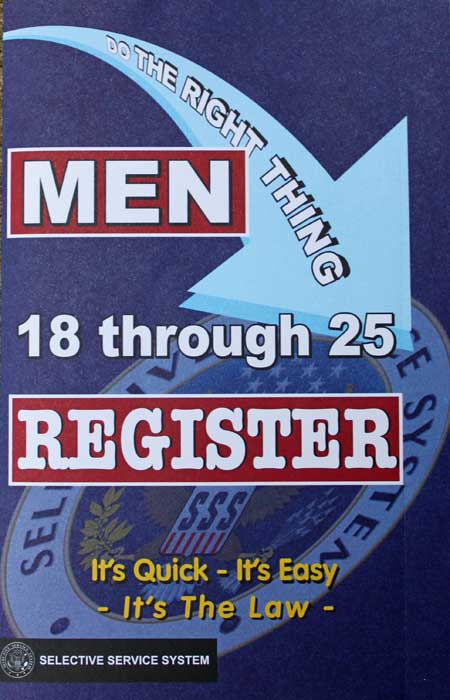
Recently I picked up a Selective Service registration form at the Post Office.  The persistence of sexist selective service has an interesting intellectual structure. The form itself, in contrast, displays simple, appalling moral obtuseness that goes beyond contempt for sex equality.

selective service registration form - cover

The most prominent words on the cover of the form are “men” and “register”.  Within an arrow is written the moral exhortation, “Do the right thing.” Does “do the right thing” mean throw the sexist selective service form in the garbage can, and then throw the garbage can through the post office window? Does “do the right thing” mean engage in non-violent civil disobedience, such as sitting down in the post office and refusing to move until the stack of sexist selective service forms is removed?  Or maybe have a men’s die-in at the post office?

Inside the cover of the selective service form are answers to questions.  But the obvious, painful question, “How can this sexism be tolerated in the U.S. in the year 2010?” isn’t answered. The questions and answers that are listed only make that question more searing.

“What is Selective Service Registration?”

Registration is the process by which the U.S. Government collects names and addresses of men age 18 through 25 to use in case of a national emergency, determined by Congress and the President, which would require rapid expansion of the Armed Forces.

“What Happens If I Don’t Register?”

Not registering is a felony.  Young men prosecuted and convicted of failure to register may be fined up to $250,000, imprisoned for up to five years, or both.  Failure to register also may cause men to permanently lose eligibility for student financial aid, government employment, job training, and U.S. citizenship for male immigrants.

A felony?!!!?  Apparently criminal prosecutions for failure to register have not occurred since 1986.  But this crime remains in the law books, and severe punishment for it is cited in this current government form.  A least one man has recently lost his job because of failure to register with Selective Service seventeen years earlier.

Discretionary application of absurdly punitive and nonsensical criminal laws has become a general characteristic of the U.S. criminal justice system.  This criminal justice system has led to about 2.4 million persons being locked up in prisons and jails today.  That’s an unrecognized national emergency.  Given that the criminal justice system locks up ten times as many men as women, this national emergency particularly concerns men.  Amidst this real and present national emergency, the Selective Service System prepares to conscript men, and only men, to use them in a national emergency.  Sacrificing men’s lives obviously is all too easy.

“Who Must Register?”

Male U.S. citizens and immigrants, documented and undocumented, residing in the U.S. and its territories must register if they are age 18 through 25.

“What About After I Register?”

If you move, you are required by Federal law to provide address changes to Selective Service, which can be done at www.sss.gov to “Report a Change of Address Online,” or by filling out and mailing a SSS Form 2 (Change of Information) at the post office.

This is worse than being asked to display right of residence if stopped by the police.  Whether a citizen or not, whether a documented or undocumented immigrant, the Selective Service System demands under federal law to be informed of the movement of all males ages 18 to 25.  After all, these males might be needed in the future to die for freedom.