Bell System response to automatic telephony

Early in the year 1900, local authorities in Springfield, Massachusetts, held a hearing on Hampden Automatic Telephone Company’s application to provide automatic telephone service in Springfield.  The Bell System at that time provided operator-switched telephone service in Springfield. The hearing produced an early battle of experts.  It also displayed general argumentative strategies quite common in modern regulatory proceedings.

Testifying against granting the application for the competing automatic service was Isaiah H. Farnham, “the well-known Bell telephone expert.”  Mr. Farnham’s arguments:

  1. He has studied the 300 relevant patents and has concluded that automatic telephony is not practical.
  2. He personally made 100 telephone calls on an automatic telephone system, and he found that more than half the calls were failures (no response or failure to connect to the right customer).
  3. The automatic telephone system operating in Aiken, South Carolina, had an even higher rate of failure.
  4. The automatic telephone system operating in Augusta, Georgia, had many stations out of order.
  5. A person standing on a damp floor would receive an electrical shock from the dial of an automatic telephone.
  6. The automatic telephone had no protection against electrical currents from lightning or from telephone wires crossing electric light wires.
  7. He found that the automatic telephone system took 11 seconds to make a connection, while the Bell system in Springfield made connections in about 4 seconds.
  8. An ordinary person would have difficulty using an automatic telephone in the dark.
  9. Because the apparatus is more complicated, a subscriber is more likely to make mistakes with an automatic telephone.
  10. It takes longer to correct a mistake with an automatic telephone.
  11. The automatic telephone system provides a greater opportunity for central office personnel to eavesdrop on telephone conversations, because, with an automatic system, central office personnel have less work to do.
  12. An automatic telephone system costs more to construct, requires more expert knowledge, and has higher depreciation costs, and hence has a greater total cost than an operator-switched telephone service.
  13. The “central office of a modern telephone company” (meaning here one that employs operators) serves as a bureau of information. Automatic telephone service cannot provide information services.
  14. Automatic telephones have created public harms: “The fire department have been called out on false alarms over the automatic telephone.  The police have been sent on fruitless errands, and newspapers misled by people, who maliciously used the automatic telephone, knowing that there was no way in which to trace out their identity.  In one place, he said, the fire department has a standing rule not to answer any calls which come over the automatic telephone.”

S.L. Powers, an attorney for the New England (Bell) Telephone & Telegraph Company, added other arguments against granting the application:

  1. Only 20 companies have installed automatic switching equipment, and the largest automatically switched exchange has only 500 subscribers.
  2. New England Telephone pays $3.63 per year per telephone royalties, while the Automatic Company pays $5 per year in royalties.
  3. New England Telephone’s Springfield service has in the past reduced rates $4 per telephone, and the company has pledged to reduce rates as fast as possible.

E.A. Keith, an “electrical expert” from Chicago, offered testimony on behalf of the Automatic Company.  According to a news report, “Mr. Keith’s testimony differed materially from that offered by Mr. Farnham, and in certain points appeared to be exactly contradictory.”  Mr. Keith declared:

  1. An automatic telephone required, from an experienced user, one second per number dialed.  Hence only three seconds were required to call anyone in an exchange of 999 lines or less.
  2. An automatic systems was being implemented in Chicago.
  3. All the automatic exchanges in operation have been installed within the past three years and have better equipment than the automatic telephone system patented in 1891.
  4. Automatic telephone switches can serve party lines, but the company does not plan to implement party lines because they provide inferior service.
  5. The Bell System has experts in the central offices.  Their opportunity to overhear telephone conversations is as great as that of any automatic company personnel.
  6. Secret service is practically assured with an automatic system where metallic circuits are used.
  7. There’s little chance of wires getting crossed.
  8. Both the Bell System and the automatic system can be abusively used.[1]

The Bell System implemented automatic switching slowly compared to other telephone companies.  By 1920, two decades after this hearing, only 2% of telephones in the Bell System were automatically switched.[2]  Public hearings in which Bell System leaders argued against potential automatic-switching competitors probably helped to convince Bell System leaders’ of the inferiority of automatic switching long past when that inferiority was otherwise plausible.[3]

Just as liars risk becoming confused about true and false, those battling with arguments before regulators may lose the capacity to discern their real interests.

*  *  *  *  *

Notes:

[1] The quotations and the argument points are from “Arguments For and Against Automatic Telephony,” Electrical World and Engineer (New York), v. 35, n. 10 (Mar. 10, 1900).

[2] In 1929, 26% of Bell System telephones were automatically switched,  while the automatic shares in Austria, Netherlands, and Germany were 71%, 52%, and 40%, respectively.  Sweden, a early leader in teledensity, also lagged in implementing automatic switching.  Sweden’s share of automatically switched telephones was only 6% at the end of the 1920s.  For the non-U.S. figures (and mis-statement of the U.S. figure), see Lipartito, Kenneth (1994) “Component Innovation: The Case of Automatic Telephone Switching, 1891–1920,” Industrial and Corporate Change, v. 3, n. 2, pp. 327, 351.

[3] Id., p. 328, states that in 1910 in large U.S. cities, automatic switching would have cut Bell System costs $5 to $8 per line out of a total cost per line of $22.  On other reasons for the Bell System’s slow adoption of automatic switching, see id.  Here are statistics on U.S. telephone network technology from 1915 to 1987.

revolutionary ideas for spectrum policy

Regulations long established should not be changed for light and transient causes.  For many years, a large area of radio regulation has developed based on a consensus that it predominately concerns technical aspects of radio signal interference.  Few persons are able to contribute to deliberations thus organized.  Yet centuries of conversation and experience have explored, in ways deeply relevant to everyone, the meaning of interference and freedom.  Now interactive, broadband and ubiquitous communications, which undoubtedly will depend heavily on radio, are expected to reshape personal activities and relationships.  Radio regulation should no longer be a field ruled by a reason inaccessible to most persons.  Now is the time for radio regulation to recognize, as most persons do, revolutionary ideas about government, persons, and freedom.

The U.S. Declaration of Independence remains relevant.

the official form for sexist selective service registration

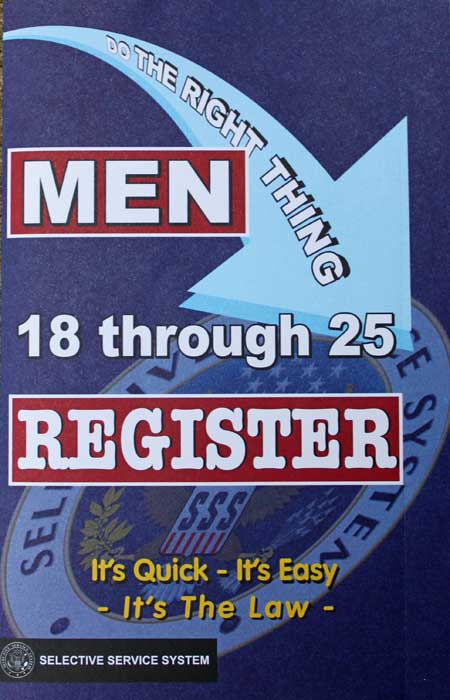
Recently I picked up a Selective Service registration form at the Post Office.  The persistence of sexist selective service has an interesting intellectual structure. The form itself, in contrast, displays simple, appalling moral obtuseness that goes beyond contempt for sex equality.

selective service registration form - cover

The most prominent words on the cover of the form are “men” and “register”.  Within an arrow is written the moral exhortation, “Do the right thing.” Does “do the right thing” mean throw the sexist selective service form in the garbage can, and then throw the garbage can through the post office window? Does “do the right thing” mean engage in non-violent civil disobedience, such as sitting down in the post office and refusing to move until the stack of sexist selective service forms is removed?  Or maybe have a men’s die-in at the post office?

Inside the cover of the selective service form are answers to questions.  But the obvious, painful question, “How can this sexism be tolerated in the U.S. in the year 2010?” isn’t answered. The questions and answers that are listed only make that question more searing.

“What is Selective Service Registration?”

Registration is the process by which the U.S. Government collects names and addresses of men age 18 through 25 to use in case of a national emergency, determined by Congress and the President, which would require rapid expansion of the Armed Forces.

“What Happens If I Don’t Register?”

Not registering is a felony.  Young men prosecuted and convicted of failure to register may be fined up to $250,000, imprisoned for up to five years, or both.  Failure to register also may cause men to permanently lose eligibility for student financial aid, government employment, job training, and U.S. citizenship for male immigrants.

A felony?!!!?  Apparently criminal prosecutions for failure to register have not occurred since 1986.  But this crime remains in the law books, and severe punishment for it is cited in this current government form.  A least one man has recently lost his job because of failure to register with Selective Service seventeen years earlier.

Discretionary application of absurdly punitive and nonsensical criminal laws has become a general characteristic of the U.S. criminal justice system.  This criminal justice system has led to about 2.4 million persons being locked up in prisons and jails today.  That’s an unrecognized national emergency.  Given that the criminal justice system locks up ten times as many men as women, this national emergency particularly concerns men.  Amidst this real and present national emergency, the Selective Service System prepares to conscript men, and only men, to use them in a national emergency.  Sacrificing men’s lives obviously is all too easy.

“Who Must Register?”

Male U.S. citizens and immigrants, documented and undocumented, residing in the U.S. and its territories must register if they are age 18 through 25.

“What About After I Register?”

If you move, you are required by Federal law to provide address changes to Selective Service, which can be done at www.sss.gov to “Report a Change of Address Online,” or by filling out and mailing a SSS Form 2 (Change of Information) at the post office.

This is worse than being asked to display right of residence if stopped by the police.  Whether a citizen or not, whether a documented or undocumented immigrant, the Selective Service System demands under federal law to be informed of the movement of all males ages 18 to 25.  After all, these males might be needed in the future to die for freedom.

video communication better with natural gestures

More than a third of all Skype calling minutes are in video calls.  The share of Skype video in Skype calling minutes is higher in higher income countries.  One interpretation of these statistics is that as income increases, users move from basic communication to richer, video communication.[1]  Video calling with Skype suggests a bright future for personal video calling.

Skype calls, however, are not representative of general calling patterns.  Skype calls typically involve a large, stationary screen (personal computer screen) rather than a small, hand-held screen (phone display). Faces, particularly eyes, are important features in communication.  The large, stationary screen is easier to use for face-based video communication.  In addition,  Skype calls are much more likely to be long-distance / international than are calls in general.[2] Seeing the face of a distant friend or relative might be a motivation for video calling.  But persons who see each other regularly can more easily synthesize within their brains the faces of the family and friends with whom they talk over the phone.  Hence face-oriented video calling may be less attractive among persons who regularly see each other in person.

The iPhone 4’s Facetime video communication service seems to be designed for communicating faces.  Even with the iPhone 4’s record-breaking sales and Facetime’s potential for developing open industry standards for mobile video calling, communicating faces with mobile video calling is no sure bet for a viable business.  Some speculate that Facetime is actually a Trojan Horse VoIP service.

Watch the gestures and hand positions involved in using Facetime.  The gestures and hand positions are remarkably awkward and unnatural. Switching from the front-facing camera to the rear-facing camera is a completely bizarre visual gesture. Moreover, it emphasizes the way that the iPhone flattens the visual field.

A better designed show-and-tell communicator would facilitate naturally pointing and moving the visual field. Gestures and bodily movement add much to communication beyond the showing of faces.

Notes:

[1] Sten Tamkivi, General Manger, Skype Estonia, stated this fact in his presentation at eComm Europe 2009, Amersterdam, Oct. 28-30 (presentation transcript).  In an interview on May 7, 2010, Skype CEO Josh Silverman stated that more than a third of Skype calling minutes are video minutes.  Tamkivi discusses the correlation between Skype video calling and country income.

[2] Telegeography recently reported that Skype accounts for 12% of all international calling minutes.  According to Telegeography, international calling totaled about 400 billion minutes in 2009. These figures suggest about 50 billion international Skype minutes.  Figures for total Skype minutes in 2009 range from roughly 25 billion to 100 billion (for the later figure, see Tamkivi presentation). Note that conversation / traffic minutes  are one-half of end-user minutes, while the definition of minutes in reported statistics often isn’t specified. In any case, Skype international calling minutes probably account for considerably more than 50% of all Skype minutes.  In the U.S., wireline international calling minutes account for about 3% of all wireline toll minutes (see Table 14.1 in FCC, Trends 2008).  Toll minutes account for roughly 20% of all calling minutes (see ARMIS data, table 4). Roaming minutes account for about 6% of all wireless minutes.  Hence international minutes probably account for less than 1% of all minutes for U.S. wireline and wireless phones.