historic patterns of paying for content

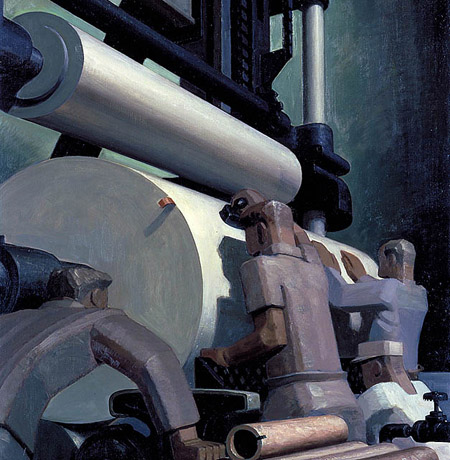
Compared to periodicals, newspapers have developed a business model much less propitious for profitably distributing content in a digital world.  Most of newspapers’ revenue historically has come from newspaper establishments integrated with the business of printing.  A much larger share of periodicals’ revenue has come from publishing establishments not integrated into printing.  Accounting for frequency of issues, newspapers produce much more, lower quality printed paper than do periodicals.  Given the greater weight of paper in their business, newspapers had a stronger incentive than periodicals to invest in paper-distribution systems.  Not surprisingly, newspapers developed special newspaper delivery networks, but periodicals did not.  Newspapers have developed a romance of journalism.  However, the newspaper business historically has been mainly about cheaply printing and rapidly distributing a large amount of paper.

Both newspapers and periodicals have sold general-interest content, but newspapers have relied more heavily on advertising revenue.  In 1880, subscriptions and sales amounted to 51%  and 61% of U.S. newspapers’ and periodicals’ content-related revenue, respectively.  By 2007, these statistics had dropped to 22% and 39% for newspapers and periodicals, respectively.  Within the over-all shift toward advertising revenue, periodicals show that subscriptions and sales can play a relatively large role in supporting general-interest content.  In 1996, subscriptions and sales amounted to 49% of U.S. general-interest periodicals’ revenue.

Content-creation businesses in the future will be more like periodicals than newspapers. Cheaply printing and rapidly distributing  large amounts of paper will remain a viable business.  It’s now the business of companies like FedEx Kinkos.  Future content-creation businesses probably won’t be tightly integrated with particular media and distribution systems.  With appreciation for the businesses of general-interest periodicals in the past, future creators of general-interest content can aspire to having about half of their revenue coming from subscriptions and sales. Of course, just as for periodicals, many will fail.  The periodical business has much greater entry and exit of firms than the newspapers business does. In this way, too, digital content businesses will be more like periodicals than newspapers.

* *  *  *  *
Data note:   In the U.S. in 1939, 99% of newspaper revenue came from newspaper publishing establishments also engaged in printing.  For periodicals, the corresponding figure is 43%. The data are available and sourced in the newspapers and periodicals business integration spreadsheet.  From 1960 to 1979, the average number of pages per issue of daily newspapers rose from 43 pages to 64 pages.  In 1979, advertising content accounted for 64% of newsprint in newspapers.  See the U.S. Statistical Abstract for 1980, Table 1007. Here’s a spreadsheet with data on newspapers’ and periodicals’ revenue structure from 1880 to 2007. It is also available as an Excel file.

unsettling North America at the Smithsonian

With an insightful display of different viewpoints, the Smithsonian’s exhibition, Jamestown, Québec, Santa Fe: Three North American Beginnings, explores settlement and unsettlement.  An opening theme of the exhibition is “unsettling the continent.”  Text on a large sign-barrier at the beginning of the exhibition presents in three languages this one text:

Societies of indigenous peoples inhabited the North American continent for thousands of years. In the 1500s, limited contacts with European explorers, traders, and fishermen introduced deadly germs and disrupted established alliances, rivalries, and ways of life. Soon, however, European efforts to create permanent settlements would introduce more devastating disease and challenges on an earth-shaking scale.

One of the diseases that Europeans carry is a strain of fanaticism that makes them prone to bizarre delusions.  According to Wikipedia, which may be more credible than the Smithsonian, 18 European attempts at colonizing North America failed prior to the founding of Jamestown. Why did these Europeans again and again voyage to bring disease and earth-shaking challenges to North America?  Of the 104 European colonists who landed in Jamestown in April, 1607, only 38 survived through January, 1608.  Why didn’t the rest just return home and stay there?  Instead, hundreds more arrived, and hundreds more died during the “starving time” in the winter of 1609-1610.  Fanaticism along with delusions must have driven those early settlers.

Maybe it’s their religion.  The curators of this exhibition hold positions roughly analogous to those of high-ranking clerics in seventeenth-century Europe.  A large sign in the exhibition declares in three languages:

Europeans believed in an orthodox theology, whether Catholic or Protestant.  English, French, and Spanish settlements each established a state church and prosecuted dissenters from what they considered “the one, true faith.”

Indigenous peoples were more tolerant of new beliefs and ways of connecting with the divine.  Yet Powhatan, Algonquin, Huron, and Pueblo peoples all encountered newcomers who expected them to abandon their religious beliefs and embrace European ones.

“Europeans believed in an orthodox theology, whether Catholic or Protestant.” Do most ordinary persons actually believe this?  The Orthodox in eastern Europe, who understand themselves to be neither Catholic nor Protestant, believe in Orthodox Christian theology.  Jews and Muslims living in Europe have probably believed that their faith is true, and other faiths, false.  Perhaps that makes Jews and Muslims living in Europe orthodox, but they’re neither Catholic, Protestant, nor Orthodox.

Europe was fertile ground for new, competing religious ideas and organizations.  For example, among Christians living in England in the seventeenth century were Protestant Episcopals (who divided into High-Church Anglicans versus Latitudinarians), underground atheists and underground Roman Catholics, Lutherans of various reform orientations, Presbyterians, Calvinists, Baptists and Anabaptists, Pietists of various sorts, Quakers, and Puritans, among others.  Looking back about 2500 years, the tribal religions in Northern Europe and the gods of the Greeks were altogether different forms of religion.  It’s highly unlikely that peoples living in North America prior to European settlements had as much spiritual innovation and re-organization as did peoples living in Europe.  That’s because the sort of social elaboration, stratification, and competition that led to the Smithsonian Institution and its exhibition of seventeenth-century North American history fosters religious innovation.

At the exhibition exit is a large standing sign-board.  It’s titled, “The Year is 1700: Where Does Everything Stand?”  It declares:

There is not yet a nation called Canada or a country called the United States.

Settlement is taking place not only from east to west but begins at many points and moves in many directions.  Unsettlement — the loss of population and disruption of Native societies — may be the key characteristic of the era.  Still, Native peoples outnumber European colonists at least nine to one.

As  yet, neither Spain, France, nor England dominates.  Native nations and European ones will continue to contend with one another, some for domination, others for survival.

Leaving the exhibition, persons living here, now, in both Europe and North America, should worry about their future.

From Greece to today, what a long strange trip it's been.

Jamestown, Québec, Santa Fe: Three North American Beginnings is on display at the Smithsonian’s International Gallery, Ripley Center, through Nov. 1, 2009.  The Virginia Historical Society and the Smithsonian’s National Museum of American History co-organized the exhibition.  The sculpture pictured above is Ron Mueck’s “Untitled (Big Man),” 2000.  It is in Strange Bodies: Figurative Works from the Hirshhorn Collection, on display at the Hirshhorn though the fall, 2009.

the power of W.S. Merwin's words

W.S. Merwin this year won his second Pulitzer Prize for poetry.  He has had an extraordinarily distinguished poetic career.  In 1952, his first book of poetry was selected for the prestigious Yale Younger Poets series.  He subsequently wrote much more poetry and translations and engaged in some political protests.  He won his first Pulitzer Prize for poetry in 1971. Through his influence and his longevity, he has played an enormous role in shaping the Yale Younger Poets series and late-twentieth-century American poetry.

Merwin read his poetry at the Folger Library on October 15, 1997.  As an economist and a skeptic,  I didn’t buy one of his books before the reading.  Instead, I borrowed one from my local public library.  I took this library book with me to Merwin’s reading  so I could read some of Merwin’s poems on my metro ride there.

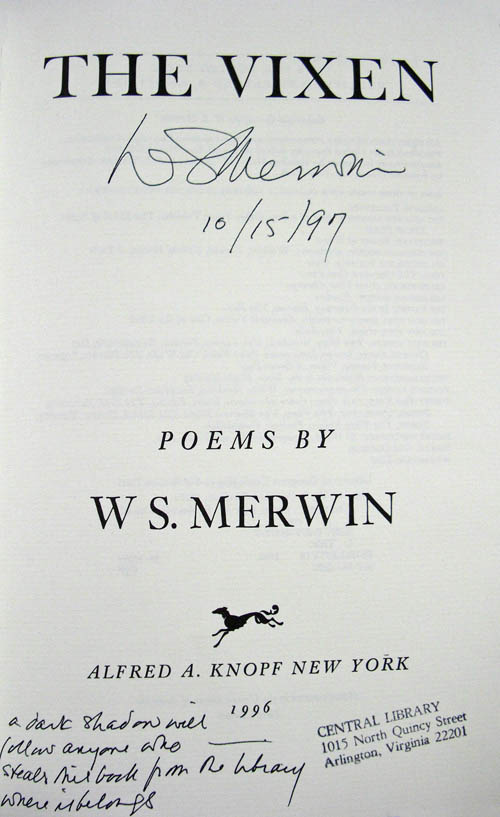
I enjoyed Merwin’s reading at the Folger.  I decided that I liked his poetry.  Remembering the thrill of discovering as a boy Ernest Hemingway’s signature in my local public library’s copy of The Sun Also Rises, I brought my library book up to Merwin to sign.  When I presented my library book, he looked at me suspiciously and severely.  He signed the book, and wrote on the bottom of the title page:

a dark shadow will follow anyone who steals this book from the library where it belongs

Yesterday, I checked my public library.  Merwin’s poetry book is still there!  In the nearly twelve years since I borrowed that book, it has been borrowed by about 1.2 persons per year, or a total of 14 borrowers. None of them stole the book from the library.  Perhaps that’s just because most persons in most circumstances don’t steal.  Maybe Merwin’s book curse scared away potential thieves.  Or perhaps Merwin’s book wasn’t stolen because few persons are interested in it.  I credit the book’s enduring presence in the library to the power of Merwin’s words.

Merwin's book curse

the effects of new advertising media

New advertising media have had remarkably little effect on aggregate advertising expenditure. In 1919, total U.S. advertising expenditure was 2.5% of U.S. GDP. The corresponding figure in 2007 was 2.0% of GDP. Advertising spending as a share of GDP is cyclical, and in 2000 the advertising share reached 2.5% of GDP. But from 1919 to 2007, the advertising-to-GDP ratio shows no overall trend.

Advertising-to-sales ratios for major advertisers confirm the relative constancy of advertising spending over nearly a century.  In 1917, a survey of 90 national advertisers found an average advertising-to-sales ratio of 5.2%.  Other firm-level data from this period also support about a 5% advertising-to-sales ratio among major advertisers.  In 2002, among 50 leading national advertisers, the average advertising-to-sales ratio was 5.9%.[1]  Major advertisers allocated about the same share of sales revenue to advertising about 1917 and 2002.

From 1919 to 2007, the media distribution of advertising spending changed greatly.  In 1919, newspaper and periodical received 60% of total advertising spending, and radio, television, and the Internet did not exist as advertising media.  In 2007, newspapers and periodicals received 21% of total advertising spending, and radio, television, and the Internet received 40%.[2]  The development of new media did not increase advertising spending, but merely redistributed it.

The relative constancy of aggregate advertising expenditure increases the threat of new advertising media to current advertising media.  An important new advertising medium may be networked electronic books that make possible inserting timely advertisements in books. Information about the book a person is reading is highly valuable for providing useful ads to that person.  Google’s recent announcement that it will soon sell electronic books probably isn’t just a new venture into e-commerce.  It also makes sense as positioning for competition in a potential new advertising medium.

*  *  *  *  *

Notes:

[1] L.D.H. Weld, “The Economics of Advertising,” Printers’ Ink, v. 54, no. 2 (July 11, 1918) pp. 99-100 cites two studies of advertising-to-sales ratios.  One, described in Printers’ Ink, Oct. 19, 1916, “found in an investigation made in 1916 that the average advertising expense of fifty-one national advertisers was 5.67 per cent of sales.” See Hurd advertising expenditure survey, 1916.  Another study, made at Yale, “yielded an average of 5.2 per cent as the average advertising expense of ninety national advertisers.”  Weld included a sub-sample categorization of average advertising-to-sales by firm type.  Martin, Mac, Advertising Campaigns (New York: Alexander Hamilton Institute, 1919) pp. 116-7, lists advertising-to-sales ratios for 35 major national advertisers about 1915. The average advertising-to-sales for these firms is 3.9%.  The 2002 advertising-to-sales figures are calculated from the first 50 advertisers listed in the 2003 Ad Age 100 Leading National Advertisers. See the supporting spreadsheet for the advertising-to-sales data (xls file here).

[2] The figures for the media distribution of advertising expenditure are calculated from the Coen Advertising Expenditure Dataset.