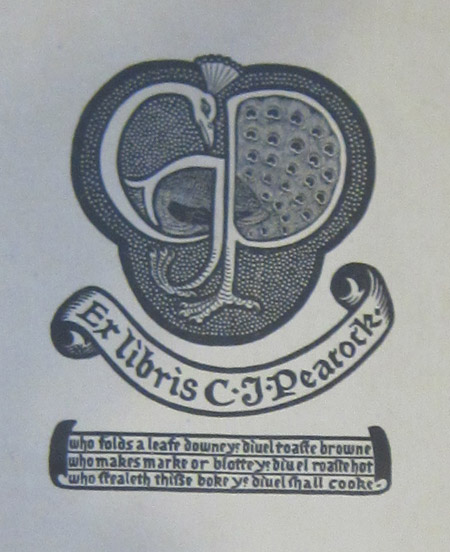
book curses reduce exchange value

book curse from ex libris C. J. Peacock

Book curses attempt to protect books from damage and theft.  A book printed in Paris in 1502 has written on its inner upper cover:

Whoever steals this Book of Prayer
May he be ripped apart by swine,
His heart be splintered, this I swear,
And his body dragged along the Rhine.[1]

While it has terrifying terms, this curse has communicative force only for potential thieves or an actual thief.  Others can’t tell whether the book was stolen.

A book curse that specifies the book owner has broader communicative effect.  An owner-specified book curse communicates the curse to those who find the book in the possession of someone other than the specified owner.  For example, along with specifying its owner, C. J. Peacock’s “peacock” bookplate contains a book curse:

Who folds a leafe downe ye divel {devil} toaste browne
who makes mark or blotte ye divel roaste hot
who stealeth this boke ye divel shall cooke.[2]

A book written before 1327 similarly contains an owner-identified curse:

This book belongs to St. Mary of Robert’s Bridge; whoever steals it, or sells it, or takes it away from this house in any way, or injures it, let him be anathema-maranatha.

Sensitive to others’ perspective, a different owner of this book added in 1327 this inscription:

I, John, Bishop of Exeter, do not know where the said house is: I did not steal this book, but got it lawfully.[3]

A better lawyer would have included in the subject of the book curse, “{whoever…} or buys it, or acquires it in any way, including but not limited to, transactions lawful under the jurisdiction of {insert jurisdiction favorable to the client}.”  With good enough lawyering and a credible enough public, a book curse could prevent a book’s circulation and reduce its exchange value to zero.

W.S. Merwin’s book curse doesn’t prevent his book from circulating.  Merwin wrote in one of his books:

a dark shadow will follow anyone who steals this book from the library where it belongs

That curse is on the title page with a book label for a public library.  Hence Merwin’s book curse doesn’t impede the public circulation of his book.

*  *  *  *  *

Read more:

Notes:

[1] In the Book of Hours of Simon Vostre of Paris, Paris PML 18206.  Originally written in old French.  Drogin (1983) p. 88-9.

[2] In Charles Kelsall, Classical excursion from Rome to Arpino (Geneva: 1820), copy in the National Gallery of Art (Washington, DC), displayed in the exhibit, In the Library: Marks of Ownership, Jan. 9-Apr. 20, 2012.

[3] This and previous book curse originally in Latin.  For both, see Drogin (1983) pp. 91-2.  Maranatha in “anathema-maranatha” intensifies the curse.

Reference:

Drogin, Marc. 1983. Anathema!: medieval scribes and the history of book curses. Totowa, N.J.: Allanheld, Osmun.

Hanayn ibn Ishaq: disciple of Jesus and Galen

For Christian physicians in the ancient Islamic world, Jesus and Galen were revered figures.  Mythic popular history expressed that reverence with claims that Galen and Jesus were historical contemporaries, that Galen sought out Jesus’ medical knowledge, that Galen discussed with Mary Magdalen Jesus’ cure of a man blind from birth, that the apostle Luke was one of Galen’s pupils, and that the son of Galen’s sister was the apostle Paul. Any serious reader of Galen at any time in history would recognize these stories to be complete fantasies.

Hunayn’s autobiographical epistle presents Hunayn as a disciple of Jesus and Galen.  Hunayn is known for his careful translations of Greek works and his wise judgments about the authenticity of works attributed to Hippocrates or Galen.  Hunayn surely would not have believed any fanciful biographical claims relating Jesus and Galen.  However, as a well-read, well-connected scholar at the center of literary activity in ninth-century Baghdad, Hunayn probably would have been aware of these stories.  Hunayn’s autobiographical epistle relates Jesus and Galen through a highly respected scholar doing highly respected scholarly work.  Providing respectable testimony to the relation of Jesus and Galen may have been a motivation for the writing of Hunayn’s autobiographical epistle.

*  *  *  *  *

Read more:

Notes:

Nutton (2001) provides a historically encompassing view of how Galenic medicine was made appealing to Jews, Christians, and Muslims.  A chronology placing Jesus and Galen as contemporaries is appended to Ishaq ibn Hunayn’s Ta’rih al-atibba.  Rosenthal (1954) for text and translation, Zimmerman (1974) for chronological analysis. Id., p. 329, places Ishaq’s source as the Muslim world c. 800.  Swain (2006), pp. 398-402, argues for a Greco-Roman source, particularly the Alexandrian Greek John the Grammarian (Yahya al-Nahwi), c. 600.  According to the Andalusian pharmacologist Ibn Juljul of Cordova (d. 1009):

At a time when Christianity was spreading, he {Galen} was told that a man who cured the blind and lepers and revived the dead had appeared in Jerusalem at the end of Octavian’s reign. He commented that he probably had supernatural powers to do it, and asked whether any of that man’s companions were left. On being informed that there were, he left Rome for Jerusalem. He died on the way, in Sicily, then called Sataniya, and was buried there.

HP p. 160.  The story of Galen’s discussion with Mary Magdalen is preserved in Greek in Michael Glycas, Annales, iii.231; Nutton (2001) p. 30, Swain (2006) p. 403.  The story about Galen and Luke is in Syriac author Bar Bahlula’s tenth-century lexicon.  Swain (2006) p. 405.  In his Arabic book “Reservoirs of Experience and Wonders of Wonders,” the Persian biographical writer al-Bayhaqi (d. 1169/1170) stated:

If there had been no other apostle than Paul, the son of Galen’s sister, it would have been enough. Galen himself sent him to Jesus to say that owing to weakness and old age, he was unable to come to him. Galen believed in Jesus and ordered his sister’s son, Paul, to swear allegiance to him.

HP p. 141.  The phrase “it would have been enough” echoes the “dayenu” of a traditional Jewish Passover prayer. Al-Bayhaqi’s source for this story was the Baghdad-based Christian philosopher Ibn al-Tayyib (d. 1043), known in Latin as Abulpharagius Abdalla Benattibus.  Swain (2006) p. 405.  Ibn Abi Usaybia, who typically records accurately but does not critically evaluate his sources, declared: “The claim that Galen was a contemporary of Christ and went to see him and believed in him is not true.”  HP p. 141.

References:

HP: Ibn Abi Usaybi’ah, Ahmad ibn al-Qasim. English translation of History of Physicians (4 v.) Translated by Lothar Kopf. 1971. Located in: Modern Manuscripts Collection, History of Medicine Division, National Library of Medicine, Bethesda, MD; MS C 294Online transcription.

Nutton, Vivian. 2001. “God, Galen and the Depaganization of Ancient Medicine.”  Pp. 17-32 in Biller, Peter, and Joseph Ziegler.  Religion and medicine in the Middle Ages. Woodbridge, Suffolk: York Medieval Press.

Rosenthal, Franz. 1954.  “Ishāq b. Ḥunayn’s Taʾrīf al‐Aṭibbāʾ.” Oriens 7(1): 55–80.

Swain, Simon. 2006. “Beyond the Limits of Greek Biography: Galen from Alexandria to the Arabs.” Pp. 395-433 in Brian McGing and Judith Mossman (eds.), The limits of ancient biography. Swansea: Classical Press of Wales.

Zimmermann, F. W. 1974. “The Chronology of Isāq ibn unayn’s Ta’rih al-atibba’.” Arabica, 21(3): 325-330.

Donnolo the doctor: asserting rights in early personal authorship

A mid-tenth-century Jewish scholar, Shabbetai bar Abraham, called Donnolo the doctor, labored long and hard to produce a book describing the secrets of the universe.  In the introduction to his book, Shabbetai asked for blessings on those who copied his book:

May the great peace, the blessings, and the good comfort of Almighty God come to everyone who copies out this book of my studies.[1]

This distribution imperative is like that commonly found in Buddhist scriptures.  Copying books was a central practice in the book-filled ancient Islamic world.  Today, copying works tends to be associated with piracy, and governments take aggressive actions to punish persons who copy works.  However, at least some authors, like Shabbetai, do not consider preventing copying to be in their interest.

Shabbetai did not favor unrestricted copying.  He wanted correct attribution and fidelity in copying:

May God bring him salvation if he copies it out in the name of Shabbetai, if he only writes my name unchanged and erases it not from my book of secrets.  For then he will certainly be reckoned to have payed me my due, by recognizing how I toiled and moiled with all my might, unsparing of what was dearest to me, and so gained the skill to record and to learn from what I recorded.  Is it not meet, therefore, that he who feeds on the nourishment I provide preserves what I have said, and records it as I have written it?  Let him act righteously and not despise to learn from the name by which my fathers called me.  Let him put away jealously from his heart and not return evil for my good, if he desires to gain blessings from the Lord and righteousness from the God of my salvation.  Let him take heed to write this my rhyme and rubric at the beginning, and at the end be sure that he has written exactly the words of this book with its wisdom, for I bear witness that thus do I wish my thoughts to be set down.[2]

False claims of authorship, as well as making changes in a text in the course of transmitting it, were common in the ancient world.  Correct attribution and fidelity in copying, in conjunction with urging copying, indicates Shabbetai’s interest in having his personal work become well-known.[3]  Those interests tend to be associated with what scholars call “romantic authorship.” Later romantic authors, however, were more commercially interested than was Shabbetai.

*  *  *  *  *

Read more:

Notes:

[1] Trans. in Sharf (1976) p. 7.

[2] Id. pp. 7-8.  Shabbetai goes on to invoke God’s vengeance on anyone who does not correctly copy and attribute his work.  The plural “fathers” in “the name by which my fathers called me” suggests an expansive view of fatherhood in Shabbetai’s Jewish culture.

[3]  Without fidelity in copying, attribution is an acknowledgement of a source, but not necessarily an accurate transmission of that source.

Reference:

Sharf, Andrew. 1976. The universe of Shabbetai Donnolo. New York: Ktav Pub. House.