Things are crucial to human social networks. Some things never lose their appeal.
Month: May 2010
Wednesday's flowers

upgrading U.S. telephone network technology
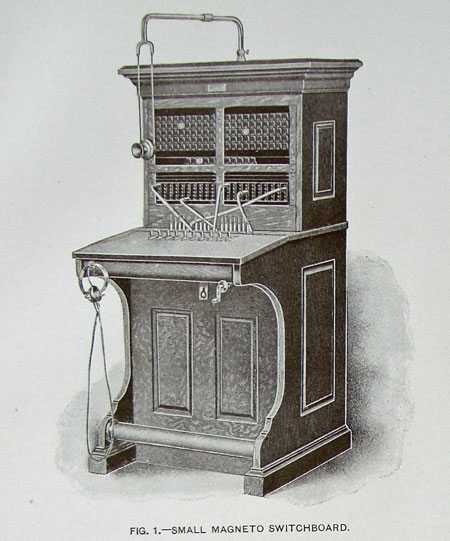
Major upgrades of the U.S. telephone network have taken decades. The first U.S. commercial installation of a automatic (mechanical) telephone switch occurred in 1892.[1] In the Bell System in 1920, nearly three decades later, only 2% of telephones were automatically switched.[2] The share of telephones in the U.S. that were automatically switched didn’t rise to 75% until 1950. The category “electronic” switch was added to FCC statistics in 1968. Two decades later, the share of telephones that were electronically switched first rose above 75%. [3]
Implementing these new telephone network technologies required coordinated upgrades in central office equipment and end-user equipment. The development of more powerful, more general purpose end-user equipment allows central (cloud) service upgrades to be more independent of end-user equipment upgrades. That independence contributes to more rapid network innovation.
U.S. telephone companies owned most of the telephones made obsolete by upgrades to mechanical and electronic switching. Technical change that makes obsolete user-owned equipment and requires users to buy more equipment is more likely to be commercially favored. User frustration and anger puts some constraint on forced upgrades. Nonetheless, user ownership of end-user equipment provides greater network operator incentives for network service upgrades.
Upgrades of telephone network technology occurred faster in larger exchanges. In 1936, non-common-battery exchanges, which were very technologically backward, served on average 180 telephones per exchange. Mechanically switched central offices served on average about 5900 telephones, more than twice as many as the average for manually switched central offices. A higher average number of telephones per exchange correlated regionally with a higher share of mechanically switched telephones. Larger exchanges’ lead in upgrades continued with the upgrade from mechanical to electronic switches. In 1980, electronic central offices served on average 31% more telephones than did mechanically switched central offices.
Fixed costs of upgrades and greater service growth favored faster upgrades in larger exchanges. A significantly share of exchange upgrade costs were likely not highly correlated with the number of telephones served. Hence an exchange with more telephones had a lower upgrade cost per telephone (and telephones were essentially the revenue unit). In addition, because population was shifting from farms to towns and cities, larger exchanges were in places that were growing more rapidly in population. Potential for future subscriber growth favored larger exchanges.
Company size was not strongly associated with the the share of mechanically switched telephones in 1939. All companies serving more than 25,000 telephones had some mechanically switched telephones. Many smaller companies had no mechanically switched telephones. But small companies pioneered mechanical switching. Some relatively small companies had relatively high shares of mechanically switched lines. Among companies serving more than 1000 telephones and having some mechanically switched telephones, the share of mechanically switched lines was not significantly correlated with company size.[4]
Relative to company size, industry structure deserves more attention in thinking about how to foster innovation. General-purpose devices, end-user device ownership, and common technology knowledge readily available to small organizations all contribute importantly to faster network innovation.
* * * * *
Data: U.S. telephone network technology, 1934-1987 (Excel version); financial and operating data for U.S. telephone companies in 1939.
Notes:
[1] The first mechanical telephone switch in the U.S. was installed in La Porte, Indiana. It used a Strowger switch. About this time telephone systems began implementing common-battery systems. These systems powered end-user telephones with a battery at the central office. In 1936, 5% of U.S. telephones were not powered from a common source in the central office.
[2] Lipartito, Kenneth James, “When Women Were Switches: Technology, Work and Gender in the Telephone Industry, 1890-1920,” American Historical Review, October, 1994, p. 1095, notes that in 1915 about 400,000 independent lines were automatically (mechanically) switched. Independents served roughly one-third of total U.S. telephones. In 1915, the Bell System had no automatically (mechanically) switched telephones.
[3] Other categories of switches separate from “electronic” were “manual,” “step-by-step dial,” “cross-bar dial,” “panel dial,” and “other (rotary and relay dial)”. “Electronic” seems to mean a switch using transistor (semi-conductor) circuits.
[4] Here’s the individual telephone company data for 1939. Among the five telephone companies with greater than 90% of telephones mechanically switched, three served less than 10,000 telephones.

selling via the title page
Technological change in book production occurred much faster than stylistic change. Gutenberg began printing Bibles with his movable-type printing press about 1455. Many others quickly got into the printing business. Across the second half of the fifteenth century, the books that they printed looked a lot like manuscripts of that time. Print fonts imitated hand-written scripts. Printed books had neither a title page nor a specifically formulated title. A printed book, like a manuscript, was identified by its incipit, the first words of the text. Information about the printer, like that about the scribe, was included in a colophon, meta-text appended to the main text.
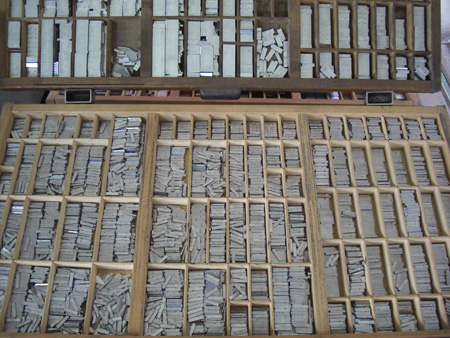
The U.S. National Gallery of Art’s exhibit, Announcing the Text, shows the development of title pages from 1470 to 1900. By early in the sixteenth century, at least some books included a separate, printed title page. Over time the title page became elaborated with different size and color fonts, specially written text, and information about the printer. These changes served the purpose of identifying the text among the rapidly growing supply of texts, building up the printer’s brand name, and selling the text to persons browsing the book. Such changes in business models and markets take more time to develop than does innovation in production technology.
The economic functions of the title page are not closely related to printing technology. Consider, for example, the vibrant book market of the Roman Empire. Most Roman texts have been transmitted to the present through medieval manuscripts. The original presentation style of Roman texts, however, may have looked a lot less like medieval manuscripts and a lot more like eighteenth-century printed books.
early DIY wireline network
Country gentleman Andrew Crosse began studying atmospheric electricity on his estate in Somerset, England, in 1807. To serve his experiments, he constructed an impressive wireline network. The network consisted of “copper wire one-sixteenth of an inch thick, stretched and insulated between stout upright masts from 100 to 110 feet in height.” The wire originally extended for a mile and a quarter, but difficulty in maintaining the wire’s insulation in fog and snow prompted Crosse to shorten it to 1800 feet. He maintained this wire for at least 18 months.[1]

Crosse’s network connected atmosphere electricity to a Leyden-jar apparatus in his home laboratory. An author of an early treatise on electricity, who was Crosse’s friend and correspondent, noted:
none but a spectator can conceive the awful though sublime effect of such phenomena. At every flash of lightning an explosive stream, accompanied by a peculiar noise, passes between the balls of the apparatus, and enlightens most brilliantly every surrounding object, whilst these effects are heightened by the successive peals of thunder, and by the consciousness of so near an approach to its cause. During this display of electric power, so awful to an ordinary observer, the electrician sits quietly in front of the apparatus, conducts the lightning in any required direction, and employs it to fuse wires, decompose fluids, or fire inflammable substances; and when the effects are too powerful to attend to such experiments securely, he connects the insulated wire with the ground, and transmits the accumulated electricity with silence and with safety.[2]
Crosse made no major contributions to electrical science or electrical applications. He did, however, demonstrate that one extraordinarily motivated persons could build amazing communication infrastructure.
Notes:
[1] Singer, George John, Elements of Electricity and Electro-Chemistry (London: Longman, 1814) p. 271-2. Giambatista Beccaria had in the mid-eighteenth century conducted electrical experiments using a wire 141 (English) feet long. Id. p. 269. Additional information about Crosse can be found in Pocock, R.F., “Andrew Crosse: Early nineteenth-century amateur of electrical science,” IEE Proceedings-A, vol. 140, no. 3 (May, 1993) pp. 187-196; and Crosse, Cornelia, Memorials, Scientific and Literary, of Andrew Crosse, the Electrician (Longman: London, 1857). Cornelia Crosse was Andrew Crosse’s second wife.
[2] Singer (1814), p. 273-4. Using frictional electric machinery, Crosse also delivered electrical shocks to local residents who sought treatment for various pains.