Poor Teddy. His human friend wants him to fetch an old-fashioned newspaper. You can see the forlorn look on his face. Old media is for old dogs. Teddy probably would prefer to fetch a newfangled digital tablet.
Month: July 2012
Wednesday's flowers

Why Aristotle’s Problemata?: popular success in authorizing knowledge
To understand Aristotle’s Problemata, you have to spend time with children. Most adults who have spent time with children have experienced a child asking “why” about natural phenomena. Why does medicine taste bad but it’s supposed to be good for you? Why can’t dogs talk like me? Why do flowers turn brown? Why do I feel sleepy? Because you’re tired. Why am I tired? Because you haven’t gotten enough sleep. Why do I have to sleep? Because if you don’t sleep, you’ll feel tired. But why do I have to sleep? Because, that’s why!
All persons naturally desire to know. While imagining knowledge to be innocent of socio-political relations, persons also naturally associate knowledge with authority and social status. Aristotle’s Problemata provides deep insight into the problem:
Why is the philosopher generally regarded as superior to the orator? Is it because the philosopher treats of the nature of injustice, while the orator says that such and such a person is unjust, and the orator states that such and such a person is a tyrant, while the philosopher discusses the nature of tyranny? [1]
The orator’s art aims for socio-political dominance over opponents. With that aim, it cannot claim to provide knowledge, and the orator cannot achieve the status of the philosopher. That is the nature of the philosopher’s tyranny.
Aristotle’s Problemata has been a hugely successful father for the why’s for more than two millennia. It contains hundreds of questions beginning with “why” or “why is it.” It provides discursive responses to those questions. The responses include relevant information, distinctions, and reasoning. The responses often take the form of a responding question. Here are typical examples:
Why is it that those who are very drunk are not most troublesome in their cups, but those who are only slightly intoxicated? Is it because they have neither drunk so little that they still resemble the sober nor so much that they are in the incapacitated state of those who have drunk deep? Further, those who are sober have more power of judgement, while those who are very drunk make no attempt to exercise their judgement; but those who are only slightly intoxicated can still exercise their judgement because they are not very drunk, but they exercise it badly because they are not sober, and they are ready to despise some of their neighbors and imagine that they are being slighted by others.
Why is it that the other animals seldom or never emit semen during sleep? Is it because no animal except man sleeps on its back and no emission of semen takes place except in that position? Or is it because the other animals dream less than man, and the emission of semen only takes place when the imagination is stirred? [2]
The questions and responses are highly particular and wholly unsystematic. They are grouped into about thirty-eight topically incoherent books such as “medicine,” “perspiration,” “mathematical theory,” “literary study,” “shrubs and vegetables,” “justice and injustice,” and “the coloration of the flesh.” Aristotle’s Problemata on the whole primarily conveys the status of knowing (“I know why….”), rather than an actual body of knowledge.
Aristotle’s Problemata has been a highly successful model in the knowledge business. A work of the form of the Problemata and some of the question-response pairs within it plausibly can be attributed to Aristotle. The Peripatetics, a school of scholar-teachers working under Aristotle’s brand, circulated and expanded the Problemata for the next millennium. In the ninth century, Hunayn ibn Ishaq, a leading translator in Baghdad, translated the work into Arabic.[3] A derivative work, Problemata Aristotelis, circulated widely in over one hundred editions in early modern Europe and had the largest circulation of any work of natural philosophy. The Problemata Aristotelis was printed in many editions through to the nineteenth century.[4]
Aristotle’s Problemata offered students the superiority of Aristotle through question-response knowledge units that could be acquired individually at low cost, but which were also numerous enough to serve full courses of learned discussion. Aristotle has been the most honored philosopher in western Eurasia and northern Africa since Alexander the Great conquered much of that wide expanse in the fourth century BGC. Aristotle’s response to a question is highly valued knowledge. Moreover, the questions in Aristotle’s Problemata aren’t oriented toward deciding a course of action, nor are they questions that passing time or popular observations could ever resolve. The questions and responses in Aristotle’s Problemata are oriented toward the personal satisfaction of knowing. Such knowing can easily assume a nature like the status that the orator seeks.

* * * * *
Read more:
- moving beyond oratory in contesting Aristotle’s public status in Athens
- knowledge and status competition in thirteenth-century Damascus
- scholarly training for orators in the Roman Empire
Notes:
[1] Aristotle’s Problemata, XVIII.5. See also XXX.9. Trans. Forster (1927). Additional Problemata in Greek and attributed to Aristotle have been published in Kapetanaki & Sharples (2006).
[2] Id. III.2 (edited slightly for clarity), X.24. Note that the first problem (III.2) runs contrary to Aristotle’s typical emphasis on moderation.
[3] See Filius (1999).
[4] Blair (1999a), p. 189, and Blair (1999b).
References:
Blair, Ann. 1999a. “Authorship in the popular ‘Problemata aristotelis’.” Early Science and Medicine. 4 (3): 189-227.
Blair, Ann, 1999b. “The problemata as a natural philosophical genre.” In Grafton, Anthony, and Nancy G. Siraisi, eds. Natural particulars: nature and the disciplines in Renaissance Europe. Cambridge, Mass: MIT Press.
Filius, L. S. 1999. The Problemata physica attributed to Aristotle: the Arabic version of Ḥunain ibn Ishāq and the Hebrew version of Moses ibn Tibbon. Leiden: Brill.
Forster, E.S. 1927. Problemata. Vol. VII in W.D. Ross, ed., The Works of Aristotle (Oxford: Clarendon Press).
Kapetanaki, Sophia, and R. W. Sharples. 2006. Pseudo-Aristoteles (Pseudo-Alexander), Supplementa problematorum: a new edition of the Greek text with introduction and annotated translation. Berlin: Walter de Gruyter.
early Islamic stories shift heroes from deeds to ideals
Ancient Greek stories make heroes known by their deeds. Structurally similar early Islamic stories shift narrative weight from deeds to ideals. Stories about an honored physician saving a person dying from lovesickness illustrate this shift.
By no later than the first century in the Greco-Roman world, a story was circulating about a physician who saved a royal dying from lovesickness. The royal fell silently in love with a forbidden other and was subsequently wasting away. Only an eminent physician was able to identify the disease as lovesickness. Granting the royal the forbidden beloved cured the lovesickness.
The most prominent version of this story involves Prince Antiochus, son of King Seleucus. King Seleucus ruled the third-century BGC Seleucid Empire. In one telling of the story, Antiochus fell deeply in love with his stepmother, Seleucus’s wife. Antiochus silently suffered nearly to death from that forbidden love. His father, his friends, and the whole court were in despair. A physician or astrologer, variously named as Erasistratus, Leptines, and Cleombrotus, correctly diagnosed Antiochus’ lovesickness. Informed of the nature of the disease, Seleucus gave his wife to his son, and his son’s sickness was cured.[1]
A structurally similar Islamic story was circulating in the Islamic world by no later than the tenth century. The Islamic story takes place in the seventh century, the early years of Islam. The story participants apparently were high-status figures in the relatively egalitarian tribal structure of early Islam. Their circumstances paralleled those of the father and son in the Greek story:
there were two brothers of the Banū Kinna, a subtribe of Thaqīf, who loved each other dearly — indeed, greater affection than shown by those two had never been seen. When the elder once went on a journey, he left his wife in the care of the younger, and the latter, looking at her one day, inadvertently, fell in love with her and became ill as a consequence.[2]
Several physicians could not diagnose the cause of this illness. The eminent physician al-Hārith ibn Kalada, however, devised a diagnostic experiment.[3] Although Muslims were forbidden to drink wine, ibn Kalada ordered that the ill younger brother be given wine to drink. The ill younger brother became intoxicated and recited a love poem. This effect prompted the people to declare to ibn Kalada, “You are the best physician among the Arabs.” Ibn Kalada ordered that the brother be given more wine. The brother then recited a poem obscurely revealing his love for his older brother’s wife.[4] The older brother hence divorced his wife and told the younger brother to marry her. The story ends not with the Greek unification of lovers, but with death:
the younger brother replied: “By God, I shall never wed her.” And he died true to his word. [5]
In contrast to the Greek story, the heart of this early Islamic story is not the physician’s shrewd diagnosis, nor the curative act of making a forbidden love available. The heart of this story is the ideal — “true to his word.”[6]
* * * * *
Read more:
Notes:
[1] Pinault (1992), Ch. 2, review sources for the Greek story. These sources include Valerius Maximus, Memorable Deeds and Sayings, 5.7.3; Plutarch, Life of Demetrius 38; Appian, Roman History 11.10; Lucian, The Syrian Goddess 17-18, and How to Write History 35; Julian, Misopogon 347; and Suda, s.v. Erasistratus.
[2] HP, pp. 214-5, transmits this early Islamic story and provides the above quotations. The physician who subsequently figures in the story, ibn Kalada, is also from the tribe of Thaqīf.
[3] Some versions of the Greek story of lovesickness describe the physician conducting an experiment to determine the cause of the sicknesses. The experiment consists of having young women of the court (and in some versions, also young men) appearing to the patient to test his response.
[4] The poetic translation seems to lose the key to the revelation. The key apparently depends on details of Islamic family law and familial terms.
[5] The ending is consistent with a sobriety-sensitive interpretation of the hadith:
He who loves and remains chaste, conceals his love, and dies, dies a martyr.
Here’s some scholarly analysis and interpretation of this hadith.
[6] A tenth-century Arabic text by as-Sijistani tells of Hippocrates diagnosing a prince’s lovesickness for his father’s concubine. Compared to the Greek versions, this early Islamic story also highlights ideals, in this case the ethical wisdom of Hippocrates. See Pinault (1992) Ch. 6 (analysis) and App. B (English translation of source text).
References:
HP: Ibn Abi Usaybi’ah, Ahmad ibn al-Qasim. English translation of History of Physicians (4 v.) Translated by Lothar Kopf. 1971. Located in: Modern Manuscripts Collection, History of Medicine Division, National Library of Medicine, Bethesda, MD; MS C 294. Online transcription.
Pinault, Jody Rubin. 1992. Hippocratic lives and legends. Leiden: E.J. Brill.
logic of substitutes in ancient materia medica
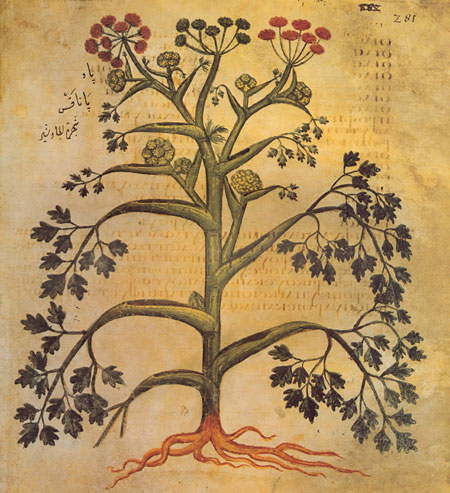
Medical practice created a demand for knowledge of substitutes among materia medica. A sphere of knowledge competition in ancient medicine stretched from southern Spain to India and from northern Greece to northern Africa. Across this vast geographic expanse, a medicinal herb found in one location might not be readily available in another location. More generally, the cost of medicines promoted demand for substitutes. Some medicines, such as theriac, consisted of many exotic ingredients and were very expensive. At the same time, physicians sought to provide medicine for the poor. Cheap substitutes for expensive medicines helped physicians to serve the poor.
Some ancient lists of substitutes among materia medica have a simple propositional form. They consists of lists of pairs of medical substances. A focal medical substance is paired with its substitute.[1] The earliest surviving list of substitutes among materia medica has such a form. It exists as a chapter in the influential, seventh-century Medical Compendium in Seven Books, by Paulus Aegineta. In Baghdad early in the eighth century, the Jewish physician Māsarjawaih produced in Arabic a formally similar list of substitutes. Māsarjawaih, thought to have been the first to translate a scientific book into Arabic, apparently was an important scholar. His list of substitutes thus probably garnered considerable attention in the ancient world.
What is the logical structure of the substitute propositions individually and as a list? A substitute might be equivalent to the focal medicine. That’s often the case today for a brand-name drug and a generic drug. But a substitute might also be a useful but inferior replacement for the focal medicine. Expressed in logical formalism, if the substitute for A is B, does that mean A = B, or does it mean A > B? What about if the substitute for A is B, and the substitute for B is C, then is C also a substitute for A?
Paulus Aegineta’s substitute list shows no awareness of these logical issues of substitution. Paulus Aegineta attributes to Galen the substitute list that he reproduces. He introduces the list with the following text:
In Alexandria, he {Galen} says, wishing to obtain the campion (lychnis) for a certain woman who was in danger, and not having got it, if I had not found and used the seed of acanthium, the woman would have been soon lost. Hence, having been requested by my companions, I made out a list of the medicines which may be substituted for one another, in order, beginning with this same article: [2]
After the list, Paulus Aegineta appends this commentary:
Commentary. This is taken from a work ascribed to Galen, the authenticity of which, however, is very doubtful. Cornarius has attempted many corrections of the text, and we have found ourselves compelled to make other alterations.
The introductory text, with the exception of the apparently inserted “he says,” seems to have come from Paulus Aegineta’s source. Its claim “if I had not found and used the seed of acanthium, the woman would have been soon lost” has the ring of authentic Galenic self-promotion. More importantly, both Cornarius and Paulus Aegineta have critically reviewed the list. Nonetheless, the first substitute pair listed is “Instead of {for} the seed of acanthium, campion (lychnis).”[3] That substitute-pair statement suggests that seed of acanthium would be used if both seed of acanthium and campion are available (no need for a substitute). Galen, in contrast, apparently would choose campion in such circumstances. If seed of acanthium and campion are medically equivalent substitutes, then the choice of one or the other has no medical significance.
If the substitutes in Paulus Aegineta’s list are medical equivalents, then its materials would be more usefully placed in equivalence classes, rather than pairs. Paulus Aegineta’s list contains 41 repeated materials. These repeated materials imply equivalence classes with more than two members. For example, Paulus Aegineta’s list includes these pairs (preceding number is the pair sequence number and A => B indicates that the substitute for focal medicine A is B):
 45: diphryges => Phrygian stone
105: magnet => Phrygian stone
106: Phrygian stone => agerat
128: roasted misy => diphryges
If the substitute relation is an equivalence, then these pairs imply the equivalence class {diphryges, Phrygian stone, magnet, agerat, roasted misy}. Presenting the substitutes as pairs obscures some of the facts, e.g. that a substitute for roasted misy is Phrygian stone.
Moreover, in Paulus Aegineta’s list, no materials repeat as the focal medicine in different pairs. Materials are either a focal medicine and a substitute, or a substitute for two different focal medicines. That lack of symmetry in the pairs is contrary to the symmetry of equivalence.[4]
Internal evidence in Māsarjawaih’s list suggests that its substitute pairs are not equivalences. Māsarjawaih’s list contains 15 repeated materials. All these repeated materials occur once as the focal medicine and once as the substitute medicine (except for oil of radish, which occurs twice as a substitute). In Māsarjawaih’s list, as in Paulus Aegineta’s list, no material is repeated as the focal medicine. Moreover, in Māsarjawaih’s list, the repeated elements are arranged in adjacent pairs, with the repeated element as the substitute in the first pair, and as the focal medicine in the second pair.[5] That textual arrangement fosters an inference of transitivity and thus a substitute preference order. For example, consider these pairs from Māsarjawaih’s list:
7: crystalline sugar => dry black plum
8: dry black plum => tamarind [6]
The arrangement of those pairs supports the inference that tamarind is a substitute for crystalline sugar, but an inferior substitute relative to dry black plum.
References to groups of medicines in Māsarjawaih’s list also suggests that the pairs are not equivalences. Māsarjawaih’s list contains six instances of “all of these {with or without further specification}” and two instances of “both of these”. All eight of these grouping occur in the focal position. That’s consistent with the focal position being superior to the substitute position. A physicians looking for a substitute chooses not among focal medicines, but among substitutes. Specifying multiple inferior medicines would not instruct a physician’s choice among those inferior medicines.
Māsarjawaih’s list contains some inconsistencies. Consider these pairs:
 98: leech => place cupping glass on the spot affected by a snake, scorpion, a kind of worm, and dalmukha
 99: inspissated juice of artichoke => nux vomica
100: both of these => borax and mustard
The grouping “both of these” most plausibly refers to “inspissated juice of artichoke” and “nux vomica.” However, with the transitivity that the list suggests overall, pair 100 could be more simply specified as “nux vomica => borax and mustard.” The transitive inference would generate the same substitute relation as the grouping “both of these.” A more surprising specification is this:
49: caper => caper with pure honey or caper with oxymel or mountain mint
The substitute apparently encompass the focal medicine. That makes no sense.
Specifying medical substitutes as a list of pairs of materials has weighty medical weaknesses. Medicine is typically used to treat a specific sickness. That specific sickness is likely to be relevant to the best substitute medicine. Specifying substitutes without respect to quantities also seems irrational: the potencies of materia medica surely vary. Other ancient specifications of substitutes provide details on the medical application and relative quantities.[7]
The systemic shortcomings of ancient medical substitute lists suggest a more general systemic problem. Ibn Abi Usaibia’s History of Physicians indicates that ancient physicians commonly studied logic and could have applied it to lists of medical substitutes. Nonetheless, even a highly sophisticated, extraordinarily comprehensive pharmacological treatise from the twelfth century seems not to have considered the logical relation between substitute claims.[8] Systemic reasoning has less direct personal return than pursuing particular interests. That’s as true in intellectual reasoning as it is in government budgeting.
* * * * *
Data: substitutes among materia medica according to Paulus Aegineta and Māsarjawaih (Excel version)
Read more:
- the ancient pharmaceutical profession
- formulating medicines for the poor
- astrology and medicine closely related in the ancient world
Notes:
[1] Usually the medical substances are what’s called simple medicines — a single plant, animal, or inorganic material.
[2] Bk 7, Sec. 25, trans. Adams (1844) p. 604. What the Galenic text means by “in order” isn’t clear. The pairs in this list are much less ordered than in Māsarjawaih’s list. In addition to the ordering of pairs with repeated materials (described above), Māsarjawaih’s list also groups pairs by non-medicinal characteristics, e.g. robs, electuaries, oils, clysters, galls, etc.
[3] Levey’s example translation of Paulus’ list is “For A, B.” Levey (1971b) p. 10. That A is the focal medicine is consistent with the position of repeated materials across the lists of both Paulus and Māsarjawaih.
[4] Pythagoras’ list of substitutes, which was valued enough for Hunayn ibn Ishaq to translate in ninth-century Baghdad, explicitly identifies substitute equivalences with a separate pair and often the descriptive tag phrase “in turn.” See Levey (1971b) pp. 24-5 (mugwort and camomile), pp. 28-9 (common germander and Hart’s Tongue fern; white mustard and gum ammoniac; black nightshade and knotweed) pp. 30-1 (gum of the olive and black cumin).
[5] Such pair adjacencies occur in Paulus’ list (see, e.g. above pairs 105 and 106 with Phrygian stone), but adjacent pairs with repeated materials are much less frequent than pairs with repeated materials that are widely separated in the pair list sequence.
[6] For Māsarjawaih’s list translated from Arabic into English, see Levey (1971b) pp. 35-45. The list describes the pairs with sentences of the form, “The substitute for A is B.”
[7] See the substitute lists of Pythagoras and al-Rāzī in Levey (1971b).
[8] Ibn Baklarish was a leader in compiling information on medicines. According to Ibn Abi Usaybiah:
Ibn Baklārish was a Jew, one of the greatest medical savants in Andalusia, who possessed vast experience and knowledge in the field of simple medicines. He served the dynasty of Banū Hūd as physician. Among his books is a “Synopsis of Simple Medicaments” with an index; this was composed in Almeria for al-Musta`īh bi-Allāh Abū Ja`far Ahmad ibn al-Mu`amin bi-Allāh ibn Hūd.
HP p. 644. Levey (1971a) reproduces a few pages from ibn Baklarish’s monumental twelfth-century book on simple medicines. That book shows mace gum as a substitute for sarcocol, and sarcocol as a substitute for marine sponge. These relations imply that mace gum is also a substitute for marine sponge. But ibn Baklarish didn’t list mace gum as a substitute for marine sponge.
References:
Adams, Francis. 1844. The seven books of Paulus Aegineta, tr. from the Greek, with a commentary embracing a complete view of the knowledge possessed by the Greeks, Romans, and Arabians on all subjects connected with medicine and surgery. London: Sydenham Society.
HP: Ibn Abi Usaybi’ah, Ahmad ibn al-Qasim. English translation of History of Physicians (4 v.) Translated by Lothar Kopf. 1971. Located in: Modern Manuscripts Collection, History of Medicine Division, National Library of Medicine, Bethesda, MD; MS C 294. Online transcription.
Levey, Martin. 1971a. “The pharmacological table of ibn Biklãrish”. Journal of the History of Medicine and Allied Sciences. 26 (4): 413-21.
Levey, Martin. 1971b. Substitute drugs in early Arabic medicine. With special reference to the texts of Māsarjawaih, al-Rāzī, and Pythagoras. Stuttgart: Wissenschaftliche Verlagsgesellschaft.
[image] Thanks to the Historical Collections & Services, Claude Moore Health Sciences Library, University of Virginia, for making the above image available on the web.