online video visitation with prisoners has promising future

While onsite video visitation systems for communicating with prisoners have been used in the U.S. since 1995, online video visitation with prisoners has now become highly feasible.  Online video visitation allows prisoners’ family and friends to visit prisoners via personal, secure Internet video conferencing from their homes.[*]  A crude estimate for potential online prisoner video visitation service revenue is about $200 million per year in the U.S. This communications industry development can increase prison security, lower prison operating costs, and increase the welfare of prisoners and their friends and family.

Personal visits with prisoners can be a significant conduit for contraband.  The risk of passing contraband causes many prisons not to allow personal contact visits with prisoners.  Even non-contact but open-air visits have contraband risks.  Because of security concerns, allowing personal visits only across a transparent barrier is quite common.  Such visits have similar sensory properties to video visitation, but much higher costs for all parties.

Online video visitation lessens prison operating costs.  Moving prisoners securely from cellblocks to visiting areas requires considerable prison staff time.  A physically separate visitation facility also requires dedicated staffing.  Video visitation stations for prisoners can be distributed close to cell blocks and in a way that minimizes additional staffing required to supervise the video visitation stations.  Such efficiencies in turn allow prisons to offer a wider range of times and days for visits.

Online video visitation also lessens visitors’ costs.  Prisoners held for terms longer than one year are typically held in large state facilities that can be a long distance from where the prisoners’ family and friends live.  Online video visits eliminate visitors’ travel costs, both time and expenses. Because of unavoidable variance in travel times, on-site prisoner visits cannot be precisely scheduled, and often they are not pre-scheduled. Hence visitors can spend considerable time waiting for a visit.  Online video visitation allows more precise visit scheduling, allows visits to be scheduled across a wider range of days and times, and reduces visitors’ opportunity cost of waiting.

Online video visitation would serve to foster successful prisoner re-integration into society after release from prison.  Newly released prisoners face enormous challenges in surviving as law-abiding citizens.  Support from family and friends plays a critical role in successful re-intergration.  Online video visitation, by fostering communication between prisoners and their family and friends, would help prisoners to maintain the relationships that they will need upon release.

Providing new communication opportunities for prisoners is not just a promising business.  It’s also in the public interest.

*  *  *  *  *

Read more:

Data: U.S prisoner visiting statistics and estimated online video visitation revenue (Excel version)

[*] In the U.S., an onsite video visitation systems was first installed in the Brevard County jail complex in Florida in 1995.  The system reduced the cost of moving prisoners within the prison. A similar system was installed in a Washoe County, Nevada, jail in 1999.  An online video visitation system was installed in Ada County, Idaho, in 2009.  After an Ada County sheriff’s poll found that 43% of homes didn’t have Internet access, churches and bail bond companies stepped up to provide Internet access.  The high share of homes not having Internet access may reflect a bias toward the demographics of the disadvantaged jail population.  The Twin Falls County jail in Idaho is moving towards online video visitation. The Kootenai County jail in Idaho has a similar system that could also support online video visitation.

COB-65: the wisdom of trepanation

Most persons approach bureaucrats only with trepanation.  Given the importance of bureaucracy, that’s unfortunate.  Nonetheless, this bureaucratic obstacle can be removed.  According to Wikipedia, “Trepanation is perhaps the oldest surgical procedure for which there is forensic evidence, and in some areas may have been quite widespread.”  Trepanation probably helped to support the construction of the Great Pyramid of Giza and other monumental bureaucratic achievements.  Modern public health bureaucracies should set up mass trepanation programs to help ensure that our children, who are our future, are prepared to live healthy and happy lives in bureaucratic society.

But what about bureaucrats’ children?  After suffering generations of abuse, many bureaucrats have evolved thick skulls.  A thick skull makes trepanation more difficult and dangerous.  However, trepanation is probably less necessary for bureaucrats’ children.  Since bureaucracy begins at home, bureaucrats’ children from an early age are likely to harbor less fear of bureaucrats.  Bureaucrats are also likely to have fewer children than less resolutely committed workers.  For the aforesaid reasons, we tentatively conclude that a program to explore innovation in technologies for trepanation in the case of thick-skulled children is not warranted to be pursued at this time.

In other bureaucratic news this month, the Library of Congress has established a wonderful online collection of blank historic forms.  Historians have sadly neglected bureaucratic history, including the important history of forms.  Persons interested in becoming better educated can enjoy hours of informative reading in this form collection.

Reading through some of these forms this past Friday evening, I came across an intriguing dog license from Reading, Massachusetts in 1860.  Some jurisdictions today require dog licenses via the appropriate form, but they only issue a dog tag, not an actual paper dog license.  Given the choice between a small metal tag and an actual paper document, the paper document is clearly superior because it can be filed much more regularly.  Note also that the Reading dog license explicitly specifies “male dog.” This suggests either discriminatory practices or separate licenses for male and female dogs.  The latter much better honors bureaucratic ideals.

Tripp Babbitt considers whether bureaucrats are getting a bum rap.  He correctly recognizes that they are.  He astutely observes:

If we are to fix government, we need everybody engaged and the bureaucrats are in the best position to see the problems and identify ways to fix them and help fix the systems they work in.

We encourage all concerned citizens to write that sentence on an index card and make copies of the card and hand them out whenever they hear bureaucrats being made fun of.

That’s all for this month’s Carnival of Bureaucrats.  Enjoy previous bureaucratic carnivals here.  Nominations of posts to be considered for inclusion in next month’s carnival should be submitted using Form 376: Application for Bureaucratic Recognition.

did Hunayn author his autobiographical epistle?

Did Hunayn author his autobiographical epistle?  That’s not a nonsensical question.  Autobiography could be merely a literary form that a different author adopted in writing the epistle.  Acting, speaking, and writing in another’s name are as old as drama, spirit possession, and oracles.  An epistle having an autobiographical form is quite weak evidence that its subject actually wrote it.  The weight of all the available evidence, however, favors more strongly Hunayn’s authorship of his autobiographical epistle.

Ibn Abi Usaibia emphatically attributed to Hunayn the epistle’s authorship. After recounting two sources that conflicted both in the circumstances and date of Hunayn’s death, ibn Abi Usaibia stated:

The truth about what is reported of Hunayn in this connection became apparent to me from a missive by Hunayn himself … These are Hunayn’s words: {… a lengthy transcription of the autobiographical epistle follows, concluding with …} The foregoing is a literal rendering of Hunayn ibn Ishaq’s account.[1]

In response to the epistle’s mention of book production, ibn Abi Usaibia interjected a first-hand physical description of codices that Hunayn produced.  Ibn Abi Usaibia named Hunayn’s scribe, described his script in detail, and described the weight of the codices’ paper.  Calligraphic qualities were of great importance to ibn Abi Usaibia.  Ibn Abi Usaibia seeing the epistle’s script and the weight of its paper can account for his emphatic attribution and for his use of the epistle to determine the truth about Hunayn. [2]

Hunayn’s account is by far the longest transcription that ibn Abi Usaibia included in his History of Physicians.  The transcription includes opening and closing summaries.  It thus probably encompasses the full epistle. The full epistle isn’t needed to establish the truth that Hunayn died in courtly favor and prosperity. While ibn Abi Usaibia commonly included interesting stories in his biographies, he easily could have abbreviated the epistle to Hunayn’s latest tribulation.  Including the whole epistle suggests that ibn Abi Usaibia considered the epistle to be a document distinctively worth preserving.  That’s consistent with it being a rare, original document that Hunayn himself authored nearly four centuries earlier.[3]

Within its formal structure, the epistle’s expressively resentful and self-praising ego also weighs in favor of personal autobiography.  The epistle’s prefatory summary begins:

Through my enemies and persecutors and those unmindful of my benefactions, who denied my rights and wronged me, I suffered so many afflictions, hardships and injuries that I was neither able to sleep nor to attend to my duties. Their motive was sheer envy of the knowledge and exalted position with which God, the Mighty and most High, had favored me.[4]

The epistle doesn’t assume knowledge of Hunayn’s credits, not does it describe them as a setting.  Recalled aggrievements lead to asserted credits as if driven by contemporaneous emotional response. The asserted credits are not limited to general honors; they also detail items of professional pride:

How should I not hate when I am envied by so many and defamed so often in the presence of high-ranking persons, when large sums were spent to have me killed, when those who disparaged me were respected and those who honor me reviled?  And all this without my having harmed any of my adversaries.  The only reason was that they saw that I bettered them in knowledge and skill, translated important scientific works from languages they had neither mastered nor even had the slightest inkling of and turned out work unsurpassed as to elegance and clarity of language, free from faults and slips, of inclination to a specific sect, obscurities and solecisms, meeting the standards set by the Arab masters of style, who are authorities on everything pertaining to grammar and lexicology.  They could find no fault with my work, every concept and meaning rendered by the most suitable and most easily intelligible expression.[5]

The epistle formally has an opening summary, body, and closing summary, and it seems to use autobiography according to the model of a Pauline epistle.  At lower levels of organization, the epistle is mimetic.  That combination suggests the authoring ego being absorbed into closely felt reality.[6]

If courtly etiquette, rather than ontological beliefs, governed behavior toward icons in Abbasid Caliph al-Mutawakkil‘s court, the epistle’s icon story is a plausible representation of reality.  Following the behavioral counsel of a fellow court physician, Hunayn spit on a Hodegetria-type icon in al-Mutawakkil’s presence.  Hunayn subsequently realized he had been fooled.  Nonetheless, he asserted that he had committed no crime.  Hunayn seems not to have been fooled about the ontological status of the icon.  In the epistle’s account, Hunayn didn’t consider carefully the ontological status of the icon.  Hunayn was plausibly fooled about proper courtly behavior toward the icon.  Similarly, the Caliph declaring Hunayn’s behavior a crime makes sense in terms of a serious violation of courtly etiquette.  The seriousness of courtly etiquette is underscored in the Caliph recalling in his dream imploring Christ: “Forgive me for being unable to get up and welcome you, I begged.”  Theodosius’s agent-conditional analysis of the significance of spitting on the icon similarly backgrounded ontology and emphasized responsibility to behavioral protocol.  The Caliph’s punishment of Hunayn for spitting on an icon is not unrealistically harsh if that action is interpreted as an insult to the honor of the Caliph’s court.  The icon story in Hunayn’s autobiography concerns courtly intrigue and courtly etiquette, not the ontological status of icons.[7]

Weighing most heavily against Hunayn’s authorship is the market for the epistle.  With its doubled witness to the teaching of Christ and the wisdom of Galen, the epistle would be most directly relevant to a community of Christian physicians.  It surely would not have had an propitious reception among the Christian physicians closely associated with Hunayn.  Later generations of Christian physician might have been eager for an autobiographical epistle offering Hunayn’s inspiring witness to Christ and Galen.  Perhaps Hunayn wrote the epistle for generations of Christian physicians to come, or for Christian physicians in distant cities.  But the epistle’s survival nearly four centuries to ibn Abi Usaibia’s day can be most simply understood if the epistle had a propitious position in a contemporaneous, local textual market.

Hunayn may have intended the epistle for broader readership than Christian physicians.  The epistle noted:

Every reader, even if not a physician and quite ignorant of the methods of philosophy, and whether a Christian or an adherent of another religion, was bound to recognize the merit of my work. … I may also rightly say that all other men of learning {other than the Christian physicians who were Hunayn’s kin and close colleagues}, whatever was their religion, loved and respected me.

If Hunayn authored his autobiographical epistle, he would have hoped to appeal to this broader market.

A Hunayn follower might have authored Hunayn’s autobiographical epistle more than a generation after Hunayn’s death.  But the overall weight of currently available evidence seems to me to favor Hunayn’s authorship.

More study could bring additional evidence to the authorship question.  Some matters for further study:

  1. In Kopf’s translation, Hunayn introduces the icon story thus: “Here is the story of my latest trial, which took place quite recently.”  Cooperson translates the relevant text as “Here then, is the story of my last tribulation:”  The former translation, particularly with its parenthetical temporal reference, more strongly indicates an author with a specific temporal sense for the events recounted.   The differences in translations may reflect different Arabic source texts, or a subtle issue of Arabic language.[8]  More study of this sentence in manuscripts of ibn Abi Usaibia’s History of Physicians might identify the most accurate translation and contribute some small additional insight into the authorship question.
  2. The significance of ibn Abi Usaibia’s authorship attribution depends on whether he identified the epistle’s script and paper as directly associated with Hunayn.  Did other letters that Hunayn authored survive to ibn Abi Usaibia’s time?  Did Hunayn’s scribe write Hunayn’s letters?  If not, would ibn Abi Usaibia be able to identify the script of Hunayn himself?
  3. The Hunayn epistle uses a Pauline model of autobiographical witness.  Being able to situate the epistle within a history of such authorship would bear on the plausibility of its internal dating (recently relative to 853-858).[9]  The epistle doesn’t indicate a self-conscious intention to be formally innovative within its contemporary literary circumstances.  The form of the epistle is treated as if it’s a well-established literary convention.  Further study might find other evidence of that literary convention in the Islamic world between the ninth and thirteenth centuries.

*  *  *  *  *

Read more:

Notes:

[1] HP pp. 365, 378.

[2] HP pp. 377.  Ibn Abi Usaibia recognized and distinguished pseudepigrapha.  See, e.g., HP pp. 61, 187, 190-2.

[3] The epistle takes up 12.3 pages in HP.  The next longest transcription in HP is the autobiography of Muwaffak al-Din Abd al-Latif.  That’s 11.3 pages in HP (HP pp. 851-862).  Muwaffak al-Din Abd al-Latif, who was a close friend of ibn Abi Usaibia’s family, described ibn Abi Usaibia as “dearer to me than any other man.”  Ibn Abi Usaibia extravagantly flattered friends and patrons. Including long excerpts of Muwaffak al-Din Abd al-Latif’s writing seems to have been an aspect of such flatterery.  For comparison, ibn Abi Usaibia’s transcription of ibn Sina’s autobiography runs about 5 pages.

[4] HP p. 365.

[5] HP pp. 366-7.

[6] Cooperson (1997) p. 243 notes that the narrator describes in vivid detail events and dialogue that Hunayn himself could not have experienced.  Such passages can be understood as Hunayn’s enacted knowledge of the circumstances and events.

[7] The icon story is at HP pp. 369-76.  Hunayn asserted his innocence when he was informed that the Caliph had ordered him to be killed.  HP p. 373. In the Caliph’s dream, Christ declared Hunayn’s action a crime in the course of forgiving Hunayn.  Christ’s declaration need not be interpreted as an assertion of Christian truth about icons.  The Caliph had previously publicly declared Hunayn’s action a crime.  Within the Caliph’s dream, Christ’s declaration is plausible as a ratification of the Caliph’s courtly authority.

[8] HP p. 369; Cooperson (2001) p. 111.  Cooperson’s translation is based on the Arabic text of Nizar Rida (Beirut: Dar Maktabat al-Hayat, 1965).  Lothar Kopf, who headed the Oriental Department of the University Library at Jerusalem, died in 1964.  See Ullendorff (1978).  Hence Kopf’s translation was not based on Cooperson’s published source.

[9] The epistle describes Theodosius the Catholicos extravagantly venerating the icon.  HP p. 371.  Theodosius held the office of Catholicos from 853-858.  Cooperson (1997) p. 248, n. 5.  On recently, see translation issue above.

References:

Cooperson, Michael, trans.  2001. “Epistle on the Trials and Tribulations Which Befell Hunayn ibn Ishaq (‘Uyun, pp. 257-74).”  In Reynolds, Dwight F., ed,, coauthored by Coauthors: Kristen E. Brustad, Michael Cooperson, Jamal J. Elias, Nuha N. N. Khoury, Joseph E. Lowry, Nasser Rabbat, Devin J. Stewart and Shawkat M. Toorawa. 2001. Interpreting the self: autobiography in the Arabic literary tradition. Berkeley: University of California Press.

Cooperson, Michael.  1997. “The Purported Autobiography of Hunayn ibn Ishaq.” Edebiyat, v. 7, pp. 235-249.

HP: Ibn Abi Usaybi’ah, Ahmad ibn al-Qasim. English translation of History of Physicians (4 v.) Translated by Lothar Kopf. 1971. Located in: Modern Manuscripts Collection, History of Medicine Division, National Library of Medicine, Bethesda, MD; MS C 294.

Ullendorff, Edward. 1978.  Review of Lothar Kopf, Studies in Arabic and Hebrew Lexicography. Bulletin of the School of Oriental and African Studies, University of London, Vol. 41, No. 3 (1978), pp. 586-587.

Adam & Eve: biblical unity of male and female across millennia

The creation of humans in the biblical book Genesis represents belief in the unity of male and female. That unity is represented in the ambiguous linguistic status and use of Adam. Adam in ancient Hebrew means a person made from earth. Adam was not simply a proper male name. God created Adam man, “he created him, male and female he created them,” and God expelled him-them from the Garden of Eden.[1] The unity of male and female is represented in Genesis’s poetic structure of Adam’s enveloping love for “this one,” a power like oneself alongside of oneself.[2]

The biblical unity of male and female was an innovative understanding of humans. Sex differences have always been obvious to anyone with common sense.  The biblical account pushed sex beyond common sense to an abstract idea of person, but kept that abstract idea connected to the biology of human reproduction. The innovative result was male and female persons.

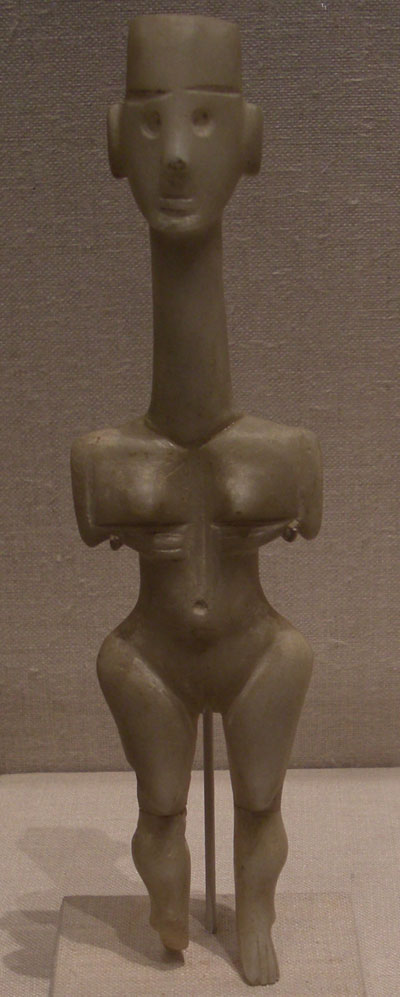
The biblical unity of male and female supports similar representations of male and female. Like a contemporary sex symbol, a marble figure carved on an island in the Aegean Sea about 4250 years ago leaves no doubt as to the figure’s sex. In stark contrast, Adam and Eve in the Genesis poem of the Junius manuscript (made in England about 930-960 GC) look remarkably androgynous. That representation plausibly relates to the biblical unity of male and female in the Genesis source text.

A male sense of female beauty has evolved biologically to emphasize indications of fertility. Adam and the narrator in the Junius manuscript repeatedly describe Eve’s physical beauty: Eve is “shaped shiningly {sceone gesceapene},”the most shining of women, / of wives most bright {idesa scenost, / wifa wlitegost}.”[3] The male sense of female beauty in England about 1100 years ago almost surely had important commonalities with the male sense of female beauty near Greece about 4250 years ago, as well as with the male sense of female beauty anywhere in the world today. The peculiar visual representation of Adam and Eve in the Junius manuscript makes sense within the biblical marriage of sex to persons.

Within Genesis, men and women are equally persons of God’s creation. To Jews, Christians, and Muslims, sex differences are a sign of women and men being made for each other.

* * * * *

Read more:

Notes:

[1] Genesis 1:27, 3:24 (God “drove out the man”). Images of the expulsion from the Garden of Eden always show Adam and Eve being expelled. In the fourth century, Jerome of Stridon explicitly recognized the Adam meant man and woman:

Let us read the beginning of Genesis, and we will find Adam, that is man, so declared to be both male and female.

{ Legamus principium Geneseos, et inveniemus Adam, hoc est hominem, tam virum quam feminam nuncupari. }

Adversus Jovinianum 1.29, Latin text from Patrologiae Latinae 23, p. 262, my English translation. Cf. Genesis 1:27.

[2] Genesis 2:23.

[3] Junius Manuscript (Oxford, Bodleian Library MS Junius 11, also known at the Caedmon poems) vv. 549, 626b-627a, English translation from Oldrieve (2010), Old Saxon text from Krapp (1931) and Vickrey (2015) pp. 105, 97. For a freely available online translation of the whole manuscript, Kennedy (1916). The Caedmon poem treats Genesis consistent with Christian orthodoxy. Vickrey (2015).

[images] (1) The marble female figure is Early Cycladic II, Chaladriania type, ca. 2300-2200 BGC and is on display at the Metropolitan Museum of Art of New York (accession 1977.187.11). The Met advances art education and culture in part by allowing visitors to photograph items on display in the museum. (2) Adam and Eve in Junius Manuscript. Oxford University’s Bodleian Library has made a digital image of the Junius manuscript (MS. Junius 11) available on the web. Making this important artifact of human cultural heritage written more than a millennium ago accessible world-wide is commendable and wonderful. Universities and libraries are commonly thought to seek to promote education and universal access to informative and cultural work. Oxford University’s Bodleian Library website for the Junius manuscript includes, however, an elaborate and restrictive statement of copyright over the digital reproductions of that manuscript. Wikipedia, which has quickly become an enormously influential educational institution, includes reproductions of images from the Junius manuscript. The official position of the Wikimedia Foundation is that “faithful reproductions of two-dimensional public domain works of art are public domain, and that claims to the contrary represent an assault on the very concept of a public domain.” I have transformed an image from the Bodleian’s reproduction for the non-commercial, critical, and educational use above.

References:

Oldrieve, Susan. 2010. “Genesis B: Introduction and Translation.” Department of English, Baldwin Wallace College, Department of English. Online.

Kennedy, Charles W. 1916. The Caedmon Poems, translated into English prose. London: Routledge. (alternate presentation)

Krapp, George Philip, ed. 1931. The Junius Manuscript. London: George Routledge.

Vickrey, John F. 2015. Genesis B and the Comedic Imperative. Bethlehem, PA: Lehigh University Press.