silk trade between ancient Rome and China

About two millennia ago, silk clothes were fashionable in Rome.  Moreover, a leading Roman physician had in his personal library in Rome about 192 GC “books written on white silk, with black covers, for which he had paid a high price.”  It’s likely that these books were silk scrolls.  In any case, the Romans clearly had a considerable amount of silk goods.[1]

Evidence of considerable silk trade between ancient Rome and China is less clear.  Roman texts indicate that silk came from “Seres,” which means “the land of silk.”  Seres has subsequently been interpreted as China.  A merchant’s trading manual from first-century Egypt provides a more direct connection between silk and China:

Beyond this region {the mouth of the Ganges River}, by now at the northernmost point, where the sea ends somewhere on the outer fringe, there is a very great inland city called Thina {China} from which silk floss, yarn, and cloth are shipped by land via Bactria to Barygaza and via the Ganges River back to Limyrike.  It is not easy to get to this Thina; for rarely do people come from it, and only a few.  The area lies right under Ursa Minor and, it is said, is contiguous with the part of the Pontus and the Caspian Sea where these parts turn off, near where Lake Macotis, which lies parallel, along with {the Caspian} empties into the ocean. [2]

This text’s geography is muddled.  It suggests, however, that some, but not a lot, of silk trade may have existed between China and ancient Rome.  Oasis economies in central Asia show little evidence of long-distance silk trade.[3]

Perhaps ancient Romans got a large volume of silk goods from some place other than China. Extraction of silk from wild silkworms for use in textiles has occurred in South Asia outside of China since the late third millennium BGC.  Moreover, that silk in some instances appears to have been reeled, a relatively advanced silk-processing technique.[4]  The domestication of silk worms was a secret apparently exclusive to the Chinese until after the collapse of the western Roman Empire. Perhaps silk goods in ancient Rome were somewhat lower quality silk goods made from wild silk worms processed outside of China.

Perhaps silk goods in ancient Rome came from China via a route different from what has been called for just over a century the “silk road.”  The cultural and economic sophistication of loose networks of nomadic peoples has tended to be underestimated.  Silk trade between Rome and China may have been organized through nomadic Central Asian peoples, rather than via a “silk road” connecting oasis settlements.  Another alternative to the “silk road” is maritime trade.  Maritime routes from western Eurasia to China are thought to have been established from the eleventh century.  Perhaps maritime trade between the eastern and western ends of Eurasia was established much earlier than previously thought.

No authentic Roman-era coins have been found in China.[5]  That suggests that if trade between ancient Rome and China occurred, it occurred within a network of transactions that separated the circulation of Roman coins from the transfer of silk from China to Rome.  Whether ancient Rome got silk from China or elsewhere, the ancient economy of Eurasia was more complex than the exchange of silk for gold between China and Rome.

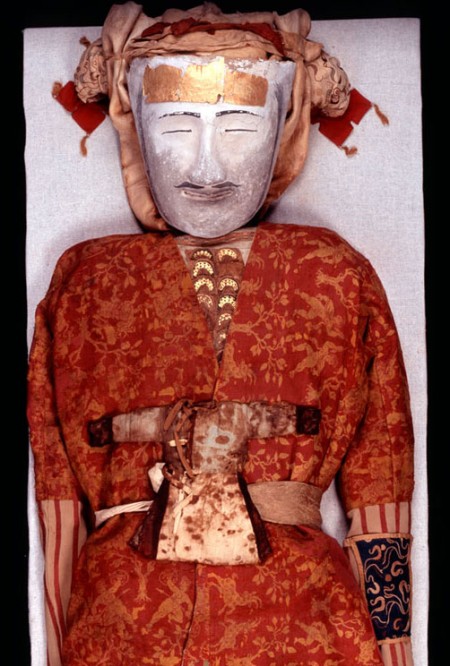
Tarim mummy yingpan has silk clothing


*  *  *  *  *

Read more:

Notes:

[1] Disparaging references to women’s luxurious and revealing silk clothes exist in Pliny the Elder (Natural History 6.54, 11.26, 12.84) and Seneca the Younger (Declamations, see note [2] here). Eumolpus, in his poem Bellum civile, refers to luxury goods including “silk from China, a strange new kind of garment.” See Petronius, Satyricon, sec. 118. Jerome also disparaged silk clothes (Life of Paul, s. 17).

[2] From the Periplus Maris Erythraei, trans. Casson (1989) p. 91. An alternate translation is freely available online.

[3] Hansen (2012).

[4] Good, Kenoyer & Meadow (2009).

[5] Hansen (2012) p. 20.

References:

Casson, Lionel. 1989. The Periplus Maris Erythraei: text with introduction, translation, and commentary. Princeton, N.J.: Princeton University Press.

Good, Irene, J. Mark Kenoyer, Richard H. Meadow.  2009. “New Evidence for Early Silk in the Indus Civilization.” Archaeometry. 51 (3): 457-466.

Hansen, Valerie. 2012. The Silk Road: a new history. Oxford: Oxford University Press.

Gog and Magog behind Alexander the Great's wall in China

constructing Alexander's wall against Gog and Magog; from 16th-century Falnama

Gog and Magog are apocalyptic figures in Jewish, Christian, and Islamic scripture.  Alexander the Great was an ancient Greek leader who conquered much of western Eurasia and northern Africa.  Like Gog and Magog, and Alexander the Great, a great wall in China was well-known about 2200 years ago.  A millennium later, a story existed, with learned support, that Alexander the Great built a wall in China to protect civilization from Gog and Magog. Those story pieces incredibly-credibly fit.

The Book of Ezekiel describes Gog like a Mongol leader.  Early Jewish and Christian references to Gog and Magog variously refer to them as individuals, peoples, and lands.  In the Book of Ezekiel, Gog is from Magog.  Prophesying about 2600 years ago, Ezekiel declared that Gog from Magog will come with many peoples, “out of the remotest parts of the north, … all of them riding on horses, a great horde, a mighty army.”  Gog from Magog attacks quiet peoples living in unwalled “waste places” and carries off plunder.  Those people seem like migrants to the great expanses of Eurasia.  Ezekiel prophesies that Gog from Magog will attack the people of Israel.  The people of Israel have walled and gated cities.  However, the decisive defense of Israel in Ezekiel’s prophecy comes from God showing his power to the world.[1]

In stories popular among sedentary peoples of southwestern Eurasia, Alexander the Great walled off savage peoples living somewhere north.  The story appears in the writing of the Jewish-Roman historian Josephus in the first century GC.[2]  Alexander the Great was a world conqueror broadly similar to Genghis Khan.  Alexander the Great, unlike Genghis Khan, was from a sedentary people.  The conflict between sedentary (“civilized”) and nomadic (“savage”) peoples is the underlying structure of the story of Alexander’s wall.  Having Alexander the Great as the protagonist suggests that sedentary peoples considered the threat from nomadic peoples to be world-threatening.  The threat that Alexander walled off was like the apocalyptic threat of Gog and Magog in Jewish and Christian literature.

No later than 630, the stories of Gog and Magog and Alexander’s wall came together among Syrian Christians in northern Mesopotamia.  Legends about Alexander the Great probably became popular soon after his death in 323 BGC.  An Alexander Romance written in Greek is known to have existed from no later than the third century GC.[3]  A Syrian Christian author in 630 wrote a text that described itself thus:

An exploit of Alexander the son of Philip the Macedonian, how he went forth to the ends of the world, and made a gate of iron, and shut it in the face of the North wind, that the Huns {variously also called the Scythians} might not come forth to spoil the countries [4]

This text identified the Huns as Gog and Magog.  A Syriac poem written about this time described itself as “Poem on the pious king Alexander and on the gate which he built against Gog and Magog.”[5]  The Islamic conquest of Syria in the mid-seventh century provided additional impetus to Syrian Christian apocalyptic writing.  The Syrian Apocalypse of Pseudo-Methodius, probably composed in the last decade of the seventh century, describes Alexander constructing a wall against Gog and Magog.  The Apocalypse of Pseudo-Methodius circulated widely and was well-known across western Eurasia from the eight century.  It popularized the story of Alexander the Great walling off Gog and Magog.[6]

By the mid-ninth century, learned men believed that Alexander’s wall against Gog and Magog was in northwestern China.  The influential early-ninth-century Persian astronomer, geographer, and mathematician al-Khwārizmī placed Alexander’s wall in northwestern China.[7]  In 842, Caliph al-Wathiq sent Sallām at-Turjumānī, who was highly proficient in languages, on a mission to determine whether Gog and Magog had broken through Alexander’s wall.  Sallām traveled to Tiflis (Tbilisi) in the Georgian Caucasus and plausibly passed through the Darial Pass.  Some accounts of Alexander’s feats suggested that he had walled off the Darial Pass.  Evidently what Sallām saw in the Caucasus was not compelling.  He headed east, traveling 3200 miles to northwestern China.  Sallām ultimately reported to Caliph al-Wathiq that he found Alexander’s wall in China about 300 miles from Igu (present-day Hami), probably at Yumenguan.  Assuaging the Caliph’s anxiety, Sallām declared that this wall against Gog and Magog was intact.[8]  That comforting report probably depended on identifying Alexander’s wall with what has become known as the Great Wall of China.  Eastern Christian stories of Alexander’s wall indicated that the wall was in the Caucasus.[9]  But a location in China had supporters in the Islamic world.[10]  That location also had the advantage of corresponding to the location of an actual, enduring, great wall.

Possible effects of communication are boundless.  The circulation of claims and stories about Gog and Magog, Alexander building a wall, and a great wall in China coalesced in an official report to Abbasid Caliph al-Wathiq, one of the most powerful and learned ninth-century leaders on earth.  The report, and similar accounts of Alexander’s wall in China, annihilated the 3200-mile-wide space from the Caucasus to northwestern China.  The most amazing communication technology has always been human minds and human networks.

*  *  *  *  *

Read more:

Notes:

[image] Bottom half of image, Alexander Builds a Wall against Gog and Magog; from the dispersed Falnama, Iran, Safavid period, mid-1550s to early 1560s.  Held in the Chester Beatty Library, Dublin, MS 395.  The Qur’an describes a story of Dhū’l-Qarnayn’s wall against Gog and Magog. Dhū’l-Qarnayn (the two-horned one) probably represents Alexander the Great. Dhū’l-Qarnayn met an uncivilized people (people who could scarcely understand his words; Qur’an 18:93) who offered to pay him tribute for building a protective wall.  Dhū’l-Qarnayn refused to accept tribute, but asked the people to help in constructing the wall (Qur’an 18:95).  The creatures working on the wall in the above painting may indicate those uncivilized people. The depiction of two of them as dog-headed seems to reflect descriptions of persons associated with Gog and Magog in the Alexander stories.  See Doufikar-Aerts (2011) pp. 44-46.  The creatures carrying cauldrons is consistent with a reference to molten metal in Qur’an 18:96. The creature on top of the wall has two horns. That depiction creates an additional dimension in the relationship between Dhū’l-Qarnayn and Alexander the Great.

[1] Book of Ezekiel, Chs. 38-39.  Quotes from New Revised Standard Version, Ez. 38:15, 38:12.

[2] Josephus, War of the Jews, Bk. 7, Ch. 7, Sec. 4.  Alexander the Great did not attack Jerusalem and is well-regarded in ancient Jewish literature.

[3] Stoneman (1991) is a recent English translation of texts associated with the Greek Alexander Romance.

[4] Donzel, Schmidt & Ott (2009) p. 18.

[5] Id. p. 22.

[6] Id. p. 26 describes the Syrian Apocalypse of Pseudo-Methodius.  An account of Alexander walling off unclean nations exists in the γ recension of the Greek Alexander Romance.  The account specifies 22 nations and names 16 nations, led off by “Goth, Magoth, ….”  These were “unclean nations” in the sense of ritual purity and practices considered savage, evil, and disgusting:

They used to eat worms and foul things that were not real food at all — dogs, flies, snakes, aborted foetuses, dead bodies and unformed human embryos; and they ate not only animals but the corpses of humans as well.

Trans. Stoneman (1991) pp. 185-187 (Bk. III, Sec. 26A).

[7] Ducène (2012) p. 107.

[8] Donzel, Schmidt & Ott (2009) Ch. 7, 10-12.  Id. provides an English translation of the text from Ibn Khurradadhbih, and compares other sources. Id. argues with detailed analysis that Sallam actually took the trip from Samarra to western China.  Id., p. 233, gives routes and mileages.  Sallam reportedly traveled from 842-845.  Ducène (2012) maintains that the trip was fictive.  Even if it was fictive, it seems to have been believable.

[9] Eastern Christian sources located Alexander’s Wall at the Caucasian Gates, the Caspian Gates, the Derbent Pass (in present-day Daghestan), and the Darial Pass (on the border of present-day Russian and Georgia).  In these sources, the story includes Alexander praying for two mountains to move together to close off the unclean nations.  Thus the most consistent location in the Eastern Christian sources is the Darial Pass. Islamic tradition located Alexander’s wall similarly.  Donzel, Schmidt & Ott (2009) pp. 51-6, 81.  In Arabic literature Gog and Magog are called Yājūj and Mājūj.

[10] Al-Mas’udi (died 956), Qudama ibn Ja’far (died c. 932), Ibn Hawqal (died 988) and other later thinkers located Alexander’s wall in or near China.  Id. pp. 99-109.

References:

Donzel, E. J. van, Andrea B. Schmidt, and Claudia Ott. 2009. Gog and Magog in early Syriac and Islamic sources: Sallam’s quest for Alexander’s wall.  Leiden: Brill.

Doufikar-Aerts, Faustina.  2011.  “Dogfaces, Snake-tongues, and the Wall against Gog and Magog.” Pp. 37-52 in Asghar A. Seyed-Gohrab, Faustina Doufikar-Aerts and Sen McGlinn (eds.). Embodiments of Evil: Gog and Magog. Interdisciplinary Studies of the ‘Other’ in Literature & Internet Texts. Leiden University Press (apparently a re-issue of Gog and Magog: the clans of chaos in world literature (2007)).

Ducène, Jean-Charles. 2012. Review. Gog and Magog in early Eastern Christian and Islamic sources. Sallam’s quest for Alexander’s Wall. Central Asian Survey.  Vol. 31, Iss. 1.

Stoneman, Richard. 1991. The Greek Alexander romance. London, England: Penguin Books.
yellow pages directory paper weight shrinks 75% from 2009

yellowbook yellow pages print directories dropped at entryway

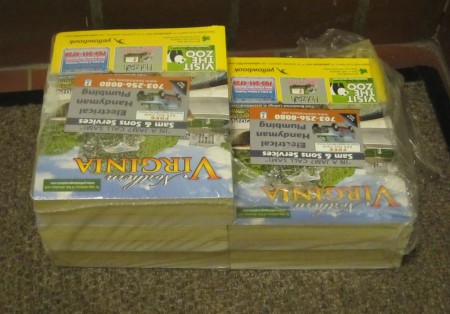
The yellowbook directory yellow pages and business white pages amounted to about 75% less paper in the recent 2013-2014 yellowbook delivery than for the similar delivery of the 2009 yellowbook.  Relative to 2011, the standardized listing count was down 38% for yellow pages and 20% for business white pages.  As in previous years, the changes were primarily in page size and print size, not in the number of pages (book thickness).  Thickness for all kind of books is ironically associated with perceived value.

Yellowbook may be moving to a 2-year publication cycle. The yellowbook delivered about this time in 2011 was labeled just “2011”.  I didn’t see any 2012 yellowbooks and hence never got one.  This year the yellowbook is labeled “2013 2014.”  Perhaps that means that no yellowbook will appear about this time next year.

Most residents in my apartment complex do not bother to pick up the directories that are delivered to the entryways of the complex.  In previous years, the number of books delivered was equal to the number of units in my apartment complex.  This year, the number of books delivered was half the number of units.  That implies an aggregate yellowbook paper weight reduction of 75% relative to the 2009 delivery.

Means for halting wasteful delivery of yellow pages directories aren’t working effectively.  The 2013-2014 yellowbook features prominently on the upper right corner “To stop delivery of this directory visit www.yellowpagesoptout.com”  That website allows you to register for which directories you would like to receive, e.g. an implicit personal opt-out.  To use this opt-out from unrequested yellowbook delivery, you have to provide personal information, including at least an email address.  Most residents in my apartment complex apparently prefer the simpler and more private approach of ignoring the directories and letting condo management place them in the recycling bin.  But overall, that’s environmentally and economically wasteful.[*]

The front page of the 2013-2014 yellowbook again has Sam & Sons Services (electrical, handyman, plumbing) in a front-cover refrigerator magnet position.  Sam & Sons also had this advertising position in the 2011 book.  The telephone number listed on the refrigerator magnet is no different than the telephone number listed on Sam & Sons webpage, hence Sam & Sons cannot be measuring the performance of its ad via call-counts on a dedicated number.  However, the refrigerator magnet says “Free $25 gas card / present this magnet with any purchase.”  That’s a well-established means for monitoring the performance of an ad.  If Sam & Sons is accurately calculating its return on its yellowbook front-cover refrigerator magnet, then its repeated use of it indicates that the advertising has a positive return on expenditure.

Yellow pages print directories have been a highly successful business since the 1920s.  Given general trends in the communications industry, paper directory advertising probably doesn’t have much of a future.  The challenges of communications industry changes, however, are not just for old advertising media.  The shift in Internet use from big-screen computers to small smart phones presents major challenges for online advertisers.

*  *  *  *  *

Data: yellowbook yellow pages advertising volume stastistics, 2009-2012 (Excel version)

Read more:

Note [*]:  Such waste is common.  The majority of pages of printed books that are purchased are probably never read.  Many persons buy clothes that they almost never wear.  However, at least one socially conscious and virtuous senior citizen wears the same overalls every day.  If everyone would follow his example, the earth’s natural environment would be much less ravaged.

COB-78: customer experience exhancements

This Carnival of Bureaucrats (COB) is committed to customer-experience excellence. Some organizations focus on customer service.  However, as a result of a thorough, multi-year mission-statement review process, COB has adopted a more comprehensive framework for managing its customer interactions with the goal of producing customers who not only meet or exceed metrics for customer service standards established for cross-business evaluation and planning, now under the responsibility of the Customer Service Evaluation and Planning Division, but also who are “delighted customers,” in accordance with the definitions adopted in the Final Report of the Commission for Re-Imagining the COB Mission. To further deepen and expand the “delighting” of customers, Customer Service Representatives have been promoted to Customer Experience Representatives and given added responsibility for a 10-point customer “delighting” checklist.  The Consolidated Facilities Division (CFD) has been given company-wide responsibility for removing lights in customer waiting rooms. CFD will thus also contribute to raising the disappointing scores received in last year’s sustainable-green washing and painting initiative.

As a result of the corporate restructuring necessary to achieve this new, comprehensive program of service goals centered on customer experience, this month’s COB is rescheduled to next month. You can enjoy previous bureaucratic carnivals here.  Nominations of posts to be considered for inclusion in next month’s carnival should be submitted using Form 376: Application for Bureaucratic Recognition.