Apollonius of Tyre through Arabian Nights: patterned tales

A doctor walking along the sea shore sees a coffin floating in the waves.  The doctor orders his servants to retrieve the coffin and take it to his house.  There, the doctor opens the coffin and finds “a very beautiful girl adorned with royal ornaments and lying in a state of apparent death.”  Inside the coffin is also twenty thousand gold coins.  An accompanying note awards half of those coins to the finder and asks that the other half be spent on a funeral for the girl.  The doctor, swearing to spend more than half the money on a funeral, orders his servants to construct immediately a pyre.

But while the pyre was being carefully and expertly constructed and assembled, a medical student of youthful appearance but mature judgment arrived.  When he saw the corpse of the beautiful girl being placed on the pyre, he looked at his teacher and said, “What is the cause of this recent death?”  The teacher said: “Your arrival is timely; the situation requires your presence.  Take a jar of unguent and pour it over the body of the girl to satisfy the last rites.”[1]

Consider the medical student’s question and the teacher’s answer.  They are substantially disjoint.  The teacher didn’t answer the medical student’s direct question.  Moreover, the teacher declared that the medical student’s presence is necessary, but then asked the medical student to perform a task unrelated to being a medical student.  The teacher could have poured the unguent over the girl’s body, or the teacher could have ordered a servant to do so.  Between the medical student’s question and the teacher’s answer is a substantial seam that the narrative thread traverses.

The above fragment is part of a text known as The Story of Apollonius King of Tyre.  The Apollonius text was highly popular in Europe during the Middle Ages.[2]  It has been, however, generically troublesome for modern critics.  The Apollonius text seems formally between New Comedy of post-Alexandrian Macedonian-ruled Greece, and Greek novels thought to have been most prevalent in the Roman Empire about the second and third centuries.[3]  Scholars have surmised that The Story of Apollonius King of Tyre is a summary of an earlier, more coherent narrative.[4]  Substantial seams like the one above are thus understood as artifacts of the summary text.
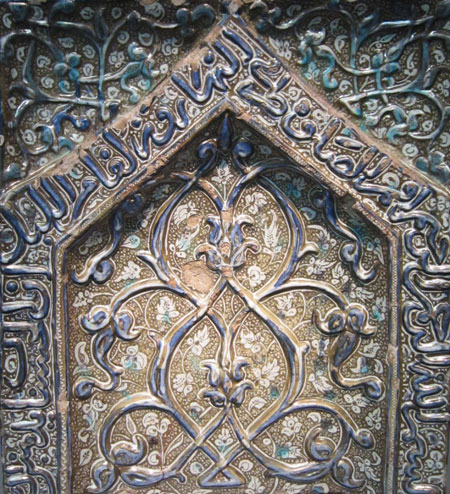
Apollonius of Tyre, like the Arabian Nights, is marvelously patterned text. Praise God!

Seams in The Story of Apollonius King of Tyre are better understood as a fundamental characteristic of the text.  Agon amidst the chaotic actions of humans and Gods; story journey, most paradigmatically from slavery in Egypt to freedom in covenant with God in the promised land; and wonder at  the marvels of God’s creation are three artistic keys with great imaginative force in Greek, Judeo-Christian, and Islamic art, respectively.  The third key is associated with intricately patterned art.

The text known in Europe as the Arabian Nights exemplifies the third key.  Its unifying frame narrative is relatively uninteresting.  Its art is in wonderful patterns of events recounted and juxtaposed within the text.[5]  While the Apollonius text and the Arabian Nights probably had their main origins in much different times, places, and genres, they both developed through literary processes and literary cultures that had much in common.[6]  The third key helps to open greater artistic appreciation of a text misunderstood as only a story, The Story of Apollonius King of Tyre.

The full account of the medical student in the Apollonius text is as marvelous as tales in the Arabian Nights.  The medical student — “of youthful appearance but mature judgment” — treats the beautiful girl’s dead body with unusual wisdom.  He pulls aside the clothing on her upper body and massages her chest and all her limbs.  He puts his lips to her lips.  Translators render an obscure phrase as the medical student oddly saying to himself, “Apply heat at four points.”  Early Arabic poetry associates a similar phrase with vaginal intercourse.  The medical student takes the beautiful dead girl into his bedroom and places her on his bed.[7]  The medical student then applies a heated woolen compress to the girl’s upper body.  The beautiful girl’s body responds warmly to the medical student’s treatment.[8]  Surely not only men with impure hearts can appreciate this erotic treatment.

Although effective, this erotic treatment is illicit.  Doctors are not supposed to have sex with their patients.  Having sex with a corpse is widely frowned upon, even where not outlawed.  But the medical student’s erotic treatment brings the beautiful girl’s corpse back to life.  Opening her eyes, recovering her breath, in a soft, indistinct voice the girl speaks:

Please, doctor, do not touch me in any way other than it is proper to touch the wife of a king and the daughter of a king.

Contemporary critics in high academic chairs will recognize that rape has occurred. They will denounce the medical student’s actions and insist that he be ran out of the story and locked up.  Men who don’t get it will wonder why the girl isn’t grateful.  The teacher, an instructional businessman lacking a modern education, praises the medical student’s expertise.  Disposing of the medical student like an extraordinarily well-paid common prostitute, the teacher pays him ten thousand gold coins.  The medical student then disappears from the story.[9]

The ending part of the sexual-healing account sounds additional notes on the Apollonius text’s themes of fidelity and licentiousness.  After the medical student is paid for his services and disappears, the teacher-doctor takes over treatment of the beautiful girl.  The doctor prescribes for her a nourishing diet and a regime of warm compresses.  A regime of warm compresses echoes the medical student’s erotic treatment.  In contrast, the medical student apparently didn’t tell the doctor of the beautiful girl’s royal stature.  After a few days, the doctor learns of the girl’s royal descent.  He then decides to adopt her as a daughter.  That choice seems only to highlight carnal interests mixed with familial relations, a motif that plays repeatedly in the text.  However, echoing virtuous regulation of sexuality across the text, the ideal of virginity prevails:

When she {the beautiful girl} tearfully pleaded that she not be touched by any man, he {the teacher-doctor} granted her wish and placed her within the cloistered confines of the priestesses of the goddess Diana, where all the virgins were able to preserve their chastity.

The girl already had a daughter with Apollonius.  Being touched by the medical-student man apparently shouldn’t be counted since she was then dead.  In the temple of Diana, the girl gains recognition as the most beautiful and most chaste virgin.  She becomes a figure like the Christian sense of the Virgin Mary, but in the temple of Diana.[10]

The Apollonius text is marvelous like the Arabian Nights.  Like the Arabian Nights, it is difficult to source and date within a wide range.  Both the Arabian Nights and the Apollonius text seem to aggregate a wide range of sources, from ancient high literature of celebrated authors to trans-historical folktales.  The Arabian Nights contains both colloquial Arabic and highly literary language and rhetoric.[11]  The Apollonius text is likewise linguistically heterogeneous.  A noted translator of the Apollonius text observed:

I have found The Story of Apollonius King of Tyre difficult to translate, the major problem being the abrupt stylistic changes, the wild fluctuations from simple, almost primitive narrative to stylized and elaborate forms of expression.  It has been hard to resist the temptation to correct deficiencies such as repetition, parataxis, and the failure to subordinate one idea or event to another, or even to differentiate between distinct periods of time. [12]

Repetitive designation and leading-word repetition are frequently used techniques in the Arabian Nights.  These artistic techniques also occur frequently in the Apollonius text.  Thematic and formal patterning, which necessarily require apparent junctions and seams, are important artistic techniques in both the Arabian Nights and the Apollonius text.[13]

Limiting appreciation of the Apollonius text to a story — The Story — is a historical literary problem.  The Judeo-Christian heritage of Europe has elevated the importance of story in literary interpretation.  But the third key — wonder at patterned creation — unlocks art of the Apollonius text.[14]  That text differs from surviving Greek novels not just in the asymmetry of its intersexual relationships, but also in its marvelously varied patterning of intersexual relationships.[15]  Its relational texture includes romantic love (in the sense of the Greek novels), covenant love (the Judeo-Christian ideal), bare carnal desire (the motive to use a prostitute), and licentious desire most shocking (father-daughter incest).  The affair of the medical student with the beautiful girl’s corpse is an outrageous, highly entertaining focal point in that relational texture.

*  *  *  *  *

Read more:

Notes:

[1] Apollonius, ch. 26, trans. Sandy (1989) p. 753.  Previous quote is from id.  All subsequent quoted Apollonius text is from that translation, unless otherwise noted.

[2]  The Apollonius text has survived in at least 114 Latin manuscripts written before the eighteenth century and in many vernacular manuscripts written all across medieval Europe.  Numerous references and allusions to it further indicate its popularity.  Archibald (1991) p. 3 & Ch. 3-4. Within the widely disseminated late thirteenth-century work Gesta Romanorum, the Apollonius text is Tale 153, from Latin trans. Swan & Hooper (1976) pp. 259-99.

[3] Konstan (2011).

[4] E.g., Kortekaas (2004).  For brief conjectural history, see id. Ch. 9.

[5] Hamori (1983), pp. 38-42, provides an insightful discussion of patterned tales. On patterning in Latin literature of Late Antiquity, Roberts (1989).

[6] The prevailing scholarly opinion is that the earliest surviving recension of the Apollonius text is from the late fifth or early sixth centuries. That recension is thought to have developed from a Greek or Latin original from the second or third century.  The earliest surviving Apollonius text is from the ninth century.  A stable text has survived from ninth century, although many minor variations were also produced.  A stable text probably also existed from the sixth century, although the evidence is less compelling.  See Archibald (1991) Ch. 3.  In pondering the relation of Islamic culture to the theme of courtly love in European troubadour lyrics, Grunebaum (1952), p. 238 observed:

The interaction between East and West in the Middle Ages will never be correctly diagnosed or correctly assessed and appraised unless their fundamental cultural unity is realized and taken into consideration. It is that essential kinship of East and West that will account both for Europe’s receptiveness to Arabic thought and to the (more or less) independent growth in the Occident of ideas and attitudes that on first sight appear too closely akin to their oriental counterparts not to be attributed to mere borrowing.

Those observations may also apply a millennium earlier.  A text created through a process of aggregation and redaction, within the common cultural sphere that gave rise to Islam, might well exemplify the same imaginative key as Islamic art more generally.  The Appollonius text is a “carefully patterned and symmetrical story,” and it is “probably the result of an accumulation of oral and literary motifs and garbled historical memories.”  Archibald (1991) pp. 12, 44.  Konstan (2012) fruitfully compares the structure of the Apollonius text to that of the folktale “Hansel and Gretel.”

[7] How the girl got into the medical student’s bedroom is a crux in the Latin text.  Sandy (1989) translates: “With some assistance he took the girl to his bedroom, placed her on his bed, … .” Archibald (1991), in contrast, has: “Taking equipment with him, he brought the girl into his own room and placed her on the bed.”  See Kortekaas (2007) for a philological analysis of the crux.  Id. favors the former sense in translation.  But the overall tone of the section seems to me to favor strongly the latter, improved with explicit use of the terms “his bedroom” and “his bed.”

[8] Sexual stimulation as cure for frozen humors is also a feature in a story of the eminent physician Jibra’īl ibn Bakhtīshū curing a woman who had her arms frozen, outstretched above her head.

[9] While ten thousand gold coins would be a huge fee for a common prostitute, in context that’s not a large reward.  Ten thousand gold coins is the amount of found money directed to the funeral.  The teacher-doctor pocketed a corresponding amount as the finder’s reward.  Moreover, the teacher-doctor declared that he would spend more than the directed amount on the funeral.  Yet when the medical student brought the girl back to life, the teacher-doctor didn’t reward the student with any more money than the directed amount for the funeral.  In the ancient world, reviving the dead was a celebrated feat of the consummate physician.

[10] An Old English Apollonius text has survived in an eleventh-century manuscript amidst Christian legal and homiletic works of Archbishop Wulfstan.  A large middle section of text, including the medical-student section, is missing.  Perhaps that section was too outrageous for a churchman to include.

[11] G, the fourteenth-century Syrian manuscript that is the oldest Arabian Nights manuscript extant, is highly colloquial and includes textual indications of oral story-telling.  It also includes extravagant literary ornamentation.

the wording of G comprises a “third language,” neither purely colloquial nor exclusively literary, in which both fushā {classical literary Arabic} and colloquial are employed in the presentation of each tale.

See Pinault (1992) p. 15.

[12] Sandy (1989) p. 739.

[13] For example, in the medical-student section of the Apollonius text, the word “touched” is repeated in three important positions.  Word foreshadowing occurs when Apollonius’ tearful wife pleads to go to sea with Apollonius: “Let’s sail together, … let’s live or die together.” The reference to die foreshadows her fate at sea.  Similarly, Apollonius orders that his wife’s coffin have its joints sealed with pitch and covered with sheets of lead before the coffin is thrown into the sea. Those details make sense only in terms of subsequently finding the coffin and reviving the apparently dead wife.  On general techniques of story-telling in the Arabian Nights, see Pinault (1992) pp. 16-30.

[14] The Apollonius text is typically now entitled Historia Apollonii Regis Tyri (The Story of Apollonius King of Tyre).  Manuscript incipits also included other descriptions with respect to Apollonius: gesta (deeds), vita (life), narratio vitae (narrative of the life), and liber (book). Archibald (1991) p. 92.

[15] On the contrast between symmetry and asymmetry in Greek novels and the Apollonius text, see Konstan (1994).

References:

Archibald, Elizabeth. 1991. Apollonius of Tyre: medieval and Renaissance themes and variations: including the text of the Historia Apollonii Regis Tyri with an English translation. Cambridge: D.S. Brewer.

Grunebaum, G. E. von. 1952. “Avicenna’s Risâla fîʾl-ʿišq and Courtly Love.” Journal of Near Eastern Studies. 11 (4): 233-238.

Hamori, Andras. 1983. “A Comic Romance from the Thousand and One Nights: The Tale of Two Viziers.” Arabica, 30 (1), 38-56 DOI: 10.1163/157005883X00021

Konstan, David. 1994. Sexual symmetry: love in the ancient novel and related genres. Princeton, N.J.: Princeton University Press.

Konstan, David. 2011. “Apollonius King of Tyre: Between Novel and New Comedy.” Paper presented at 5th Trends in Classics International Conference on Latin Genre, 27-29 May 2011 at the Archaeological Museum of Thessaloniki.

Konstan, David. 2012. “The ‘Hansel and Gretel’ Effect in Apollonius King of Tyre.  In Marcos Carmignani, Luca Graverini, Guillermo De Santis and Benjamin Todd Lee, eds., Collected Studies on the Roman Novel (special issue of Ordia Prima).

Kortekaas, G. A. A. 2004. The story of Apollonius, King of Tyre a study of its Greek origin and an edition of the two oldest Latin recensions. Leiden: Brill.

Kortekaas, G. A. A. 2007. Commentary on the Historia Apollonii Regis Tyri. Leiden: Brill.

Pinault, David. 1992. Story-telling techniques in the Arabian nights. Leiden: Brill.

Roberts, Michael. 1989. The jeweled style: poetry and poetics in late antiquity. Ithaca: Cornell University Press.

Sandy, Gerald N., trans. 1989. Anonymous.  The Story of Apollonius King of Tyre.  Pp. 736-72 in Reardon, Bryan P. , ed.  Collected ancient Greek novels. Berkeley: University of California Press.

Swan, Charles, and Wynnard Hooper, trans. 1876. Gesta romanorum: entertaining moral stories. New York: Dover Publications Inc. (reprint edition of 1969).

Google Fiber confronts geographic heterogeneity

Google Fiber‘s network build in Kansas City is publicly organized around fiberhoods.  A fiberhood is a small, geographic area that is a candidate for having Google fiber installed.[1]  Google is prioritizing its network build across fiberhoods based on the extent to which fiberhoods exceed pre-registration goals.  Differences in pre-registration goals across fiberhoods suggest cost and expected per-household profitability heterogeneity across fiberhoods.  Differences in pre-registrations received indicate take-up heterogeneity across fiberhoods.

The initial distribution of pre-registration goals across fiberhoods was simple.  A majority of fiberhoods (57%) had a preregistration goal of 10%.  Only two other pre-registration goal levels existed: 25% (for 13% of fiberhoods) and 5% (for 29% of fiberhoods).  The distribution of network build costs across fiberhoods is probably much more continuous than this simple pre-registration goal distribution.  Hence a reasonable conjecture is that the pre-registration goals, which differ by a factor of five, are not closely related to network build costs.  Heterogeneity in expected per-household profitability, or some other factor, apparently is determining pre-registration goal levels.[2]

Pre-registration take-up heterogeneity appears to be significantly affecting Google Fiber’s build.  As of August 29, 2012, about 15,900 households had preregistered, and about 99 fiberhoods (out of 202) had met or exceeding their preregistration goals.  Each fiberhood exactly meeting its pre-registration goal implies about 16,200 pre-registrations.  Hence Google Fiber has nearly met in aggregate its pre-registration goal, but the distribution of those preregistrations implies a network build to less than half of the fiberhoods.  Google Fiber recently announced that it has adjusted downward its pre-registration goals. That change favors a broader network build.

Successfully investing in mass-market network infrastructure is a difficult business.  Four cable companies have unsuccessfully attempted to build networks in Kansas City. According to public FCC data, the number of providers of high-speed Internet access varies considerably across census tracts in Kansas City.  Most high-speed internet service provides in Kansas City probably serve only a few, highly specialized customers.  Google Fiber is an interesting mass-market experiment that is likely to evolve as its reveals more information about network costs and customer demand.

*  *  *  *  *

Data: public data on Goggle Fiber fiberhoods in Kansas City, as well as public data on other networks (Excel version)

Notes:

[1]  Currently defined for the first stage of the Google Fiber build in Kansas City are 202 fiberhoods in Kansas City, Kansas, and in Kansas City, Missouri.  The median fiberhood size is 771 households, with upper and lower quartiles of 1096 and 461 households.  For details, see the fiberhoods sheet.

[2] As of Aug. 29, the median pre-registration shares across the sets of fiberhoods with goal shares of 5%, 10% and 25% were 8%, 6%, and 13%, respectively.  If goal shares are inversely correlated with household income, that pattern of take-up suggests free Internet service is dominating take-up.

COB-74: bureaucratic work day

Keep moving.  Except in times of danger (downsizing or reorg), good bureaucrats keep moving.  Schedule a meeting, present a proposal, reschedule a meeting, present a new proposal, and repeat.  The more times you fly back and forth between the same cities, the more important you are in your organization.  Perfect your memo’s cover sheet, and then go back and edit the cover sheet again.  Keep moving through your work routine despite all the craziness in the world. Companies are innovating, new products are appearing, and disturbed people are doing things differently.  Entrepreneurs scurry about like cockroaches testing the offerings in a messy kitchen.  Don’t let the craziness in the world distract you.  Keep moving.

This Monday is Labor Day in the U.S. The above video is a tribute to bureaucrats world-wide, moving through their bureaucratic work days.

A friend who is a history professor once told me, “Those who cannot learn history are doomed to repeat it, next semester.”  But that was not always true.  As the American History Association, a venerable bureaucratic organization, asserts on its website:

When the American Historical Association (AHA) was founded in 1884, history had only recently emerged as a distinct academic discipline. The first few professors in the field of history had only been appointed at major universities in the 1870s.

Without history professors, there is no one to require that history be repeated.  Fortunately, a meeting of an organization called for the formation of another organization:

In 1884, “professors, teachers, specialists, and others interested in the advancement of history in this country” were called to gather at the annual meeting of the American Social Science Association (ASSA) in Saratoga, New York. Despite the opposition of the ASSA’s president, John Eaton, the historians present voted to establish the American Historical Association as a separate organization. The central figure in this initiative was Herbert Baxter Adams, an associate professor in history at Johns Hopkins University, who became the first secretary of the AHA and remained so for the next sixteen years. Andrew Dickson White, a historian and president of Cornell University, was selected as the AHA’s first president.

The new organization has been electing officers now for well over a century.  The current president of the American History Association, William Cronin, recently wrote an article on professional boredom.  Only members of the organization are allowed to add comments to the article, and members must register and log in to make a comment.  Don’t let this happen to you.

A key economic challenge with advancing automation and highly scalable network services is creating jobs.  Bureaucrats are experts in creating and preserving jobs.  Consider, for example, Terrence “Terry” Telco, a bureaucratic leader in the communications industry:

The decision of whether or not to deploy IPv6 is a decision that is largely dead simple. Oh no, not for Terry. Its an excuse to overanalyze, debate and investigate something ad infinitum in the hopes that a) people around will get too bored to notice this study has been ongoing for the past 6 years, and b) no one doing the study will ever be tasked with ever implementing the strange, overly complex and surely bespoke architecture that Terry invents to deploy IPv6.

Can there by any doubt that Telco supports a large workforce?  Isn’t it clear that Telco excels in creating jobs?  The economy needs Telco, now more than ever.

Venkat at ribbonfarm has an insightful post about waste and creativity.  Bureaucracies are often accused of being wasteful.  Venkat points out, “being able to afford to waste materials allows for better creativity.”  Bureaucrats are able to create so many procedures, rules, and documents in part because they can afford to waste materials.  So don’t criticize bureaucracies for being wasteful.

That’s all for this month’s Carnival of Bureaucrats.  Enjoy previous bureaucratic carnivals here.  Nominations of posts to be considered for inclusion in next month’s carnival should be submitted using Form 376: Application for Bureaucratic Recognition.

ibn Butlān and ibn Ridwān in vicious intellectual competition

warm rubber chick

In the eleventh century, the eminent physicians ibn Butlān and ibn Ridwān viciously disputed the intellectual question: “which is warmer, the chick or the chicken?”  Similar disputes are prevalent in a wide variety of academic fields today.  As the dispute between ibn Butlān and ibn Ridwān illustrates, intellectual competition focused on personal status encourages pointless arguments and personal attacks.

Seeking a better position as a physician, ibn Butlān moved from Baghdad to Fustāt, the capital of Egypt.  Ibn Butlān arrived in Fustāt about 1049.  He arranged to meet there the leading physician in Egypt.  That was ibn Ridwān, the chief physician to the Fatamid caliph al-Mustansir bi-Allāh.[1]  Ibn Ridwān initially greeted ibn Butlān cordially. Ibn Butlān did not, however, quickly gain the intellectual status that he felt that he deserved.

Within a few months after arriving in Egypt, ibn Butlān wrote a treatise scientifically reasoning that the chick is warmer than the chicken. Poultry-raising and the artificial incubation of eggs were big business in Egypt.[2]  However, the relatively warmth of the chick and the chicken had no practical implications for the poultry business.  Ibn Butlān’s treatise wasn’t primarily a contribution to scientific knowledge.[3]  It was a gambit to gain high intellectual status.

Ibn Butlān’s status gambit was socially sophisticated.  Egyptian physicians, reasoning based on Hippocratic-Galenic medical knowledge, generally regarded the chick to be warmer than the chicken.  Al-Yabrūdī, a Christian physician from Damascus, had argued impressively at a meeting at the Vizier’s palace in Cairo.  Al-Yabrūdī’s argument was that the chick is colder than the chicken.  Ibn Butlān, a Christian physician from Baghdad, expertly reviewed and reformulated al-Yabrūdī’s argument.  He criticized inadequate responses to al-Yabrūdī from one Egyptian physician (who may have been one of ibn Ridwān’s students).  At the same time, ibn Butlān maintained that the common belief of Egyptian physicians, not al-Yabrūdī’s argument, is correct.  Ibn Butlān reformulated al-Yabrūdī’s argument in order to provide material “to be useful to students as spiritual training and gymnastics, to learned men as a material on which they may show their ability, and to ignorant people as a means of rebuke.”[4]  Ibn Butlān thus positioned himself as a master physician-teacher who could both dominate for the Egyptians the outside intellectual force of fellow Christian al-Yabrūdī and who could correct the intellectual failings of a low-ranking Egyptian physician.

Recognizing a potential rival, the leading Egyptian physician ibn Ridwān publicly attacked ibn Butlān.  Ibn Ridwān begin his response with a passive-aggressive rhetorical claim:

I have read the discourse of the shaikh {ibn Butlān}… which he has sent to me in his own handwriting and which he invited me to answer.  I informed him that I was too occupied to reply, but he insisted.  Then I undertook, reluctantly, to answer it.  Consequently, if this answer makes him vexed and angry, he must not blame me, but himself, if the blunder and the mistake is on his side; if it is on my side he may divulge it and make it known amongst the people.[5]

Ibn Ridwān went on to analyze carpingly ibn Butlān’s arguments and to attack viciously ibn Butlān’s person.  Ibn Ridwān described ibn Butlān as confused, ignorant, mentally defective, and laughable.  Ibn Ridwān reported that the learned men of Iraq nicknamed ibn Butlān “good-for-nothing.”  Ibn Ridwān ended his treatise thus:

End of the discourse … exposing the nonsense, the idle talk and the futilities of the utterings of {ibn Butlān} which are pure sophistry, and some of his erroneous beliefs and untrue opinions which I have found out.  Allah knows best the truth.[6]

That last sentence was purely conventional.  Ibn Ridwān didn’t leave to Allah the task of chastising ibn Butlān for falsehoods.  Ibn Ridwān called forth his own knowledge-authority to deliver a severe intellectual beating to ibn Butlān.

Ibn Butlān responded with a wide-ranging counter-attack on ibn Ridwān.  Like ibn Ridwān, ibn Butlān began with an assertion of good will.  He stated that he “only strove after everything that was likely to promote love and consideration”:

I received from him {ibn Ridwān} questions and I answered them immediately, but abstained until now from sending the answers to him, because I wished to continue friendly relations.[7]

Ibn Butlān then stated that he had received “an order from one in a high place, an order “which I could not disobey or postpone,” an order “to compose this discourse.”[8]  In that lengthy discourse, ibn Butlān argued that learning from oral instruction is better than learning from books (ibn Ridwān, a self-made scholar, learned from books), that the doubts of persons who wrongly interpret from books are difficult to dispel, and that persons whose reason is affected by absurdity have difficulty recognizing truth.  Ibn Butlān harshly criticized the learning and conduct of students of ibn Ridwān.  Ibn Butlān ridiculed ibn Ridwān with claims such as “his belief that the saying of Hippocrates, ‘Life is short, and the Art is long,’ is contradicted by seventy-two objections.” Ibn Butlān concluded with a call to ibn Ridwān:

I ask the shaikh {ibn Ridwān} to criticise my suggestions after the manner of reasonable men and to answer every single section and every single chapter with arguments excluding doubt [9]

Ibn Butlān also wrote poetry mocking ibn Ridwān’s appearance:

When his face to the midwives appeared,
They withdrew in the deepest of gloom,
Saying softly, so as not to be heard:
“Would that he had been left in the womb.” [10]

Ibn Ridwān apparently began this line of dispute with criticism of ibn Butlān’s appearance.  Both ibn Ridwān and ibn Butlān reportedly were physically unattractive.[11]

The dispute between ibn Butlān and ibn Ridwān quickly generated at least ten written articles.  These articles attracted widespread attention and remained well-known for centuries.[12] Social influence ultimately resolved the dispute.  Ibn Ridwān urged other physicians in Egypt to shun ibn Butlān:

All this is sufficient reason for you to wonder about that man {ibn Butlān} and to laugh at him and to avoid speaking with him, if you have any business with him in the future; and that you ought not to pay attention to anything he says, but to treat him like one confused and who is subject to evil suggestions {of Satan}.  For he babbles and talks nonsense continuously, and does not merit that his death should ever be lamented nor that one should recommend him to {Allah’s} mercy — and this is sufficient.[13]

In 1052, about three years after he arrived, ibn Butlān withdrew from Egypt in defeat.

Intellectual activity in the ancient Islamic world was highly personal and not institutionalized.  Contemporary intellectual life, in contrast, is bureaucratized and cartelized through academic disciplines and punishments.  Contemporary intellectual life also heavily emphasizes institutions such as “regular examination, completion of fixed curricula, or official regulation and inspection.”[14]  Such institutions impede new intellectual competition and reduce possibilities for unauthorized dissemination of knowledge.  In theory, well-vested and entrenched intellectuals know their place and are less likely to do intellectual battle with each other.  In practice, in walled domains from poetry to public policy, nasty intramural academic disputes still commonly occur.  Higher walls and narrower intellectual spaces don’t greatly reduce scholarly viciousness.

Greater interest in truth, practice, and joy relative to personal status more effectively lessens scholarly viciousness.  Truth known cannot be unknown through changes in personal status. Useful knowledge doesn’t necessarily depend on social context.  Scholarly joy can be independent of others’ opinions.  With emphasis on truth, practice, and joy rather than social status, intellectual activity that is highly personal and not institutionalized need not be vicious.  That’s the best, and largely unrealized, hope for intellectual activity on the Internet.

*  *  *  *  *

Read more:

Notes:

[1] The full names of the protagonists: Abū al-Hasan al-Mukhtār ibn al-Hasan ibn ‘Abdūn ibn Sa‘dun ibn Butlān of Baghdad (ibn Butlān) and Abū ‘l-Hasan Alī ibn Ridwān ibn Ja`far of Cairo (ibn Ridwān). Both names are commonly written in simplified, formally incorrect transliteration: ibn Butlan and ibn Ridwan. Ibn al-Qifti and Ibn Abi Usaybi’ah provide biographies of both.  For English translations of these texts, see Schacht and Meyerhof (1937) pp. 33-69 and HP pp. 464-9, 706-17.

[2] Conrad (1995) p. 93.

[3] Id. insightfully explains that the controversy was a matter of not medicine and philosophy, but social and professional status.  By today’s standards, both ibn Butlān’s and ibn Ridwān’s scientific understandings were far from biological truth.  According to ibn al-Qifti, ibn Ridwān began working as a folk astrologer.  Later, as a learned physician, ibn Ridwān wrote a commentary on Ptolemy’s Tetrabiblos, which was a leading scholarly authority for astrologers.  Ibn Ridwān’s commentary on the Tetrabiblos was his most influential work.  See Seymore (2001).  Ibn Butlān also practiced astrology.  HP pp.  465-6.  More generally, medicine and astrology were closely associated fields in the ancient world.

[4] Schacht and Meyerhof (1937) pp. 15-6 (editors’ introduction: background of argument), p. 72 (ibn Butlān’s 1st treatise: “We will begin with the mention and the refutation of the true opinion {the general opinion of Egyptian physicians}, not that we really believed {the arguments of al-Yabrūdī}, but as it were as a test for clear intelligences in face of dark and doubtful questions.”), p. 70 (quoted text, trans. from ibn Butlān’s first treatise); HP p. 790 (reference to al-Yabrūdī’s treatise on the relative warmth of the chick and the  chicken). Ibn Butlān’s conflation of science, argument, and courtly posing is exemplified in this passage from his first treatise:

After having quoted and refuted the opinion of those who maintain that the young of the bird is warmer than the chicken and having furnished in the place of al-Yabrūdī strong proofs to the contrary … we now begin to enjoy the gardens of the intellect and picks the fruits of science.  Our aim in this is to reveal the secrets of Nature concerning the egg and connected matters.  We shall put attractive questions which we will at first enumerate, and then, if it is Allah’s will, answer, after the physicians will have revealed in a scientific manner the false conclusions in these analogies, viz. in all the questions and problems which we discuss about oviparous animals, about the properties of the egg, and brooding by animals, and about chickens and young birds …. On these four subject matters eighty-one questions are to be raised.

Schacht and Meyerhof (1937) p. 75.

[5] Schacht and Meyerhof (1937) pp. 76-7.

[6] Id. p. 80.

[7] Id. p. 81.

[8] Id. p. 82.  That a worldly authority ordered ibn Butlān to write the treatise that he wrote is improbable.  I suspect that the higher authority to which ibn Butlān refers is Allah. While ibn Butlān was a Christian and ibn Ridwān a Muslim, they didn’t engage in inter-religious polemic.  Instead, they used their common understanding of Allah to warn each other about consequences of falsehoods and to ridicule each other.

[9] Id. p. 106.

[10] HP p. 465.  Among intellectuals in the ancient Islamic world, writing poetry was a prevalent practice.  When I was a child, I heard the insult “when you were born, you were so ugly the doctor spanked your mother.”  More research is needed on the filiation of this invective family.

[11] The biographies of both physicians mention their unattractiveness.  For an example of their physiognomic polemic, see Schacht and Meyerhof (1937) pp. 97-8.

[12] Ibn Abi Usaybi’ah’s history of physicians, written in mid-thirteenth-century Damascus, preserves an account of articles in this battle:

  1. ibn Butlān: A treatise opposing by logical reasoning, the view of those who maintain that the chick is warmer than the hen; he wrote it in Cairo in the year 1049-50
  2. ibn Ridwān: A treatise in refutation of Ibn Butlān’s treatise on chicks and other young birds
  3. ibn Ridwān: A treatise on baffling questions mentioned by Ibn Butlān
  4. ibn Butlān: A treatise addressed to Alī ibn Ridwān, which he composed in the year 1049-50, on his arrival in Fustāt, in answer to what ‘Alī ibn Ridwān had written to him
  5. ibn Ridwān: A treatise propounding that what Ibn Butlān does not know is established truth and wisdom and what he does know is error and sophistry
  6. ibn Ridwān: A treatise demonstrating that Ibn Butlān does not understand his own words, let alone those of others
  7. ibn Butlān: The Failure {Conflict} of Physicians
  8. ibn Ridwān: A statement by him {ibn Ridwān} in which he resumes his refutation {of ibn Butlān}
  9. ibn Ridwān: An epistle to the physicians of Fustāt and Cairo on Ibn Butlān, being a summary of Ibn Ridwān’s main criticisms of him
  10. ibn Ridwān: A treatise pointing out the nonsense in the sayings of Ibn Butlān

The treatises and descriptions above are from lists in HP pp. 467-9 (ibn Butlān) and pp. 712-7 (ibn Ridwān).  The corresponding item numbers in those lists for the ten articles above are 8, 55, 57, 6, 58, 59, 11, X, 60, and 101.  Schacht and Meyerhof (1937) pp. 64-6, 41-9 provides an annotated alternate translation of those lists from a different ibn Abi Usaybi’ah manuscript with slightly different lists.  The 8th article above is reported only in id. p. 46, #61.  Treatises 1-5 published in id. (often in abridged and summarized form) correspond to articles 1, 2, 4, 5, and 9 above.  The order given above is a conjectural chronological order.  Article 10 may be identical with an earlier article.

[13] Id. p. 118.

[14] Quoting Conrad (1995) p. 98, which seems to regret the absence of these institutions.

References:

Conrad, Lawrence I. 1995. “Scholarship and social context: a medical case from the eleventh-century Near East.” In Bates, Donald G., ed., Knowledge and the scholarly medical traditions. Cambridge: Cambridge University Press., 84-100 DOI: 10.1017/CBO9780511621666.005

HP: Ibn Abi Usaybi’ah, Ahmad ibn al-Qasim. English translation of History of Physicians (4 v.) Translated by Lothar Kopf. 1971. Located in: Modern Manuscripts Collection, History of Medicine Division, National Library of Medicine, Bethesda, MD; MS C 294Online transcription.

Schacht, Joseph, and Max Meyerhof. 1937. The medico-philosophical controversy between Ibn Butlan of Baghdad and Ibn Ridwan of Cairo; a contribution to the history of Greek learning among the Arabs.  Cairo: Egyptian University.

Seymore, Jennifer Ann. 2001. The life of Ibn Ridwan and his commentary on Ptolemy’s ‘Tetrabiblos’.  Ph.D. Dissertation. Columbia University: School of Arts and Sciences.