book house: imaginary world made real

Caitlin Phillips' Journey Through My Book House at Artomatic

Journeys Through My Book House is an installation that Caitlin Phillips has created for Artomatic.  It’s a room wallpapered with the pages of books.  Hung on the walls are purses that Phillips makes from the covers of discarded books.  Like a doll house or a tree house, Phillips’ book house conjures imaginary worlds.  Phillips explains:

Lost in a book in my room, on vacation in the car with my nose in a book instead of looking at the scenery, hiding out in the backyard; the places I went in books seem as real to me as the places I visited in real life, and sometimes the real and imagined places bled over into each other.

Creating an imaginary world isn’t a distinctive attribute of books.  Radio shows, television shows, electronic games, and other forms of entertainment can also create imaginary worlds.  Philips’ book house, like her book purses and iPad book covers, celebrate the physical body of books.

Love is realized with physical bodies.

*  *  *  *  *

Read more:

Exhibit note:  Journeys Through My Book House is on display at Artomatic in Crystal City, Virginia, through June 23, 2012.  Artomatic is a unjuried, non-profit exhibit of more than 1000 persons’ art.  Admission is free.  A fine local news source has reviewed Artomatic 2012.

lovesickness unto death, for a day or forever

Lovesickness, like eros, has long been a motif in human communication.  An Egyptian poem written about 3200 years ago states:

Seven days from yesterday I have not seen my beloved,
And sickness has crept over me,
And I have become heavy in my limbs,
And am unmindful of my own body.
If the master-physicians come to me,
My heart has no comfort from their remedies,
And the magicians, no help are they,
My malady is not diagnosed.[1]

The Greek poet Sappho, writing about 2600 years ago, poetically detailed with detached first-person statements her physical responses to seeing a beloved with another.  Those responses take the lover not far from death.[2]
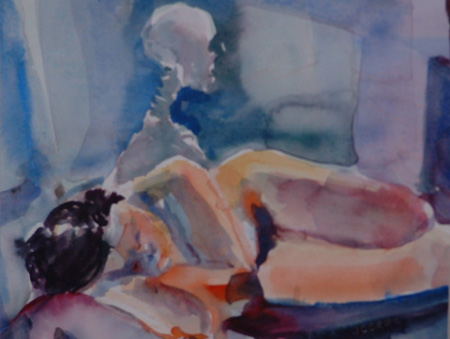
Lovesickness, if acute and persisting, might lead to death.

A Greek-Arabic text from earlier than 1100 years ago describes lovesickness onto death.  This text explains lovesickness using universalized observations and the highly respected Hippocratic-Galenic humoral system of biological reasoning.[3]  It seems to be popular science like that in the Alexandrian pseudo-Aristotelian Problemata Physica from about the fifth century.[4]  Yet at least in one place it is also quite poetic and makes highly unnatural claims:

The final stage {of lovesickness} is madness, in which case the lover sometimes kills himself or dies of grief; sometimes he may come into contact with his beloved and then dies either of joy or of sorrow, sometimes he heaves a sigh and loses consciousness for twenty-four hours, so that he is believed dead and is buried alive; at times he sighs very deeply and his breath is caught in his pericardium, where the heart closes in on it, so that it cannot escape until he dies; sometimes during moments of relaxation he raises his eyes to look around, and he suddenly sees his beloved — then his soul departs in one stroke.[5]

Breathing typically indicates a living animal body.  In pre-Aristotelian Greek and Hebrew language and thought, the soul similarly animates the body.  In the above text, breath and the soul, moving outward and inward, double in an explanation of lovesickness onto death.  That death is for a day or forever, poetically suggesting a subjective erasure of time in grief and mourning.  But temporary death was not just poetry.  It was also a concern of natural philosophy.  According to an eleventh-century Arabic source, Galen wrote a treatise entitled “On the Prohibition of Interment until Twenty-four Hours after Death.”[6] The possibility of temporary death from lovesickness may have provided additional medical justification for delaying burial.[7]

Lovesickness onto death in the Greek-Arabic text also transcends biology.  In counterpoint to the embodiedness of breath’s movement, at the sight of the beloved the soul sometimes streaks from the body.  The soul’s implicit destination is the sight of the beloved.  That’s highly incorporeal, spiritual love.

The account of the tripartite possibilities for the soul in the Greek-Arabic biological text on lovesickness has literary qualities.[8]  Popular natural philosophy in the Hellenistic world or late antiquity apparently encompassed literary interests.

*  *  *  *  *

Read more:

Notes:

[1] From P. Chester Beatty I, Group A, No. 37.  Trans. Gardiner (1942) pp. 77, adapted slightly.  In Apuleius’ Metamorphoses, a late second-century Latin novel, Apuleius castigates physicians for failing to diagnose the obvious physical signs of lovesickness:

Everyone knows the detriments to health and appearance that beset those who are ill and also those who are in love: an unsightly paleness, languid eyes, weak knees, restless sleep and a sighing that is more vehement because it is slowly tortured.  You would have believed that she was tossing so with the heat of fever if it were not for her crying.  Oh, the shallow intellect of physicians!  What does the beating of the pulse indicate, what does the immoderate heat mean, why the weary panting and the incessant tossing and turning back and forth, from side to side? Good gods!  How easy is the diagnosis although not to the ingenious physician, nevertheless to anyone who has experienced Venus’ passion, when you see anyone burning without bodily fire.

Metamorphoses, X, 2, trans Amundsen (1974) p. 12.  Id., p. 10, notes physicians’ failure to diagnose the lovesickness of the King of Pentapolis’ daughter in Apollonius, Prince of Tyre, XVIII.

[2] Sappho, Fragment 31 (“That one seems to me the equal of the gods….”).

[3] Biesterfeldt and Gutas (1984) provides a critical, synoptic edition of the text. HP pp. 58-9 provides a text of what id. calls the “Short Version.”  Here’s an example of its Hippocratic-Galenic humoral reasoning:

Love is a desire that surges in the heart and leads to the formation therein of elements of fixation.  The stronger it grows the more the person is affected by agitation, obsession, intense anxiety and frequent sleeplessness. In this condition the blood is burnt and transformed into black bile, and the yellow bile becomes inflamed and turns into black bile. By an excess of black bile the thinking faculty is disturbed, and disturbed thinking leads to dullness, weakness of reason, vain hopes, and futile yearnings.

On the Sacred Disease, from the Hippocratic Corpus c. 400 BGC, associates bile with emotionally disturbing the brain.

[4] Biesterfeldt and Gutas (1984) pp. 52-3.  On the pseudo-Aristotelian Problemata Physica, see Filius (1999) and Kapetanaki and Sharples (2006).

[5] Adapted from Biesterfeldt and Gutas (1984) pp. 42-3 and HP p. 59.  HP describes the text as a saying by Hippocrates, “quoted by Hunayn ibn Ishāq in his book ‘Anecdotes of Philosophers and Savants.'”  Hunayn ibn Ishāq, a leading Arabic translator of Greek scholarship, died in 873.  Biesterfeldt and Gutas (1984) find that text on lovesickness in Nawadir al-falasifa, MS Escorial 760, f. 48.  However, the relation of MS Escorial 760 to Hunayn ibn Ishāq’s book is more complicated than Biesterfeldt and Gutas (1984) recognizes.  See my post on the transmission of wisdom and Zakeri (2004).  In HP pp. 58-9, the passage occurs in a list of seven sayings that Hunayn ibn Ishāq’s book attributed to Hippocrates.  One of the sayings paraphrases Hippocrates aphorism “life is short…,” and, like Asaph’s Book of Medicine, expands it in a novel direction.  Another saying describes how intelligence relates to love:

Love may develop between two intelligent individuals as a result of their affinity in intelligence, but it will not occur between two stupid persons as a result of their affinity in stupidity. For intelligence keeps to a certain order, and so it may happen that, with regard to it, two individuals agree on one and the same way, whereas stupidity adheres to no order, whence it is not likely that through it agreement should take place between two individuals.

Muruj adh-dhahab wa ma’adin al-jawahir (Meadows of Gold and Mines of Gems) by al-Masʿūdī (d. 956) includes this text, but attributes it to Galen.  Meisami (1989) pp. 275-6 (para. 2581).  Galen seems to me a more plausible author of it than does Hippocrates.  In any case, it’s likely that the text has been translated from Greek into Arabic.

[6] HP pp. 193, 436.

[7] Early in the first century GC, Valerius Maximus described King Seleucus I’s son Antiochus as sick to the point of being bedridden and near death.  The leading physician Erasistratus correctly diagnosed that Antiochus was lovesick with forbidden love for his stepmother.  Pinault (1992) pp. 63-7.  This story is closely related to a story of the celebrated physician Hippocrates curing King Perdiccas of lovesickness.  Galen, not shy about self-promotion, referred to this story, declared his skill in diagnosing lovesickness, and castigated other physicians for their failures.  Galen, Prognosis 6, trans. Nutton (1979).  Elsewhere Galen, adding to a Hippocratic statement on epilepsy, declared, “neither epilepsy nor love is a divine disease” (In Hippocratis prognostica commentarius, bk I, pt. 1).  For Galen, love, like epilepsy, is a serious condition worthy of an excellent physician’s attention.

In the medieval story-collection Gesta Romanorum, a clerk feels the pulse of a knight’s wife to detect her love for another man. Gesta Romanorum, Tale 40, from Latin trans. Swan & Hooper (1876) p. 75.

[8] Another biological analysis of love, also attributed to Galen, also concerns the soul:

Love is one of the activities of the soul.  The soul has its seat in the brain, in the heart, and in the liver.  There are three dwelling places in the brain: imagining in the front part, thinking in the middle, and remembering in the rear part.  A person can be said to be in love in the full sense of the term only if, should his lover leave him, his imagination, his thought, his memory, his heart, and his liver are preoccupied with the lover, so that he can neither eat nor drink because his liver is too busy, nor can he sleep because his brain is too busy imagining [him], thinking about him, and remembering him.  All the dwelling places of the soul are thus [fully] occupied with him; (when, however, at the time of separation [from his lover], the soul is not [thus] occupied, then he is not in love). When he meets him, these dwelling places are no longer preoccupied.

Biesterfeldt and Gutas (1984) p. 23, n. 22 (collating four sources including HP); HP p. 170.  This text, in contrast to the one above, seems to me to have little literary quality.

References:

Amundsen, Darrel W. 1974. “Romanticizing the ancient medical profession: the characterization of the physician in the Graeco-Roman novel.”  Bulletin of the History of Medicine. 48 (3): 320-337.

Biesterfeldt, Hans Hinrich, and Dimitri Gutas. 1984. “The Malady of Love.”  Journal of the American Oriental Society. 104 (1): 21-55.

Filius, L. S. 1999. The Problemata physica attributed to Aristotle: the Arabic version of Ḥunain ibn Ishāq and the Hebrew version of Moses ibn Tibbon. Leiden: Brill.

Gardiner, Alan H. 1942. “Writing and Literature.” In S.R.K. Glanville, ed., The Legacy of Egypt (Oxford: Oxford University Press).

HP: Ibn Abi Usaybi’ah, Ahmad ibn al-Qasim. English translation of History of Physicians (4 v.) Translated by Lothar Kopf. 1971. Located in: Modern Manuscripts Collection, History of Medicine Division, National Library of Medicine, Bethesda, MD; MS C 294Online transcription.

Kapetanaki, Sophia, and R. W. Sharples. 2006. Pseudo-Aristoteles (Pseudo-Alexander), Supplementa problematorum: a new edition of the Greek text with introduction and annotated translation. Berlin: Walter de Gruyter.

Meisami, Julie Scott. 1989. “Masʽūdī on love and the fall of the Barmakids.”  Journal of the Royal Asiatic Society of Great Britain & Ireland. 121 (02): 252-277.

Nutton, Vivian. 1979. Galen. On prognosis = De praecognitione. Berlin: Akademie-Verlag.

Pinault, Jody Rubin. 1992. Hippocratic lives and legends. Leiden: E.J. Brill.

Swan, Charles, and Wynnard Hooper, trans. 1876. Gesta romanorum: entertaining moral stories. New York: Dover Publications Inc. (reprint edition of 1969).

Zakeri, Mohsen. 2004. “Ādāb al-falāsifa: The Persian content of an Arabic collection of aphorisms.” Mélanges de l’Université Saint-Joseph, vol. 57, pp. 173-190.

Dogon paternity study: high-tech genetics, shallow anthropology

A Dogon leader has different interests in Dogon paternity certainty than do low-status Dogon men

A recent study of the Dogon people living in Mali, West Africa, provides good insight into false biological-paternity belief within broader systems of beliefs.  The Dogon are an agricultural people who live without low-cost genetic paternity testing and without recently developed contraceptives, as well as without television and electricity.  Among 1706 personally and socially identified Dogon father-son pairs, genetic tests indicate 1.8% false paternity attributions.[1]  Most persons in high-income countries today have access to low-cost genetic paternity testing and a variety of technologically advanced contraceptives.  Nonetheless, for people in high-income Western countries today, the corresponding false-paternity statistic is roughly 5%.[2] Hence, compared to high-income Westerners, the Dogon achieve much lower false paternity with much less technologically advanced means.[3]

Dogon indigenous menstrual practices apparently contribute to their low false paternity.  Among Dogon following indigenous beliefs, menstruating women spend their nights in separate huts apart from their family and possessions.  Spending nights in a menstrual hut signals publicly that a women is cycling and hence potentially can get pregnant.  That gives the husband extra incentive to have sex with his wife, and for the husband and his family to be vigilant to prevent extra-pair sex.  In two-thirds of the father-son pairs, the son’s mother reportedly used the menstrual hut.  The prevalence of false paternity among those pairs was 1.3%, compared to 2.9% among hut non-users.  The difference is estimated to be statistically significant.[4] But perhaps more significant for meaningful interpretation is that, even without the use of menstrual huts, the Dogon have low false paternity compared to high-income Westerners.

The Dogon paternity study’s authors view simplistically men’s social position and behavior.  They describe males’ interests as determining sexual regulation:

Our theoretical perspective is that of human behavioral ecology, which sees culture, including religion, as the cumulative product of the reproductive striving of individuals. … we argue that religious texts reflect the reproductive dilemmas and genetic interests of their authors—who were virtually always males. …  In most religions, males have traditionally held the important positions of power and authority.  Among the laity, males have enjoyed greater religious freedom in guiding the religious choices of families and nations.  Males have therefore disproportionately influenced sexual morality, embedding tactics that serve their reproductive interests—especially the promotion of paternity certainty—into religious systems.[5]

Conflating the interests of alpha males and low-status males is a sure means for misunderstanding reproductive competition.  Limiting reproductive competition among men to acquiring wives that provide exclusive sexual access, along with tight constraints on the number of wives that a man can acquire, typically favors the reproductive interests of low-status men.  Among Dogon fathers for which data are reported, more than half have more than one wife.[6]  That suggests that many men have no wives.  The Dogon study pays no attention to those men.  Within the specific circumstances of Dogon reproductive competition, one would like to know whether low-status men favor tighter constraints on the number of wives or greater opportunities to engage in extra-pair sex.

Belief systems are more complicated than the religious texts of particular traditions.  Despite greater false paternity in the U.S., religion in the U.S. may well be a stronger normative force than among the Dogon.  The Dogon, after all, have considerable religious diversity and fluidity, and their religious beliefs seem quite responsive to other interests.[7]  The Dogon paternity study found that Islam has no statistically significant effect on false paternity, while Christianity increases false paternity.  That’s not an obvious implication of differences in their sacred texts.  The Dogon study reports that in world religions “the supreme deity or source of moral authority is male.”[8]  That’s an obtusely literal reading of sacred texts.  That claim is deeply offensive to many followers of those religions, especially Muslims, who abhor anthropomorphic representations of God.  Appreciation for anthropology should provide more culturally informed understanding.

Lack of reflective appreciation for the Western system of paternity regulation undermines the credibility of the Dogon paternity study.  Despite regular claims that men have run or still run Western societies, routine genetic paternity testing at childbirth happens neither as a matter of law or common norm.  The U.S. imprisons about 50,000 men on any given day for no choice of their own beyond engaging in consensual sex of reproductive type.  Men face enormous discrimination in child custody and child support awards, yet that discrimination attracts much less concern than the number of female professors in engineering and sciences.  These social facts are not effects of Buddhism, Christianity, Judaism, Hinduism, or Islam.  They have emerged through complex interactions of human social nature, historical dynamics, and status-stratified interests.  The Dogon paternity study’s theoretical perspective utterly fails to explain its authors’ own system of paternity regulation.

*  *  *  *  *

Read more:

Notes:

[1] Strassmann et al (2012) p. 1.

[2] In particular, in high-income countries today, roughly 5% of children believe the wrong man to be their father.  That statistic is not equivalent to the share of men who have false paternity beliefs.  Every child has one father, but a father can have multiple children.  This obvious truth is commonly ignored in discussing false paternity beliefs.  Assuming that false paternity belief is not correlated with the sex of the child, the false-paternity share of father-son pairs estimates the same statistic as a false-paternity share of children.

[3] Id.,  Abstract, states: “Our findings provide evidence for high paternity certainty in a traditional African population….”  A 1.8% share of genetically false paternity beliefs among father-son pairs is not “high paternity certainty” judged against contemporary technological possibilities.  Routine genetic testing at birth could nearly eliminate false attributions of paternity.  Moreover, paternity is associated with large male investments in time and resources.  Judged against those investments, 1.8% false paternity might well be considered to be quite high.  To appreciate the importance of life context, recognize that a car that killed 1.8% of its drivers would not be considered a high-safety car.

[4] Dogon women who have adopted Christianity or Islam marry within their new religion.  Those women have abandoned use of menstrual huts.  However, the odds of false paternity did not differ statistically significantly between Dogon Muslims and Dogon followers of indigenous beliefs.  The higher false paternity associated with not using a menstrual hut seems to depend on the roughly 6% of the father-son pairs where the father is a Christian.  The small share of Christians, along with the small share of false paternity, imply considerable margin for idiosyncrasies and conflicting statistical results.

[5] Id., Supplement, p. 2.

[6] Id, Supplement, Table S4.

[7] Data on the father’s religion are available for 1704 father-son pairs.  Among those pairs, 67% of fathers follow indigenous Dogon beliefs, 28% are Muslims, and 6% are Christians.  The Dogon who are Muslims and Christians have converted from indigenous beliefs since 1940. Regarding Dogon conversion to Islam, the Dogon paternity study states:

To understand the attraction of Islam for young Dogon males, it is useful to recognize that Islam is the dominant religion in the Republic of Mali and neighboring countries such as the Côte d’Ivoire. When young Dogon men go to Bamako or Abidjan to earn wages, they usually convert to Islam and bring their new faith back home. The indigenous religion cannot be practiced in the city because it is tied to worship at nonportable religious shrines and altars in the home village, a factor that disfavors the Dogon religion among urban workers.  More importantly, people tend to trust and cooperate with their coreligionists, and young men who seek friends and job opportunities in the city, yet admit to worshiping their ancestors, are viewed as country bumpkins and treated with skepticism.  The indigenous Dogon religion carries low prestige in urban areas where most of the powerful people are Muslim.

With respect to Dogon Catholics, the study notes “the relaxed way that this religion is practiced compared with official Church dogma in Rome.”  The Dogon paternity study also reports:

The relative superficiality of Catholicism at the study site was captured by one woman who explained why she and her husband became Catholic: “The Catholic missionaries give out watering cans—what do the Protestant missionaries give you? Nothing.” Informants also emphasized that Christians incur fewer expenses on funerals and holidays.

Dogon Christians typically continue to practice polygyny.  See Supplement, p. 2 (references omitted in quotes above). The Dogon paternity study’s title, “Religion as a means to assure paternity,” and its emphasis on religion might best be interpreted as shrewd marketing of the enormous scholarly work that went into the study.

[8] Supplement, p. 1.

Reference:

Strassmann, Beverly I., Nikhil T. Kurapati, Brendan F. Hug, Erin E. Burke, Brenda W. Gillespie, Tatiana M. Karafet, and Michael F. Hammer, “Religion as a means to assure paternity.” Proceedings of the National Academy of Sciences of the United States of America (PNAS), Published online before print, June 4, 2012, doi: 10.1073/pnas.1110442109

the perfect physician can revive the dead

Human nature encompasses illness and death.  Universally human as well, like love, is the hope that some person or power can restore health and life.  Asclepius, the ancient Greek ideal physician, reputedly healed the sick and revived the dead.[1]  The Christian Gospels tell of Jesus of Nazareth curing lepers, restoring sight to the blind, giving the lame and paralyzed graceful movement, and bringing the dead back to life.[2] Physicians of various sorts throughout human history undoubtedly have treated illnesses.  Subsequent to such treatments, many sick persons undoubtedly have gotten better.  Compared to claiming medical efficacy in treating the sick, claiming to have revived the dead requires much more faith.  Only the perfect physician can revive the dead.

In intense status competition among physicians in the ancient Islamic world, at least six physicians were associated with claims to having revived the dead.  These stories of reviving the dead are formally realistic, mimetic narratives.  For example, here’s the story of the physician Ibn Jumai` reviving the (apparently) dead:

One day, when Ibn Jumai` was sitting in his pharmacy near the Candle Market in Fustāt, a funeral procession passed by.  After looking at it, he shouted to the kinsfolk of the dead, that their beloved was not dead and that if they interred him, they would be burying a living person.  The people stood open-mouthed at this, astonished at his words, and refused to believe him.  Then they said to one another: “It will not harm us to check what he says.  If he is right, so much the better; and if he is wrong, nothing will have changed.”  So they called to him to approach and said to him: “Prove what you have told us.”  He instructed them to return home, remove the shrouds from the body and carry it into the bathroom.  There he poured some hot water on it to warm it up, and treated it with aromatic substances, which had resulted in his sneezing.  So the people were able to note some sign of sensation in it.  When it made some slight movements, Ibn Jumai` said: “Rejoice at his return to life.” He then continued treating him until he recovered consciousness and felt well.  This was the beginning of Ibn Jumai`’s fame as a practitioner and scientist.  It seemed as if he had performed a miracle.  Later, he was asked how he had known that the body carried on a bier and covered with shrouds still had some life in it, and he replied: “I looked at his feet and saw that they were turned upward, whereas the feet of those who are dead are stretched out flat.  So I guessed that he was alive, and my guess proved correct.”[3]

Ibn Jumai` was a physician to Salāh ad-Dīn Yūsuf ibn Ayyūb (Saladin), the twelfth-century Egyptian sultan.  Ibn Jumai` was also a Jew.  Accounts of reviving the dead are associated with physicians from non-Muslim minorities: Jews, Christians, Indians, and Sabians.[4]  Stories of reviving the dead are claims to extraordinary medical skill.  Describing particular physicians from non-Muslim minorities as the perfect physician may help to explain and justify their unusually high personal status.[5]

Claims about reviving the dead played into disputes over the proper time between death and burial.  For more than 1500 years, Jewish law has generally required burying the dead before the subsequent nightfall.[6]  By no latter than the eleventh century, some scholars in the Islamic world thought that Galen had written a treatise entitled, “On the Prohibition of Interment until Twenty-four Hours after Death.”[7]  This book apparently was concerned with the burial of persons who physicians could revive.  While ostensibly positioned as a claim to medical expertise (no medical figure had more authority than Galen), it probably was actually a thrust in inter-religious polemics.

Today, the Lazarus Phenomenon refers to persons whom doctors have declared dead, but who, usually less than an hour later, are recognized to be alive.  No reputable doctor today would want to be associated with a literal claim to reviving the dead.  That’s not out of respect for Asclepius or Jesus.  Avoiding malpractice, rather than being perfect, is the more important concern for physicians today.

*  *  *  *  *

Read more:

Notes:

[1] Edelstein (1945), vol. 1, T. 56, T. 66-93; vol. 2, pp. 39-47.  Claims that Asclepius revived the dead date back to at least as far as 600 BGC.  Aeschylus, Agamemnon, 1019-24, states, “Even him {Asclepius} who possessed the skill to raise from the dead — did not Zeus put a stop to him as a precaution?” Wright (2003) pp. 76, 83 states:

Nobody in the pagan world of Jesus’ day and thereafter actually claimed that somebody had been truly dead and had then come to be truly, and bodily, alive once more.  … The ancient world was thus divided into those who said that resurrection didn’t happen, though they might have wanted it to, and those who said they didn’t want it to happen, knowing that it couldn’t anyway.

That’s not correct.  Claims that Asclepius, and probably other physicians as well, had revived the dead surely existed in the ancient world.  While Endsjø (2009)’s interpretation of Paul’s beliefs is questionable, that work rightly emphasizes that ancient Greeks valued bodily physicality and hoped for restoration of bodily life after death.  Most humans throughout history have probably shared that value and hope.

[2] John 11:1-44 (reviving Lazarus); Luke 7:11-17 (reviving the widow’s son at Nain); Luke 8:40–56 (reviving the daughter of Jairus); Luke Mark 5:21–43, Matthew 9:18–26,  Luke 5:13 (healing leper); Luke 5:24 (healing paralytic); John 9:1-11 (curing the blind); Mark 1:40-5 (healing leper), and many other cases recounted in the Gospels.  Jesus to his followers was the perfect physician.

[3] HP pp. 730-1.  I have corrected a minor, obvious mistake in the translation. Aulus Cornelius Celsus (c. 25 BGC to 50 GC) describes a similar incident:

rumor has spread it about that some have revived whilst being carried out to burial. … Asclepiades {Asclepiades of Prusa, a Greek physician}, when he met the funeral procession, recognized that a man who was being carried out to burial was alive

Celsus, De Medicina, II, 6.13-15.  Pliny the Elder, Natural History, Bk. XXVI, Ch. 8, notes of Asclepiades of Prusa:

he acquired a great professional reputation, and a no less extended fame; which was very considerably enhanced by the following incident: meeting the funeral procession of a person unknown to him, he ordered the body to be removed from the funeral pile and carried home, and was thus the means of saving his life.

Natural History, Bk. 7, Ch. 37, also refers to this story.

[4] Ibn Abi Usaibia recounts stories of the following physicians reviving persons widely thought to be dead:

  1. Salah ibn Bahlah (Indian).  HP pp. 604-7.
  2. Ibn Jumai` (Jew). HP pp. 730-1.
  3. al-Yabrūdī (Jacobite Christian).  HP pp. 786, 789.
  4. Thābit ibn Qurrah, as claimed by grandson, Abū al-Hasan Thābit ibn Sinān (Sabian community residing in Harrān).  HP pp. 413-4.
  5. Abū al-Hasan al-Harrānī and son Abū al-Hasan Thābit ibn Sinān, son and grandson of Thābit ibn Qurrah (Sabians who converted to Islam).  HP pp. 434-6.

[5] Religious belief and medical skill interact ironically in a poem praising the physician Awhad al-Zamān:

You composed the Bursha`thā when I was suffering;
Since then I have never suffered any disorder.
If the dead had not been resurrected after the coming of Jesus,
You would have revived them with Bursha`thā!

HP p. 511.  Awhad al-Zamān, who composed the Bursha`thā, was a Jewish physician who converted to Islam.  He would not have believed, as Christians do, that Jesus resurrects the dead.  The physician Abū al-Qāsim Hibat Allāh ibn al-Fadl authored the poem.  He lived in twelfth-century Baghdad.  Ibn Abi Usaybi’ah described Abū al-Qāsim as: “one of the best physicians.  He was also an oculist, but poetry got the better of him.  He was a witty man with a sharp tongue and wrote a book of poetry.” HP p. 508.

[6] Deut. 21:22-23 requires that a person executed by hanging be buried on the same day.  The writers of the Talmud interpreted that passage to apply to all dead persons.  Talmud Bavli, Sanhedrin, 46 a-b, and Talmud Yerushalmi, Nazir, ch.7, 1.  See Kottek (1988).

[7] HP pp. 193, 436.  `Ubayd Allāh ibn Jibrā’īl ibn `Ubayd Allāh ibn Bakhtīshū` referred to that supposed Galenic text in his book “Virtues of the Physicians,” a work that he wrote in 1030-31.  HP pp. 149, 197.

References:

Edelstein, Emma Jeannette Levy, and Ludwig Edelstein. 1945. Asclepius: a collection and interpretation of the testimonies. Baltimore: The Johns Hopkins Press.

Endsjø, Dag Øistein. 2009. Greek resurrection beliefs and the success of Christianity. New York: Palgrave Macmillan.

HP: Ibn Abi Usaybi’ah, Ahmad ibn al-Qasim. English translation of History of Physicians (4 v.) Translated by Lothar Kopf. 1971. Located in: Modern Manuscripts Collection, History of Medicine Division, National Library of Medicine, Bethesda, MD; MS C 294Online transcription.

Kottek, Samuel S. 1988. “The controversy concerning early burial: a historic chapter in Halachah.” ASSIA – Jewish Medical Ethics, Vol. I, No. 1, May 1988, pp. 31-33.

Wright, N. T. 2003. The resurrection of the Son of God. Minneapolis, MN: Fortress Press.