Adam & Eve: biblical unity of male and female across millennia

The creation of humans in the biblical book Genesis represents belief in the unity of male and female. That unity is represented in the ambiguous linguistic status and use of Adam. Adam in ancient Hebrew means a person made from earth. Adam was not simply a proper male name. God created Adam man, “he created him, male and female he created them,” and God expelled him-them from the Garden of Eden.[1] The unity of male and female is represented in Genesis’s poetic structure of Adam’s enveloping love for “this one,” a power like oneself alongside of oneself.[2]

The biblical unity of male and female was an innovative understanding of humans. Sex differences have always been obvious to anyone with common sense.  The biblical account pushed sex beyond common sense to an abstract idea of person, but kept that abstract idea connected to the biology of human reproduction. The innovative result was male and female persons.

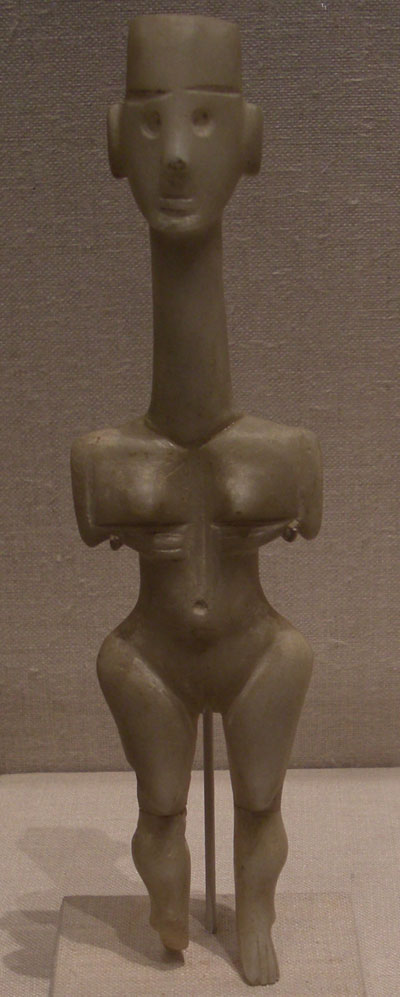
The biblical unity of male and female supports similar representations of male and female. Like a contemporary sex symbol, a marble figure carved on an island in the Aegean Sea about 4250 years ago leaves no doubt as to the figure’s sex. In stark contrast, Adam and Eve in the Genesis poem of the Junius manuscript (made in England about 930-960 GC) look remarkably androgynous. That representation plausibly relates to the biblical unity of male and female in the Genesis source text.

A male sense of female beauty has evolved biologically to emphasize indications of fertility. Adam and the narrator in the Junius manuscript repeatedly describe Eve’s physical beauty: Eve is “shaped shiningly {sceone gesceapene},”the most shining of women, / of wives most bright {idesa scenost, / wifa wlitegost}.”[3] The male sense of female beauty in England about 1100 years ago almost surely had important commonalities with the male sense of female beauty near Greece about 4250 years ago, as well as with the male sense of female beauty anywhere in the world today. The peculiar visual representation of Adam and Eve in the Junius manuscript makes sense within the biblical marriage of sex to persons.

Within Genesis, men and women are equally persons of God’s creation. To Jews, Christians, and Muslims, sex differences are a sign of women and men being made for each other.

* * * * *

Read more:

Notes:

[1] Genesis 1:27, 3:24 (God “drove out the man”). Images of the expulsion from the Garden of Eden always show Adam and Eve being expelled. In the fourth century, Jerome of Stridon explicitly recognized the Adam meant man and woman:

Let us read the beginning of Genesis, and we will find Adam, that is man, so declared to be both male and female.

{ Legamus principium Geneseos, et inveniemus Adam, hoc est hominem, tam virum quam feminam nuncupari. }

Adversus Jovinianum 1.29, Latin text from Patrologiae Latinae 23, p. 262, my English translation. Cf. Genesis 1:27.

[2] Genesis 2:23.

[3] Junius Manuscript (Oxford, Bodleian Library MS Junius 11, also known at the Caedmon poems) vv. 549, 626b-627a, English translation from Oldrieve (2010), Old Saxon text from Krapp (1931) and Vickrey (2015) pp. 105, 97. For a freely available online translation of the whole manuscript, Kennedy (1916). The Caedmon poem treats Genesis consistent with Christian orthodoxy. Vickrey (2015).

[images] (1) The marble female figure is Early Cycladic II, Chaladriania type, ca. 2300-2200 BGC and is on display at the Metropolitan Museum of Art of New York (accession 1977.187.11). The Met advances art education and culture in part by allowing visitors to photograph items on display in the museum. (2) Adam and Eve in Junius Manuscript. Oxford University’s Bodleian Library has made a digital image of the Junius manuscript (MS. Junius 11) available on the web. Making this important artifact of human cultural heritage written more than a millennium ago accessible world-wide is commendable and wonderful. Universities and libraries are commonly thought to seek to promote education and universal access to informative and cultural work. Oxford University’s Bodleian Library website for the Junius manuscript includes, however, an elaborate and restrictive statement of copyright over the digital reproductions of that manuscript. Wikipedia, which has quickly become an enormously influential educational institution, includes reproductions of images from the Junius manuscript. The official position of the Wikimedia Foundation is that “faithful reproductions of two-dimensional public domain works of art are public domain, and that claims to the contrary represent an assault on the very concept of a public domain.” I have transformed an image from the Bodleian’s reproduction for the non-commercial, critical, and educational use above.

References:

Oldrieve, Susan. 2010. “Genesis B: Introduction and Translation.” Department of English, Baldwin Wallace College, Department of English. Online.

Kennedy, Charles W. 1916. The Caedmon Poems, translated into English prose. London: Routledge. (alternate presentation)

Krapp, George Philip, ed. 1931. The Junius Manuscript. London: George Routledge.

Vickrey, John F. 2015. Genesis B and the Comedic Imperative. Bethlehem, PA: Lehigh University Press.

historical reason for doubt about Internet TV

In 1929, the Radio Corporation of America (RCA), a radio equipment pioneer, purchased the Victor Talking Machine Company, the leading American phonograph company.  By 1938, RCA Victor was selling a living-room radio with a fine wooden exterior that was about 4 feet tall and 2.5 feet wide .  Two jacks in the back of the radio were labeled with the following text:

This instrument is design for use with

  • Television An RCA Victor television attachment plugged into this jack enables you to receive television programs.  You see the picture on the attachment, you hear the sound accompaniment on this radio.
  • Records With the RCA Victor record player plugged into this jack, the radio becomes a fine record playing instrument.  You may then listen to your favorite artists by means of Victor and Bluebird records.

That business direction evidently failed. The radio business, the television business, and the record business have remained largely separate businesses through to today.

RCA Victor’s radio in 1938 occupied a similar physical and economic space to today’s big-screen televisions.  Occupying the living room and economizing on high-performance hardware seems to have been less important than diverse device forms and circumstances of use.  While Internet TV is currently generating a lot of excitement, it’s future is far from certain.

*  *  *  *  *

Read more:

understanding the autobiographical epistle attributed to Hunayn

In thirteenth-century Damascus, Ibn Abi Usaibia preserved an autobiographical epistle attributed to Hunayn ibn Ishaq.  Hunayn was a Christian scholar who served Islamic Abbasid caliphs in the vibrant intellectual world of ninth-century Baghdad.  The epistle attributed to Hunayn, which may be the earliest prose autobiographical work existing in Arabic, is far from a simple factual chronicle.[1]  Its main rhetorical structure is autobiography witnessing to Galen’s wisdom and Christ’s teaching.  It’s thus formally similar to Pauline epistles in the Christian New Testament.[2]  The Hunaynine epistle is best understood as a Pauline epistle with Hunayn as the famous and faithful Galenic-Christian disciple.

The Hunaynine epistle begins with a personalized summary of its ethical teaching on persecution and response.  Hunayn suffered persecution from kinsmen and friends that eventually resulted in his imprisonment.[3]  Hunayn responded only by praising God.  The prefatory summary concludes:

At last, the Almighty cast the eye of mercy upon me, restored His grace and renewed His favor which I had been wont to enjoy.  The immediate cause of my reinstatement was a man who had been one of my sworn enemies.  This bears out Galen’s remark that the best of men may sometimes benefit by their worst enemies.  Upon my life, that man was the best of enemies.[4]

The prefatory summary refers to the greatness of God (“the Mighty and Most High”) and the dependence of all on God’s will.  The prefatory summary also draws upon the ethical guidance of Galen, a historical leader of the medical profession.[5]  Another story about Hunayn’s ethical behavior similarly describes coinciding teachings of religion and professional ethics, specified as Christian teaching on behavior towards enemies and the Hippocratic precept to abstain from doing harm.[6]  Moral teaching, doubled through the teaching of Christ and historical leaders in the medical profession, provides the macro-structure of Hunayn’s autobiographical epistle.

The main body of the epistle witnesses in more detail to moral behavior toward enemies.  The Gospel of Luke declares:

Love your enemies, do good to those who hate you, bless those who curse you, pray for those who abuse you. To him who strikes you on the cheek, offer the other also; and from him who takes away your coat do not withhold even your shirt. Give to every one who begs from you; and of him who takes away your goods do not ask them again. … love your enemies, and do good, and lend, expecting nothing in return; and your reward will be great [7]

The Anti-Marcionite Prologue to the Gospel of Luke, dated to before the fifth century, describes Luke as a physician by profession and a native of Antioch, a Greek-speaking city in ancient Syria.  As an Assyrian Christian and a well-traveled and learned scholar, Hunayn may have been aware of this Lucan biographical tradition.[8] The Hunaynine epistle is a personal witness to the Lucan teaching:

I never complained to anyone about my condition, however bad it might be, and even praised my enemies at public meetings and in the presence of dignitaries.  When it was mentioned to me that they defamed and disparaged me at these meetings, I pretended not to believe what I was told. On the contrary, I said: We are one single entity, united by a common religion, place of residence and profession. I therefore cannot believe that such people would say anything bad about anyone, let alone me. …  I always endeavored to fulfill their {his enemies} wishes and be their faithful friend, and I never repaid them for what they had done to me, not a single one of them.  After hearing what was said about me in public, and especially in the presence of my lord, the Emir of the Faithful, people kept wondering why I was so anxious to be at their service.  I even made it a habit to translate books for them without getting any compensation or reward [9]

Hunayn’s reward ultimately was great.  After the Caliph had confiscated all Hunayn’s goods, destroyed his house, and imprisoned him, the Caliph had a dream in which Christ instructed him to pardon Hunayn and follow Hunayn’s medical advice.[10]  The Caliph did so and recovered from his illness.  The Caliph declared to Hunayn:

I shall compensate you many times over for all you have lost and make your enemies dependent upon you and place you high above all the other members of your profession.[11]

Hunayn’s loss was not merely reversed; he was made much better off.  Moreover, he received a blessing from his civic lord much like “sit at my right hand until I make your enemies your footstool.”[12]  In its conclusion, the epistle again invokes Galen, with Hunayn adding his own claim of authority:

All this had come to pass through the agency of malicious enemies; as Galen says: The best of men sometimes benefit by their worst enemies.  I swear by my life, Galen had to undergo severe trials, but they did not affect him as much as mine did me. [13]

The epistle concludes:

Praise be to God for granting me new life, making me prevail over the enemies who wronged me, and placing me in a position surpassing them in honor and prosperity! [14]

Thus Hunayn’s life gives witness to both Galen’s wisdom and Lucan teaching.

While the treatment of an icon figures in Hunayn’s autobiography, the interpretive status of icons was probably unimportant for the intended reading of the Hunaynine epistle.  Icons became a matter of high political and religious controversy in the Byzantine Empire in the eight and ninth centuries, just as they did in sixteenth-century England.  Through the intrigues of his enemies, Hunayn was prompted to spit on an icon of Mary and the child Jesus.[15]  Hunayn didn’t require a highly compelling motivation to spit on the icon.  At the same time, both the Caliph and Christ declared spitting on the icon to have been a sin.  A story from a different transmitting source has Hunayn refusing to spit on an image of the men who crucified Christ.  Hunayn refused to spit because an image of the men is not really the men.[16]  But spitting on an image that is only an image should not be a concern.  A plausible interpretation of these apparent tensions is that iconoclasm, while a contentious issue in the ninth-century Byzantine Empire, mattered little in the ninth-century Abbasid Empire.

In the Abbasid Empire, spitting on icons seems to have been a matter of rivalry in courtly learning and etiquette.  The challenge to Hunayn to spit on the image of the men who crucified Christ is prompted by Hunayn besting a rival in advising the Caliph.  The rival declared to the drunk Caliph, “The sun is injurious to intoxication.”  Hunayn declared that it was not.  Asked to explain that medical opinion, Hunayn declared: “intoxication is the condition of the intoxicated, and the sun is not injurious to intoxication but to the intoxicated.”[17]  That response defeated and infuriated Hunayn’s rival physician.  Improper behavior toward icons seems to have similarly been a matter of rivalry in courtly behavior both within the Abbasid court and for the intended readers of the Hunaynine epistle.[18]

The intended readers of the Hunaynine epistle seem to have been elite professional Christians like Hunayn.  If Hunayn himself composed the epistle, it probably wasn’t written for his fellow Christian physicians.  It might have been intended for Christian professionals in other fields such as law, astronomy, or the military.  If the epistle was written in Hunayn’s name sometime after his death, it’s intended readers may well have been Christian physicians.[19]  In any case, the Hunaynine epistle appears to be an exemplar of a continuing tradition of Pauline epistles among Christians in the Islamic world.[20]

*  *  *  *  *

Read more:

Text: Cooperson (2001) pp. 109-11 provides an English translation of the full text of the autobiographical epistle attributed to Hunayn. HP of course also includes a translation.

Notes:

[1] Reynolds et al. (2001) p. 108 calls the epistle “one of the earliest prose works in Arabic in the autobiographical mode.”  The currently prevailing scholarly view seems to be that Hunayn didn’t actually write it.  Hunayn died in 877.  Ibn Abi Usaibia, writing in 1245, described the epistle as a “missive by Hunayn himself” and emphasized “these are Hunayn’s words.”  HP. p. 365.  Hunayn employed the scribe al-Azraq to write for him.  Many original Hunayn manuscripts survived the three centuries to ibn Abi Usaibia’s time.  HP p. 377.  Ibn Abi Usaibia may have identified Hunayn’s words paleographically via the script of Hunayn’s scribe.  If the epistle was written in the ninth century, it is the earliest prose autobiographical working existing in Arabic.  If it was written in the tenth century or later, then it’s not. The epistle has been preserved only in ibn Abi Usiabia’s History of Physicians.

[2] Paul’s epistles are inextricably connected to his autobiography.  For examples of Paul’s explicit use of autobiography, see 1 Cor. 9:9-12, 2 Cor. 1:3-11, and Gal. 1:13-2:21.

[3] Kopf’s translation of the prefatory summary doesn’t explicitly mention imprisonment.  The relevant lines (HP p. 366):

Indeed, things went so far that for some time I was so distressed and enfeebled that my hand touched no gold or silver coin nor a book or even a sheet of paper to read from.

The relevant lines in the Cooperson (2001) translation (p. 109):

The situation eventually reached the point where I found myself utterly ruined and heartbroken, in prison, and reduced to the narrowest of circumstances.  During that time I was unable to obtain even the smallest amount of gold or silver, a book, or even a single sheet of paper to peruse.

The subsequent text in the elaborated story clearly describes Hunayn being imprisoned.

[4] HP p. 366.  Cooperson (2001) translates Galen’s remark as “the best people are those who can turn the animosity of evil men to advantage” and identifies that remark as the title of one of Galen’s texts.  Cooperson (2001) p. 109 and p. 118, ft. 1.  Galen complained bitterly about the actions of his rivals.  Mattern (2008) Ch. 3.

[5] The greatness of God and the dependence of all on God’s will is a pervasive understanding in the Islamic world.  The lives of leaders of a profession also generally transmitted ethical guidance in the Abbasid-era Islamic world.  Cooperson (2000) p. xii.

[6] Testing Hunayn, the Caliph asked Hunayn for a medicine to kill an enemy.  Hunayn responded that he had no knowledge of such medicine and explained that religious and professional teaching opposed such medicine.  HP pp. 360-1.

[7] Luke 6:27-31, 35 (RSV).

[8] Nestorius, an important figure in Assyrian Christianity, studied at the School of Antioch and remained closely connected to Antioch.  On Luke as a physician, see also Colossians 4:14.

[9] HP pp. 369, 377. The story of Hunayn’s lack of knowledge of deadly poisons has Hunayn declaring, “Religion enjoins us to be good and kind even to our enemies.”  HP pp. 359-61.  This is evidence, from a different transmitting source, of Hunayn’s embrace of the Lucan teaching.

[10] HP p. 375.  Instructive dreams are a common feature of autobiography in the Arabic literary tradition.  Reynolds et al. (2001) pp. 88-93.  Visions are a key part of Paul’s autobiography.  Acts 9:1-19.

[11] HP p. 376.

[12] Psalm 110:1 (which is quoted in Luke 20:42-3).

[13] HP p. 376.

[14] HP p. 377.

[15] HP pp. 370-1.  The icon, described as a Syrian painting, was of the hodegetria type.  That icon type is associated in Christian tradition with Luke the Evangelist, who was thought to have been a painter as well as a physician.

[16] HP pp. 364-5.

[17] HP p. 364.

[18] Cf. Cooperson (1997) p. 247.  The court physician Bakhtishu ibn Jibra’il kissed the icon several times in the Caliph’s presence.  In the presence of the Caliph, Theodosius the Catholicos displayed even greater devotion to the icon:

on seeing the icon on the ground in front of the Caliph, {he} threw himself upon it even before saluting him, embraced it, and kissed it again and again weeping all the time.

After arising, delivering a long speech to the Caliph, and then sitting down with the icon in his lap, the Catholicos stated:

{The icon} should be kept in a place where it is duly honored, illuminated by lamps burning the finest oil, which will never go out, and constantly perfumed with the most fragrant incense.

The Catholicos distinguished the significance of spitting on the icon by different classes of persons.  Muslims and ignorant Christians would not be punished, but only rebuked and instructed in proper behavior. Only when an educated Christian spat on the icon did that action signify an alternate reality.  According to the Catholicos:

if he who spat upon the icon is an educated person, he may be said to have actually spat upon Mary, the mother of our Lord, and on our Lord Christ.

This conditional interpretation underscores the concern for practical ethics (courtly and religious etiquette) rather than for correspondence to reality.

[19] Cooperson (1997), pp. 239-43, reviews the scholarly debate on whether Hunayn actually wrote the epistle and provides additional arguments weighing against Hunayn authorship.  The truth is not clear.  Kopf (HP p. 369) translated the sentence introducing the icon story thus: “Here is the story of my latest trial, which took place quite recently.”  Cooperson (2001) (p. 111) translated that sentence: “Here then, is the story of my last tribulation.”  The first translation has a much stronger sense of contemporaneous narration.

[20] Reynolds et al. (2001) p. 108 observes:

Hunayn’s epistle on his trials and tribulations resembles, to some degree, the Greek genre of apologetic autobiography, but it is also highly reminiscent of the biblical / Qur’anic story of Joseph. … The epistle thus presents a fascinating amalgam of Greek and biblical elements in an Arabic literary form.

In its macro-structure, the epistle seems to me to be quite different from the story of Joseph.  Pauline epistles draw upon the Greek genre of apologetic autobiography, but differ significantly in their witness to a specific ethical framework.

References:

Cooperson, Michael, trans.  2001. “Epistle on the Trials and Tribulations Which Befell Hunayn ibn Ishaq (‘Uyun, pp. 257-74).” In Reynolds et al. (2001) pp. 109-117.

Cooperson, Michael. 2000. Classical Arabic biography the heirs of the prophets in the age of al-Maʼmūn. Cambridge: Cambridge University Press.

Cooperson, Michael.  1997. “The Purported Autobiography of Hunayn ibn Ishaq.” Edebiyat, v. 7, pp. 235-249.

HP: Ibn Abi Usaybi’ah, Ahmad ibn al-Qasim. English translation of History of Physicians (4 v.) Translated by Lothar Kopf. 1971. Located in: Modern Manuscripts Collection, History of Medicine Division, National Library of Medicine, Bethesda, MD; MS C 294.

Mattern, Susan P. 2008. Galen and the rhetoric of healing. Baltimore: Johns Hopkins University Press.

Reynolds, Dwight F., ed,, with coauthors Kristen E. Brustad, Michael Cooperson, Jamal J. Elias, Nuha N. N. Khoury, Joseph E. Lowry, Nasser Rabbat, Devin J. Stewart and Shawkat M. Toorawa. 2001. Interpreting the self: autobiography in the Arabic literary tradition. Berkeley: University of California Press.
copyright absent in vibrant ancient Islamic book economy

Vigorous book production and circulation occurred in the ancient Islamic world without a legal regime of copyright.  When the Chief Physician of Baghdad’s ‘Abudi Hospital died in 1065, the books from his personal library were carried off on the backs of twelve camels.[1]  A reasonable load for a camel is 300 lbs, hence this personal library had a total weight of roughly 3600 lbs.  Another physician who lived in Kairouan, Tunisia, about a century earlier left an estate that included “25 hundredweight of medical and other books.”[2]  These two libraries thus had roughly similar book weights.  Given the different units of reporting, that similarity suggests that these figures aren’t wild exaggerations.

Personal libraries in the ancient Islamic world had value on the order of an agricultural estate.  A physician who was a high official in late-eleventh-century Baghdad purchased an agricultural estate for 2000 dinars, with a promise to pay 1000 dinars more when the proceeds of its crops were received. The harvest failed.  Pressed for payment, the physician pawned his personal book collection for 500 dinars.[3]  His personal book collection thus had collateral value equal to one-sixth the value of the agricultural estate.

Personal libraries contained as many as tens of thousand of books.  Abu ‘l-Musaffar, a scholar who lived in twelfth-century Cairo, possessed “many thousands of books.”  Writing about 1245, Ibn Abi Usaibia reported:

{Abu ‘l-Musaffar} was keenly interested in alchemy and was eager to meet its adepts.  With his own hand he copied an immense number of books on that subject, as well as numerous medical and philosophical books.  He was most ardent to acquire books and study them.  Shaikh Sadid al-Din al-Mantiqi told me that Balmuzaffar {Abu ‘l-Musaffar} had in his house a large room whose shelves were crammed with books.  In that room, he spent most of his time, writing, reading and copying.  …  I have seen a great number of medical and philosophical works that formerly belonged to Abu ‘l-Musaffar and had his name inscribed on them, each bearing on it some interesting notes and sundry remarks pertinent to its contents.[4]

Ifra’im ibn al-Zaffan, a Jewish physician who served caliphs in early twelfth-century Cairo, continually employed copyist to make books for his personal library.  Ifra’im’s book collection became a matter of national pride.  Ibn Abi Usaibia observed:

My father told me that a man from Iraq once came to Egypt in order to buy books and take them with him. He met Ifra’im, who sold him 10,000 volumes from among the books in his possession. At that time, al-Afdal, the son of the commander-in-chief of the army, was governor {of Cairo}. When he heard of the transaction, he wanted those books to remain in Egypt and so he sent to Ifra’im from his own treasury the amount of money which had been agreed upon, between Ifra’im and the Iraqi as the purchasing price. The books were transferred to al-Afdal’s library and his honorific names were inscribed in them. This is why I have come across a great number of medical and other books bearing the name of Ifra’im and also the honorific names of al-Afdal.  Ifra’im left {at his death} more than 20,000 books and a great deal of money and valuables.[5]

Muwaffaq al-Din ibn al-Mutran, a Christian who became the physician to Saladin, founder of the Ayyubid dynasty in late twelfth-century Damascus, also acquired a large personal library. Ibn Abi Usaibia stated:

Muwaffaq al-Din ibn al-Mutran was a great collector of books, so that, when he died, about ten thousand medical and other works were found in his library, besides those he had copied. He was much concerned with copying and correcting books, and there were three copyists in his permanent service. They received a salary and gifts from him.  One of them as Jamal al-Din, known as ibn al-Jamala, who wrote a neat well-proportioned hand.  Ibn al-Mutran copied many books himself; I have seen several such copies, and found them to be unsurpassable as to script, correctness and expressiveness. He read a great deal — in fact, most of the time.  The majority of the books in his possession contain his corrections and notes in his handwriting. Many small books and individual medical essays were found in his library combined into single volumes; they had been accurately and neatly copied, in half one-eighth of Baghdadi script, some of them in his own hand.  There were a great many of these small collections. [6]

In mid-twelfth century Damascus, the vizier Amin al-Dawlah stated that his personal library contained “more than twenty thousand volumes.”  Amin Al-Dawlah made this statement to Ibn Abi Usaibia’s father nearly contemporaneously with the completion of Ibn Abi Usaibia’s History of Physicians.[7]  Ibn Abi Usaibia and readers of his book could have verified the size of the Amin Al-Dawlah’s library, which was a significant matter in a culture that highly valued learning.  Ibn Abi Usaibia’s reports on the other large personal libraries describe his personal inspection of books from these libraries.  His statements concerning the sizes of personal libraries are credible.

A story of a distraught wife underscores the attraction of a personal library.  Al-Mubashshir ibn Fatik, an eleventh-century scholar in Cairo, acquired a huge number of books.  Books surviving from this scholar’s library were discolored.  A story explained the physical condition of those books:

On coming home, {ibn Fatik} spent most of his time with {his collection of books}, finding no better occupation than reading and writing and convinced that this was the most important pursuit. He had a wife of noble descent like him, of the family of one of the state dignitaries. After his death — may Allah have mercy upon him — she betook herself with her maids to his library. She bore a grudge against the books, since her husband had devoted himself to them and neglected her. While bewailing him, she, together with her maids, threw the books into a large water basin at the center of the building. Later the books were retrieved and this is why the many books of ibn Fatik which have been preserved are in such a state.[8]

While this story may be apocryphal, it indicates both that ibn Fatik acquired many books and that a large collection of books was understood to be alluring to scholars.

Producing the books in large personal libraries required thousands of scribe-years of work.  In eleventh-century Cairo, a physician who cultivated ascetic habits and lived in a mosque subsisted on copying two or three books a year.[9]  Ten professional scribes in thirteenth-century Damascus copied in two years the eighty volumes of The History of Damascus.[10]  Their average copying rate was thus four books per year.  At a copying rate of four books per year, a library of 20,000 books would require 5,000 scribe-years to copy.  Many persons, both professional scribes and practicing scholars, surely were engaged in copying books.

Freedom to copy books existed in conjunction with vigorous interest in authoring books.  Patronage, personal scholarly motivation, and intellectual status competition seems to have supported authorship.  In addition, freedom to copy books brought into the present the past thousand years of authorial work.  While a common direction of authorship was to write a commentary on one of Galen’s works, authorship encompassed a wide range of subjects and styles. Ibn Sina (Avicenna), who flourished in early eleventh-century Persia, is thought to have authored more than 450 works.  Ibn al-Hazen (Alhazen), who worked mainly in eleventh-century Cairo, wrote more than 200 works.  Al-Razi (Rhazes) and Thabit ibn Qurra also authored more than 200 works.  In addition to these highly productive scholars, many others also authored books.  Ibn Abu Usaibia provided lists of authored books for about 120 scholars who interests related to medicine.  Among those authors, 31 authored 10 or more titles.[11]

In the ancient Islamic world, the book economy prospered in conjunction with widespread copying of books.  Persons acquired large personal libraries through both buying and copying texts.  Amin Al-Dawlah “purchased many magnificent editions of various scientific works and always kept copyists in his service.”[12] Because calligraphy was highly valued, the value of a copy could be higher than the value of the original.  Marginal comments, commentary, and dedications written into a manuscript also significantly affected its value.  Adding value in copying and augmenting the text supported both the copying business and the product-differentiated book-selling business.

Content businesses today are greatly concerned about uncompensated copying.  The ancient Islamic world shows that eliminating freedom to copy books isn’t necessary for a vibrant book economy. Suppressing copying probably also isn’t necessary for vigorous growth in other content forms.

*  *  *  *  *

Read more:

Notes:

[1] HP p. 499, referring to Amin al-Dawlah ibn al-Tilmidh, a Christian who died in Baghdad in 1165.  Ibn Abi Usaibia described him as having “left great wealth, and property and books which had no equal in quality.”  Hence low-quality books did not create the mass of the books.  Note also that books were put in series with wealth (money) and property (land).

[2] HP p. 615, referring to Abu Ja’far Ahmad ibn al-Jazzar.  He left an estate valued at 24,000 dinars.  Comparing these and other currency values is difficult because dinars and dirhams varied significantly in metallic content and across places and times.

[3] HP p. 483, referring to Abu Sa’id ibn al-Mu’awwaj.  Abu Sa’id acquired the estate at the time when he was appointed head of the state council.  The connection between these two events is unclear.  The physician Ibn al-Wasiti redeemed Abu Sa’id’s pawned books and give him and his retinue lavish gifts, including an additional gift of 50 dinars.

[4] HP p. 723.

[5] HP p. 718.  At HP p. 717, Ibn Abi Usaibia noted:

In consequence of his eagerness to acquire books and have books copied, he eventually built up a large collection of medical and other works.  He constantly employed copyists, whose upkeep he undertook, among them Muhammad ibn Sa’id ibn Hisham al-Hagari, known as Ibn Malsaka.  I have seen a number of books in the latter’s handwriting, which he wrote for Ifra’im and which were signed by the latter himself.

[6] HP p. 824.  The collections of various works apparently amounted to 3,000 volumes.  HP p. 825.

[7] HP p. 899.  Amin al-Dawlah Kamal, whose full name was Amin al-Dawlah Kamal al-Din Sharaf al-Milla Abu al-Hasan ibn Ghazal ibn Abi Sai’id, described his library in the context of requesting a copy of Ibn Abi Usaibia’s History of Physicians.  Ibn Abi Usaibia dedicated that book to Amin al-Dawlah Kamal.  HP p. 3.

[8] HP p. 705. Ibn Fatik’s book, Choice Maxims and Sayings (written about 1053) was translated into Spanish, Latin, French, and English.  It was highly popular in Europe from the fourteenth to the sixteenth centuries.

[9] HP p. 703, referring to Ibn al-Haitham.  The books he copied every year were Euclid’s Elements, the al-Mutawassitat, and Ptolemy’s Almagest.  HP p. 701 indicates that he copied every year two books, Euclid and the Almagest.  Ibn al-Haitham also authored more than 200 books, so all his time wasn’t spent copying.

[10] HP p. 898. The History of Damascus was 80 volumes “in petite script.” The vizier Amin al-Dawlah Kamal ordered the scribes’ work and kept all the volumes that they produced.

[11] See spreadsheet of authored title counts for scholars included in Ibn Abi Usaibia’s History of Physicians (Excel version).

[12] HP p. 898.  A street in tenth-century Baghdad was known as the “Street of the Booksellers.”  HP. p. 451.  That indicates vigorous book-selling activity.

Reference:

HP: Ibn Abi Usaybi’ah, Ahmad ibn al-Qasim. English translation of History of Physicians (4 v.) Translated by Lothar Kopf. 1971. Located in: Modern Manuscripts Collection, History of Medicine Division, National Library of Medicine, Bethesda, MD; MS C 294.