al-Nadim's Fihrist addresses poetry and sects without book titles

In tenth-century Baghdad, court companion and bookseller al-Nadim wrote the Fihrist.  The Fihrist is widely regarded as being a catalog of books.  Al-Nadim, however, actually cataloged persons and social groups.  Within that primary organization, al-Nadim listed titles of books.  The Fihrist‘s main divisions covering poetry and sects contain very few titles of books.[1]  The Fihrist‘s coverage of poetry and sects underscores its fundamental concern with persons and groups.

The Fihrist indicates that persons wrote individual poems, not books of poetry.  In the ancient Islamic world, poetry functioned widely as an important instrument in personal relations.  A poem could exhibit literary learning and social status, be done for hire to celebrate a specific occasion, serve as an application to a potential patron, or support or oppose a theological or political party.  Al-Nadim recorded the number of leaves of poetry that persons wrote.  Since many learned, socially ambitious persons wrote poetry, al-Nadim probably cataloged persons whose poetry had gained some social circulation and acclaim.  Persons other than poems’ authors collected poems into anthologies and collections.  The titles of those books mattered less than the name of the poet and knowledge of how much poetry he or she wrote.

Sects to al-Nadim seem to be a book problem.  The Qur’an definitively established Islam.  The Qur’an refers to earlier religious groups based on books: Jews, Christians, and Sabians.[2]  Al-Nadim treated with skepticism the transmission of Jewish and Christian books.  He covered other sects in a primary division separate from people of the book.  He described sects sociologically.[3]  He also recorded an eighth-century Muslim author’s enumeration of sixty-one sects existing between the time of Jesus and the coming of Islam.[4]  That enumeration served in argument against Christianity.  The wide variety of sects that al-Nadim catalogs, including ones in India and China, contrasts with the ideal unity of Islam through the Qur’an.

Al-Nadim did not list titles for all the books that he knew.  He does not list the title of the work enumerating the sixty-one sects between the time of Jesus and Islam. He quotes at length from the Akhbār Bābak of Wāqid ‘Amr ibn-Tamīnī, but does not list the title of that book. He quotes Ahmad ibn ‘Abd Allah Salam describing many of his translations, but does not list titles of any of those books.  Factors other than just the existence of a book affected whether the book was included in the Fihrist.

The Fihrist is a catalog.  The Fihrist isn’t, however, a catalog of books in the conventional understanding of books in high-income, twentieth-century democracies.  The Fihrist is a catalog of persons and groups recorded with books.  That social understanding of books is likely to become more important with the Internet increasingly connecting persons through electronic books.

*  *  *  *  *

Read more:

Notes:

[1] The Fihrist’s first sub-division of its first division concerns languages, scripts, and calligraphy.  That sub-division includes no titles of books.  It might be thought of as preliminary material concerning the symbolic substance of books.  But the sub-division also gives considerable emphasis to persons and groups, e.g. “names of persons who wrote copies of the Qur’an in gold” and scripts of various groups.

[2] Although Sabians, like Jews and Christians, are recognized in the Qur’an, al-Nadim doesn’t include Sabians in division I.2 with Jews and Christians.  He puts “Sabians” in IX.1, and describes that label as adopted by a sect at Harran for political advantage.  Fihrist, trans. Dodge (1970) pp. 751-2.

[3] Al-Nadim sought to describe accurately.  He reported two Bardaisan parties’ views on the metaphysical relationship between light and darkness:

One party asserted that light became mixed with darkness voluntarily, so as to make it good. … The other party asserted that light desired to clear away darkness from itself when it perceived its coarseness and putridness, but it became interwoven with it against its will.  It was like a man who desired to remove something with sharp splinters sticking into him.  The more he tries to remove them, the further into him they go.

Id. pp. 805-6.  Splinters are small, concrete, mundane objects.  Nonetheless, al-Nadim used them in a metaphor to explicate cosmic views of the relationship between light and darkness.

[4] Id. pp. 814-6.  Al-Nadim attributes the list to a work of Ahmad ibn Muhammad al-Qahtabi.

Reference:

Dodge, Bayard Dodge. 1970. The Fihrist of al-Nadīm: a tenth century survey of Muslim culture. New York: Columbia University Press.

Bar Sauma and Rubruck’s experiences of learned religious debate

In the thirteenth century, Rabban Bar Sauma, a Christian monk from China, served as an ambassador from the western Mongol empire to the Roman Catholic pope.  Bar Sauma debated Christian cardinals in Rome. About the same time, Friar William of Rubruck, a Christian monk from the western edge of Eurasia, traveled with letters from the French King to the Mongol capital in central Eurasia.  Rubruck debated Buddhists and Muslims at the great khan’s court.  Both Bar Sauma’s and Rubruck’s experiences underscored the fruitlessness of learned religious debate.

god-trinity

Bar Sauma was born in the Chinese city now called Beijing.  He was the son of an eminent and wealthy Christian family.  Following an honored Chinese practice, he withdrew from society and became a monk.  He moved to an isolated place to pursue a life of poverty, study, and contemplation.  After more than seven years, news of his wisdom became known.  People began to honor him and visit him to hear his words.  After several more years, he set off on a pilgrimage to Jerusalem.  A long journey and intervening events, including his elevation to an episcopate of the eastern Christian church, led him to meeting with Roman Catholic cardinals in Rome in 1287.[1]

Bar Sauma and the cardinals in Rome engaged in sophisticated discussion of the precise relationship of the Holy Spirit to the Father and the Son.  When asked to expound his creed, Bar Sauma provided a philosophical description of God’s nature.  The cardinals then initiated a dialectic focused on the Holy Spirit:

The cardinals asked:  “The Holy Spirit, does He proceed from the Father, or from the Son, or is it separate? ”

Bar Sauma replied:  “The Father and the Son and the Holy Spirit, are They associated or separate in regard to Nature?”

The cardinals: “They are associated in Nature but separated in Individualities.”

Bar Sauma: “What are their Individualities?”

The cardinals: “Of the Father, begetting; of the Son, being begotten; of the Spirit, proceeding.”

Bar Sauma: “Which of Them is the cause of the other?”

The cardinals: “The Father is cause of the Son, and the Son is cause of the Spirit.”

Bar Sauma: “If They are equal in the matter of Nature and operation and power and authority, and They are just Three Persons, how can one of Them be the cause of the other? [2]

Bar Sauma thus brought the reasoning to a contradiction.  They continued to argue respectfully through many more arguments about the same issue.  Bar Sauma then declared:

I have come from far lands not to dispute nor to expound the themes of the Faith; but to receive a benediction from the Reverend Pope and from the shrines of the saints, and to declare the business of the King and the Catholicos {head of the Church}.  If it be agreeable to you that we leave the discussion and you make arrangements and appoint some one who will show me the churches here and the shrines of the saints, you will confer a great favor upon your servant and disciple. [3]

Traveling across the former Roman Empire, Bar Sauma was deeply moved by the vast array of holy religious relics shown to him, wildly implausible to reason though those relics were.  Bar Sauma also marveled at the magnificent churches.  Things, not arguments, moved Bar Sauma.

The Christian ritual of communion was also important for Bar Sauma in building relationships in the foreign land of the former Roman Empire.  Bar Sauma traveled from Rome to visit Edward I, King of England, who was in the French province of Aquitaine-Gascony.  Bar Sauma celebrated the Eucharist in King Edward’s presence and served King Edward communion.[4]  Back in Rome, Bar Sauma received permission to celebrate the Eucharist there.  A large congregation gathered to see how the Christian ambassador from the Mongols, born in China, would celebrate the Eucharist.  Seeing Bar Sauma’s priestly acts, the congregation rejoiced and declared, “The language is different, but the rite is one.”[5]  Actions communicated more effectively than words.

Friar William of Rubruck had a similar experience of learned religious debate at the Mongol court in central Asia.  Rubruck was probably born in French Flanders.  He apparently spoke French in addition to Latin and was familiar with Paris.  He journeyed to the Mongols as a missionary and as an unofficial envoy carrying letters from the French King Louis IX.  He knew little about the Mongols and did not speak their language.  After a long, arduous journey, he arrived at the court of the Great Khan Mongke Khan in Karakorum in Central Asia in 1254.  Mongke Khan ordered representatives of Christians, Muslims, and Buddhists to engage in a public debate about the truth of their beliefs.  Rubrick spoke as a representative of Christians.[6]

The debate before Mongke Khan was formally serious.  Mongke Khan ordered each party to write before the debate a statement of its beliefs.  Rubruck and other Christians at the Mongol Court, whom Rubruck called Nestorians, plotted strategy before the debate.  The Nestorians wanted to debate first the Muslims, but Rubrick wisely explained that the Muslims would serve as their allies in debating against the polytheistic Buddhists.  The Christians together shrewdly decided to have Rubruck speak first for them, since Rubrick required an interpreter.  The Nestorians could join in subsequently with more agility and more rapid responses.  Rubruck proposed to his fellow Christians a debate rehearsal in which he would play the part of the Buddhists.  Rubrick, playing the role of a Buddhist, acted like a good medieval Christian philosopher.  He asked the Nestorians to prove the existence of God.  Rubrick recorded:

But at this point the Nestorians were incapable of proving anything, but could only relate what Scripture tells. ‘They do not believe in the Scriptures,” I said: “if you tell them one story, they will quote another.” [7]

As Rubruck acknowledged, holy scripture is not suitable for learned debate with non-believers.

Rubruck kept the actual debate with the Buddhist to philosophical-theological issues.  The Buddhist proposed debating matters of cosmological narrative: “how the world was made or what becomes of souls after death.”  Rubruck countered:

that ought not be the starting-point of our discussion.  All things are from God, and He is the fountain-head of all.  Therefore we should begin by speaking about God, for you hold a different view of Him from us and Mangu {Mongke Khan} wishes to learn whose belief is superior.

Rubrick shrewdly invoke Mongke Khan’s interest, but not in a way that reasonably discriminated between the possible opening questions for dispute.  The debate umpire ruled in favor of Rubrick.  Rubrick then declared to the Buddhists:

We firmly believe in our hearts and acknowledge with our lips that God exists, that there is only one God, and the He is one in a perfect unity.  What do you believe?

The Buddhist debater responded:

It is fools who claim that there is only one God.  Wise men say that there are several.  Are there not great rulers in your country, and is not Mangu Chan {Mongke Khan} the chief lord here?  It is the same with gods, inasmuch as there are different gods in different regions. [8]

The Buddhists had probably lost at this point.  Mongke Khan, as the Great Khan, regarded himself as Son of God and Lord of all the earth.  Before the debate, Mongke Khan, in imposing rules of civilized debate, asserted his exclusive claim to the authority of God:

The following announcement was made: “This is Mangu’s decree, and let nobody dare claim that the decree of God is otherwise.  He orders that no man shall be so bold as to make provocative or insulting remarks to his opponent, and that no one is to cause any commotion that might obstruct these proceedings, on pain of death.” [9]

After several turns of debate, Rubruck pressed home the winning question to the Buddhist: “{do} you believe that any god is all-powerful?”  In the presence of Mongke Khan, the Buddhist, not surprisingly, was reluctant to answer.  The Buddhist after some time answered that no god was all-powerful.  The Muslims responded with loud laughter.  Mongke Khan did not object to that commotion.  Rubruck pressed the point further and the Buddhist was rendered silent.  Rubruck then started to argue for “the unity of the Divine essence and for the Trinity.”  The Nestorians wisely silenced him.  They turned to begin debate with the Muslims.  However, according to Rubruck’s account, the Muslim conceded the truth of Christianity and declined to debate.  The Nestorians then engaged in a long, apparently friendly discussion with an old priest of a Uighur sect, whom Rubruck regarded as monotheistic, non-Christian idol-worshippers.  No one challenged a word of the Nestorians’ account of Christian salvation history and beliefs.

The result of the debate was only superficially a Christian victory.  Rubruck observed:

for all that no one said, “I believe, and wish to become a Christian.” When it was all over, the Nestorians and Saracens {Muslims} alike sang in loud voices, while the tuins {Buddhists} remained silent; and after that everyone drank heavily. [10]

Learned religious debate did little to bring together persons with different religious beliefs.  Singing and drinking was the superior practice.

The results of the debates in which Bar Sauma and Rubrick engaged were not idiosyncratic.  Across the first millennium after the birth of Jesus, Christian intellectual leaders engaged in learned debates about the nature of God.  How to describe precisely the relationship between God and man in Jesus Christ was an issue of bitter intellectual dispute.  That dispute led many Christians living in Eurasia northwest of Syria to condemn Christians in the rest of Eurasia as heretical Nestorians.[11]

Another issue of bitter intellectual dispute was how to describe precisely the relationship of the Holy Spirit to the Father and to the Son.  Christians reciting the Nicene Creed in Latin declared (in approximate English translation), “I believe in the Holy Spirit, who proceeds from the Father and the Son.”  Christians reciting the Nicene Creed in Greek declared (in approximate English translation), “I believe in the Holy Spirit, who proceeds from the Father.”  The presence or absence of the clause “and the Son” prompted heated conflict among religious authorities.[12]

Not participating in learned religious debate is not necessarily anti-intellectualism.  Not participating in learned religious debate is not necessarily the thinking position of a ghetto believer.  It may be a wise judgment based on broad historical evidence of human understanding.

*  *  *  *  *

Read more:

Notes:

[1] The facts in this paragraph are from The History of Yaballaha III and of his Vicar Bar Sauma, trans. Montgomery (1927) and Budge (1928).  Bar Sauma meant in Syriac “son of fasting.”  Montgomery (1927), Introduction, p. 19, n. 4.  Syriac was the liturgical language of early Chinese Christians.  Rabban was an honorary title meaning “master.”  Bar Sauma journeyed with his disciple Markos, a younger Uighur monk also from an eminent Christian family in China.  Markos became Patriarch Yaballaha III.  Murre-Vand Den Berg (2006) provides an insightful overview of the History and suggests that its author was Mar Yosep of Arbil, who became Patriarch Timothy II.  Pilgrimages westward were common among Chinese Buddhists.  In seventh-century China, the Buddhist pilgrim Yijing wrote a book containing biographies of 56 eminent Chinese Buddhist monks who traveled to India during the Tang Dynasty. See Lahiri (1986).

[2] Trans. adapted from that of Montgomery (1927) p. 58 and Budge (1928) Ch. 7.  The technical name of the issue under dispute was the matter of the filioque.  A letter that Patriarch Yaballaha III sent to Pope Benedict IX in 1304 illustrates the complexity of the issue.  The Latin translation of Yaballaha’s letter has him including the filioque.  The Arabic original is more subtle.  Teule (2003) pp. 113-6.

[3] Trans. Montgomery (1927) p. 59.

[4] Id. p. 65.

[5] Id. p. 68.

[6] The facts in this paragraph are based on The Mission of Friar William of Rubruck, trans. Jackson (1990).  On Rubruck’s origins, see id., introduction, p. 40.  The earlier translation of W.W. Rockhill, updated, is available online as William of Rubruck’s Account of the Mongols.  Jackson (2011) provides an overview of the text.

[7] Rubruck, 33:11, trans. Jackson (1990) p. 232.

[8] Id. pp. 232-3.

[9] Id. p. 231. Christians and Muslims viciously insulted each other within the Mongol court.  Id. p. 225.  The Buddhists in turn were accustomed to highly confrontational debates:

Ritualized exercises in dialectics (sometimes involving magic), accompanied by all the pomp of a medieval duel or joust, were a common feature of Tibetan monastic life (and continue to be in the Geluk-pa order). The questioner faced his seated opponent in an aggressive posture, squaring his shoulders, raising his rosary and rolling up the sleeves of his gown, accentuating the final word of each question, stamping his feet, and clapping his right hand on his left in the other man’s face. The opponent might leap to his feet and reply with a question of his own. Colleagues of the winner would carry him on their shoulders in a victory procession, or he might sit on the loser’s back as if riding a donkey.

Young (1989) pp. 112-3.

[10] Id. p. 235.  Rubruck seems to have been highly intelligent and well-educated in Christian theology.  Yet he also had a keen sense for ritual and liturgy.  When he entered the Mongol leader Baatu’s court, he was instructed to kneel on both knees and then told to speak.  He recalled:

reflecting to myself that I could be at prayer, seeing I was on both my knees, I took my first words from a collect {ab oratione}, saying: “My lord, we pray God, from whom all good things do proceed ….

Id. p. 133.  When he entered a chapel, before he greeted an Armenian monk sitting there he prostrated himself and chanted the Ave regina celorum.  Id. p. 174.  He entered Mongke Khan’s presence in distinctive Franciscan habit, clasping a bible to his breast and singing.  Id. p. 190.  He and other Christians paraded about the Great Khan’s camp holding a cross aloft and singing.  Id. p. 199.  He made careful, eager preparation to have communion for Christians excluded from the eastern Christians’ communion service.  Id.  pp. 213-216. Over time Rubruck raised his status among the Mongols by emphasizing his priestly role.  Watson (2011).

[11] Positions in these disputes have been labeled monophysitism, miaphysitism, and Nestorianism.  Brock (1996) points out the inappropriateness of labeling all Christians of the eastern churches as Nestorians.

[12] The clause “and the Son” is known as the filioque.  The Greek and Latin words translated into English as “proceeds” have subtle differences.  Linguistic misunderstanding played an important role in the dispute.

[image] Andrei Rublev, Angels at Mamre (Holy Trinity), 1410, in Tretyakov Gallery, Moscow.

References:

Brock, Sebastian P. 1996. “The ‘Nestorian’ Church: A Lamentable Misnomer.” Bulletin of the John Rylands Library, 78(3):23-35.

Budge, E. A. Wallis, trans. 1928. The Monks of Kûblâi Khân, Emperor of China, or, The history of the life and travels of Rabban Ṣâwmâ, envoy and plenipotentiary of the Mongol khâns to the kings of Europe, and Markôs who as Mâr Yahbh-Allâhâ III became Patriarch of the Nestorian Church in Asia. London: Religious Tract Society.

Jackson, Peter, trans. 1990. Willem van Ruysbroeck. The mission of Friar William of Rubruck: his journey to the court of the Great Khan Möngke, 1253-1255. London: Hakluyt Society.

Jackson, Peter. 2011.  “The Itinerarium of Friar William of Rubruck.”  Seoul National University, Center for Central Eurasian Studies, Archive of Central Eurasian Civilizations.

Lahiri, Latika. 1986. Yijing. Chinese monks in India: biography of eminent monks who went to the western world in search of the law during the great Tʻang dynasty. Delhi: Motilal Banarsidass.

Montgomery, James A., trans. 1927. The history of Yaballaha the Third, Nestorian Patriarch, and of his vicar Bar Sauma, Mongol Ambassador to the Frankish courts at the end of the 13th century.

Murre-Vand Den Berg, Heleen (H.L.).  2006. “The Church of the East in Mesopotamia in the Mongol Period.”  Pp. 377-394 in Malek, Roman, and Peter Hofrichter, eds. 2006. Jingjiao: the Church of the East in China and Central Asia. Sankt Augustin: Institut Monumenta Serica.

Teule, Herman.  2003. “Saint Louis and the East Syrians, the Dream of a Terrestrial Empire: East Syrian Attitudes to the West.” Pp. 101-122 in Ciggaar, Krijna Nelly, and Herman G. B. Teule. 2003. East and West in the Crusader states: context, contacts, confrontations. III, Acta of the congress held at Hernen Castle in September 2000. Leuven: Uitgeverij Peeters.

Watson, A.J. 2011. “Mongol inhospitality, or how to do more with less? Gift giving in William of Rubruck’s Itinerarium.” Journal of Medieval History, 37:1, 90-101.

Young, Richard Fox. 1989.  “Deus Unus or Dei Plures Sunt? The Function of Inclusivism in the Buddhist Defense of Mongol Folk Religion Against William of Rubruck (1254).” Journal of Ecumenical Studies, 26:1 (Winter) pp. 100-137.

higher men's mortality relative to women's correlated with development

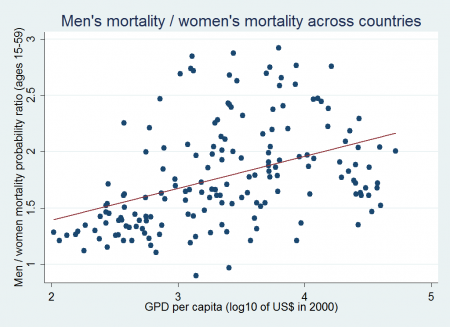
Men are more likely than women to die before reaching a ripe old age.  Consider persons ages 15 to 59, divided into men and women.  In 2010, across 187 countries for which data are available, only three countries had an estimated mortality for men that was less than the corresponding figure for women.[1]  In 125 countries, men’s probability of death was 50% or more than women’s.  Men’s lowest relative probability of death was in Honduras, at 90% that of women.  Men’s highest relative probability of death was in Estonia, at nearly three times that of women.  Across 187 countries encompassing most of the world, the median mortality sex ratio implies men had a 64% higher probability of dying than women did.

mortality sex differences across countries

Countries with higher income per capita tend to have a higher probability of men dying relative to women dying.  A simple linear estimation implies that a 10% increase in average monetary income per capital is associated with a 1.3% increase in the probability of a man’s death relative to a woman’s death among persons ages 15 to 59.[2]

Consistent with the cross-sectional correlation and economic growth over time, the median mortality sex ratio increased from 1970 to 2010.  In 1970, the median ratio implies a 40% higher death probability for men relative to the death probability for women among persons ages 15 to 59.  Men’s death-probability gender protrusion rose to 64% in 2010.

International development scholars and agencies show little concern for men’s relatively greater mortality, and for men’s welfare more generally.  Men’s distinctive individual biology does not imply that men are destined for gender inequality in death.  The growth of that gender inequality, and lack of concern about it, seems to be a deep structure of human social development.

*  *  *  *  *

Read more:

Data: international sex differences in mortality workbook (Excel version)

Notes:

[1] Rajaratnam et al. (2010) developed sex-specific mortality rates for persons ages 15-59 (45q15) for 187 countries by year from 1970 to 2010.  Those data are available from the Institute for Health Metrics and Evaluation (IHME).  The data for 1970 and 2010 are compiled in a more accessible, more linkable format in the international sex differences in mortality workbook.  Similar data for sex-specific expected lifespans are developed in Wang et al. (2012), but those data are not readily accessible online.  IMHE provides a variety of data visualizations, including a mortality visualization. The problem of sex differences in mortality isn’t mainly a problem of data visualization, but one of social communication.

[2] Average monetary income per capita is measured here as gross domestic product per capita (GDP per capita).  The GDP per capita figures are from the World Bank’s World Development Indicators.

References:

Rajaratnam, Julie Knoll, Jake R Marcus, Alison Levin-Rector, Andrew N Chalupka, Haidong Wang, Laura Dwyer, Megan Costa, Alan D Lopez, and Christopher JL Murray. 2010. “Worldwide mortality in men and women aged 15–59 years from 1970 to 2010: a systematic analysis.” The Lancet. 375 (9727): 1704-1720.

Wang, Haidong, Laura Dwyer-Lindgren, Katherine T Lofgren, Julie Knoll Rajaratnam, Jacob R Marcus, Alison Levin-Rector, Carly E Levitz, Alan D Lopez, and Christopher JL Murray. 2012. “Age-specific and sex-specific mortality in 187 countries, 1970–2010: a systematic analysis for the Global Burden of Disease Study 2010.” The Lancet. 380 (9859): 2071-2094.

Bābak and the Khurramī revolt according to Wāqid's account

Wāqid ‘Amr ibn-Tamīnī’s account of Bābak and the Khurramī revolt against the Abbasid caliphate is formally like news or history.  Yet surviving excerpts are obviously derogatory representations often implausibly knit together.  Wāqid’s account probably had value as entertainment.  It probably had value as support for the dominant Abbasid ideology against that of Bābak and the Khurramīs.  It also served as a source of information for those who had no other.  These same textual economics probably support much of news and history right up to the present.

Bābak led the major Khurramī uprising against the Abbasid caliphate from 817 to 837.  The Khurramīs lived in the Azerbaijan region of the far northwest of present-day Iran.  They had close ties to the pre-Islamic religion of Mazdakism.  Culturally Iranian, Bābak and his fellow Khurramīs were hostile to Muslim Arabic colonists who settled in their region.

Abbasid caliphs numerous times directed generals to suppress the Khurramī revolt.  Again and again Abbasid forces suffered great loses in attempting to attack Bābak’s mountainous strongholds.  In 837, a large, well-supplied, and well-paid Abbasid army finally managed to capture Bābak and put down the Khurramī revolt.

Bābak’s execution underscored the public importance of these events.  Bābak was brought as a captive to the Abbasid capital of Samarra:

To give the populace an exemplary lesson, a parade was held … in which Bābak, clad in an embroidered cloak and capped with a miter, was made to ride on an elephant …. The whole length of the street to the Bāb al-ʿĀmma was lined on both sides with cavalrymen and foot soldiers and huge numbers of people.  Then {Abbasid Caliph} al-Muʿtasim ordered the executioner to proceed.  First Bābak’s hands and feet were cut off, then at the caliph’s command his mangled body was strung on a gibbet in the outskirts of Sāmarrā.  According to some sources his head was later sent around for display in other cities and in Khorasan. [1]

The general and soldiers who overcame Bābak and the Khurramīs were lavishly rewarded.  Court poets celebrated the victory.  The events were what today would be called headline news.

Bābak and the Khurramī revolt remained a popular subject into the tenth century.  Probably in the mid-tenth century the Abbasid author Wāqid ‘Amr ibn-Tamīnī wrote a book about Bābak.  Wāqid’s book was called Events in the Life of Bābak.  That book name translated more literally and anachronistically means news about Bābak.[2]  Just as newspaper forerunners in sixteenth-century England greatly sensationalized events, so too did Wāqid’s book about Bābak.

Wāqid deployed a dense array of derogatory representations in describing the events of Bābak’s life.  According to Wāqid, Bābak’s father was from the area that had been the capital of the Sassanid Empire.  However, Bābak’s father was not a man of princely status.  Bābak’s father was an cooking-oil peddler who carried his oil on his back.  That would have been a well-recognized figure of a pack animal like a donkey or a camel.  According to Wāqid, Bābak’s mother was a one-eyed woman who was caught fornicating in a bush with Bābak’s father.  Wāqid added the telling detail that while fornicating in a bush Bābak’s mother and father were singing in Nabataean.  A book written early in the tenth-century celebrated the Nabataeans and their hostility to the Arab invaders of Mesopotamia.  Wāqid thus depicted Bābak’s parents as alien, primitive, and hostile to the Arab colonists of his region.[3]

Wāqid added further demeaning descriptions of Bābak’s parents.  According to Wāqid, Bābak’s father died after being attacked “from the rear.”  That suggests either his fleeing from an attacking foe or suffering homosexual violence.  After Bābak’s father’s death, Wāqid reported that Bābak’s mother “started to serve the people for wages as a wet nurse.”  She lived in destitution and poverty.  The rebel king Bābak thus appears to have come from a most un-royal family.

According to Wāqid’s account, Bābak gained his kingship through chance, adultery, and treachery.  Jāvīdān, a Khurramī chief, was driving 2000 sheep to market.  He stopped in a village for lodging.  Despite all Jāvīdān’s animal wealth, his host judged him to be an unimportant person.  Jāvīdān’s host thus directed Jāvīdān to lodge with Bābak’s mother.  She, destitute, could offer Jāvīdān no food or drink.  That a chief driving 2000 sheep to market would be judged as unimportant and directed to lodge with Bābak’s mother is wildly implausible.  These events are most plausibly interpreted as meaning the cosmic righteousness of insulting Jāvīdān.

From Wāqid’s perspective, the righteousness of insulting Jāvīdān is that Jāvīdān took Bābak into his household.  When Jāvīdān came to Bābak’s mother’s lodgings, Bābak took care of Jāvīdān’s servants and animals.  That’s a lowly task.  Jāvīdān also observed that Bābak’s language was “indistinct, a crude vernacular.”  In other words, Bābak didn’t speak Arabic.[4]  Nonetheless, Jāvīdān saw that Bābak was “crafty and clever.”  Jāvīdān then incomprehensibly offered Bābak’s mother fifty silver coins a month for taking Bābak and making him guardian over Jāvīdān’s lands and possessions.

Bābak subsequently had sex with Jāvīdān’s wife and caused Jāvīdān to die.  Jāvīdān left his mountain castle to do battle with a rival chief.  Jāvīdān’s wife, “passionately in love with Bābak,” repeatedly had sex with Bābak.  Jāvīdān returned to his castle victorious, having killed in battle his foe.  But Jāvīdān was suffering his own wound.  Within three days of his return home, Jāvīdān died.  According to Wāqid, Jāvīdān’s wife said to Bābak:

You are hardy and clever; he has died!  I won’t raise my voice about this to any of his companions {Jāvīdān’s loyal warriors / comitatus}.

Those words suggest that Bābak slyly caused Jāvīdān’s death.  Especially contrasted with Jāvīdān’s action in battle against his foe, Bābak engaged in unmanly, profoundly treacherous behavior against his master Jāvīdān.  Jāvīdān’s wife instructed Bābak on his great purpose, in addition to being able to have sex freely with her:

Get ready for tomorrow!  I’ll have a gathering of them {Jāvīdān’s companions} for you and tell them that Jāvīdān said, “I wish to die during this night, so that my spirit will go forth from my body and enter the body of Bābak, associating itself with his spirit.  He will accomplish for himself and for you something which no one else has ever accomplished and no one will accomplish after him.  For he will rule the earth, slay the oppressors, and restore the Mazdakiyah {Mazdakism}.  By him shall you abject {people} become mighty and by him shall your lost be uplifted.

That abstract political mythology contrasts jarringly with the story-facts of the lowly Bābak’s treachery toward his generous master Jāvīdān.

Bābak restoring Mazdakism is best interpreted as Wāqid’s parodic sarcasm.  Mazdakism urged non-violence.  Bābak historically was associated with waging two decades of very bloody war.  According to Wāqid, one day Bābak’s mother found Bābak asleep under a tree, with blood all over his body.  She concluded that Bābak “would have a brilliant mission.” His bloody mission failed.  It ended with him dying, covered in blood, before a large crowd in the Abbasid capital.  Wāqid’s account surely is fabricated with keen awareness of those historical facts.

Wāqid’s account included a parody of Christian communion.  The morning after Jāvīdān’s death, his wife informed his companions of his alleged death wish.  They accepted Bābak as the bearer of Jāvīdān’s spirit and authority.  Jāvīdān’s wife immediately arranged for a ceremony to confirm ritually that fidelity:

she called for a cow and ordered that it be killed and flayed with its skin spread out.  Then she placed on the skin a vessel full of wine, beside which she broke bread, placing it in the bowel.  Then she called upon one man after another, saying, “Step on the skin with your foot, take a piece of bread, dip it into the wine, eat it, and say, ‘I have placed my faith in thee, oh, spirit of Bābak, as I had faith in the spirit of Jāvīdān.’  Then take the hand of Bābak, do obeisance to it and kiss it.”

Other peoples may have used rituals similar to Christian communion.  However, Bābak was politically associated with the Byzantine Christian foe of the Abbasid caliphate.[5]  Moreover, Wāqid also described Jāvīdān’s wife as publicly enacting a marriage ceremony between her and Bābak the same day after Jāvīdān’s death.  In the marriage ceremony, Jāvīdān’s wife and Bābak publicly sat together on bedding.  Jāvīdān’s wife then gave Bābak a sprig of basil.  Basil was a Christian symbol of kingship.  To Muslim readers, these rituals and symbols emphasized Bābak’s status as an alien, morally outrageous other.

The Abbasid caliphate encompassed cultural battle between Arabic Islamic culture and non-Arabic pre-Islamic cultures.  Wāqid’s account of events in Bābak’s life was a blow within that conflict.[6]  It denigrated Bābak’s non-Arabic pre-Islamic culture in factually implausible ways.  Factual implausibility, however, seems to have been relatively unimportant in accounts of Bābak and the Khurramīs over more than a millennium.[7]

Bābak joker mosaic

*  *  *  *  *

Read more:

Notes:

[1] Yūsofī (1988).

[2] All the details of Wāqid’s account cited in this post are from the excerpts of it preserved in al-Nadim’s Fihrist, Part IX, trans. Dodge (1970) pp. 818-822. Yūsofī (1988) reports the book’s name as Akhbār Bābak.  Akhbār is transliterated Arabic for “news.”  Nothing is now known about Wāqid other than that he wrote that book.  Wāqid’s book has survived only in others’ excerpts of it.  Wāqid, like most journalists today, probably had a low position in the authorial status hierarchy.  A variety of other historical sources also provide some, often conflicting, information about Bābak and the Khurramīs.  Wāqid refers to Bābak’s parents singing in Nabataean.  Ibn Wahshiyah’s Nabataean Agriculture, which would have given considerable force to that reference, is dated to 930.  Al-Tabari’s History for the year 223 (837) includes a fanciful story describing Bābak as the bastard son of a vagabond desperado.  It also refers to Bābak’s mother as one-eyed.  Trans. Bosworth (1991) pp. 90-1.  Al-Tabari died in 923.  Wāqid seems to have amplified al-Tabari’s tale about Bābak’s parentage.  Wāqid’s book is thus plausibly dated to the mid-tenth century.

[3] According to Wāqid, Bābak’s father was born in al-Mada’in, which is the cities of Seleucia-Ctesiphon.  That was the capital of the Sassanid Persian Empire.  Ibn Wahshiyah’s Nabataean Agriculture celebrated pre-Islamic, pre-Arabic life in ancient Iraq.

[4] Bābak lived near Ardabil, in the mountains of al-Badhdh. Arabic was uncommonly spoken there.  The Islamic encyclopaedia-writer Yaqut (d. 1229) reported that persons in that area spoke Adhriyah, a Medo-Persian language.  Wright (1948), p. 44.

[5] Bābak was in contact with the Byzantine Emperor Theophilus.  Yūsofī (1988).  When Bābak was captured, a large number of his warriors converted to Christianity and aligned themselves with Theophilus. Venetis (2005).

[6] Conflict between pre-Islamic Iranian culture and Islamic Arabic cultural was even more starkly represented in the subsequent treason trial and punishment of the Iranian general, Khaydār b. Kāvūs Afshīn, who captured Bābak.  Wright (1948) pp. 56-59, 124-131.

[7] Readers of Wāqid’s account haven’t treated it as mainly ideology or entertainment. Yūsofī (1988) notes:

statements about his {Bābak’s} parentage and background are unclear and inconsistent, sometimes fantastic and incredible.  … In most of these accounts, other than Dīnavarī’s, a note of sarcasm and hostility can be perceived.

That’s an understatement.  In her “Bābak” entry for the Encyclopaedia of Islam, Patricia Crone seems to have interpreted Wāqid’s account as factual history.  Bābak, associated with Mazdakism and proto-socialism, was celebrated as a hero in the Soviet Union’s Azerbaijan Soviet Socialist Republic.

References:

Bosworth, Clifford Edmund, trans. 1991. al-Ṭabarī.  Storm and stress along the northern frontiers of the Àbbāsid CaliphateHistory of al-Ṭabarī, v. 33.  Albany, N.Y.: State University of New York Press.

Dodge, Bayard Dodge, trans. 1970. The Fihrist of al-Nadīm: a tenth century survey of Muslim culture. New York: Columbia University Press.

Venetis, Evangelos. 2005. “ḴORRAMIS IN BYZANTIUM.” Encyclopædia Iranica, online.

Wright, Edwin M. 1948. “Bābak of Badhdh and Al-Afshin During the Years 816-841 A.D.: Symbols of Iranian persistence against Islamic penetration in North Iran.” Muslim World 38:1 (Jan.) pp. 43-59 and 38:2 (Apr.) pp. 124-131.

Yūsofī, Ḡ. -Ḥ.  1988.  “BĀBAK ḴORRAMĪ.” Encyclopædia Iranica. Vol. III, Fasc. 3, pp. 299-306, and online.