Abdullah ibn Abbis, Ka'b al-Ahbar, and the origin of writing

Scientific archeology and secular history finds that writing developed with new accounting techniques about five thousand years ago.  Religious traditions centered on sacred scripture include stories that place writing much earlier in the history of the world and humans.  In the first century of Islam, Abdullah ibn Abbas and Ka’b al-Ahbar confronted a wide variety of Jewish and Christian stories about the origin of writing.

newspaper rock petroglyphs

In Tales of the Prophets of al-Kisa’i, written about 1200 GC, writing is the first thing that God created.  The cited authority for this story is Abdullah ibn Abbas (died c. 687), a highly respected Qur’anic exegete.  Ibn Abbas conversed with the Companions of the Prophet.  He also conversed with Ka’b al-Ahbar (died c. 652), a Yemenite Jew who converted to Islam.  The story of the tablet and the pen occurs as the first tale in the Tales of the Prophets of al-Kisa’i:

Ibn Abbas said:  The first thing that God created was the Preserved Tablet, on which was preserved all that has been and ever shall be until the Day of Resurrection.  What is contained thereon no one knows but God.  It is made of white pearl.

A tablet made of white pearl is even more sumptuous than books made of ivory.  The tale continues:

Then, from a gem, He created a Pen, the length of which would take five hundred years to traverse.  The end of it is cloven, and from it light flows as ink flows from the pens of the people of this world.  The Pen was told, “Write!”  And, as the Pen trembled because of the awesomeness of the proclamation, it began to reverberate in exaltation, as thunder reverberates.  Moved by God, it flowed across the Tablet, writing what is to be until the Last Day, whereat the Tablet was filled and the Pen ran dry.  And he who is to be happy shall be, and he who is to be wretched shall be. [1]

In Genesis, the first command of God is “Let there be light.”  Here it is “Write!”  The writing is performed with light.  Ancient audiences were likely to be enthralled with the sensuous description of the Pen trembling and reverberating in exaltation “as thunder reverberates.”  A translator of the tales of al-Kisa’i observed:

whereas the prophetic tales have their pious and devotional aspect, al-Kisa’i’s version is basically designed for popular entertainment and should ideally be recited by a professional raconteur. [2]

The tale of the pen is attention-grabbing and entertaining.  But it also underscores a core imperative of Islam: submit to God’s will of what is to be.

The Book of Adam and Eve, in its Latin corpus, describes Eve’s strategy of technological diversification for the first writing.  The Book of Adam and Eve isn’t actually a single book, but a corpus of thematically related manuscripts in ancient western Eurasian languages and medieval vernaculars.[3]  According to surviving Latin texts from the tenth century and later, after Adam died, Eve recognized her impending death.  Eve gathered all her sons and daughters and said:

Hear me, my children, and I will tell you what the archangel Michael said to us when I and your father transgressed the command of God.  The archangel Michael said, “On account of your transgression, Our Lord will bring upon your race the anger of his judgement, first by water, the second time by fire; by these two will the Lord judge the whole human race.”  But listen carefully to me, my children.  Make tablets of stone and others of clay, and write on them all of my life and all of your father’s life, all that you have heard and seen from us.  If by water the Lord judges our race, the tablets of clay will be dissolved and the tablets of stone will remain; but if by fire, the tablets of stone will be broken up and the tablets of clay will be baked hard. [4]

Eve seems to have misinterpreted the archangel Michael’s sequence of judgments as alternate possibilities.  However, modern academic scholarship has established that blaming women is wrong, and that lack of attention to this story is part of a broader patriarchal plot to oppress women.[5]  On the other hand, diversification in storage media is currently recognized as a best practice for secure archiving.  The text written on tablets of stone should have survived the judgment by water (flood) that Hebrew scripture describes.

In his extensive book catalog, the learned bookseller al-Nadim recorded in tenth-century Baghdad a story associating Adam with the first writing.  The form of writing is important in Arabic culture, as in many other cultures around the world.  Al-Nadim began his book catalog, the Fihrist, with a section describing ways of writing.  He began that section with discussion of the origin of Arabic script.  Al-Nadim recorded:

Ka’b said, and before Allah I am not responsible for his statement, that the first to originate the Arabic and Persian scripts and other forms of writing was Adam, for whom be peace.  Three hundred years before his death he wrote on clay which he baked so that it kept safe even when the Flood overflowed the earth.  Then each people found its script and wrote with it. [6]

Writing on clay is less costly than writing on stone.  Moreover, by correctly anticipating the flood and baking the clay, Adam avoided losing the text.  Ka’b’s account makes reasonable corrections, within its own context, to Eve’s account of writing in the Book of Adam and Eve.

Unlike its apparent accounting source, writing has great creative potential.  People enjoy telling stories.  A vast array of stories are attributed to ibn Abbas and Ka’b in the Tales of the Prophets of al-Kisa’i.  Al-Nadim did not mention the tale of the tablet of pearl, attributed to ibn Abbas.  Al-Nadim explicitly distanced himself from responsibility for Ka’b statement about the origin of Arabic and Persian scripts.  Early Qur’anic exegesis (tafsir) indicates deep respect for both ibn Abbas and Ka’b.[7]  Neither ibn Abbas nor Ka’b could control others’ attribution of stories to them.  Writing can be pious, devotional, and entertaining.  Accounting for writing requires good faith and good judgment from the reader.

*  *  *  *  *

Read more:

Notes:

[1] Trans. Thackston (1978) p. 5.

[2] Id., introduction, p. xxiv.  Visual story-telling has been popular across Eurasia for millennia.

[3] Murdoch (2009) Ch. 1.

[4] Vita Adae et Evae, 49:3-50:2, trans. Charles (1913), slightly modernized.  A variant of this particular motif appears in Josephus, Antiquities of the Jews, Bk 1, Ch. 2, sec. 3.  Antiquities of the Jews is a first-century work in Greek.  Judgment of the world by water (flood) occurs in Genesis 6-9.

[5] Jager (1996).

[6] Trans. Dodge (1970) p. 7.  Tales of the Prophets of al-Kisa’i doesn’t include this story.  It includes a story of Adam writing on tanned sheepskins an acrostic poem encompassing the letters that are in the “Torah, Gospel, the Psalms and the Qur’an.”  Trans. Thackston (1978) no. 32, pp. 74-75 (“Adam’s Mission”).

[7] Twakkal (2008).  Ka’b was a key Islamic source for information about Jewish and Christian traditions prior to the Qur’an (Isra’iliyyat).  Id. provides extensive support for the statement of eminent hadith scholar Muhammad Husayn al-Dhahabi (d. 1348):

O God! Verily Ka‘b has been wronged by his accusers, and I cannot say anything regarding him other than that he is trustworthy and reliable, a scholar whose name was exploited and had many narrations attributed to him, most of which were fables and falsehoods, only to be circulated amongst the common masses and accepted by the aged from amongst the uneducated.

[image] Photo of Newspaper rock, Utah, showing petroglyphs from roughly 2000 to 650 years ago.  Dave Jenkins generously made the image available under a Creative Commons license.

References:

Charles, Robert Henry. 1913. The apocrypha and pseudepigrapha of the Old Testament in English. Oxford: Clarendon Press.

Dodge, Bayard Dodge. 1970. The Fihrist of al-Nadīm: a tenth century survey of Muslim culture. New York: Columbia University Press.

Jager, Eric. 1996. “Did Eve Invent Writing? Script and the Fall in ‘The Adam Books’.” Studies in Philology. 93 (3): 229-250.

Murdoch, Brian. 2009. The apocryphal Adam and Eve in medieval Europe: vernacular translations and adaptations of the Vita Adae et Evae. Oxford: Oxford University Press.

Thackston, Wheeler M., trans. 1978. Muḥammad Ibn-ʻAbdallāh al-Kisā’ī. The tales of the prophets of al-Kisa’i. Boston: Twayne Publ.

Twakkal, Abd Alfatah. 2008. Ka’b al-Ahbar and the Isra’iliyyat in the Tafsir literature. McGill University.

Aquila and his Islamic doppelganger translate Hebrew scripture

Group identity interacts closely with the form and content of communication.  Consider Aquila, a Greek-speaking Roman from Pontus.  He probably was a relative of the second-century Roman Emperor Hadrian.  A Jewish biblical interpretive text (midrash) transmits a dialogue between Aquila and Hadrian:

Aquila once said to Hadrian the King: I wish to convert and become a Jew.

Hadrian said:  Do you really want to join this people?  How much have I humiliated it!  How many of them I have killed!  You would get mixed up with the very lowest of nations?  What do you see in them that makes you wish to become a proselyte?

Aquila said:  The least among them knows how the Holy One created the world, what was created on the first day and what was created on the second day, how long it is since the world was created and on what the world is founded.  Besides, their Torah is the truth.

Hadrian said:  Go and study their Torah, but do not be circumcised. [1]

Aquila learned Hebrew, studied the Torah, and got circumcised.  He became a proselyte to Judaism and conversed with leading Jewish sages.  Seeking knowledge and truth led him into a new group identity.
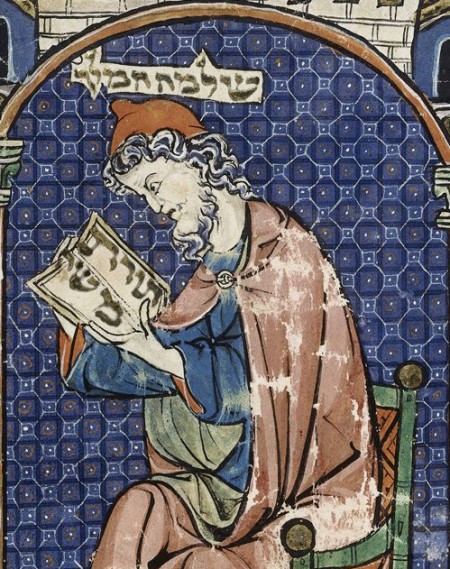
Solomon reading Hebrew scripture

Aquila translated the Hebrew Bible into Greek.  Aquila’s translation was not into his native Greek.  Aquila’s Greek translation closely followed the verbal sense of the Hebrew Bible.  Aquila translated the Hebrew into Greek “syllable by syllable and letter by letter,” capturing Hebrew linguistic particles and Hebrew etymologies within individual words.[2]  Aquila’s Greek translation is difficult to read and not pleasing by ancient standards for Greek style.  Aquila’s Greek translation probably was meant to be read under the guidance of an expositor who knew the Hebrew source text.[3]

Aquila’s translation encouraged personal intimacy with Jews.  The Torah was translated into Greek about four centuries earlier than Aquila’s translation as part of what’s come to be known as the Septuagint.  The Septuagint was probably made for Jews in Alexandria who could not read Hebrew.  The Christian New Testament, written in Greek hundreds of years after the Septuagint, incorporated text from versions of the Septuagint.  Compared to the Septuagint, Aquila’s translation brought Greek readers much closer to the Hebrew.  Like the Septuagint, Aquila’s translation served Jews who could not read Hebrew.  Aquila’s translation also served non-Jews who sought Jewish knowledge through becoming closer to the Jewish people.  Aquila’s translation strengthened the division between Jewish and Christian peoples and led readers of Hebrew scripture in Greek toward the Jews.

Another conversation between Aquila and Hadrian highlighted the importance of common life-forms in conveying the meaning of a text.  The importance of form appears in Hebrew from the beginning:

the earth was a formless void and darkness covered the face of the deep, while ruah {wind/spirit} of God swept over the face of the waters [4]

The “face of the deep” and the “face of the waters” are images difficult to imagine.  Moreover, the Hebrew word ruah ranges in meaning from the physical movement of air in a living being’s breathing to an abstract cosmological spirit.  Leading Greek intellectuals of the time probably would have associated the latter portion of meaning with a Platonic demiurge.  Aquila described the meaning of ruah to Hadrian through specific, detailed action:

Hadrian asked Aquila the proselyte:  Is it true that you {plural form, probably but not necessarily meaning Jews} say that the world is sustained by ruah?

Aquila said to Hadrian: Yes.

Hadrian said to Aquila: Based on what do you say this?

Aquila said to Hadrian: Bring me camels.

Hadrian brought Aquila camels.  Aquila loaded the camels with burdens, stood the camels up and made them kneel, and then took the camels and strangled them.

Aquila said to Hadrian: Here are your camels, make them stand up.

Hadrian said to Aquila: After you strangled them?!

Aquila said to Hadrian: I have taken nothing from them; is it not ruah that I took from them? [5]

Many descriptions of a camel apply equally well to a recently strangled camel.  Signs of missing breath aren’t easy to perceive.  An animated form is a work of art that isn’t easy to translate.  Aquila’s response was to stay close to the animated form, which for Aquila meant Hebrew scripture in Hebrew.

Overlapping, encompassing, and enduring group identities make translation necessary though treacherous.  A text-based group identity requires at least interpretative translation of the text through the group’s changing linguistic practice over time.  The constellation and boundaries of groups are also dynamic.  The new Christian way incorporated Hebrew scripture, which has to be translated for Christians who cannot read Hebrew.  In Islam, the Qur’an revealed God’s message specifically in Arabic.  The Qur’an itself recognizes God speaking through Jewish and Christian scripture, but expresses concern about Jews and Christians corrupting God’s message:

there are among them illiterates, who know not the Book, but (see therein their own) desires, and they do nothing but conjecture.  Then woe to those who write the Book with their own hands, and then say, “This is from Allah.”

They change the words from their (right) places and forget a good part of the message that was sent them [6]

Corruption is always a risk in human communication.  Yet staying close to an animated form isn’t the same as preserving a textual artifact.  Without translation or extensive cross-linguistic description, a sacred text may die.

Translation technique alone does not necessarily have any implications for group identity.  Al-Nadim’s Fihrist, a learned, extensive book catalog from late tenth-century Baghdad, transmits from an ancient source a description of translations from Hebrew.  The translator was Ahmad ibn ‘Abd Allah ibn Salam.  The Fihrist describes Ahmad as a “protegé” of Caliph Harun al-Rashid.  Ahmad’s name describes him as a son of the Jewish convert to Islam, ʿAbd Allāh ibn Salām, who was a celebrated companion of the Prophet of Islam.  Ahmad describes his translations as being like Aquila’s translations:

I have translated the beginning of this book {the book of a righteous follower of Abraham in pre-Islamic times}, and the Torah, the Gospels, and the books of the prophets and disciples from Hebrew, Greek and Sabian, which are the languages of the people of each book, into Arabic, letter for letter.  In so doing I did not wish to beautify or embellish the style for fear of inaccuracy.  I added nothing to what I found in the book which I was translating and I subtracted nothing, unless there were words presented by the language of the people of that book with meanings which could not be clearly translated into Arabic except by transposing.  Thus something coming last may not be clear unless it is placed first, so as to be understood in Arabic.  For example, the {Hebrew} words of one who says at maym tan I have translated into Arabic as ma’ hat, only I have placed ma’ (water) last and hat (bring) first.  So in translating these languages correctly into Arabic I seek the protection of Allah lest I add or subtract, except in the manner which I have recorded and explained in this book. [7]

Translation from Hebrew “letter for letter” is the type of translation Aquila did.  Ahmad’s claim that he did not add or subtract is consistent with imperatives in Deuteronomy.[8]  It would also seem to foreclose, like Aquila’s translation technique, Islamic concerns about corruption of Jewish scripture.  While sharing patterning in closeness to high authority, religious conversion, knowledge of ancient scripture, and translation technique, Aquila and Ahmad had much different positions relative to the Jewish people.  Aquila was a second-century convert to Judaism.  Ahmad was a Muslim from a Jewish family that had converted to Islam.

Ahmad as a translator of Hebrew scripture seems to be not a historical figure but an Islamic literary doppelganger of Aquila.  Specific biographical chronology is an important organizing principle within al-Nadim’s Fihrist.[9]  The biographical chronology that the Fihrist provides for Ahmad is meager and incoherent.  The Fihrist records Ahmad describing “People of the Book who became Muslims, among whom were ‘Abd Allah ibn Salam, ….”[10]  ‘Abd Allah ibn Salam died in 663/4.[11]  Ahmad ibn ‘Abd Allah ibn Salam means Ahmad, son of ‘Abd Allah ibn Salam. That filial relation is inconsistent with Ahmad being a protegé of Caliph al-Rashid, who reigned from 786-809.  Moreover, al-Nadim in the Fihrist provides a folkloric context for Ahmad’s statements:

I once read a book which fell into my hands, and which was an ancient transcription, apparently from the library of al-Ma’mun.  In it the copyist mentions the names and numbers of the scriptures and revealed books, with their scope and with the things which most of the common people and the populace feel sure of and believe. [12]

Credible sourcing in the Islamic world typically meant a chronological list of respected scholars transmitting a text across time.  Al-Nadim provides, in contrast, a vague, abstract chronology (“once” upon a time; “an ancient transcription”) and a reference to common belief.  Moreover, al-Nadim records Ahmad declaring that the total number of books that God revealed was 104, with 100 books revealed from the time of Adam to that of Moses.  According to Ahmad, Adam wrote 21 books.[13]  A non-biblical Adam literature undoubtedly was in circulation, but it probably fell well short of 21 books.  Moreover, the Christian Gospels, the Christian epistles, and the Christian books of Acts and Revelation seem to add up to more than three books, even with Islamic combinations and discounting.[14]  Some Jews were renowned for multilingualism in the ancient Islamic world.[15]  But Ahmad translating from Hebrew, Greek, and Sabian seems like a construct created from the Qur’anic description of the People of the Book.  While the Fihrist is an expansive, detailed book catalog, it doesn’t seem to take seriously cataloging Jewish and Christian scripture.[16]  The most plausible explanation for the Fihrist‘s lack of care in cataloging Jewish and Christian books is that al-Nadim believed Jewish and Christian books were not credibly transmitted.  Abbasid courtly literature parodically inventing Ahmad as Aquila’s Islamic doppelganger is consistent with al-Nadim’s approach to cataloging Jewish and Christian books.

Human symbolic forms are not easily to control.  Horace, who was an eminent poet close to the Roman Emperor Augustus, wrote, “Captive Greece took captive her rude conqueror and brought the arts to rustic Latium.”  But Horace wrote of Greek culture in Latin, the language of imperial Rome.  Jerome, a Christian translating Hebrew scripture and Greek Christian gospels and epistles into Latin about three hundred years later, wrote, “What harmony can there be between Christ and the Devil? What has Horace to do with the Psalter, Virgil with the Gospels, and Cicero with the Apostle?”[17]  By Jerome’s time, Horace, Virgil, and Cicero were models of elegant Latin style.  They were ghostly figures that could influence Jerome’s translation of the bible from Hebrew and Greek into Latin.  The treachery of translation is mainly in over-interpreting intentionality in human symbolic action.

*  *  *  *  *

Read more:

Notes:

[1] From Exodus Rabba 30:12, trans. Seidman (2006) p. 87, adapted slightly.  The text is probably from the 11th or 12th century, and may reflect significant editing over time.  See Labendz (2009) pp. 354-5.  Seidman (2006), p. 87, observes that various sources describe Aquila as a relative of Hadrian, usually his nephew.  According to Epiphanius of Salamis, a fourth-century Christian bishop, Aquila first converted to Christianity.  However, Aquila’s devotion to astrology prompted him to renounce Christianity.  Epiphanius stated that Aquila was a relative to Hadrian by marriage and from Sinope in Pontus.  Epiphanius, On Weights and Measures, para. 14-15, trans. Dean (1935).

[2] From Jerome, Letter LVII. To Pammachius on the Best Method of Translating, para. 11, trans. Fremantle (1892) (NPNF2-06).

[3] Brock (1979) pp. 74, 79.  The Yerushalmi (Palestinian Talmud), redacted sometime between late in the fourth century and early in the fifth century, indicates that translating Hebrew Scripture into Greek was acceptable to Jewish rabbis, in particular Rabban Shimon ben Gamliel, about 2000 years ago.  Yerushalmi Megillah 1:8, 71a-b, trans. Labendz (2009) 358-9.  Id. p. 354 for dating.  Aquila’s translation was included in Origen’s Hexapla along with the Hebrew-Greek translations of Theodotion and Symmachus.  Among the three, Aquila seems to have attracted the most attention.  These three Hebrew-Greek translations were carried forward subsequently across 1500 years of Jewish life.

[4] Genesis 1:2.

[5] Yerushalmi Hagigah 2:1, 77a, trans. Labendz (2009) p. 357, adapted slightly.  The text’s original language is Aramaic.  I’ve used above the Hebrew word ruah for the closely related Aramaic word ruha.  See Seidman (2006) p. 111.

[6] Qur’an 2:78-79, 5:13, described in English by ‘Abdullah Yusuf Ali.  Here’s more on this issue (tahrif) in Islamic thought.

[7] Fihrist, Ch. 1, Sec. 2, trans. Dodge (1970) v. 1, p. 42.  As-Safadi (d. 1363) described two methods of translation among (mainly Christian) translators from Greek and Syriac into Arabic in ninth-century Baghdad.  These methods were word-for-word translation and translation of the sense of whole sentences.  He declared that the second method of translations is superior.  Trans. Brock (1979) pp. 74-5.  In fact, a variety of translation styles existed.  Translations into Arabic in the ninth century did not develop chronologically from “crudely literal translations” to “polished, free translations.”  Gutas (1998) pp. 142-4

[8] Deuteronomy 4:2, 12:32.  The phrases “nothing added” / “nothing subtracted” were also used in ancient Greek treaties.  Brock (1979) p. 76. They are sensible phrases for early contracts that were recopied.  Literal translation more generally was a defense against charges of changing the text or responsibility for heresies within the text.  Id.

[9] Stewart (2007).

[10] Fihrist, Ch. 1, Sec. 2, trans. Dodge (1970) v. 1, p. 42.

[11] On ‘Abd Allah ibn Salam, see Horovitz, J. “ʿAbd Allāh b. Salām.” Encyclopaedia of Islam, Second Edition; Steven M. Wasserstrom. “ʿAbd Allāh ibn Salām.” Encyclopedia of Jews in the Islamic World.

[12] Fihrist, Ch. 1, Sec. 2, trans. Dodge (1970) v. 1, p. 41.  Al-Maʾmun was caliph from 813 to 833.

[13] Id. p. 42.

[14] Based on Ahmad’s count, God revealed four books after Moses.  From an Islamic perspective, the Qur’an was one.  That leave three others.  The three remaining must include at least the Christian scripture that the Qur’an explicitly recognizes.

[15] E.g. Sallām at-Turjumānī.

[16] The Fihrist‘s relevant section first presents a Muslim forerunner (a pre-Islamic believer in Abraham) and a Muslim convert from Judaism (Ahmad).  The section then presents information from Jewish and Christian informants that al-Nadim consulted.  The sub-section on Christian books begins:

I asked Yunus the priest, who was an excellent man, about the books translated into Arabic language which they expounded and according to which they act.

Trans. Dodge (1970) p. 45.  The Fihrist‘s list of Christian books includes:

The Gospel of Matthew; The Gospel of Mark; The Gospel of Luke; The Gospel of John.  Book of Disciples, known as Fraksis {Acts}; Paul the Apostle, twenty-four epistles

Id. The Christian New Testament includes four gospels, Acts, twenty-one epistles (of which thirteen are under the name of Paul), and the Book of Revelation.  Thus the above count for Paul the Apostle appears to be inconsistent with any reasonable counting of the New Testament canon.  An accurate catalog of the New Testament canon should have been relatively easy for al-Nadim to acquire from the still vibrant Christian church under the early ‘Abbasids.  Al-Nadim seems to distance himself from his catalog of Jewish and Christian books.  The Fihrist describes the relevant section as “about titles of the books of the laws revealed to the sects of the Muslims and the sects of {other} peoples.” Dodge notes that the meaning of this phrase isn’t entirely clear. Id p. 2 (text translation from al-Nadim’s “Summary of Book”), p. 2, n. 6 (comment).  Al-Nadim’s position seems to be that Jewish and Christian scripture is encompassed historically within Islam, but not credibly transmitted.

[17] Horace, Epistles 2.1.156; Jerome, Epistle 22, To Eustochium, sec. 29. At the time of Jerome’s Latin translation, existing Latin translations of Hebrew scripture (Vetus Latina) apparently had been made from the Septuagint.  Tertullian exclaimed:

What has Athens to do with Jerusalem? What has the Academy in common with the church?

Tertullian, On the prescription of heretics, Ch. 7.  The Christian New Testament has been transmitted in Greek.  Paul of Tarsus, a Jewish Christian, wrote his epistles in Greek and was highly learned and polished Greek rhetorician.

[image] Solomon studying Torah.  From the thirteenth-century Northern French Miscellany, British Library Additional 11639, folio f. 116.

References:

Brock, Sebastian. 1979. “Aspects of Translation Technique in Antiquity.”  Greek, Roman and Byzantine Studies 20, 1: 69-87.

Dean, James Elmer Dean, trans. 1935.  Epiphanius’ Treatise on weights and measures; the Syriac version. Chicago, Ill: The University of Chicago Press.

Dodge, Bayard Dodge. 1970. The Fihrist of al-Nadīm: a tenth century survey of Muslim culture. New York: Columbia University Press.

Gutas, Dimitri. 1998. Greek thought, Arabic culture: the Graeco-Arabic translation movement in Baghdad and early ʻAbbāsid society (2nd-4th/8th-10th centuries). London: Routledge.

Labendz, Jenny R. 2009. “Aquila’s Bible Translation in Late Antiquity: Jewish and Christian Perspectives.” The Harvard Theological Review. 102 (3): 353-388.

Seidman, Naomi. 2006. Faithful renderings: Jewish-Christian difference and the politics of translation. Chicago: University of Chicago Press.

Stewart, Devin. 2007. “The Structure of the Fihrist: Ibn al-Nadim as Historian of Islamic Legal and Theological Schools.” International Journal of Middle East Studies. 39 (3): 369-387.


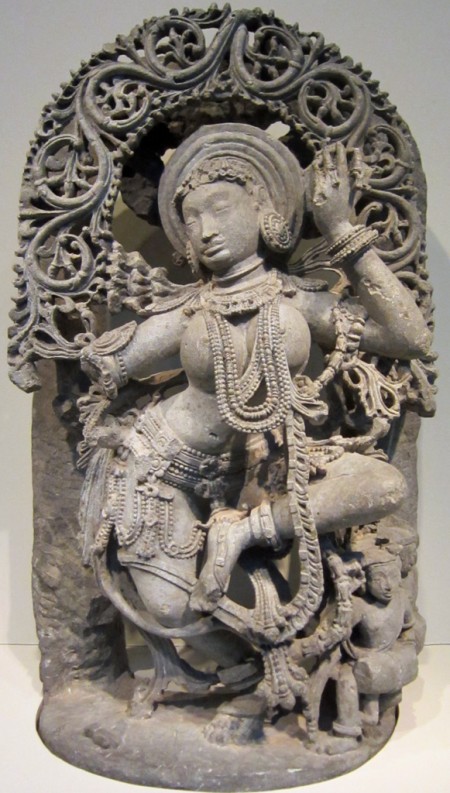
all-powerful caliphs subjected to their slave-girls

epitomes of love or celestial dancers

In the eighth-century, the Islamic caliphate controlled a vast territory stretching across Spain, northern Africa, Arabia, Turkey, Iraq, Iran, central Asia, and Afghanistan.  Caliph Yazid II, who reigned from 720 to 724, received everything he desired.  The orders of Caliph Yazid’s wife helped to bring about that result:

One day Yazid’s wife Sa’da said to him: “Commander of the Faithful {Caliph}, is there anything yet in the world that you desire and have not?” He answered: “Yes, ‘Aliya.” Sa’da then privately sent a man to Africa and bought ‘Aliya from her owner for four thousand dinars. When she arrived and had recovered from the fatigue of her journey, Sa’da made her up, and brought her to Yazid’s house, sat her behind a curtain, and again asked him if there was anything in the world that he desired. Yazid, irritated, replied: “You have asked me that already, and I told you.” Sa’da raised the curtain, and said: “Here is ‘Aliya, and she is for you.” Then she got up and left them together. [1]

Yazid’s comment, “You have asked me that already, and I told you,” reflects well-appreciated mundane relational experience.  Less well-known is the rest of Yazid’s domestic story:

Yazid’s happiness was complete. He had complained earlier that the caliphate in itself would never satisfy him without the two girls {Aliya and another slave-girl named Sullamah}. … It was Yazi’s supreme felicity now to be governed by the two girls. Hababah {Yazid’s pet name for Aliya} was the prettier but Sallamah the better singer. Yazid’s affections were fairly divided between the two, favouring first one and then the other in turn. [2]

Yazid focused on wine, women, and song rather than governing the caliphate.  After his half-brother reproved him, Yazid resolved to focus on public affairs.  He stopped seeing his current favorite girl, Hababah {Aliya}.  Seeking to regain control over him, she commissioned a poem and arranged to have the poet sing it to Yazid.  She also sang it to him.  The last three lines of the poem:

In search of heart’s content I’m called a fool, yet know
that I’m not alone in love.
You, if you have have not loved or known what passion is,
then stay a block of hardest stone.
Cold hearts may scoff and scold, but life is what you love
and gives delight — that’s all. [3]

After Hababah sang the last line, Yazid again turned:

Yazid turned towards her and said: “You’re right, by God! Damn him who blamed me for you! Boy, go bid Maslamah to lead the prayers.” So he went back to Hababah, and stayed with her, drinking while she sang, and so reverted to his old habits. [4]

Yazid managed to stay away from Hababah for only a week.  Hababah’s personal power, including her polished skills in using poetry and song, enabled her to regain control over Yazid.

Caliph Harun al-Rashid similarly struggled with his foreign slave-girl Marida.  A courtier summoned the poet al-Abbas ibn al-Ahnaf and explained to him:

I must tell you that the girl Marida is just now in power with His Highness, but the two have quarreled; so now she, in the presumption of a favored mistress, refuses to seek for forgiveness; and he, in the majesty of the Caliphate and his royal dignity, also holds back. I have sought to bring about the reconciliation from her direction, but the task has proved too much for me. Now he is the more inclined of the two to rekindle the affection; so compose some verses by way of making this easy for him.

Al-Abbas wrote:

The two lovers have quarreled.
Each feels aggrieved, each nurses anger.
She has turned away in wrath from him, and he from her.
Each is weary of whatever might bring healing.
Return to the loved-ones you have renounced.
The enslaved one {Caliph al-Rashid}, truly should not stand long aloof.
When the estrangement between you has lasted long,
then indifference creeps in, and the reconciliation sought is hard to reach!
To every lover the time is sure to come
for him to stand ‘twixt strife and dissension sore,
until, when he feels the quarrel too long drawn out,
he returns, in spite of himself, to his love once more!

In his eagerness to go to Marida and reconcile with her, the Caliph forgot to reward the poet al-Abbas. But a messenger soon brought al-Abbas news of great fortune:

Marida came to meet the Caliph, when she heard of his approach, and said to him: “O Commander of the Faithful, how has this happened? He handed her the poem, saying: “This has brought me to you.” “Who is its author?” she asked; and he replied: “Al-Abbas ibn al-Ahnaf.” “And what have you done for him?” “I have done nothing yet.” “Then,” said she, “I vow I will not sit down until he is rewarded.” So the Amir {Caliph} puts himself at her bidding, and I put myself at his; and they are waiting now with rival eagerness for your coming. [5]

The chain of authority in the caliphate is clear.  The foreign slave-girl Marida is on top.[6]  Al-Abbas received from the Caliph an enormous fortune, thanks to Marida’s power.

Caliph Walid II further illustrates an elite man’s weakness before a woman.  Married by age 15, Walid subsequently fell in love at first sight with his wife’s sister Salma.  Walid divorced his wife.  However, Salma’s father refused to allow Walid to marry Salma.  Deeply hurt, Walid wrote:

No wine twice tinged with musk, no honeyed milk,
no purest water cooled, for me is more
desired than nectar sucked from Salma’s tongue.
No, never in my life, by God, shall I
forget the bolted door with me shut out. [7]

Walid imagined himself ravishing Salma, but only gently with the help of God:

May God not yet make me and Salma one?
Does He not do whatever pleases Him?
He’ll bring her out and lay her on the ground
and make her sleep. And, look, her wrap is down!
Then He’ll bring me and lay me down on her,
and waken me. And see, the thing is done!
And God will send on us a bounteous rain
to wash us, and we’ll know no weariness.

Walid’s desire for Salma was not a desire for power and control over her.  Walid declared his utter subjection to Salma:

God let me see you as I see you now,
Salma, in life and at the Judgement Day.
Have you no recompense for him you’ve long
enslaved, who’d answer every claim you made?
One who, if you died (but do not die!) would die
himself. Or, doomed by Fate to live, would live
in tears. Who, if his every hope were met
in this wide world, would turn to none but you.
Salma! Requite a lover sick with care,
who, if he tripped, would call no name but yours.
Who, if you told him: Die! — and he could die —
obedient would taste of death for you. [8]

In this poem, Walid figured Salma like God in the understanding of a pious Muslim.  Walid was not known for godly piety.  Yet he was faithful in his love for Salma.  Perhaps twenty years after falling in love with Salma, Walid became Caliph.  Salma’s husband and Salma’s father then had to acquiesce to Walid’s desire.  Salma received a legal divorce from her husband and married Walid.  Less than forty days after marrying Walid, Salma sickened and died.  Walid grieved deeply.  He neglected his duties as caliph and was assassinated about fourteen months after becoming caliph.[9]

Walid’s elite status did not make him sexually dominant.  After failing to marry Salma, Walid then sought to regain his former wife.  She rejected him.  A court buffoon from whom Walid sought help in securing the women of his desire reported:

One day I went in to Walid. When he saw me he raised his skirt and revealed his weapon at full cock — like a painted ebony flute. “Did you ever see the like of it?” said Walid. “Never, my master,” said I. “Then prostrate yourself,” he said. So I performed three prostrations. “What’s all this?” said he. “I only said once.” “No, master,” said I, “one for the sceptre and one each for the orbs.” At which he laughed and ordered me a reward. [10]

That story surely served as courtly entertainment.  It also suggests that Walid, for all his political power, perceived himself to lack sexual respect.  In courtly social circumstances, caliphs of mighty ancient Islamic empires did not sexually dominate even their foreign slave-girls.

*  *  *  *  *
Read more:

Notes:

[1] Hamilton (1988) p. 67, describing account from al-Tabari, History, v. 24.  Aliya was from the clan of Hashim, a rival clan to Umayya within the Quraish tribe.

[2] Id.  “Nothing exposed more blatantly Yazid’s incapacity for office than his subjection to women.”  Id. p. 64.

[3] Id. pp. 70-1, poem trans. from Abu al-Faraj Isfahani, Kitab al-Aghani.  The poet was Ahwas (‘Abd Allah ibn Muhammad).

[4] Id.

[5] From the Arabic manuscript of el-Ghozuli, trans Torrey (1896) pp. 63-5 (previous three quotes above).  Al-Abbas ibn Al-Ahnaf typically describes love as an overwhelming force enslaving the lover.  In his poetry, “The beloved is placed far above the lover.  She is his sovereign, he is her ‘client’ or ‘slave’; she has magic, even cosmic, faculties.” Meisami & Starkey (1998), entry for al-‘Abbas ibn al-Ahnaf, p. 2.  Al-Abbas was born about 750 and died about 808.

[6] Many of the late eighth and ninth century Abbasid caliphs were born of foreign slave girls. Torrey (1896) pp. 63, 70.

[7] Hamilton (1988) pp. 103-5, poem trans. from Isfahani.

[8] Id. pp. 108, 168 (previous two poems).

[9] Id. pp. 147-9.

[10] Id. pp. 106-108, from Isfahani.  The Nagaur Palace paintings, in contrast, show Maharaja Bakhat Singh playfully squirting water at women with an elongated pumping toy.

[image] Celestial Dancer (exemplar of madanakai, or epitomes of love).  India, state of Karnataka, Hoysala Monarchy, 12th century.  Made from Chlorite schist.  Sackler Gallery, S1996.38.

References:

Hamilton, Robert. 1988. Walid and his friends: an Umayyad tragedy. London: Published by Oxford University Press for the Board of the Faculty of Oriental Studies, University of Oxford.

Meisami, Julie Scott, and Paul Starkey. 1998. Encyclopedia of Arabic literature. London: Routledge.

Torrey, Charles Cutler. 1896. “The story of El-Àbbâs ibn El-Aḥnaf and his fortunate verses.”  Journal of the American Oriental Society. v. 16, pp. 43-70.

linen, silk, and ivory books in ancient Rome

ivory book cover, c. 810

The Historia Augusta describes linen and ivory books in the Ulpian Library in Rome.  The Historia Augusta was written in Latin sometime between 360 and 425.  A playful work, it provides chronologically arranged biographies of Roman Emperors in “something like an ancient mockumentary.”[1] The biography of Roman Emperor Aurelian states:

All these things you may learn in your zeal for research from the linen books, for he {Emperor Aurelian} gave instructions that in these all that he did each day should be written down.  I will arrange, moreover, that the Ulpian Library shall provide you with the linen books themselves. [2]

The biography of Tacitus states:

And now, lest any one consider that I have rashly put faith in some Greek or Latin writer, there is in the Ulpian Library, in the sixth case, an ivory book, in which is written out this decree of the senate, signed by Tacitus himself with his own hand.  For those decrees which pertained to the emperors were long inscribed in books of ivory. [3]

The translator of these texts notes, “the ‘ivory book’ is doubtless as fictitious as the ‘libri lintei‘ {linen book}.”[4]

Linen books and ivory books may well have existed in ancient Rome.  A fire in Rome about 192 destroyed many of Galen’s books.  According to an eleventh-century scholar in Cairo, Galen’s loss included “dearest to him — the books written on white silk, with black covers, for which he had paid a high price.”[5]  A bookshop owner in Baghdad in the tenth century stated:

The Greeks write on white silk, parchment, and other things, as well as on Egyptian scrolls and al-fulhan, which is the skin of wild asses. [6]

Books written on white silk would have been a luxurious version of books written on parchment.  Books made from ivory plates similarly would have been a luxurious version of books made from wooden tabulae.[7]  The latter are known to have existed in the Roman Empire.  Books written on linen could have fitted within the book-material product range between parchment and silk.  Ivory books would have been at the top of the book product range.

The Ulpian Library is a reasonable location for sumptuous books.  The Ulpian Library was the most lavish library in Rome.  Across the Roman Empire, it lagged in fame only the great libraries at Alexandria and Pergamum.  The Ulpian Library, like most major libraries in the Roman Empire, had separate sections for books in Greek and books in Latin.  Both sections of the Ulpian Library together probably held roughly 20,000 scrolls.  Within the grandeur of the Ulpian Library may well have been linen, silk, and ivory books.

*  *  *  *  *

Read more:

Notes:

[1] From Jona Lendering’s description and analysis of the Historia Augusta.

[2] Historia Augusta, Life of Aurelian, 1.7, trans. David Magie (Loeb Classical Library). Licinius Macer is the only other source to attest to linen books in the Roman Empire.  Mehl (2011) p. 175.

[3] Id. Life of Tacitus, 8.1-2.  The references to linen and ivory books are realistic, i.e. the nature of the books doesn’t seem to be part of any verbal play.

[4] Id. note 23.

[5] Al-Mubashshir ibn Fātik, quoted in HP p. 164.  Galen, On the Avoidance of Grief (trans. Rothschild and Thompson (2011)), describes the destruction of Galen’s library, but does not mention silk books.  Galen’s silk books may have been silk scrolls imported to Rome from China.

[6] Al-Nadim (Abu al-Faraj Muhammad ibn Ishaq ibn Muhammad ibn Ishaq), Fihrist, trans. Dodge (1970), v. 1, p. 39.  Al-Nadim finished writing the Fihrist in 987-8.  Id. states that the Indians also write on white silk.

[7]  The ivory books alternatively may have been books with ivory covers.  One such cover from c. 810 is shown above. Of course books in the Ulpian Library in Rome prior to the fourth century would not have featured Christian iconography.

[image] Ivory cover (front view) of the Codex Aureus of Lorsch, c. 810, Carolingian dynasty, Victoria and Albert Museum.

References:

Dodge, Bayard Dodge. 1970. The Fihrist of al-Nadīm: a tenth century survey of Muslim culture. New York: Columbia University Press.

HP: Ibn Abi Usaybi’ah, Ahmad ibn al-Qasim. English translation of History of Physicians (4 v.) Translated by Lothar Kopf. 1971. Located in: Modern Manuscripts Collection, History of Medicine Division, National Library of Medicine, Bethesda, MD; MS C 294Online transcription.

Mehl, Andreas. 2011. Roman historiography: an introduction to its basic aspects and development. Chichester, West Sussex: Wiley-Blackwell.

Rothschild, Clare K, and Trevor W. Thompson. 2011. “Galen: ‘On the Avoidance of Grief.’” Early Christianity, vol. 2, pp. 110–129.