Chaucer and Adam Scrivener in the communicative division of labor

Between God and the writer of a book, and between Geoffrey Chaucer and Adam Scrivener, are a wide range of understandings of authority and writing.  Chaucer is generally regarded as the greatest English poet of the European Middle Ages.  He wrote a long poem reformulating a well-known story about ancient Greece.  Chaucer appended to his poem an assertive prayer:

And for there is so great diversity
In English and in writing of our tongue,
So pray I God that none miswrite you,
Nor mispronounce your rhythm for defect of tongue,
And read wheresoever you be, or else sung,
That you be understood, God I beseech! [1]

The Bible was widely copied and read in Chaucer’s time.  A high priest, concerned for the communication of God’s word in the worldly babel of religious tongues from Spain to Ethiopia to China, might magnanimously pray: “pray I God that none miswrite you … that you be understood, God I beseech!”  Yet the “you” in Chaucer’s text most literally refers to Chaucer’s own work.  That reference is clear in the lines preceding those above:

Go, little book, go, my little tragedy,
Here God your maker yet, before he die,
So send might to make some comedy!
But little book, not making you in envy,
But subject to all poetry,
And kiss the steps where you see pace
Virgil, Ovid, Homer, Lucian, and Statius. [2]

Chaucer the maker sends out his “little book” onto the portico from which the literary gods Virgil, Ovid, Homer, Lucian, and Statius perform.  Chaucer’s prayer to God pushes together the Bible and Chaucer’s own work.  Chaucer seems to imagine great authors, including himself, to be godlike.

godlike portrait of Chaucer

Problems for God and the godlike author appear lower in the communicative division of labor.  A poem concerning Adam Scrivener (Adam the scribe) exists in one surviving medieval manuscript:

Adam scrivener if ever it befalls you
Boece or Troilus to write again,
Under your long locks you shall have itching scabs,
But after my making you write more truly,
So often I must your work rewrite again
It to correct and strain to rub and scrap,
And all is through your negligence and rape. [3]

This poem is headed “Geoffrey Chaucer’s words to Adam his own scrivener.”  Recent scholarship has identified Adam Pinkhurst as the scribe of the earliest and most authoritative manuscripts of Chaucer’s Canterbury Tales.[4]  Adam Pinkhurst is then identified with Adam Scrivener in the above poem.  Adam in the above poem also plausibly alludes to Adam, the first human in Genesis.[5]  Irrespective of whether Adam Scrivener refers to Adam Pinkhurst, Adam the first human, or both, Adam Scrivener intermediates and corrupts the author’s communication.  In the worldly reality of communication, both God and godlike authors are intermediated and potentially corrupted.

Uncertainty about the communicative division of labor raises questions about Chaucer’s special status as a godlike author.  In the poem concerning Adam Scrivener, Chaucer being the poem’s speaking voice seems inconsistent with a plausible communicative division of labor:

rubbing and scraping are specialist activities that would normally be undertaken by a scribe to a finished manuscript, that is one that has been completed in fair copy by (generally) a trained copyist, as Adam seems, at least notionally, to have been.  At earlier stages in the compositional process such careful efforts at correction would lack necessity since less labour-intensive means of signalling correction would be appropriate: deletion, interlineation, or marginal corrections.  Why would Chaucer, at the latest stage in production, be involved in the actual preparation of the final manuscript, doing tasks that fall within the purview of the skilled artisan? [6]

Other evidence also suggests that Chaucer did not author the poem concerning Adam Scrivener.  A hypothetical alternative author is a line manager in the scribal business:

a person with overall responsibility for overseeing the writing of a manuscript or manuscripts of Chaucer’s works might venture a complaint about the competence of a scribe under his supervision and the tiresome number of corrections that such supervision might entail. [7]

The poem concerning Adam Scrivener is literary: it uses figurative language that supports wonder, mobile meaning, and scholarly explication.  If a line manager in the scribal business authored the poem concerning Adam Scrivener, godlike authors are not just on the steps of the ancient, honored portico.  They are in kitchens, bureaucracies, and all across the Internet.

*  *  *  *  *

Read more:

Notes:

[1] Chaucer, Troilus and Criseyde, 5.1793-98.  All quotes from Chaucer are my close translation into modern English.

[2] Id., 5.1786-92.

[3] Boece and Troilus are works of Chaucer.  The poem appears in Trinity College Cambridge MS R. 3.20, p. 367. The manuscript is in the hand of John Shirley (c. 1366- c. 1456).  Edwards (2012) gives a verbatim transcription.  The poem is headed “Chanciers wordes a Geffrey vn to Adame his owen scyveyne” (Geoffrey Chaucer’s words to Adam his own scrivener).  Outside the poem, I refer to “Adam scryveyne” as “Adam Scrivener,” where I capitalize “scrivener” to form a name like “Adam Taylor.”

[4] Mooney (2006)

[5] Mize (2001) explores in detail such an interpretation.  The poem is also similar to book curses.  Olson (2008) pursues that generic issue.

[6] Edwards (2012) p. 136.

[7] Id.  As id. describes, other evidence for non-Chaucerian authorship are lexical (five words in the poem about Adam Scrivener appear nowhere else in the Chaucer canon), that Shirley made other mis-attributions to Chaucer, and that the poem is the only single rhyme royal stanza in the Chaucer canon.

[image]  Portrait of Chaucer. Engraving by British printmaker George Vertue, dated 1717.  Frontispiece in Urry (1721).

References:

Edwards, A. S. G. (2012). “Chaucer and ‘Adam Scriveyn.'” Medium Aevum, 81 (1): 135-138.

Mize, Britt. 2001. “Adam, and Chaucer’s Words Unto Him”. The Chaucer Review. 35 (4): 351-377.

Mooney, Linne R. 2006. “Chaucer’s Scribe.” Speculum. 81 (1): 97-138.

Olson, Glending. 2008. “Author, Scribe, and Curse: The Genre of Adam Scriveyn.” The Chaucer Review. 42 (3): 284-297.

Urry, John, ed. 1721. The works of Geoffrey Chaucer compared with the former editions, and many valuable MSS..London: Printed for Bernard Lintot.

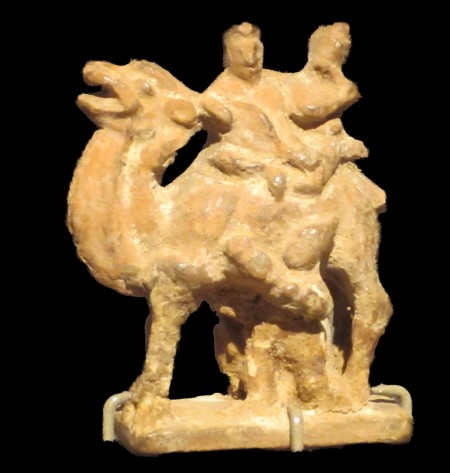
music business in ancient Eurasian traveling trade

camel and musicians: ancient Eurasian music business

An earthenware miniature from early eighth-century China represents a camel and three musicians. On the camel one musician is playing a flute and another, a lute.  Standing beside the camel a third musician is playing perhaps an ancient multiple free-reed instrument called a sheng.[1]  A camel and three musicians could have been part of a wealthy entourage traveling across ancient Eursia.  Alternatively, a camel and three musicians might have been an independent trading party, trading entertainment for goods with other traveling parties along the “Silk Road“.  The earthenware miniature itself makes best sense as a gift/trade good from up-market musicians exchanging memorable entertainment for physical goods from wealthy Eurasian travelers.[2] The earthenware miniature indicates that ancient Eurasian travel routes supported an entertainment business structure similar to that of independent magic lanterne operators in early modern Europe.

The music business in Eurasia was not just a specialized, elite urban profession.  In a fragmentary Judeo-Persian business letter from west-central China late in the eighth century, a Jewish merchant mainly recounted difficulties in his sheep trades.  Yet the merchant also referred to a harp, a girl, and a eunuch:

to me one harp {missing line end and next beginning} you bring the harp, I shall teach the girl, and how quick {missing line end and next beginning} I find, I did not find, but from {name} one {missing line end and next beginning} I give, so that he shall teach {name}, the black eunuch [3]

Whatever these lines mean, the context is clearly commercial, long-distance trade in central Eurasia.  Persons (“courtesans”), mainly women but also some men, provided men with music and sex in exchange for goods and personal power in thriving central Eurasian cities such as Baghdad and Kucha.  In ninth-century Baghdad, a knowledgeable writer stated that accomplished female courtesans could sing upwards of four thousands songs two to four verses long.  An Abyssinian (Ethiopian) female courtesan reportedly was traded for the enormous sum of 120,000 dinars.[4]  Yet the courtesan business also existed as a much smaller enterprise.  A Jewish merchant traveling across central Eurasia and struggling with sheep trades had a small business with a harp, a girl, and a eunuch.

*  *  *  *  *
Read more:

Notes:

[1] The earthenware miniature (shown above) is on display through July 7, 2013, in the Sackler Gallery’s exhibit, One Man’s Search for Ancient China: The Paul Singer Collection.  The miniature is labeled “camel with musicians, Tang dynasty, first half of the 8th century, earthenware with white slip, RLS1997.48.106.” It measures approximately 3.2 cm wide x 3.8 cm tall.  If you click on the image, you will see a larger image with the instruments labeled.

[2] Eurasian nomadic peoples are associated with solo performers (bards), known for engaging in bardic duels called aitys.  Three musicians traveling on one camel and playing together is a rather different music business structure than a bard competing with other bards.  Large, high-quality, well-preserved Tang-era sculptures show non-Chinese musicians atop camels.  These sculptures are more likely to be grave goods of wealthy Eurasian merchants.  The earthenware miniature of a camel and musicians would have been relatively cheap to produce.  It’s also quite worn.  That’s unlike grave objects buried new and uncovered as buried.

[3] Trans. Utas (1968) p. 130 (a “word for word” translation), adapted slightly here. The words “from” and “black” in the translation are marked with “?”, indicating tentative translation.  The word “quick” similarly is tentative relative to “quickly.”  The translation “harp” has supporting evidence.  Id also provides an image of the manuscript, the Judeo-Persian text in its Hebrew letters, a transcription, and commentary.  The translation is considerably different from the earlier translation of Margoliouth (1903).  See McClanahan (2011), Part II, for the cultural context of the Judeo-Persian letter.

[4] Al-Jahiz, Risalat al-qiyan, trans. Beeston (1980) (“Epistle on Singing Girls”) paras. 53, 55, p. 35.  Al-Jahiz is a highly literary writer often neither transparent nor sincere.  The claims above are plausible in the context of the Abbasid court in ninth-century Baghdad.  Under Islamic law, a man was allowed to have sex with his wives as well as his personally owned servants (“slaves”).  Al-Jahiz describes a transaction by which a person who owned a highly regard musician could legally pimp her or him:

It is perfectly legitimate for a girl to be sold to a rich man, who has his will on her (remaining at the same time morally irreproachable), and then returns her to her {original} owner at a less price than that for which the latter first sold her, so that the latter gets the profit

Id. para. 59, trans. p. 37.  Such exchanges are clearly much more intimate than arms-length transactions.  Modern accounting regulations seek to prevent illicit manipulations of transfer prices.

References:

Beeston, Alfred Felix Landon, trans. 1980.  ‘Amr ibn Baḥr al-Gāḥiẓ. The epistle on singing-girls of Jāḥiẓ (Risālat al-qiyān). Warminster: Aris & Phillips.

Margoliouth, D. S. 1903.  “An Early Judaeo-Persian Document from Khotan, in the Stein Collection, with Other Early Persian Documents.”  Journal of the Royal Asiatic Society of Great Britain and Ireland.  Oct., pp. 735-760.

McClanahan, Jim R. 2011. “Kaifeng Jews: Why their ancestors came to China.”

Utas, Bo. 1968. “The Jewish-Persian Fragment from Dandan-Uiliq.”  Orientalia Suecana (Stockholm Sweden), v. 17, pp. 123-136.

COB-79: hold your memo high

bureaucrat, Tang Dynasty, ChinaWhen entering a meeting room, well-trained bureaucrats always hold a document in front of themselves.  The position of the document relative to the bureaucrat’s ventral surface depends on the importance of the document.  Unimportant documents are held low.  Important documents are held high.  So if you consider a memo that you have prepared for a meeting to be highly important, walk into the meeting holding your memo high above your head.

In other bureaucratic issues this month, Ben Horowitz at ben’s blog describes “how to minimize politics in your company.”  His central point is “build strict processes for potentially political issues and do not deviate.”  Put more simply, build a strong bureaucracy.  Horowitz is a leading entrepreneur and venture capitalist.  Even he recognizes the value of bureaucracy.

At McSweeney’s Internet Tendency, Christopher Mah presents the Middle Manager’s Oath.  All middle managers should affirm this oath to make the world a better place.  The oath robustly upholds the value of bureaucratese, also known as jargon: “Jargon is not meaningless as long as it is strategic, measurable, and scalable.”  That’s a game-changing declaration.

The Independence Hall Association (IHA) developed and maintains a U.S. history and civics website.  IHA was established in Philadelphia in 1942.  IHA’s age and bureaucratic history indicate that it’s a bureaucratic organization.  Nonetheless, IHA’s webpage entitled “who are the bureaucrats?” concerns only U.S. federal government workers.  It deserves credit for an inclusive treatment of the federal government workforce:

Vince and Larry, U.S. Department of Transportation crash test dummies, have been used in ad campaigns encouraging motorists to wear seatbelts and discouraging drunk driving. The Department of Transportation is instrumental in enforcing regulations regarding automobiles, railroads, and aviation.

Contrary to the scope of IHA’s web page, the vast majority of bureaucrats are not part of the federal government workforce.  Bureaucrats shuffle papers in the private sector, fill out forms in non-profit organizations, and help to ensure that proper procedures are followed in nursery schools, libraries, local planning departments, state commissions, and many other organizations.  Wherever there are desks and paper, bureaucrats will be found.

That’s all for this month’s Carnival of Bureaucrats.  Enjoy previous bureaucratic carnivals here.  Nominations of posts to be considered for inclusion in next month’s carnival should be submitted using Form 376: Application for Bureaucratic Recognition.

Selective Service in ignored history of controlling men’s bodies

show your back: Selective Service and controlling men's bodies

The U.S. Military Selective Service Act requires men, only men, to register with the government as preparation for being used in a national emergency.  In 1981, the U.S. Supreme Court upheld sexist selective service registration.[1]  The Court noted that Congress decided not to require women to register after wide-ranging public debate and extensive Congressional hearings.  The Court judged that sexist selective service registration is not an “accidental byproduct of a traditional way of thinking about females.”  Citing a Congressional finding that “in a wartime scenario, the primary manpower need would be for combat replacements,” the Court declared that combat restrictions on women fully justify sexist selective service registration.

The U.S. military has now lifted its ban on women in combat positions.

Don’t misunderstand.  Lifting combat restrictions on women will make no difference to the ancient political regime of disposing of men’s bodies in war. A Chinese poem from more than 1200 years ago told of men’s fate:

Our lots were drawn again.
Some of us were first conscripted
when we were just fifteen,
sent north to guard the Yellow River.
Now we’re forty and headed to the west.
Back then the village elders honored us.
Now we come home with white hair
and then they ship us out again
to where the blood is lapping like a sea.
The emperor wants to expand his realm
though back where we come from
whole villages are overrun with weeds
while women try to work the farms
and the fields are a tangled mess at harvest
watercourses choked, crops gone.
Soldiers from the mountains are good fighters,
so they are driven on like dogs and birds.
It’s good of you to ask about us
but do we really dare complain? [2]

In 1992, the U.S. Supreme Court struck down a Pennsylvania law requiring a wife to give prior notice to her husband before she had an abortion.  A justice joining the ruling opinion of the Court wrote:

“Our whole constitutional heritage rebels at the thought of giving government the power to control men’s minds.” Stanley v. Georgia, 394 U.S. 557, 565, 89 S.Ct. 1243, 1248, 22 L.Ed.2d 542 (1969).  The same holds true for the power to control women’s bodies. [3]

The word “men” in “giving government the power to control men’s minds” clearly means in context “humans.” That was a common use of the word “men” in the past.  The word “women” in “the power to control women’s bodies” means women.  That’s the way ruling elites spoke in the past, and continue to speak.  Government control of men’s bodies is marked with seas of blood and manly silence.

Here it is bitter winter
and the Guanxi troops have not returned.
Tax-gatherers go back and forth,
but where will the taxes come from?
It makes us question whether
there’s any sense in having sons.
Daughters can marry neighbors.
Boys seem born to die in foreign weeds.
Have you seen how the bones from the past
lie bleached and uncollected near Black Lake?
The new ghosts moan, the old ghosts moan —
we hear them at night, hear them in rain. [4]

The traditional way of thinking about men is that men’s lives are less valuable than women’s lives just in being.  That’s not inconsistent with favoring the birth of sons.  The empire depends on men working to provide material goods for rulers and women, and men soldiers fighting for ruler’s and women’s freedoms.

Listen, and you will hear ghosts moaning.

*  *  *  *  *

Read more:

Notes:

[1] Rostker v. Goldberg, 453 U.S. 57 (1981).  U.S. post offices contain pamphlets encouraging men to register with Selective Service.  An eligible man who doesn’t register with Selective Service has committed a felony under U.S. criminal law.

[2] Excerpt from Du Fu, “Song of the War Carts,” English translation (with changes in capitalization and punctuation for ease of reading) by Young (2008) pp. 43-44.  The poem was written in China about 750 GC.

[3] Planned Parenthood of Southeastern Pennsylvania v. Casey, 505 U.S. 833 (1992), opinion of Justice Stevens.  The quote from Stanley v. Georgia, 394 U.S. 557 (1969), is from the opinion of the Court.  It ruled that the U.S. Constitution prohibits making mere private possession of obscene material a crime.  Whether private possession of obscene material is by a man or a woman is irrelevant to the Court’s ruling.

[4] Excerpt from Du Fu, “Song of the War Carts,” sourced as previously from Young (2008) pp. 43-44.

Reference:

Young, David. 2008. Du Fu: a life in poetry. New York: Alfred A. Knopf.