Sebokht and al-Biruni on universal science and parochialism

Claims of the universal truth of science existed among ancient intellectuals who recognized learning in cultures spanning from Egypt to Greece to India.  For example, Severus Sebokht of Nisibis was a seventh-century bishop living in a monastery at Qenneshren, Syria.  He was well-versed in Greek literature, yet also aware of the more ancient sciences of the Egyptians and the Babylonians.  In addition, Sebokht described the Hindus as having “subtle discoveries in this science of astronomy, discoveries that are more ingenious than those of the Greeks and the Babylonians.”  He also noted that the Hindus did computations by means of nine signs.  Those signs (augmented with the sign for zero) are now known as Arabic numerals and used worldwide.  Sebokht wrote:

If those who believe, because they speak Greek, that they have reached the limits of science should know these things, they would be convinced that there are also others who know something.  I don’t say this to disparage Greek science, but to show that science is universal. [1]

In the eleventh century, al-Biruni, writing about India, presented a similar complaint:

According to their {the Hindus’} belief, there is no other country on earth but theirs, no other race of man but theirs, and no created beings besides them have any knowledge or science whatsoever.  Their haughtiness is such that, if you tell them of any science or scholar in Khurasan and Persis, they will think you to be both an ignoramus and a liar. [2]

The truth of science is universal.  So too is the truth of parochial human nature.

*  *  *  *

Read more:

Notes:

[1]  Ms., Syriac, No. 346, Bibliotheque Nationale de Paris, trans. into French, Nau (1910) p. 250.  Ginsburg (1917) p. 368 provides most of the translation from Nau’s French into English, and biographical background on Sebokht.  Sebokht also wrote to his Greek scientific correspondent:

As an ignorant Syrian, I send you these minor questions for those who believe that all scientific knowledge is found in Greek; I beg you to answer me all these questions, so that when those I have spoken about have answered me, I will give thanks to God, who provides wisdom and science, and also thanks to your wise explanation and brotherly solicitude, by means of which I will have learned these and other similar things.

Nau (1910) p. 252, my translation from Nau’s French.  Sebokht here is richly sarcastic.

[2] Al-Biruni, Indica, trans. Sachau (1910), vol. 1, p. 23.

References:

Ginsburg, Jekuthial. 1917. “New light on our numerals.” Bulletin of the American Mathematical Society. 23 (8): 366-370.

Nau, Francois. 1910. “La cosmographie au VIIe siècle chez les Syriens.” Revue de l’Orient chrétien 15 (18): 225–254.

Sachau, Eduard. 1910. Muḥammad ibn Aḥmad al-Bīrūnī. Alberuni’s India. An account of the religion, philosophy, literature, geography, chronology, astronomy, customs, laws and astrology of India about A.D. 1030. London: K. Paul, Trench, Trübner & Co.

Christian icons in Islamic world during Byzantine iconoclasm

Within the Byzantine Empire, iconoclastic emperors prescribed religious use of images between 726 and 787, and between 813 and 842.  That action had little effect on Christians beyond the Byzantine Empire.  Christians in Syria and Egypt had a long tradition of religiously active images (icons).  Icons were ubiquitous in Christian churches and monasteries in the Islamic world about the year 800.
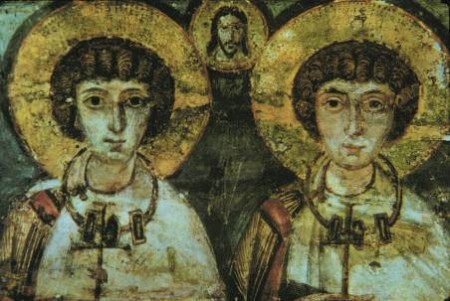
St. Sergius & Bacchus icon, early 7th century

Sometime between 800 and 812, Theodore Abu Qurrah, a Christian bishop in Harran, Syria, wrote a polemical treatise supporting prostration to icons.  Abu Qurrah was living within the Islamic world and writing in Arabic.  He declared:

nothing is more prevalent in the church than the icons.  What country is there, by my life, in whose churches there are no icons of the saints?  If their ubiquity does not prove that they have come down from the beginning, then one is on the verge of disapproving everything else, the ubiquity of which is commonplace [1]

While Abu Qurrah’s arguments in support of prostration to icons could be challenged in many ways, his observation of current Christian practice is credible.  Christian use of icons was readily observable.  If Abu Qurrah had greatly exaggerated icon use, his opponents could have easily discredited him.

Icons were prevalent in Christian churches and monasteries in the ninth-century Islamic world.  In a literary story set about 830, the narrator and Caliph al-Ma’mun “entered an old church in Syria which had marvelous paintings/sculptures.”  A different narrator recounted that he and Caliph al-Mutawakkil, probably about 858, saw in a monastery in Homs, Syria, “marvelous pictures.”  In another account, probably from about 900, the narrator describes going into a Christian church in Syria “to see things in it that I had heard praised.”  He reports seeing pictures.[2]  An Arabic-Egyptian poet who died in 830 wrote of a wine party in a monastery:

Cup by cup we drank to the glory of the images; an icon holds both heart and glance spellbound, in silence it moves us, it supplants both lute and torch. [3]

Caliph Yazid II in 721 ordered that icons be removed from churches and monasteries.[4]  That order was not effective, at least after less than a century.

Christian images generated claims of special powers and extraordinary origins.  Muslim sources in the Islamic world reported:

Dayr al-Ba’uth had an ancient icon whose colours had not dimmed with the passage of time.  A monastery near Jusiya on the road from Homs to Damascus possessed carved reliefs of the prophets and an icon of the Mother of God whose eyes always looked at the beholder, wherever he stood.  In Dayr al-Qusayr there was an icon of the Mother of God with Christ which people came specially to see. The Tulunid ruler Khumarawayh {ruled 896-904} liked it so much that he used to install himself in the monastery in a room from where he could look at it while he was drinking. [5]

The renowned Mandylion of Edessa (a portrait of Christ) was first described in the fifth century as having been painted by King Abgar of Edessa’s emissary to Jerusalem.  By the end of the sixth century, the Mandylion of Edessa was described as a miraculous portrait not made by human hands (acheiropoieton).[6]  In a Syriac polemical text probably set in Iraq in the 720s, a Christian monk declared:

We make prostration and we pay honor to his {Christ’s} image because he has impressed it with his countenance and has given it to us.  Every time we look at his icon we see him.  We pay honor to the image of the king, because of the king. [7]

How Christ had impressed the image with his countenance isn’t stated.  Images made by human hands and acheiropoieta probably weren’t distinguished by humans at the time of image production.  Acheiropoieta are more reasonably understood as religious images that succeeded in attracting popular attention and claims for extraordinary powers within an image-making process that also produced many other images made by human hands.[8]

Veneration of icons in Syria preceded Islam.  John Moschus, a Christian monk born in Damascus and who died in Jerusalem in 619, described a demon confronting an anchorite monk in Jerusalem:

“Stop venerating this icon,” the demon said, “and then I will stop attacking you.”

Now this icon consisted of a lifelike painting of our holy lady Mary the birthgiver of God carrying our Lord Jesus Christ. [9]

The description of the icon and the practice of venerating it seems historically realistic.  Al-Biruni, a Muslim scholar in central Eurasia, reported that icons to which Christians prayed for intercession were brought from Syria into Arabia before Islam.

Spiritual use of images is common human practice across religions, cultures, and peoples.  The Greeks and Romans honored gods through paintings and sculptures.  Christians’ spiritual use of images doesn’t need to be explained by Greco-Roman influence or contamination.  Spiritual leaders in Africa, Hindus in India, Buddhist in China, and many other groups around the world have used images similarly.  Particular historical, religious, and cultural circumstances are needed to explain rejecting spiritual use of images.  Byzantine iconoclasm was an unusual development in Christian history of image use.  Byzantine iconoclasm was also an unusual development in the broad human history of image use.

statue of Hindu goddess Parvati

*  *  *  *  *

Read more:

Notes:

[1] Abu Qurrah, Treatise on Veneration of the Holy Icons, Ch. VII, trans. Griffith (1997) p. 42. Byzantine iconoclasm is not mentioned in Abu Qurrah’s treatise.  Abu Qurrah’s treatise is directed against Muslims’ and Jews’ criticism of Christians’ prostration to icons, and to the effects of these criticisms on Christians: “many Christians are abandoning prostration to the icon of Christ our God,” because “anti-Christians … are reprimanding them for their prostration … and they sneer at them.” Id. p. 21. Abu Qurrah’s treatise seems to be aimed at boosting the status of prostration to icons in inter-religious public discourse.  As political inferiors in the Islamic world, Christians would have been sensitive to such criticism.

[2] Kitab adab al-ghuraba’, attributed to Abu al-Faraj al-Isfahani, trans. Crone & Moreh (2000) pp. 21, 59, 70 (secs. 1, 51, 60).

[3] Muhammud ibn ‘Asim, quoted in Griffith (1992) p. 135.  Id. passim provides other examples.  Wine, song, and seduction in monasteries was a motif in early Abbasid literature.

[4] Id. p. 129.

[5] Kilpatrick (2003) p. 25.

[6] Brock (2004) p. 48.

[7] From Diyarbekir Syriac MS 95, trans. Griffith (2000) p. 46. This dispute is set in a monastery in Bêt Halê and occurs with “an Arab notable in the entourage of the emir Maslama.”  The text’s setting seems to be in the 720s at “the site known as Dayr Mār ‘Abdâ near Kufa and Hirā in Iraq.” Id. p. 42.

[8] Brubaker & Haldon (2011) ch. 1 claims that icons prior to 680 were acheiropoieta.  But id. doesn’t provide a reasonable account of the development of acheiropoieta.  Christians understand the Bible to be God’s word, but most believe that it was written by human hands.  A process like the canonization of scripture, but more decentralized, plausibly explains what came to be recognized as acheiropoieta.

[9] John Moschus, Leimonarion (Pratum spirituale / Spiritual Meadow) Ch. XLV, trans. Benedict Baker.

[images] First image: St. Sergius and St. Bacchus.  Encaustic icon from the Monastery of St. Catherine, Sinai.  City Museum of Eastern and Western Art, Kiev, no. 111.  Thought to date from the early seventh century.  Fowden (1999) p. 31. Saints Sergius and Bacchus also appear on a silver flask thought to date to the mid to late sixth century (from the Kaper Koraon treasure, Syria; the Walters Art Gallery, Baltimore, no. 57.639).  Id. p. 30.  Second image: the Hindu goddess Parvati, 12th century. Los Angeles County Museum of Art (M.90.153).

References:

Brock, Sebastian. 2004. “Transformations of the Edessa Portrait of Christ.” Journal ofAssyrian Academic Studies 18, 1: 46–56.

Brubaker, Leslie, and John F. Haldon. 2011. Byzantium in the iconoclast era (c. 680-850): a history. Cambridge: Cambridge University Press.

Crone, Patricia and Shmuel Moreh. 2000. Abu al-Faraj al-Iṣbahani. The book of strangers: mediaeval Arabic graffiti on the theme of nostalgia. Princeton, NJ: Markus Wiener Publishers.

Fowden, Elizabeth Key. 1999. The barbarian plain: Saint Sergius between Rome and Iran.  Berkeley: University of California Press.

Griffith, Sidney H. 1992.  “Images, Islam and Christian Icons: a Moment in the Christian/Muslim Encounter in Early Islamic Times,” in P. Canivet & J. –P. Rey-Coquais (eds.), La Syrie de Byzance à l‟Islam VIIe-VIIIe siècles. Actes du Colloque International Lyon-Maison de l‟Orient Mediterranéen, Paris – Institut du Monde Arabe, 11-15 Septembre 1990, Damascus: Institut Français de Damas, 1992, pp. 121-138.

Griffith, Sidney H. 1997.  A treatise on the veneration of the holy icons written in Arabic by Theodore Abu Qurrah, Bishop of Harran. Louvain: Peeters.

Griffith, Sidney H. 2000. “Disputing with Islam in Syriac: The Case of the Monk of Bêt Hãlê and a Muslim Emir.”  Hugoye: Journal of Syriac Studies 3,1:29-54.

Kilpatrick, Hilary. 2003.  “Monasteries through Muslim Eyes: The Diyarat Books.” Pp. 19-37 in David Thomas, ed. Christians at the heart of Islamic rule: church life and scholarship in ʻAbbasid Iraq. Woodbrooke-Mingana Symposium on Arab Christianity and Islam.  Leiden: Brill.

Matthew of Edessa re-imagined Sindbad’s lure of the sea

Monks and sailors are at opposing ends of popular imagination.  Monkish types are generally imagined to be quiet, solitary, bookish, and unworldly.  Sailors, in contrast, are associated with drunken, salty-talking, brawling, world-wandering men with a girl in every port.  Despite these contrasting images, Matthew of Edessa, a twelfth-century Armenian Christian monk, figured himself within the Islamic Abbasid legend of Sindbad the Sailor.

Matthew of Edessa is an unlikely figure of a sailor.  Edessa was not a port town but an inland city in upper Mesopotamia.  Edessa was a leading center of early Christian intellectual life.  Edessa also had been home to an icon, thought to have been divinely created, that showed Jesus’ face.  Matthew of Edessa described himself as an “elder of a monastery.”  He evidently was part of a large fraternity of clergy, monks, and religous scholars.[1]  He emphasized that for fifteen years he engaged in “ceaseless research” within Edessa as preparation for writing his chronicle.[2]  The framework for Matthew of Edessa’s chronicle is prophesied, God-imposed suffering for historical sins.

ancient sailors on Hariri ship

Matthew of Edessa literally described himself like a passionate sailor, eager for profit, pushing aside historical memory of suffering.  After halting writing his chronicle for a number of years, Matthew began writing again.  He explained:

And so I, Mattʿēos, became passionate about this {writing a chronicle} and I wished to return along that same thematic thoroughfare, like one who roamed for many years about the great universal ocean sea, and was driven mad by many tribulations, and after the tempest would go to his home in peace. And upon contemplation he might remember his love of great profit, then he bears nothing in mind of his past troubles, and with great eagerness hastens to return to the same sea-voyaging. So by this example let us also return to the point in the book {Matthew’s chronicle} at which we left off [3]

Matthew of Edessa almost surely had no seafaring experience.  As an elder of a monastery within a well-institutionalized consecrated community in the inland city of Edessa, he probably had never met a sailor.  His chronicle values historical memory and records the realization of prophecy.

Matthew of Edessa’s figure of the sailor, unmindful of his history, yearning for the sea, probably came from Matthew’s reading of the legend of Sindbad the Sailor.  That legend was popular in the Islamic world no later than the early tenth century.[4]  It could have easily reached Edessa through neighboring Muslim peoples by the early twelfth century.  In that legend, Sindbad the Sailor comes from a wealthy and prominent family in Baghdad in the time of the caliph Harun al-Rashid.  As a young man, Sindbad the Sailor squanders his inheritance through epicurian living.  He then remembers poetry:

It is through toil that eminence is won;
Whoever seeks the heights must pass nights without sleep. [5]

Sindbad the Sailor thus decides to go to sea as a sailor-trader.  The Sindbad legend consists of episodes of Sindbad the Sailor going to sea, enduring hardships and terrors, returning to Baghdad wealthy, and then being drawn to the sea again.  Here’s one such account:

I was delighted at my safe return …. I enjoyed the company of my friends and companions,  and was more prosperous than ever, forgetting the time that I had spent abroad, together with the toils and distress that I had suffered and the terrors of the voyage. … I was enjoying a life of the greatest pleasure until one day I got the idea of traveling {again} to foreign parts, as I wanted to trade, to look at other countries and islands, and to earn my living. [6]

Through forgetting the toils and distress he suffered, he went on to suffer similarly again.

Like Matthew of Edessa’s account of Armenian captives’ dialogue with infidel women, Matthew’s figure of himself as a sailor provides a subtle counterpoint within his chronicle.  The framing story of the Sindbad legend couples Sindbad the Sailor with Sindbad the Porter.  Sindbad the Porter remains in Baghdad and leads a “laborious and humble” life.  Matthew of Edessa’s autobiographical framing of his chronicle similarly doubles the status and work of the holy vardapet Yovhannēs Kozern and Matthew’s own life and chronicle.  Matthew emphasizes his heavy labor in researching his chronicle.[7]  The Sindbad legend describes humble and wonder-filled labors of, respectively, Sindbad the Porter and Sindbad the Sailor.  But what explains their different statuses, and rationally motivates Sindbad the Sailor’s repeated changes of fortune, is unfathomable:

All are created from a drop of sperm;
I’m like the next man and he is like me.
But oh how different are the lives we lead!
How different is wine from vinegar.
I do not say this as a calumny;
God is All-Wise and His Decrees are just. [8]

Such wisdom seems to have been within Matthew of Edessa’s consciousness as he recounted the holy vardapet Yovhannēs Kozern’s prophecies and worked on his chronicle.  As he researched history unceasingly, Matthew of Edessa sensed limits of historical understanding.

*  *  *  *  *

Read more:

Notes:

[1] Matthew of Edessa, Chronicle, author’s prologue to Book II, trans. Andrews (2009)  p. 301 (“elder of a monastery”); id. p. 213 (general commentary on Matthew’s community as revealed in his chronicle).

[2] In the author’s prologue to Book III, Matthew states that he has “spent many years in diligent research and, having collected {records} with a valiant will in the Mesopotamian city of Uṙha {Edessa}, I wrote up to this point.”  Trans. id. p. 302. Dostourian (1993) provides an English translation of the full chronicle.

[3] Matthew of Edessa, Chronicle, author’s prologue to Book III, trans. Andrews (2009)  p. 304.

[4] References to the tale of Sindbad exist in tenth-century Islamic writing.  The future caliph al-Radi (reigned 934-940) declared to courtly visitors checking on his reading:

Tell them who sent you,  “You have seen these books and found them to be books of tradition, jurisprudence, poetry, language, history, and the works of the learned — books through the study of which God causes one to benefit and to be complete. They are not like the books which you read excessively such as The Wonders of the Sea, The Tale of Sindbad, and The Cat and the Mouse.”

Trans. Abbott (1949) p. 155.  Al-Nadim in the Fihrist declares:

There was the book Sindbadh al-Hakim, which is in two transcriptions, one long and one short. … What is most probable and closest to the truth is that the Indians composed it.

Trans. Dodge (1970).  Sindbadh al-Hakim refers to Sindbad the Sage, a figure in the Book of SindibadThe Tale of Sindbad, in contrast, probably refers to Sindbad the Sailor.

[5] Lyons (2008) v. 2, p. 456 (night 538).

[6] Id. p. 463-4 (nights 542-3).

[7] In his two prologues Matthew declares that he “enquired for a long time,” “engaged ceaselessly in research”; “my work of labour”; “ceaseless research”; “unceasing research”; “many years in diligent research”; “for 15 years we have been engaged in this work of research”; “we have been tireless.”  Phrases from trans. Andrews (2009).

[8] Lyons (2008) v. 2, p. 454 (night 537).  Wine and vinegar are elements in Jesus’ last supper and crucifixion in the Gospels.  What happened to Jesus is a matter of dispute within Islam.  In the poem and in the Sindbad legend, a fundamental theme is God’s will.  That is also a fundamental theme of Islam.

[image] The Hariri Ship (AH 634 / 1237 GC) from al-Hariri of Basra, Maqamat, illustrated by Yahya ibn Mahmud al-Wasiti; Schefer collection, MS. arabe 5847, fol. 119v, Bioliotheque Nationale de France.

References:

Abbott, Nabia. 1949. “A Ninth-Century Fragment of the ‘Thousand Nights’: New Light on the Early History of the Arabian Nights.” Journal of Near Eastern Studies. 8 (3): 129-164.

Andrews, Tara L. 2009. Prolegomena to a critical edition of the chronicle of Matthew of Edessa, with a discussion of Computer-Aided methods used to edit the text. Ph.D. Thesis. Oxford University.

Dodge, Bayard Dodge. 1970. The Fihrist of al-Nadīm: a tenth century survey of Muslim culture. New York: Columbia University Press.

Dostourian, Ara Edmond. 1993.  Armenia and the Crusades: tenth to twelfth centuries: the Chronicle of Matthew of Edessa. Lanham: University Press of America, National Association for Armenian Studies and Research.

Lyons, Malcolm C. 2008. The Arabian nights: tales of 1001 nights. vols. 1-3. London: Penguin.

ibn al-Rumi shows dangers of singing slave-girls

Highly trained singing slave-girls captured the hearts of men in the ancient Islamic world.  A highly sophisticated author writing in Baghdad early in the ninth century warned alluringly:

Passion for singing-girls is dangerous, in view of their manifold excellencies and the satisfaction one’s soul finds in them.  They provide a man with a combination of pleasures such as nothing else on the face of the earth does. [1]

Ibn al-Rumi, a poet in ninth-century Baghdad, wrote a poem entitled, “Wahid, the Singing Slave-Girl of ‘Amhamah.”  Ibn al-Rumi’s poem began:

O my two friends, Wahid has enslaved me,
Till my heart is tormented and broken by love. [2]

Lovesickness was a recognized biological illness in the ancient Islamic world.  At the same time, Islamic authors drew upon conventions of Roman love elegy and Hellenistic myth in depicting lovesickness. Ibn al-Rumi’s poem about the singing slave-girl Wahid figured her as the Hellenistic god Cupid:

She does not shoot at hearts with her love
Without hitting her prey wherever she wants.
A lute-string in her hands is like
The bowstring of an army in which a sharp arrow is set. [3]

Ibn al-Rumi having sex with Wahid, the singing slave-girl of ‘Amhamah, would be illicit under Islamic law.  Ibn al-Rumi described obstacles:

Wherever I leave her, I find a companion in passion for her,
Wherever she alights, a guardian over her.
To my right, to my left, in front of me and behind,
How can I get around him? [4]

This sense of other men as obstacles to approaching the singing slave-girl implicitly references and re-writes a sense of god like that in St. Patrick’s breastplate:

Christ with me, Christ before me, Christ behind me,
Christ in me, Christ beneath me, Christ above me,
Christ on my right, Christ on my left. [5]

Idolatry wasn’t a religious concern in Greco-Roman culture. Hence Roman love elegy couldn’t figure erotic desire as idolatry.  Islamic love poetry could.  With the potent cultural resource of one god, Islamic love poetry burned hotter.

*  *  *  *  *

Read more:

Notes:

[1] Al-Jahiz, Risalat al-qiyan, trans. Beeston (1980) (“Epistle on Singing Girls”) para. 47, pp. 30-1.  Music is the food of love, and singing slave-girls played on:

It is said in {Islamic} Tradition, “Beware of gazing {on women}, for it sows carnal desire in the heart, and that is a most grievous temptation for one who experiences it.”  How much the more will this be the case with gazing and carnal desire, when they are accompanied by music and helped along with flirting.

Id.

[2] Ode 593 in Diwan ibn al-Rumi, l. 1, trans. Motoyoshi (2001) p. 5.  The more widely known Rumi was a thirteenth-century Persian Sufi poet.

[3] Id. ll. 25-6.

[4] Id. ll 39-40.

[5] Here’s St. Patrick’s Breastplate in the original Irish and a literal translation into English.  Scholars think that the prayer was written in the eighth century.  Jews in Kaifeng, China, in the fifteenth century expressed similarly the omnipresence of God:

In movement, he {the praying Jew} examines his conduct, and by vocal praise he honours the Way, for that which should not be substituted for is Heaven.  The worshiper recedes three paces, and immediately (the Way) is behind him, and in consequence he honours the Way which is behind him.  He advances five steps, and perceives (the Way) before him, and in consequence he honours the Way which is before him.  Turning to the left he bends his body to honour the Way, which is good, for the Way is then on his left. Turning to the right he bends his body to honour the Way, which is not so good, for the Way is then on his right.  He uplifts his head to honour the Way, and the Way is above him; he lowers his head to honour the Way, and the Way is near him.  Finally he worships the Way, and It is honoured in this act of worship.

From the 1489 Kaifeng stone inscriptions, trans White (1966) p. 10.  Ninth-century Muslims probably had a similar expression of God’s presence or practice of prayer.

References:

Beeston, Alfred Felix Landon, trans. 1980.  ‘Amr ibn Baḥr al-Gāḥiẓ. The epistle on singing-girls of Jāḥiẓ (Risālat al-qiyān). Warminster: Aris & Phillips.

Motoyoshi, Akiko. 2001. “Sensibility and Synaesthesia: Ibn Al-Rūmī’s Singing Slave-Girl.” Journal of Arabic Literature. 32 (1): 1-29.

White, William Charles. 1966. Chinese Jews: A Complication of Matters Relating to the Jews of K’ai-Feng Fu, 2nd ed. New York: Paragon Book Reprint.