men’s desire in the Life of Saint Pelagia

Pelagia as Aphrodite

Saint Pelagia, the leading actress-dancer of Antioch, rode by Bishop Nonnus and other bishops.  Bare of head, shoulder, and limb, she was wearing only gold, pearls and precious stones.  She smelled of sweet perfume.  Accompanying her was a train of sumptuously dressed young men and women.  The other bishops groaned and turned their heads away.  But Nonnus did not:

the most blessed Nonnus did long and most intently regard her: and after she had passed by still he gazed and still his eyes went after her.  Then, turning his head, he looked upon the bishops sitting round him.  “Did not,” said he, “the sight of her great beauty delight you?” [1]

The other bishops said nothing.  Nonnus lowered his face onto the Bible in his lap and wept.  Then he asked the other bishops again, “Did not the sight of her great beauty delight you?”  Again the other bishops said nothing.

Nonnus perceived a guide to holiness within men’s typical response to a beautiful woman.  After the other bishops refused twice to answer his question about Pelagia’s beauty, Nonnus declared:

it greatly delighted me, and well pleased was I with her beauty. God shall set her in presence of His high and terrible seat, in judgment of ourselves and our episcopate. [2]

He explained that Pelagia made herself beautiful for men who loved her for only one night.  He grieved that he and his fellow bishops made much less effort to make their souls beautiful for God, the Immortal Lover.  Nonnus’s natural response to Pelagia’s beauty thus provided instruction in loving God.

The fearful silence of the other bishops has a parallel trace within the manuscript history of the Life of Saint Pelagia.  The above text is from a Latin version of the Life of Pelagia.  A Syriac version of the Life, from no later than 850, changed Nonnus’s delight to astonishment, and made Nonnus weep not in response to the silence of the other bishops, but from the sight of Pelagia:

The holy bishop Nonnos {Nonnus}, however, observed her carefully in his mind, filled with wonder.  Once she had passed in front of them, he turned away his face, placed his head between his knees, and wept with great feeling, so much that his lap was filled with tears.

Lamenting greatly for her, the holy bishop Nonnos sighed and said to his fellow bishops, “To be honest, fathers, did not the beauty of this prostitute who passed in front of us astonish you?”  They kept silent and did not answer a word. [3]

Even the most pious Christian reader would likely snort in derision at this response to a beautiful women: Nonnus “observed her carefully in his mind, filled with wonder” and then, after she passed, wept “with great feeling.”  Then, without any plausible motivation, Nonnus combined “beauty,” “prostitute,” and “astonish” into an emotionally incoherent question for his fellow bishops.  The narrative subsequently turns even further away from men’s real human nature:

Having wept a great deal, he said to his fellow bishops, “I beg you, my brothers, tell me, did you lust in your minds after the beauty of that prostitute who passed in front of us?  And did you suffer for her?  I myself was greatly astonished at her beauty and I suffered because of her ornaments, which were a baited snare for all who beheld her, a stumbling block leading to perdition.  In my weakness I beseech and supplicate God to turn her to a life of truth and to let her stand chastely before the awful throne of his majesty. [4]

In figuring Pelagia as a “baited snare,” the narrative focuses on the woman.  Nonnus suffers for the woman. His concern about God’s judgment shifts from God’s judgment of him and his fellow bishops to God’s judgment of the woman.  The Syriac version of the Life of Saint Pelagia the Harlot effaced holy appreciation for men’s distinctive human nature.

Confronted with men’s distinctive human nature, remaining silent or shifting focus to women devalues men.  The shocking honesty of Nonnus in the Latin version of the Life of Saint Pelagia the Harlot is not just good, ancient, literary art.  It’s inspiration for women and men to appreciate men’s human nature more fully and joyfully today.

*  *  *  *  *

Read more:

Notes:

[1] From the Latin version (in Vitae Patrum) of The Life of Saint Pelagia the Harlot, trans. Waddell (1936) p. 269.  Until otherwise noted, subsequent quotes are from id.  Here’s an alternate online translationJohn Chrysostom, writing in Greek probably late in the fourth century, described a harlot woman-of-the-stage who became a model of godliness (Homily LXVII).  That may have been the kernel of the life of Pelagia.  In any case, the original of the Life of Saint Pelagia was in Greek, probably from a mid-fifth-century Syro-Palestinian milieu.  The Life of Pelagia was highly popular in medieval Europe.  At least 31 Greek manuscripts of the Life, dating from the tenth to the seventeenth centuries, have survived.  Among 175 surviving Latin manuscripts of the Life, a word-for-word Latin translation of what’s thought to be the original Greek text has survived in a twelfth/thirteenth-century Italian manuscript.  Medieval versions of the Life exists in a wide variety of languages, including Arabic, Armenian, Georgian, Slavonic, and Syriac.  On the manuscript history of the Life, see Petitmengin (1984).

[2]  While Pelagia’s beauty delighted Nonnus, the Life also depicts Nonnus as recognizing the problem of temptation.  After receiving a letter from Pelagia asking to meet with him, Nonnus wrote her:

seek not to tempt my weakness, for I am a man that is a sinner, serving God.  If in very deed thou hast a desire after divine things and a longing for goodness and faith, and dost wish to see me, there are other bishops with me: come, and thou shalt see me in their presence: for thou shalt not see me alone.

Trans. Waddell (1936) pp. 273-4.

[3] Life of Pelagia, trans. from Syriac in Brock & Harvey (1998) p. 43. The subsequent quote is from id.  The Syriac text is from British Library, Add. 14651, a manuscript dating from 850.  It is the oldest extant manuscript of the Life of Pelagia.  Introduction, id. p. 41.  From the seventh century, Syriac translations of Greek texts were highly literal.  That suggests that the Syriac text  of the Life of Pelagia dates from earlier than the seventh century.  Other (later) manuscript witnesses to the original Greek text don’t have the Syriac text’s recasting of Nonnus’s initial reaction to Pelagia.

[4] Within this text are added references to Matthew 5:28 (“everyone who looks at a woman with lust has already committed adultery with her in his heart”) and the biblical figure of a “stumbling block,” e.g. Ezekiel 14:4.  In the Latin version, Nonnus’s delight in Pelagia’s great beauty is not necessarily equivalent to lust in its scriptural context of hyperbolic amplification.  Pelagia’s great beauty explicitly functions for Nonnus not as a stumbling block but as a sign for spiritual adornment.

[image] Statuette of Aphrodite (Aphrodite Heyl), terracotta, 2nd century BCE, Altes Museum, Berlin, Germany.

References:

Brock, Sebastian P., and Susan Ashbrook Harvey. 1998. Holy women of the Syrian Orient. Berkeley, Calif: University of California Press.

Petitmengin, Pierre. 1984. Pélagie la pénitente: métamorphoses d’une légende. Paris: Etudes augustiennes.

Waddell, Helen. 1936. The desert fathers; translations from the Latin with an introduction. London: Constable.

Evagrius of Antioch’s non-ascetic Life of Anthony translation won

Late in the fourth century, two translations of the Life of Anthony provided a market test of translation as close as possible to the original (“word-for-word translation”) and translation close to the language and terms of the intended readers (“sense-for-sense translation”). The Life of Anthony translated more closely to its intended readers was much more popular. Yet ease or pleasure in reading wasn’t the only fact in determining ancient translation methods. The value of connecting the reader to the source text and the relative cultural prestige of the destination languages also influenced ancient translation techniques.

An anonymous translator and Evagrius of Antioch translated the Life of Anthony from Greek into Latin in the fourth century. Anthony was a Christian anchorite in Egypt. He died in 356. Shortly after Anthony’s death, Athanasius, Bishop of Alexandria, wrote in Greek the hagiographic Life of Anthony. An anonymous translator literally translated Athanasius’s Life of Anthony into Latin soon after Anthanasius wrote it in Greek. By 374, Evagrius of Antioch had produced another Latin translation. Evagrius translated the Life of Anthony into elegant Latin that used terms and concepts more accessible to western European readers.

In translating the Life of Anthony from Greek into Latin, both the anonymous translator and Evagrius made informative changes. The anonymous translator kept close to word-for-word translation of the Greek original. Yet the anonymous translator deleted repetitive words and unnecessary phrases, added relevant factual specifications, heightened some adjectives into superlatives, made scriptural references fuller and more explicit, amplified horrors of demons, and associated demons with the threatening Arian heresy. These effects were through local changes of merely a word or phrase. The anonymous translator seems to have been a well-educated monk who was a follower of Anthony in the desert of Egypt. He apparently sought to produce a translation that was precise, specific, and true to Anthony’s anchorite life in the Egyptian desert.[1]

Evagrius, in contrast, translated the Life of Anthony into rhetoric and terms more attractive and accessible to Latin readers in western Europe. Evagrius was a rhetorically educated religious and political leader in Antioch, which was a leading city for early Christianity. Evagrius translated Athanasius’s Greek original with added rhetorical embellishments (alliteration, graphic description, dramatic dialogue, rhetorical questions), new ecclesiastical terminology, and more weight on relatively abstract theological ideas such as God the creator, the actions of angels, and heaven. Evagrius’s translation shifted focus up the hierarchy of evil from demons to Satan, mitigated ascetic rigor, and brought forward community practices of monasticism.[2] In a prologue he added to the Life of Anthony, Evagrius explained his translation technique:

Direct word for word translation from one language to another darkens the sense and strangles it, even as spreading couchgrass a field of corn. For in slavishly following cases and constructions, the language scarcely explains by lengthy periphrasis what it might state by concise expression. For my part, to avoid this, I have so transposed this life of the Blessed Antony which you desired that whatever lack may be in the words, there is none in the meaning. Let the rest go bat-fowling for letters and syllables: do you seek for the sense.[3]

That description itself is highly rhetorical and tendentious. Evagrius’s translation indicates that he had at hand the earlier anonymous translation.[4] In describing translation techniques, Evagrius implicitly contrasted his translation with the earlier anonymous translation.

Evagrius’s translation of the Life of Anthony was much more popular than the anonymous translation. The leading scholar of Latin translations of Life on Anthony declared:

Evagrius’s translation was immensely popular, as demonstrated by its preservation in more than 300 codices dating from the ninth through the sixteenth century. His translation has been mentioned in the writings of numerous medieval authors and has frequently been cited in medieval library catalogs. [5]

The anonymous translation, in contrast, was unknown in post-Renaissance scholarship until a century ago. Only one manuscript of the complete anonymous translation has survived.[6] Across more than 1400 years, Evagrius’s Latin translation has been an overwhelming winner against the earlier anonymous Latin translation.[7]

Most ancient translations from Greek into Latin and Syriac did not follow Evagrius’s winning translation technique. From the sixth century until the Renaissance, the norm for virtually all translations from Greek to Latin was literal translation.[8] Translations from Greek into Syriac also shifted toward literal translation. Fifth-century translations from Greek to Syriac were free and expansive, while seventh century translations closely followed the Greek text. In addition, from the fourth to the seventh century, Greek words became much more frequently incorporated into Syriac translations.[9] The prestige of Greek culture and the leading examples of Jewish and Christian biblical scholarship and biblical translation seems to have driven ancient translations closer to the original Greek texts. Contrary to likely advantage among the broad market of potential readers, ancient translators sought to catch individual Greek words.

Translations from Greek into Arabic, whether through Syriac or direct, were typically much closer in diction and style to the destination language. Hunayn ibn Ishaq, a leading translator of Greek scholarship into Arabic in ninth-century Baghdad, rejected word-for-word translation. Hunayn sought to translate the meaning of Greek texts into Arabic.[10] To that same end, Arabic scholars generated a vast array of Arabic works that freely adapted, abridged, and expanded Greek texts. Arabic, as the language of the Qur’an, was a more prestigious language than Greek in the ancient Islamic world. Arabic scholars drew upon the authority of ancient Greek texts without privileging literal translations of those Greek texts.

* * * * *

Read more:

Notes:

[1] The characterization of the anonymous translation is from Gandt (2008). Anthony (Anthony the Great) is also commonly called Antony and Saint Antony.

[2] The characterization of Evagrius of Antioch’s translation is also from id.

[3] Trans. Waddell (1936), p. 2, with an omitted sentence added from the translation of the Life of Anthony in the Nicene and Post-Nicene Fathers (see note 983). Compare the above translation with a translation into a contemporary plain style:

A literal translation from one language to another conceals the meaning. If it closely follows verbal forms, a translation becomes much more lengthy than is necessary. I have avoided this in translating, as you requested, the life of the blessed Antony. I have translated in such a way that nothing should be lacking from the sense although something may be missing from the words. Some people try to capture the syllables and letters, but you must seek the meaning.

Adapted from Ward (2003) p. xxxii.

[4] Gandt (2008) pp. 186-7.

[5] Id. p. 2.

[6] It was found in 1914 in a Roman Church archive. It is a tenth or eleventh century manuscript copied in beautiful Farfa script. A small fragment of the anonymous translation, probably written in the thirteenth century in Central Italy, has also survived. Id. pp. 3-4.

[7] Life of Anthony was a highly popular work in the ancient world and influential in the development of Christian monasticism. In addition to 300 manuscripts of Evagrius’s Latin version, at least 175 manuscripts of the Life of Anthony in Greek have also survived. Manuscript translations into Coptic and Syriac have also survived. Id. p. 35.

[8] Brock (1979) pp. 70, 80.

[9] Brock (1982) p. 18.

[10] Brock (1979) pp. 74-75.

References:

Brock, Sebastian. 1979. “Aspects of Translation Technique in Antiquity.” Greek, Roman and Byzantine Studies 20, 1: 69-87.

Brock, Sebastian. 1982. “From Antagonism to Assimilation: Syriac Attitudes to Greek Learning.” Pp. 17-34 in Nina G. Garsoïan, Thomas F. Mathews, and Robert W. Thomson, eds., East of Byzantium: Syria and Armenia in the Formative Period. Dumbarton Oaks Symposium 1980. Washington, D.C.: Dumbarton Oaks, 1982. Reprinted in Brock (1984), Syriac Perspectives on Late Antiquity, Ch. V.

Gandt, Lois. 2008. A philological and theological analysis of the ancient Latin translations of the Vita Antonii. Thesis (Ph. D.) Fordham University, 2008.

Waddell, Helen. 1936. The Desert Fathers; translations from the Latin with an introduction. London: Constable & Co. Ltd.

Ward, Benedicta. 2003. The Desert Fathers. London: Penguin Books. Penguin Classics.

anchoresses warding off beastly, devious, desperately importuning men

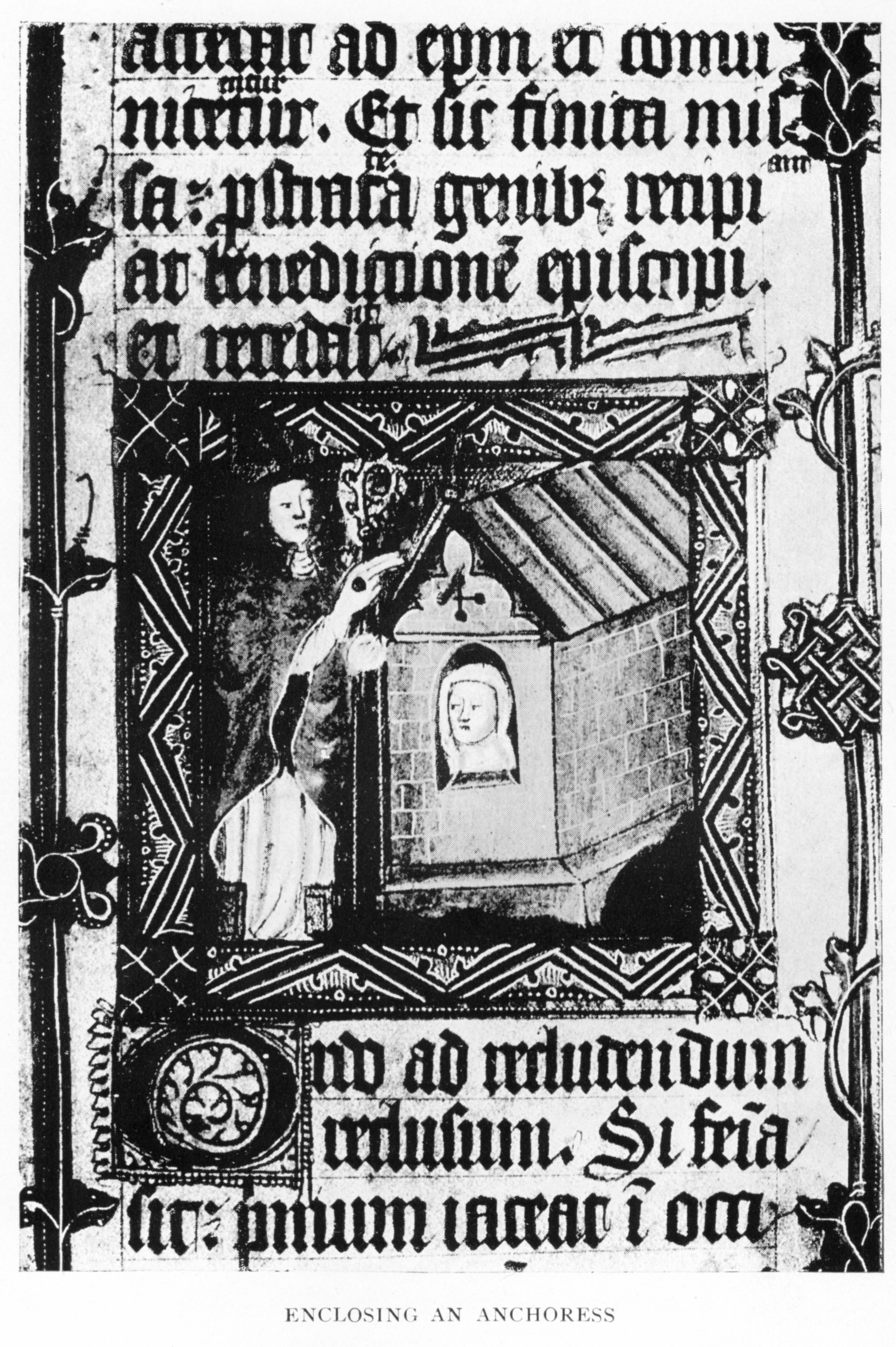
Bishop enclosing an anchoress

In the early thirteenth century, a friar in England offered instruction to anchoresses in dealing with men.  The friar wrote lovingly and compassionately to his “dear sisters.”  He strove to identify with women.  Through that identification, he expressed emotions that women might be too embarrassed to acknowledge even to themselves:

“But do you think,” someone says, “that I am going to leap on a man even if I do look at him?”  God knows, dear sisters, stranger things have happened. [1]

The friar thus counseled anchoresses against gazing upon men.

The friar treated men less personally and less sympathetically.  He figured men as beasts who might fall into the pit of a woman’s beauty: “a dog will happily go in wherever he finds it open.”  The friar counseled anchoresses:

my dear sisters, if any man asks to see you, ask him what good may come of it, since I see many evils in it and no profit.  If he is importunate, trust him the less.

The friar offered words of scripture for anchoresses to use in warding off men who might reach out to the curtain in their window or utter words of earthly love.  He advised anchoresses to say to such men:

Depart from me, you evildoers, that I may keep the commandments of my God; Godless men have dug pitfalls for me, men who do not conform to your law. [2]

The friar warned strongly against women having sympathy for men.  Men lamenting their sleeplessness, suffering, and incipient madness should be ignored:

No wooing is so base as that in the guise of a lament  — as if someone spoke thus: “I would not, though I died, think of doing anything filthy with you,” and swore deep vows: “But even if I’ve sworn not to, I have to love you. Who’s worse off than me?  It stops me sleeping a lot.  Now I’m very sorry that you know it.  But now forgive me that I have told it you.  Even if I go mad, you shall never more know how things stand with me.”

The anchoress forgiving the man and talking about something else is a mistake, according to the friar.  The suffering man is merely devious:

Afterwards he looks for his moment to break his promise, swears he has to, and so the evil grows, getting worse the longer it goes on.

The friar advises treating the man as a false friend and an enemy.[3]

While friars and anchoresses sought to lead lives of extraordinary spirituality, the friar had fundamental sympathy for the human weaknesses of anchoresses.  At the end of his thirteenth-century book of instruction to anchoresses, the friar wrote:

If you find that you do as you read, thank God earnestly.  If you do not do it, pray for God’s mercy and in the future work at keeping it better according to your strength.

In our times, elite men righteously join with elite women to help advance the welfare, as they understand it, of anchoresses and ordinary women.  Persons involuntarily incarcerated in jails and prisons have replaced anchoresses and anchorites.[4]  Those modern-day involuntary anchorites and anchoresses are predominately men.  Sympathy for ordinary men’s sufferings remains beyond the realm of public expression.

*  *  *  *  *

Read more:

Notes:

[1] Ancrene Wisse, trans. White (1993) p. 29.  Subsequent quotes are from id. pp. 31, 49, 199.  Hasenfratz (2000) provides the Middle English text and commentary.

[2] Psalm 199: 115, 85, which Ancrene Wisse (id. p. 31) quotes in Latin.  Authorities now counsel person subject to such harassment to get a restraining order requiring the man to stay away upon threat of imprisonment.  At work, a person could be accused of sexual harassment and fired for such behavior.

[3] The friar-author of the Ancrene Wisse may have formed this advice with knowledge of the Life of St. Mary the Harlot (Mary the niece of Abraham).  In that hagiographic Life, Mary, a twenty-seven-year-old anchoress, was lured out of her house by a man who softened her firm resolve:

the girl {Mary} eventually opened the door of the house where she lived as a recluse and came out to see him.  He assaulted her with his blandishments, bespattering her with the mud of his lust.

After “this sinful episode took place,” Mary felt deep regret.  She exclaimed:

I have rebelled against God and slain my soul … Alas, what have I done! … Alas, how did I fall? … How my downfall occurred, I was unaware; how I become corrupted, I do not know.  A dark cloud overlaid my heart, preventing me some seeing what I was doing.

After Mary lost her virginity as described above, she ran off to a town and became a harlot.  From the fifth-century Syriac Life, trans Brock & Harvey (1998) p. 30.  In accordance with contemporary academic norms, Beresford (2007) states that Mary was raped.  In the U.S., such a conviction could put the man in prison for nearly a decade.  The friar-author is less oriented toward punishing men than preserving the welfare of the woman, as he understands her welfare.  That means her not losing her virginity and not becoming a harlot.

[4] A formal proceeding, and approval from a bishop, was required in fourteenth-century England in order for a woman or a man to become an anchoress or anchorite.  Modern court proceedings impose incarceration against a person’s will as punishment for criminal guilt and, in some cases, for inability to pay a court-imposed financial obligations.

[image] From a 14th-century manuscript, Corpus Christi College Cambridge, MS 79, fol. 72r.  Clay (1914) Plate 28 reproduces the image in two-tone.

References:

Beresford, Andrew M. 2007. The legends of the holy harlots: Thais and Pelagia in Medieval Spanish literature. Woodbridge, Suffolk, UK: Tamesis.

Brock, Sebastian P., and Susan Ashbrook Harvey. 1998. Holy women of the Syrian Orient. Berkeley, Calif: University of California Press.

Clay, Rotha Mary. 1914. The Hermits and Anchorites of England … With fifty-four illustrations. Methuen & Co: London.

Hasenfratz, Robert, ed. 2000.  Ancrene Wisse.  Medieval Institute Publications: Kalamazoo, Michigan.

White, Hugh. 1993. Ancrene wisse: guide for anchoresses. London: Penguin Books.

fidelity and seduction in ancient intimate cross-cultural encounters

In the third century, a Roman Christian woman became a wife of the Persian king.  In the ninth century, a Syrian Christian woman became a wife of the Abbasid caliph.  The brief, surviving stories of their relationships differ starkly in their depictions of fidelity and seduction.

The story of the Roman Christian woman and the Persian king celebrates Christian fidelity within circumstance of sexual submission.  In the third century, Persian forces took captive a Roman Christian woman named Candida.  The Persians took Candida and other Christian captives back to Persia.  According to a fifth-century Syrian account, Candida’s beauty caused Persian King Vahran II to fall in love with her:

because of her astonishing beauty the king, on seeing her, became enamoured of her and gave orders that she should enter his bed-chamber; and he took her as a wife.  His love for her exceeded his love for all his other wives [1]

Seduction here is nothing more than military conquest, personal beauty, and personal power.  Yet King Vahran did not merely ravish Candida.  He took her as his wife and loved her greatly. Moreover, Candida’s sexual submission to the king did not undermine her blessed status:

The blessed girl held on to her faith because she had been brought up by her parents as a Christian, and so she preserved her modesty and her faith intact.

Martyrdoms of Christian women often celebrate preserving virginity.  The martyrdom of Candida, in contrast, attaches relatively little importance to sexual seduction.

Culturally elaborate forms of sexual seduction are at the center of the ninth-century story of the Syrian Christian woman and the Abbasid caliph.  In this story, Abbasid Caliph al-Mutawakkil decides to take a leisurely walk about a monastery in Homs, Syria.  The beauty of the girls and young men in the monastery captivates him.  He calls to a particularly beautiful girl.  She is “wearing a gown of the type slipped over the head and carrying incense for fumigation”; “she moved towards him with accomplished and perfect manners.”[2]  Displaying his own knowledge of manners, al-Mutawakkil turns to a monk to ask for the girl’s name.  Her name is Sa’anin, from the Arabic for “Palm Sunday.”[3]  Al-Mutawakkil asks for a drink of water.  After a highly mannered expression of honor for al-Mutawakkil, Sa’anin brings water in a silver jug.  Then al-Mutawakkil implores her like a man warily in love with a well-experienced and dangerous singing slave-girl:

“Sa’anin, if I loved you would you make me happy?” he asked her.  She took a deep breath and said, “Now I am your slave; but if I knew your love to be true and I controlled your heart, I fear that I would become a tyrant once my power was well-established.  Have you not heard what the poet says?
At first you were a slave to me,
but when you acquired power you became an enemy.
Where is the old joy of meeting?
It has turned into avoidance and repugnance.

These words project onto a Syrian Christian woman living in a monastery the courtly personal politics of singing slave-girls and the caliph’s harem.  Emphasizing that context, Sa’anin invites al-Mutawakkil and his companion to an upper room. There they enjoy food and wine. Al-Mutawakkil delights in Sa’anin’s “refined manners and the sweetness of her diction.”  That’s Abbasid cultural sophistication completely implausible for a young Christian girl living in a Syrian monastery.  After much drinking, Sa’anin takes up a lyre and sings:

O you who court my love, welcome,
I obey your order and may you court me for ever.
I am a slave to your love, so drink and give me to drink,
and turn away your cup from your friend if he refuses.
By the one who raised the sky, you have taken possession
of me and left my heart tormented by passion for you.

Like a highly professional singing girl, Sa’anin welcomes suitors, expresses her submission to them, and orders them to drink and buy her drink.  She thus encourages their patronage and generates income for the establishment’s proprietor.  That’s how elite entertainment establishments in Baghdad operated.  As caliph, al-Mutawakkil could demand unconditional submission from his subjects.  The Syrians, in turn, frequently contended Abbasid power.  Al-Mutawakill imposed degrading civic penalties on non-Muslims in 850 and crucified at the city gates of Homs two rebels in 855.[4]  That history plays no part in this story.  This story uses a Christian woman in a monastery in Homs to revel in the personal intrigues, culture, and pleasure of elite Abbasid sexual seduction.[5]

seduction of Dionysus

Religious fidelity is the central concern in the martyrdom of Candida.  Jealous of the Persian King Vahran’s love for Candida, his other wives complained to him that Candida “does not conform to your way of thinking but serves her own god and invokes him.”  King Vahran requested many times that Candida renounce Christianity and follow his Zoroastrianism.  He tried blandishments and offers of increased honors for her.  Candida refused to convert.  Then the King turned to terrible threats, and then to public humiliations and physical tortures.  These punishments included sexual shaming (showing Candida about the city naked but for chains) and sexual mutilations (cutting off her breasts).

Candida endured these horrors while proclaiming her love for Christ.  She described herself as betrothed to Christ and headed to her wedding feast.  Candida’s sexual submission to King Vahran did not impede her from understanding herself as being a bride of Christ.  Her sexual submission was unimportant within the ancient Christian celebration of her as a holy Christian woman.  Candida suffered death for her unwavering fidelity to Christianity as a religious identity.  The martyrdom of Candida seems to be oriented towards a persecuted ancient Christian community in Syria confronting the threat of captivity in Persia and of assimilation within Persian society.[6]

The story of al-Mutawakkil and the Syrian Christian woman diminishes human moral agency.  Just before al-Mutawakkil summons Sa’anin, he reads an inscription on a wall in the monastery:

A fugitive stranger robbed of his property was here and he says: my gathering split up having been in harmony, and my body is wretched with discomfort.

The triple misfortune of being away from home (stranger), not being able to go back home (fugitive), and being robbed of property combines widely recognized laments.  These misfortunes are further augmented with bodily wretchedness and the disintegration of social harmony.  Writing “I have exchanged joy for grief,”  the inscriber inscribes for himself in verse witness to the wisdom of Job:

O self, patiently endure the adversities of time!
Everything submits to what is decreed.

Sa’anin, a Syrian Christian woman living in a monastery and acting like a singing slave girl, parodies the holy Christian woman of Christian hagiography.  Al-Mutawakkil’s interest in her is culturally elaborated reactive desire.  Drinking wine is arguably against Islamic law.  The wine they drank in their upper-room revelry Sa’ani’s father brought from the stock of communion wine.  Al-Mutawakkil’s companion tried to refuse to drink, but at the caliph’s urging, he drank.  The story ends with conversion, marriage, and death:

al-Mutawakkil awakened her interest (in Islam) and she converted.  He married her and she was his favourite wife until he was killed; she was in the palace at the time. [7]

Fidelity and death here aren’t morally related.  In this story, the Christian woman’s conversion is much less important than her skills in seduction.  This story is from the Abbasid elite, playing in moral emptiness, tumbling forward with the belief that what will be, will be.

*  *  *  *  *

Read more:

Notes:

[1] Sixth-century Syrian manuscript, British Library Add. 12142, ff 104a-107b, trans. Brock (1978) p. 178.  All the quotes from the martyrdom of Candida are from id.  The account realistically describes ensuing problems with the king’s other wives: “they became jealous of the believing Candida, but because of the king’s love for her they were afraid of her.”  Id.

[2] Kitab adab al-ghuraba’, attributed to Abu al-Faraj al-Isfahani, trans. Crone & Moreh (2000) sec. 51, p. 60.  All the quotes from Kitab adab al-ghuraba’ are from id., sec. 51.  Al-Mutawakkil relocated temporarily to Damascus in 858.  Cobb (1999).  That’s a plausible setting for this story.

[3] Id., Commentary, p. 116.

[4] In 850, al-Mutawakkil decreed disabilities, obligations, and public signs of inferiority on Jews, Christians, and other dhimmi. The population of Homs, including some Christians, revolted against local officials in 854 and again in 855.  Al-Mutawakkil had two of the Homs rebel leaders “publicly beaten, executed, and crucified on the city gates.” Cobb (2001) pp. 100-101.

[5] This story seems to come from Abbasid literature called dirayat.  See Kilpatrick (2003).  Diyarat books associated monasteries with gardens, beautiful young men and women, intellectual pursuits, wine drinking, music, singing, and amorous adventures.  Monasteries were an alternate paradise in the Abbasid literary imagination.  In this story, al-Mutawakkil explicitly seeks a “pleasant place,” “the place known as Faradis.”

[6] A large number of Roman Christians were sent to Persia as captives under Persian King Shapur I.  Greek and Syriac speaking Christians in Persia maintained separate identities and ecclesiastical hierarchies into the fifth century.  Brock (1982) p. 3.

[7] A Turkish soldier, perhaps acting in a conspiracy with al-Mutawakkil’s son, killed al-Mutawakkil in 861.

[image] Bottles. Iran. Sasanian period.  6th-7th century CE.  Silver and gilt.  Freer Gallery of Art F1964.3, F1965.20, F1966.1.  The front bottle shows Dionysus, Greek god of wine, with a panther on a leash.

References:

Cobb, Paul M. 1999. “Al-Mutawakkil’s Damascus: A New ‘Abbasid Capital?” Journal of Near Eastern Studies. 58 (4): 241-257.

Cobb, Paul M. 2001. White banners: contention in ʻAbbāsid Syria, 750-880. Albany: State University of New York Press.

Crone, Patricia and Shmuel Moreh. 2000. Abu al-Faraj al-Iṣbahani. The book of strangers: mediaeval Arabic graffiti on the theme of nostalgia. Princeton, NJ: Markus Wiener Publishers.

Brock, Sebastian. 1978. “A Martyr at the Sasanid Court under Vahran II: Candida.” Analecta Bollandiana 96: 167-81.

Brock, Sebastian. 1982. “Chris­tians in the Sasanian Empire: A Case of Divided Loy­alties.” Studies in Church History 18: 1-19.

Kilpatrick, Hilary. 2003.  “Monasteries through Muslim Eyes: The Diyarat Books.” Pp. 19-37 in David Thomas, ed. Christians at the heart of Islamic rule: church life and scholarship in ʻAbbasid Iraq. Woodbrooke-Mingana Symposium on Arab Christianity and Islam.  Leiden: Brill.