New York court imposed false paternity on prisoner

U.S. law today legally establishes million of men as fathers through legal paternity procedures involving undue influence, mis-representation, and mis-service. William Brennan, probably the most influential U.S. Supreme Court justice in the twentieth century, observed that in the field of contested paternity, “the truth is so often obscured because social pressures create a conspiracy of silence or, worse, induce deliberate falsity.” English common law long held that a husband was legally the father of his wife’s child even if he could prove beyond reasonable doubt that he did not engage in sex that could have led to her conceiving that child. Today, a more common deliberate falsity is invoking the emotive claim of “best interests of the child” where that claim has no more relevance than an excuse to transfer money from a man to the child’s mother.

A case concerning false paternity of a prisoner in New York State illustrates the extent to which the law mocks cuckolded men.  Under the title “Adultery Case Dismissed Despite Man Being in Jail,” the Post-Standard of Syracuse in 1975 reported:

An ex-convict whose wife had four children while he was doing a nine-year stretch in prison for robbery has failed to win a divorce on grounds of adultery. Although prison records do not show the prisoner’s wife ever visited him in jail, the judge ruled she had “many possibilities of access” to the prison. The ex-convict, Theodore Walker of Bay Shore, N.Y., says he now fears his wife will get a court order forcing him to support the four children.

Walker produced in court depositions from prison officials which stated that he never left the prison during the entire length of his term and that there was no record of his wife ever visiting him. But New York State Supreme Court Justice Victor Orgera said in his decision, handed down on May 13, there were ‘‘many possibilities of access” to the prison for Walker’s wife, Margaret, and therefore Walker had failed to prove that he was not the father of the children.

Mrs. Walker, who is now living in Thomasville, N.C., with the four children and an older daughter who Walker concedes is his, did not appear in court to contest the divorce. To complicate Walker’s woes, he never was able to obtain a birth certificate for his wife’s youngest child, believed born in 1971, so Orgera ruled that there was insufficient proof of her pregnancy. The youngest child was the only one at issue in the case since New York State’s five-year statute of limitations on adultery ruled out consideration of the other three youngsters. Walker’s lawyer said he will appeal the case if he can find witnesses to the time of Margaret’s last pregnancy.

Travesties of justice such as this serve merely as amusing articles in newspapers. They generate no public action. Instead, state departments of corrections promote further punishment of prisoners with child-support debt and pay “experts” to shame prisoners into legally assuming paternity for children that may not actually be their biological children.

imposing false paternity on prisoners

*  *  *  *  *

Read more:

Source note:

The above article was distributed by United Press International (UPI). It was printed in the Post-Standard (Syracuse, NY), “Can for 9 Years Still Said Dad,” July 24, 1975 (p. 2).  Versions were also printed in the Lincoln Star (Lincoln, NE),”Adultery Case Dismissed Despite Man Being in Jail,” Sept. 30, 1975 (p. 9), the Chicago Tribune, “Loses adultery plea: Walks out of jail a ‘father’ of 4,” July 24, 1975 (section 1, p. 5), and other newspapers across the U.S. The judge was Justice Victor Orgera. He apparently served in the Suffolk County Supreme Court of New York (10th Judicial District). I have not been able to get the case opinion or the case documents.

[image] Costa – Horse Stock 11. Thanks to Aussiegal7.

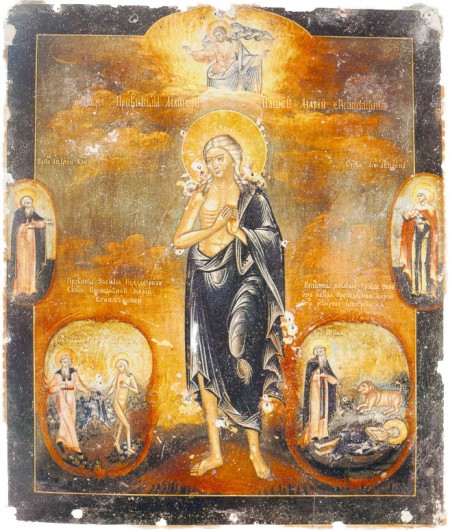
venerating Marian icon in the life of Mary of Egypt

icon of St. Mary of Egypt

As a young woman in the large, ancient city of Alexandria, Mary of Egypt exercised her strong, independent sexuality. Driven by her carnal interests, Mary traveled with a large group of men to Jerusalem. There throngs celebrated the discovery of a relic of the cross on which Jesus Christ was crucified. Mary, however, was unable to enter the church that held the cross. An “overwhelming power” held her back.

Mary’s prayer to a Marian icon released her from the sins that held her back. While standing in the church courtyard lamenting her exclusion, “a salvific word touched the eyes of my heart.” She recognized her sinful behavior:

I began to cry, lamenting and beating my breast, raising sighs from the depths of my heart.  As I was crying, I saw the icon of the all-holy Mother of God standing above the place where I stood. I looked straight at Her and said, “Virgin Lady, Thou Who didst give flesh to God the Word by birth, I know, I know well that it is neither decent, nor reasonable for me who is so filthy and utterly prodigal, to look upon Thy icon. … help me, a lone woman who has no one to help her. Command that I, too, may be allowed to enter the church. … Command, my Lady, that the door may be opened also to me, that I may venerate the divine cross; … from the moment I look upon the wood of Thy Son’s cross, I shall immediately renounce the world and all worldly things, and I shall go wherever Thou shall instruct and guide me, as the guarantor of my salvation. [1]

As soon as she spoke these words, Mary “received the fire of faith just like some kind of assurance.” She entered the church effortlessly. She saw the relic of the “life-giving cross.” She kissed the ground in front of it. Then Mary rushed outside to address the icon. Kneeling in front of it, she said:

O my Lady, Thou Who lovest goodness hast shown me Thy love for mankind, for Thou didst not abhor the prayers of an unworthy woman. … Guide me now wherever Thou dost command. Be the teacher of my salvation and guide me toward the path which leads to repentance.

A voice instructed Mary to cross the river Jordan and go into the desert wilderness. There Mary lived an austere and secluded life. The story of her life established her as Saint Mary of Egypt, a desert mother. She became an eremitic leader greater than Saint Paul the First Hermit and the famous Saint Antony.

Attributing spiritual powers to images has been common among humans across cultures and throughout history.  In Western Eurasia, the status of images in Christianity were central to major political conflict. In Byzantium in the eighth and ninth centuries and in England in the sixteenth and seventeenth centuries, authorities fought viciously over whether images had extra-representational powers. The Protestant Reformation and the rise of secularism have formed the main stream of Western Eurasian elite culture. Parochialism within that culture has obscured the pervasiveness of humans attributing spiritual powers to images.[2]

The life of Mary of Egypt was written in Greek probably in the seventh century.[3] It provides poignant witness to the deep human roots of ascribing spiritual powers to relics and icons.

*  *  *  *  *

Read more:

Notes:

[1] Life of Mary of Egypt, the Former Harlot, from Greek trans. Kouli (1996) p. 84. All subsequent quotes are from id. pp. 84-5. Here’s an online English translation of Mary of Egypt’s life. The ancient translation into Latin is similar. Ward (1987) provides an English translation of the Latin, as well as excerpts in translation from earlier accounts. “The phrase “Command, my Lady, that the door may be opened also to me,” is similar to early Coptic Marian prayers for ritual power. The Piacenza Pilgrim, writing about 570, reported venerating the true cross in Jerusalem in the Basilica of Constantine. He also reported:

There is the sponge and the reed, of which mention is made in the gospel, and we drank water from the sponge. There is also the cup of onyx, which our Lord blessed at the last supper, and many other relics. Above is the painting of the Blessed Mary and her girdle, and the wrapper which she wore upon her head.

Ch. XX, from Latin trans. Stewart & Wilson (1896) p. 17. Epiphanios the Monk in the eighth century stated that he saw “on the left side of Saint Constantine … the icon of the very holy Theotokos, who forbade Saint Mary to enter the church on the day of the Exaltation.” Kouli (1996) p. 83, n. 49.

[2] For a learned failure to appreciate the pervasiveness of icon use, see Brubaker & Haldon (2011).

[3] Kouli (1996) p. 66, 68. Manuscripts attribute the Life of Mary of Egypt to Sophronios (lived c. 560 – 638). Sophronios was patriarch of Jerusalem from 634 to 638. In the eighth century, John of Damascus cited the Life of Mary of Egypt and Paul the Deacon in Italy translated it into Latin. The Life provides no indication of Islam.

[image] Icon of St. Mary of Egypt, Russia, 18th century, now held in Kuopio Orthodox Church Museum. Thanks to Wikicommons.

References:

Brubaker, Leslie, and John F. Haldon. 2011. Byzantium in the iconoclast era (c. 680-850): a history. Cambridge: Cambridge University Press.

Kouli, Maria. 1996. “Life of Mary of Egypt, the Former Harlot.” Pp. 65-94 in Talbot, Alice-Mary Maffry, ed. 1996. Holy women of Byzantium: ten saints’ lives in English translation. Washington, D.C.: Dumbarton Oaks Research Library and Collection.

Stewart, Aubrey, and Charles William Wilson, ed. and trans. 1896. Of the holy places visited by Antoninus Martyr (circ. 560-570 A.D.). London: Palestine Pilgrims’ Text Society.

Ward, Benedicta. 1987. Harlots of the desert: a study of repentance in early monastic sources. Kalamazoo, Mich: Cistercian Publications.

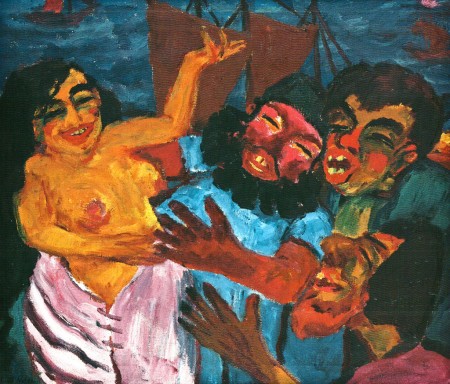
penitent harlot Mary of Egypt victorious in competition among hermits

harlot Mary of Egypt by Nolde

Men have a propensity to compete to be first and to argue about who was first. Writing about 375 GC, Jerome noted that who was the first important Christian hermit  “has been a subject of wide-spread and frequent discussion.” Jerome made that observation in the first sentence of his work, Life of Paul the First Hermit. Jerome’s Life of Paul the First Hermit implicitly competed against Evagrius of Antioch’s popular translation of the Life of Antony, completed in 374 GC.[1] Jerome put forward the claim that Paul, not Antony, was the first important Christian hermit. That argument eventually led to honoring the penitent harlot Saint Mary of Egypt.

Jerome signified the primacy of Paul over Antony in a variety of ways. Paul was 23 years older than Antony. Jerome narrated:

the thought occurred to {Antony}, that no hermit-monk more perfect than himself had settled in the desert. However, in the stillness of the night it was revealed to him that there was farther in the desert a much better man than he, and that he ought to go and visit him {Paul}.[2]

Antony made a difficult, dangerous journey to visit Paul. At first Paul refused to see him, but Antony’s pleadings won Paul over. They competed in humility to have the other break bread for a meal. They finally agree to simultaneously break bread together for their meal. Paul requested to be buried in the cloak that Bishop Athanasius gave Antony. Antony, in awe of Paul’s presence, readily agreed. After Paul’s death, Antony took the tunic Paul had woven for himself out of palm-leaves. Antony kept Paul’s garment and wore it on the most holy days of Easter and Pentecost. If Antony recognized Paul as first among hermits, who could dare claim Antony to be first?

The Life of Mary of Egypt, the Former Harlot, probably from the sixth or seventh century, implicitly acknowledged competition in providing stories about saints’ lives. The narrator’s frame for Mary’s life justified as a religious obligation publicly recording her life. The narrator’s frame emphasized the truthfulness of the account.  The sexual dimension of Mary of Egypt’s life probably helped to motivate these meta-assertions. Yet sexual temptations and activities were issues that early Christians openly discussed. The life ends with assertion and denial of competitive striving:

The monks continued to pass on these events by word of mouth from one generation to the other, presenting them as a model {of ascetic life}, to benefit those who wish to listen.  However, to this day they have never heard that anyone else has set this story down in writing. I have put down in this written narrative what I had heard by word of mouth. Perhaps others, too, have written the Life of the blessed {woman}, and probably in a more imposing style than my own, even though nothing of this sort has ever come to my attention. Nevertheless, I wrote this story to the best of my ability, desiring to prefer nothing but the truth.[3]

Primacy in writing and concern for style and writing ability are matters of personal status. They are common competitive issues beyond making truth widely known. The sensational sexual dimension of Mary of Egypt’s life made it a particularly potent competitor to other saints’ lives.

The Life of Mary of Egypt, the Former Harlot describes monastic community rules designed to suppress competition among monks. In that account, the monk Zosimas, like the monk Antony in Jerome’s Life of Paul the First Hermit, was an exceptionally good monk concerned about whether another monk existed better than he:

Is there any man among those leading a contemplative life in the desert who surpasses me in ascetic practice or spiritual contemplation? [4]

Pondering this question, Zosimas received the command to go forth “to learn how many other ways lead to salvation.” Zosimas went forth and joined a community of monks who excelled in ascetic life and spiritual contemplation. On the first Sunday of Lent, each monk went out to be alone in the desert. They returned on Palm Sunday. The monks’ spiritual struggles in the desert were by institutional rule non-competitive:

there was a rule that each monk observed as an inviolable law: not to be concerned with the way that the other monks practiced self-restraint or conducted themselves. … Each monk returned {to the monastery}, having as the fruits of his own purpose his own conscience, which knew how he had labored and with what toil he had sown the seeds {of his spiritual struggle}. No {monk} asked another anything whatsoever about how or in what way he had exerted himself in his struggle. This was the rule of the monastery and in this way it was well fulfilled. For when each of them is in the desert, he struggles by himself under the supervision of God, the Judge of the contest, so that he may free himself from the desire to please men or to practice self-restraint in order to show off. For those actions actions undertaken for the sake of men and performed in order to please them, not only do not benefit the one who does them, but are an additional cause of much harm to him.[5]

This institutional rule indicates the reality of the corresponding problem. Early Christian monks competed with each other to be recognized as outstanding in ascetic discipline and spiritual purity.[6]

The penitent humility of the harlot Mary of Egypt trumped monks’ competition in ascetic discipline and spiritual purity. Zosimas didn’t follow the monastery’s rule on non-competition. He rapidly journeyed to the innermost part of the desert hoping to find a holy father. He encountered instead Mary of Egypt, naked and burnt black by the sun. She fled from him. He chased her and begged her for a blessing. Finally, when he was exhausted, she turned to him and addressed him by name. She described herself as a sinful woman. She asked him for his blessing. Like Antony and Paul arguing over who should break the bread for their meal, Zosimas and Mary argued over who should bless whom. With poignant irony, Mary, deferring to Zosimas’ priestly authority, obeyed his request for her to bless him.

Zosimas recognized that the penitent harlot Mary of Egypt was spiritually superior to him. Further parallels to the Life of Paul the First Hermit figure Zosimas as Antony and Mary as Paul.[7]  Mary of Egypt, the former harlot, emerged as the ultimate victor in competition for ascetic and spiritual excellence among desert hermits.

*  *  *  *  *

Read more:

Notes:

[1] Rebenich (2009).

[2] Jerome, Life of Paul the First Hermit, from Latin trans. Freemantle (1892), adapted slightly.

[3] Life of Mary of Egypt, the Former Harlot, from Greek trans. Kouli (1996) pp. 92-3. The ancient translation into Latin is similar. Ward (1987) provides an English translation, as well as excerpts in translation from earlier accounts. The Life of Mary of Egypt includes a textual reference (“made the desert their city”) from the Life of Antony. Kouli (1996) p. 75, n. 34.

[4] Life of Mary of Egypt, the Former Harlot, from Greek trans. Kouli (1996) p. 72. Jerome’s Life of Paul the First Hermit was highly popular and rapidly translated into Greek. It almost surely was known to the author of the Life of Mary of Egypt, the Former Harlot.

[5] Id. pp. 74-5.

[6] Surviving collections of stories of early Christian hermits include the Lausiac History of Palladius, the Meadow of John Moschos, and the Apophthegmata Patrum (Sayings of the Fathers).

[7] Antony and Zosimas see Paul and Mary in extraordinary spiritual visions: “in robes of snowy white ascending on high among the bands of angels” (Paul), walking on water (Mary). Like Antony at Paul’s request, Zosimas returns to his community at Mary’s request. Antony and Zosimas bury Paul and Mary, respectively, with the help of lions digging the graves.

[image] Mary of Egypt among sinners in the port of Alexandria. Emil Nolde,1912. Kunsthalle (Museum of Art), Hamburg, Germany. Thanks to Playing Futures: Applied Nomadology on flickr.

References:

Kouli, Maria. 1996. “Life of Mary of Egypt, the Former Harlot.” Pp. 65-94 in Talbot, Alice-Mary Maffry, ed. 1996. Holy women of Byzantium: ten saints’ lives in English translation. Washington, D.C.: Dumbarton Oaks Research Library and Collection.

Freemantle, William Henry, trans. 1892. “The Life of Paulus the First Hermit.” In  The Principal Works of St. Jerome.  Philip Schaff, ed. Nicene and Post-Nicene Fathers, 2nd Series, vol. 6. Oxford: Parker.

Rebenich, Stefan. 2009. “Inventing an Ascetic Hero: Jerome’s Life of Paul the First Hermit.” Pp. 13-28 in Cain, Andrew, and Josef Lössl. 2009. Jerome of Stridon his life, writings and legacy. Farnham, England: Ashgate.

Ward, Benedicta. 1987. Harlots of the desert: a study of repentance in early monastic sources. Kalamazoo, Mich: Cistercian Publications.

news-seeking in Jerome’s Life of Paul the First Hermit

In Jerome’s Life of Paul the First Hermit, the old, holy hermit Antony travels out into the deep desert in search of an even more holy hermit. He finds the hermit Paul living in a cave:

The two embraced each other and greeted one another by their names, and together returned thanks to God. And after the holy kiss, Paul sat down beside Antony, and began to speak. “Behold him whom you have sought with so much labor, his shaggy white head and limbs worn out with age. Behold, you look on a man that is soon to be dust. Yet because love endures all things, tell me, I pray you, how fares the human race: if new new roofs be risen in the ancient cities, whose empire is it that now sways the world; and if any still survive, snared in the error of the demons.” [1]

Suggesting that Antony’s love for him endures despite his infirmity, Paul asks Antony to tell him worldly news. That’s an astonishing request. As an old hermit living in a cave in the middle of a desert, Anthony shouldn’t know what’s happening in the wide world of ordinary human life. He shouldn’t care. Paul asking Antony for such news in Jerome’s Life of Paul the First Hermit indicates Jerome’s literary daring. Paul seems to be mocking Antony’s continuing connection to the world that Paul has left behind.[2]

In the Life of Mary of Egypt, the Former Harlot, probably written about 250 years after Jerome’s Life of Paul the First Hermit, the monk Zosimas journeys out into the desert and encounters Mary. She says to him:

Why did you come to see a sinful woman? Why did you wish to see a woman who is deprived of every virtue? But since the grace of the Holy Spirit surely guided you to me that you might render a service appropriate to my old age, tell me, how do the Christian people fare these days? How fare the kings? How are the affairs of the Church managed? [3]

Telling general news wouldn’t seem to be appropriate service to an old, penitent harlot living out in the desert. The Life of Mary of Egypt, the Former Harlot drew upon Jerome’s Life of Paul the First Hermit in a variety of ways.[4] The above request for news almost surely is adapted from Jerome’s work.

news banner: mom tried to facebook-shame daughter

The Life of Mary of Egypt spiritualized the news-seeking in Jerome’s Life of Paul. Jerome’s work didn’t include an answer to the news-seeking questions. The Life of Mary of Egypt included this answer:

Zosimas said to her, “Briefly, mother, thanks to your holy prayers, Christ has granted stable peace to all. Yet accept the unworthy request of an old man, and pray for the whole world and for me the sinner, so that my sojourn in this desert may not prove fruitless.” [5]

Zosimas reply suggests intercessory prayer of the sort that became common in the Middle Ages: intercessory prayer to Mary, the mother of Jesus.

Many readers throughout history haven’t appreciated the literary art in Jerome’s construction of Theophrastus’ Golden Book on Marriage. The anonymous author of the Life of Mary of Egypt, the Former Harlot seems to have understood Jerome’s game of news-seeking and moved it to a higher spiritual level.

*  *  *  *  *

Read more:

Notes:

[1] Jerome, Life of Paul the First Hermit, from Latin trans. Waddell (1957) p. 35. Here’s an alternate English translation. On the manuscript tradition of Jerome’s Life of Paul, Degórski (2018).

[2] Kleinberg (2008), pp. 159-60, observes that Paul addresses Antony ironically and is sarcastic and condescending to him. Jerome could be brutal in his rhetoric.

[3] Life of Mary of Egypt, the Former Harlot, from Greek trans. Kouli (1996) s. 14, p. 78. Similar news-seeking questions exist in the later Latin version of the life. See ch. 10, trans. Ward (1987) p. 43.

[4] The Life of Mary of Egypt seems to participate in competitive inter-textual telling of stories of saintly hermits from Antony to Paul and beyond. On specific parallels, see here note [7] and associated text above.

[5] Life of Mary of Egypt, the Former Harlot, from Greek trans. Kouli (1996) s. 14, p. 78.

[image] Douglas Galbi’s photograph in Rosslyn, VA.

References:

Degórski, Bazyli. 2018. “The manuscript tradition of the vita s. Pauli primi eremitae and the most ancient printed editions of this work of st. Jerome.” Vox Patrum, 69, 155–173.

Kleinberg, Aviad M., with Marie Todd, trans. 2008. Flesh Made Word: saints’ stories and the Western imagination. Cambridge, Mass: Belknap Press of Harvard University Press.

Kouli, Maria. 1996. “Life of Mary of Egypt, the Former Harlot.” Pp. 65-94 in Talbot, Alice-Mary Maffry, ed. 1996. Holy Women of Byzantium: ten saints’ lives in English translation. Washington, D.C.: Dumbarton Oaks Research Library and Collection.

Waddell, Helen. 1957. The Desert Fathers; translations from the Latin with an introduction. Ann Arbor: University of Michigan Press.

Ward, Benedicta. 1987. Harlots of the Desert: a study of repentance in early monastic sources. Kalamazoo, Mich: Cistercian Publications.