ibn al-Muqaffa vigorously promoted Kalilah and Dimnah and himself

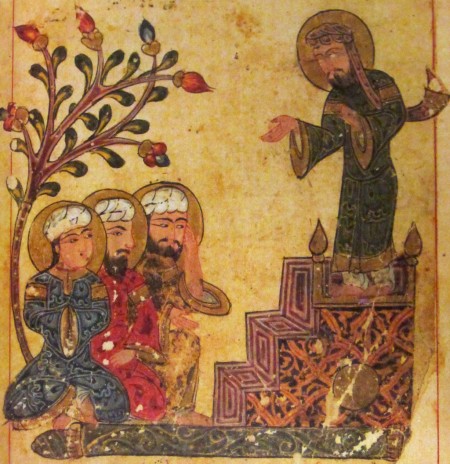
Kalilah and Dimah illustration from 13'th century Arabic manuscript

Kalilah and Dimnah, a book of practical wisdom, has been popular across Eurasia for more than a millennium.  In the mid-sixth century, royal physician Borzuya produced the first version.  Kalilah and Dimnah consisted mainly of Indian stories that Borzuya translated from Sanskrit into Middle Persian.  In the mid-eighth century, royal advisor ibn al-Muqaffa produced an Arabic version of Kalilah and Dimnah.[1]  Ibn al-Muqaffa, with a keen sense for his own position, promoted Kalilah and Dimnah vigorously.

Ibn al-Muqaffa began his introduction to Kalilah and Dimnah by evoking learned others.  Ibn al-Muqaffa wrote in the Arab-ruled Islamic Abbasid caliphate.  He came from a Persian, Zoroastrian family that was part of the conquered Sassanian regime.  Ibn al-Muqaffa was thus enmeshed in a political, cultural, and religious regime change.  The introduction to Kalilah and Dimnah begins:

The scholars of India compiled the book of fables, Kalilah and Dimnah.  It contains the most elegant proverbs, parables and analogies.  Scholars from various schools, after long toil, brought out the best of their thoughts and embodied them in a most creative manner.  This culmination of their deep reflection expressed their wisdom in fables using animals as their main characters. [2]

The Sassanian royal physician Borzuya actually compiled Kalilah and Dimnah.  Scholars of India were learned others without the status complications of the former Sassanian elite within the new Abbasid regime.  Recognizing Indian learning would be a step toward recognizing Sassanian learning.  That would be a step toward recognizing a distinctive area of ibn al-Muqaffa’s learning.[3]

While animal fables are frequently found in folktales, ibn al-Muqaffa emphasized the erudite learning contained within Kalilah and Dimnah.  Ibn al-Muqaffa implicitly recognized that Kalilah and Dimnah might be considered as containing only folktales:

The book of fables, Kalilah and Dimnah, is not written for entertainment only. … One ought not conclude that it is merely an assemblage of anecdotes about two animals [4]

Ibn al-Muqaffa described Kalilah and Dimnah as containing the best thoughts resulting from scholars’ long toil and deep reflections.  He urged intensive study of it:

The reader of Kalilah and Dimnah with all its fables should therefore spend careful and tireless time on understanding it.  … If one scrutinizes it thoroughly and meditates on the meanings embodied in the fables and analogies, he will surely become of the same mind.  The reader should therefore spend time on understanding every fable and every word in the book. [5]

According to ibn al-Muqaffa, success in reading Kalilah and Dimnah requires insight and comprehension:

Any persons who accumulates knowledge of the arts and sciences and spends his time reading books without patience and insight exhausts himself in vain. … A like frustration awaits anyone who reads this book of fables without comprehending both the apparent and implicit ideas within.  Such a reader will not benefit from the text on these pages, which offer no real value on their own except through the meaning they embody. … Reading Kalilah and Dimnah without insight will thus be time lost. [6]

Ibn al-Muqaffa’s introduction implicitly affirms that he understood the deep meanings of Kalilah and Dimnah.  Ibn al-Muqaffa thus positioned himself to serve as a tutor to a patron seeking to read it well.

Ibn al-Muqaffa described vaguely and abstractly the broad benefits of reading well Kalilah and Dimnah.  The benefits are as broad and vague as the appreciation of experience:

Whoever has learned from his own experience and that of others, and remembers and appreciates what he has learned, may appreciate these fables and take them to heart without knowing in advance how and when he will draw upon them.  He knows only that he has gained a variety of insights that could be useful at any opportune time. [7]

Ibn al-Muqaffa described the book as intended to appeal to everyone:

He who peruses this book should know that its intention is fourfold.  Firstly it was put into the mouths of dumb animals so that lighthearted youths might flock to read it and that their hearts be captivated by the rare ruses of the animals.  Secondly, it was intended to show the images of the animals in varieties of paints and colours so as to delight the hearts of princes, increase their pleasure, and also the degree of care which they would bestow on the work.  Thirdly, it was intended that the book be such that both kings and common folk should not cease to acquire it; that it might be repeatedly copied and re-created in the course of time thus giving work to the painter and copyist.  The fourth purpose of the work is to be of interest to philosophers in particular. [8]

According to the account of Borzuya’s journey to India, Borzuya produced Kalilah and Dimnah to provide immortality.  Ibn al-Muqaffa apparently added some additional chapters morally appealing from an Islamic perspective.  While illustrated books were well-known in Sassanian Persia, no direct evidence exists that Borzuya’s Kalilah and Dimnah was illustrated.  Illustrations help to make works popular.  Illustrations in Ibn al-Muqaffa’s version are consistent with his effort to make the work broadly appealing.[9]

Promoting Kalilah and Dimnah served ibn al-Muqaffa’s worldly interests.  Ibn al-Muqaffa lacked a high courtly position like Borzuya held when he created the Middle-Persian version of Kalilah and Dimnah. Ibn al-Muqaffa depended much more on success as an author.  While authors and publishers puffing books typically make money per copy sold, that almost surely wasn’t the case for ibn al-Muqaffa.  He most likely created the work for a specific patron.  Others who gained access to it could copy it without any payment to him.  However, personal status was key to scholars’ worldly success in the ancient Islamic world.  Ibn al-Muqaffa’s verion of Kalilah and Dimnah associated him with relatively attractive Indian learning.  At the same time, because its source was in Middle Persian, he had a comparative advantage in accessing it.  Ibn al-Muqaffa could cash out success as a source of Indian wisdom through patronage and position in the Abbasid court.  Relative to Borzuya’s new spiritual understanding of immortality, ibn al-Muqaffa’s worldly interests probably contributed more to generating Kalilah and Dimnah’s enduring popularity.

*  *  *  *  *

Read more:

Notes:

[1] Borzuya produced the first, Middle-Persian version of Kalilah and Dimnah under Persian king Khosrau I (Anushirvan).  Anushirvan reigned from 531 to 579 GC.  Ibn al-Muqaffa was born to a noble Iranian family in Fars in 720 GC.  He died about 756.  He probably created his version of Kalilah and Dimnah about 750.  For the scant surviving biographical details about ibn al-Muqaffa, see the Encyclopedia of Islam.

[2] Abdullah ibn al-Muqaffa’s introduction, Kalilah and Dimnah, from Arabic trans. Jallad (2002) p. 29. Jallad’s translation is based on Silvestre de Sacy’s 1816 Arabic text, as printed in Egypt in 1817 (Bulaq imprint).

[3] István Kristó-Nagy and Jennifer London have explored ibn al-Muqaffa’s non-Arabic origin in relation to his political thought and position in Abbasid intellectual circles.  See, e.g. Kristó-Nagy (2009) and Kristó-Nagy’s forthcoming book, La Pensée d’ Ibn al-Muqaffa; and London (2008) and London’s forthcoming book, Autocracy and the Foreigner: The Political Thought of Ibn al-Muqaffa.  Ibn al-Muqaffa also had interests common to authors.  Careful consideration of author’s interests is crucial to understanding otherwise inexplicable behavior, e.g. publishing scholarly work in forms difficult and expensive for almost everyone to access.

[4] Id. pp. 34, 35.

[5] Id. pp. 35, 34. Ibn al-Muqaffa seems to have been aware of different styles of reading.  The difference between intensive and extensive reading now tends to be considered in relation to the proliferation of novels since the mid-18th century.

[6] Id. pp. 29, 30, 29.

[7] Id. p. 29.

[8] Trans. Rice (1959) pp. 208-9.  I’ve eliminated the translator’s parenthetical notes and adapted the last sentence slightly.  Jallad (2002), p. 36, provides a less literal translation.  The translation in Knatchbull (1819), p. 64, seems to be abridged.  It doesn’t include the references to images, painter, and copyist.  O’Kane (2003), p. 23, mis-transcribes Rice’s “rare ruses” as “rare uses.”

[9] The frequency and position of images in illustrated versions of Kalilah and Dimnah suggests that its most popular features were “rattling good yarns, sometimes laced with risqué elements (frequently explicitly illustrated in the manuscripts), which has always had most appeal.”  O’Kane (2003) p. 26.

[image] The King of the Crows conferring with his political advisors, from illustrated Arabic Kalilah and Dimnah manuscript dated c. 1210.  Bibliothèque Nationale, Paris, via Wikipedia.

References:

Jallad, Saleh Saʻadeh, trans. 2002. The fables of Kalilah and Dimnah. London: Melisende.

Knatchbull, Wyndham, trans. 1819. Kalila and Dimna, or, The Fables of Bidpai. Oxford: W. Baxter for J. Parker.

Kristó-Nagy, István T. 2009. “Reason, religion and power in ibn al-Muqaffa.” Acta Orientalia Academiae Scientiarum Hungaricae. 62 (3): 285-301.

London, Jennifer. 2008. “How to do things with fables: Ibn al-Muqaffa’s frank speech in stories from Kalīla wa Dimna.” History of Political Thought. 29 (2): 189-212.

O’Kane, Bernard. 2003. Early Persian painting: Kalila and Dimna manuscripts of the late fourteenth century. London: I.B. Tauris.

Rice, D. S. 1959. “The Oldest Illustrated Arabic Manuscript.” Bulletin of the School of Oriental and African Studies, University of London. 22 (1/3): 207-220.

Persian royal physician Borzuya pondered Matthew’s Gospel

In his autobiography, the sixth-century Persian royal physician Borzuya explicitly referred to ancient medical writings.  Borzuya studied Persian medicine and Indian medicine.  He might have also studied Greek medicine and Egyptian medicine.  Nonetheless, in referring to ancient medical writings, Borzuya seems to have been referring to Matthew’s Gospel.

proclaiming the biography of Persian royal physician Borzuya

Borzuya studied ancient medical writings as he considered his future as a physician.  He perceived before himself a choice:

I had to choose, as it appeared to me, between four things, which in general occupy the attention and engage the affections of men: acquiring material wealth, gaining a good name, enjoying worldly pleasures, and earning rewards in the afterlife.  I found in the medical writings that the best doctor seeks with dedication to his profession only rewards in the afterlife.  I determined likewise to persevere in my profession so that I would not be like the merchant who sold a precious ruby for a worthless imitation pearl. [1]

Among the four gospels, Matthew’s Gospel alone contains a parable of a pearl:

the kingdom of heaven is like a merchant in search of fine pearls, who on finding one pearl of great value, went and sold all he had and bought it. [2]

Borzuya’s parable of the ruby reverses the merchant’s position in Matthew’s parable of the pearl.  Borzuya’s parable teaches the foolishness of a physician exchanging rewards in the afterlife for worldly goods.  Matthew’s parable allegorizes the same goods in exchange.

Immediately following Borzuya’s parable of the ruby is an authoritative assurance.  Borzuya wrote:

I found moreover in the books of the ancients that, although the physician in his practice looks chiefly to rewards in the afterlife, he does not lose his share of worldly goods. [3]

What sort of written authority would assure a physician that dedication to rewards in the afterlife would not imply worldly sacrifices, or at least not unendurable worldly sacrifices?  Matthew’s Gospel provides such authoritative assurance:

do not worry, saying, ‘What will we eat?’ or ‘What will we drink?’ or ‘What will we wear?’ For it is the Gentiles who strive for all these things; and indeed your heavenly Father knows that you need all these things. But strive first for the kingdom of God and his righteousness, and all these things will be given to you as well. [4]

In Borzuya’s autobiography, immediately following the assurance of worldly needs being met is another parable:

he {the physician who looks chiefly to reward in the afterlife} is like the farmer who sowed his land only for a crop of corn, yet after the harvest was over, found that the land also provided grass. [5]

Among the four gospels, Matthew’s Gospel alone provides a parable of weeds:

The kingdom of heaven may be compared to a man who sowed good seed in his field; but while men were sleeping, his enemy came and sowed weeds among the wheat, and went away. So when the plants came up and bore grain, then the weeds appeared also. And the servants of the householder came and said to him, “Sir, did you not sow good seed in your field? How then has it weeds?” He said to them, “An enemy has done this.” The servants said to him, “Then do you want us to go and gather them?” But he said, “No; lest in gathering the weeds you root up the wheat along with them. Let both grow together until the harvest; and at harvest time I will tell the reapers, ‘Gather the weeds first and bind them in bundles to be burned, but gather the wheat into my barn.'” [6]

In Matthew’s Gospel, the weeds parable appears near to the pearl parable.  Just as Borzuya’s ruby parable does for Matthew’s pearl parable, Borzuya’s grass parable values differently elements of Matthew’s weeds parable.  In Borzuya’s parable, the land produces crops and grass.  That’s not the work of an enemy.  The mixed harvest of crops and grass is an allegory for providential provision of worldly needs along with the harvest of goods for the afterlife.

Early manuscripts based on the Arabic Kalilah wa Dimnah include a chapter that almost surely quotes from Matthew’s Gospel.  The chapter recounts the story of the lioness and the jackal.  It contains this passage:

It has been said: ‘As you judge, you will be judged.’  As you, {lioness,} have judged and judgement has been meted out on you.  For every deed there is the fruit of the deed, reward or punishment, proportionate to the deed in greatness and smallness.  It is like seeds: When the sower has sown them the reaper pays him proportionately to what he has sown. [7]

A leading scholar of Kalilah wa Dimnah identified “As you judge, you will be judged” as a direct quotation from Matthew 7:2.[8]  Other biblical references apparently exist in the above passage and elsewhere in this chapter.[9]  Unlike ten chapters of Kalilah wa Dimnah with Indian or Middle Persian sources, this chapter does not celebrate ego-serving instrumental cleverness and deceit.  That has been put forward as an argument against it being in the book that Borzuya originally produced.[10]  On the other hand, this chapter advocates vegetarianism, asceticism, and piety.  The latter two practices clearly interested Borzuya.  Drawing upon Matthew’s Gospel further connects this chapter and Borzuya’s autobiography.

A Christian cleric who translated Borzuya’s autobiography understood it in the context of Matthew’s Gospel.  The Christian cleric translated Borzuya’s autobiography from Arabic into Syriac in the tenth or eleventh century.  He added a phrase and a two-clause quotation from Matthew’s Gospel to his translation:

Then a thought occurred to me, and I brought to mind that which was spoken by the divine Word: “Though ye do all manner of good, say ‘we are unprofitable servants,’ ” and I was terrified by that which was spoken: “Bind him hand and foot, and cast him into outer darkness.” [11]

The Christian cleric also added to Borzuya’s autobiography the phrase “weeping and gnashing of teeth.” That phrase occurs in six times in Matthew’s Gospel, and only once elsewhere in the Bible.[12]  He represented Borzuya turning to piety through Biblical language:

I became a stranger to the seat of sinners, loved quietness, delighted in good things, aspired to virtue, and chose a seat with the excellent.  They stand in awe of death, tremble at the punishment of hell, and shrink from ignominy.  But they do not tremble at any earthly prince, for  water cannot drown, nor fire burn, nor vipers sting them. [13]

The kernel of that passage exists in Matthew’s Gospel.  It also exists in Borzuya’s autobiography transmitted through non-Christian contexts.[14]  The Christian cleric’s translation added more specific references to the Bible, particularly Matthew’s Gospel, but without greatly distorting ideas and themes already existing in Borzuya’s autobiography.

Other Christian translators of Borzuya’s autobiography were more symbolically domineering.  In 1305, the physician Raimond de Béziers translated Kalilah wa Dimnah from Spanish to Latin for the queen and king of France.  Raimond significantly changed Borzuya’s autobiography:

{Borzuya} is represented as a model christian monk. Long discourses on the Christian virtues are introduced. {Borzuya} sees in a vision paradise, the Virgin Mary, the angels and all the saints of God. This vision is described in hexameters and is illustrated by miniatures. [15]

Such forms and figures are far from the autobiography that Borzuya wrote.  Yet Raimond’s approach might not have been idiosyncratic.  Borzuya’s autobiography apparently attracted attention from a Christian translator in sixth-century Persia.[16]  An extravagant Christian elaboration of Borzuya’s autobiography might have been part of a lost textual tradition that developed among Christian scholar-physicians across more than half a millennium.

Borzuya in some respects is similar to Galen.  Both Galen and Borzuya came from wealthy families and had fathers who arranged for them outstanding scholarly educations.  Both served powerful rulers as physicians and provided medical care to others with little concern for earning wealth.[17]  While Galen honored Greco-Roman gods and Borzuya came from a Zoroastrian family, both of their lives are amenable to Christian interpretation.  Galen glorified divine creation of living organisms and acted as a missionary much like Paul of Tarsus.[18]  Borzuya’s autobiography shares central themes with Augustine’s Confessions.

While surviving Christian-authored texts across more than a millennium exalt Galen as a physician, Galen has major flaws as a Christian personality.  Galen was egotistical and pugnacious.  He showed little charity toward his fellow physicians, and none for his enemies.  Galen, moreover, had great pride in his medical knowledge.  Galen favorite words in his writings were “firmly” and “accurately.”[19]

Unlike Galen, Borzuya exhibited Christian virtues of charity and humility.  Borzuya was concerned about his own soul, not his status relative to physician-competitors.  Borzuya wrote:

I did not envy any of my colleagues who had the same knowledge as I, but surpassed me in prestige and wealth, and yet in words and works lacked probity and good conduct.[20]

Borzuya described medical knowledge as having limited value and being inferior to other knowledge:

I thought about medicine and realised that a physician cannot give his patient a remedy which would heal his disease to such a degree that he would never again suffer from it, or from any other illness.  Seeing that there is no guarantee against the same disease, or an even more serious one from recurring, I come to the conclusion that knowledge of the hereafter is the only thing which brings permanent salvation from all diseases. [21]

Borzuya’s translation Kalilah wa Dimnah became widely known around the world.  Borzuya apparently also worked on a personal translation of Matthew’s Gospel.  The success of that fascinating work is beyond worldly judgment.

*  *  *  *  *

Read more:

Notes:

[1] From Borzuya’s autobiography, thought to be a sixth-century Middle Persian text surviving through Arabic translations.  Above English translation adapted from Knatchbull (1819), p. 66 (English translation from de Sacy’s Arabic text), and Nöldeke (1912) p. 12 (German translation from earliest surviving manuscripts).  Keith-Falconer (1885), p. 249, provides an English translation from a tenth/eleventh century Syriac translation from an Arabic source.  A Christian cleric with only scholarly knowledge of Syriac and no experience of salt water made that translation.  Id. p. lix-lx.  The relation to Matthew’s Gospel does not come from that Christian cleric-translator.

[2] Matthew 13:45-46.

[3] Adapted from Knatchbull (1819) p. 66 and Nöldeke (1912) p. 12.

[4] Matthew 6:31-33.

[5] Adapted from Knatchbull (1819) p. 66 and Nöldeke (1912) p. 12.

[6] Matthew 13:24-30.  The parable of the weeds is one of the few parables that Jesus explained to his disciples.  Matthew 13:36-43.  Borzuya’s autobiography ends with an explained parable.  So too does the separate account of Borzuya’s journey to India.

[7] Trans. Blois (1990) p. 36.  The three characters in the story are the lioness, the jackal, and the horseman, also called the archer.  Blois refers to the story as the story of the lioness and the horseman. Irving (1980) entitles the chapter, “The Chapter of the Archer and the Lioness.”  That translation, id. p. 185, somewhat obscures the Biblical quotation, but notes, “This may be a Christian element.  Cf. Matthew VII:2.”  Id. p. 201, n. 2.  The earliest surviving reference in Arabic to Kalilah wa Dimnah is from the early tenth century.  That reference lists the story of the lioness and the jackal (horseman) as part of the contents of Kalilah wa Dimnah.  Keith-Falconer (1885), intro., p. xix, n. 1 (referring to the history of ibn Wadith).  Blois (1990) p. 15 says the story is “not attested in India.”  Keith-Falconer (1885) p. xxxiii, in contrast, declares, “There can be no doubt that it is of Indian and Buddhist origin.”

[8] Blois (1990) p. 36. Such literary borrowing is attested. The eleventh-century GC Persian epic Vāmiq and ʿAdhrā builds upon the first-century BGC Greek novel Metiokhos and Parthenope. Hägg & Utas (2003). On motifs that Hellenistic literature and Persian literature share, Davis (2002).

[9] Id. perceives an allusion to Galatians 6:7 (“you reap whatever you sow”) and notes that the Bible frequently associates punishment and reward with fruit of a plant, e.g. Jeremiah 21:14.  The chapter also includes a reference to the Golden Rule, e.g. Matthew 7:12.  The Golden Rule in some form is common across religions.  Yet that reference contributes to the density of plausible references to Matthew’s Gospel.  Id., p. 37, states that the author of this chapter was “quite familiar with the Bible.” Another chapter included in early manuscripts based on the Arabic Kalilah wa Dimnah is “the ascetic and his guest” (alternatively, “the hermit and his guest”). In that story, the ascetic knows Hebrew.  The guest finds the sound of the Hebrew language fascinating and pleasing, and seeks to learn it.  Just as for the chapter on the lioness and the jackal, when the chapter on the ascetic and the guest was included in Kalilah wa Dimnah is unclear.

[10] Id. pp. 16-17.

[11] Trans. Keith-Falconer (1885), p. 257. Cf. Matthew 25:30, 22:13.  On the translator, see Keith-Falconer (1885) Intro., pp. lvi-lx.

[12] Matthew 8:12, 13:42, 13:50, 22:13, 24:51, 25:30; Luke 13:28.  The Christian cleric’s Syriac translation states:

I perceived that for him who is addicted to carnal pleasures, who departs from this world in the midst of luxurious ease, and sells the bliss to come for dishonest pleasures, very evil things are reserved, namely, the terrible merciless Judgement, the ceaseless weeping and gnashing of teeth, and the fire which feeds not on wood and cannot be quenched, the worm that dies not, and the shame which passes not away.

Trans. Keith-Falconer (1885), p. 261.

[13] Adapted from trans. Keith-Falconer (1885), p. 258.

[14] On the kernel of the story, cf. Matthew 10:28, Mark 16:18.  On protection from snakes, Mark 6:18, Acts 28:3-6.  Early Arabic texts mention robbery, fire, flood, and wild animals (not specifically vipers). See trans. Knatchbull (1819) p. 74, Nöldeke (1912) p. 19.

[15] Keith-Falconer (1885), intro., p. lxxxii-iii.

[16] A Syriac translation thought to be from the sixth century has survived, but apparently only in part (it doesn’t contain Borzuya’s autobiography).  Id. pp. xlii-lvi.

[17] For a biography of Galen from the leading authority on Galen, see Nutton (2013) Ch. 15.

[18] Hunayn ibn Ishaq, a Christian and a leading physician in ninth-century Baghdad, presented himself as a Christian-Galenic disciple.

[19] Nutton (2012) p. 44.

[20] Adapted from Nöldeke (1912) p. 12.

[21] Trans. Blois (1990) p. 26.

[image] Vizier Buzurjmihr reciting the biography/autobiography of Burzoe/Borzuya.  From Bodleian Library Kalilah wa Dimnah, transcribed by Muhamad ibn Ahmad in 1354 (Pococke 400).

References:

Blois, François de. 1990. Burzōy’s voyage to India and the origin of the book of Kalīlah wa Dimnah. London: Royal Asiatic Society.

Davis, Dick. 2002. Panthea’s children: Hellenistic novels and medieval Persian romances. New York: Bibliotheca Persica Press.

Hägg, Tomas, and Bo Utas. 2003. The virgin and her lover: fragments of an ancient Greek novel and a Persian epic poem. Leiden: Brill.

Irving, Thomas Ballantine, trans. 1980. Kalilah and Dimnah: an English version of Bidpai’s fables based upon ancient Arabic and Spanish manuscripts. Newark, Del: Juan de la Cuesta. {this translation unfortunately includes neither the introductory chapter by ibn al-Muqaffa, nor the account of Borzuya’s voyage to India, nor Borzuya’s autobiography}

Keith-Falconer, I. G. N, ed. and trans. 1885.  Kalilah and Dimnah: or, The Fables of Bidpai: being an account of their literary history. Cambridge: University Press.

Knatchbull, Wyndham, trans. 1819. Kalila and Dimna, or, The Fables of Bidpai. Oxford: W. Baxter for J. Parker.

Nöldeke, Theodor. 1912. Burzōes Einleitung zu dem Buche Kalila waDimna. Strassburg: K.J. Trübner.

Nutton, Vivian. 2012. “Galen’s rhetoric of certainty.” Pp. 39-49 in Joel Coste, Danielle Jacquart and Jackie Pigeaud, eds.  2012. La rhétorique médicale à travers les siècles. Actes du colloque international de Paris, 9 et 10 octobre, 2008. Geneva, Droz.

Nutton, Vivian. 2013. Ancient medicine. 2nd ed. Milton Park, Abingdon, Oxon: Routledge.

good old-fashioned social television watching

In the good old days, friends and family used to gather together in the living room to watch television.  It’s not like that any longer.  Now 40% of YouTube video views occur on mobile devices.  The social experience of television is becoming more imaginary.

* * * * *

Read more:

Video note: The above video contains an excerpt of Jamie Davidovich’s “Blue, Red, Yellow” (1974), live at the Hirshhorn Gallery (2013).  Davidovich’s work contains three television screens and runs for 12 minutes and 2 seconds.  It loops continuously.

Lancelot-Grail: Hippocrates revived dead, got humiliated & killed

Hippocrates attending to bedridden patient

An inclusion in the thirteenth-century Old French Lancelot-Grail’s History of the Holy Grail credits Hippocrates with reviving two dead persons.  The Lancelot-Grail inclusion also recounts that a beautiful woman ridiculed that feat and humiliated Hippocrates.  The inclusion ends with Hippocrates’ wife killing him with bad meat.  This inclusion, and the History of the Holy Grail more generally, foregrounds truth and doubt.  From the Middle Ages to the present, the underlying revelations of the Holy Grail’s Hippocrates tale are sobering: a human physician cannot actually revive the dead, and women’s superiority in guile is beyond reasonable doubt.

A physician reviving a dead person was credible in the ancient world.  Famous physicians, and ones seeking fame, were associated with claims of having revived the dead. The sixth-century Persian royal physician Borzuya journeyed on a highly professional trip to India to acquire medicine to revive the dead.  In eighth-century Baghdad, a story of an Indian physician reviving the dead asserted the superiority of Indian medicine over Greek medicine.  Hippocrates reputedly saved a king from lovesickness near to death.  Reviving the dead would be a plausible further feat for a physician as highly regarded as Hippocrates.

The Hippocrates inclusion in the History of the Holy Grail insists duplicitously on its truthfulness.  It describes itself as a “true story.”[1]  The inclusion declares:

Now the story says it is true — that Hippocrates was the foremost practitioner of the art of medicine, of all the men who were dominant in his time and who had worked long and diligently at this science. [2]

The distanced authority, “the story,” seems to refer to a book that the prologue declares that the narrator received from Christ himself.[3]  Around the Mediterranean world for more than two thousand years, Hippocrates has been commonly regarded as the father of professional medicine.  The inclusion further declares:

It is proven truth that in the time of the good emperor Augustus Caesar, Hippocrates came to Rome.

Hippocrates was born about 460 BGC.  Augustus reigned as Roman Emperor from 27 BGC to 14 GC.  Serious scholars in thirteenth-century France would have known that Hippocrates coming to Rome under Augustus could not be true.[4]  The question of true and false is part of the story in the History of the Holy Grail.

According to the Hippocrates inclusion, prominently positioned golden statues of Hippocrates and the Emperor’s nephew indicated to all of Rome Hippocrates success in reviving the dead.  When Hippocrates arrived in Rome, everyone was grieving deeply from the recent death of the Emperor’s nephew.

After hearing this, Hippocrates … headed for the {Emperor’s} palace, thinking that if he could arrive in time, before the soul had left, he had learned enough to bring him back to health through this medicine.  Upon arriving, he pushed through all the people until he came to the body.  They were all so intent on their grief that no one attempted to keep him away.  When he came to the body, he began to inspect that part where he might learn whether the child was dead.  Thus it happened that as soon as he had put his hands on the body, he knew the soul was still in it.  Then he opened the mouth and put inside it a liquor made from herbs of such great power and strength that the child immediately got up as healthy and well as ever.

Hippocrates was greatly acclaimed for this feat.  The Emperor had a golden statute made, “as tall as a man and as similar as one could make it to Hippocrates’s form.”  A similarly golden, life-like statue was made of the Emperor’s nephew.  These two statues were installed “on top of the highest tower of Rome, so that everyone who came would see them them clearly.”  The golden statues were protected from rain by a vaulted arch made of silver and gold.  Engraved underneath Hippocrates was an epigram:

This is Hippocrates, the paramount doctor of the philosophers, who through his wisdom brought from death to life the nephew of Augustus Caesar, the Emperor of Rome, the very one whose figure is besides him.

Deictics (“this is” … “the very one”) are characteristic of Hellenistic epigrams, as is play across presence and representation, reality and illusion.  The statues proclaiming that Hippocrates brought Augustus’ nephew from death to life are idols with no life in them.  For Jews and Christians, such idols indicate movement from life to death.

A physically beautiful woman declared that the statues were false, and she demonstrated that Hippocrates was foolish.  When she saw the statues and heard what they meant:

she began to smile and said that he who could make the dead man live again had not yet been born.  “I say,” she said, “that those who made these statues in memory of what you told me were foolish.  No matter how wise you may consider him, I tell you that if I could spend one day with him, I would make him seem crazy and foolish, for he certainly lies when he praises himself by saying he can make a man return from death to life, and I won’t believe him, whatever he may say.

Hippocrates fell in love with the beautiful woman.  He become lovesick near to death.  When Hippocrates told the woman of his love, she said that she would consent to his love if he visited her secretly.  The woman’s response immediately cured Hippocrates of his acute lovesickness.

The woman plotted to humiliate Hippocrates.  She told Hippocrates to visit her at night in a wooden vessel that she would pull up to her window.[5]  Unknown to Hippocrates, the vessel was actually used to display and shame prisoners sentenced to death.  When the night for their tryst came, instead of pulling Hippocrates up to her, she and her cousin stranded him in mid-air.  Hippocrates was a prisoner there all night.  He was shamefully displayed to all of Rome throughout the next day.

The woman further arranged to have the honorary golden statue of Hippocrates taken down.  Questioned by the Emperor, Hippocrates refused to explain how he got hung up in the vessel.  The woman artfully exposed Hippocrates:

secretly she had painted on a silver table two ladies pulling a man in a wooden vessel up to the top of a tower.  She had the figure made to look as much like Hippocrates as she could and the other figures made to resemble the ladies who had done this deed.  The table was beautiful and splendid, and after it had been painted just as you have heard, the lady had it placed during the night in front of the two statues that the emperor had placed on high in honor of Hippocrates.

The emperor saw the painted table and questioned Hippocrates about it.  Hippocrates acknowledged his depicted shame and dishonor.  The emperor, solicitous of Hippocrates’ status, ordered that the table be removed.  The woman objected with clever reasoning:

Certainly, my lord, it can be removed if you wish, but it is more just that it be before the gaze and view of the Romans than these other images, because what the statues bear witness to never really happened, and I know very well that Hippocrates, whom you consider to be a philosopher, cannot bring a dead man to life.  In these images that are painted on the table there is nothing but truth, for the thing is portrayed just as it happened.

Hippocrates acknowledged that the table depicted what actually happened.  Without giving a reason, Hippocrates then insisted that the honorary statues of him and the Emperor’s revived nephew be taken down.  The Emperor had the painted table removed and the honorary statues taken down.

Hippocrates’ humiliation did not have an enduring effect on his professional career.  Hippocrates subsequently lived in Rome “for a very long time,” greatly honored by the Emperor and the Roman people.  How much time passed since the beautiful woman stated “he who could make the dead man live again had not yet been born” isn’t made clear.  In any case, Hippocrates then heard of Jesus of Nazareth making the blind see, the deaf hear, the lame walk, and the dead come back to life.  Hippocrates decided to journey to Jerusalem to see if Jesus actually had greater medical powers than he.

While the Holy Grail tale contains nothing more about Hippocrates and Jesus, it depicts the extent and limit of Hippocrates’ power.  On his way from Rome to Jerusalem, Hippocrates met Anthony, King of Persia.  Anthony (apparently an alternate name for Artabanus III) just happened to be sailing in the Mediterranean, far from Persia, during the reign of Roman Emperor Tiberius.  The Persians had been grieving for two days for the death of the Persian king’s son.  Hippocrates went straight to the apparently dead body:

Once there, he looked it over from head to toe.  Not finding any sign of life in it, he believed the boy really was dead.  But he had a little color in his face and lips, which showed that he still had life in his body.  Hippocrates returned to one of his servants and asked for a little wool.  The latter gave it to him right away, and he took a clump and put it before the young man’s nostrils.  In this way he knew at once the truth about his state, for the boy’s breathing was so weak that it could not be seen by a man’s eyes as he inhaled and exhaled.  But Hippocrates saw the wool move slightly, and then he knew that the soul had not yet left the body and that the boy was still alive.  Then Hippocrates took a good balm that he thought would help, opened the mouth, and put it inside.  Very shortly after this, the young man let out such a loud cry that all those near him heard it. [6]

Hippocrates received great acclaim for reviving the Persian king’s apparently dead son.  Hippocrates feat enabled him to get as his wife a beautiful, twelve-year-old daughter of a king; vast riches; and a massive, luxurious house on his own island.

Hippocrates subsequently died because he did not gain love, or even just respect, from his young wife.  She sought to poison him.  She failed in one attempt because Hippocrates drank from a cup that rendered any poison harmless.  His wife then threw that cup into the sea and plotted further.  One day, Hippocrates foolishly pointed to a “wild sow in rut.”  He told his wife that anyone eating of that animal in its time of heat would die.  His wife immediately went to her cook and ordered him to kill the animal and prepare it to eat.  The wife served the sow’s head to Hippocrates.  Hippocrates naively ate what his wife served and died.

Technical knowledge, even medical knowledge to revive the apparently dead, does not enable a man to dominate a woman.  In another true story, Alexander the Great’s mistress humiliated Aristotle.  So it has been for powerful men, as well as for ordinary men, throughout history.  Within the Lancelot-Grail’s History of the Holy Grail, two messengers and a lady discussed what the story of Hippocrates revealed:

there is a devilish and very redoubtable thing in a woman, for a man’s wisdom can never protect him against her guile.

The swerving, vanishing, spectral narrator of the History of the Holy Grail seems to know the territory away from the straight path.  Some scholars believe that the great, under-appreciated medieval author Marie de France wrote the History of the Holy Grail.  Regardless of the author, the deep truth of the Holy Grail is beyond reasonable doubt.

*  *  *  *  *

Read more:

Notes:

[1] Lancelot-Grail Cycle, History of the Holy Grail (Estoire del saint Graal), from Old French trans. Chase (1993) p. 100:

But now the story leaves off speaking about them for a while, in order to tell the true story about his house that Hippocrates had built as his manor …

On the History of the Holy Grail’s insistence on truth, see Chase (1994) pp. 121-6.

[2] History of the Holy Grail, trans. Chase (1993) p. 101.  All subsequent quotes are from id., pp. 100-107.  That’s Ch. 26, “The Story of Hippocrates: His Powers, His Troubles with Women, and His Downfall” (the inclusion), plus the last and first pages of the previous and subsequent chapters.

[3] Prologue, History of the Holy Grail, id. pp. 3-9.

[4] Surviving texts of the Hippocratic corpus are written in the earlier Ionic Greek, rather than the Koine Greek of Augustus’ time.

[5] In Aristophanes’s mockery of Socrates, to study meteorological phenomena Socrates had himself suspended above ground in a basket. Aristophanes, Clouds vv. 218-34. Covertly transporting a person between an upper window and the ground using a wooden vessel or basket became well-established in world literature.  See, e.g. Paul of Tarsus’ escape from Damascus, 2 Corinthians 11:32-33; 1001 Nights, tale of Ishaq al-Mausili, nights 279-282, trans. Lyons (2008), vol. 1, pp. 902-8; Old French fabliau Le chevalier a la corbeille / Le chevaler e la corbaylle (The knight of the basket), trans. Revard (2005) pp. 117-23 (also in MS Harley 2253, Art. 82, online); and Virgil in the basket, relevant text and images reviewed in Ziolkowski & Putnam (2008) pp. 457-8, 874-90.  The last representation is typically paired with Virgil’s revenge.  That’s the story of Virgil, acting as a magician, extinguishing all the fires in Rome and making it possible for the fires to be lit only by the vagina or anus of the woman who humiliated him.  See id.

[6] Soul and breath are connected etymologically in the Latin word “anima.”

[image] Doctor, perhaps representing Hippocrates, attending to patient; f. 39 from medical texts, known as the Articella (France, Central (Paris), 1’st quarter of 14th century); British Library, Harley 3140.

References:

Chase, Carol J., trans. 1993.  “The History of the Holy Grail.” Pp. 3-166 in vol. 1, Lacy, Norris J., ed. 1993-1996. Lancelot-Grail: the Old French Arthurian Vulgate and post-Vulgate in translation. New York: Garland Publishing.

Chase, Carol J. 1994.  “‘Or dist li contes’: Narrative Interventions and the Implied Audience in the Estoire del Saint Graal.”  Pp. 117-138 in William W. Kibler, ed. 1994. The Lancelot-Grail Cycle, Text and Transformation. Austin: University of Texas Press.

Lyons, Malcolm C. 2008. The Arabian nights: tales of 1001 nights. vols. 1-3. London: Penguin.

Revard, Carter. 2005. “Four Fabliaux from London, British Library MS Harley 2253, Translated Into English Verse.” The Chaucer Review. 40 (2): 111-140.

Ziolkowski, Jan M., and Michael C. J. Putnam. 2008. The Virgilian tradition the first fifteen hundred years. New Haven: Yale University Press.