COB-83: every detail matters in bureaucratic work

The relationship between the forest and the trees is widely mis-perceived.  Every forest is made up of trees.  Without trees, there is no forest.  Stay focused on the trees.  After all, if you fail to see a tree, you could run into it and get a bloody nose.

points showing work of punctator

Just like every tree in the forest matters, details are essential in bureaucratic work.  Remember the celebrated bureaucratic career of Berechiah ha-Nakdan.  He was a thirteenth-century Jewish intellectual worker living in France or England.  Probably in part because writing materials were expensive, ancient Hebrew texts were written without vowels.  Missing vowels, like incompletely filled-in forms, pain bureaucrats to the very soft outer skin of the souls of their feet (they spend most of their time sitting).

Berechiah ha-Nakdan evidently worked in a department that addressed the problem of missing vowels in Hebrew texts.  He was a “punctator,” probably a Senior Managing Punctator (SMP).  Punctators added points (dots and other small marks) below the letters of Hebrew texts so that the vowels would be fully specified.  A page of Hebrew text containing a thousand letters could easily require two or three thousand additional individual points.  Thirteenth-century punctators faced a crushing burden of important bureaucratic work.  But like many heroic bureaucrats through the ages, they sat through the challenge.  Berechiah ha-Nakdan’s monumental work as a SMP was recognized in his very name: “ha-Nakdan” means “the punctator.”  Other than Ali Kazma the Rubber Stamper, no one else in history has made for himself a name as distinguished as Berechiah ha-Nakdan.

In other bureaucratic issues this month, the Standing Committee for the Food Chain and Animal Health (SCOFCAH) of the European Union (EU) has established new rules that make importing giraffes easier. The EU’s SCOFCAH should be commended for this tall achievement.

Jona Lendering and Bill Thayer at New at LacusCurtius and Livius explain that an elderly historian in 2040 will find that the humanities departments have closed.  Closing departments is a serious challenge for bureaucrats struggling to hang on to their positions.  Lendering and Thayer see the closing of humanities departments as a self-inflicted catastrophe:

The historian will conclude that the humanities had committed suicide.  Still, there had been people, inside and outside the universities, who had done their best.  People who had refused to join the academic rat race, who had not been interested in the length of their publication list, who were really interested in the dialog with the larger audience.

The job of bureaucrats in universities is to lengthen their publication list by producing documents.  Producing documents has no relation to any audience whatsoever.  That’s why academic journals are distributed in a limited number of paper copies.  University bureaucrats should not be punished for following their job descriptions.

When Andrew Mason was fired as Groupon CEO this past February, he wrote a farewell memo.  That’s standard bureaucratic practice.  Unfortunately, some entrepreneurs posted his standard letter on the innovative, interactive text platform rapgenius.  This new platform threatens corporate-speak.  For example, Mason wrote:

I’ve decided that I’d like to spend more time with my family. Just kidding – I was fired today.

That’s a bad enough breach of standards.  But then Marc Andreessen, a leading funder of ventures hostile to bureaucrats, added an annotation:

Over the last 20 years it has become customary in business for executives to claim to be “resigning to spend more time with my family” when they have actually been fired. It has become such a cliche that it is now a sort of running joke in corporate-speak.

(The additional subtext to the joke is that most executives are not liked by their families, who would prefer that they not spend more time at home and try to get them into a new job as quickly as possible.)

Bureaucrats must resist these sorts of textual innovations.  As newspaper journalists have repeatedly reported, nothing can replace the feel of paper.

That’s all for this month’s Carnival of Bureaucrats.  Enjoy previous bureaucratic carnivals here.  Nominations of posts to be considered for inclusion in next month’s carnival should be submitted using Form 376: Application for Bureaucratic Recognition.

false accusations of rape in world literature

In world literature throughout history, a prevalent motif is a man being falsely accused of rape.  Sex and violence are common features of animal life.  False accusations of rape are matter of higher culture. False accusations of rape provide insight into human sociality and communication across millennia.

metal grate imprisons falsely accused

A false accusation of rape prompted male sexual renunciation in the ancient Egyptian story of two brothers.  In this story, which was written about 1225 BGC, the older brother’s wife sexually propositioned the younger brother.  He rebuffed her sexual advance.  She then made herself look beaten and sick.  She told her husband that his brother sought to have sex with her and beat her.  She demanded that he kill his brother, or she would kill herself.  Moreover, she urged her husband not to let his brother speak; she claimed that otherwise the younger brother would escape and attack her again.  The older brother prepared to ambush and kill his younger brother returning home in the evening.  But the cows that the younger brother was herding home warned him of his older brother’s ambush.  The younger brother fled, with the older brother in murderous pursuit. The Sun God intervened in the chase to separate the brothers by a river containing crocodiles.  The younger brother explained what happened. After he finished explaining with words, he cut off his own penis and threw it in the river.[1]  Recognition of men’s inferiority in guile prompted a man’s sexual renunciation before his brother.

In Homer’s Iliad, a false accusation of rape forced Bellerophon to demonstrate extraordinary heroism.  Bellerophon was residing as a guest of King Proteus.  Proteus’s wife Antea lusted for Bellerophon.  Bellerophon refused her sexual advances.  Antea then told Proteus that Bellerophon was attempting to seduce her forcefully.  She urged Proteus to kill Bellerophon.  However, in ancient Greek ethics, killing a guest is immoral.  Without giving Belleropon a hearing, Proteus sent Bellerophon to Antea’s father Lycia with a private message requesting Bellerophon’s death.  Lycia sent Bellerphon on tasks intended to bring about his death.  Bellerophon killed the fire-breathing monster Chimaera with the heat of her own breath, he defeated the fiercely violent Solymanas tribe, and he overcame the Amazons.  Bellerophon also wiped out an ambush that Lycia himself set with his strongest men.  Lycia then embraced Bellerophon as a son.[2]  Few men would have the strength to overcome such mortally dangerous obstacles to earn basic human acceptance.

The story of Joseph and Potiphar’s wife shows a false accusation of rape ultimately failing to overcome blessedness.  Joseph, sold into slavery by his brothers, became a slave in the house of the Egyptian Potiphar.  Potiphar was the Pharaoh’s captain of the guards.  Potiphar’s wife became infatuated with Joseph.  “Lie with me. Lie with me!” she ordered him.  He refused.  He could not report this workplace harassment to the HR Department’s EEOC Officer, because that didn’t exist in ancient Egypt.  So he fled, leaving behind Potiphar’s wife clutching his garment.  She took the garment to Potiphar and falsely accused Joseph of attempting to rape her.  Without giving Joseph a hearing, Potiphar imprisoned Joseph.  But God made this imprisonment work for the good of Joseph.  Joseph gained through his imprisonment key opportunities for dream interpretation.  He subsequently rose to be the Pharaoh’s chief executive.[3]  Few men have faith that they are so blessed.

The younger Egyptian brother, Bellerophon, and Joseph faced false accusations of rape in cosmopoetic literature.  False accusation of rape was also a motif in less symbolically prominent, popular literature.[4]  One such example is the Book of Sindibad / Seven Sages of Rome corpus.  This corpus became widely distributed in western Eurasia from 500 to 1500 GC.[5]  In the frame narrative of that corpus, the king’s wife propositions her step-son.  He rejects her sexual advance.  She then tells the king that his son attempted to rape her.  Without a hearing from his son, the king orders his son killed.  The king’s counselors intervene and urge restraint with cautionary fables.  The king’s wife pushes for death with competing fables.  The king vacillates:

  • {counselor} “Sir, I have not related this fable to you for any reason except that you may understand the deceits of women, whose wiles are potent and numberless.” And the king ordered that his son should not be killed.
  • {wife} “Sir, if you do not see to the punishment of your son before he commits further atrocities, he will destroy you.” And the king ordered his son put to death.
  • {counselor} “Sir, I told you this story only so that you would not execute your son on the word of a woman, for in women are contained deceits without number.” And the king ordered the execution stayed.
  • {wife} “Sir, I have related this tale to you so that you will not depend upon your wicked counselors.  If you do not wreak justice for me on the one who has wronged me, I shall destroy myself with my own hands.”  And the king ordered his son put to death.
  • {counselor} “Sir, I have related this tale to you so that you will not execute your son until you know the truth, and will not be sorry.”
  • {wife}”If you do not give me satisfaction against this prince, you will see what these wicked counselors will do for you.  After I am dead we shall see what you will get from their advice.  And when you stand before God, what will you say, having committed such a great wrong in letting your son live and having refused to see justice done?  And how can you, failing to do what is just in this world, permit him to live, on the recommendation of your wicked advisors and privy-counselors?  I know that you will be called to account by God!” … the king feared that she would take the poison she was carrying in her hand, and he ordered his son slain. [6]

Not this story competition, but the son finding his voice resolves the matter.  The son tells the truth of what happened to him.  The king believes the truth that his son tells him.  In various versions, the wife is then alternatively hanged, burned in a dry caldron, thrown into the sea with stone tied to her foot, or paraded through the city shamefully on an ass.[7]  But that’s not all.  In the Hebrew version, the son pardons his step-mother and “the King and the officers that were with him, and the whole nation, were happy to forgive her sin.”  The king gratefully offers to fulfill any request his leading sage, who had educated his son, makes.  The sage declares: “my petition and my request is that what is hateful unto you do not do to your neighbor, and love your neighbor as yourself.” [8]

False accusations of rape are a serious public problem today.  Consider the painful and damaging situation that Michael Arrington had to confront.  Or the experience of the man accused of making a sexually threatening post on Facebook (further developments in the case).  The Committee of the Wrongly Accused provides impressive case records and analysis of the injustice of false accusations of rape.  The number of men whose lives are destroyed through false accusations of rape surely is much smaller than the number of men who die from accidents.  But terrible injustices in addressing false accusations of rape aren’t individual misfortunes.  They are a systemic problem that undermines the legitimacy of the justice system.

Few persons today take seriously the problem of false accusations of rape.  Just as most men wouldn’t rape a woman, most women wouldn’t falsely accuse a man of rape.  Men tend to be afraid to discuss false accusations of rape, because those seeking to silence them might call them “antifeminists” or “misogynists.”  Women generally aren’t interested in discussing false accusations of rape, because they don’t understand how addressing this problem is in their interests.  Similar communicative circumstances have probably existed for millennia.  Stories of false accusations of rape probably circulated widely because false accusations of rape was a serious public problem difficult to discuss directly.

*  *  *  *  *

Read more:

Notes:

[1] John A. Wilson’s translation of the relevant part of the story is available in Pritchard (2010) pp. 11-14 (online here).  The two brother’s names were Anubis and Bata.  The text is from the Papyrus D’Orbiney in the British Museum.  The British Museum’s summary of the story fails to mention that Bata cut off his own penis.

[2] Homer, Iliad, Bk 6, ll. 155-203.  A translation of Bk. 6 is available online.

[3] Genesis, Ch. 39-41.  A version of the story exists in the Qur’an, Surah 12.  Over time writers developed excuses for Potiphar’s wife’s false accusation (Joseph was handsome and good-looking, he incited her, etc.)  The sex-specific aspects of the problem have also been obscured.  Goldman (1995) well illustrates these trends.

[4] Thompson (2008) provides relevant citations under the motif K2111: “Potiphar’s wife.  A woman makes vain overtures to a man and then accuses him of attempting to force her.”  This gynocentric description reflect the typical social distribution of concern.

[5] Versions in the area of the eastern Roman Empire and Mesopotamia tend to be called the Book of Sindibad.  Version in the area of the western Roman Empire tend to be called the Seven Sages of Rome.  From the fifteenth century or earlier versions of the Book of Sindibad survive in Persian, Hebrew, Syriac, Arabic, Greek, and Old Spanish.  An early western version is a Latin work called Dolopathos, dating to about 1200.  Versions subsequently appeared in all the European vernaculars.  In Europe, 40 different versions have survived in over 200 manuscripts.  Epstein (1967) p. 3.  A version exists in the 1001 Nights, across nights 578-606 (Macnaghten / Calcutta II edition).  Within the 1001 Nights, the Book of Sindibad is known as the story of the seven viziers.  Clouston (1884) provides English translations of the Persian and Arabic versions.  Scholars have argued that the original source was either Indian, Persian, or Hebrew.  See, e.g. Perry (1960) and Epstein (1967).

[6] El libro de los engaños e asayamientos de las mugeres (The Book of the Wiles of Women), trans. from Old Spanish in Keller (1956), pp. 23, 24, 26, 27, 28, 32.  This text, a version of the Book of Sindibad, was written in 1253.

[7] Epstein (1967) p. 295, n. 2.

[8] Mishle Sendebar (Tales of Sendebar), trans. from Hebrew in id. pp. 295, 297.

References:

Clouston, William Alexander. 1884. The book of Sindibad, or the Story of the king, his son, the damsel and the seven vazirs: from the Perzian and Arabic. Privately printed.

Epstein, Morris. 1967. Tales of Sendebar. An edition and translation of the Hebrew version of the Seven sages, based on unpublished manuscripts. Philadelphia: Jewish Publication Society of America.

Goldman, Shalom. 1995. The wiles of women / the wiles of men: Joseph and Potiphar’s wife in ancient Near Eastern, Jewish, and Islamic folklore.  Albany: State University of New York Press.

Keller, John Esten. 1956. The book of the wiles of women. Chapel Hill: University of North Carolina Press.

Perry, Ben Edwin. 1960. “The Origin of the Book of Sindbad.” Fabula. 3 (1): 1-94.

Pritchard, James Bennett. 2010. The ancient Near East: an anthology of texts and pictures. Princeton, N.J.: Princeton University Press.

Thompson, Stith. 2008. Motif-index of folk-literature: a classification of narrative elements in folktales, ballads, myths, fables, medieval romances, exempla, fabliaux, jest-books, and local legends. Bloomington: Indiana University Press.

kiss my ass: struggle against matriarchy in medieval Europe

Deep in the woods, a knight confronted another knight. One dropped his sword and begged for mercy. The other issued an ultimatum: either joust with me to the death, or kiss my ass. The first knight eagerly chose to kiss ass. The other knight dismounted, turned, bent over, and bared ass:

The {first} knight looked into the crevice, and because the hole and the other parts seemed to run together, he thought that he had never seen such a long arsehole. Then, like a baseborn coward, he gave it a thick kiss, smack on the spot right near the hole. [1]

The second knight, satisfied, declared, “I am Beranger Longbottom, who puts all cowards to shame.” Beranger Longbottom then rode off home.

knight in armor

Beranger Longbottom was the first knight’s wife in disguise. She despised her cowardly, low-born husband. To further humiliate him, she invited her lover to be with her and to remain with her when her defeated husband returned home. Her husband scolded her for blatantly cavorting with her lover. She declared that if he denounced her, she would complain to Beranger Longbottom, who would humiliate him. The husband was filled with great shame and rage. But he knew that he was defeated. He no longer objected to her extra-pair affair.

So goes the story of Beranger Longbottom. It’s a thirteenth-century Old French fabliau. Other medieval stories similarly tell of men, inferior to women in guile and lacking Ovidian learning in love, kissing women’s asses.[2] Such stories, along with other literature of men’s sexed protests, show popular awareness of matriarchy.

While dislodging matriarchy is more difficult than evenly dividing a fart, medieval stories show signs of resistance and struggle. Another medieval fabliau tells of a man ordered to kiss the ass of the woman he loved in order to demonstrate his true love for her. Here’s how the story goes. A maid served a high-born Lady contemptuous of her husband’s family. A squire served the Lady’s husband and was her husband’s brother. The squire loved the maid. The maid told the Lady about the squire’s love:

“Ah,” said the Lady, “does he so?
Is his love true? How can you know?”
“Madame, his love is true and whole,
he’s sworn it deeply, on his soul!”
“Really? Go back and tell this squire
he shall not have your love entire,
because you cannot know if he
loves you with heart both whole and free —
unless he first can pass one test
by which he’d set your doubts at rest:
to kiss your ass — all privately,
of course, no gentlefolk would see [3]

After learning that the squire, love-besotted, had agreed to kiss the maid’s ass, the Lady arranged a bet with her husband:

“Milord,” she said, “just come with me
if your own brother you would see
kissing the ass-hole of my maid!”
“Never!” he said, “I cannot think he
ever would do a thing so stinky!”
“Yes, by St. Martin, it’s all set —
a tun of vintage wine I’ll bet
that from this window you will see it!”

The maid bent over in the garden beneath a pear tree, with the Lady and her husband surreptitiously watching from the window. But then, I think, the maid, sensing the squire’s manly presence and desire, lovingly signaled to him to kiss with a different organ, at a slightly lower location. The squire held her tightly and performed his manly function with huge vigor.[4] The squire and the maid subsequently married. In the work of the tale, they surely lived happily ever after. The husband toasted his brother’s virility. The Lady, having lost her bet and now more knowing, henceforth honored and respected her husband’s family.

The maid and the squire subverted the Lady’s degrading, ass-kissing plot. That’s just a fabliau. Yet there is historical truth in it. Ordinary men and women, suffering under matriarchal oppression, can resist with pleasure and laughter.

* * * * *

Read more:

Notes:

[1] “Bérengier au Lonc Cul” (Beranger Longbottom), trans. from Old French verse, Hellman & O’Gorman (1965) p. 64. The subsequent quote is from id. For translation into English verse, Eichmann & DuVal (1992) pp. 99-106.

[2] For another example of the “kiss my ass” motif, see Chaucer’s The Miller’s Tale. In the Old French story Audigier from the end of the twelfth century, the old, ugly lady Grinberge compelled the knight Audigier to kiss her ass. See Audigier, trans. Brians (1973) pp. 57-68.

[3] “La Gageure” / “La gagure, ou L’esquier e la chaunbrere” (How a Well-Hung Squire Cost the Snobbish Lady a Tun of Wine), trans. from Old French verse, Revard (2005) p. 125. The subsequent quote is from id. p. 126. A version of this fabliau is available online in MS Harley 2253, Art. 84. On evenly dividing a fart, see Chaucer’s The Summoner’s Tale.

[4] In editorial comments, Revard (2004), p. 124 declares that this fabliau involves “forcible lovemaking in a non-missionary position” and is “violently misogynistic.” Forcefully making love in a non-missionary position is not rape if the force of the lovemaking was consensual. Other scholars might declare that a rape has occurred and seek to have incarcerated the fictional squire, or perhaps the fabliau’s author. Particularly in the context of the demonization of male sexuality, these are misandristic approaches. All reading involves interpretation. Academic literary study now celebrates multivocality, ambiguity, complexity, and transgression. Those academic fashions, or good faith in men, allow room for enjoying this fabliau.

References:

Brians, Paul, trans. 1973. Bawdy tales from the courts of medieval France. New York: Harper & Row.

Eichmann, Raymond, and John DuVal, ed. and trans. 1992. Fabliaux, fair and foul. Binghamton, N.Y.: Medieval & Renaissance Texts & Studies.

Hellman, Robert, and Richard O’Gorman, ed. and trans. 1965. Fabliaux; ribald tales from the old French. New York: Crowell.

Revard, Carter. 2005. “Four Fabliaux from London, British Library MS Harley 2253, Translated Into English Verse.” The Chaucer Review. 40 (2): 111-140.

Jesus the good physician amid bad ancient medicine

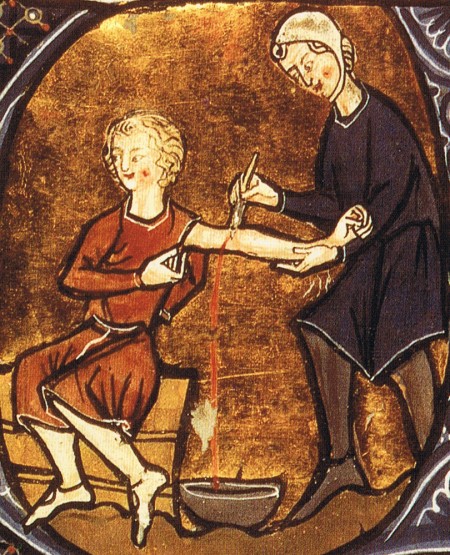
medieval physician performing blood-letting

According to Christian scripture, Jesus of Nazareth and his disciples were popularly acclaimed healers within a highly competitive medical services market.  A Syriac Christian text, probably from no later than the early fifth century, addressed Jesus as “Jesus, the Good Physician.”  The epithet “the Good Physician” was not just abstract spiritual praise.  In the Roman Empire, bad physicians traded on complex, intellectually prestigious, costly, and dangerous treatments to amass great wealth for themselves.  Jesus the Good Physician healed without cost through a word or a touch.

Bad physicians converted medical knowledge into prestigious professional secrets.  Once upon a time, persons grateful for cures inscribed those cures on the walls of the temple of Asclepius (Asculapius), the god of medicine.  Hippocrates copied the inscribed cures into books.  After the temple of Asclepius burned down, these once-public inscriptions became the Hippocratic school’s professional trade secrets.  The public came to attach great intellectual prestige to Greek learning.  Greek medical treatises and Greek doctors then dominated the Roman medical business.  That is the professional history of medicine according to the Roman statesman and encyclopedist Pliny the Elder, writing about the time of Jesus.[1]

Bad physicians were avaricious.  Pliny explained:

There was no limit to the profit from medical practice, for one of the pupils of Hippocrates, Prodicus, born in Selymbria, founded iatraliptice (“ointment cure”), and so discovered revenue even for the anointers and drudges of the doctors.

{ nec fuit postea quaestus modus, quoniam Prodicus Selymbriae natus, e discipulis eius, instituit quam vocant iatralipticen et unctoribus quoque medicorum ac mediastinis vectigal invenit. }

According to Pliny, no art brings greater monetary profits to practitioners than does medicine.  Pliny explained that some believe nothing is beneficial unless it is costly.  Pliny described physicians receiving huge incomes and amassing enormous wealth from serving emperors.

Bad physicians favored false knowledge.  Pliny deplored bad physicians’ irresponsibility:

their out-of-the-way use of hot water in sickness, their strict fasts for patients, who when in a fainting condition are stuffed with food several times a day, their thousand ways of changing their minds, their orders to the kitchen, and their compound ointments, for none of life’s seductive attractions have they refrained from incorporating. … There is an elaborate mixture called theriac, which is compounded of countless ingredients, although Nature has given as many remedies, anyone of which would be enough by itself.  The Mithridatic antidote is composed of fifty-four ingredients, no two of them having the same weight, and some are prescribed at one sixtieth part of one denarius.  Which of the gods, in the name of Truth, fixed these absurd proportions?  No human brain could have been sharp enough. It is plainly a showy parade of the art, and a colossal boast of science. And not even the physicians know their facts.  I have discovered that instead of Indian cinnabar there is commonly added to medicines, through a confusion of names, red lead, which, as I shall point out when I discuss pigments, is a poison.

{ in morbis aquarum calidarum deverticulis imperiosa inedia et ab isdem deficientibus cibo saepius die ingesto, mille praeterea paenitentiae modis, culinarum etiam praeceptis et unguentorum mixturis, quando nullas omisere vitae inlecebras. … theriace vocatur excogitata compositio. fit ex rebus sexcentis, cum tot remedia dederit natura quae singula sufficerent. Mithridatium antidotum ex rebus LIIII componitur, inter nullas pondere aequali et quarundam rerum sexagesima denarii unius imperata, quo deorum, per Fidem, ista monstrante! hominum enim subtilitas tanta esse non potuit, ostentatio artis et portentosa scientiae venditatio manifesta est. ac ne ipsi quidem illa novere, conperique volgo pro cinnabari Indica in medicamenta minium addi inscitia nominis, quod esse venenum docebimus inter pigmenta. }

Pliny described one physician as successfully gaining a large following by combining medicine with astrology.  A competing physician responded by substituting cold baths for hot baths “even during the winter frosts.”  Such innovations did not serve sick patients:

There is no doubt that all these, in their hunt for popularity by means of some novelty, did not hesitate to buy it with our lives.  Hence those wretched, quarrelsome consultations at the bedside of the patient, no consultant agreeing with another lest he should appear to acknowledge a superior.  Hence too that gloomy inscription on monuments: “It was the crowd of physicians that killed me.” Medicine changes every day, being refurbished again and again, and we are swept along on the puffs of the clever brains of Greece.

{ nec dubium est omnes istos famam novitate aliqua aucupantes anima statim nostra negotiari. hinc illae circa aegros miserae sententiarum concertationes, nullo idem censente, ne videatur accessio alterius. hinc illa infelix monumentis inscriptio, turba se medicorum perisse. mutatur ars cottidie totiens interpolis, et ingeniorum Graeciae flatu inpellimur }

Physicians came not just for the sick, but also for the healthy.  Physicians governed daily life:

Those, I say, have ruined the way of life of the Empire. I mean the practices to which we submit when in health — wrestlers’ ointments, as though they were intended to treat ill health; broiling baths, by which they have persuaded us that food is cooked in our bodies, so that everybody leaves them the weaker for the treatment, and the most submissive are carried out to be buried; the sips taken fasting; vomitings followed by further heavy drinks; effeminate depilations produced by their resins, and even the vaginas of women exposed to public view.

{ illa perdidere imperii mores, illa quae sani patimur, luctatus ceromata ceu valitudinis causa instituta, balineae ardentes quibus persuasere in corporibus cibos coqui ut nemo non minus validus exiret, oboedientissimi vero efferrentur, potus deinde ieiunorum ac vomitiones et rursus perpotationes ac pilorum eviratio instituta resinis eorum, itemque pectines in feminis quidem publicati. }

The problem is not just bad physicians, but also human nature:

The medical profession is the only one in which anybody professing to be a physician is at once trusted, although nowhere else is an untruth more dangerous. We pay however no attention to the danger, so great for each of us is the seductive sweetness of wishful thinking.

{ in hac artium sola evenit ut cuicumque medicum se professo statim credatur, cum sit periculum in nullo mendacio maius. non tamen illud intuemur, adeo blanda est sperandi pro se cuique dulcedo. }

Within common understanding of the physician’s heart is personal care.  The sick and the well yearn for a good physician.

Ancient followers of Jesus understood Jesus to be a good physician in ways that contrast specifically with Pliny’s description of bad physicians.  In the Gospel of Mark, a woman suffering from an issue of blood for twelve years received no benefit from the services of other physicians:

She had endured much under many physicians, and had spent all that she had; and she was not better, but rather grew worse.

{ καὶ πολλὰ παθοῦσα ὑπὸ πολλῶν ἰατρῶν καὶ δαπανήσασα τὰ παρ᾽ αὐτῆς πάντα καὶ μηδὲν ὠφεληθεῖσα ἀλλὰ μᾶλλον εἰς τὸ χεῖρον ἐλθοῦσα }[2]

She was healed just by touching Jesus’ clothes.

Jesus and other outstanding physicians were believed to be capable of raising the dead.  In the ancient medical business, what made Jesus distinctive as a good physician was more than a reputation for raising the dead.  In a Syriac text probably from no later than the early fifth century, Abgar, the King of Edessa, wrote to Jesus:

Abgar Ukkama, to Jesus, the Good Physician, who has appeared in the country of Jerusalem. My Lord: Peace. I have heard of you and of your healing, that it is not by medicines and roots that you heal, but by your word you open the eyes of the blind, you make the lame to walk, you clean the lepers, and you make the deaf hear.  And unclean spirits and lunatics, and those tormented, them you heal by your word.  You also raise the dead. [3]

In this text, raising the dead is a supplementary medical capability.  King Abgar had a physical illness.  His first interest was in the sort of healing usually done with medicines and roots.  Jesus could heal with just words: “only say the word, and my servant will be healed {μόνον εἰπὲ λόγῳ καὶ ἰαθήσεται ὁ παῖς μου}.”[4]  Abgar requested Jesus to come and heal him.  Jesus, focused on his primary mission in Jerusalem, promised to send one of his disciples to Edessa to heal Abgar.  The disciple who went to Abgar was Addai the Apostle.  Addai was one of the seventy-two first apostles of Jesus.  Addai, with a touch of his hand, healed Abgar instantly.  Addai then refused to take any gold and silver for his healing service.  Instead, he proclaimed publicly the new knowledge of Jesus.  Simple, costless healing, without effort to conceal professional knowledge, characterized Jesus and his apostle Addai as good physicians.[5]

Many good physicians today draw upon deep medical knowledge and complex medical procedures.  Nonetheless, what makes a good physician today has important commonalities with what made a good physician in Jesus’s day. The good physician does only what is truly necessary to make the patient well and shares with others knowledge to heal.

*  *  *  *  *

Read more:

Notes:

[1] Pliny the Elder, Natural History, Latin text and English translation from Rackham, Jones & Eichholz (1949), Bk. 29, sec. 2.  Pliny’s history appears to be similar in form to recent scholarly work on discrimination against men on sinking ships.  Nutton (2013), p. 168, describes Pliny as having provided a “magnificently malicious account of the crimes and follies of the medical profession.”  The dominance of Greek medicine was real.  More than 95% of doctors known to have worked in Italy or the western Latin provinces of the Roman Empire before 100 GC had Greek names.  Id.  All the subsequent references and quotes, unless otherwise noted, are from Pliny, Natural History, Bk. 29, secs. 1-9.  I’ve made minor stylistic changes to some of the quoted translations for ease of reading.

[2] Mark 5:26.  Luke, a physician according to Christian tradition, omits that the woman had endured much {suffering} under physicians’ treatments and had only gotten worse.  Luke 8:43.  Matthew omits all reference to physicians in this story.  Matthew 9:20.

[3] The Doctrine of Addai, trans. from Syriac in Phillips (1876).  I’ve modernized the English of the translation.  The subsequent account above is from the Doctrine of Addai.  Abgar’s letter to Jesus probably isn’t historical.  In any case, it contains an early Christian understanding of Jesus.  Subsequently Addai refers to Jesus as “Jesus Christ, the Physician of troubled souls, and the Saviour of future life, the Son of God.”  The context backgrounds mundane healing practice and highlights Christian doctrine.  For a general review and analysis of the Doctrine of Addai, see Griffith (2003).  On the rise of Christianity in Edessa and Syria, El-Badami (2006).

Jesus was known as a physician from no later than the second century. In that century, both Ignatius, Bishop of Antioch, and Justin Martyr referred to Jesus as a physician.  Rayner (1973) p. 85, Ordine (2017).

A struggle for authority between the ancient Greek physician-god Asclepius (Aesculapius) and Jesus occurred in the second and third centuries. In To the Nations {Ad nationes} 2.14, Tertullian disparaged Asclepius  as “illegitimate, since from an uncertain father {spurius ut incerto patre}” and claimed that Asclepius “puts medical arts for sale in violation of duty {praeuaricatione uenalis medicinae agebat}” and “was trumpeted as condemned for his desire and greed for money {cupiditatem et avaritiam lucri in eo canit iudicatam}.” Similarly, Tertullian, Apology {Apologeticum} 14.5. Cf. Heyne (2011). In contrast, Tertullian in Against Marcion {Adversus Marcionem} 3.17 described Jesus as “healer {mediator}.” Origen’s Against Celsus / Contra Celsum {Κατὰ Κέλσου}, written about 248 GC, disparaged Asclepius and described Jesus as the great physician. Pease (1914) p. 74; Arbesmann (1954) p. 3. On the conflict more generally, Spampinato (2020).

Both Jerome and Augustine lauded Jesus as a physician. Jerome referred to Jesus as “the true physician {verus medicus}”, “the only physician {solus medicus}”, “himself both physician and medicine {ipse et medicus et medicamentum}”, “true head physician {verus archiater}”, and “a kind of Hippocrates for the spirit {quasi spiritualis Hippocrates}.” For textual references, Pease (1914) pp. 74-5. Augustine frequently used the theme “Christ the physician {Christus medicus}.” For textual references, Arbesmann (1954), Marciniak (2019).

An inscription found at the site of the Roman city of Thamugadi (Timgad) in present-day Algeria states:

I beg you to help me, Lord Christ, you alone are the physician of saints and penitents.

{ Rogo te, Domine, subveni, Christe, tu solus medicus sanctis et penitentibus }

Latin text from Monceaux (1924), my English translation. The inscription probably dates from late-fourth-century conflict under the Donatist Bishop Optatus of Thamugadi. See note of M. Albertini, associated with Monceaux (1924). Cf. Rayner (1973) p. 88.

[4] Matthew 8:8.

[5] In a medieval Jewish story, a demon at a heathen (Christian) medical shrine says to a Jew who came there for healing:

If you are Jewish, why have you come here?  Can a Jew traffic in idolatry?  Don’t you know that heathen rites have nothing real in them?  It is for this reason that I am misleading them, so they will cling to error, and they’ll have no portion in the world to come.  But you, why have you run to alien worship instead of standing up to pray before the Holy One, blessed be He, who is the one to cure you?  You should know that by tomorrow your time had come to be healed, but because you have done this, you will never find a cure.  Therefore, do not trust in any mortal being, but rather in the Holy One, blessed be He — for He, this kingly God, is a physician who heals for free!

Trans. Rosenberg (1998) p. 97 (on 2nd commandment).  Despite Jesus healing for free, the sale of blessings and unctions for the sick became deplorably prevalent in the medieval Christian church.

References:

Arbesmann, Rudolph. 1954. “The Concept of Christus Medicus in St. Augustine.” Traditio. 10: 1–28.

El-Badami, Emran.  2006. “Tales of King Abgar: A Basis to Investigate Earliest Syrian Christian Syncretism.” Journal of Assyrian Academic Studies v. 20, n. 2.

Griffith, Sidney H. 2003. “The Doctrina Addai as a Paradigm of Christian Thought in Edessa in the Fifth Century.” Hogoye Journal of Syriac Studies 6.2: 269-292.

Heyne, Thomas. 2011. “Tertullian and Medicine.” Studia Patristica. 50: 131–174.

Marciniak, Bernard Jarosław. 2019. “Medical Metaphors in Augustine’s Letters.” Vox Patrum. 71: 373-388.

Monceaux, Paul. 1924. “Nouveau Fragment de l’Inscription ChréTtenne de Timgad relative au Christus Medicus.” Comptes rendus des séances de l’Académie des Inscriptions et Belles-Lettres. 68 (1): 78–81. Note de M. Albertini directeur du service des antiquités de l’Algérie.

Nutton, Vivian. 2013. Ancient Medicine. 2’nd ed. London: Routledge.

Ordine dei Ministri degli Infermi Religiosi Camilliani. 2017. “Christe the physician in the thought of St.Augustine.” Posted online Sept. 5, 2017.

Pease, Arthur Stanley. 1914. “Medical Allusions in the Works of St. Jerome.” Harvard Studies in Classical Philology. 25: 73–86.

Phillips, George, ed. and trans. 1876. The doctrine of Addai, the Apostle: now first edited in a complete form in the original Syriac, with an English translation and notes. London: Trübner.

Rackham, H., W.H.S. Jones, and D.E. Eichholz. 1949-54. Pliny the Elder. Natural history. Loeb Classical Library. Cambridge, MA: Harvard University Press.

Rayner, S. L. 1973. The Early Church and the Healing of the Sick. M.A. Thesis, Durham University, UK.

Rosenberg, Joel.  1998.  “Midrash on the Ten Commandments.”  Ch. 5 (pp. 91-120) in Stern, David, and Mark Mirsky. 1998. Rabbinic fantasies: imaginative narratives from classical Hebrew literature. New Haven: Yale University Press.

Spampinato, Gaetano. 2020. “The Use of the Figure and the Myth of Asclepius in the Greek anti-pagan Controversy.” Electra (Departmentof Philology, University of Patras, Greece). 5. Online.