guile and wiles of women impossible to compile

In versions of the Book of Sindibad extant from Spain to Persia about a millennium ago, sages instruct the king with stories of scholars who sought to compile the wiles of women.  Scholars of the wiles of women remained unmarried, and perhaps never even looked at women.  One seated himself upon an ash heap and ate nothing but barley as he copied many books about the wiles of women.  Another worked for forty years compiling women’s lies, excuses, tricks, and contrivances.  The resulting books filled chests that had to be carried upon a camel and were too big to fit into a house.  These scholars became weak and sick with the burden of their scholarly labor.[1]
seductress of Mesopotamia

Women showed these scholars that their wearisome scholarly labors were foolish.  One woman considered such a scholar to be a “booby and a simpleton”:

“I firmly believe,” she told him, “that no women in the world will ever deceive you, nor will one ever be the equal of those books you have composed.”  But in her heart she said: “Be as wise as you may, for I shall make you see this stupidity of yours under which you labor.”

{ E dixo: “Bien creo verdaderamente que nunca mujer del mundo te pueda engañar nin es a emparejar con aquestos libros que as adobado.” E dixo ella en su coraçón: “Sea agora cuan sabidor quisiere, que yo le faré conoscer el su poco seso, en que anda engañado. ¡Yo só aquella que lo sabré fazer!” }[2]

The woman told the scholar that her husband was a tired, old man.  She propositioned the scholar:

She began to hug and to kiss him and he arose and got into the bed in order to lie with her.  Then she screamed a tremendous scream.  And her husband came, his men with him.  Then the man dropped like a corpse from fear.

Said she to her husband, “Hey, you brought me a man to feed and as soon as he started eating the food he choked and he could not swallow a thing on account of his illness.  So I screamed as loud as I could because I was afraid he would die. [3]

The husband believed the wife, and no harm came to the scholar.

After this personal, shocking experience of a woman’s double deception, the scholar learned his lesson.  In various versions of the story, he burned his books or washed them out.  He acknowledged, “I have labored in vain.”[4]  In one version, the pain and stress of this new knowledge caused the scholar’s death.[5]  Another version has a happy ending:

He discontinued the investigation of woman’s evil-craft, returned to his native land, and married a wife. [6]

Whether the story ends with the scholar’s death or his marriage, the message is clear: compiling the wiles of women is futile.

Men are inferior to women in guile.  Many men today don’t know (or refuse to acknowledge) their inferiority in guile.  Moreover, some women today, taking the game to a higher level, stridently denounce any claim that men are inferior in guile.  The reality of life is common sense.  Men and women should give more credit to the wiles of women.

*  *  *  *  *

Read more:

Notes:

[1] In the Book of Sindibad / Seven Sages of Rome corpus, the story is known as IngeniaIngenia occurs only in the eastern Book of Sindibad tradition. Story details above are aggregated from different story versions:  Hebrew versions, Mishle Sendebar, trans. Epstein (1967) pp. 275-283; an Old Spanish version, El libro de los engaños e asayamientos de las mugeres, dated 1253, story 18, trans. Keller (1956) pp. 39-41; a Persian version, text of Mohammad ‘Ali Zahiri Samarqandi, Sendbad-name, written about 1161-1164, story entitled “Story of the Man who compiled a Book on the Wiles of Women,” trans. Clouston (1884) pp. 45-8; and a Greek version, Michael Andreopulos, Syntipas, dated late 11th century,  trans. Clouston (1884) pp. 95-7.  Redondo (2011) argues that Syntipas is not a translation into Greek, but an original Greek text in the style of the second-century Greek of Pausanius.

[2] The book of the wiles and deceptions of women {El libro de los engaños e asayamientos de las mugeres}, story 18, “The Tale of the Young Man Who Did Not Wish to Marry Until He Had Learned All the Evils of Women {Enxemplo del mancebo que non quería casar fasta que sopiese las maldades de las mujeres},” Old Spanish text from Orazi (2006), English translation from Keller (1956) p. 40. With an elaborate rhetorical figure of impossibility (adynaton {ἀδύνατον}), a medieval Latin poem indicated the impossibility of compiling the wiles of women:

Even if a thousand men come, all are likewise deceived,
and just as many women are found to deceive them.
Indeed, all the stars could be counted,
and the tiny ant could equal the elephant,
and more easily the lion be overcome by a grub,
and the flame-spewing dragon be bloodied by a fly,
and a bear be well-chained by a spider’s web,
before all the deceits of women could be enumerated.

{ Mille licet veniant, sic omnes decipiuntur,
et quae decipiant quam plures inveniuntur.
Ante quidem possent omnes stellae numerari,
et formica brevis elephantis aequiperari,
et levius poterit leo vermiculo superari,
et draco flammivomens musca poterit sanguinari,
ursus et araneae filo bene concatenari
quam possint fraudes mulierum dinumerari. }

Against women {Contra mulieres} vv. 20-7, Latin text and English translation (modified) from Hexter, Pfuntner & Haynes (2020), pp. 334-5. This Latin work of men’s sexed protest has survived in only one manuscript: Vatican City, Biblioteca Apostolica, MS Vat. lat. 1602. This manuscript was written late in the fourteenth century. Id. p. 434. Adynata are associated with “the world upsidedown” topos. See my post on conservative medieval women in Cligès.

[3] Hebrew version (Mishle Sendebar), trans. by Epstein (1967) pp. 281, 283 (modified insubstantially). False accusations of rape have been a motif in world literature throughout history.

[4] Id. p. 283. An Italian work of men’s sexed protest probably from the middle of the thirteenth century summarized:

And a Roman traveled for seven years throughout kingdoms,
writing down the artifices and wiles of women,
until a peasant woman ingeniously tricked him
and made him burn his books in a large fire of wood.

{ Et un Roman set’ani cercando andà li regni,
scrivendo de le femene le art e li ençegni
e poi una vilana lo schernì com ençegni,
ch’arder li fe’ li libri en grand fogo de legni. }

Stanza 38 (vv. 149-52) of Proverbs that discuss the nature of women {Proverbia que dicuntur super natura feminarum}, Old Italian text of Gianfranco Contini via Bonghi & Mangieri (2003), my English translation, benefiting from the modern Italian translation of id.

[5] Persian version (Sendbad-name), trans. Clouston (1884) p. 47.

[6] Greek version (Syntipas), trans. Clouston (1884) p. 97.

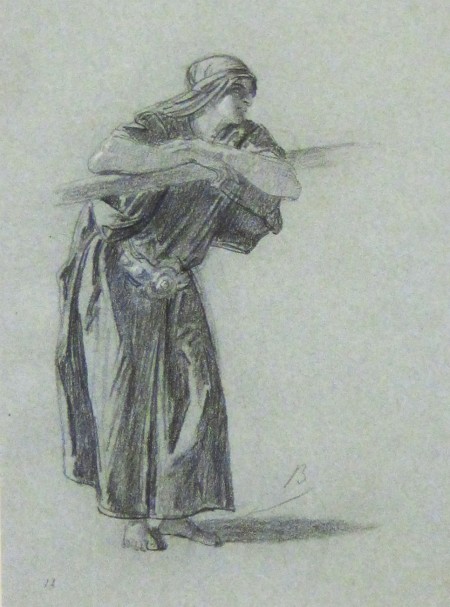
[image] Alexandre Bida, The Woman in the “Song of Songs,” chalk, c. 1886, U.S. National Gallery of Art, Joseph F. McCrindle Collection 2009.70-41.

References:

Bonghi, Giuseppe, and Cono A. Mangieri, trans. (Italian) with notes. 2003. Proverbia que dicuntur super natura feminarum. Biblioteca dei Classici Italiani. Online. Alternate source.

Clouston, William Alexander. 1884. The book of Sindibad, or the Story of the king, his son, the damsel and the seven vazirs: from the Persian and Arabic. Privately printed.

Epstein, Morris. 1967. Tales of Sendebar. An edition and translation of the Hebrew version of the Seven sages, based on unpublished manuscripts. Philadelphia: Jewish Publication Society of America.

Hexter, Ralph J., Laura Pfuntner, and Justin Haynes, ed. and trans. 2020. Appendix Ovidiana: Latin poems ascribed to Ovid in the Middle Ages. Dumbarton Oaks Medieval Library, 62. Cambridge, MA: Harvard University Press.

Keller, John Esten, ed. and trans. 1956. The book of the wiles of women. Chapel Hill: University of North Carolina Press.

Orazi, Verónica. 2006. Sendebar: Libro de los engaños de las mujeres. Barcelona: Crítica.

Redondo, Jordi. 2011.  “Is Really Syntipas a Translation?  The Case of The Faithful Dog.” Graeco-Latina Brunensia 16:1, pp. 49-59.

Sefer Hamusar teaches that you can't buy food with poetry

From about 1200 to 1600,  Jewish writers created works similar to the Arabic literary genre of maqamaMaqama feature rhetorically ornate, rhymed prose, often with some interspersed poetry.  Maqama tell stories of an eloquent rogue who swindles the narrator in weakly connected episodes of mundane life.  Well-known in Arabic from the tenth century, this widely mixed genre was adapted into Hebrew in Spain about 1200.[1]  One of the last major Hebrew works of maqama was Sefer Hamusar, written about 1580.  In Sefer Hamusar, the story of a boy trumping the eloquent rogue indicates the erosion of the privilege of cultural sophistication.

In the Sefer Hamusar story, the eloquent rogue, famished, questions a boy in a town square.  The eloquent rogue’s name is Abner ben Helek the Yemenite.  The boy is not named.  Here’s their dialog:

Will limes be sold for perfect rhymes? Replied the boy: At no time.

Nor figs in aspic for rhetoric? Said he: It would be quite a trick.

Nor a savory slice for a poetic device?  Said the youth: At no price.

Nor a bit of grain for a choice refrain?  Said he: It would all be in vain.

Not a bean or pea for astronomy?  Said he:  Do not ask additionally.  My lord, you’ve spoken quite profusely; please do not react obtusely!  Know that the natives of this land will not trade the words of the wise for bran; nor a poem by a connoisseur for a brown bread loaf of a coarse texture; nor a missive of honeyed fluency for chicory; nor rhymes for dandelion; nor the grandest elegy for barley; nor a prayer penitential for a single lentil; nor breeding meet and fit, for a scrap or a meaty bit; nor matters grave and great, for marsh fish or whitebait.  For none of them attend to the sciences or the arts; they would rather banish them to distant parts; to these fields they turn their backs and not their hearts. [2]

Poetry and fashionable knowledge was valuable currency in the ancient Islamic world.  But here, the boy doesn’t yield to Abner’s cultural sophistication.  The boy warns the man not to be obtuse and expands Abner’s figure of exchange for far more words than Abner produced.  The dialog indicates that the town merchants do not value the sciences and the arts.  Yet the reason in context seems to be that cultural sophistication not longer distinguishes between a man and a boy.

Abner subsequently got an excellent meal by tricking the narrator into paying for it.

*  *  *  *  *

Read more:

Notes:

[1] The Hebrew term for maqama is mahbarot.  Early Hebrew works of mahbarot were the Book of Delight (Sefer Shaashuim) (c. 1200), and about two decades later, the Book of Wisdom (Sefer Takhemoni).

[2] Sefer Hamusar, Ch. 14, trans. Tanenbaum (2003) p. 301.  Zechariah Aldahiri (c. 1519 – c. 1585) was the author of Sefer Hamusar.  Aldahiri lived in the Jewish community of Sana’a in Yemen.  He traveled throughout the Middle East and to India.  Id. p. 297.  Astronomy, closely associated with medicine, supported important personal services in the ancient world.

Reference:

Tanenbaum, Adena. 2003. “Of a Pietist Gone Bad and Des(s)erts Not Had: The Fourteenth Chapter of Zechariah Aldahiri’s Sefer hamusar.”  Prooftexts. 23 (3): 297-319.

seven sages of Greece and Rome

In ancient Greek tradition, seven sages were renowned for their wisdom.  By the time of Plato about 2400 years ago, seven sages of Greece were recognized in Greek tradition.  The seven sages lived about 2700 to 2500 years ago.  They predated what is now considered the golden age of ancient Greek literature and philosophy.

Just as the set of lists of the top-10 U.S. law schools encompass far more than ten law schools, the seven sages of Greece in ancient discussion encompassed at least twenty-three sages.  The sage lists typically include Thales, Pittacus, Bias, and Solon, while common additional names were Chilon, Cleobulus, and Periander. A wide variety of other names alternated on ancient lists of the seven sages of Greece.

Few of the seven sages of Greece have significant surviving wisdom.  Little is known about most of them.  Archaic obscurity seems to have been an ancient requirement for joining the elite group of seven sages.

The archaic obscurity of the seven sages of Greece persisted in Latin writings in the late Roman Empire.  Ausonius, writing in Latin about 1650 years ago, gave a fairly typical list for the seven sages of Greece: Solon, Chilon, Cleobulus, Thales, Bias, Pittacus, Periander.[1]  Augustine, writing about 1600 years ago, produced the same list.[2]  In the late Roman Empire, Homer, Aristotle, Plato, and Hippocrates were honored ancient Greek thinkers.  These thinkers appear on neither Ausonius’s nor Augustine’s list of the seven sages of Greece.[3]

Seven sages appear in a widely dispersed, highly popular tale collection now known as the Book of Sindibad / Seven Sages of Rome.  The frame narrative for the tale collection concern a king planning to have his son killed in response to the king’s wife falsely accusing the son of rape.  Versions that emerged in Eurasia east of Rome, called the Book of Sindibad, in almost all cases don’t name the sages.[4]  The western branch came to be known as the Seven Sages of Rome.  Many of these versions name the seven sages.  The usual names of the sages are Bancillas, Ancilles or Anxille, Lentulus, Malquidras or Malquidrac, Cato, Jesse, and Maxencius or Merous.[5]  Among these sages only Cato is now known.  Cato is not Cato the Elder or Cato the Younger, but the third or fourth century author of the Distichs of Cato.[6]  That work was an enormously popular schoolbook of Latin wisdom in medieval Europe.  Giants of Roman Latin literature, e.g. Horace, Virgil, and Cicero, never appear among the seven sages of Rome.

Obscurity seems to be central to popular understanding of wisdom.

Anselm Kiefer, The Book,

*  *  *  *  *

Read more:

Notes:

[1] Ausonius, “The Masque of the Seven Sages,” trans. from Latin in Evelyn-White (1919) vol. 1, pp. 311-29.

[2] Augustine, The City of God, Bk. 18, Ch. 25.

[3] A Greek Christian text from perhaps the time of Augustine (“On the Temple, Schools, and Theatres in Athens”) provides a more innovative list of the seven sages of Greece.  It lists the sages as Titon, Bias, Solon, Cheilon, Thucydides, Menander, and Plato.  Bias, Solon, and Cheilon (Chilon) are among the usual seven sages of Greece.  Titon may have meant Titan, which was a name Homer used for the Sun God.  A Christian writer identifying Titan as a Greek sage is bizarre.  Thucydides, Menander, and Plato are ancient Greeks — a historian, a playwright, and a philosopher — widely read and studied right up to the present.  Such eminent Greek thinkers don’t appear in other lists of the seven sages of Greece.

[4] The Hebrew version is an exception in naming the seven sages.  It sets the story in India and names the sages Sendebar, Ipokras, Apulin, Lukman, Aristalin, Hind, and Amami.  Epstein (1967) pp. 55, 370-1.  Among these names can perhaps be recognized Hippocrates, Apuleius, Aristotle, and Pindar.  Apuleius is a second-century Latin comic writer; the other apparently recognizable sages are still-revered ancient Greeks.  None of these recognized sages belongs in India.

[5] Campbell (1907) p. xxii.  In surviving manuscripts, “numerous more or less radical variations in the spelling of these names” occur.  Id. ft. 3.  The spelling variations further indicate that the sages were not well-known.

[6] Id. p. 152.

[image] Anselm Kiefer, The Book, 1979-85, Hirshhorn Gallery, 85.27.

References:

Campbell, Killis. 1907. The seven sages of Rome. Boston: Ginn & Company.

Epstein, Morris. 1967. Tales of Sendebar = [Mishle Sendebar]. Philadelphia: Jewish Publication Society of America.

Evelyn-White, Hugh G., ed. and trans. 1919. Decimus Magnus Ausonius.  Ausonius. London: W. Heinemann.

Sefer Shaashuim provides folk wisdom on how wars start

Delacroix lithograph of battle

Sefer Shaashuim, a book written in Hebrew in Spain about the year 1200, collected medical information, folk tales, proverbs, and anecdotes from across western Eurasia. Sefer Shaashuim includes a story about how a war between two families started.  According to this story, the devil, frustrated with his inability to cause mischief, was preparing to depart from a place.  Then the devil met a washerwoman.  She declared that she would show him how to create excitement.

The washerwoman used her social networking capabilities to cause a war.  She whispered in the ear of a lady that she served, telling her that her husband was having an affair with another woman.  The lady was greatly upset.  The washerwoman offered to cure the problem.  She told the lady to take a razor and cut off three hairs from her husband’s beard while he was sleeping.  The washerwoman said that she would compound those hairs into a medicine that would cause the lady’s husband to love no woman but her.  Because of her relational jealousy, along with the usual allure of medicine, the lady agreed to secure the hairs for this cure.

The washerwoman then sought out the lady’s husband.  She told him, “with every sign of distress in voice and manner,”  that his wife and her lover were plotting to kill him in his sleep.  Because men are inferior in guile, the husband believed the washerwoman.

The distrust between the lady and her husband led to deadly war.  Here’s what happened:

The husband returned home, and, pretending to fall asleep, watched his wife closely.  He saw her take the razor to cut the three hairs for the remedy, and, thinking that she meant to kill him, he darted up suddenly, wrested the razor from her hands, and slew her with it on the spot.  Soon the news spread, and the wife’s relatives united to avenge her death and kill the husband.  In their turn the relatives of the husband resolved to avenge him, both houses were embroiled, and before the feud was at an end two hundred and twenty lives were sacrificed. [1]

This story probably arose from real historical events somewhere within the vast historical and cultural space that Sefer Shaashuim encompasses.[2]  In Milton’s Paradise Lost, the devil is a heroic figure.  Paradise Lost is less realistic than Sefer Shaashuim.

Just as for God, the devil is in small events of everyday life.  According to a book written in Old Spanish in 1253, a hunter found some honey in the woods.  He took the honey into a nearby village to sell it:

Upon opening the bag so as to show the honey to the shopkeeper, a drop of honey fell out and a bee lighted upon it.  Now the shopkeeper had a cat, and this cat leaped upon the bee and killed it; the hunter’s dog fell upon the cat and killed it; the cat’s owner came and killed the dog; and then the dog’s master slew the shopkeeper.  At this, the men of the shopkeeper’s village came and slew the hunter, who owned the dog; finally, the men of the hunter’s village marched against those of the shopkeeper, and they fell upon one another and all were killed, not even one remaining alive.  So all were slain for one drop of honey. [3]

Let’s hope that, in different circumstances, peace can emerge from one drop of honey.

*  *  *  *  *

Read more:

Notes:

[1] Davidson (1914) p. LXVII.  Sefer Shaashuim is transliterated Hebrew that means the Book of Delight.  Hadas & Sherwood (1932) provides an English translation of all the fables in Sefer Shaashuim.

Tahrid, a genre of early Arabic poetry, describes women inciting men to war. A major work of men’s sexed protest, written in Latin in 1290, declares “woman’s tongue causes almost all wars” (Omnis guerra fere lingua mulieris habetur). Lamentations of Matheolus II. 735, in van Hamel (1892). Ovid, in Amores II.12, lists mythical wars that he claims women started. Men vastly predominate among persons killed in wars.

[2] Sefer Shaashuim encompassed cultures from India to Spain:

It is built in the Arabian style, decorated with fables and riddles of India, inlaid with the choicest products of Greek science, and illumined with the wisdom and maxims of the Orient.

Davidson (1914) p. p. XXXI. The exact figure for the number of persons killed suggests a historical kernel of the tale. Id. p. LXVII.

[3] Book of the Wiles of Women, trans. Keller (1956) p. 28.  Nearly the same story occurs in the 1001 Nights, night 582 ((Macnaghten / Calcutta II edition).  Both texts are part of the Book of Sindibad corpus.

[image] Eugene Delacroix, “The Battle of the Giaour and the Pasha”; lithograph, 1827; U.S. National Gallery of Art, Rosenwald Collection, 1946.II.46.

References:

Davidson, Israel, ed. 1914. Joseph ben Meir ibn Zabara. Sepher Shaashuim: a book of Mediaeval lore. New York: Jewish Theological Seminary of America.

Hadas, Moses and Merriam Sherwood. 1932. Joseph ben Meir ibn Zabara. The book of delight. New York: Columbia University Press.

Keller, John Esten, ed. and trans. 1956. The book of the wiles of women. Chapel Hill: University of North Carolina Press.

Van Hamel, Anton Gerard, ed. 1892. Matheolus, Jean Le Fèvre. Les lamentations de Matheolus et le livre de leesce de Jehan Le Fèvre, de Ressons: poèmes français du XIVe siècle. Paris: Bouillon.