
husbands: disparage only bad women, or be shackled
Ordinary, uneducated men in medieval Europe suffered from ignorance of advanced knowledge on how to refer to women. Consider the case of a brutish husband in Greece, as recorded in a text from sometime before the twelfth century:
A certain man possessed a house and a prudent wife, and was always disparaging all woman. “Don’t disparage all women,” his wife said, “but only the bad.” “All,” retorted he. “Don’t speak like that,” the wife replied, “since you happen not to be united with one of them.” “Had I fallen in with one of them,” he then said, “I should have cut off her nose.” After his own fashion, he also criticized some quarrelsome female neighbors. [1]
This man was a farmer. He implicitly acknowledged that his wife was a good woman. Moreover, despite the husband’s apparently peevish nature, he showed some respect for his wife. Before he headed out for a long day’s work ploughing a field, he said to her:
I am going into the field, and at your your leisure, cook something and bring it there, that I may dine.
He didn’t demand that his wife get him a sandwich right now. He told her to cook something “at her leisure,” so that he would have something to eat while he was working.
Apparently remaining upset about her husband’s generic references to women, the wife decided to punish her husband and reform his manner of referring to women. Without her husband’s knowledge, the wife went out, bought some fish, and scattered them in the field that he was to plough. Arriving to plough the field, the husband saw the fish, collected them, and brought them home to his wife. Returning later for dinner, the husband told his wife to cook the fish for dinner. She denied any knowledge of having fish. The husband declared:
“You fool,” said he, “didn’t I bring some fish just now, which I found in the field?” The woman, scratching her face with her nails, cried out: “O listen to me, neighbors!” And the neighbors having assembled, the wife said to them: “Listen, O my masters! My husband asks me to cook fish that he has brought from the field.” The men asked the husband: “What do you say — that you found fish in a ploughed field?” He replied, “O my masters and brethren! The fish I found there, but how they happened to be there, I don’t know.” His wife then cried out: “This man has a devil!” The neighbors then put iron shackles on the husband’s hands and feet, and the whole night through the wretched man continued to say: “Didn’t I find the fish, and bringing them to this bitch, tell her to cook them? Why have they then bound me with shackles?”
The husband was recalcitrant. After three days of her husband’s foodless suffering in shackles, the wife tested his reformation. She said to him:
“Are you hungry? May I give you something to eat? How about some fish, these in the frying pan?” “That’s right, woman. Aren’t those the same that I brought you from the field?” The wife then exclaimed: “O Christian masters! The evil spirit still possesses this man, as he continues to talk about fish.” But on his declaring: “I no longer maintain what I said before,” she gave him a piece and he ate the fish, without saying a word about it. She even asked him: “Don’t you remember the fish?” He replied, “I don’t know what you’re talking about.”
She then released him from the shackles. She said to him: “O husband, all that you have said is true, but before you disparaged not only bad women, but also good women. And I said to you: ‘Be silent!’ but you replied, ‘If I had a wicked wife, I would kill her.’ Don’t vainly boast of being superior to women.” [2]
The story ends with this admonishment. Men’s inferior in guile is clear from medieval literature. The husband surely learned his lesson and submitted to his wife’s rule in referring to women.

The literature of men’s sexed protests tends to be condemned for its practice of referring to persons other than men. This literature, which has been marginalized and has little academic credibility, criticizes women for their treatment of men and for their privileges relative to men. However, not all women are bad women. Not all women are the same. In fact, every woman is unique and special. Building on these insights, an academic superstar has established that the term “women” oppresses women.[3]
Scholars who have worked for years on such problems have developed insightful solutions. Leading labor historians now use the term “working classes” rather than the term “working class.” Scholars studying sexuality have progressed to using the term “sexualities.” Scholars contemptuous of men now write about “masculinities” rather than “masculinity.” But what about women? Ordinary grammatical sense doesn’t allow the pluralistically plural form “womens.”
Scholars are currently studying solutions to the important problem of referring to women. One possible solution is to replace the word “women” with the term “women(s).” A more sophisticated proposal, which draws on the resources of Islamic culture, is to replace the word “women” with the term “women (b/ NAWALT).” The mandatory appended tag “(b/ NAWALT)” represents “but Not All Women Are Like That.” This latter proposal seems the most promising. Consider, for example, a possible advance in the literature of men’s sexed protests:
While women (b/ NAWALT) frequently express concern about injustices against women (b/ NAWALT), women (b/ NAWALT) have said little about injustices against men. That women (b/ NAWALT) falsely accuse men of rape is dangerous for men to say in the presence of women (b/ NAWALT) or men. Women (b/ NAWALT) are skilled at getting men in trouble with other men. More than three times more men than women (b/ NAWALT) are killed. Women (b/ NAWALT) need to take more responsibility and show more concern about violence against men.
When the important problem of how to refer to women is resolved, public deliberation can turn to less important issues such as women being deprived of the choice to serve in front-line combat positions.
* * * * *
Read more:
- awkward positions for submissive husbands
- wiles of women beyond scholarly understanding
- promoting men’s disposability and death discrimination
Notes:
[1] A Greek version of the Book of Sindibad, attributed to Michael Andreopulos, Syntipas, dated late 11th century, trans. Clouston (1884) pp. 95-6. All subsequent indented quotes, except the last, are from id. I have modernized the English and made some stylistic adjustments to the translation. Redondo (2011) argues that Syntipas is an original Greek text perhaps from the second century. Cutting off a woman’s nose figures in Marie de France’s lai Bisclavret.
[2] Matheolus, a leading figure in the medieval literature of men’s sexed protests, presented a more general code of conduct for husbands seeking to avoid punishment:
What can be, from the time she wants it, must be;
that is, a husband should do it, if he doesn’t want to be stoned to death.
She wants that whatever she praises, he praises; whatever she loves,
he must love; whatever she disparages, he must disparage.{ Id licet officiat, ex quo vult ipsa, necesse
Est quod vir faciat, lapidatus ni velit esse.
Vult quod laudetur quitquid laudat, quod ametur
Quitquid amat, quitquid reprobat vult quod reprobetur. }
Liber lamentationum Matheoluli, Bk. 1, ll. 337-340, Van Hamel (1892), v. 1, p. 23, my translation from the Latin original above. Matheolus’s book is from about 1295. Jean le Fèvre’s Old French translation of Matheolus adds that the husband must keep his mouth shut. Id.
[3] Butler (1990).
[image] Farmer plowing in Fahrenwalde, Mecklenburg-Vorpommern, Germany; image thanks to Ralf Roletschek and Wikipedia.
References:
Butler, Judith. 2005. “Subjects of Sex/Gender/Desire.” Pp. 1-34 in Judith Butler, Gender trouble: feminism and the subversion of identity. New York: Routledge.
Clouston, William Alexander. 1884. The book of Sindibad, or the Story of the king, his son, the damsel and the seven vazirs: from the Persian and Arabic. Privately printed.
Redondo, Jordi. 2011. “Is Really Syntipas a Translation? The Case of The Faithful Dog.” Graeco-Latina Brunensia 16:1, pp. 49-59.
Van Hamel, Anton Gerard, ed. 1892. Mathéolus, Jean Le Fèvre. Les lamentations de Mathéolus et le livre de leesce de Jehan Le Fèvre, de Ressons: poèmes français du XIVe siècle. Paris: Bouillon.
Marie de France’s Bisclavret on men’s secret, inner beast
Marie de France, a twelfth-century author, is a leading figure in conventional academic romances of the past century. In 1911, a scholar wrote:
An age so feminist in its sympathies as ours should be attracted the more easily to Marie de France, because she was both an artist and a woman. To deliver oneself through any medium is always difficult. For a woman of the Middle Ages to express herself publicly by any means whatever was almost impossible.[1]
Subsequent scholarship has largely elaborated upon that view. It has ignored Marie de France’s seminal contributions to the literature of men’s sexed protests and failed to recognize her profound insights into man’s human condition.
In Marie de France’s romance Bisclavret, a noble knight was married to a noble lady. He loved her, and she loved him. Only one thing disturbed the wife: for three entire days a week her husband went away. She knew not where or why. She wanted to know.
The wife pleaded and cajoled and nagged her husband to tell his secret. She declared:
My lord, I’m in terror every day,
Those days when you’ve gone away,
My heart is so full of fear,
I’m so afraid I’ll lose you, dear–
If I don’t get some help, some healing,
I will die soon of what I’m feeling!{ sire, jeo sui en tel effrei
les jurs quant vus partez de mei;
el lever en ai mut grant dolur
e de vus perdre tel poür,
si jeo n’en ai hastif cunfort,
bien tost en puis aver la mort. }[2]
The husband responded with an equally dire warning:
“My lady,” he said, “Please, God above!
I’ll suffer great harm if I tell you:
I’ll drive you off, right out of love,
And lose my own self if I do.”{ “Dame,” fet il, “pur Deu, merci!
mal m’en vendra si jol vus di,
kar de m’amur vus partirai
e mei memes en perdirai.” }
The husband had tried to be silence. His wife, however, interpreted his silence to be proof of his wrong:
Where do you go? Now you must say
What life you live, where do you stay?
You are in love — that’s it, I know —
And you do wrong if this is so!”{ kar me dites u vus alez,
u vus estes, u conversez!
mun escient que vus amez,
e si si est, vus meserrez. }
In reality, women rule. With some additional nagging and cajoling, the husband told the wife his secret.[3]
The husband explained to his wife that he becomes bisclavret. Men turning into beasts figures in human imagination around the world. Bisclavret is commonly misunderstood as a man-beast, or worse, a werewolf.[4] Bisclavret is the name of this romance. The husband explained that as bisclavret he roams undressed about the thick woods of the great forest. He lives on what prey he encounters. Your imagination can understand (pigs! beasts!) if you have suspicions about men.
Clothes return the husband from bisclavret to man. The husband hides his clothes when he becomes bisclavret. If he were to lose his clothes, he would remain bisclavret forever. The wife asked where he hides his clothes. The husband refused to divulge that secret crucial only to his self. The wife insisted that he tell:
“My lord,” the lady replied, “It’s true
More than all the world I love you.
You should hide nothing from me, nor
Ever doubt I’m loyal in any affair.
That would not seem like true friendship.
How have I ever sinned? What slip
Makes me seem untrustworthy to you?
Do what’s right! Now tell me, do!”
She nagged him thus, and thus harassed
Him till he just had to tell, at last.{ “Sire,” la dame li respunt,
“jeo vus eim plus que tut le mund:
nel me devez nïent celer,
ne de nule rien duter;
ne semblereit pas amisté.
Quei ai jeo forfait? Pur queil peché
me dutez vus de nule rien?
Dites mei, si ferez bien!”
Tant l’anguissa, tant le suzprist,
ne pout el faire, si li dist. }
The literature of men’s sexed protests describes how men’s inferiority in guile and personal weakness allows wives to expropriate their husbands’ secrets. Marie de France seems to have recognized the merit of that literature.[5] Telling was nearly this man’s undoing.
Repulsed by her new imagination of her husband, the wife arranged to acquire another husband. She summoned a knight who loved her, and she declared her willingness to love him. After they swore an oath of engagement, she told him of her husband’s periodic times being bisclavret, and where her husband hides his clothes. The lover stole the husband’s clothes. That meant that her husband could not return. Her lover then married her.
The literary genius of Marie de France redresses the bisclavret as a man. The King, out hunting, came upon the bisclavret. The hunting hounds attacked the bisclavret, who then threw himself in supplication at the King. The King recognized the bisclavret’s humanity. The King called the bisclavret a beast, using the feminine gender.[6] He insisted that she be treated well. The King and the beast became close companions.
One day, for a feast, the beast’s wife and her new husband appeared at court. The beast violently attacked the new husband, and later, the wife. She had never violently attacked anyone else. A wise man advised the King to question forcefully the wife about why the beast hated her. The wife confessed. The clothes were returned to the beast. In a final, poignant twist, the beast, naturally modest about her nature, declined to put on the clothes in the presence of others. Left alone in a room with the clothes, the beast redressed. The bisclavret regained the form of a man.[7]
Marie de France had magnanimous appreciation for men’s human nature. An adaptation of Bisclavret written in French about 1320 concludes:
Thus you see how stupidly he behaves
Who reveals to his wife
Secrets that should be hidden,
If he does not wish them revealed to everyone.{ Dont voiz tu que folemant ouvre
Qui a sa fame se descouvre
Dou secré qui fait a celer,
S’a touz ne le viaut reveller. }[8]
Bisclavret presents injustice arising from men’s personal subordination. Yet Marie de France’s Bisclavret understands men in an even more extraordinary and profound way. Marie de France’s Bisclavret acknowledges men’s depths of human being. It insists on imaginative space — “don’t doubt a single word” — for a beast within the still-human man.
* * * * *
Read more:
- scholarly literature fails to comprehend the wiles of women
- ancient appreciation for men’s human nature
- constructing men’s humanity as a threat to women
Notes:
[1] Mason (1911), introduction.
[2] Marie de France, Bisclavret, vv. 43-8, Old French text from Waters (2018), English trans. from Shoaf (1996). In the Book of Sindibad/Seven Sages corpus, the King’s wife frequently threatens to commit suicide in attempts to persuade the King to execute his son on a false accusation of rape.
Bisclavret is technically classified as a lai. While the exact definition is subject to vigorous scholarly debate, a lai is roughly a short, verse romance in octosyllabic couplets. Here are brief descriptions of lais attributed to Marie de France.
Waters’s text of Bisclavret is based on MS H: London, British Library, Harley, 978, f. 131va-133vb. Mad Beppo provides an excellent parallel Old French text and English translation of Bisclavret. Mason (1911) provides an alternative online English translation, as does Spence (1917), Ch. XI.
Subsequent quotes from Bisclavret are similarly sourced. They are vv. 53-6 (“My lady,” he said…), 49-52 (Where do you go?…), and 79-89 (“My lord,” the lady replied…).
[3] Matheolus, a leading figure in the literature of men’s sexed protests, declared:
The wonderful nature of women is to seek to know everything
Immediately, each moment, all points
Examining place, times, deep causes
Who, what, where, which, by which, why, when, how, whence
If a man keeps silent, the woman says that he is an adulterer
Even if he is as worthy as John the Baptist.{ Nature mire mulieres sunt, quia cuncta
Nituntur scire subito, momentaque, puncta,
Indagando, loca, tempus causasque profunde,
Cui, quid, ubi, quo, qua, cur, quando, qualiter, unde.
Si vir enim taceat, dicet mulier quod adulter
Est, quamvis ille meritis Batista sit alter. }
Liber lamentationum Matheoluli (dated c. 1295), Bk. 2, vv. 1041-46, Latin text from Van Hamel (1892), v. 1, p. 75, my English translation.
The twelfth-century Facetus, which became part of the late-medieval school core curriculum of Auctores octo morales, included relevant instruction:
Whatever you do, do not make known your secrets to your wife,
for from this can arise for you life’s hazards.{ Quicquid agis, ne pande tuae secreta maritae,
unde tibi possunt nasci discrimina vitae. }
Facetus 65, Latin text from Schroeder (1911) p. 19, English translation adapted from Pepin (1999) p. 46.
[4] Shoaf (1996) p. 1, n. 1, insightfully notes this distinction and the play between the name of the romance and the name of the beast.
[5] Jean de Meun’s Romance of the Rose (dated c. 1275) has a lengthy section protesting wives extracting secrets from husbands. Id. ll. 16347-16576, trans. Dahlberg (1995) pp. 277-9. Jehan Le Fevre’s Old French translation/adaptation (dated c. 1371) of Liber lamentationum Matheoluli includes a similar passage. Bk. 2, ll. 1107-1242, Van Hamel (1892), v. 1, pp. 75-7. Marie de France similarly developed material on men’s inferiority in guile (see note [1] in linked post).
[6] Shoaf (1996) p. 5, n. 3, insightfully points out this feature of the Old French text.
[7] The knight/bisclavret’s ex-wife, physically marked by the blowing of her presumption that she knows man, is exiled along with her new husband. Scholars have focused on the beast tearing the wife’s nose (knows) off. Shoaf (1996) p. 9, n. 7, provides important insight into Marie de France’s perspective.
Medieval literature attests to women inciting men to commit violence against men and violence against women. In a medieval Occitan tenso, a wife tells her husband:
Sir, I wish you had cut off the nose of the one
who told you that I had dishonored you,
so that I might be pure and free of sin,
as I am, yet he is washed clean
even though he carries a bow and barbarian’s knife.
I brood and I ponder, and then I think
I might know what she is most knowledgeable in,
she his whore with the complexion of a Saracen.{ Seingner, son nas volri’agues taillat
qui vos a dig que·us aia enantat;
c’aissi fos solt’e monda de peccat
con sui de cel, de cui es adalbat,
si tot port’arc e coutel barbarin.
Pens e repens e quant n’ai ben pensat,
puosca saber don si’espermentat,
mas, sa putan color de Sarrazin. }
Guilhem Rainol d’At and anonymous domna, “Auzir cugei lo chant e·l crit e·l glat {I though I heard the song, the cry, and the twittering},” st. 2, Occitan text and English translation (modified slightly) from Nappholz (1994) pp. 50-1. Here’s an online Occitan text of the full song. The troubadour Guilhem Rainol d’At was from the Vouacluse region of southeastern France and flourished early in the thirteenth century.
[8] Biclarel, vv. 457-60, Old French text and English trans. from Hopkins (2005) p. 105. Bisclarel is an extract from the first redaction (A-text) of The Romance of Renart the Hypocrite {Le Roman de Renart le Contrefait}. Id. pp. 9-10.
The anonymous lai Melion, probably composed about 1200, tells a similar story to that of Bisclavret and Biclarel. In Melion, the man Melion transformed himself into a werewolf to get stag meat that his wife said she desired. As he was hunting the stag, she deserted him. She took his squire and a ring that was his means to return to human form. Melion was justifiably angry about how his wife had betrayed him:
He left his wife in Ireland.
He commended her to the devil.
She would never again be loved by him
because she had mistreated him so badly,
as you have heard in the tale.
He never wished to take her back
He would like to have let her burn or be dismembered.
Melion said: “It will never fail to happen
that he who believes his wife completely
will be ruined in the end.
He should not believe all she says.”{ Sa feme en Yrlande laissa:
A deables l’a commandee;
Jamais n’iert jor de li amee,
Por ce qu’ele l’ot si bailli,
Con vos avés el conte oï.
Ne le volt il onques reprendre,
Ains le laissast ardoir u pendre.
Melïon dist: ‘Ja ne faldra
Que de tot sa feme kerra,
Qu’en la fin ne soit malbaillis;
Ne doit pas croire tos ses dis’. }
Melion, vv. 580-90, Old French text and English translation from Hopkins (2005). Men shouldn’t merely listen and believe others, not even their wives. They should attempt to evaluate what others say in relation to the truth.
Melion survived to the nineteenth century in two manuscripts. Hopkins’s edition is based on MS C: Paris, Bibliothèque nationale de France, Arsenal, 3516, f. 343ra-344rd. That manuscript is dated 1268. Tobin suggests a date of composition between 1900 and 1204. Id. p. 9. Hopkins’s text of Melion is included in Burgess & Brook (2007).
In considering Bisclavret, Melion, and Biclarel, the introductory discussion in Hopkins (2005) shows no appreciation for men and the literature of men’s sexed protests. From Marie de France’s Bisclavret to the adaptation Biclarel, “The narration of the werwolf tale has moved from woman writer to woman hater.” Id. p. 49. That misandristic perspective obscures Bisclavret‘s central concern for men.
Spiegel (1994) provides a particularly grotesque example of channeling misandry through Marie de France. Creamer (2002), in contrast, provides a comical reverse-NAWALT argument: because Marie de France depicts an evil woman and good men, Marie de France hates women. Creamer concludes with monstrous prose worthy of Bulwer-Lytton:
Even more troubling for us today is conceiving of this lay being offered to the ears of Marie’s original late-12th-century audience, men and women and perhaps boys and girls who sought from it divertissement and instruction. {Think of the children!} Bisclavret … might well have served, however unintentionally and subtly, as a public exemplum that endorsed and reinforced male control over females in the real world. This chilling possibility, rooted not in folklore but in sociology, is certainly the most monstrous aspect of the lay.
Id. p. 272. Monstrous aspects of today’s reality are truly more frightening.
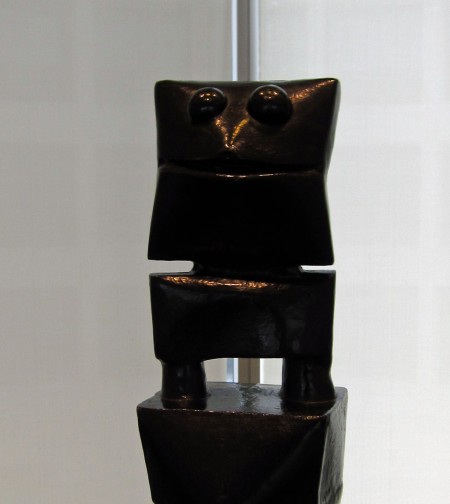
[image] My photograph of Under the Bridges of Paris, Max Ernst, 1961, cast 1962-63, bronze sculpture, Hirshhorn Museum, Washington DC.
References:
Burgess, Glyn S., Leslie C. Brook, ed. and trans. 2007. French Arthurian Literature. Volume IV: Eleven Old French Narrative Lays. Cambridge, UK: D.S. Brewer.
Creamer, Paul. 2002. “Woman-Hating in Marie de France’s Bisclavret.” Romanic Review. 93 (3): 259-274.
Dahlberg, Charles, trans. 1995. The romance of the Rose. 3rd ed. Princeton, N.J.: Princeton University Press.
Hopkins, Amanda, ed. and trans. 2005. Melion and Biclarel: two Old French werwolf lays. Liverpool Online Series, 10. Liverpool: University of Liverpool, Department of French.
Mason, Eugene, ed. and trans. 1911. French mediaeval romances from the lays of Marie de France. London: J.M. Dent & Sons.
Nappholz, Carol Jane, trans. 1994. Unsung Women: the anonymous female voice in troubadour poetry. New York: Lang.
Pepin, Ronald E. 1999. An English translation of Auctores octo, a medieval reader. Lewiston, N.Y.: Edwin Mellen Press.
Schroeder, Carl. 1911. Der deutsche Facetus. Berlin: Mayer & Müller.
Shoaf, Judith P., trans. 1996. Marie de France. Bisclavret (translator’s note).
Spence, Lewis, ed. and trans. 1917. Legends and romances of Brittany. London: G.G. Harrap & Co.
Spiegel, Harriet. 1994. “The Male Animal in the Fables of Marie de France.” Medieval Masculinites: Regarding Men in the Middle Ages. Pp. 111-26 in Clare A. Lees, ed. Medieval Cultures, no. 7. Minneapolis: University of Minnesota Press.
Van Hamel, Anton Gerard, ed. 1892. Mathéolus, Jean Le Fèvre. Les lamentations de Mathéolus et le livre de leesce de Jehan Le Fèvre, de Ressons: poèmes français du XIVe siècle. Paris: Bouillon.
Waters, Claire M. 2018. The Lais of Marie de France: Text and Translation. Peterborough, Ontario: Broadview Press.
father almost kills son: who is to blame?
In the Book of Sindibad / Seven Sages of Rome corpus, a king nearly kills his son in response to a false accusation of rape. The framing narrative in this literature has the king’s sages and the king’s wife offering competing fables to urge, respectively, the king to spare his son or kill his son. After the king learns the truth that the accusation of rape was false and does not kill his son, the king asks who would have been to blame if he had killed his son. In an Old Spanish text of the Book of Sindibad, written in 1253, the question “who would have been to blame?” prompts a dispute among the sages. The winning position avoids answering the question of personal blame.
The dispute is a direct response to the king’s question about blame. The king asks his sages:
who would have been to blame had I executed my son? Would the blame have been mine? My son’s? My wife’s? The teacher’s? [1]
One sage declares execution would have been the son’s teacher’s fault for failing in his professional responsibilities. Another sage responds to the first: “It is not as you say.” The second sage declares the fault would have been the king’s “because he ordered his son put to death on the word of a woman, when he did not know if her story was true or false.” A third sage objects: “It is not as you say.” The third sage declares that the woman is to blame for lying to the king about rape. A fourth sage contradicts the third, saying that the woman is not to blame. It is the son’s fault. The woman accused him of rape because he is “handsome and well-made” and refused her sexual advance. Moreover, since the woman had tried to entice the son with an offer to help kill his father and place the son on the throne, the woman had to get the son executed to ensure that she was not executed for attempted treason. The woman thus acted in self-defense and is not to blame. The fault for the son being executed for being falsely accused of rape would have been the son’s.
Blaming the son for him being falsely accused of rape ends the first analytical disputation and leads into the son telling a fable. After the fourth sage reasoned that the fault would not be the woman’s but the son’s, another sage declares:
It is not as you say, for the greatest of all wisdom lies in speaking.
Hearing the son speak had made clear the truth about the false accusation of rape and had saved the king from killing his son. Yet the wisdom of speaking is more abstract than that particular case. In response to the sage’s claim about the wisdom of speaking, the son tells a fable about the death of many persons:
They say that a man prepared a feast and invited his guests and his friends, and dispatched his maidservant to the market for milk for them to drink. Now she purchased it and was carrying it home on her head. Above her a falcon flew. It was carrying in its claws a serpent which it squeezed so tightly that the venom ran out of it and fell into the milk. They drank the milk and all of them died from it. Now the tell me whose fault it was that all of those people perished? [2]
One sage reasons that the host was at fault for his guests’ deaths. A second sage contradicts him, reasoning that the falcon was to blame. A third sage responds to the second, “It is not as you say,” and reasons that the serpent is to blame. A fourth sage contradicts the third and gives reasons for blaming the maidservant. Another sage, the son’s teacher, says that all of those four sages are wrong, and he explains their errors. The king turns to his son to explain who is to blame. The son declares:
None of these was to blame, for the hour in which each was to die was at hand.
The king acclaims his son’s wisdom. His son’s teacher declares of the son, “No one is wiser than he.” The other sages do not disagree.[3] The winning position is the wisdom of recognizing fate.
This highly structured, relatively elaborate dispute about blame seems to be a distinctive feature of the Old Spanish text of the Book of Sindibad. Scholarly disputation was central to Jewish rabbinical and Latin scholastic practice.[4] In thirteenth-century Spain and France, Jews were being summoned to dispute with Christians about theological questions. In the Old Spanish text of the Book of Sindibad, the competing fables and stories of the sages and the king’s wife failed to convince the king definitely of the right course of action. To determine subsequently who would have been to blame if the king had executed his son, the king’s sages engaged in principle-based moral reasoning. That reasoning also failed. The son regaining his natural voice prompts the king to recognize definitively his wife’s false accusation of rape against the son. The son’s acclaimed analysis of blame denies attribution of blame and asserts fate. The winning arguments aren’t arguments, but affirmations of nature.
Perhaps more truthful understanding of human nature can help to address the systemic social problem of false accusations of rape.
* * * * *
Read more:
- scholarly reasoning and the burden of manliness
- little public concern about men’s deaths
- the hidden history of matriarchy

Notes:
[1] El libro de los engaños e asayamientos de las mugeres, trans. Keller (1956) p. 42. All the subsequent quotes are from id., pp. 42-4.
[2] I’ve changed the translation’s term “kite” to “falcon” for ease of understanding. This tale apparently goes back to ancient India. It appears in ancient Sanskrit texts. Clouston (1884) pp. 99-101.
[3] In response to the king asking the sages whether anyone is wiser than his son, “They replied that no one should speak evil of what seems good.” That’s diplomatically vague and professionally shrewd.
[4] Disputation about sensational questions was a central feature of intellectual competition in the Roman Empire. The Hebrew version of the Book of Sindibad (Mishle Sendebar) doesn’t include the dispute about blame. It does, however, refer to the question of blame. Regarding the woman who falsely accused him of rape after he rejected her sexual advance and her proposal of treason, the king’s son declares:
Let her not be condemned to die, for every man fights for his life. And now I will ask of the King and his counselors to pardon her sin, and not to execute her.
Trans. Epstein (1967) p. 295. Other versions of the Book of Sindibad include brief, unstructured discussions of alternate parties at fault if the king had killed his son. Some also include the subsequent story of the maidservant. See, e.g., Persian version of Mohammad ‘Ali Zahiri Samarqandi, Sendbad-name, written about 1161-1164, trans. Clouston (1884) pp. 48-9, and Arabic version, “Story of the Seven Viziers,” 1001 Nights, nights 602-3 (Macnaghten / Calcutta II edition), trans. Lyons (2008) v. 2, pp. 602-3.
References:
Clouston, William Alexander. 1884. The book of Sindibad, or the Story of the king, his son, the damsel and the seven vazirs: from the Persian and Arabic. Privately printed.
Epstein, Morris. 1967. Tales of Sendebar. An edition and translation of the Hebrew version of the Seven sages, based on unpublished manuscripts. Philadelphia: Jewish Publication Society of America.
Keller, John Esten, ed. and trans. 1956. The book of the wiles of women. Chapel Hill: University of North Carolina Press.
Lyons, Malcolm C. 2008. The Arabian nights: tales of 1001 nights. vols. 1-3. London: Penguin.
Wednesday's flowers
