COB-84: Shi Miao exemplified bureaucratic virtue

Shi Miao, illustrious bureaucrat

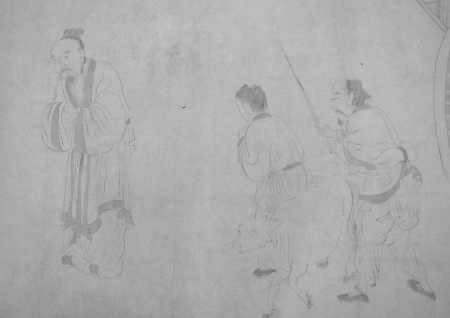
Bureaucrats should study their illustrious ancestors for guidance in virtue and proper procedure.  Shi Miao is one such worthy figure.  He served as a bureaucrat in the Shouchun prefecture in China during the Han Dynasty (206 BGC to 220 GC).  Having lived in impoverished circumstances, he came to his bureaucratic seat wearing an old robe and driving a rickety cart that a female ox pulled.  That ox birthed a calf about a year after Shi Miao arrived in Shouchun.  When Shi Miao finished his term of office, he gave the ox calf to the people of Shouchun.  He explained:

When I came here I did not have this calf.  It was born here south of the River Huai, and it has grown big eating the grass and drinking the water of Shouchun, none of which had anything to do with me.

Note that Shi Miao did not gave the calf to the people of Shouchun because of his generosity or concern for their welfare.  He gave them the calf as a result of accurate accounting of grass and water used.  Virtuous bureaucrats keep detailed accounts and make decisions based on historical records.

In other bureaucratic issues, bureaucratic morale in the U.S. Navy continues to sink as highly successful operational procedures are abandoned based on flighty or earthy reasoning.  U.S. Navy commands have been sent in ALL CAPITAL LETTERS SINCE THE 1850S, OR SO THE STORY IMPLAUSIBLY GOES (typewriters weren’t commercially successful until the 1870s).  SENDING MESSAGES IN ALL CAPITAL LETTERS HAS ACCOMPANIED THE U.S. NAVY’S RISE TO A SUPERPOWER ON THE SEA.  IGNORING THAT SUCCESS, THE NAVY HAS RECENTLY ORDERED MESSAGES TO BE MIXED UP WITH UPPER AND LOWER CASES.  JIM HUNT REPORTED THE ORDER:

UNODIR REF A MOD REF B. READD REF A FORAC ALCON. CEASE ALCAP IMMED. ACK MSG OP.

CALL IN THE AIR FORCE AND THE ARMY.  THE NAVY HAS LOST BUREAUCRATIC BALLAST AND IS SINKING.

Unfortunately, the problems at sea are being reduplicated again and again.  Richard Branson, founder of Virgin Group, has erected “6 tips to screw business meetings as usual.”  Virgin Group should not be in the business of screwing, even if it usually has been.  For Virgin Group to move forward to the next stage of development, it needs to embrace meetings.  Meetings bring people together and perpetuate the existence of organizations.

Goldman Sach’s recent investment in gaming shows that gaming is an important growth area for bureaucracy.  Goldman funded a high-tech, bureaucratically intensive scavenger hunt called Midnight Madness.  Game control, which is another name for bureaucracy, played a key role in the enterprise:

A lot of player behavior is driven by mistrust of the 34 people running the game, who are collectively known as Game Control. The parsimony with which Game Control dispenses information had historically been merciless, and the latest Midnight Madness was similar. … Most players’ default assumption was that Game Control was trying to double-cross them.

Game control makes the game, and bureaucracy makes the business.

That’s all for this month’s Carnival of Bureaucrats.  Enjoy previous bureaucratic carnivals here.  Nominations of posts to be considered for inclusion in next month’s carnival should be submitted using Form 376: Application for Bureaucratic Recognition.

*  *  *  *  *

[image] “Leaving the Calf Behind,” China, Ming Dynasty, handscroll, ink on paper, Freer Gallery, F1916.405.  The relevant quotation above is from the image label for the scroll in the Freer Gallery.

La Saineresse displays malice toward cuckolded men

In La Saineresse, an Old French fabliau from the twelfth or thirteenth century, a man had the temerity to challenge women’s superiority in guile.  The man boasted that no woman could deceive him.  That boast annoyed his wife.  The husband’s boast was just transgressive words, but the wife rehashed those words to herself and became deeply offended.[1]  The wife resolved to put her husband in his (properly subservient) place.
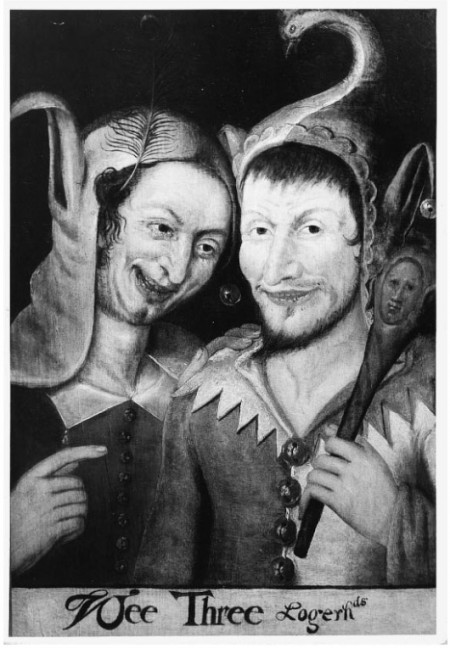
we three loggerheads (dolts)

One day a rogue dressed as a woman and pretending to be a doctor arrived at the home.  The wife, who had summoned the doctor, evidently was in on the ruse.  The doctor asked the wife, “tell me your pleasure.”[2]  The wife asked to the doctor to come upstairs with her for awhile, for she needed “professional assistance.”  Upstairs, the wife and the doctor had sex.  Then:

When they’d had all the fun they wished,
Screwed, embraced, and hugged, and kissed,
They rose and went downstairs again. [3]

The husband, oblivious to the nature of the doctor’s treatment, urged his wife to pay the doctor well.  Evidently she controlled their purse.  The wife sharply told her husband to mind his own business.  The false doctor then left without the wife paying him.

The wife’s malice toward her husband went further than cuckolding him.  She also ingeniously described to her husband in intimate detail her having sex with the doctor.  The wife’s purported problem was with her kidneys, and the doctor’s pretextual treatment was the common ancient medical practice of bleeding the patient.[4]  The wife’s trick was to use equivocal language that her husband lacked the wit to understand fully:

I strained as hard as a woman could.
A hundred strokes. It did no good.
I couldn’t bleed. She thumped me till
My flesh was as soft as dough, and still
I didn’t bleed a single drop.
Three times she took me, and atop
My loins she placed two heavy tools
And struck me blows so long and cruel
I felt the pangs of martyrdom,
But not a drop of blood would come.

The account climaxed with the application of an ointment:

When all the hammerings had ceased,
This easeful ointment she applied
Upon my wounds both deep and wide
Until it cured me of my ache.
This medicine was good to take.

Adding to her description of the erect penis as a tool of welcomed violence, the wife also described it as ugly and crude:

This ointment issued from a dropper
Down through a pinhole in a stopper
That was grotesque and dark and rude.
But glory be, the salve felt good! [5]

The husband responded ignorantly and sympathetically: “My dear, I fear you must have almost died.”  The wife delighted in gulling him sexually and verbally.  Male and female scholars explicating this fabliau have found similar delight.[6]

Not merely the matter of a fabliau, malice toward cuckolded men is a deep feature of human social life.  That some women and men behave with malice towards others is widely known through personal experience.  That some men and women are utter dupes is also widely known.  Less commonly recognized is that the force of law has long imposed legal fictions of paternity on cuckolded men.  If the wife gives birth to a child from having sex with someone other than her husband, the husband is often still responsible legally for the child.  Law-based cuckolding of men has been extended to impose financial obligations on unmarried men who falsely believe a woman’s claim of sexual fidelity.  The legal system of malice toward cuckolded men shows the extent to which women’s interests socially dominate men’s.

*  *  *  *  *

Read more:

Notes:

[1] In La Saineresse, ll. 5-6, the wife “en parla priveement & en jura .i. serement…” DuVal & Eichmann (1992), The Lady Leech, p. 60, translates those lines as “The more she pondered it, the more / she was annoyed.  At last she swore….”  Dubin (2013), The Healer, p. 525, translates these lines as she “spoke about it on the sly, / swearing an oath….”  The wife’s “private” discussion of her husband’s boasting and the wife’s “swearing an oath” seem to me best interpreted as internal, figurative acts.  They suggest her inner disturbance at her husband’s boasting.  DuVal & Eichmann’s translation better captures that sense.  The French text is available online in Barbazan & Méon (1808), v. 3, pp. 451-4.

[2] My translation of La Saineresse, l. 30, “Or me dites vostre plesire.” DuVal & Eichmann (1992) p. 60, translates this as “What are you wanting me to do?”

[3] Trans. DuVal & Eichmann (1992) p. 61.  Subsequent quotes are from id. p. 62.

[4] The title of the fabliau, La Saineresse, means in context a female member of the medical bleeding profession, or more humorously, a “lady leech.”  The saineresse (doctor) arrived equipped with “a kit of tubes and bleeding cups.”  The kidneys in medieval understanding were a source of sexual desire.  The wife told the doctor that she suffered from “goute es rains mout merveillouse.”  That’s literally sickness (gout) in the kidneys.  The meaning of the phrase “goute es rains” covers a lower-back ache and sexual yearning.  A more direct term for the later is the closely related term “goute en l’aine” (itchy loins).  Levy (2000) p. 223, p. 230, n. 46.

[5] The fabliau Le Peschor de Pont-Sur-Seine (The Fisherman of Pont-Sur-Seine) similarly explores a wife’s contradictory feelings and actions in relation to her husband’s genitals.  The wife describes her husband’s genitals as repugnant: “your little hanging bit of bowel.  There’s nothing else I find more foul.”  Trans. Dubin (2013) p. 443.  Most literary scholars seem to interpret such an attitude toward male genitals as natural.  At the same time, they describe the fabliaux as a celebration of the phallus, marred by occasional antifeminism.

[6] The wife’s treatment of her husband is “deserved punishment.” DuVal & Eichmann (1992), prefatory note, p. 60.  A leading scholar of fabliaux has declared:

The story is funny enough in itself, though crude, but placed in the courtly context it gains a third level of reference that makes it even more witty.

Nykrog (1974) p. 68.  According to another leading scholar of fabliaux, the wife’s description of her experience with the doctor, including her description of the man’s penis, “catches something of the quintessence of fabliau humor.”  Pearcy (1974) p. 180. A newly minted literature Ph.D. described that passage as “so delicious.”  Regarding the wife’s delight in energetic extra-pair sex, the new literature doctor diagnosed:

This overabundance of frustration is obviously due to the fact that the bourgeois {her husband} is not fulfilling his husbandly duties. … She has obviously exercised some restraint in not cheating on him before.

Horton (2007) pp. 232-3.

[image] We Three Loggerheads (dolts), painting, thought to be from c. 1650, held in Shakespeare Birthplace Trust Museum, Stratford-upon-Avon, England.  In Shakespeare’s Twelfth Night, the clown Feste refers to a picture of “we three.”  Act. 2, Scene 3, line 16.  Similar prints appeared earlier in continental Europe.  See Jones (2010) pp. 503-4.

References:

Barbazan, Étienne, and Méon. 1808. Fabliaux et contes des poetes françois des 11,12,13,14, et 15e siecles, tirés des meilleurs auteurs Nouv. éd., augm. et rev. sur les manuscrits de la Bibliotheque impériale. Paris: B. Warée.

Dubin, Nathaniel. 2013. The fabliaux. New York: Liveright.

DuVal, John and Raymond Eichmann, trans. and ed. 1992. Fabliaux, fair and foul. Binghamton, N.Y.: Medieval & Renaissance Texts & Studies.

Horton, Ingrid D. 2007.  Engendering Vice: The Exemplarity of the Old French Fabliaux.  Ph.D. Thesis.  Program in French and Italian. University of Kansas.

Jones, Malcolm. 2010.  “The English Broadside Print, c. 1550 – c. 1650.” Pp. 478-526 in Hattaway, Michael. 2010. A new companion to English Renaissance literature and culture. Chichester: Wiley-Blackwell.

Levy, Brian J. 2000. The comic text: patterns and images in the Old French fabliaux. Amsterdam: Rodopi.

Nykrog, Per. 1974. “Courtliness and the Townspeople: The Fabliaux as a Courtly Burlesque.” Pp. 59-74 in Thomas Darlington Cooke and Benjamin L. Honeycutt, eds. 1974. The humor of the fabliaux: a collection of critical essays. Columbia: University of Missouri Press.
Pearcy, Roy J. 1974. “Modes of Signification and the Humor of Obscene Diction in the Fabliaux.” Pp. 163-196 in Thomas Darlington Cooke and Benjamin L. Honeycutt, eds. 1974. The humor of the fabliaux: a collection of critical essays. Columbia: University of Missouri Press.

inhumane scope of taxation, or expanding the tax base

The most popular taxes are taxes on others.  Tax the rich (those much richer than you).  Tax corporations (who aren’t real persons like you are).  Tax traders, money-lenders, and importers-exporters (what they do is much less important than what you do).  And who here would object to taxing foreigners?

Given ominously growing public-sector debts around the world and public resistance to paying taxes, tax authorities should consider shifting the tax base toward non-humans.  A renegade political economist teaching on the eastern shore of the Mediterranean about two thousand years ago described this tax policy innovation:

When they came to Capernaum, the collectors of the two-drachma tax went up to Peter and said, “Does not your teacher pay the two-drachma tax?”  He said, “Yes.”  And when he came home, Jesus spoke to him first, saying, “What do you think, Simon {Peter}?  From whom do the kings of the earth take customs fees or capitation taxes?  From their sons or from others?”  And when he said, “From others,” Jesus said to him, “Then the sons are free.  However, not to give offense to them, go to the sea and cast a hook, and take the first fish that comes up, and when you open its mouth you will find a stater; take that and give it to them for me and for you.” [1]

Peter declared that Jesus pays the tax.  Peter also implicitly described Jesus as an other, because taxes were collected “from others.”  Jesus, however, implicitly described himself and Peter as sons of a king, hence free from the obligation of having to pay taxes.  That freedom isn’t limited to Jesus and Peter.  Christian scripture makes clear that every human being can be a child of God, the greatest king.[2]  The only beings left for “others” in Jesus’s personal categorization are non-human animals like fish.  A tax scheme based on taxing others, according to the promise of Jesus, taxes only non-humans.  Fortunately, fish, if caught, can pay taxes.

ichthus: fish symbol of Christians

For more than 1500 years, some taxpayers have remembered Jesus with the symbol of a fish.  The fish represents “Jesus Christ, Son of God, Savior.”[3] The fish indicates an alternate source for paying taxes.

*  *  *  *  *

Read more:

Notes:

[1] Matthew 17:24-27.  I’ve adapted the New Revised Standard translation to describe monetary and tax terms more literally.  This pericope occurs in only the Gospel of Matthew.  Matthew 9:9 and 10:3 describe the apostle Matthew as being a tax collector, or in the specific terms of the above translation, a collector of customs fees.  Exodus 30:11-16 describes a half-shekel capitation tax to be given as an offering to God.  This pericope is commonly called “Jesus and the Temple Tax,” but some aspects of the text suggest a Roman tax.  No scholarly consensus exists as to whether the tax was a Jewish or Roman tax.

A wide-spread folktale motif is a ring, thrown into the sea, turned in the belly of a fish. See, e.g. Herodotus, Histories 3.39-43 and Verstraete (1998). In the biblical story, the folktale motif perhaps suggests that the money found in the fish refunds taxes previously paid.

[2] John 1:12, 11:52; Romans 8:16-16; Ephesians 1:5; Galatians 3:26; 1 John 3:1-2.

[3] The symbol is known as the ichthys.  The letters of the Greek word for fish correspond to the first letters of each word in the Greek expression for “Jesus Christ, Son of God, Savior.”

Reference:

Verstraete, Beert. 1998. “The Ring inside the Fish: A Comparison of the Use of a Similar Folklore Motif in Herodotus and a Dutch-Frisian Folktale.” Canadian Journal of Netherlandic Studies 19(1): 14-18.

domestic violence in fabliaux and farce: medieval and modern

Russian popular print showing wife beating husband

Wives and husbands verbally and physically abusing each other has been a sad feature of human life throughout recorded history.  In medieval Europe, communities through a shaming ritual called charivari publicly punished men for beating their wives.  They also through charivari publicly punished men for being beaten by their wives.  Since medieval times, domestic violence against men has come to be largely ignored.  Men who are victims of domestic violence are now punished by denial rather than by charivari.  Now a U.S. Marine gets beat up by his wife and then arrested for domestic violence.  He poignantly pleads, “What do you do when a girl hits you?

Le Vilain Mire, a thirteenth-century Old French fabliau, represents imaginatively charivari for domestic violence.  A rich peasant won with his wealth the hand of an impoverished knight’s daughter.  Fearing that he would be cuckolded while he was out working in the fields, the peasant resolved to beat his wife in the morning so that she would weep all day and not be attractive to men.  When he returned home in the evening, the peasant planned to make up with her and enjoy marital life.  After getting beaten twice, the wife ingeniously prompted the king’s messengers to beat her husband repeatedly.  The king’s messengers found the husband, beat him for the first time, and then “they mounted him on a horse, his face to the tail, and led him to the king.”[1]  That’s the characteristic charivari position of a man being publicly shamed for beating his wife, or getting beaten by his wife.  Crediting the wife’s ingenuity in securing two strong proxies, the husband was positioned for a double dose of punishment in this fabliau.

Domestic violence appears in farce in the recently published book The Farce of the Fart and Other Ribaldries.  This book provides English translations of twelve medieval French plays.  In the preface, the author declares:

there are aspects of this repertoire that are distinctly unfunny and worthy of our serious exploration.  The recurring theme of domestic violence is one of them, in which many a playwright goes so far as to make the preposterous suggestion that women were the ones who regularly brutalized their husbands. [2]

That’s not funny.  It’s also farcical.  Women and men living together brutalize each other, usually not regularly, but more times than is right, which is never. Many social-scientific studies indicate that women are as physically aggressive, or more physically aggressive than men in their relationships with male intimate partners. Many academics now fervently believe that no essential gender differences exist, except that men are more evil and that men deserve to be incarcerated in vastly gender-disproportionate numbers. They don’t believe that domestic violence among intimates is commonly mutual.

Medieval fabliaux and farces come closer to truth about domestic violence than does much modern scholarship.

*  *  *  *  *

Read more:

Notes:

[1] Le Vilain Mire, trans. from Old French in Hellman & O’Gorman (1965) p. 75.  The quoted text in Old French is ll. 195-6: “Si le montent à reculons / La teste devers les talons.”  Here’s a version of the complete Old French text of Le Vilain Mire. Another version of the Old French text has “Einz monterent tuit enroment / Le vilain sor une jument.” (But they mounted right away in a row / the peasant seated on a mare.)  See Zipperling (1912) p. 117.

[2] Enders (2011) p. xiv.

[image] popular print, Russia, 1880s, British Museum, 1996,0323.2.3.

References:

Enders, Jody. 2011. “The Farce of the Fart” and other Ribaldries: twelve medieval French plays in modern English. Philadelphia, Pennsylvania: University of Pennsylvania Press.

Hellman, Robert, and Richard O’Gorman, ed. and trans. 1965. Fabliaux; ribald tales from the old French. New York: Crowell.

Zipperling, Carl. 1912. Das altfranzösische Fablel du vilain mire kritischer Text mit Einleitung, Anmerkungen und Glossar ; dazu Anhang mit photographischer Reproduktion eines Teiles der zugrunde gelegten Handschriften. Halle: Niemeyer.