participation in contest judgment in medieval literature

Medieval literature occasionally sets up a contest among story characters.  A well-known example is Geoffrey Chaucer’s late-fourteenth-century Canterbury Tales.  In that work, pilgrims compete with each other to tell the best story while traveling on pilgrimage between Tabard Inn and Canterbury Cathedral.  The winner receives a Tabard Inn dinner paid for by the other contestants.  The contest creator and judge is the Host (Bailey), the owner of Tabard Inn.[1]  As in most contests disseminated through commercial media today, the contest creator-judge benefits financially from sponsoring the contest.

Medieval literature also contains more democratic, more participatory, non-commercial contests.  For example, an Old French fabliau from about the thirteenth century sets up a contest between three wives for a ring that the three found.[2]  The wife winning the ring will be the one who exploits most impressively a husband’s inferiority in social ingenuity in the course of cuckolding him.  The narrator ask the reader or auditor to participate in judgment of the characters’ performances:

I want you to explain
which one you think should have the ring.

Let’s have no lies, now; you decide,
and honestly and wisely choose,
The ring in question should be whose? [3]

For your judgment, consider the three wives’ exploits.

One wife got her husband into a drunken sleep.  She and her lover then tonsured her husband, dressed him in monk’s clothes, and dropped him off at the door of a monastery.  When the husband awoke from his stupor, he concluded from his inexplicable circumstances that God wanted him to join the monastery.  The family house, some land, and some property he signed over to his wife.  She then had complete freedom to enjoy her life with her lover.

Another wife enacted a variation of the punishment of a husband who disparaged all women.  For a noon meal, the husband asked the wife to roast on a grill some dried and preserved eels.  The wife went out and spent the week cavorting with her lover.  The following Friday, she asked a neighbor to grill the eels to fulfill her husband’s request.  The wife returned and presented the cooked eels to her husband as if a week had not passed.  The husband angrily confronted his wife.  She cried out to the neighbors.  They came running.  The wife declared that the husband had gone mad, imagining a week’s passing.  The neighbors believed the wife and shackled the husband.  After the neighbors left, the wife called in her lover.  They then enjoyed the company of each other with a view of the hog-tied husband.

The third wife managed to get her husband to give her away in marriage to her lover. The wife instructed her lover to ask at night her husband to give him in marriage the husband’s niece.  The wife, who the husband thought was back at their home, was in fact disguised as the niece.  The story emphasized that giving away a woman in marriage is for life:

“If he freely makes me your own,
I say, a gift is not a loan.”

Because he didn’t lend his wife,
he couldn’t get her back again. [4]

The wife’s trick was to make her lover’s borrowing of her into her being his own.

You choose which wife best deserves to win the ring for her exploits.  The absence of online polls in medieval Europe didn’t impede the popularity of works offering open, democratic participation in contest judgment.  At least five such works have survived in written medieval texts.[5]

*  *  *  *  *

Read more:

Notes:

[1] Who wins the contest in the Canterbury Tales isn’t told.  That seems to be a result of Chaucer never finishing the work.  Competing stories within a frame narrative were a component of the early, eastern Book of Sindibad corpus.

[2] Contests between three women exist in earlier literature.  For example, the story Al-Asma’i and the Girls of Basra from the 1001 Nights existed in eleventh-century literature from the Islamic world. See my post on courtly and Bedouin love poetry, note [4].  The Judgment of Paris from ancient Greek literature also has three women competitors.

[3] From Les trois dames qui troverent l’anel, trans. from Old French in Dubin (2013) p. 599.

[4] Id. pp. 597, 599.

[5] The Les trois dames qui troverent l’anel  exists in two manuscripts versions.  An alternate version has the narrator supporting the third wife as winner, but still appealing for participation in contest judgment.  Pearcy (1980) pp. 63-4.  The Old French fabliau Le Jugement des cons has three girls competing for the hand of a handsome young man.  The contest is to best answer the riddling question, “which came first, your vagina or you?”  Such riddles have a long history in literature, philosophy, courtly debates about wisdom before kings, and intellectual disputes.  In the Jugement des cons, a mock court declares the winner, but the narrator concludes:

I’m travelling the wide world over
to ask: “Was the right verdict given?
and pray your sins may be forgiven.
If you’d amend this verdict, now
I call on you to tell me how.

Trans. Dubin (2013) p. 917.  Two other short, Old French stories in verse from the thirteenth or fourteenth centuries similarly seek extra-diegetic participation in judging contests among three women: Watriquet Brassenel de Couvin’s Les Trois Chanoinesses de Couloingne and the fragmentary Jugement.  Pearcy (1980) pp. 65-6, 68.  William Dunbar’s The Tretis of the Twa Mariit Wemen and the Wedo (dated c. 1500) also has that structure.

References:

Dubin, Nathaniel. 2013. The fabliaux. New York: Liveright.

Pearcy, Roy J. 1980. “The Genre of William Dunbar’s Tretis of the Tua Mariit Wemen and the Wedo.” Speculum v. 55, n. 1,  pp. 58-74.
men fail: Shabbetai’s Zerah is no Lysistrata

Judah ibn Shabbetai’s early-thirteenth-century Hebrew narrative Minhat Yehudah Sone ha-Nashim provides an insightful contrast with Aristophanes’ Lysistrata.  Both literary works depict sex-based social movements for peace.  In Lysistrata, the Lysistrata-led women’s movement succeeds.  In Minhat Yehudah, the Zerah-led men’s movement fails.

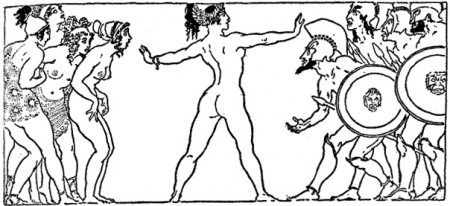
Lysistrata from Aristophanes's play Lysistrata

The plot of Aristophanes’ Lysistrata is relatively well-known.  The women of Greece are upset that the men are making women’s lives more difficult through their well-organized attempts to kill each other.  The main character Lysistrata leads a sex boycott that conquers the Greek men.  The women force the men to redirect their efforts from war on men to better serving women.[1]

Judah ibn Shabbetai’s Minhat Yehudah is less well-known and deserves more attention.  The main character Zerah declares that women have rejected wisdom and embraced folly.  Women have thus made peace impossible amid the chaos of mis-directed desires.  Zerah urges the men of his Castillian village to shun women.  Zerah leads the men to a new, men-only place of peace and delight far beyond that of the modern MGTOW imagination.  Zerah’s place is on a bank of river where grow henna, nard, lush oaks, and fruit trees of every kind.  Every kind of fawn and deer is there, and birds, cooing and piping, chirping and twittering in the old-fashioned way.  There the men care for themselves:

Sometimes they discoursed on laws and statutes, sometimes they turned to food and drink; yet other times they would laugh and play, for thus are days of pleasure passed.[2]

Zerah, their leader, does not lead a life of total self-indulgence.  For one month each year he preaches throughout neighboring districts:

Wherever he went he proclaimed:  “Shun woman as you beware the glittering sword!  Seek ease!  Find peace! Rid yourselves of jewelry-wearers that your days may be long.  … Let the wise man listen and pay me heed; to make my speech longer there is no need.”

Men living lives of their own choosing, not under the direction of women, infuriated women:

Hopping with rage they gathered, young and old, widows and girls, to take counsel and to plan action.  Pain and shock had seized them; their spirits were shaken.  They tore at their skin in their fashion, and their faces were fallen. … “This man {Zerah} is guilty of a capital crime!  By stoning shall he die, and no ransom will get him reprieve, for he has slandered the virgins of Israel.  Where are the masters of deceit, experts in intrigue? … Let us find a stratagem to wipe him out of the nation and get our revenge.  Let us demolish his devices so that men may go with their sons to visit the girls again.” [3]

The women arrange to exploit a well-recognized weakness of most men.[4]  They bring to Zerah a young, beautiful, warmly receptive woman.  Zerah falls in love with her and wins her hand in marriage.  Blissfully in love, Zerah obliviously agrees to a wedding contract with terms like these:

And this is the dowry that the bride brought with her: waste, shame, horror, and blame.  Thus the sum of the ketubbah, the gift, the dowry, and addition is a burn, a wound, a sore, and a lesion.

For Zerah’s bride, the women substituted an ugly shrew.  Her name is Rizpah bat Aiah, which means “Coal, Daughter of the Vulture.”

Zerah’s movement of men for peace collapses amid the horrors of Zerah’s married life.  Rizpah demands from Zerah a long list of expensive material goods, including jewelry and fancy clothes.[5]  She also orders Zerah to stop reciting poetry:

Stop taking up your rhyme!  Do not even raise your voice.  I have no interest in wisdom or culture, only in bread and meat.  Your poems and lyrics mean nothing to me … Get up, take your plow and your plowshare, your quiver and bow, and go about the town from dusk to dawn, stealing, murdering, and swearing falsely.  As your household grows, you will have to provide their daily bread.

Zerah’s friends advise him to flee.  But Zerah wisely replies that he cannot escape the force of law that extracts from men money for having sex or getting married: “husbands are like prisoners in irons; they can be redeemed only with silver.”

After Zerah’s friends give him what amounts to much silver, Zerah heads to family court to try to extract himself from his horrible marriage.  But the family court system is highly politicized.  Women dominate the proceedings.  The majority urges that Zerah be treated harshly:

Let him not be redeemed or buy his freedom.  Make his yoke heavy; do not sunder his bonds.  It is well for a man to bear the yoke when he is young.

After the wife’s advocate warns of dire consequences for the nation if Zerah is shown mercy, the judge condemns Zerah to death.

Zerah is saved only by the narrator declaring that the whole story is imaginary.  Many men now and then know better.  In Judah ibn Shabbetai’s Minhat Yehudah Sone ha-Nashim, men fail to win peace in a way far beyond the imagination of Aristophanes’ Lysistrata.[6]

hen-pecked husband washing dishes

*  *  *  *  *

Read more:

Notes:

[1] Here’s an online translation of Lysistrata.  Roche (2005) provides a more recent translation.

[2] Judah ibn Shabbetai, Minhat Yehudah Sone ha-Nashim (probably written c. 1208), trans. from Hebrew by Raymond P. Scheindlin as “The Misogynist,” in Stern & Mirsky (1990) pp. 269-94.  Minhat Yehudah Sone ha-Nashim is Hebrew for “The Offering of Judah the Misogynist.”  Some writers refer to the text as “The Offering,” others as “The Misogynist.”  To avoid the misandristic connotations of the term misogynist, I refer to the work as Minhat Yehudah.  The quotations above are from id. pp. 277-8, 284, 286, 287.

[3] This text, like many others, acknowledges men’s inferiority in social ingenuity.

[4] Zerah’s weakness is foreshadowed in dreams.  After his first dream, his companions counsel him: “Pay no heed to fantasies that originate deep within the body.”  Id. p. 280.  In Zerah’s second dream, a beast “seized him, pulled out his root, and took hold of his privates; then it opened its mouth and made to swallow him.”  In a third dream, he fell into a deep pit.  Id.  Falling into a deep pit commonly figures marriage in the literature of men’s sexed protests.

[5] The list of goods demanded includes text from an ordinary man’s sexed protest in Isaiah 3:15-4:1. The rabbi Maimonides in the twelfth century described Jewish law concerning the ketubbah. See The Code of Maimonides, Bk. 4, Ch. 12-14, trans. Klein (1972).

[6] Lack of imagination is also evident in scholarly articles considering Shabbetai’s Minhat Yehudah Sone ha-Nashim.  For example, Fishman (1988) and Jacobs (2003) dwell on misogyny.  They show no appreciation for how the term misogyny has functioned to shame, silence, and subordinate men while obscuring the literature of men’s sexed protests.  Scheindlin, in his introduction to his translation in Stern & Mirsky (1990), compares Shabbetai’s Minhat Yehudah to Euripides’ Hippolytus.  The latter work, however, lacks the dimension of social protest in men’s heterosexual renunciation.

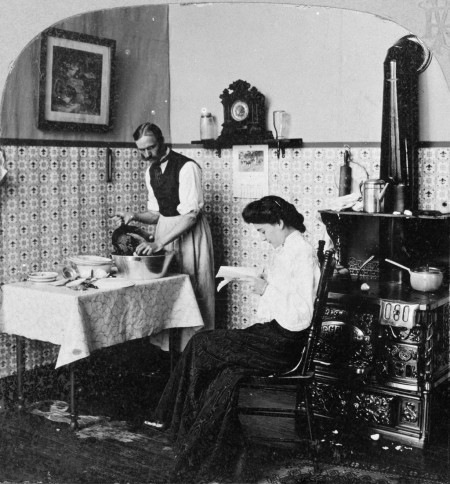
[images] Lysistrata, from Lindsay & Lindsay (1926); “Mr. and Mrs. Henpeck wash the dishes,” stereograph, Phila., U.S.A. : C.H. Graves, publisher, c. 1903, in U.S. Library of Congress print collection.

References:

Fishman, Talya. 1988. “A Medieval Parody of Misogyny: Judah ibn Shabbetai’s ‘Minḣat Yehudah sone hanashim.'” Prooftexts. 8 (1): 89-111.

Jacobs, Jill. 2003. “‘The Defense Has Become the Prosecution’: Ezrat HaNashim, a Thirteenth-century Response to Misogyny.” Women in Judaism: A Multidisciplinary Journal. 2 (3).

Klein, Isaac, trans. 1972. The Code of Maimonides. Book 4, The Book of Women. New Haven: Yale University Press.

Lindsay, Jack, and Norman Lindsay. 1926. Lysistrata … Done into English verse by Jack Lindsay, with illustrations and decorations by Norman Lindsay.  London: Fanfrolico Press.

Stern, David, and Mark Mirsky, eds. 1990. Rabbinic fantasies: imaginative narratives from classical Hebrew literature. Philadelphia: Jewish Publication Society.

Roche, Paul, trans. 2005. Aristophanes. The complete plays. New York, N.Y.: New American Library.

seven sages in interactive medieval parody

we are seven: seven sages parody

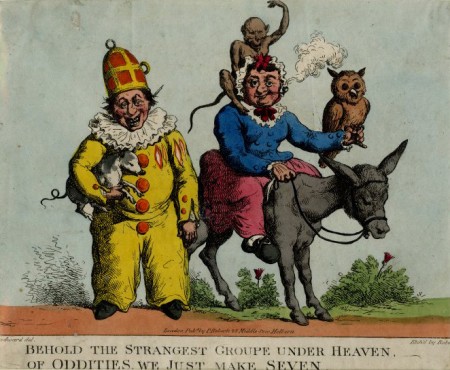
Honor for seven sages (known by name and not much more) has been part of European culture since classical Greece.  By the sixteenth century, medieval Europe had developed an interactive variant of the seven sages.  This variant was known under the catchphrase “we are seven.”  It consisted of a print showing six foolish, incongruous, and stupid persons and animals.  The viewer made up the seventh.

The print above is from London about 1805.  In it “a clown holding a pig stands beside a woman riding astride an ass with a monkey on her shoulders and an owl perched on her left hand.”[1]  Similar iconography exists in a print made in Amsterdam c. 1695.  In ancient Greek iconography, an owl accompanied Athena, the goddess of wisdom.  The interactive print “we are seven” seems to be a parody of the seven sages.[2]  Wisdom wasn’t beyond laughter.

*  *  *  *  *

Read more:

Notes:

[1] From the image description for hand-colored etching, “Behold the Strangest Groupe under Heaven, of Oddities, we just make Seven,” Print made by: Piercy Roberts; Published by: Piercy Roberts. British Museum, 209, 7032.1.

[2] Some surviving “we are seven” prints from the seventeenth century don’t include the owl, but instead have a formally sophisticated arrangement of three asses and three riders.  See, e.g. “Unser sind Siben / Nous sommes Sept,” Amsterdam, c. 1650.  Another variant is “we are three,” showing two persons/animals.  See, e.g. “Search the World you’ll seldom see – Hansomer Folks than we three” (London, 1775), and “We Three Logerhds {Loggerheads}” (England, c. 1650).  Factors other than a parody of the seven sages evidently also contributed to this class of viewer-included, satirical depictions.

La Dame Escoilliee: medieval superhero defeats matriarchy

In short comic tales in Old French verse from about the thirteenth century, ordinary women and men scheme and trick in usual human ways.  These fabliaux are usually comical within realistic plausibility.  The fabliau La Dame Escoilliee, in contrast, presents a medieval superhero in comic-book action. With extraordinary feats, this superhero defeats a particularly oppressive matriarchy in medieval life.

Robin Hood, superheroThe fabliau opens with a scene of conventional betadom, which is just another way of describing matriarchy.  A rich, noble knight is having marital troubles:

because he so loved his wife,
he raised her even over him
and let her govern at her whim
all that he had. Household and lands,
he put it all in her hands,
which so debased him in her sight
and cheapened him that if the knight
said yes, she would say no instead [1]

The new applied game theory has conclusively established what this fabliau advised men nearly a millennium ago:

you ought not to carry out
whatever your wives bid you do;
they’ll only think the less of you.

Men, by nature and nurture, seek to please women.  Yet as we have learned in recent decades, human history is one long, sad story of men failing to please women effectively.  The medieval world, like our world today, yearns for a superhero to overturn male betadom and to make women happy with joyful, exuberant love.

La Dame Escoilliee describes a fantasy super-hero who establishes a new, fantasy world free from matriarchy.  The fabliau provides the usual romantic-epic motifs.  Hunting, thunder, lightning, nightfall.  A count and his companions seek shelter at the home of another noble.  That man mysteriously demurs: “I do not dare … I can’t.”  He is a lord, but one without will and person because of the dominance of his wife.  He explains:

I’m just a coat she wears for rain;
she does her will, but never mine.
If it’s my will, she will decline.

The first super-heroic act is subtle.  Simply through the count addressing this man with respect for his person, the man’s person is activated.  He realizes that he can will events in his household by stating the opposite.  He refuses the count lodgings.  His wife then invites the count in and gives him lodgings and a feast.  He refuses to have his daughter join them for the feast.  His wife then leads the daughter in.  The count falls in love with the daughter and asks for her hand in marriage.  The man refuses the count’s request for marriage.  His wife then gives the count their daughter’s hand.  The man has actually effected his true will.  Yet within his own home he is still deprived of the non-instrumental dignity and respect of a person.  The count, not yet recognized as a superhero, has more work to do.

The count subsequently establishes clearly his superhero credentials.  He orders two hounds to catch a hare before it crosses two fields.  The hounds get the hare after four fields.  That’s not good enough to satisfy a superhero.  The count strikes off their heads with a blow of his sword.  Shortly thereafter, with another blow of his sword, he cuts off the head of his horse.  Only an imaginary man could do such acts.

The count’s superhero status is also established geopolitically.  One of the count’s servants is described as a Moor.  When the count gives a command, “The Moor immediately obeyed.”  Moor in medieval Europe meant a dark-skilled Muslim from the rich, highly cultured, and powerful Muslim lands that extended for centuries from northern Africa to present-day Pakistan.  In thirteenth-century France, having Muslims as subservient people was a Christian superhero fantasy.

While imaginary, this superhero is nonetheless immersed in the details of his kitchen.  For the wedding feast of the count and the daughter, the count provides specific directions to his cook:

He summons his cook and confers
with him and lets him know what flavors
on this occasion he most favors
and with what highly seasoned sauces
to fête his people, …

Following her mother’s instructions, the daughter-bride subsequently enters the kitchen and tells the cook:

“See to it that there’s not one course
where garlic doesn’t dominate,
but lavish care on every plate.”
“I wouldn’t dare.” “You’ll do just this.
Be sure he won’t take it amiss
if he knows it was my desire;
and you must do as I require.
I can advance you or undo you.”

The daughter seeks to establish the normal household matriarchy under which most men live.  Whatever the wife desires, must be.  After all, an unhappy wife means an unhappy life.

The superhero count, however, is unafraid to stand up for his own preferred seasonings.  After the distasteful feast, he summons his cook for questioning.  The cook confesses that he doused all the dishes with garlic because he was afraid to defy the wife’s wishes.  That is not an acceptable excuse to the count.  The count plucks out the cook’s eye, cuts off his hand and ear, and exiles him, never to return.[2]  The count then beats his wife nearly to death.  But he keeps her within the home and takes care that she will heal.  As remains the case today, violence against men is more severe and more frequent than violence against women.  In this fabliau, as in life, violence against men is also less noticed.[3]  The wife repents her act and gives her word that she will not establish the normal matriarchy.  What subsequently happens to the cook isn’t mentioned.

Up to this point in the fabliau, the husband of the wife’s mother remains under jackbooted matriarchy.  But the superhero count steps in to perform an extraordinary fantasy feat.  The count orders his Moor to cut off a bull’s testicles and bring them to him.  The count then declares that he will physically emasculate the wife’s mother.  That action parallels her personal evisceration of her husband.  The count’s servants hold the lady down and expose her ass.  A servant cuts her buttocks and pretends to pull out the bull’s balls.  After the count threatens a cauterization to prevent the balls from growing back, the lady declares:

… Have mercy, lord!
In loyalty I give my word,
on relics I will gladly swear
against my lord never to dare
speak out, but serve him as is fit.
Yes, on my oath I promise it.

The count has mercy on the woman.  Her husband, like many men lacking appreciation for guile, believes the count’s tale of what happened.  So too have literally believed many scholars who have written about this fabliau.  All are solicitous for the welfare of the woman.  They bind her wounds and lovingly carry her home on a gurney.  Because she is rich, she has an excellent physician.  She recovers her health.  But now, when her husband says something, she agrees.  The superhero count has freed the husband from matriarchy.[4]

The superhero saved only one man.  The superhero and his fabliau acts do not represent reality.  Matriarchy endures.[5]  Unruly readers with a sense of humor at least have the pleasure of laughter.

*  *  *  *  *

Read more:

Notes:

[1] La Dame Escoilliee, trans. from Old French in Dubin (2013) pp. 407-439.  Id. also provides an Old French text.  All subsequent quotes, unless otherwise noted, are from id.

[2] These are punishments in Hebrew and Christian scripture.

[3] Lacy (1993), p. 109, ignores the injuries to the male cook but notes “viciously slashing her thighs without benefit of anesthetic.”  After reading a fairy tale, such readers search for pixie dust in their backyards.

[4] Scholars have typically responded to the literature of men’s sexed protests with efforts to shame, silence, and subordinate men.  For example, consider this analysis of La Dame Escoilliee for the learned we:

Unless we happen to share the narrator’s misogyny, we are not likely to find this fabliau very funny or even very pleasant.  I confess that I do not {how daring!}; this text provides a severe test of scholarly detachment.  Nonetheless, the fact that we may find the subject repugnant should not prevent us from reading the work in its own terms and appreciating the construction of the tale

This scholar concludes his analysis of La Dame Escoilliee with a moderate and balanced consideration of antifeminism:

Critical circumspection is required here, and detailed analysis of individual texts must replace the sort of wholesale generalizations that fill many manuals. … In the fabliaux, we cannot expect to find feminist manifestos {how disappointing!} ….  But if it is a striking understatement to say that, in general, the authors of these works do not hold women in particularly high esteem, it is also true that, in some fabliaux, questions of antifeminism are simply irrelevant.  In others, poets simply take for granted traditional assumptions regarding the proper role or the nature of women … we should not assign {these fabliaux} to the same general category of “antifeminism” that we reserve for texts into which an author inserts categorical condemnations of women, or for those rare texts that present an unmistakable hatred of women behind a thin veil of humor.

Lacy (1993) pp. 67, 76-7.  That’s a literary judgment in the spirit of Mayor Peter Stockmann in Ibsen’s Enemy of the People.  It is of course preferable to R. Howard Bloch’s viciously misandristic invocations of misogyny. See, e.g., post on gender symmetry in love, note [4].

[5] La Dame Escoilliee, in the Old French text that Dubin (2013) judges best (MS. Paris, B.N. fonds fraincais 19152), concludes:

Here is the moral of this fabliau:
Cursed be the woman who hates men!

Trans. Lacy (1993), p. 110. That conclusion over-generalizes from matriarchy to misandry.  Id., following conventional lines of interpretation, declares that conclusion to be “a remarkable demonstration of tortured misogynist logic.”  Dubin (2013)’s translation of those two lines invokes God and makes the reason for cursing woman more misandristic:

such is the moral of our text
God curse the wife who disrespects

{Old French: teus est de cest flabel la some.
Dahet feme qui despit home!}

Id. pp. 438-9. The effect is to deflect attention from matriarchy and misandry.

[image] Douglas Fairbanks as Robin Hood in the 1922 United Artists film Robin Hood.

References:

Dubin, Nathaniel. 2013. The fabliaux. New York: Liveright.

Lacy, Norris J. 1993. Reading fabliaux. New York: Garland Pub.