Nahid in the Shahnameh: bad breath makes world history

oral hygiene in history

In my leisurely reading of back issues of the Journal of Dental History, I’ve discovered that the history of bad breath has been sadly neglected.  The history of bad breath is fascinating and of considerable world-historical importance.  In Ferdowsi’s Shahnameh, a Persian epic that is among the greatest works of world literature, bad breath plays a decisive role in placing Alexander the Great at the head of a Greek army.  Alexander’s Greek army conquered and reshaped the ancient world from North Africa to Afghanistan.

The Shahnameh’s story begins with King Darab invading Greece and defeating King Filqus about 2400 years ago.  Darab was the King of Persia.  Filqus (Philip II of Macedon) was the King of Macedon.  Darab’s staff urged him to take as booty Filqus’s daughter Nahid (Olympias):

{She is} elegant as a cypress tree, her face as fresh as springtime.  No one has ever seen any idol in China as lovely as she is, she outshines all others in her beauty.  If the king sees her, she will please him: this cypress would be well placed in his garden. [1]

Filqus gladly complied and sent Nahid to Darab in a way befitting a princess:

There were ten camels carrying Greek brocade embroidered with jewels and gold, together with three hundred camel loads of carpets and necessities for the journey.  The princess remained in her {golden} litter, guided by a bishop and a monk.  Behind her came sixty maidservants, each of them adorned with a diadem and earrings and carrying a golden goblet filled with jewels.

Darab joyfully received Nahid, placed a crown on her head, and began living with her in his royal palace at the Persian capital in Pars.

Darab and Nahid did not live happily ever after.  The problem was bad breath:

One night this lovely moon, arrayed in jewels and scents, lay sleeping beside the king.  Suddenly she sighed deeply, and the king turned his head away, offended by the smell of her breath.  This bad odor sickened him, and he frowned, wondering what could be done about it.

The origin of medicine has long been a subject of rhetorical dispute.  At a practical level, physicians were closely associated with rulers in the ancient world. Darab, like most ancient rulers, had ready access to the most respected physicians of his time:

He sent knowledgeable doctors to her; one who was especially expert was able to find a remedy.  There is a herb that burns the palate, which they call “Sekandar” in Greece, and he rubbed this against the roof of her mouth.  She wept a few tears and her face turned as red as brocade, because it burned her mouth, but the ugly smell was gone.

Unfortunately, Darab’s desire for Nahid was also gone:

But although this beautiful woman’s breath was now as sweet as musk, the king no longer felt any love for her.  His heart had grown cold toward his bride, and he sent her back to Filqus.  The princess grieved, because she was pregnant, but she told no one of this.

Back in Greece in the court of Filqus, Nahid gave birth to a son.  Her son was named Sekandar.  He was Alexander the Great.  But for Nahid’s bad breath, Alexander the Great would have been born in Persia, and the course of world history would have been much different.

The importance of Nahid’s bad breath is consistent with ancient concern about bad breath.  The biblical book of Genesis reports that traders traveling from Gilead to Egypt led camels carrying labdanum, a resin used for breath-freshening in the ancient world.[2]  Within the Hippocratic Corpus, a treatise On the Diseases of Women includes prescriptions for mouthwash to eliminate bad breath.[3]  Rufus of Ephesus, a leading medical scholar of the first century, wrote a treatise On Foul Breath.[4]  Pliny the Elder’s Natural History, also from the first century, advises, “it is a good plan to rinse the mouth with undiluted wine, before going to sleep, for the purpose of sweetening the breath.”[5]  Nearly a century earlier, Ovid advised women “never to neglect to keep your teeth white and to rinse your mouth out every morning with clean water.”[6]

More detailed stories of bad breath exist from the ancient Islamic world.  Early in the ninth-century, the eminent physician Jibra’īl ibn Bakhtīshū` reportedly cured the bad breath of Zubaida, wife of Caliph Hārūn al-Rashīd. Jibra’īl ibn Bakhtīshū’s son explained:

She had complained also of foul breath, about which she was informed by one of her intimates, adding that this was worse than death for her.  My father made her fast until evening, then forcibly fed her a macerated salt fish and had her drink the sediment of wine made of inferior dates.  She felt sick and vomited. He repeated this treatment for three days and then told her: ‘Exhale in the face of whoever had informed you of it, and ask this person if indeed it has gone.’ [7]

In the mid-eighth-century, Isā ibn Mūsā, a leading court figure within the first two Abbasid caliphates, reportedly used bad breath as a rhetorical ploy to cover up his erectile difficulty.  After enjoying many women,  Isā ibn Mūsā retired to a life of abstinence.  His abstemious life was interrupted by the sight of a slave girl “enchanting, with a firm and shapely body as white as palm core and gleaming like a silver bough.”[8]  Positioned to fulfill his newly recovered desire, Isā ibn Mūsā went limp.  To avoid embarrassment, he turned on the girl and accused her of bad breath.  He said to her:

You come on to me but you’ve got bad breath, you won’t relax your thighs, you’re unresponsive and you won’t even help yourself. …  If you were a Persian princess, your master would consider you the perfect mate, since all the men there like doing it with women with bad breath! [9]

The Shahnameh, which Ferdowsi wrote between 980 and 1010, celebrates the Persian greatness of pre-Islamic Iran.  Within the early Islamic world, tension existed between Persians and Arabs.  The claim that Persian men like to have sex with women who have bad breath is a national insult.  Ferdowsi, in the Shahnameh’s story of Darab’s rejection of Nahid, showed the fine sensibility of a Persian man, at least with respect to bad breath.

*  *  *  *  *

Read more:

Notes:

[1] Ferdowsi’s Shahnameh, trans. Davis (2006) p. 454.  Subsequent quotes, until otherwise noted, are from id. pp. 454-5.  Other translation have Iskandar for Sekandar.

[2] Genesis 37:25.  Other translations of the relevant Hebrew word are resin and myrrh.  Here’s more on labdanum.

[3] Bk 2.  Guerini (1909), pp. 50-1, translates the relevant text.  On the Disease of Women reports that one of the mouthwashes is “known under the name of Indian medicament.”  Al-Jahiz, an Islamic scholar in Baghdad early in the ninth century, reported that Indians use toothpicks and toothbrushes.  Al-Jahiz, Kitab fakhr al-sudan ‘ala al-bidan, trans Colville (2002) p. 49 (The Superiority of Blacks to Whites).  Here’s relevant background on views of India from the ancient Islamic world.

[4] HP p. 68.

[5] Pliny the Elder, Natural History, 28:14 (trans. Bostock & Riley, 1855). For further bad breath history, see Fischman (1997).

[6] Ovid, Ars Amatoria (The Art of Love), Bk. III, trans. May (1930).  I’m grateful to David Konstan for this reference.

[7] HP p. 274.  The son was Bakhtīshū` ibn Jibrā’īl, physician to caliph al-Mutawakkil.

[8] Al-Jahiz, Kitab al-nisa’, trans. Colville (2002) p. 178 (On Women).

[9] Id.  Arab physician Nafi al-Harith ibn Kalada of Thaqif advised the Persian King Khosrau I to avoid sex with an old woman: “Her water is deadly poison and her breath speedy death.”  Al-Harith counseled having sex with a young woman: “her mouth is cool, her saliva sweet and her breath fragrant.” HP p. 212.

References:

Colville, Jim, trans. 2002.  Al-Jāḥiẓ.  Sobriety and mirth: a selection of the shorter writings of al-Jāhiz. London: Kegan Paul.

Davis, Dick, trans. 2006. Firdawsī.  Shahnameh: the Persian book of kings. New York: Viking.

Fischman, Stuart. 1997. “The history of oral hygiene products: how far have we come in 6000 years?” Periodontology 2000, 15 (1), 7-14 DOI: 10.1111/j.1600-0757.1997.tb00099.x

Guerini, Vincenzo. 1909. A History of dentistry from the most ancient times until the end of the eigthteenth century. Philadelphia: Lea & Febiger.

HP: Ibn Abi Usaybi’ah, Ahmad ibn al-Qasim. English translation of History of Physicians (4 v.) Translated by Lothar Kopf. 1971. Located in: Modern Manuscripts Collection, History of Medicine Division, National Library of Medicine, Bethesda, MD; MS C 294Online transcription.

Mosaic story explains idols in ancient India?

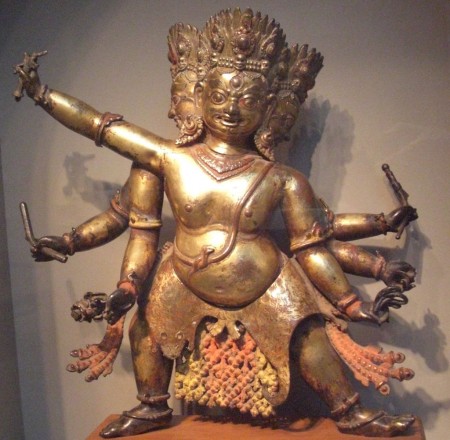
sculpture (idol) of Bhairava, manifestation of Hindu god Shiva

In his extraordinary study of India, eleventh-century Muslim scholar al-Biruni reported a story explaining the ancient origin of idols in India:

Another story of theirs {the Indians} is the following :—Brahman had a son called Narada, who had no other desire but that of seeing the Lord.  It was his custom, when he walked about, to hold a stick.  If he threw it down, it became a serpent, and he was able to do miracles with it.  He never went without it.  One day being engrossed in meditation on the object of his hopes, he saw a fire from afar.  He went towards it, and then a voice spoke to him out of the fire: ” What you demand and wish is impossible.  You cannot see me save thus.”  When he looked in that direction, he saw a fiery appearance in something like human shape.  Henceforward it has been the custom to erect idols of certain shapes. [1]

Both Hebrew scripture and the Qur’an describe Moses throwing down his staff (rod / stick) and it changing into a serpent.  According to those texts, Moses performed miracles with his staff.  He struck with his staff the Nile River, and its water turned into blood.  Moses struck with his staff a rock in the wilderness, and the rock gushed forth with drinking water.  Moses also saw a fire and heard the voice of the Lord coming from within the fire.  Moreover, Moses believed that if he looked upon the face of the Lord, he would fall dead.[2]  These Mosaic events in Hebrew scripture and the Qur’an parallel events in the story of Brahman’s son Narada.

The last two sentences in the story of Brahman’s son Narada shift to a sharp clash with Hebrew scripture and the Qur’an.  Both Hebrew scripture and the Qur’an strongly and repeatedly condemn idols and idolatry.  For example, when Moses found the Israelites worshiping a golden calf, he, outraged, “burned it with fire, ground it to powder, scattered it on the water, and made the Israelites drink it.”[3]  In the story of Brahman’s son Narada, the Mosaic parallels temporally explain the origin of Indian idolatry.  Al-Biruni was a devout Muslim.  The concluding change in moral direction would have been obvious to al-Biruni.

The story of Brahman’s son Narada wasn’t for al-Biruni a satisfying explanation of Indian idolatry.  According to al-Biruni, common, uneducated persons are universally attracted to the sensible world and pictorial representations.[4]  Al-Biruni believed that the origin of idolatry was over-development of common practice:

It is evident that the first cause of idolatry was the desire of commemorating the dead and of consoling the living; but on this basis it has developed, and has finally become a foul and pernicious abuse. [5]

Al-Biruni himself valued most highly abstract verbal knowledge.  He admired the well-educated Indian elite whom he perceived to have values like his:

For those who march on the path to liberation, or those who study philosophy and theology, and who desire abstract truth which they call sâra, are entirely free from worshipping anything but God alone, and would never dream of worshipping an image manufactured to represent him. [6]

Study of philosophy and theology are much different from sacred stories of Moses.  Al-Biruni’s Indian informant may have been responding tactically to al-Biruni’s Muslim’s beliefs in providing the account of Brahman’s son Narada.  But a Mosaic story with an unusual turn didn’t convince al-Biruni of the sacred origin of Indian idolatry.

*  *  *  *  *

Read more:

Notes:

[1] Al-Biruni’s Indica, trans. Sachau (1910) p. 116.  The story is from Chapter XI: “About the Beginnings of Idol-Worship and a Description of Individual Idols.”

[2] See, e.g., Exodus 3:1-6, 4:2-5, 7:8-13; Qur’an 7:103-117, 20:9-24.

[3] Exodus 32:20.  Qur’an 20:97 has a similar account.

[4] Al-Biruni’s Indica, trans. Sachau (1910), p. 111, states:

It is well known that the popular mind leans towards the sensible world, and has an aversion to the world of abstract thought which is only understood by highly educated people, of whom in every time and every place there are only few. And as common people will only acquiesce in pictorial representations, many of the leaders of religious communities have so far deviated from the right path as to give such imagery in their books and houses of worship, like the Jews and Christians, and, more than all, the Manichaeans. These words of mine would at once receive a sufficient illustration if, for example, a picture of the Prophet were made, or of Mekka and the Ka’ba, and were shown to an uneducated man or woman. Their joy in looking at the thing would bring them to kiss the picture, to rub their cheeks against it, and to roll themselves in the dust before it, as if they were seeing not the picture, but the original, and were in this way, as if they were present in the holy places, performing the rites of pilgrimage, the great and the small ones.

His example of popular Muslim attraction to pictorial representations emphasizes the universality of the practice.  Much other evidence also indicates that pictorial and multi-sensuous representations are relatively popular.

[5] Id. p. 124.

[6] Id. p. 113.

Reference:

Sachau, Eduard. 1910. Muḥammad ibn Aḥmad al-Bīrūnī. Alberuni’s India. An account of the religion, philosophy, literature, geography, chronology, astronomy, customs, laws and astrology of India about A.D. 1030. London: K. Paul, Trench, Trübner & Co.

Mann Act criminalized men's sexual activity

In 1910, the Mann Act criminalized persuading or helping any woman to cross state lines “for the purpose of prostitution or debauchery, or for any other immoral purpose.” Conviction under a Mann Act charge carried punishment of up to five years imprisonment and a fine of up to $5000.[1]  U.S. courts interpreted the Mann Act’s description of purpose to encompass a man seeking to have sex with any woman other than his wife.  Intending to have sex with a woman, but not actually having sex with her, was sufficient for conviction under the Mann Act.  Whether the woman voluntarily engaged in sex was irrelevant under the Mann Act.[2]  A Mann Act violation was typically charged against only the man, and not the woman, in a consensual, non-commercial sexual affair.  The Mann Act’s name literally indicates its concern.  The Mann Act primarily criminalized men for sexual activity with women.

The Mann Act was biased against men from prosecution to imprisonment.  In the Pacific Northwest from 1910 to 1930, an estimated 532 men, and only 15 women, were prosecuted under the Mann Act for interstate non-commercial heterosexual affairs.  Nation-wide from 1927 to 1937, an estimated 2988 men were imprisoned for Mann Act convictions, while only 41 women were. Men imprisoned under the Mann Act on average received longer sentences of imprisonment than women did.  In the Pacific Northwest from 1910 to 1930, men sentenced to imprisonment under the Mann Act averaged a sentence of 17.5 months, while women averaged 15 months.[3]  Because women were charged in more aggravated cases than men, that difference in average sentence length underestimates the gender bias in sentencing.  For  example, a man and a woman having an affair in 1931 traveled together from their homes in Pennsylvania to West Virginia, where they stayed in the same hotel room.  Convicted under the Mann Act, the man received a 30-month prison sentence, and the woman, an 18-month sentence.[4]  In another case, an unmarried couple traveled together from Pennsylvania to Alabama in 1934.  Convicted under the Mann Act, the man received six months imprisonment, and the woman received probation.[5]

Legal scholars have downplayed the effect of the Mann Act on men and highlighted its effect on women.  In 2008, a law professor’s short note “Sex, Corruption, Federalism, & the Mann Act” exclaimed:

The defendant {in Mann Act cases} was frequently the woman who, when she drove the car, was indicted as a co-conspirator in transporting herself across state lines for immoral purposes!

That claim is highly misleading.  Probably less than 4% of Mann Act defendants were women charged as co-conspirators for transporting themselves.[6]  That claim is also not relevant to the substantive point of the author’s note, although it may have served to enhance the author’s standing among his peers.  Written by a man, the leading scholarly monograph on the Mann Act declares:

One of the ironies of the Mann Act’s evolution is that women, as the protected class of the statute, in fact became its chief victims. … The statute distinctly inhibited women from taking trips with their male friends.  It not only deprived women of opportunities for vacation and travel but effectively prevented women from using the vehicle of interstate travel as a method of expressing their own sexuality.  Women were deprived of a fundamental human activity which caused no harm to anybody.  They were also subjected to a double standard, since males could travel in interstate commerce to meet women, but no couple without fear of prosecution could allow the woman to similarly travel to meet the male.[7]

The pairing of the nouns “woman” and “male” emphasizes that men comprise a relatively bestial gender.  These sophistical arguments about the greater victimization of women, placed against the punishing reality of the Mann Act, indicate men’s keen interest in publicly showing concern for women’s welfare.[8]

imprisoned white slave girl, impetus for passage of the Mann Act

Sensational public concern about “white-slave trade” in women motivated the passage of the Mann Act in 1910.  Women from rural areas and from foreign countries — France, Germany, Italy, China, Japan, and others — were allegedly duped and forced into involuntary servitude as prostitutes.  Once captured, they were allegedly bought and sold like black slaves had been.  Leaders in the fight against the white-slave trade greatly exploited sexual and racial biases.  For example, a book published in 1910 was entitled Fighting the Traffic in Young Girls or War on the White Slave Trade. The title page sensationally advertised:

THIRTY-TWO PAGES OF STRIKING PICTURES
Showing the workings of the blackest slavery that has ever stained the human race.

The book included essays on white slavery from persons in the following positions:

  • United States District Attorney, Chicago
  • Assistant United States District Attorney, Chicago
  • Assistant State’s Attorney, Cook County, Ill.
  • Secretary of the National Vigilance Association, London, England
  • Member of the National Vigilance Committee, New York
  • President of the National Florence Crittenton Mission
  • Superintendent of the Illinois Training School for Girls
  • Missionary of the Moody Church, Chicago
  • Deaconess of the Methodist Episcopal Church, Chicago
  • Principal, Red Water Institute, Red Water, Texas
  • Professor at Rush Medical College, Chicago
  • Professor at Northwestern University Medical School, Chicago
  • Pastor of the Lexington Avenue Baptist Church, Chicago [9]

In that book, the United States District Attorney in Chicago warned rural girls coming to Chicago:

One thing should be made very clear to the girl who comes up to the city, and that is that the ordinary ice cream parlor is very likely to be a spider’s web for her entanglement.  This is perhaps especially true of those ice cream saloons and fruit stores kept by foreigners.  Scores of cases are on record where young girls have taken their first step towards “white slavery” in places of this character. [10]

Interest in theater, the Assistant State’s Attorney explained, was also a common path into white slavery:

The most worked method of securing the confidence by appealing to the ambition of the girl is by the stage or theatrical route. It is because so many girls are “stage struck” now-a-days that this method has been worked most successfully. Perhaps of all the cases that have been tried in nearly the last three years in Chicago, the girls who have been procured by inducements to go upon the stage outnumber all others. The slave trader represents himself as the agent of some theatrical manager, or perhaps as the manager himself. Going to a factory town, for example, he makes it his business to meet some girl who is working there who he has learned is “stage struck.” After the formalities of an introduction, which he secures in one way or another, he leads up to the subject by telling that he is a theatrical man and is looking for new recruits.

The girl is at once interested. She is naturally ambitious. She wants to better her condition in life. She doesn’t suspect that a fiend with the heart of a devil is masquerading before her as the agent of some theatrical manager. He explains to her that if she will accompany him she can make from $15 to $20 a week at the very start and in a year she will be playing a part, and a year or so later she will possibly be leading lady. The picture is an alluring one to this young girl, for she is now making only perhaps $4, $5 or $6 a week, and the thought of securing such a large salary at the very start almost sweeps her off her feet. She is entranced by the beautiful picture that has been painted and she goes, perhaps to a stage from which she will never return. [11]

The old white men who made up the political and intellectual elite vigorously expressed concern about young white girls being turned into sex slaves.  A New York Times editorial in 1909 declared:

In his belief that the white slave trade is a great as well as monstrous evil, President Taft has the support of all the commissions and individuals who have given the matter examination at once honest and careful. The denials come partly from people who are loath to admit that such things can be going on in modern communities pretending to be civilized, and partly from those who profit directly or indirectly, by the abhorrent traffic. [12]

That position recognized no room for honest, reasoned, public-spirited judgment that “white-slave trade” was rare, not systematic.  Some persons nonetheless evidently persisted in denial.  In early 1910, the New York Times headlined its front page, “White Slave Traffic Shown to Be Real.”  The article reported on a press conference in which the District Attorney declared that a “light mulatto” woman and a “colored man,” as well as a man with a typically Jewish last name, had been arrested in conjunction with the sale of two white girls (“white slaves”), ages 17 and 18.[13]  These white slaves subsequently testified that they were ages 25 and 23, and had voluntarily accepted money to travel to Seattle to work there as prostitutes.[14]  That was probably the sort of transaction typically associated with the movement of prostitutes.[15]

White slavery was a successful fictional and non-fictional, multi-media theme.  John Marvel, Assistant (1909), The House of Bondage (1910), The Rose Door (1913) and other novels exploited the theme, as did the 1913 Broadway plays, The Lure and The  Flight.  A formally non-fictional white-slavery genre was “books filled with lurid case studies and grossly distorted real events combined with chapters contributed by public officials and social workers.” Such works included Fighting the Traffic in Young Girls or War on the White Slave Trade (1910),  The great war on white slavery, or fighting for the protection of our girls (1911), Chicago’s Black Traffic in White Girls (1912), and Canada’s War on the White Slave Trade (1912).  White slavery also made fictional and documentary movies such as The Fatal Hour (1908), Traffic in Souls (1913), The Inside of the White Slave Trade (1913), House of Bondage (1914) (a film version of the book by that name), The Little Girl Next Door (1916), and Is Any Girl Safe? (1916).[16] The New York Times, perhaps concerned to strengthen its reputation for non-fictional stories, changed its position and declared that an organized white slave industry didn’t exist:

By July 1914 it {the New York Times} declared “sensational magazine articles had created a belief in the existence of a great interstate ‘white slave’ trust.  No such trust exists, nor is there any organized white slave industry anywhere.”  By 1916 it referred to the “myth of an international and interstate ‘syndicate’ trafficking in women” as merely “a figment of imaginative fly-gobblers.” [17]

That change in position hardly mattered.  White slavery had too much support in real sexual and racial biases to be regarded as largely fictional.

The racial bias supporting concern about white slavery is more widely recognized today than the sexual bias.  The Mann Act entitled itself the White Slave Traffic Act.[18]  Congress passed the Mann Act in 1910.  In 1920, the Nineteenth Amendment to the U.S. Constitution extended women’s right to vote uniformly across all jurisdictions and all elections.  The Mann Act nearly always in application assigned men sole criminal responsibility for a consensual interstate heterosexual affair.[19]  When women gained equal voting rights, they did not also gain equal criminal responsibility.  The Mann Act continued essentially unchanged until 1986.  Amendments in 1986 removed the sexist language and limited the application of the Act to activities that were criminal under state law.[20]  Those amendments did not signal the end to the sexual bias underlying the White Slave Traffic Act, also fittingly known as the Mann Act.  Men and women are much more likely to express publicly concern about women’s welfare than about men’s welfare.

*  *  *  *  *

Read more:

Data: Statistics on Mann Act cases (Excel version)

Notes:

[1] Here’s the text of the Mann Act.

[2] Caminetti v. United States, 242 US 470 (1917), clarified that the Mann Act applied to non-commercial consensual sex.  Even prior to that decision, Mann Act convictions included buying a railroad ticket for a seventeen-year old girl/woman to travel from Atlanta to Florida to work in a theater associated with debauchery.  See Athanasaw v. United States, 227 US 326 (1913).  The Mann Act, Section 3, encompassed:

any person who shall knowingly persuade, induce, entice, or coerce, or cause to be persuaded, induced, enticed, or coerced, or aid or assist in persuading, inducing, enticing or coercing any woman or girl … with the intent and purpose on the part of such person that such woman or girl shall engage in the practice of prostitution or debauchery, or any other immoral practice, whether with or without her consent

The Mann Act thus criminalized sexual intent, as well as sexual practice.

[3] For statistical details and sources, see Mann Act statistics workbook.

[4] Beckman (1984) p. 1127 (case of Elizabeth and Russell).

[5] Langum (1994) pp. 1-2 (case of Eleanor Becker and Maurice Shannon).

[6] United States v. Holte, 236 US 140 (1915), affirmed that Clara Holte, a 41-year-old married woman, could be charged as a co-conspirator in violation of the Mann Act for traveling with a man across state lines to engage in adultery.  Gebardi v. United States, 287 US 112 (1932), greatly narrowed the applicability of Holte.  After Gebardi, the U.S. Attorney General directed U.S. Attorneys not to bring Mann Act cases against women in noncommercial (non-prostitution) circumstances.  Beckman (1984) p. 1127.  An estimated 8% of Mann Act cases, 1927-1937, had female defendants. In the Pacific Northwest from 1910 to 1930, 2.7% of Mann Act cases had female defendants.  Women were charged as co-conspirators only in non-commercial cases.  Non-commercial cases with female defendants probably amounted to no more than half of total cases with female defendants.  For data, see Mann Act statistics workbook.

[7] Langum (1994) pp. 10-11.  Ch. 4., id., is devoted to the issue of blackmailing men with the threat of exposure to a Mann Act prosecution.  Such blackmail was widely regarded as a serious problem.  The conclusion returns to expressing particular concern about women:

In the area of noncommercial sexual expression, and particularly as regards women, the intended beneficiaries of the Act, this majoritarian morality profoundly oppressed those whose harmless conduct did not conform.

Id. p. 259.  The next paragraph, referring to consequences of the Mann Act, makes no specific reference to men or males, but does refer to consequences “such as … repression of female sexuality.”  Id.

[8] The effect does not seem to be sexually symmetric.  Beckman (1984), an article by a woman author, provides detailed data on women imprisoned under the Mann Act.  No such data exist for men.  McCoy, another woman author,  in McCoy (2010), p. 10, declares:

Men imprisoned for interstate affairs while their mistresses faced no consequences may be viewed as victims of the overzealous enforcement of this law.  But their abandoned families—left to fend for themselves while the men served their sentences—may have been the ones who suffered the most.

Not seeing direct harm to men as a compelling social concern and emphasizing the effects of harm to men on their instrumental value to others supports social devaluation of men as intrinsically valued persons.

[9] Bell (1910), title page.

[10] Id. p. 71, from Ch. IV, Edwin W. Sims, United States District Attorney, Chicago, “Menace of the White Slave Trade.”

[11] Id. pp. 165-6, from Ch. XII, Clifford G. Roe, Assistant State’s Attorney of Cook County, Illinois, “The Auctioneer of Souls.”  Roe’s story itself is quite theatrical.  In mid-nineteenth-century America, respected authorities considered theaters to be a leading source of crime.

[12] Editorial, “There is a White Slave Trade,” New York Times, Dec. 9, 1909, p. 10.

[13] “White Slave Traffic Shown to be Real,” New York Times, Apr. 30, 1910.

[14] “Belle Moore Guilty of Selling Girls,” New York Times, May 20, 1910.  The transcript of the Belle Moore case is available online.

[15] Chicago was an epicenter of concern about white slavery.  A study of white-slave prosecutions in Chicago from 1910 to 1913 found that less than 5% of cases involved a woman held against her will.  Langum (1994) p. 35 judges that figure to be “as close to the truth as we can come.” The share of women held against their will in prostitution within the total population of female prostitutes would be much smaller.

[16] Examples from Langum (1994) pp. 33-4.

[17] Id. p. 33.

[18] The name “Mann Act” arose from the name of the Act’s sponsor, Congressman James R. Mann from Chicago.  Sec. 8 of the Act declared:

That this Act shall be known and referred to as the “White-slave traffic Act.”

That latter name is typically standardized to the White Slave Traffic Act.

[19] McCoy (2010) p. 230, ft. 61 declares:

Although it may have been technically possible for a woman to be charged with transporting another woman for an “immoral” interstate sexual affair, it was not conceptually possible for most early-twentieth century Americans. To the best of my knowledge, no one ever suggested the possibility that women could be noncommercial violators for having same-sex affairs across state lines. It simply would have almost never occurred to contemporary observers that women traveling on trains together or sleeping in the same hotel room might be engaged in interstate love affairs, even if some were.

The issue seems to me less lack of knowledge of lesbianism than lack of interest in prosecuting women.

[20] Langum (1994) pp. 248-51.  A 1978 amendment changed only the section of the Mann Act dealing with juvenile victims.  Id. pp. 244-5.

References:

Beckman, Marlene D. 1984.  “The White Slave Traffic Act: The Historical Impact of a Criminal Law Policy on Women.” Georgetown Law Journal, v. 72, pp. 1111-1142.

Bell, Ernest A., ed. 1910. Fighting the traffic in young girls or, War on the white slave trade (Project Gutenburg version).

Langum, David J. 1994. Crossing over the line: legislating morality and the Mann Act. Chicago: University of Chicago Press.

McCoy, Kelli Ann. 2010. Claiming victims: the Mann Act, gender, and class in the American West, 1910-1930s. Ph.D. Thesis, History Department. University of California, San Diego.

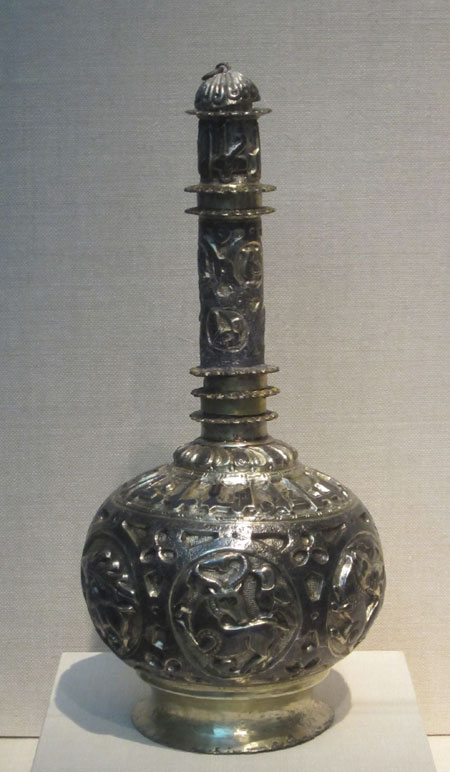
rosewater for sensual revival in the ancient world

rosewater bottle, Iran, early 12th century (Freer Gallery)

In the Indian-Persian-Arabic-Greek-Egyptian tales of The Thousand and One Nights, rosewater is a luxurious perfume that revives the limp and is associated with love.  Here’s an example of rosewater described in the context of luxurious objects:

they brought him {the caliph} liqueur flavoured with fruit, and sweet spices in goblets of gold, silver and crystal.  Two pages, lovely as moons, wearing gold-embroidered Alexandrian robes, brought this in, carrying in front of them trays with crystal jugs of rosewater scented with musk. [1]

Lines of beautiful singing girls subsequently entertain the caliph.  In another example, the merchant ‘Ali Shar is brought before his beloved slave girl, Zumurrud, who is disguised as a king:

{‘Ali Shar said,} “I am here to look for a slave girl whom I have lost.  She was dearer to me than my hearing and my sight, and, although I have lost her, she still holds my soul.  This is my story.”  He then wept until he fainted.  Zumurrud ordered rosewater to be sprinkled on his face and this was done until he had recovered his senses. [2]

That night ‘Ali Shar had passionate sex with Zumurrud.  Rosewater also appears in the story of Zain, a woman so beautiful that men who see her fall deathly in love with her.  Zain served her lover Masrur in her home when her husband was thought to be away:

Zain took a wine cup and brought it to Masrur, having flavoured it with rosewater and crushed musk.  He got up and went to meet her, saying: “By God, your saliva is sweeter than this.”  She started pouring wine for him and he poured it for her, after which she sprinkled him from top to toe with rosewater until the whole room was perfumed.  Her husband, {secretly} watching all this, was astonished by the strength of their mutual affection, and the sight filled him with furious anger and passionate jealousy. [3]

Rosewater appears in many other similar contexts in the tales of The Thousand and One Nights.

Roses have long been highly valued in Eurasia.  Roses were widely cultivated in China no later than 1600 years ago.  In early ninth-century Baghdad, a physician to the caliph al-Māʾmūn reportedly did not use any medicinal treatments that had not been established for at least two hundred years:

He did not use Oxymel and preserved rose unless it was preserved in honey.  Nor did he use rose water unless it was extracted from a rose which had been boiled in hot water, but never made with sugar.  On the whole he did not use anything which the ancients did not know. [4]

Ibn Abi Usaybi’ah had close personal connections to the sultan living in Damascus early in the thirteenth century.  Ibn Abi Usaybi’ah transmitted the following account:

One night, when {one of the Sultan’s wives} was well again and the Sultan was sleeping with her, as the night was ending, she pretended to be frightened, clutched at her heart and kept shivering and crying. The Sultan, who loved her dearly, noticed it and said: “What is the matter with you?” But she did not reply. He then ordered some apple juice to be brought and had her drink some, sprinkled her face with rose water and said: “Will you not tell me what has happened to you, why you are so upset?” [5]

This account of the use of rosewater is quite similar to accounts of the use of rosewater in The Thousand and One Nights.

An ornate silver rosewater bottle has survived from the early twelfth-century Islamic world.  It is inscribed in Arabic with a generic blessing:

And blessing and good fortune.  Blessing and good fortune and joy and happiness and safety and honor and longevity to the owner.[6]

The rosewater bottle offers these blessings with a form evoking male sexual vitality.

*  *  *  *  *

Read more:

Notes:

[1] Thousand and One Nights, Night 415, trans. Lyons (2008) v. 2, p. 240, edited slightly for grammar.  The story of the ninth-century physician Bakhtīshū ibn Jibrā’īl’s luxurious control over the season includes rosewater in the desired environment.  Bakhtīshū offered the caliph luxurious accommodation that included rosewater perfume:

The physician admitted the Caliph to a large square room, whose ceiling was all covered with openings to give light. It was hung entirely with brocaded cloth, which showed under it gum-wood dyed with rose water, sandal and camphor wood. When the Caliph lay down to sleep, he suddenly smelled the most exquisite odors; he could not understand what they were, for he did not see in that room any perfumes, fruits or flowers, neither did he find any fragrant herbs behind the cloth nor any place where they could be put. He was greatly astonished and ordered al-Fath ibn Khāqān to trace the source of these smells. Al-Fath went searching and found around the room, from the outside and all its sides and corners, fine chinks filled with sweet-smelling herbs, crammed with all kinds of aromatic plants, fruits, perfumes and scents; among these were mandrake, the skins of watermelons filled with wild thyme, sweet basil from Yemen, prepared with rose water, yellow saffron perfume, camphor, old wine, saffron and curcuma.

HP p. 270-1.

[2] Id., Night 326, v. 2, p. 66.

[3] Id., Night 853, v. 3, p. 313.  In the story of Aziz and Aziza, Aziz observes, “She {Aziza} sprinkled me with rosewater, and I sat with her, feeling in perfect health.”  Id. Night 118, v. 1, p. 504.  Rosewater here seems to highlight Aziz’s lack of sexual desire toward Aziza, who loves him deeply.

[4] HP p. 351.  The physician was Mikhā’īl ibn Māsawayhi, brother of Yūhannā ibn Māsawayhi.

[5] HP p. 905.  The sultan was Ayyubid al-Adil.  Ibn Abi Usaybi’ah heard the story from his father, who was a physician in the sultan’s court.

[6] Translation from the label for the rosewater bottle, on display in the Freer Gallery.

References:

Lyons, Malcolm C. 2008. The Arabian nights: tales of 1001 nights. vols. 1-3. London: Penguin.

HP: Ibn Abi Usaybi’ah, Ahmad ibn al-Qasim. English translation of History of Physicians (4 v.) Translated by Lothar Kopf. 1971. Located in: Modern Manuscripts Collection, History of Medicine Division, National Library of Medicine, Bethesda, MD; MS C 294Online transcription.