gladiators’ sexual allure in real understanding

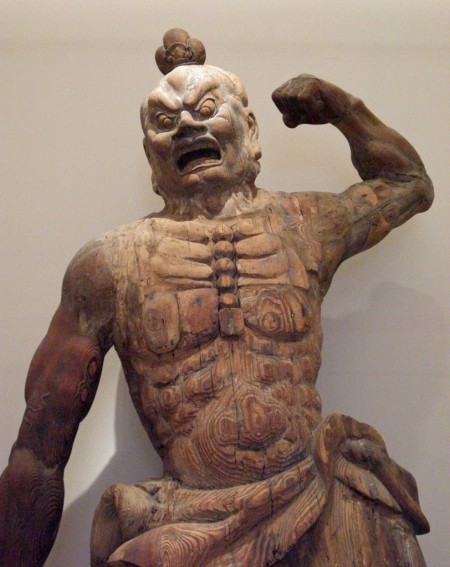
Japanese gladiator: guardian figure, Japan, Kamakura period (1185–1333)

Like rogues, thugs, and bad boys today, Roman gladiators were highly attractive to women.  Within the old gladiatorial barracks in Pompeii have survived graffiti indicating gladiators’ sexual allure.  Among the graffiti are these:

  • Celadus, heart-throb of the girls
  • Celadus, the girls’ idol
  • Cresces, the net-man, puts right the night-time girls, the morning girls and all the others [1]

According to a leading scholar of ordinary life in ancient Rome, these graffiti are:

simultaneously bloke-ish boasting and the poignant fantasies of a couple of young fighters, who faced a short life and may never have got their girl, or at least not for long. [2]

Only an academic with no memory of masculine men could interpret as “bloke-ish boasting … poignant fantasies” a gladiator writing “Celadus, heartthrob of the girls” or “Celadus, the girls’ idol.”[3]  Men typically don’t boast or fantasize about being the center of attention.  Men’s interests are usually more act-oriented.  Moreover, much closely observed and carefully analyzed experience indicates that men who act like they are not desperate for sex or for women’s attention are more successful in getting just that.  Scholars of the new applied game theory call this “aloof asshole game.”

Rather than representing Celadus’s boasting or fantasies, the Celadus heart-throb / idol graffiti more probably represent another gladiator taunting Celadus.  Men’s sexual allure to women depends strongly on their status among men.  Describing Celadus as the heart-throb / idol of the girls implicitly questions his status among men.  One aspect of that status challenge might be homosexual, but it’s not necessarily so.  Describing Celadus as the heart-throb / idol of the girls also puts pressure on Celadus’s ability to run aloof asshole game.  Pretending that you aren’t eager to have sex with girls requires more guile when your brothers-in-arms are taunting you about how much girls adore you.

The richly jeweled woman found within the volcanic ash that smothered the Pompeii gladiator barracks most probably is further evidence of gladiators’ sexual allure.  No one plausibly believes that the rich woman was in the gladiator barracks having sex with a gladiator during the eruption of Mt. Vesuvius.  Seventeen other persons and a couple of dogs were also in the small room during the eruption of Mt. Vesuvius.  Knowing that isn’t necessary to surmise that the rich woman and a gladiator weren’t having sex during the eruption of Mt. Vesuvius.  Nonetheless, a Cambridge don who has a prominent newspaper column (a symbolic superpower!) authoritatively declared:

the myth of the upmarket Pompeian lady being caught red-handed in the gladiatorial barracks, with her gladiator lover, is just that: a myth [4]

That’s a thought-suffocating myth of a myth.  Do you believe that during the eruption of Mt. Vesuvius a richly jeweled woman took shelter in a gladiator barrack with strong, dangerous men that she did not know?  That’s possible.  But reason, feeling, and experience tend to suggest otherwise.  During the terror that Mt. Vesuvius rained down on Pompeii, the rich woman probably sought out the strong arms of her gladiator-lover.[5]

Subvert the power of myth-makers with real understanding and your own creative thinking.

*  *  *  *  *

Read more:

Notes:

[1] Reported in the above English translation in Beard (2008) p. 275.

[2] Id.  If a male scholar put forward such an obtuse, tendentious, and belittling interpretation of a woman’s writing, he would be condemned as a misogynist and sternly instructed that only women can justly celebrate women’s voices.

[3] The third graffito probably isn’t a fantasy.  It seems to reflect a man’s sense of instrumental achievement.  That mode of personal valuation contributes to men’s relative disposabilityOther Roman graffiti also display that sense of men’s sexual achievement, with one rare note of protest.

[4] Id.  The remains of the persons in the gladiators’ barracks were found in the eighteenth century and subsequently lost.  Hence scientific testing on the age and sex of the skeletons cannot now be performed.  The reports indicate that only one richly jeweled woman was found in the room.  Roman literature humorously described gladiators’ sexual allure:

Eppia, the senator’s wife, ran off with a gladiator … And what were the youthful charms which captivated Eppia? What did she see in him to allow herself to be called “a she-Gladiator”? Her dear Sergius had already begun to shave; a wounded arm gave promise of a discharge, and there were sundry deformities in his face: a scar caused by the helmet, a huge wen upon his nose, a nasty humour always trickling from his eye. But then he was a gladiator! It is this that transforms these fellows into Hyacinths! It was this that she preferred to children and to country, to sister and to husband. What these women love is the sword: had this same Sergius received his discharge, he would have been no better than a Veiento.

Juvenal, Satires 6, ll. 103-113.  Another contemporary writer sarcastically refers to “those most loving gladiators, to whom men prostitute their souls, women too their bodies.” Tertullian, The Shows (De Spectaculis) Ch. 22.  These texts now tend to be moralistically disparaged.  That doesn’t change the truth.

[5] Underscoring the trans-historical appeal of bad boys and rough men, the maid Chrysis explained to Encolpius:

There are certain women, you see, whose lust is set in motion only at the sight of slaves or messenger boys with their tunics belted high up. Gladiators in the arena, a mule driver covered with dust, an actor in the shameful exposure of this performance — that’s what it takes to heat up certain females. My mistress is one of this tribe: her taste goes fourteen rows back from the reserved seats and looks for a lover at the fringes of the mob.

Petronius, Satyricon (written c. 60 GC) sec. 126, from Latin trans. Ruben (2000) p. 109.

[image] Guardian figure, Japan, Kamakura period (1185–1333), Wood, 226.4 cm. (F1949.20), 233.5 cm. (F1949.21), Freer Gallery of Art, Smithsonian Institution, Washington, D.C.

References:

Beard, Mary. 2008. The fires of Vesuvius: Pompeii lost and found. Cambridge, Mass: Belknap Press of Harvard University Press.

Ruden, Sarah, trans. 2000. Petronius. Satyricon. Indianapolis: Hackett Pub. Co.

Ōtomo no Kuronushi, immortal of poetry

Otomo no Kuronushi, of the six immortals of poetry

In Japan in 905, a highly influential poetry anthology established six immortals of poetry. Ōtomo no Kuronushi, a ninth-century Japanese poet, was among those six immortal poets.[1]

Kuronushi lasted as an immortal of poetry less than two centuries.  A highly influential Japanese literary work from the early eleventh century did not include Kuronushi in a list of thirty-six immortals of poetry.  Moreover, a poem by Kuronushi wasn’t included in an anthology of one hundred classical Japanese poems, each from a different classical Japanese poet, written about 1235.[2]

While Kuronushi lived into the 890s, his poetic reputation was under threat even by 905.  A compiler of the poetry anthology that came to define the six immortals of poetry criticized Kuronushi for being vulgar and provincial.  By the thirteenth century his poetry was described as “like a mountaineer with a load of wood on his back stopping to rest under cherry blossoms.”[3]  Criticism of Kuronushi was remembered as his immortal status died.

Among the six immortal poets, Kuronushi was not the only one to be forgotten.  Three others mentioned with him in 905 also faded in literary status.  But those other immortals did not disappear from the lists of immortals as quickly as Kuronushi did. Ōtomo no Kuronushi has a distinguished position among the six immortals of poetry.[4]

*  *  *  *  *

Read more:

Notes:

[1] The six immortals of poetry (rokkasen) were listed in the Kokin Wakashu. Ōtomo no Kuronushi had large landholdings in Otsu in the Omni province of Japan.  He was from the influential provincial Ōtomo family that had connections with the Japanese imperial court going back at least to the seventh century.

[2] The thirty-six immortal poets come from Fujiwara no Kinto’s “Anthology of Poems by the Thirty-Six Poets” (Sanjūrokkasen).  The hundred poets are from Fujiwara no Teika’s Ogura Hayakunin Isshu.

[3] Ki no Tsurayuki, from his introduction to the Kokin Wakashu. Fujiwara (1967) p. 17.

[4] Among the six immortal poets recognized in Japan in 905, two have had a large, enduring effect on Japanese literary imagination.  These two are Ono no Komachi and Ariwara no Narihira.  Komachi wrote complex erotic poems.  She is remembered as a beautiful woman who had many love affairs before she became old and ugly.  Narihira was a grandson of the Japanese emperor and also had many love affairs.  He is thought to have been a primary contributor to the Tales of Ise and to have served as a model for the leading man in The Tale of the Genji.  Komachi and Narihira were celebrated as archetypes of the beautiful woman and man in the imperial court of Heian-period Japan (794-1185).  According to a scholarly authority, “Ono no Komachi is even better known today, mainly because of the legends that grew up around her.” Keene (1999) p. 224.

The other four immortals are largely forgotten.  Kisen Hōshi and Fun’ya no Yasuhide were “minor poets who are remembered mainly because Tsurayuki mentioned them {in his introduction to Kokin Wakashu in 905}.”  Id. pp. 224-5.  A third immortal, Sōjō Henjō, was a grandson of the emperor and seems to be remembered mainly for rumors that he had a love affair with Komachi.  Nonetheless, all three of these poets made the early eleventh-century list of thirty-six immortals of poetry.  Only Ōtomo no Kuronushi has the distinction of being on the 905 list of six immortals of poetry, but not on the subsequent list of thirty-six immortals of poetry.

[image] Ōtomo no Kuronushi. One of a set of six hanging scrolls of the six immortals of poetry by Katsushika Hokusai (1750-1849). Japan, Edo period, ca. 1806-8.  In Freer Gallery, F1907.369.

Reference:

Keene, Donald. 1993. Seeds in the heart: Japanese literature from earliest times to the late sixteenth century. New York: Henry Holt & Co.

Fujiwara, Sadaie. 1967. Fujiwara Teika’s Superior poems of our time; a thirteenth-century poetic treatise and sequence. Stanford, Calif: Stanford University Press.

more ancient history of bad breath: Jerome on Bilia & Duillius

avoid bad breath to stay close to God

In proclaiming the virtues of women in a work written in 393, the learned Christian scholar Jerome set out the example of Bilia and her husband Duillius.  Duillius once criticized Bilia:

After Duillius had grown old and feeble, he was once in the course of a quarrel taunted with having bad breath.  Feeling deeply shamed, he went home and complained to his wife that she had never told him of his bad breath so that he might remedy that fault.  She replied that she would have done so, but she thought that all men had foul breath as he had.

{ Is jam senex et trementi corpore in quodam jurgio audivit exprobrari sibi os foetidum, et tristis se domum contulit. Cumque uxori questus esset quare nunquam se monuisset, ut huic vitio mederetur: Fecissem, inquit illa, nisi putassem omnibus viris sic os olere. }[1]

This isn’t an example of misandry.  Jerome’s point is that Bilia was so chaste that she did not know the smell of the breath of any man other than her husband.  Jerome’s story implicitly suggests that other wives had greater knowledge.

Bad breath seems to have become a conventional gag.  In a thirteenth-century Old French fabliau, a widow who remarried complains about her new husband:

He doesn’t ask for any other action
than to sleep and eat.
All night long he snores like a pig.
That’s his delight and pastime.
Am I not thus ill-treated?
When I, naked, stretch out next to him
and he turns away from me,
that almost tears the heart out of me.
Former husband, you never treated me that way.
You called me your sweet beloved
and I called you beloved,
because you turned towards me
so to kiss me very sweetly
and said to start:
“My beautiful sweet lady of the castle,
what sweet breath you have!”
Former husband, that was what you said.
May your soul rest in Paradise!

{ Il ne demande autre dangier
Que de dormir et de mangier.
Tote nuit ronque con uns pors.
C’est ses delis et ses depors.
Enne sui ge dont mal venue?
Qant je me’estenc joste li nue
Et it se torne d’autre part,
Por poi que li cuers ne me part.
Sire, ce ne fasiés vos mie,
Ains m’apeliés vo dolce amie,
Et je vos apeloie ami,
Puis vos torniés par devers mi,
Si me baisiés molt dolcement,
Et disiés au conmencement:
“Ma bele dolce castelainne,
Con vos avés soef alainne!”
Sire, c’estoit tos tans vos dis.
Vostre ame soit em paradis! }[2]

Academics might categorized this passage as an example of misandry — the savaging of the real man set against the socially constructed, unreal ideal Man.  But there’s something funny here.  Maybe the remarried widow actually had bad breath, and the former husband never actually said that she had sweet breath!

Bad breath is not just a joke.[3]  Without bad breath, Alexander the Great’s reshaping of western Eurasia would have started from Persia.

*  *  *  *  *

Read more:

Notes:

[1] Jerome, Against Jovinian {Contra Jovinianum}, Bk. I, para. 46, Latin text from Patrologia Latina 23.287-8, English translation (modified insubstantially) from Freemantle (1892). According to Jerome, Duillius was “the first Roman to triumph in a naval battle {primus Romae navali certamine triumphavit}.” Id.

Policraticus, a book that John of Salisbury wrote about 1159, has a similar story about a woman not knowing what sexual intercourse involves. Policraticus, Bk. VIII, Ch. 11, from Latin trans. Pike (1938) p. 359.

Jerome also has Theophrastus in his book on marriage warn about bad breath and other personal characteristics:

Notice that in the case of a wife you cannot pick and choose: you must take her as you find her. If she has a bad temper, or is a fool, if she has a blemish, or is proud, or has bad breath, whatever her fault may be — all this we learn after marriage.

{ Adde quod nulla est uxoris electio, sed qualiscunque obvenerit, habenda. Si iracunda, sit fatua, si deformis, si superba, si foetida, quodcunque vitti est post nuptias discimus. }

Contra Jovinianum, Bk. I, para. 47, sourced as previously. Jerome was concerned that women were learning too much about men before marriage. The figure of Theophrastus, in contrast, warned about men not learning enough about women before marriage,

[2] Gautier le Leu, “The Widow {La Veuve}” vv. 407-24, Old French text from Livingston (1951), English translation (modified) from Hellman & O’Gorman (1965) p. 153.

[3] Philogelos (The Laughter Lover), a collection of jokes that Hierocles and Philagrius put together perhaps in the fourth or fifth century GC, includes a section of jokes about bad breath. Here are two such jokes:

  • A man with bad breath decided to kill himself, so he covered his face and was asphyxiated.
  • A man with bad breath, kissing his wife over and over, said: “My Lady, my Hera, my Aphrodite.” And she said, turning away: “My – o Zeus an ozeus {a person with bad breath}!”

Philogelos, jokes 231 & 239A, from Greek trans. Przemyslaw Marciniak in in Attardo (2014) (joke 231) and Quinn (2001) (joke 239A).

References:

Attardo, Salvatore, ed. 2014. Encyclopedia of humor studies. Thousand Oaks, California : SAGE Publications, Inc.

Freemantle, William Henry, trans. 1892.  The Principal Works of St. Jerome.  Philip Schaff, ed. Nicene and Post-Nicene Fathers, 2nd Series, vol. 6. Oxford: Parker.

Hellman, Robert, and Richard O’Gorman. 1965. Fabliaux; ribald tales from the old French. New York: Crowell.

Livingston, Charles H. 1951. Le Jongleur Gautier Le Leu: étude sur les fabliaux. Cambridge, MA: Harvard University Press.

Pike, Joseph B., trans. 1938. John of Salisbury. Frivolities of courtiers and footprints of philosopher: Being a transaltion of the first, second, and third books and selections from the seventh and eighth books of the Policraticus of John of Salisbury. Minneapolis: The University of Minnesota Press.

Quinn. John T. 2001. “45 Jokes from The Laughter Lover.” Online at Diotima.

understanding sexual inequality and men’s needs

Many men today lack encouragement and support for their sexuality.  The persecution of Charlie Chaplin for his sexuality has transmogrified into a state system that holds in prison or jail roughly 45,000 men for having done nothing more than have consensual sex of reproductive type.  Academics treat masculinity as a disease.  The media ignores important dimensions of sexual inequality and treats men’s sexuality as dangerous and in need of suppression.  Everyone should be concerned, because this situation hurts women.

A thirteenth-century author of a fabliau offered sage counsel.  He wrote wearily:

So I tell you well of the proverb:
she who wants her tail soothed must stroke her husband’s head.

{ Car je vos di bien de recief:
Pités de cul trait lent de cief. }[1]

The thirteenth-century proverbial wisdom emphasizes the importance of encouraging men sexually.  That idea is well-nigh incomprehensible today.

This problem needs to be understood within the history of sexual inequality.  Historically, men’s sexual appetite was considered inferior to women’s.  In his seminal work The Art of Love {Ars amatoria}, Ovid about 2000 years ago declared:

The cow lows to the bull in gentle pastures:
the mare whinnies to the hoofed stallion.
Desire in us men is milder and less frantic:
the male fire has its lawful limits.

{ Mollibus in pratis admugit femina tauro:
Femina cornipedi semper adhinnit equo.
Parcior in nobis nec tam furiosa libido:
Legitimum finem flamma virilis habet. }[2]

A Latin school commentary from the eleventh or twelfth century explained the situation less poetically and more directly:

Sexual drive is greater in women than in men.

{ Maior enim libido est in feminis quam in maribus. }[3]

The medieval literature of men’s sexed protests includes a Latin lyric describing dangers of having a wife:

Her appetite no man fulfills,
for too much copulation kills.
No man, as often as she’d choose,
could pay to her his carnal dues.

Thus married women love to stray
and wish their husbands’ lives away.
Since none a woman’s lust can sate,
I don’t commend the married state.

{ Quis satisfaciet illi per coitum?
Qui nimis coeunt incurrunt obitum.
Ei non seruiet quisquam ad libitum
Vt reddat tociens carnale debitum.

Idcirco plurime fiunt adultere,
Tedetque plurimas maritos viuere.
Cum nullus femine possit sufficere.
Dico quod nemini expedit nubere. }[4]

Christian morality contributed to the hardship of marriage.  Before the development of non-sexual freedom, Christian husbands and wives were required to have sex, even if they didn’t feel like it, as part of their marital debt to each other.  The result was exhausted husbands being forced to do it out of Christian duty.

Compared to now, in the European Middle Ages fewer men had the advantage of having wives with high-paying jobs.  Men thus faced a greater burden of earning money.  But even medieval men who shrewdly married wealthy widows were not well-rested enough to keep up with their wives.  One such man complained to his wife:

Lady, you have a greedy mouth
that too often wants to be fed.
It has exhausted my spotted war-horse.
I have just withdrawn him
all shrunken and all sore.
One cannot work so much
without getting weary and limp.
The peasant may be a beautiful worker by his blessings,
but not every day is a working day.
You can drive the mare so hard
as not to leave in her a drop of blood or saliva.
You have so milked and drained me
that you have cast me to my death.

{ Dame, vos avé un gloton
Qui trop sovent velt alaitier;
Il a fait Bauçant dehaitier.
Je l’ai ioan de lui retrait
Tot hasqueret et tot contrait.
On ne puet pas faire tos tans
C’on ne soit lasset et estans.
Li vilain on beax bués par eures,
Mais tos tans ne sont mie meures.
Vos poés tant estraindre l’ive
Qu’il n’i a seve ne salive.
Tant m’avés estrait et suciet
Que vos m’avés a mort juciet. }[5]

The husband requested his monetary allowance from his wife.  He threatened that if he didn’t receive it he wouldn’t do any more sexual work.  The wife refused his request for some monetary compensation for his work within the home.

The new field of sexual economics describes rather different sexual circumstances today.  A leading academic work in sexual economics declares:

Sexual economics theory has pointed to a wealth of data depicting marriage as a transaction in which the male contributes status and resources while the woman contributes sex (Baumeister and Vohs 2004). How will that play out in the coming decades? The female contribution of sex to the marriage is evanescent: As women age, they lose their sexual appeal much faster than men lose their status and resources, and some alarming evidence even indicates that wives rather quickly lose their desire for sex (Arndt 2009). To sustain a marriage across multiple decades, many husbands must accommodate to the reality of having to contribute work and other resources to a wife whose contribution of sex dwindles sharply in both quantity and quality—and who also may disapprove sharply of him seeking satisfaction in alternative outlets such as prostitution, pornography, and extramarital dalliance. [6]

This analysis rests on finding men’s sexual desire to be stronger than women’s.  A variety of social-scientific studies support that finding in contemporary circumstances.[7]  The male-female intensity of sexual desire seems to have reversed over history.  The result is much different sexual economics:

We speculate that today’s young men may be exceptionally ill prepared for a lifetime of sexual starvation that is the lot of many modern husbands. The traditional view that a wife should sexually satisfy her husband regardless of her own lack of desire has been eroded if not demolished by feminist ideology that has encouraged wives to expect husbands to wait patiently until the wife actually desires sex, with the result that marriage is a prolonged episode of sexual starvation for the husband. (A memorable anecdote from Arndt’s 2009 diary study on marital sexuality involved a couple in which the wife refused sex so often that the husband finally said that they would not have sex again until the wife initiated it. When Arndt interviewed them nine years later, he was still waiting.) Today’s young men spend their young adulthood having abundant sex with multiple partners, and that seems to us to be an exceptionally poor preparation for a lifetime of sexual starvation.[8]

New developments in communications technology, such as the rapidly growing mobile app Bang With Friends, are likely to exacerbate married men’s relative sexual deprivation.  The flourishing of men’s sexual desire in modern society is nothing less than remarkable.  That achievement should be celebrated with concerted efforts to alleviate married men’s sexual starvation.

addressing sexual inequality by meeting men's needs

*  *  *  *  *

Read more:

Notes:

[1] Gautier le Leu, The Widow {La Veuve}, vv. 561-2, Old French text from Livingston (1951), my English translation benefiting from that of Hellman & O’Gorman (1965) p. 155:

For I tell you once again, according to the proverb: she who would have her husband soothe her tail must pile endearments on his head.

For a less regularized, freely available Old French text with some significant differences relative to Livingston’s edition, Montaiglon & Raynaud (1872). Here’s the couplet in the latter text:

{ Et si vos di bien de rechief:
Pitiet de cul trait leus de chief. }

Id. p. 213. In part because of it is longer than a typical fabliau, La Veuve is more commonly called a roman than a fabliau. A fabliau is:

a brief tale in verse written to amuse, with characters, actions, and scenes drawn from real life, and with few supernatural or marvelous elements.

Id. p. 182.  About 160 fabliaux have survived in Old French from the final years of the twelfth century to 1346.  Subsequently the genre lost favor.  Id. pp. 182-3.

[2] Ovid, Ars Amatoria, I.279-82, Latin text from Ehwald (1907) Teubner edition via Perseus, English translation (modified slightly) from Kline (2001). Similarly, id. I.342 declares women’s sexuality  “more fierce than ours, and more frenzied {Acrior est nostra, plusque furoris habet}.”  With respect to “lawful limits,” a thirteenth-century work within the literature of men’s sexed protests complained:

Woman, why is a multitude unable to satisfy you?
Woman, you swear, but with no care for perjury,.
Woman has no concern that the law can sentence death.

{ Femina, te quare multi nequeunt satiare?
Femina, tu iuras, sed non periuria curas,
Femina, nec curas quod mortem iure figuras. }

“Beneath a tree Adam the clerk wrote {Arbore sub quadam dictavit clericus Ada}”, vv. 35-7.

[3] Hafn. G1. kgl. Saml. 2015 (Copenhagen), f. 18r, quoted and translated from Latin in Hexter (1982) p. 69.  According to a scholarly authority, “medieval thought attributed superior sexual appetite to the female.”  Muscatine (1986) pp. 121-2.

[4] Do not get married {De Conjuge Non Ducenda}, Latin text and English translation from Rigg (1986) p. 91 (J10-J11).

[5] Gautier le Leu, La Veuve, Old French text from Livingston (1951), English translation (modified) from Hellman & O’Gorman (1965) p. 154. Subsequent quotes from La Veuve are sourced similarly. The widow complained about her first husband’s sexual inadequacy:

He had a very honorable heart,
but he didn’t have any of the delight
that the valiant man makes in bed.
As soon as he went to bed,
he would turn his behind toward me
and he would sleep that way all night.
I didn’t have any other pleasure.
It used to make me very unhappy.

{ Il avoit molt le cuer onestre,
Mais il n’avoit point del delit
Que li prodome font el lit.
Tantost con il estoit colciés,
M’ert ses cus en l’escorç ficiés;
Ensi dormoit tote la nuit,
Si n’en avoie autre deduit;
Si me pooit molt anoier. }

La Veuve, vv. 256-63. She complained more bitterly about her second husband’s sexual inadequacy:

We have in the house a poor thing,
a wretch, a softy.
Ahhh! God must hate me,
me who disdained good young men
and gallants and gentlemen
so as to take this born weakling.

{ Nos avons çaiens un bruhier,
Un durfeüt, un hebohet.
Ahi! Damerdex me het
Qui fui des bons vallés aquius,
Et des cortois et des gentius,
Si pris cest caitif par nature. }

La Veuve, vv. 398-403.

The fourteenth joy in the fifteenth-century The Fifteen Joys of Marriage {Les Quinze Joyes de Mariage} also depicts a sexually exhausted new husband of a former widow.  Pitts (1985) provides an English translation.

[6] Baumeister & Vohs (2012).

[7] Baumeister, Catanese & Vohs (2001) provides a good review of the data.

[8] Baumeister & Vohs (2012).

References:

Baumeister, Roy F., Kathleen R. Catanese, and Kathleen D. Vohs. 2001. “Is There a Gender Difference in Strength of Sex Drive? Theoretical Views, Conceptual Distinctions, and a Review of Relevant Evidence”. Personality and Social Psychology Review. 5 (3): 242-273.

Baumeister, Roy F., and Kathleen D. Vohs. 2012. “Sexual Economics, Culture, Men, and Modern Sexual Trends.” Society. 49 (6): 520-524.

Hellman, Robert, and Richard O’Gorman. 1965. Fabliaux; ribald tales from the old French. New York: Crowell.

Hexter, Ralph Jay. 1982. Medieval school commentaries on Ovid’s “Ars amatoria”, “Epistulae ex Ponto” and “Epistulae heroidum.” Ph.D. Dissertation. Yale University.

Kline, A. S., trans. 2001.  Ovid: The Art of Love.  Poetry in Translation website.

Livingston, Charles H. 1951. Le Jongleur Gautier Le Leu: étude sur les fabliaux. Cambridge, MA: Harvard University Press.

Montaiglon, Anatole de, and Gaston Raynaud, eds. 1872. Recueil général et complet des fabliaux des XIIIe et XIVe siècles. Paris: Libr. des Bibliophiles.

Muscatine, Charles. 1986. The Old French fabliaux. New Haven: Yale University Press.

Pitts, Brent A., trans. 1985. The fifteen joys of marriage = Les XV joies de mariage. New York: P. Lang.

Rigg, A. G. 1986. Gawain on marriage: the textual tradition of the De coniuge non ducenda with critical edition and translation. Toronto, Ont., Canada: Pontifical Institute of Mediaeval Studies.