virilocality & polygyny in evolution of communicative sex differences

wedding party at wife's family's home: no virilocality

Virilocality and polygyny probably have been common features of human groups across evolutionary time.  Virilocality means heterosexual mates tend to establish a home near the man’s kin.  Uxorilocality is the corresponding term for locating near the woman’s kin.  Polygyny means one man tends to have concurrently either no or multiple heterosexual mates.  Polyandry is the corresponding term for women.  Among about 330 societies that European anthropologists have described at early dates of European contact, 70% were virilocal, 10% bilocal, and 20% uxorilocal.  About 80% practiced polygyny to some extent.[1]  Among societies classified as foragers, residence patterns have been summarized as flexible.[2]  The independence and representativeness, over an evolutionarily relevant time scale, of the data points underlying these statistics are highly problematic.[3] The expansion of agricultural societies has strongly affected the distribution and ecology of hunter-gatherer societies and plausibly their residence arrangements as well.[4] More sophisticated phylogenetic comparative analysis indicates that Proto-Indo-European social organization was virilocal and Proto-Malayo-Polynesian, uxorilocal.  Virilocality appears to be more stable than is uxorilocality.[5]

More interpretive social-geographic analysis associates key developments in human communication with virilocal and polygynous societies.  Research systematically analyzing ethnographic data from around the world for patterns in social structure identified Middle Old World social structure:

The Middle Old World includes North and Northeast Africa, the Middle East, South and Central Asia, most of China, and the Vietnamese. … for most of history the economic center of Eurasia was in this region. … The Middle Old World has a combination of two kinds of constraints – it is constrained both to being unilineal and to being patricentric.

The ecology of the Middle Old World favored competition for assets – domesticated animals, pasture land, and other capital and land associated with capital-intensive agriculture.  Probably driven by the interests of dominant, asset-rich men, social life in the Middle Old World strongly limited men’s and women’s freedom of association and freedom of sexual interaction:

the Middle Old World shows a strong tendency for women to be restricted from public roles, with little political or economic autonomy. Purdah, veiling of women, foot-binding, infibulation, the suttee, and the honor-shame complex, all originated within the Middle Old World.

The Middle Old World also was the locus of significant developments in human communication:

Most of the earliest Eurasian civilizations are in the Middle Old World – Egypt, Mesopotamia, the Indus Valley, and China. Most of the important empires of Old World history were in the Middle Old World, and all of the major world religions originated in this region, as did many of the world’s writing systems.[6]

Significant communicative developments thus occurred in social environments favoring virilocality and polygyny.

Virilocality and polygyny bias men’s communication toward kin and women’s communication toward non-kin.  Virilocality implies men’s continuing communication with kin.  Women, in contrast, under viriloclity have to establish intensive communicative relationships with new, non-kin.  Under polygyny, men’s mate-typical communication occurs across multiple mates.  Those mates, living in a common familial space, have more complex communicative relationships among each other.  The human evolutionary history of virilocality and polygyny together suggests that non-kin social communication has been more evolutionarily significant for women than for men.

*  *  *  *  *

Read more:

Notes:

[1] Based on data and coding for Murdock’s Ethnographic Atlas, as reported in Burton et al. (1996), Table 1.  Number of societies: 311 coded for marital residence, 348 coded for mating (marriage) type.  The societies are almost exclusively non-European societies that European-oriented anthropologists described at early dates of European contact.

[2] Alvarez (2004) and Marlowe (2004).

[3] Marlowe (2004) uses the Standard Cross-Cultural Sample (SCCS), which he describes as “186 societies with good ethnographic coverage that have been chosen to create an unbiased sample of the world’s societies with respect to geographic region, language family, and cultural area.”  However, the definition of society is highly problematic and not external to the SCCS.  In addition, geographic region, language family, and cultural area do not together define a consistent, well-defined sampling frame that would make the statistical concept of “unbiased sample” meaningful.  Id. p. 278,  ft. 4, notes:

North America is overrepresented among foragers (83% in the EA {Ethnographic Atlas}, 50% in the SCCS {Standard Cross-Cultural Sample}) because there were many foragers there when ethnographies were first written, while the Circum-Mediterranean region is completely absent because foragers had disappeared there before ethnographies were written.

Even in geographic regions where foraging societies exist, the advance of agricultural societies has strongly affected the distribution of foraging societies.  Alvarez (2004) analyzes fifty hunter-gathering societies selected from the Ethnographic Atlas.  The relevance of this sample to general patterns of human social organization is unclear.

[4] For example, starting from about 4000 years ago, Bantu farmers from southern Cameroon spread across sub-equatorial Africa and displaced foragers living in locations propitious for agriculture.  Wood et al. (2005).  The social organization of ethnographically described hunter-gather societies may not be more evolutionarily relevant than the social organization of non-human great apes, or the social organization of ethnographically described humans in non-hunter-gatherer societies.  Given human-Neandertal interbreeding, dispersed development of agriculture prior to 11,000 years ago, and relatively rapid genetic evolution, significant human evolution may have occurred in social circumstances different from those of current (marginalized) human foraging societies.

[5] Fortunato & Jordan (2010).  Copeland et al. (2011), using much different methods, finds evidence of virilocality in ancient hominin species.

[6] Burton et al. (1996) pp. 100-1 (previous three quotes).

[image] wedding of Miss Watts of Bonmahon, Co. Waterford, Ireland, on 29 Apr. 1907 at Watts family home.  From original glass plate negative. Thanks to National Library of Ireland and flickr Commons.

References:

Alvarez, Helen Perich. 2004. “Residence Groups Among Hunter-Gatherers: A View of the Claims and Evidence for Patrilocal Bands.” Pp. 420-441 in Bernard Chapais and Carol M. Berman, eds. Kinship and behavior in primates. Oxford: Oxford University Press: .

Burton, Michael L., Carmella C. Moore, John W. M. Whiting and A. Kimball Romney. 1996. “Regions Based on Social Structure.” Current Anthropology 37(1): 87-123.

Copeland, Sandi R., Matt Sponheimer, Darryl J. de Ruiter, Julia A. Lee-Thorp, Daryl Codron, Petrus J. le Roux, Vaughan Grimes, and Michael P. Richards. 2011. “Strontium isotope evidence for landscape use by early hominins.” Nature. 475 (7357): 532.

Fortunato Laura, and Fiona Jordan. 2010. “Your place or mine? A phylogenetic comparative analysis of marital residence in Indo-European and Austronesian societies.” Philosophical Transactions of the Royal Society of London. Series B, Biological Sciences. 365 (1559): 3913-22.

Marlowe, Frank W. 2004. “Marital Residence among Foragers.” Current Anthropology 45(2): 277-284.

Wood, Elizabeth T., Daryn A. Stover, Christopher Ehret, Giovanni Destro-Bisol, Gabriella Spedini, Howard McLeod, Leslie Louie, Mike Bamshed, Beverly I. Strassmann, Himla Soodyall and Michael F. Hammer (2005). “Contrasting patterns of Y chromosome and mtDNA variation in Africa: evidence for sex-biased demograhic processes.” European Journal of Human Genetics 13: 867-876.

shipwreck beggars: popular pictorial communication in ancient Rome

shipwreck victims

In ancient Rome, shipwreck victims begged for money using pictures.  A Roman satirist who died in the year 62 wrote:

am I going to part with a penny if a shipwreck victim sings a song?  Are you singing with a picture of yourself in a shattered ship on your shoulder?  The person who wants to bend me with his sorry tale will utter a genuine lament, not one concocted overnight.

So break off a portion of your green turf {land in the country} and give it to the penniless man, to stop him wandering around with his picture painted on a sea-blue placard. [1]

Another Roman satirist, who wrote no later than in the second century, described a shipwreck survivor:

satisfied with rags covering his freezing crotch and with scraps of food, while he begs for pennies as a shipwreck survivor and maintains himself by painting a picture of the storm. [2]

These passages attest to the prevalence of pictures in ancient Rome.  A Roman poet who died in 15 BGC complained:

The hand that first painted obscene pictures and set up disgraceful things to view in innocent homes corrupted the unknowing eyes of young girls, and denied them ignorance of sin itself. [3]

Another Roman poet from about the same time pleaded ironically:

Now, goddess, help me now (since the many pictures in your temples witness that you can heal) [4]

Pompeii and Herculaneum, buried in ashes with the eruption of Mount Vesuvius in 79 GC, contained many frescoes, including erotic frescoes. A tavern in Ostia Antica from about that time include an extensive scheme of low-culture frescoes.  Shipwreck victims begging for money had little money to commission or purchase pictures.  If shipwreck beggars in ancient Rome used pictures, pictures were accessible to everyone.

Shipwreck beggars may have used pictures to overcome language barriers in cosmopolitan Rome.  In addition to Latin and Greek, Rome contained many uneducated persons who probably understood mainly only local, ethnic languages.  One small picture of a shipwreck probably didn’t support pictorial storytelling.  Such a picture might have identified a beggar cross-linguistically as being particularly worthy of sympathy.

*  *  *  *  *

Read more:

Notes:

[1] Persius, Satires 1.89-90 (picture reference: “cantas, cum fracta te in trabe pictum / ex umero portes?”) and 6.31-3 (picture reference: “ne pictus oberret caerulea in tabula”) from Latin trans. Braund (2004).

[2] Juvenal, Satires, 14.300-2 (picture reference: “mersa rate naufragus assem / dum rogat et picta se tempestate tuetur.”) from Latin trans. id.

[3] Propertius, Bk. II.6, from Latin trans. A.S. Kline.

[4] Tibullus, III. Illness in Phaecia, from Latin trans. A.S. Kline.

[image] La Balsa de la Medusa (The Raft of the Medusa), Théodore Géricault, 1818-19. In the Louvre, Paris.  Thanks to Wikipedia.

Reference:

Braund, Susanna Morton, trans. 2004. Juvenal and Persius. Loeb Classical Library 91. Cambridge, MA: Harvard University Press.

Saint Jerome’s letters shows profound concern for women

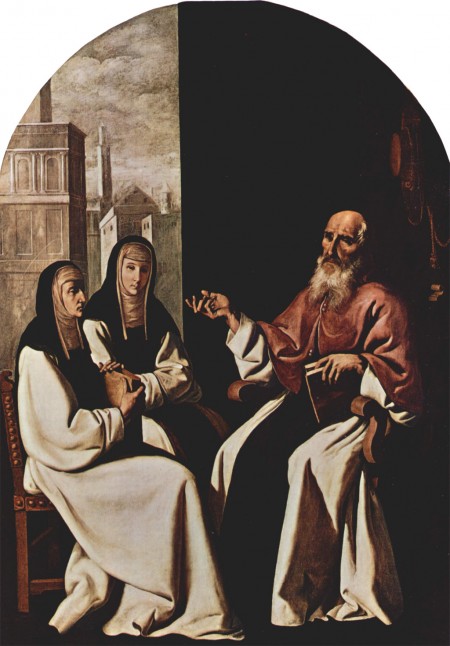
Saint Jerome was a leader in orienting his life toward women.  Of Jerome’s 123 surviving letters, 36% are addressed to women.  Jerome in his surviving letters addressed by name 20 different women.  Jerome’s letters to women have less diverse types and are more personal than his letters to men.[1]  In a scholarly letter to the learned woman Principia, Jerome stated that he was censured by many for writing to women and preferring women to men.[2]

Jerome wrote many more letters to women than have survived. In one of his works, Jerome referred to “volumes of letters which I have written to Paula.”  He also noted, “how many letters I have written to Paula and Eustochium I do not know, for I write daily.”[3]

Jerome closely associated with women.  In Rome, Jerome was frequently surrounded by women. Women and Jerome were comfortable discussing scripture and Christian living with each other.  Jerome observed of his relationship with women:

Study had brought about constant companionship, companionship comfortableness, and comfortableness a sense of mutual trust.

{ lectio adsiduitatem, adsiduitas familiaritatem, familiaritas fiduciam fecerat. }[4]

The patrician Roman women Fabiola, Paula, and Eustochium followed Jerome from Rome to Jerusalem. Jerome toured monasteries in Egypt with Paula in the winter of 386/6.[5]  Both Paula and Eustochium financially supported Jerome and lived next to him in Bethlehem. Jerome eulogized Lea, Blesilla, Fabiola, Paula, and Marcella after their deaths.[6]  They probably would have done the same for him.

two women, Saint Paula and Saint Eustochium, with Saint Jerome

Because Jerome loved women, he told them what they needed to know, not what men thought women wanted to hear.  Jerome was far from the self-abasing, desperately love-seeking man of Roman love elegy.  Rather than keeping women ignorant, Jerome told women directly what men want.  Men debated among themselves about whether men should marry.  They assumed that women should marry.  Jerome, in contrast, strongly supported women not marrying.  Few men have cared as much for women as Jerome did.[7]  Only persons who don’t understand women and don’t truly love them cannot understand why women loved Jerome.

*  *  *  *  *

Data: Letters of Jerome Dataset (Excel version)

Read more:

Notes:

[1] See the summary statistics sheet in the Letters of Jerome Dataset.  Saint Jerome is also known as Jerome of Stridon and as Hieronymus.  His full Latin name is Eusebius Sophronius Hieronymus.

[2] Jerome, Letter 65 (to Principia, dated 397), from Latin trans. by Medieval Women’s Latin Letters.  In this letter, Jerome refers to women as the “weaker sex.” That was a conventional term associated with women’s less powerful physical stature and more powerful communication capabilities.  Jerome uses that conventional term in high rhetoric replete with irony.

Jerome uses a simpler presentation in his Letter 126.  Freemantle (1892), p. 601, describes that letter as addressed to “Marcellinus, a Roman official of high rank, and Anapsychia his wife.”  Jerome addresses the husband of high public rank and his wife equally as students of scripture:

Our reverend brother Oceanus to whom you desire an introduction is a great and good man and so learned in the law of the Lord that no words of mine are needed to make him able and willing to instruct you both and to explain to you in conformity with the rules which govern our common studies, my opinion and his on all questions arising out of the scriptures.  In conclusion, my truly holy lord and lady, may Christ our God by his almighty power have you in his safekeeping and cause you to live long and happily.

{ Sanctus frater noster Oceanus, cui uos cupitis commendari, tantus ac talis est et sic eruditus in lege domini, ut absque nostro rogatu instruere uos possit et nostram super cunctis quaestionibus scripturarum pro modulo communis ingenii explicare sententiam. incolumes uos et prolixa aetate florentes Christus deus noster tueatur omnipotens, domini uere sancti. }

Letter 126, s. 3, Latin text from Hilberg,, English translation from Freemantle (1892) p. 602.

[3] Jerome, De viris illustribus (On Illustrious Men, dated 393), s. 54, 135.  Cain (2009), p. 220, observes:

Considering Jerome’s otherwise prolific literary output and the size of his social network, his 123 extant letters are bound to represent only the tiniest fraction of all of the letters he wrote during his long career.

[4] Jerome, Letter 45 (to Asella, dated 385) s. 2, Latin text from Hilberg (1910-18), English translation from Cain (2009) p. 107.  Freemantle (1892) provides an alternate translation of the full letter.

[5] Cain (2009) p. 155.

[6] Lea (Letter 23), Blesilla (Letter 39), Fabiola (Letter 77), Paula (Letter 108), and Marcella (Letter 127).  Freemantle (1892) has English translations.

[7] Misrepresentations about Jerome’s relationship with women abound. Some accuse Jerome of being a misogynist. The same has long been claimed of Euripides, and with as little reason. Jerome reportedly was also set up for a false accusation of loving women sexually:

John Beleth tells, for instance, that they used a woman’s clothing to create a false impression of him. He got up one morning to go to matins, as was his custom, and found at his bedside a woman’s gown, which, thinking it was his own, he put on and so proceeded into the church. His adversaries, of course, had done this in order to make it look as if he had a woman in his room.

Legenda Aurea (Golden Legend), entry for Saint Jerome, from Latin trans. Ryan (2012) p. 598. John Beleth (Jean Beleth) was a twelfth-century theologian who contributed significantly to the Legenda Aurea. Stories of clothes-swapping bed tricks are common in medieval literature.

[image] Saint Paula and Saint Eustochium with Saint Jerome, Francisco de Zurbarán and Workshop, c. 1640/1650, oil on fabric, Samuel H. Kress Collection, U.S. National Gallery of Art, 1952.5.88, thanks to Wikipedia.

References:

Cain, Andrew. 2009. The Letters of Jerome: Asceticism, Biblical Exegesis, and the Construction of Christian Authority in Late Antiquity. Oxford Early Christian Studies. Oxford University Press.

Freemantle, William Henry, trans. 1892.  The Principal Works of St. Jerome.  Philip Schaff, ed. Nicene and Post-Nicene Fathers, 2nd Series, vol. 6. Oxford: Parker.

Hilberg, Isidorus, ed. 1910-1918. Sancti Eusebii Hieronymi Epistulae {Letters of Saint Eusebius Hieronymus (Jerome)}. Vindobonae: Tempsky. Corpus Scriptorum Ecclesiasticorum Latinorum (CSEL) 54 (Epistulae 1-70), 55 (Epistulae 71-120), and 56 (Epistulae 120-154).

Ryan, William Granger, trans. and Eamon Duffy, intro. 2012. Jacobus de Voragine. The golden legend: readings on the saints. Princeton, N.J.: Princeton University Press. (revised version of translation first published in 1941)

men's position in social communication in human evolution

coal miner

Human societies typically prefer to sacrifice men’s lives relative to women’s lives.  A scholarly analysis explained:

It is morality that enables us to shame our males into putting their lives on the line for the group, while it is innate altruistic propensities that help to motivate those males to suffer and die in the interest of the rest of the group.[1]

Both morality (social values) and innate altruistic propensity of individuals evolve through time with the differential reproductive success of humans and human groups.  The evolved social preference for sacrificing men’s lives is more complex than simply sex differences in parental investment, sex differences in the operational sex ratio, sex differences in potential rates of reproduction, or anisogamy.[2]  Men’s relative disposability developed in human evolution through mutual re-enforcement between social values and sex differences in social communication.

Consider the relationship between parents and their biological children.  Parental support for children depends on the combination of many different factors – biological capabilities (gestation, lactation, etc.), behavioral patterns (feeding, protecting, and teaching young), social resources (availability of social substitutes for parental roles) and other aspects of the environment (such as the prevalence of food and predators, which determine the survival value of different parental activities).  Suppose that all these factors combine to produce an observable effect: if a father dies, his offspring is more likely to survive than if the mother dies. Such an effect favors social communication valuing fathers as being more disposable than mothers.

Dependence relations are a general feature of social groups.  Men’s and women’s contributions to the average reproductive success of all group members depend on a variety of factors.  A small number of men can provide sperm to a large number of women, and thus, apart from other considerations, additional men are a cost to the average reproductive success of the group.  But many other group effects also are relevant.  For example, in small, technologically primitive human societies, the meat that male hunters secure is typically shared among the whole group.[3]  In such circumstances, the value of men to the group depends on the value of this common food provision.  Similar considerations apply to men’s contribution to territorial defense, defense from predators, and to reproductively harmful within-group behaviors such as intrasexual and intersexual hostility and violence.  Suppose that all these factors combine to produce a commonly recognized effect: the death of a man reduces the expected reproduction of the group by less than does the death of a woman.  Such an effect favors social communication valuing men as more disposable than women.[4]

Socially constructed, sex-biased morality connects social values to individual behavior.  Humans plausibly evolved in circumstances in which, among breeding pairs, fathers have had less reproductive value than mothers, and, within groups, men have had less reproductive value than women.[5]  These social values suggest that, in competition to acquire resources and avoid harm, a woman can more effectively make claims in social communication than a man can.  That makes social communication more valuable to women than to men.[6]  Human evolution has thus favored women’s social communication capabilities over those of men.  That sex difference in turn supports lack of social concern about men’s lives.

*  *  *  *  *

Read more:

Notes:

[1] Boehm (1999) p. 254.

[2] For an example of simplistic evolutionary-psychological reasoning justifying men’s relatively high death rate from violence, see Daly & Wilson (1988).

[3] E.g. Woodburn (1998) and Hawkes (2001).

[4] See, e.g. Hawkes (2004), pp. 464-5, which emphasizes infanticidal males, the dangers of male mating competition, and the relative unimportance of males’ contributions to group reproductive success.

[5] These social values do not necessarily imply that men maximize their inclusive fitness by being more aggressive, taking more risks, and committing more crimes than women.  Arguments that higher male reproductive variance explains male risk-taking are remarkably ad hoc. See, e.g. Daly & Wilson (1988) Ch. 7.  Social life enables and shapes possibilities for behavioral exchanges.  The price of mates, like the price of food, is part of an aggregate budget constraint.  Suppose prices are measured in energy expenditure.  A fitness-maximizing response to a higher price of mates might be substitution into more food collection and less risk of harm to self.  On biological markets, see Noë (2001).

[6] This is a general implication of cooperative game theory.  In cooperative game theory, payouts are typically directly related to expected marginal contributions averaged across a large number of possible coalitions. Roughgarden et al. (2006) forcefully advocates the importance of such models.  Criticisms of id. have focused on whether Darwin’s theory of sexual selection needs to be replaced.  The argument here is that the cooperative distribution of fitness benefits determines the individual value of communication capabilities.

[image] Harry Fain, coal loader. Inland Steel Company, Wheelwright 1 & 2 Mines, Wheelwright, Floyd County, Kentucky.  Thanks to the National Archives and Wikipedia.

References:

Boehm, Christopher. 1999. Hierarchy in the forest: the evolution of egalitarian behavior. Cambridge, MA: Harvard University Press.

Daly, Martin and Margo Wilson. 1988. Homicide. New York, A. de Gruyter.

Hawkes, Kristen. 2001. “Is meat the hunter’s property? Ownership and explanations of hunting and sharing.” Pp. 219-236 in C. Stanford and H. Bunn, eds. Meat-Eating and Human Evolution.  Oxford: Oxford University Press: 219-236.

Hawkes, Kristen. 2004. “Mating, Parenting, and the Evolution of Human Pair Bonds.”  Pp. 443-473 in Bernard Chapais and Carol M. Berman, eds. Kinship and behavior in primates.  Oxford: Oxford University Press.

Noë, Ronald. 2001.  “Biological markets: partner choice as the driving force behind the evolution of mutualisms.” Pp. 93-118 in Ronald Noë, Jan A.R.A.M. von Hooff and Peter Hammerstein, eds. Economics in nature: social dilemmas, mate choice and biological markets. Cambridge: Cambridge University Press.

Roughgarden, Joan, Meeko Oishi and Erol Akçay. 2006. “Reproductive Social Behavior: Cooperative Games to Replace Sexual Selection.” Science 311: 965-969.

Woodburn, James. 1998. “Sharing is not a form of exchange: an analysis of property sharing in immediate return hunter-gatherer societies.” Pp. 48-63 in C.M. Hann, ed. Property Relations: Renewing the Anthropological Tradition.  Cambridge: Cambridge Univ. Press.