COB-91: how to deal with a fly on your nose

Leonid Brezhnev with a fly on his nose

Once upon a time in Basra there was a cadi called ʻAbd Allāh ibn Sawwār.  As an outstanding bureaucrat, he was grave, imperturbable, and immobile.  He spoke the proper words at the proper time and wasted no movement other than the necessary movements of his lips.  But one day a disturbance interrupted his work routine:

with his assessors and the public seated around him and in two rows in front of him, a fly landed on his nose and lingered there a long while.  Then it moved towards the inside corner of his eye.  He wanted to endure when it got into the corner of his eye and bit it with its piercing proboscis, just as he had endured it when it landed on his nose, without twitching the tip of his nose or wrinkling his face or whisking it away with his finger. [*]

The pain of the fly’s bite finally forced the cadi to blink.  He shut and opened his eye to try to dislodge the fly.  But the fly kept at him.  Finally the cadi moved his hand and attempted to whisk the fly away.  The fly kept returning.  The cadi tried to wipe the fly away with his sleeve, but he could not.  Ultimately the cadi humbled himself and acknowledged his weakness.  He addressed the fly out of the proper order of the day’s business.

Conscientious bureaucrats should be aware of even the smallest threats to their bureaucratic order.  The Bureaucrat Management Institute for the Next Generation (BMING) has adopted a recommended protocol defining what a bureaucrat should do when a fly lands on her or his nose.  While slowing moving only the right lower arm, the bureaucrat should grasp with thumb and forefinger the standard-issue fly swatter aligned vertically to the left of the pencil on the bureaucrat’s desk.  With a quick flicking motion of the wrist (keeping the upper arm as motionless as possible), the bureaucrat should vigorous plant the fly swatter onto her or his stolid face.  Slowly and solemnly return the fly swatter to its proper position aligned vertically to the left of the pencil on the desk.  According to the BMING standard recommended protocol, the bureaucrat should ignore the remains of the smashed fly on her or his nose until the close of the business day.

In other bureaucratic news this month, Jan Banning has done an outstanding series of portraits of bureaucrats from around the world.  In our age of pervasive hostility toward bureaucrats, these portraits help everyone to understand that bureaucrats are living, breathing, flesh-and-blood human beings.

Dr. Paul M. Johnson at Auburn University has made freely available online a glossary of political economy terms.  The entry for bureaucracy states:

Bureaucratic organizations are typically charcterized by great attention to the precise and stable delineation of authority or jurisdiction among the various subdivisions and among the officials who comprise them, which is done mainly by requiring the organization’s employees to operate strictly according to fixed procedures and detailed rules designed to routinize nearly all decision-making. Some of the most important of these rules and procedures may be specified in laws or decrees enacted by the higher “political” authorities that are empowered to set the official goals and general policies for the organization, but upper-level (and even medium-level) bureaucrats typically are delegated considerable discretionary powers for elaborating their own detailed rules and procedures. Because the incentive structures of bureaucratic organizations largely involve rewarding strict adherence to formal rules and punishing unauthorized departures from standard operating procedures (rather than focusing on measurable individual contributions toward actually attaining the organization’s politically assigned goals), such organizations tend to rely very heavily upon extensive written records and standardized forms, which serve primarily to document the fact that all decisions about individual “cases” were taken in accordance with approved guidelines and procedures rather than merely reflecting the personal preferences or subjective judgment of the individual bureaucrat involved.

The full entry goes on much longer.  But even this meager collection of words should leave no doubt about the value of bureaucracy.

UK Prime Minister David Cameron reportedly will tell the Federation of Small Businesses that “by scrapping more than 3,000 rules ‘dreamt up by Whitehall bureaucrats,’ businesses will save over £850m a year.”  Misguided destruction of bureaucratic capability caused the decline of the British Empire.  The decline continues.

That’s all for this month’s Carnival of Bureaucrats.  Enjoy previous bureaucratic carnivals here.  Nominations of posts to be considered for inclusion in next month’s carnival should be submitted using Form 376: Application for Bureaucratic Recognition.

*  *  *  *  *

[*] From al-Jāḥiẓ, al-Ḥayawān (Living Beings), from Arabic trans., p. 185 in Gelder, Geert Jan van. 2013. Classical Arabic literature: a library of Arabic literature anthology. New York: New York University Press.

women’s social superiority trumps men’s hardships

The Dean of the Harvard Business School, a man named Nitin Nohria, recently apologized to women at Harvard.  According to a news report:

Nohria conceded there were times when women at Harvard felt “disrespected, left out, and unloved by the school. I’m sorry on behalf of the business school,” he told a hushed room. “The school owed you better, and I promise it will be better.”

Women who win intensely sought spots at Harvard Business School have a glitteringly golden opportunity to rise to the pinnacle of wealth in American.  A major public issue is now whether at Harvard these women feel “disrespected, left out, and unloved.”

man dies, woman watches: monument to women's social superiority

The hardships of vast numbers of ordinary men matter relatively little.  Men being imprisoned for having consensual sex and being poor isn’t a major public issue.  Gender disparities in the awarding of child custody and in the imposition of child support obligations are far larger than gender disparities in the workforce.  Yet there’s no public concern about men being unjustly deprived of custody of their children and men being treated merely as a source of money deceptively called “child support.”  Men die from violence-related injuries more than four times as frequently as women. That’s of no public concern.  Sexist Selective Service registration continues as an emblem of men’s public expendability.  Men who raise concerns about these injustices are commonly labeled cranks, or even worse, anti-feminists.  In contrast, women concerned about women’s experiences at Harvard Business School get front-page attention from the New York Times and action from the Harvard Dean.

Women’s social superiority has long been recognized.  The uproariously funny medieval French work, Les Quinze joyes de mariage (The Fifteen Joys of Marriage), explains the fate of the husband who finds in his home’s bedroom his wife embracing another man.  The wife throws her arms around the husband and tells him not to do anything that he would regret.  The lover meanwhile flees.  The husband chases after the fleeing lover.  The wife packs up and goes to her mother’s.  Her mother asks for the truth about the difficulty.  The wife says:

Goodness, that wicked man’s been after me for more than two years, and I’d always been able to put him off.  But then when my husband had gone out, the other got inside the house — Lord knows how, for I had locked the door!  Then he raped me!  ‘Pon my soul, I’d fought him off near half the night before he finally got me breathless — everyone knows a woman alone is helpless. [1]

The mother tells the wife to keep that man away.  The wife then says:

Indeed, Mother, then I’ll have to order him to stay away {get a court order requiring the man to stay away, i.e. a medieval restraining order}, for I’m sure he must be in a pitiful state: he thinks my husband’s killed me, and he’s crazy enough to drop by to see if I’m still among the living.

The mother declares, “I’m amazed your husband didn’t kill the pair of you.”  The wife responds that she saved her rapist’s life:

Hail Mary, Mother, I swear if I hadn’t hugged him just then, my lover was a goner, the poor man!

The man that the wife describes as her lover is the man that she, just a moment earlier, said raped her.  The wife then further and endearingly describes her lover:

Ah, Mother!  If you only knew what a man he is!  I swear, I’ve seen the poor thing come on foot through rain, hail, and pitch-black nights just to avoid detection.  Why, he’ll shiver half the night in our courtyard while I try to think of a way to meet him, and when I do, I find him frozen solid, yet he doesn’t complain a bit.

That’s sweet.  The wife doesn’t press her inconsistently maintained charge of rape against her lover.

The mother calls together her women friends to discuss how to help her daughter.  One woman declares:

Good Lord, when that rumor of you-know-what was circulating about so-and-so and me, my husband confronted me with it, but I defended myself well, thank God.  Why, he went more than three months without food or sleep, and he tossed and churned in bed, sighing all the while.  ‘Pon my soul, I was so tickled I laughed between my sheets and had to bite my pillow!

The women eat a pie that the lover sent them.  They scold the wife’s maid for allowing the wife’s affair to be revealed to the husband.  Then the women head out to confound and shame the husband.

Against the words of the women, the husband cannot maintain belief in what he saw with his own eyes.  One woman says to him:

I must scold you, for your mother-in-law has told me I don’t know what drivel.  My word, you’re mad to believe such nonsense.  As I live and breathe, I’m as sure of one thing as I am of death, and I’d swear it by the God of everything holy: your wife was never unfaithful nor ever meant to be.

The concluding phrase “nor ever meant be” covers the act of infidelity being done.  Another woman declares to the husband:

I swear by Notre Dame of Puy, which by God’s mercy I once visited on pilgrimage, I’ve known your wife since childhood, and she’s the finest girl in the whole country.  Why, it was a crying shame she ever got engaged to you, and now you’ve defamed her and ruined her good name. [2]

The new issue is now the husband wronging the wife.  The maid added her testimony:

I don’t know what my master here thought or imagined, but in my entire life I’ve never once seen folly in milady.  I’ve served her quite faithfully, and such things wouldn’t go by me unnoticed.

Soon a crowd of women is at the house sympathizing with the wife:

“‘Pon my faith,” adds another, “the devil did it just to drive a wedge between you, since he could find no other way to hurt you.”

“Alas!” says another, “the poor girl is still weeping!”

“As God is my witness,” cries another, “it’ll be the death of her!”

“Do you imagine,” asks another, “that we’d be so foolish as to tolerate her if she’s really as you say?  Ha!” she chortles, “in a pig’s eye! We’re not so silly as even to talk to her, much less let her live in our lane or anywhere nearby.”

The social power of women is plainly apparent.  In this case, the women are using their social power to free the wife from responsibility for her love affair.

The wife’s mother weighs in powerfully against the husband.  She arrives in tears and with the threat of violence: she “makes as if she would gladly sink her fingernails into him.”  With the support of the gathered women, the mother launches a blistering attack on the husband:

Curse the hour she was engaged to you!  You’ve ruined her good name and mine!  Alas!  Such great honor we bestowed when we gave her away, for if she’d said the word, now she’d have a fine knight and the greatest honors, too, but no! she’d take no one but you.  It only stands to reason she’s unhappy now, poor thing!  Alas!  Her bad luck could only get worse!

The gathered women comfort the mother and taunt and scold the husband.  A friar, working for the women on retainer, soon arrives.  The friar declares to the husband:

I must scold you, for I swear by Monseigneur St. Dominic or Monseigneur St. Augustine, I’ve known your wife nigh on ten years now, and I’d stake my salvation she’s one of the finest, most virtuous women in the whole country.  Of that I’m quite sure, for she’s one of my flock, you know, and I’ve probed her well and discovered only the finest feminine qualities.

The friar’s declaration about probing the wife surely contains sexual innuendo.[3]  The husband, stereotypically naive and obtuse, comes to believe that he was mistaken about what he saw.  He is induced to believe in the socially maintained myth of his wife’s fidelity.

The man who is Dean of the Harvard Business School is no more powerful than the husband in this medieval story of the fifteenth joy of marriage.  His experience would make a good case study in reality.

*  *  *  *  *

Read more:

Notes:

[1] Les Quinze joyes de mariage, 15th joy, from Old French trans. Pitts (1985) p. 121.  All the subsequent quotes above are from id., pp. 121-128.

[2] Pilgrimages were associated with opportunities to have new love affairs.  In the eleventh joy of Les Quinze joyes de mariage, a girl gets pregnant.  Her guardian, seeking to provide for the pregnant girl’s future, encourages a good man to go on a pilgrimage with the girl.  The good man, who does not know that the girl is already pregnant from other man, subsequently marries the girl.  Scholars of new post-modern applied game theory would categorize the good man as a beta.  For example, the good man says to the (pregnant) girl:

Miss, I’m just a poor gentleman neither deserving nor worthy of your love, for you’re beautiful and loveable and gracious and endowed with all the qualities ever bestowed by Nature on a young girl.  But if you were willing to honor me with your love, I dare say that through kindness, fond attentions, and all the other services a man can render, I’d serve you and never abandon you, come what may, and I’d cherish your honor even more than my own.

Trans. id. p. 97.

[3] Les Quinze joyes de mariage was written in Old French about 1400.  In fabliaux written in Old French in the twelfth and thirteenth centuries, clerical lechery is a prevalent theme.

Reference:

Pitts, Brent A., trans. 1985. The fifteen joys of marriage = Les XV joies de mariage. New York: P. Lang.

15 joys of marriage, till the end of his miserable days

Consent to hear me as I plead,
That I may, of your joys serene,
Compose a poem that will be
Worthy of serving thee.

I’ll sing of all your happiness,
Entreating ever, nonetheless —
a sinner base —
That my great sins, which I confess,
You will not ponder on, but stress
Only my praise. [1]

Praise for women cannot make up for men’s pervasively professed sins.  Women’s needs aren’t being met.  Happy wife, happy life.  Men, like a woodpecker dazed after a hard day’s work, can barely perceive where to fly.  Men need to ask for directions.  The medieval French social-scientific treatise Les Quinze joyes de mariage (The 15 Joys of Marriage) provides directions.[2]  That work is even more important today than it was for medieval men.
fifteen joys of marriage

Les Quinze joyes de mariage begins with a topical review of the leading scholarly literature of its day.  Scholars, who were overwhelmingly men, reasoned about liberty and happiness without explicit reference to central circumstances of most men’s lives:

Many have toiled and strained, invoking both logic and authorities to show that a man can find greater earthly happiness by living untrammeled and free than by enslaving himself of his own will.  They agree that only a doltish man living joyously and sensually in the freedom of youth would, of his own volition and initiative, and quite unnecessarily, seek out the entrance of a confining, sorrowful, and tearful prison, and force his way inside; for once he’s there, the prison’s iron doors are slammed shut behind him and secured with heavy crossbars, and he’s so closely kept that by no means, whether by bribes or prayers, can he escape.  Now this fellow seems all the more dim-witted to have imprisoned himself since he’d heard beforehand, from within the jailhouse walls, the crying and moaning of its inmates. [3]

This author then reviews the heroic French male warriors who refused to submit to the Roman Empire and summarizes Aristotelian wisdom (“every man must seek the golden mean”).  The point of this erudition emerges only with a mundane, practical illustration figuring an unwise man as a beast:

we would consider quite ill-advised a man who sought purposefully to fall into a pit wide at the bottom and narrow at the top, like those dug in forests to capture wild animals, and from which escape is impossible.  Now once he’s down inside this pit, he casts about for a way to get out, but by then it’s too late.  So, too, with those about to marry [4]

The imaginary scholar Valerius is a character in an important work in the literature of men’s sexed protests.[5] Les Quinze joyes de mariage cites him as having provided useful Socratic instruction:

a certain scholar, Valerius, once spoke to a married friend, inquiring whether he thought he’d made a wise decision.  “Friend,” he asked, “wasn’t there any way out, even a high window from which you could’ve jumped headfirst into a deep river?”[6]

Like scholarly work seeking to pass peer review, Les Quinze joyes de mariage carefully hedges, qualifies, and argues both sides.  It declares that marriage provides “the greatest torments, afflictions, griefs, and misfortunes on earth.”  But Les Quinze joyes de mariage is no more anti-marriage than most feminist work is anti-men:

I don’t condemn them {men} for marrying; rather, I approve and consider that they’re doing the right thing.  After all, we’re only born into this world to do penance, suffer affliction, and mortify the flesh so as to win Paradise, and it seems to me that a fellow could find no harsher penance than submission to the pains and torments described below.  Yet there’s another side to this: since they reckon these torments as joys and delights, and become as calloused to them as an ass to its burden, they seem perfectly content; thus one wonders whether in their case this form of penance has any real merit.

The prologue to Les Quinze joyes de mariage ends with muddled, ineffectual argument and a sign of the direction forward:

Now I’ve consumed time, ink, and paper for the sake of others yet unmarried, and surely won’t dissuade them from entering the net, nor is that my intention.  Yet perhaps a few will come to regret their decision when it’s too late, thus they’ll have these joys forever, till the end of their miserable days.

Appreciation of this superb, subtle humor benefits from careful study of Solomon and Marcolf.  The fifteen central chapters of Les Quinze joyes de mariage all end with the phrase “till the end of his miserable days.”[7] That medieval finding that should be remembered to the end of life, liberty, and the pursuit of happiness.

Meanwhile, men will continue to pursue their interests.  The author of Les Quinze joyes de mariage concludes with an appeal to women:

Now I’ve written this {Les Quinze joyes de mariage} at the request of certain ladies; if they’re unsatisfied and want me to apply myself to write in their behalf, in their favor, to the detriment of men, and from a feminine point of view, then I’m their man!  Indeed, I’d have a lot better stuff than this considering the great wrongs, woes, and injustices that men heap on women everywhere and in general, both groundlessly and by superior force — after all, women are naturally weak and defenseless, inclining always to serve and obey.  If this weren’t so, men wouldn’t know how to live, nor could they even survive. [8]

In other words, men are naturally even weaker and more defenseless than women, because without women, men wouldn’t know how to live and couldn’t survive.[9]  Don’t try to reason through this.  Men, praise women and confess your sins, till the end of your miserable days.

*  *  *  *  *

Read more:

Notes:

[1] Libro de buen amor, s. 33-4, from Old Spanish trans. Daly (1978) p. 33-4.  From a lyric of the (seven) joys of St. Mary.  Other related medieval works are The Fifteen Joys of Notre Dame and The Fifteen Signs of Judgment.  Pitts (1985) p. viii.

[2] Pitts (1985) provide a close, modern English translation of Les Quinze joyes de mariage.  It’s thought to have been written about 1400. Here’s a nineteenth-century printing of Les Quinze joyes de mariage and the first two joys of marriage in an alternate, modern English translation.  The first known English translation was printed by Wynkyn de Worde {sic} in 1509.  It was an adaptation in verse and entitled The fyftene Joyes of maryage.  For analysis, Coldiron (2009) Ch. 4. Another English translation by Thomas Dekker, entitled The Batchelars Banquet, was printed twice in 1603 and again in 1604.  It was reprinted a total of ten times before 1700, making it “one of the non-dramatic bestsellers of the Elizabethan period.” Gildenhuys (1993) p. 13.  Another translation, entitled The xv. Comforts of Rash and Inconsiderate Marriage (running title, The fifteen Comforts of Matrimony) was printed in 1682.  Wilson (1929) provides a scholarly edition of The Batchelars Banquet, and Gildenhuys (1993), an edition with modernized spelling.  The Batchelars Banquet adapts Les Quinze joyes de mariage considerably; it is not a close translation.

[3] Les Quinze joyes de mariage, prologue, from Old French trans. Pitts (1985) p. 1. Subsequent quotes are from pp. 2, 3, 4-5 (Prologue)  and 132-3 (Conclusion).

[4] The figure of a pit “wide at the bottom and narrow at the top” suggests in context a woman’s hips and waist.

[5] Dissuasio Valerii ad Ruffinum philosophum ne uxorem ducat, attributed to Walter Map (c. 1180).  This popular work was ostensibly a letter from Valerius to Rufinus, who “Uxorari tendebat, non amari” (he was headed to be wived, not to be loved).  It apparently formed a chapter in a book that, in fourteenth-century England, “this jolly clerk Jankyn … always laughed uproariously” when reading.  See Chaucer, Canterbury Tales, The Prologue of the Wife of Bath’s Tale.

[6] Valerius has been made to paraphrase Juvenal, Satire 6, ll.28-31:

What! Postumus, are you, you who once had your wits, taking to yourself a wife? Tell me what Tisiphone, what snakes are driving you mad? Can you submit to a she-tyrant when there is so much rope to be had, so many dizzy heights of windows standing open, and when the Aemilian bridge offers itself to hand?

That paraphrase isn’t in the source text.

[7] In the Old French, tousjours et finera miserablement ses jours. The old French word miserablement means “penniless and woeful.” Coldiron (2009) p. 115.

[8] The Batchelars Banquet lacks the prologue and conclusion of Les Quinze joyes de mariage.

[9] The conclusion of Les Quinze joyes de mariage returns to the style and reasoning of its prologue.  Missing the subtle humor of such reasoning, Nykrog (1984), pp. 427-8, declares of the prologue:

the author is obviously a well-meaning bore, scholarly and pedantic, definitely not very intelligent, heavy-handed as a writer.  … By the time we reach his final philosophizing about whether the sufferings endured in marriage will ease the husband’s access to Paradise, considering that the sufferers seem to like it, we have become convinced that this man cannot be very bright.

This analysis seems to apply much more appropriately to much recent scholarship, although a male scholar would not dare say so about a female scholar’s work.  See Smith (1995).  In its introduction, Gildenhuys (1993) focuses on women.  Wilson (1929) pp. xiv-xv declares:

We are forced in fairness to remember the ruling of Robert Burton, that if women are bad men are worse, and to reflect that there may be more material for a maid’s banquet than for a bachelor’s; and the reflection, if it does not detract from our amusement, lessens the stature of the author as we realize that his work is not level with life.

That’s comical nonsense much like the carefully crafted, ridiculous prologue of Les Quinze joyes de mariage.  If you believe that Les Quinze joyes de mariage is misogynistic, you must believe that modern scholarship is even more misandristic.  Persons who disparage wildly creative literary work as being “not level with life” deserve bureaucratic jobs.

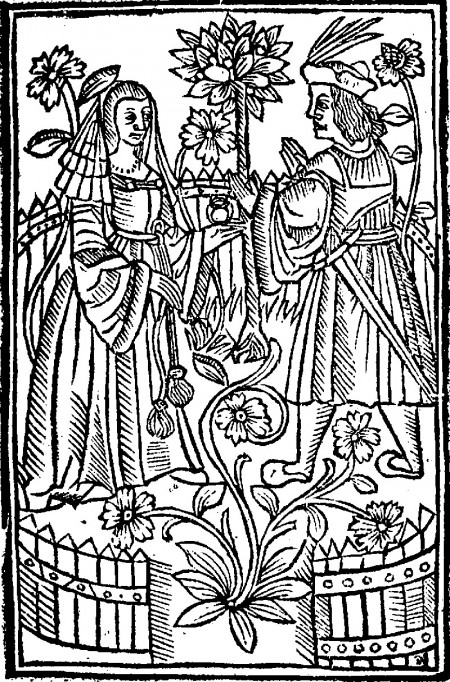
[image] Woodcut illustration preceding the first joy of marriage in The fyftene Joyes of maryage, printed in 1509.

References:

Coldiron, Anne E. B. 2009. English printing, verse translation, and the battle of the sexes, 1476-1557. Farnham, England: Ashgate.

Daly, Saralyn R., trans. and Anthony N. Zahareas, ed. 1978. Juan Ruiz. The book of true love {Libro de buen amor}. University Park: Pennsylvania State University Press.

Gildenhuys, Faith. 1993. The Bachelor’s banquet. Ottawa, Canada: Dovehouse Editions.

Nykrog, Per.  1984. “Playing Games with fiction: Les xv joyes de Mariage – Il Corbaccio — El Arcipreste de Talavera.” Pp. 423-451 in Arrathoon, Leigh A, ed.  The craft of fiction: essays in medieval poetics. Rochester: Solaris Press.

Pitts, Brent A., trans. 1985. The fifteen joys of marriage = Les XV joies de mariage. New York: P. Lang.

Smith, Susan L. 1995. The power of women: a topos in medieval art and literature. Philadelphia: University of Pennsylvania Press.

Wilson, F. P. 1929. The batchelars banquet: an Elizabethan translation of Les quinze joyes de mariage. Oxford: Clarendon Press.

reducing recidivism depends on inmate communications

In many U.S. prisons and jails, inmates communicate with family and friends in the free world via written correspondence, in-person visits, and telephone calls.  Written correspondence and in-person visits are expensive to monitor systematically.  They can be means of introducing physical contraband into prisons and jails.  Making electronic messaging and video conferencing available to inmates on reasonable terms can increase inmates’ communication with family and friends, increase public safety, and reduce the likelihood of recidivism.  Modernizing inmate communications benefits everyone.

The potential net public benefit of modernizing inmate communications appears to be large.  For example, prisons in Oregon currently hold about 15,000 persons.  The direct cost of incarcerating a person in Oregon prisons is $85 per day.  Prisoners’ median length of stay in Oregon prisons, excluding prisoners with a life or death sentence, is 3.4 years.  The total direct cost to the state of the median incarceration spell is $105,000.  About 27% of prisoners finish their sentences of imprisonment, fail to re-integrate into law-abiding society, and are sent back to prison.  That’s a costly failure for the prisoner, for the new crime victim, and for the public.  The Oregon Department of Corrections estimates that reducing recidivism by merely 1% avoids $4.3 million in annual victim and taxpayer costs.[1]

Increasing prisoner communication with friends and family can reduce recidivism.  Imagine trying to re-integrate yourself into law-abiding society after spending a few years in prison.  You have lost your job, your place to live, and probably many of your possessions and much of your money.  Relationships with family and friends are crucial for prisoner reintegration into law-abiding society.  Maintaining relationships with law-abiding persons outside prison depends on maintaining communication with them.

In Oregon prisons, inmates can electronically receive photos, exchange text messages, and engage in video visitation with screened family and friends.  The Oregon Department of Corrections offers these services to inmates in conjunction with inmate service provider Telmate.[2]  At the U.S. Federal Communication Commission’s (FCC’s) workshop on reforming inmate calling services’ rates, Telmate Chief Executive Officer Richard Torgersrud stated:

Phones are just one component of what’s going on.  The industry is changing.  The young generation doesn’t even make phone calls.  They don’t know how to call anybody.  They don’t talk on the phone.  They text, they put status updates, they exchange photos.  Families today expect to be able to video visit and see each other at home. … In the last couple of months alone, we have provided over a quarter million video visits remotely, half a million photos shared and messages. [3]

Data filed publicly in the FCC’s docket on inmate calling rates suggests that Oregon prisoners receive 5.2 photos, send or receive 18 electronic messages, and engaged in 1 video call per month.[4]  That electronic message rate is roughly consistent with federal prisoners’ monthly electronic messaging rate. Photos, which prisoners can receive but not send, are quite popular.  Few prisons or jails offer that communication service for prisoners.  Video visitation is developing rapidly, but many inmates and their loved ones currently lack that communication option.

Broad perspectives are crucial for the development of inmate communications.  Federal communications law directs the FCC to ensure that communications services have reasonable charges (prices).[5]  Unreasonably high inmate communication prices discourage the use of communication services and hence limit potential reductions in recidivism through better communication.  But the challenge is not just a matter of prices.  Communication service prices do not vary across Oregon prisons, but communication service usage per inmate varies considerably.[6]  Detailed, technical operational procedures significantly effect inmates’ use of communication services.  Prison and jail officials need to recognize the broad public interest in promoting modern, systematically monitored and supervised inmate communications offered at reasonable prices.

*  *  *  *  *

Data: Oregon DOC inmate communication services workbook (Excel version)

Read more:

Notes:

[1] Data from presentation, Oregon Department of Corrections (DOC), Implementing Enhanced Operating Technologies (Dec. 11, 2013), filed by Telmate on 1/13/2014 in FCC WCB Docket 12-375.  Recidivism rates of roughly a third within three years are common across the U.S.

[2] Here’s information on the Oregon Department of Corrections inmate communications services.

[3] FCC Workshop on Reforming Inmate Calling Services Rates, July 10, 2013, from transcript, pp. 258-9.

[4] See Oregon inmate communications services workbook, summary sheet.

[5] U.S. Communications Act of 1934, as amended, Title I, Sec. 1 (47 U.S.C. 151).

[6] On a per inmate basis, photos received vary from 3.7 to 6.1, electronic messages from 8.5 to 25.4, and video calls from 0.0 to 2.3.  Total communications vary from 13.0 to 32.3.  The variations don’t obviously correlate with security level or inmate sex.  See Oregon inmate communications services workbook, summary sheet.