Garuda Purana provides Indian wisdom on sex differences

Sukasaptati, a Sanskrit text from India before the thirteenth century, quotes a verse on sex differences from the Garuda Purana:

In metals, steeds and elephants,
in woods and stones and garments,
in waters, men and women,
the differences are many. [1]

In almost all cultures throughout human history and around the earth, sex differences are fundamental to understanding of persons.  A recurring sex difference in the tales of Sukasaptati, just as in European tales, is that men are dupes and women are guileful.
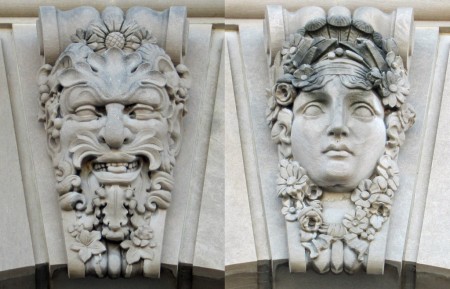
sex differences in gargoyles

In one Sukasaptati tale, a merchant went on a business trip.  His wife wore her hair in a single braid, as was the custom of women when their husbands were away.  The wife took a lover.  The lover one night cut off the wife’s braid (perhaps he wanted to wanted to gain recognition as having taken her husband’s place).  The husband returned.  Seeing him, the wife told the husband to wait at their home’s gate:

As he waited, she went inside, prayed to the household goddess and placed her braid of hair before the deity.  Coming out, she led her husband in together with the cake offering and said: “Lord, worship our household goddess.”

While making his devotions, the husband saw the braid of hair.  “What is this?” he asked.  “I had made a vow,” she said, “that when my husband comes back, I will cut off my braid before our lady.  This is what I have done.”  And that simpleton bowed to the goddess and lauded his wife. [2]

Husbands bowing to goddesses and lauding their wives isn’t necessarily foolish.  You have to know the rest of the story.

In another tale, a wife contrived an adulterous tryst with a sham physician like in the Old French fabliau La SaineresseThe wife told her new love interest that she would pretend to have been stung by a scorpion.  She instructed him to come to the door and pretend to be a physician.[3]  They carried out this scheme.  The husband implored the pretending physician to free his wife from the scorpion’s poison.  The pretending physician enacted a play on the popular belief in homopathic healing.  He smeared the wife’s lip with a bitter medicine.  He then appealed to apparently popular belief in men’s wickedness:

O merchant, the strongest of all venoms is the venom of man.  And poison is the remedy of poison.  Bearing this in mind, you should suck her lip. [4]

The husband started to suck his wife’s lip, but the bitter taste repelled him.  He told the sham physician, “You should suck the lip yourself.” The husband then went out to get rid of the bad taste in his mouth.  With the husband absent, the sham physician and the wife passionately embraced.  The wife soon declared herself cured.  The merchant was delighted with his wife’s recovery:

Full of gratitude, he fell at the physician’s feet, saying “I am in your debt for ever.”  Thereafter, the other man would come to their house in guise of a doctor, and always lie with {the wife} when the merchant {her husband} was out.

The husband never learned that the scorpion sting was faked, the physician was a sham, and he was a cuckold.  With the increasing importance of genetic knowledge in medicine, keeping cuckolds ignorant will require new tricks.  The social machinery for keeping cuckolds deceived is already whirling.

In yet another tale, a merchant had only one son.  He paid a procuress a huge sum to “make my son versed in the mysteries and deceptions of women.”  The procuress taught the son:

the affected language of harlotry; the false promises, the devious ways, the genteel begging; the simulation of emotions with make-believe tears and laughter; and fictitious grief and joy which mean nothing.  Also, the affection and the artless simplicity of these charmers; their equanimity in happiness and sorrow, virtue and sin; and the techniques of duplicity they reveal before their lovers. [5]

The merchant then sent his son on a trading mission.  On that mission, the son met a courtesan:

{he} stayed with her for a year while she practiced her arts on him.  But he would tell her: “Show me something special.  This, even my younger sister has told me about.”

The courtesan told her mother of her difficulty in getting the son’s money.  The mother devised a novel strategy:

when he starts wanting to return home and asks for your permission, you should tell him: “I too will go with you.  If you do not take me I will kill myself.”  You should then jump into the well.  This is bound to make such an impression on him that he will give you everything.

The mother spread a net inside the well to save her daughter.  The trick convinced the merchant’s son to give all his possessions to the courtesan.  She then left him.  The son returned home destitute and full of shame.

The merchant complained to the procuress that she had failed to teach his son all the wiles of women.  The procuress resolved to help the son directly.  Together they went back to the land of the courtesan.  The procuress pretended to be the son’s mother.  In front of the courtesan, the procuress accused the son of stealing all her money.  The procuress claimed to be a singer in the court of the king.  She threatened to bring the matter before the king.  That threat greatly frightened the courtesan and her mother.  They gave the procuress all the money they had stolen from the son, and all of their money, too.  The procuress and the merchant’s son then returned home happily.

Men cannot be taught all the wile of women.  As ancient Indian wisdom counsels, men need women to be with them and help them directly.

*  *  *  *  *

Read more:

Notes:

[1] Sukasaptati, Ch. 59, from Sanskrit trans. Haksar (2009) p. 181.  Id. n 1, p. 218, noting also found in Garuda Purana, 110.  Garuda Purana is a Hindu religious text from ancient India.  Garuda Purana conveys instructions from Vishnu to his carrier, Garuda, the King of Birds.

[2] Id. Ch. 14, p. 60.

[3] Sukasaptati contains many examples of strong, independent women who provide direction to men.  In Ch. 59, Rukmini ordered her lover:

Come tonight to my house and dig a trench the size of your body under the tamarind tree in the courtyard.  Then you must lie down in the trench with your organ of manhood pointing upwards.

The man did as Rukmini instructed.  Rukmini then “went under the shade of the tamarind and squatted upon the man.”  She called out to her husband to come with his bow and arrow and shoot a moonbeam for her.  Rukmini’s husband obeyed.  He attempted to shoot a moonbeam while Rukmini “enjoyed herself in the reversed position with her lover.”  Afterwards, Rukmini said to her husband:

You fool, today I have made love as I pleased before your eyes.  You may be a warrior, but you are no good for me, and I am leaving you.

Rukmini then rode away on a horse that her lover had brought her.  He then apparently dug himself out of his love-trench.  Above quotes from id. p. 179.

[4] Id. Ch. 61,  p. 186.  The subsequent quote is from id.

[5] Id. Ch. 23, p. 86.  All the subsequent quotes are from id., pp. 86-7.

[image] Gargoyles on the facade of the Botanic Garden Conservatory, Washington DC.

Reference:

Haksar, A. N. D. 2009. Shuka Saptati: seventy tales of the parrot. New Delhi: Rupa Co.

sexual innuendo: rising for marriage in Libro de buen amor

In the fourteenth-century Spanish work Libro de buen amor, the Easter arrival of Sir Love prompted wide-ranging rejoicing.  The sun was radiant, birds sang, and trees sent forth foliage and blooms.  Instruments of human construction also played:

The Moorish guitar sang its lament,
High and harsh in tone.
The portly lute accompanies a rustic dance,
And the Western guitar joins them.

The screaming rebec with its high note,
qalbī ʼaʻrābī does its rote play;
The Psaltery in their company is higher than La Mota.
The quill plectrum guitar dances in time with them. [1]

The Arabic phrase qalbī ʼaʻrābī seems to refer to a zajal that began:

qalbī bi-qalbī,
qalbī ʼaʻrābī. [2]

That’s plausibly translated as:

{I give} my heart {in exchange} for a heart,
{for} my heart is a Bedouin heart.

These lines suggest a necessity of love and an insistence on a fair bargain in love.  In Latin, galbus means yellow.  I prefer to believe that the root of galbi is the Arabic qalbī (heart).

secluded waterfall

Libro de buen amor narrates the Archpriest of Hita’s failures in love.  The Archpriest tells of his experience on the Sunday after Easter:

On Sunday after Easter I saw churches and cathedrals
All filled with festivals and marriages and joyous song;
They had great celebrations and they spread delicious banquets;
From wedding on to wedding, priests and minstrels ran along.

Those who were single just before are married now in turn;
I saw them pass, accompanied by wives for whom they burned;
I strove to think how I might taste such joy as they had earned,
For he who’s single and alone has many a hard concern. [3]

The Archpriest surely wasn’t imagining the fifteen joys of marriage, because that subtle and creative book hadn’t been written yet.[4]  In the Archpriest’s insistent yearning for a mistress, a reader might perceive a less cultured interest.  A sober and judicious scholarly authority on sexual innuendo has written:

Reading sexual innuendo in medieval literature is a delicate balancing act. … Balance requires that we see medieval sexuality as being no different in practice, if not in moral sanction, than our own; but it also requires that we do not uncritically seek a mirror to, or rather affirmation of, contemporary sexual culture or politics.  Between the two extremes there remains much fertile soil to be plowed. [5]

The Archpriest had a hard plow.  Fertile soil scarcely responded to his strenuous efforts.  In Korean, galbi is a barbeque rib dish made from beef.  Properly prepared, it’s delicious.

Between a good meal and a heart for a heart wanders Libro de buen amor.

*  *  *  *  *

Read more:

Notes:

[1] Libro de buen amor, s. 1228-9, from Old Spanish trans. Monroe (2011) p. 31.  Verse 1229b is “badly garbled in our manuscripts” and scholars have argued over the correct reading.  Willis (1972) intro., pp. lviii-lix.  See also the discussion in Monroe (2011) pp. 31-32, 33 ft. 16.

[2] Monroe (2011) p. 32, which also provides the subsequent translation above.

[3] Libro de buen amor, s. 1315-6, from Old Spanish trans. Daly (1978) p. 329.  Daly’s translation turns up the heat of s. 1316 with “burned” (cf. 1 Corinthians 7:9) and “hard concern (cf. tumescence of his penis).  The Old Spanish text for s. 1316 is:

Los que ante son solos, desque eran casados,
veíalos de dueñas estar aconpañados;
pensé cómo oviese de tales gasajados,
ca omne que es solo sienpre piens{a} cuidados.

Zahareaus’ text in Daly & Zahareas (1978) p. 328.  An alternate, close prose translation of s. 1316:

As soon as those who formerly had been alone were married, I saw that they had the companionship of ladies; I pondered how I could have such pleasure from company, for a man who lives alone always has many cares.

Willis (1972) p. 356.  The context, however, is subtly sexual.  The date is the Sunday after Easter (“Dia de Cuasimode”), i.e. Quasimodo Sunday or Low Sunday.  The name Quasimodo Sunday comes from the first two words of the Quasimodo Sunday mass’s Latin Introit:

Quasi modo geniti infantes, rationabile, sine dolo lac concupiscite {As newborn babes, with innate reason desire milk}

Libro de buen amor describes desire for sex as innate reason (“rationabile, sine dolo”), meaning a fundamental, natural part of human being:

Wise Aristotle says, and what he says of course is true,
That all men struggle most for two things: first, what he must do
To feed himself and keep alive, and second, in this view,
To have sex with a pleasing woman who is compliant, too.

And that he speaks the truth is proven with no artifice:
Mankind and birds and beasts, animals in caves and dens,
Desire by nature ever new, sweet paramours and bliss,
And man has much more itch than all the rest who’re moved by this.

Libro, ss. 71, 73, trans. Daly (1978) p. 43. The attribution to Aristotle is fallacious, and in general, Libro de buen amor ridicules Aristotle and other institutional authorities.  However, the sexual interpretation of Quasimodo Sunday is consistent with popular practice in medieval France:

This week {beginning with Quasimodo Sunday} marked the beginning of spring carnival and a universal relaxation of social convention.  Jeay states that despite local variations “the character of the celebrations was everywhere the same: couples formed outside marriage, and it was the woman who took the initiative.”

Pitts (1985) p. 143, n. 3, quoting Jeay (1977) p. 138.  Libro de buen amor can fairly be judged to be rife with sexual innuendo.  Its “Cruz Cruzada” lyric (s. 115-122):

is so replete with sexual “double entendres”, that it may be considered one of the most, if not the most obscene poem in the entirety of Spanish literature.

Monroe (2011) p. 36.

[4] Les Quinze joies de mariage, written in Old French about 1400, trans. Pitt (1985).

[5] Christoph (2008) p. 292.  The sexual innuendo here, whether intentional or not, is delightfully incongruous with the over-all style of this scholarly article.

References:

Christoph, Siegfried. 2008. “The Limits of Reading Innuendo in Medieval Literature.” Pp. 279-292 in Classen, Albrecht, ed. Sexuality in the Middle Ages and early modern times new approaches to a fundamental cultural-historical and literary-anthropological theme. Berlin, New York: Walter de Gruyter.

Daly, Saralyn R., trans. and Anthony N. Zahareas, ed. 1978. Juan Ruiz. The book of true love {Libro de buen amor}. University Park: Pennsylvania State University Press.

Jeay, Madeleine.  1977. “Sur quelque coutumes sexuelles du Moyen Ages.”  Pp. 123-41 in Bruno Roy, ed. 1977. L’Érotisme au moyen âge.  Institut d’Etudes Medievales, Montréal: Éditions de l’Aurore.

Monroe, James T. 2011. “Arabic literary elements in the structure of the Libro de buen amor (I).” Al-Qanṭara. 32 (1): 27-70.

Pitts, Brent A., trans. 1985. The fifteen joys of marriage = Les XV joies de mariage. New York: P. Lang.

Willis, Raymond S., ed. 1972. Juan Ruiz, Arcipreste de Hita. Libro de buen amor. Princeton N. J: Princeton University Press.

seven sages at Ostia offer wisdom in shitting

public latrine at Ostia, setting for seven sages wall painting

In a tavern in Ostia Antica, the seaport of ancient Rome, wall paintings from about the year 100 depict ordinary men sitting on the bench toilets of a public latrine.  Painted above them sit seven sages in scholarly dress and seated on thrones.  Associated with each sage is ironic text providing wisdom on shitting and farting:

  • Solon of Athens: “To shit well, Solon rubbed his belly {Ut bene cacaret, ventrum palpavit Solon}.”
  • Thales of Miletus: “Thales admonished those shitting to strain hard {Durum cacantes monuit ut nitant Thales}.”
  • Chilon of Lacedaemon: “Cunning Chilon taught to fart silently {Vissire tacite Chilon docuit subdolus}.” [1]

The men shitting at the latrine are also associated with text.  Some fragments have survived:

  • “shake yourself about so you’ll go faster {agita te celerivs pervenies}”
  • “you’re sitting on a mule-driver; I’m hurrying up {mvlione sedes, propero}”
  • “friend, the proverb escapes you: shit well and fuck the doctors {amice fvgit te proverbivm: bene caca et irrima medicos}”
  • “no one talks to you much, Priscianus, until you use the sponge on a stick  {verbose tibi nemo dicit dvm priscianvs utaris xylosphongio}”[2]

The wall paintings and text are humorously incongruous and inappropriate.  In the ancient Roman world, public latrines were similar in their conviviality to taverns.[3]  The wall paintings brought public facilities for eliminating bodily wastes into a public place for ingesting food and drink.  The logic of that combination is humorously jarring.

The seven sages preside over ordinary men shitting.  The wall paintings represent the sages with sculptural conventions.  All of the seven sages are men.  Lists of the seven sages in various ancient references encompass at least twenty-three male sages.  The seven sages did not include Hippocrates, Plato, Aristotle, or other highly honored intellectual authorities of Roman times.  Unlike the seven sages, wisdom was commonly personified as a woman.[4]  The seven sages were myth.  The ordinary men seated below the seven sages and shitting represent the reality of most men’s lives.

The texts included in the wall paintings relate the seven sages and the ordinary persons.  The sages’ maxims are literally above the ordinary persons’ words.  The sages’ maxims also seem to be grammatically above ordinary persons’ words.  The sages’ maxims “use the authority of the third person, the past tense, and the meter of iambic senarii.”[5] The ordinary persons’ words use first and second person pronouns, present tense, and no meter.

The ordinary persons’ words seem to have literary subtlety in crudeness beyond that of everyday talk.  For example, the words “you are sitting on a mule-driver” seem to analogize the strain of buttocks on hard stools to the work of a mule-driver on intractable asses.  The words, “friend, the proverb escapes you; shit well and fuck the doctors” seems to figure a proverb as shit.  Moreover, the Latin for “fuck the doctors” literally means vigorously thrust your penis in the doctor’s mouth and ejaculate.  Ancient doctors provided to patients advice and medicine for defecation.  The text here seems to present natural defecation and male sexual function as dominating the wisdom of doctors.[6]

The wall paintings in the tavern at Ostia Antica maintained a formal hierarchy between the seven sages and ordinary men.  The wall paintings united the seven sages and ordinary men in concern about a universal human bodily function: shitting.  They are like Solomon and Marcolf in encompassing and subverting the socio-intellectual hierarchy.  But the main effect seems to be unity in natural substance, not intellectual and practical confrontation.

painting of man sitting on toilet

*  *  *  *  *

Read more:

Notes:

[1] Latin text and English translation from Ziolkowski (2008) p. 28.  Ziolkowski is a world-leading authority on Latin.  Others’ translations are similar.  The paintings of the other sages haven’t survived, except for a fragment and a label indicating Bias of Priene.  The names of the remaining sages cannot be known for sure, because lists of the seven sages varied.

[2] These translations aren’t given in id.  I’ve based them on Latin text and English translations from the relevant Ostia Antica website page, a post in a Google group for Latin, Clarke (2003) pp. 171-2, Fagin (2006) p. 203, inc. ft. 61, and Adams (1983) p. 315, ft. 14 cont’d.  The sponge on a stick translates xylosphongio.  It was probably a tool for cleaning one’s ass after defecation.  The spacing of the men and the dimensions of the room indicate that about twenty ordinary men were originally depicted.  Clarke (2003) p. 172. A further, illegible inscription refers to Virgil.

[3] Clarke (2003) pp. 175-6.  Roman elites, in contrast, did not defecate in each other’s presence. Id. pp. 177-8.  The function of the space for which the wall paintings were made isn’t known for sure.  Id. p. 170 states “the most likely hypothesis” is that it was “a caupona that served wine.”  I’ve referred to it as a tavern, rather than a caupona, for ease of understanding.

[4] Here’s some analysis of who were the seven sages.  Proverbs 1:20-21 personifies wisdom as female.  In the Greco-Roman world, wisdom (sophia) was commonly represented as a woman.

[5] Clarke (2003) p. 178.

[6] In Latin, irrima.  That word, like “fuck” in the English language today, was commonly used as a general term of disparagement.  Adams (1983) p. 315, ft. 14 cont’d.  At Herculaneum, the eruption of Mount Vesuvius in 79 GC preserved a toilet graffito in a room known as the Casa della Gemma.  The text:  “APOLLINARIS MEDICUS TITI IMP(ERATORIS) | HIC CACAVIT BENE”; in English translation, “Apollinaris, doctor of the emperor Titus, had a good shit here.”  Fagan (2006) p. 204, n. 61.  Id. observers:

I see no reason to think that Titus’ doctor actually scribbled this report on the toilet wall, as is often assumed

In my view, this graffito humorously subordinates the imperial doctor’s expertise in defecation to the merits of this particular toilet.  In that view, it is similar to the above text’s attitude toward doctors.  Clarke (2003) p. 179 describes the wall-painting texts associated with the ordinary men as representing “everyday talk.”  That seems to me to be an exaggeration tending to heighten the contrast between the sages and the ordinary men.

[image]  Public latrine from ancient Roman Ostia Antica.  Thanks to Fubar Obfusco and Wikipedia.  “Sunday on the Pot with George,” unknown artist and date, acrylic on canvas.  Thanks to Museum of Bad Art and Wikipedia.

References:

Adams, J. N. 1983. “Martial 2. 83.” Classical Philology. 78 (4).

Clarke, John R. 2003. Art in the lives of ordinary Romans: visual representation and non-elite viewers in Italy, 100 B.C.-A.D. 315. Berkeley: University of California Press.

Fagan, Garrett G. 2006. “Bathing for Health with Celsus and Pliny the Elder.” The Classical Quarterly. 56 (1): 190-207.

Ziolkowski, Jan M. 2008. Solomon and Marcolf. Cambridge, Mass: Harvard University.

Sukasaptati: Indian parrot instructs men in guile

Within the learned culture of ancient India, tales recognizing men’s inferiority in guile and the risks of paternity deception weren’t socially suppressed.  Tales about cuckolded men served as practical instruction for men about paternity deception, warning to women that their superiority in guile was socially recognized, and entertainment for all.  Sukasaptati, written in Sanskrit no later than the second half of the twelfth century, provides tales of paternity deception within a framework that illustrates guile for men.[1]

In Sukasaptati, a merchant went on a business trip.  He left his wife Prabhavati alone at home.  At the urging of her women friends, Prabhavati prepared to have an adulterous affair.  A male parrot that her husband had received as a gift spoke to Prabhavati about her planned adulterous tryst:

This is fine and merits doing.  But it is not easy for women of good families.  Moreover, it is considered disreputable.  Go if you have the wits to handle any problems which may arise.  Otherwise you will be in for trouble. [2]

The parrot then quoted a verse:

The wicked merely watch the fun
when problems arise.
Like the starving lady did
as another pulled the merchant’s hair.

Prabhavati was confused and intrigued.  “What does this mean?” she asked.  The parrot, with the insouciance of an alpha male, brushed her off:

Go to your lover, my beauty.  Afterwards you can listen to this long story if your pretty eyes are still interested.

Filled with curiosity, Prabhavati stayed to listen to the story.  Every night for the next seventy days, the parrot similarly induced Prabhavati to change her plans for an adulterous tryst and instead stay home and listen to the parrot’s story.

Parrot Addresses Khojasta from the Tutinama

The parrot’s stories, like Old French fabliaux, provide a view of ordinary persons’ lives.  Consider, for example, the story on the eleventh evening.  The parrot’s guile provides the frame for his telling of the story:

The charming Prabhavati continued to be distracted by thoughts of love.  “I will go {to a lover} if you agree,” she said to the parrot respectfully, the next evening.

“You should certainly go,” the parrot replied.  “That is my definite view, for who can prevent the mind from seeking what it wants and water from flowing downwards.  But if you go you must be prepared to do something out of the ordinary, as Rambhika did in times past for the sake of the Brahmin.” [3]

Prabhavati then remained at home to listen to the story about Rambhika.  Rambhika was the wife of a village headman.  She sought adulterous affairs, but no other men would have sex with her because they feared her husband. One day, she saw a handsome young Brahmin who was visiting the village.  She lovingly looked at the young Brahmin.  The text here provides relevant poetic commentary:

Rolling the pelvis, and looking at you
repeatedly with a lovelorn gaze:
you simple boy, what has she not
already told you thus?

The man who cannot comprehend
the heart’s desire long conveyed
through a women’s eyes: what can
explaining do for such a fool?

Rambhika told the young Brahmin to come home with her, salute her husband, and affirm everything that she says.  She presented to her husband the young Brahmin and described him as her long-lost cousin.  The young Brahmin affirmed that he was her cousin.  The husband instructed his wife to care well for her cousin.  He then left them alone at night.  Rambhika sought sex with the young Brahmin.  He refused.  He explained that he had accepted her as his cousin, and cousins shouldn’t have sex together so as not to tarnish the family reputation.  Rambhika urged him with poetry:

For it is very hard to find
a girl devoted to one’s parents;
and men who have the same devotion
should take pleasure in that girl.

As if that claim wasn’t convincing enough, Rambhika then declared that if a woman solicits a man for sex and he refuses her, “stricken by her sighs, he will / for certain be consigned to hell.”  The young Brahmin refused to violate his moral code.  Rambhika then cried out with a false accusation of rape: “Help! Help! I am being raped!”  Her husband and his relatives came running to attack violently the accused man.  The Brahmin recognized his dire predicament:

The terrified Brahmin bowed down and fell at Rambhika’s feet.  “Mistress!” he cried, “save my life! I will do whatever you wish.”

Rambhika ingeniously redirected her alarm:

She slopped some milk and rice under the bed and quickly lit a fire nearby. “He has cholera!” she told her husband who had just come in, “that is why I screamed.” She pointed out the mess of milk and rice to her foolish spouse, who looked at it and went out again.

Rambhika then had sex with the young Brahmin.  They continued their affair throughout the month that he remained at her home on the pretext of his convalescence.

The parrot told such stories for seventy nights and kept Prabhavati at home while her merchant husband was away.  When her husband returned, Prabhavati lovingly welcomed him.  The parrot recited softly:

Attachment to women is futile,
and futile too is the conceit
that “she will always love me,
and will be my beloved for ever.” [4]

The husband ignored the parrot’s words. Academic inquisitors time-traveling back from 21st-century America to ancient India declared that the parrot is misogynist, insisted that he be silenced, or preferably, killed, and deplored any discussion of paternity deception.  The parrot laughed and said:

One who heeds the words said for his benefit, and acts upon them, earns merit both in this and the next world.

The parrot repeated this again and again until finally the husband asked the parrot for an explanation. Then Prabhavati confessed:

when you went away, for some time I could bear being separated from you.  But then I fell into bad company, and wanted to take a lover.  I nearly killed the mynah {a type of bird} which tried to stop me, but then this parrot held me back for seventy days with his flow of words.  Thus I sinned only in thought, but never by deed.  Now my life and death are in your hands.

The parrot declared that situation arose naturally from a wife being left alone.  The parrot urged the husband to forgive his wife.  The husband did.  They all lived happily ever after.

*  *  *  *  *

Read more:

Notes:

[1] Sukasaptati (Shuka Saptati) is constructed from the Sanskrit words shuka (parrot) and saptati (seventy).  The earliest surviving Sukasaptati manuscript is from the fifteenth century.  A reference to Sukasaptati exists in late-twelfth-century literature.  It may go back to the sixth century.  Haksar (2009) intro. pp. xv, xvii-xviii.  With its episodic tales united by common characters and interspersed verse, Sukasaptati is formally similar to Arabic/Hebrew maqama.  A Persian adaptation of Sukasaptati, called Tutinama, was made in the fourteenth century.  A lavishly illustrated version of Tutinama was made for Mughal Emperor Akbar in the later half of the sixteenth century.

[2] Sukasaptati, from Sanskrit trans. Haksar (2009) p. 5.  Subsequent quotes in the above paragraph are from id., p. 6.  Prabhavati figured the parrot as male, addressing it as “king of parrots.”  Id. p. 5.  She also said:

This bird gives good advice to everyone, and to me especially, has been like a father or brother.

Id. p. 205.

[3] Id. p. 49.  All subsequent quotes in the above paragraph are from id. pp. 49-53.  Wortham (1911), pp. 46-48, provides a more streamlined, less provocative translation.

[4] Sukasaptati, from Sanskrit trans. Haksar (2009) p. 204.  Subsequent quotes in the above paragraph are from id., pp. 204, 207.

[image] The Parrot Addresses Khojasta, from the Tutinama, c. 1565-1570, Mughal Dynasty, reign of Akbar, India.  Freer Gallery, F1991.8.

References:

Haksar, A. N. D. 2009. Shuka Saptati: seventy tales of the parrot. New Delhi: Rupa Co.

Wortham, B. Hale. 1911. The enchanted parrot; being a selection from the “Suka Saptati,” or, The seventy tales of a parrot. London: Luzac & Co.