how to earn a living writing poetry
A man finds himself in Hell. “Who are you?” asks the devil. The man responds:
I am ʻAlī ibn Manṣūr ibn al-Qāriḥ, from Aleppo. I was a man of letters by profession, by which I tried to win the favor of rulers. [1]
Writing to please the ruler is a difficult business plan. Ibn al-Qāriḥ declared:
I was always wretched when I pursued a literary career. I never profited from it. I tried to curry the favor of leading persons but I was milking the udder of a bad milch-camel and was exerting myself with the teats of a slow cow.
Judging by the way ibn al-Qāriḥ fertilized his statement with agricultural metaphors, he probably would have been better off being a farmer. But family farms, like small telephone companies, have always struggled.

Poets and other literary writers need a broad market of persons willing to pay a high price for poetry. Wine poems (khamriyyāt) were a saturated market in the early Islamic world for centuries.[2] But what about poems for drunk husbands trying to appease their angry wives? A small fee for a poem surely beats getting beaten by one’s wife. Consider this poem:
If you, fault-finding woman, would drink wine
till all your fingers tingled,
You would forgive me, knowing I was right
to squander all my money. [3]
That might just bring a smile to an angry wife’s face, especially if the meter was playful. It could be worth big money, if the drunk husband had any.
* * * * *
Read more:
- long-run economic development of the poetry business
- how William James won his future wife’s heart
- Pliny and Galen respond to love elegy
Notes:
[1] Abū al-ʿAlāʾ al-Maʿarrī, Risālat al-ghufrān, from Arabic trans. van Gelder (2013) p. 273. The subsequent quote is from id. p. 272. Al-Maʿarrī was a Syrian who died in 1057. His Risālat al-ghufrān, which imagines a journey to Heaven and Hell populated with historical persons, may have contributed to Dante’s Divine Comedy. Poetry played an important role in the pre-modern status economy of the Islamic world. Arabic poetry was functional:
Much of Arabic poetry — most, in fact — was produced for a special occasion, when the poet responded to a specific event or to the needs of a particular person.
Id., introduction, p. xiv.
[2] van Gelder (2013) pp. 40-2 provides two of Abū Nuwās’s wine poems in English translation. Abū Nuwās is widely regarded as the greatest wine poet in Arabic. He wrote more than four hundred wine poems. Id. p. 40.
[3] Poem attributed to Iyās ibn al-Aratt, quoted in Abū al-ʿAlāʾ al-Maʿarrī, Risālat al-ghufrān, from Arabic trans. van Gelder (2013) p. 276.
Reference:
Gelder, Geert Jan van. 2013. Classical Arabic literature: a library of Arabic literature anthology. New York: New York University Press.
poetic deception: the truth about fictional lying
Humans have probably been concerned about lying ever since they began communicating actionable information with each other. Suppose Jill knows that there isn’t water up the hill. She tells Jack that there is water up the hill. Jack believes her, because he thinks she’s giving him information useful for fetching water. In such a case, Jill has lied to Jack. She knowingly told a falsehood to Jack in circumstances in which Jack would believe that falsehood to be true.
Imaginative work can meaningfully differ from lying. Imaginative work can suspend the usual questions of truth. Imaginative literature is often put in a category commonly and explicitly known as fiction. Imaginative drama is commonly staged in a special place called a theater.[1] Persons can experience imaginative literature and imaginative drama without closely connecting it to their immediate courses of actions. Imaginative work can poetically deceive to instruct abstractly or to delight.
The fourteenth-century Old French petticoat fabliau reverses the truth-structure of lying and simultaneous mixes narrative and drama. In the petticoat fabliau, a wife dupes her husband by enacting a story that the husband believes to be fictional. The wife’s enactment of that story isn’t bracketed from the fabliau’s plot. The wife’s enacted story drives the fabliau’s plot to a conclusion that the wife seeks. The husband believes that the wife’s actions are fiction when they are actually true within the narrative. That might be called reverse lying (communicating as fiction what is really true). It’s a poetic deception. In the scholarly discourse of today, the wife’s poetic deception advances the struggle against the repression of female sexuality.
Al-Farazdaq’s story of the girls at the pond also poetically deceives. Al-Farazdaq evokes for the girls the story of the day of Dārat Juljul. Then al-Farazdaq modestly turns away from the girls. The girls subsequently urge him to tell that story. Al-Farzadaq both tells and enacts the story. He maintains an emotional distinction between himself as narrator (aloof) and himself as actor (sexually ardent). The girls, ignoring that emotional distinction, intentionally redirect the story’s plot and attack the narrator with mud. Betraying an implicit agreement on the story script is a poetic deception.[2] An emotional distinction between narrator and actor, simultaneously represented by the same person, is also a poetic deception. In al-Farazdaq’s story of the girls, the poetic deception of the girls is exploitative and hurtful. The poetic deception of al-Farazdaq reveals important truth about the Muʻallaqah of Imruʼ al-Qays.
Whether poets are liars depends on how and when they recite their poems.
* * * * *
Read more:
- bird signifies on post-modern construction of reality
- contest between economist, bureaucrat, and poet
- Emily on the true reality of poets
Notes:
[1] In his Republic, Book III, Plato distinguished between narration (diegesis) and imitation or acting (mimesis). Pantomimes in the Roman Empire enacted well-known mythic narratives in theaters. The pantomime in a sense was both a narrator and an actor who sequentially represented a number of characters.
[2] The story of the day of Dārat Juljul was well-known in al-Farazdaq’s day. That story is related to the Muʻallaqah of Imruʼ al-Qays. The Muʻallaqah includes the phrase “best of all the day at Dārat Juljul.” The truth of that poem and the subsequent story are subtle poetic questions.
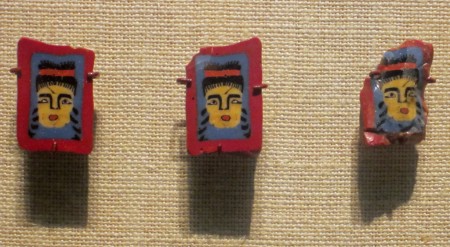
[image] My photo of mosaic plaques on display at the Freer Gallery; from Egypt, 100 BCE – 100 CE; glass, H: 2.2 cm; Freer Gallery, Washington, DC, objects F1909,496A-C. Additional images of mosaic plaques. According to the display placard:
Thousands of miniature plaques made from rectangular and columnar rods of glass have been found in ancient tombs in Egypt. While the original function of these plaques with faces sometimes wearing golden wreaths is uncertain, some scholars believe they were used to decorate furniture. Other experts assert the plaques were possibly utilized by elite patrons as entrance tickets to theater performances.
culturally hybrid literature in medieval Europe
Distinguishing between literary structure and content seems like beating poetry with the dead hand of Plato’s binary opposition of appearance and essence. Can artistic content be more real than Yves Klein’s “zones of immaterial pictorial sensibility”? The Book of Martyrs, first published in 1563, asserted the Church of England’s fidelity to God’s word with a book that had the heft of an immovable rock. Is that material form truly meaningless?[1] Such questions tend to lead to mind-numbing “post-structuralist” attempts to essentialize dominance and ignore the obvious. Plumbers know better. If a tool can clear a clog, use it. The binary opposition between structure and content can help to identify culturally hybrid literature in medieval Europe and clear up blockages in appreciation of that literature.
The literary plumber’s structure-content tool is relatively easy to use. Distinguish between a work’s literary structure and content. In practice, ordinary persons can do that about as successfully as they can distinguish between females and males. Distinguish reasonably between a newly established, dominant culture and a long-settled, subordinate culture. That’s also doable. Hybrid literature affirming the cultural hierarchy tends to use structure from the new, dominant culture and content from the settled, subordinate culture. Hybrid literature critical of the dominant culture tends to use the reverse configuration. That literature uses structure from the settled, subordinate culture and content from the new, dominant culture. This structure-content tool provides a readily understandable means for describing hybrid literature and considering its relationship to supporting cultures.[2]

In terms of structure and content, the fourteenth-century Spanish work Libro de buen amor is culturally hybrid literature. Libro de buen amor’s structure comes from Arabic literature. Its episodic narrative of a roguish clerk is similar to that of the Arabic maqāma genre. The clerk’s failures in Libro de buen amor associate that work with the Andalusī zajal poetry. Libro de buen amor’s framing narrative and embedded stories, including stories used as thrusts in debate, are a structure like that in the Arabic Kalīla wa-Dimna and the Sindibad corpus. Libro de buen amor’s content, however, largely has Graeco-Roman and European Christian sources. Written in Spain after Christians reconquered it, Libro de buen amor uses structure from the settled, subordinate culture (Arabic, mediated partly through Hebrew) and content from the new, dominant culture (Romano-Latin). That’s consistent with Libro de buen amor’s subversive, critical orientation to clerical-scholastic European culture.[3]
The medieval Latin work Solomon and Marcolf is also culturally hybrid literature. Marcolf came to the throne of King Solomon “from the direction of the East.”[4] Solomon and Marcolf’s high-level structure is a confrontation of wisdom authorities like that in the Hebrew Pseudo-Sirach. Solomon and Marcolf deploys explicit, playful, analogical references to bodily functions within literature that also displays high cultural sophistication. That’s similar to Pseudo-Sirach and Arabic literature such as that of al-Jahiz. Solomon and Marcolf culminates in concern about malice toward men and interest in the literature of men’s sexed protests. Serious interest in the question of men characterizes Arabic and Hebrew literature much more than Latin literature. The content of Solomon and Marcolf, in contrast, seems to come from European clerical culture. While it’s written in Latin, Solomon and Marcolf has a colloquial tone and is filled with constructions and words that “could point to an author whose native language was Romance, perhaps French.”[5] All the content of Solomon and Marcolf is consistent with that of Latin and Romano-European literature. Nothing in the content of Solomon and Marcolf clearly draws attention to post-biblical Hebrew literature or Arabic literature. Jews are not explicitly mentioned at all in the earliest, main text, and neither are Arabs.[6] Solomon speaks words of a European Christian preacher, and Marcolf, words of a cunning, perverse European peasant:
Solomon: Four evangelists uphold the world.
Marcolf: Four support-posts uphold the privy, so that the person who sits over it does not fall. [7]
Written in Christian-dominated Europe, Solomon and Marcolf uses structure from the subordinate culture (Hebrew, and more distantly, Arabic) and content from the dominant culture (Romano-Latin). Like Libro de buen amor, Solomon and Marcolf is hybrid literature offering a subversive, critical orientation to clerical-scholastic European culture.
Trotaconventos’s encounter with the Moorish girl in Libro de buen amor confirms the value of the considering hybrid structure and content. Trotaconventos offered the Archpriest of Hita’s love to a Moorish girl. She resolutely refused to accept that offer. In sharp contrast to the preceding, long story-dispute between Trotaconventos and the nun Lady Garoza, the Moorish girl responded with only a few words. Those words are common expressions from Arabic.[8] Medieval European Christian texts characteristically differ from eastern Hebrew or Arabic texts in verbosity:
we are immediately struck by the difference between the direct informative approach of the Christian text and the desire for narrativeness, for expansion and integration of new narrative elements, in the eastern text. … In western tradition the answers are basically brief and relate directly and concisely to the subject. … In eastern texts, on the other hand, the question is merely the starting point for a story, only indirectly of moral or aetiological significance, which provides the answer to the opening question: it is strikingly evident that the questions do not constitute a didactic means but rather a rhetorical device serving as the pretext for telling a tale. [9]
Living in Spain after Christians had reconquered it, the Moorish girl uses structure from the dominant culture (Romano-Latin) and content from the subordinate culture (Arabic words). The Moorish girl thus affirms the existing cultural hierarchy. But within Libro de buen amor itself, the Moorish girl critically opposes the Archpriest of Hita’s quest.
Sophisticated medieval European literature is not a monolith of Latin-Christian culture. Ideas have always moved across Eurasia. So too have people.[10] A division between content and structure in the analysis of Libro de buen amor and Solomon and Marcolf isn’t a perfect model and doesn’t essentialize a conceptual boundary. It provides a useful intellectual tool. It helps to appreciate those works as culturally hybrid medieval European literature.
* * * * *
Read more:
- Aquila and his Islamic doppelganger translate Hebrew scripture
- sixth-century Persian royal physician Borzuya pondered Matthew’s Gospel
- Gog and Magog from Hebrew scripture to the Great Wall of China
Notes:
[1] For relevant discussion, Galbi (2003), esp. Ch. 4.
[2] This paragraph describes my understanding of the analytical model set out in Monroe (2011).
[3] This paragraph summarizes claims in id. My own view is that Libro de buen amor parodies the mirror-for-princes genre as transmitted through Arabic literature like Secret of Secrets. That alternative is consistent with the above structure-content understanding of Libro de buen amor as hybrid literature.
[4] Solomon and Marcolf Part 1, Prologue, l. 1, from Latin trans. Ziolkowski (2008) p. 53.
[5] Ziolkowski (2008), Introduction, p. 11. Manuscripts of Solomon and Marcolf are predominately associated with southern Germany and Austria, while early printed versions are predominately from northern Germany and Low-German cities, e.g. Antwerp, Cologne, Deventer, and Leipzig. Id. p. 13.
[6] At the peak of its popularity in the fifteenth century, Solomon and Marcolf was relatively popular in:
schools, circles in which the northern European equivalent to humanism flourished, and circles in which scholasticism prevailed.
Id. p. 13. Bradbury (2008), p. 342, states:
The scholarly consensus holds that the Dialogus {Solomon and Marcolf} arose in a clerical context, on the basis of the choice of Latin, the allusions to academic disputation, the abundant scriptural quotations in the speeches of Solomon, and the technical skill revealed in the close syntactic parody of Scripture assigned to Marcolf.
Ziolkowski (2008), Commentary, p. 287, notes, “Jews are not mentioned at all in the main text.” Id. pp. 285-6 provides an alternative verse beginning that starts, “I am King Solomon, who rules the Jews by law.” This alternative beginning probably was included in the Solomon and Marcolf corpus in the fifteenth century. Id. p. 287. Except among various attestations of proverbs and folktales, Ziolkowski (2008) and Bradbury (2008) indicate little distinctive contribution of post-biblical Hebrew literature and Arabic literature to the content of Solomon and Marcolf.
[7] Solomon and Marcolf Dialogue, 38a-b, from Latin trans. Ziolkowski (2008) p. 59.
[8] The relevant text is Libro de buen amor, ll. 1508-1512. On the Arabic words, Monroe (2011) pp. 37-39.
[9] Yassif (1982) pp. 57, 58, 59.
[10] On failures to appreciate adequately the interactions of European literatures with Hebrew and Arabic literatures, Wacks (2010) and Akbari & Mallette (2013).
[image] Hispano-Moresque basin, early-to-mid 15th century. Earthenware with underglaze and luster decoration. Walters Art Museum, 48.1013.
References:
Akbari, Suzanne Conklin, and Karla Mallette. 2013. A sea of languages: rethinking the Arabic role in medieval literary history. Toronto: University of Toronto Press.
Bradbury, Nancy Mason. 2008. “Rival Wisdom in the Latin Dialogue of Solomon and Marcolf.” Speculum. 83 (2): 331-365.
Galbi, Douglas. 2003. Sense in Communication. Worldwide: Internet Printing Press.
Monroe, James T. 2011. “Arabic literary elements in the structure of the Libro de buen amor,” in parts I & II. Al-Qanṭara. 32 (1): 27-70; 32 (2): 307-332.
Wacks, David A. 2010. “Toward a History of Hispano-Hebrew Literature in its Romance Context.” eHumanista 14:178-209.
Yassif, Eli. 1982. “Pseudo Ben Sira and the ‘Wisdom Questions’ Tradition in the Middle Ages.” Fabula. 23 (1): 48-63.
Ziolkowski, Jan M. 2008. Solomon and Marcolf. Cambridge, Mass: Harvard University.
Wednesday's flowers