
my mom’s self-portrait


“Don’t write so much about sex and violence,” my mom told me. She had made Raggedy Ann and Andy dolls for her boys. As a child, I enjoyed sleeping with Raggedy Ann and beating my brothers over the head with either doll. “Sex and violence have long been central aspects of life. I write about what’s important,” I countered.
Many years later my mom made new Raggedy Ann and Andy dolls for herself. She even sewed fall, winter, and spring outfits for them. She also made Raggedy Ann and Andy’s dolls for her twin and her closest friend. One of her twin’s granddaughters caused a serious injury to Raggedy Ann’s head. Injuries are part of life. My mom would have loved to have even just one granddaughter or grandson.
To the day of her sudden and unexpected death three weeks ago, my mom wasn’t bitter at her four sons for not producing any grandchildren. She made the most of life as it rolled out for her. To remind me of how much she loved me, she made a print of Raggedy Ann and Andy dolls, wrote below the print “We love you!”, and framed the work beautifully before giving it to me.

I enjoyed talking with my mom about her various artistic endeavors. One day she asked me what sort of art I liked most. I said images of naked women. I knew my mom enjoyed figure drawing. I myself am a defender of the male gaze. Today I have hanging on my apartment walls several of my mom’s artworks representing naked or near naked women. My mom had a generous heart for her boys.


My mom didn’t only draw and paint naked women only for me. She had been taking figure drawing classes occasionally ever since her boys had nominally grown up. She made art in a wide range of media and with many different subjects. She also delighted in gardening. On my kitchen wall is one of her works of fragments, combining abstract watercolor and her calligraphy of quotes.

At the bottom-center of this garden artwork is the quote “mud is the most poetical thing in the world.” She explicitly attributed that quote in small, plain letters to “R.H. Blyth.” Reginald Horace Blyth was born to economically struggling parents in England in 1898. He was imprisoned during World War I for being a conscientious objector and pacifist. He thus escaped the massive slaughter of men in World War I. Blyth married an English woman in 1924, began studying Japanese culture and Zen in 1926 in Korea under Japanese occupation, adopted a Korean boy in 1933, and got divorced in 1935. Two years later he married a Japanese woman. They had two children. In 1939, Blyth became an English teacher at a high school in Japan. He sought to become a Japanese citizen. Instead, the Japanese interned him in a camp for enemy aliens from 1941 to 1945, as the U.S. did to Japanese-Americans during that time. Blyth remained devoted to Japanese culture, became a professor at a Japanese university, and lived out the rest of his life in Japan. Our world is a dirty place.
I have long been skeptical that mud is the most poetical thing in the world. What does that mean, really? My mom liked to work with her hands — kneading bread, collecting and stirring kitchen scraps into her compost pile, and many other hand crafts. My mom surely didn’t read any of Blyth’s works. She wasn’t much into Zen or haiku. My mom apparently picked up Blyth’s quote about mud as an isolated quote of wisdom or inspiration. That quote probably appealed to her through sensuous connections she made between mud and her personal experiences.
I am no longer skeptical that mud is the most poetical thing in the world. Blyth was a Buddhist, not a Jew, Christian, or Muslim. Nonetheless, I now understand Blyth’s insight like this:
The Lord God formed the human from humus-soil, and breathed into its nostrils the breath of life, and the human became a living being.
{ וַיִּיצֶר֩ יְהוָ֨ה אֱלֹהִ֜ים אֶת־הָֽאָדָ֗ם עָפָר֙ מִן־הָ֣אֲדָמָ֔ה וַיִּפַּ֥ח
בְּאַפָּ֖יו נִשְׁמַ֣ת חַיִּ֑ים וַֽיְהִ֥י הָֽאָדָ֖ם לְנֶ֥פֶשׁ חַיָּֽה }
The English word “poetry” is linguistically rooted in the ancient Greek verb “to make {ποιέω}.” My mom, in equal conjugal partnership with my dad, gave their flesh to the bodies of four new human beings. Every human being until very recently was created in that way. We’re all made of mud. I write about that. My mom no longer tells me to do otherwise.
When she was about thirty-five, my mom read to me Shel Silverstein’s “The Little Blue Engine” as bedtime reading. My mom still remembered doing that about thirty-three years later. She then gave to me that poem in a book that she made with her own hands.
Today, college students probably wouldn’t have read to them “The Little Blue Engine” without a preceding trigger warning. Here’s the problem: the little blue engine was little and weak, yet it aspired to climb a tall hill. In the rhythm of a machine, not a human being, the little blue engine repeatedly engaged in self-affirmation: “I think I can, I think I can, I think I can.” But it couldn’t. It failed badly. It fell back terribly and got all banged up.
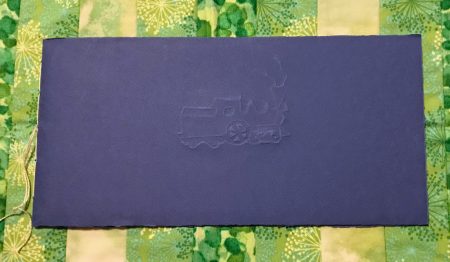
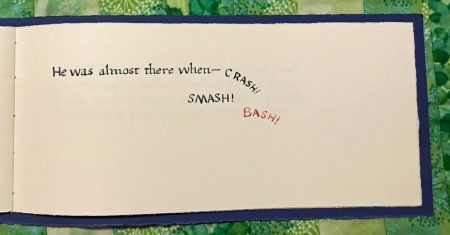
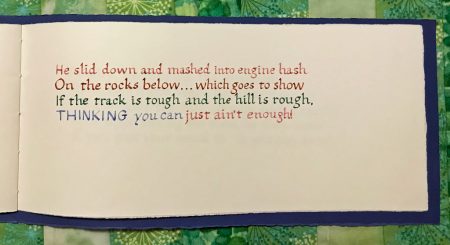
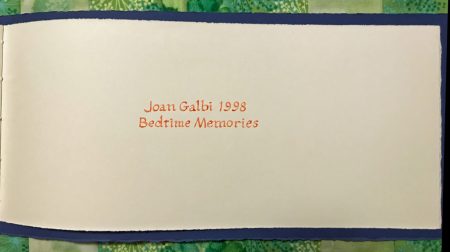
While the “The Little Blue Engine” supports a violent attack on self-identity, my mom crafted her book beautifully with care and empathy. She embossed on the cover and the title page a small, charming locomotive image that she designed. Having taught herself calligraphy, she wrote the book in a child-simple letter style (she could write much more ornately). At the same time, she used multiple colors for writing the text and used some typographic design that a child would like. She hand-stitched the binding for the book with a soft, silk-like thread, not a hanging rope for self-destruction.
I don’t have any memory of childhood bedtime trauma from hearing “The Little Blue Engine.” I’ve tried to do things that I think I can do, and have failed to do them. For example, I tried to write a great Russian novel, and failed. Failure doesn’t bother me much. I actually like to try to do things for which success is doubtful.
Making this book about thirty-three years after she had read to me “The Little Blue Engine,” my mom was concerned about the ending. We had a long telephone conversation about it. She said she wanted to change the ending. I told her that I liked the ending and that there was no need to change it. She didn’t agree. She wrote an alternate ending and wanted to know what I thought of it. I said that her alternate ending didn’t sound as good and wasn’t as poetic. She didn’t agree. My mom wasn’t one to change her view on anything in response to whatever I said. But she was very generous. She wrote the original ending to “The Little Blue Engine” and a replacement page that I could slide in over the original ending to make it how she preferred.
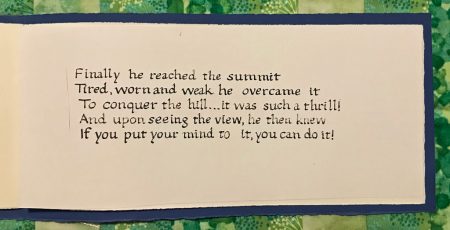
This insertable alternate ending is now my favorite feature of my mom’s hand-made book. My mom’s preferred ending reflects mainstream American ideology across centuries. She lived the American dream as the daughter of an immigrant father who began earning money as a door-to-door peddler of women’s clothes in New York City. My mom’s father went on to become a successful small-businessperson. In recent decades academics have droned on incessantly about the social construction of reality. Who wouldn’t want to believe that anything can be and anyone can do anything? The book with the insertable alternate ending incorporates important, cherished ideology. But it also allows uncovering the possibility of disastrous failure.
Within the same Shel Silverstein poetry book that contains “The Little Blue Engine” is another poem providing a radically different perspective. It’s a poem explicitly addressed to a child:
Listen to the MUSTN’TS, child,
Listen to the DON’TS
Listen to the SHOULDN’TS
The IMPOSSIBLES, the WONT’S
Listen to the NEVER HAVES
Then listen close to me —
Anything can happen, child,
ANYTHING can be.
While she probably read it to me as a child, my mom never said anything about this poem to me as an adult. Two weeks ago my mom died suddenly and unexpectedly. If she were still alive today and she wanted to change the ending to this second poem, I would readily agreed. Those last three verses now scare me.

My mom unexpectedly went to the hospital on Friday evening, June 14. She unexpectedly died on Tuesday evening, June 18. At seventy-nine years young, she was in apparently good health two days before she went to the hospital. A few weeks before her death, she hiked seven and half miles up and down Dog Mountain, which she had done several times before. She told me this time the flowers on Dog Mountain were the most beautiful that she had ever seen. About two weeks before she went to the hospital, she hiked about four and half miles up and down from Angel’s Rest, which she had done before. A week before she died, she sought to send me some blue cheese that she had made. She said it was one of her best blues. But she was concerned that its quality wouldn’t hold up through the time and temperature of express mail. While I vigorously oppose gyno-idolatry, I think my mom deserves to be at an angel’s rest.
My mom expressed more interest and more appreciation for what I’ve written on purple motes than have my father and my three brothers. That’s not saying much. My mom wasn’t a literary person or a critical thinker. She believed most of what she read in “the newspaper.” She didn’t read most of what I have written here.
Occasionally I would ask my mom what she thought about one of my posts. For those seeking material to mobilize a mob to attack me, my mom said that “husbands can work with wives reluctant to work outside the home” was terrible and the most offensive writing of mine that she had ever read.
My mom’s father and mother were immigrants from Lebanon. My mom cherished her Arabic heritage. I sent her my post about the great classical Arabic poet Abu Nuwas and overcoming the poetic problem with penises and erections. She responded, “I’m not sure I got everything you were saying.”
My mom loved hiking through the mountains singing (badly) from the movie The Sound of Music. With anyone or no one walking with her, she would sing joyfully: “The hills are alive with the sound of music, with songs they have sung for a thousand years. The hills fill my heart….” I sent her my post on the philosophical and theological views of the nun Maria in The Sound of Music. She said I shouldn’t be so hard on Maria.
What about how Jephthah’s daughter treated her father? My account of the story incorporated Peter Abelard’s twelfth-century planctus. My mom knew nothing about Jephthah and his daughter other than what I wrote. My mom declared that it’s “hard to imagine that it is true.” She also conceded, “women can be persistent.” She called me on Monday evening, June 3, with her further thoughts, and her voice is preserved here. Highlights: “I’m sure you’re not going to like my attitude” and “Love you!”

With the remark, “I think it’s important for mothers to pass on to their daughters positive attitudes toward men,” I sent my mom my post about Anne of France. My mom, who is no pushover, responded:
I enjoyed reading the article on Anne of France.
I also agree that mothers should pass on positive views of men to their daughters as well as positive views of women to their sons.Did I fail to do that?
Ouch! I’m still not quite certain whether that last sentence was sarcastic taunting or heartfelt concern. Most probably it was the latter. In any case, taking no chances, I responded, “You absolutely did not fail in doing that.”
What about the Book of Tobit and Matthew of Vendôme’s reception of it? My mom responded:
A good marriage takes work and gives and takes. … I still hope that somewhere down the road you may meet someone to share your life.
To the last days of her life, my mom wanted me to get married. She believed that marriage made women and men happy. She would have loved to have had grandchildren.
At my urging, my mom watched the movie The Red Pill. She said it was informative and that she would encourage her friends to watch it. I cautioned her against upsetting her friends with these sort of issues. These sort of issues never changed my mom’s perspective on women, men, and marriage.
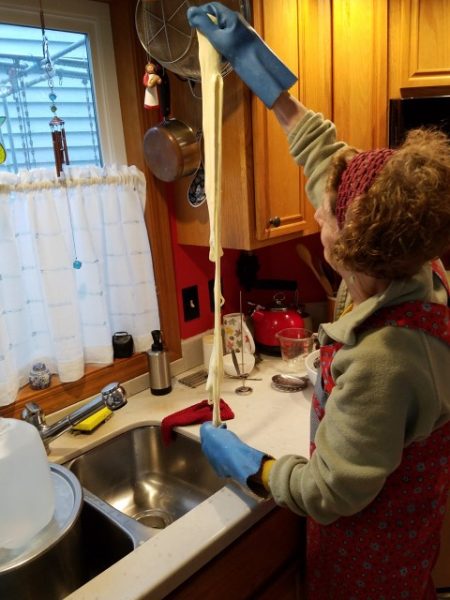
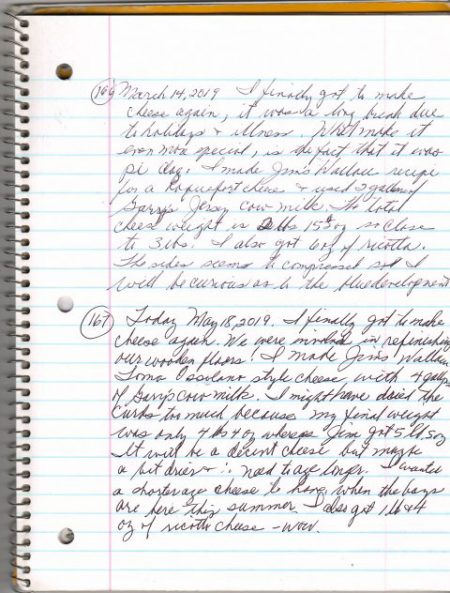
My mom was wonderfully creative. She loved art, especially art you can eat or art you can wear. In recent years she took up cheese-making. Here are the last two entries from her cheese-making diary:
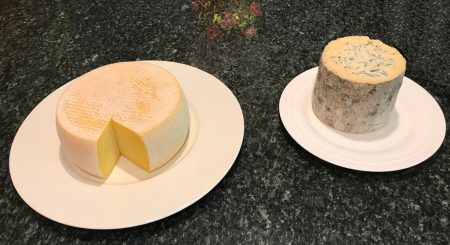
166. March 14, 2019. I finally got to make cheese again, it was a long break due to holidays & illness. What makes it even more special, is the fact that it was pi day {pi is the mathematical constant 3.14159…}. I made Jim Wallace’s recipe for a Roquefort cheese & used 2 gallons of Gary’s Jersey cow milk. The total cheese weight was 2 lbs 15 1/2 oz so close to 3 lbs. I also got 6 oz of ricotta. The sides seem to compress so I will be curious as to the blue development.
167. Friday May 18, 2019. I finally got to make cheese again. We were mired in refinishing our wooden floors! I made Jim Wallace’s Toma Ossolano style cheese with 4 gallons of Gary’s cow milk. I might have dried the curds too much because my final weight was only 4 lbs 4 oz whereas Jim got 5 lb 5 oz. It will be a decent cheese but maybe a bit drier & need to age longer. I wanted a shorter age cheese to have when the boys are here this summer. I also got 1 lb & 4 oz of ricotta cheese — wow.
In the last weeks of her life my mom was taking a class on Mokuhanga woodblock printing at Portland Community College. She was working many hours carving a woodblock for her design of feet. For Michelangelo, fingers reaching out to touch was an image of creation. My mom lived the details of life, delighted in tending her garden, and created with her feet touching the ground.
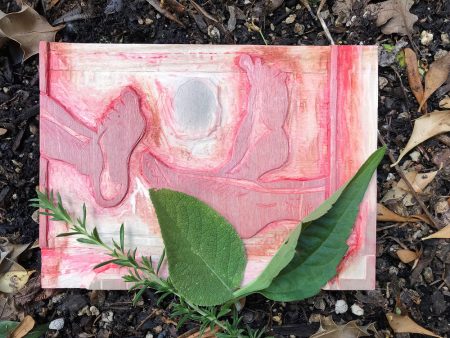
My mom didn’t have a rigidly bounded self-understanding. In a notebook forming something like a nineteenth-century commonplace book, she copied without attribution and minor differences some lyrics from a 1994 album of the rock band the Pretenders:
I’ll stand by you
Won’t let nobody hurt you
I’ll stand by you
Take me into your darkest hour
And I’ll never desert you.
I’ll stand by you.
My mom never listened to rock music. I’m almost certain that she didn’t know of the Pretenders. Yet those words resonated with her. I’m fairly sure those were unspoken words to one of her sons. They were also unspoken words of one of her friends to her.
My mom did many things. She taught math for many years as an adjunct professor at Portland Community College. After retiring from math teaching, she worked as a teacher’s aid for immigrants learning English. Probably adapting a verbal pattern she had heard, my mom wrote of herself in her commonplace book:
I am my father’s child and my mother’s daughter. I am my husband’s wife and my sons’ mother. I am a teacher to my students and a maker of things. I am a lover of life. This is what I am but not all that I am.
My mom was a lover of life, yet she was unafraid of death. That scared me. No one can know all that any person is.
My mom loved me no matter what I wrote. Some particularly egregious posts she told me I should delete. I never said I would, and I never did. My mom had a large and generous heart. She was also good at forgetting and never demanded apologies. Formal, detailed codes of conduct don’t make for a humane world, nor do demon hunts for hate speech. Much better is for everyone to learn to cope with personally uncomfortable words that they might encounter anywhere.
