medieval colophons, persons, and copying blessings

medieval colophon

Colophons — concluding meta-text concerning the production of the text — exist in about 15% of medieval manuscripts.[1] The content of medieval colophons varies widely. Items that might be included in the colophon are:

  • scribe’s name
  • scribe’s location
  • date the manuscript was copied
  • manuscript’s price
  • statements about the scribe’s spiritual character, e.g. unworthy servant of God
  • request for prayers and/or God’s mercy
  • curse upon anyone who would steal the book
  • remarks about the burden of the copy work
  • plea for corrections of the manuscript
  • concern about correctly attributing changes made to the manuscript

Here’s a short, conventional medieval colophon:

This book is finished; may the scribe be free from sin. [2]

Another frequent type of medieval colophon exonerates the scribe for changes made to the text:

the reader emends, and let him not blame the scribe [3]

A late-fourteenth-century manuscript has an amusing colophon:

This work is written master give me a drink; let the right hand of the scribe be free from the oppressiveness of pain. [4]

The scribe is usually understood to be the author of the colophon. Medieval colophons commonly refer to the scribe in the third or first person.

Medieval colophons occasionally have more elaborate forms of address. The sole surviving late-fifteenth-century, Old French manuscript of The Mirror of Simple Souls has the following colophon:

For him who has copied this book
I pray to you in your goodness of heart
To pray to the Father and the Son,
The Holy Spirit and the Virgin Mary
That after this present life
In the company of the angels
He may give thanks and praise to God.
Amen. [5]

The third person is used for the scribe (“for him who has copied this book”). The second person (“you”) refers to the reader. The first person (“I”) is most easily understood as the book’s author. The author prays to the reader to pray to God that the scribe will praise God (implicitly in Heaven after a life of virtuously copying texts). That is a complex chain of personal relations and actions. It suggests the author offering spiritual benefits to scribes who would copy the author’s work.

Medieval colophons written in verse might use different grammatical persons to refer to the same person. Consider a rhyming colophon written in Italian early in the fifteenth century:

I pray that God grant eternal peace
to the soul of the one who wrote
this little book, which I like so much.
And let his saints, as I’m determined,
pray to the Virgin Mary too,
and Saint John, who said so much that was good.
Let it please you to defend her from all things evil,
her soul and body, and protect her from her enemies.
Help her, Lord, since help her you can. [6]

The “I” of the first four line speaks about one associated with a verb for the physical act of writing (“wrote” / scrisse). The praise for the book (“which I like so much”) would be prideful if by the author, but without Christian moral taint if by the scribe. The “one” who wrote the book is grammatical marked as female. The third-personal “her” for whom prayers are to benefit is also female. The “I” of this colophon could be interpreted as the author praying for a female scribe. However, the scribe wrote this colophon in three works she copied. The “I” and “her” of the colophon more plausibly are interpreted as having poetic grammatical mobility in referring to the same person.

Some ancient authors were keen to encourage others to copy their works. One way to encourage copying is for the author to add a colophon invoking blessings for the scribe. The tenth-century Buddhist text The Scripture on the Ten Kings included explicit admonishments to copy and circulate the text. With similar interests, medieval authors might write colophons to create spiritual incentives for scribes to copy their manuscripts.

*  *  *  *  *

Read more:

Notes:

[1] According to Erik Kwakkel, an authority on medieval manuscripts, about one in seven medieval manuscripts include a colophon. In religious books, colophon use increased in the ninth century with Carolingian scribal practices. Colophons became more common in secular European manuscripts from the early fourteenth century. Morton (2014) p. 65, n. 2; p. 43. About a quarter of manuscripts that nun-scribes wrote in fifteenth/sixteenth-century Italy included a colophon. Id. p. 43.

[2] This colophon was written in Latin and had a witty form: “Explicit iste liber sit scriptor crimine liber.” Wakelin (2014) p. 29.

[3] This colophon, also written in Latin, has a rhyme that adds force to the message: “qui legit emendat, scriptorem non reprehendat.” Id.

[4] From manuscript Leiden University, VLF 5, f. 172v, written in Latin: “hoc opus est scriptum magister da mihi potum; Dextera scriptoris careat grauitate doloris.Thanks to Giulio Menna. The first-personal reference “me” and the third-personal reference “the scribe” clearly refer to the same person. See subsequent discussion above.

[5] From manuscript Chantilly, Musée Condé ms. F xiv 26, from Old French trans. College, Marler & Grant (1999) p. 175.

[6] From manuscript Florence, Biblioteca Riccardiana, MS 1338, fol. 96r, from Italian trans. Moreton (2014) pp. 52-3. One of the three manuscripts including this colophon is dated 1414. Id p. 53, p. 70, n. 30-31.

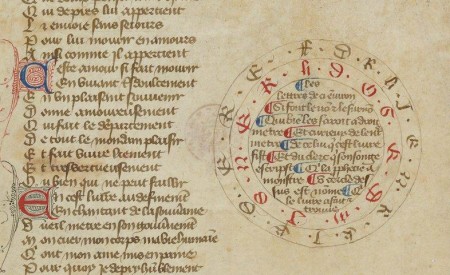
[image] medieval colophon (circular text on right), from the fourteenth-century manuscript Paris, BnF, ms.fr.1297, 169r (Le Livre du roy Modus et de la royne Racio). The excellent site Medieval Manuscript Provenance has an English translation and some discussion of the colophon.

References:

Colledge, Edmund, J. C. Marler and Judith Grant, ed. and trans. 1999. Margaret Porette {Marguerite Porete}. The mirror of simple souls. Notre Dame, Ind: University of Notre Dame Press.

Moreton, Melissa. 2014. “Pious Voices: Nun-scribes and the Language of Colophons in Late Medieval and Renaissance Italy.” Essays in Medieval Studies. 29: 43-73.

Wakelin, Daniel. 2014. Scribal Correction and Literary Craft. Cambridge: Cambridge University Press.

Porete rejects Holy Cathedral the Little & turns to annihilation

annihilation of Porete

Disillusioned with the dominant institutions of her time, the transgressive medieval lay theologian Marguerite Porete named those institutions Holy Cathedral the Little. She declared that noble Souls like her could achieve a higher life in Holy Cathedral the Great.[1] That was the place of those successful in self-annihilation. Its exemplary member was Mary Magdalene. Cultural authorities like those who helped Porete to achieve actual annihilation now celebrate her life and works.[2] Porete’s path — “she sees nothing except herself” — is becoming increasing attractive to men today.

Porete devalued reason and doing. Noble Souls on Porete’s path of annihilation leave behind reason and works of virtue. Words to Porete have two meanings.[3] Their meanings in use yield to their meanings in Porete’s noble work. Men’s self-sacrifice for their families and their societies leads them to be called kings. But men are kings only in lands where persons see with only one eye of reason: “for truly those who have two eyes consider them as slaves.”[4] Those men who live longing for idealized women are likewise slaves. Apart from reason, the noble Soul rejoices in the afflictions of her neighbors:

for in her spirit she perceives and knows without knowledge that this is the way by which they will come to the harbor of their salvation.[5]

Men, enduring storms of misandry, are beginning to understand.

Porete exalted Mary Magdalene. She had no shame for her sins:

She had no shame, because Jesus Christ said to her that she had chosen the better and the safer part, and, what is more, that it would never be taken from her. And, also, she had no shame at all because her sins were known to all the people, as the Gospel itself witnesses, which says so that all hear it that God drove seven devils out of her. She had no shame for anyone, for she was overwhelmed, and taken and seized; and therefore there was no-one that concerned her except him alone.[6]

The noble Soul, who has perfect charity, likewise never feels remorse or qualms of conscience:

whoever had always perfect charity in her will would never have remorse or qualms of conscience. For remorse or qualms of conscience in the Soul is nothing else than lack of charity; for the Soul is not created for anything else than to have within her, endlessly, the state of pure charity.

Sins aren’t causes for shame or remorse. The noble Soul’s sins serve to testify to the God’s graciousness and the Soul’s glory: “in Paradise, to her great glory, her sins will be known.” Mary Magdalene’s sins show her glory. Mary Magdalene also excelled in doing nothing:

I considered the sweet Magdalene, and what service she performed to prepare for the coming of Jesus Christ as her guest, who was often in Mary’s dwelling, he and his companions, the Apostles in a great throng, but to no avail, because Mary did not move, however much there was to do in the house. And even though our Lord Jesus Christ often returned barefooted, his blessed head all wearied, and was unfed and exhausted and rejected by all, for he could find no-one to give him drink and food, and the Magdalene knew all this, none the less she did not move, whatever his body might need, and left it to her sister Martha to serve him, whose role this was; but to love him she left to no-one but herself.

Doing nothing is the better part. Magdalene choose that part. Noble Souls likewise choose to do nothing.

While scholars for the past three decades have emphasized the Madonna-whore binary, Marguerite Porete more than seven centuries ago abolished that binary. Mary Magdalene came to be like Mary, the mother of Jesus:

she {Mary Magdalene} found God within herself, without seeking him, and, too, she had nothing to seek for, for Love had laid hold of her. But when she first took to loving, she besought him, moved by the longing of the will in her spiritual feeling, and so she was human and little, for she was then forlorn and not Mary. She did not know when she sought him that God was everything, everywhere, for then she would not have sought for him.[7]

Porete observed:

I have found no-one who knew this at all times, except the Virgin Mary. In her there was never any will prompted by the senses, never any labor of the spirit, but only the will of the Deity in the divine work.

When the young Jesus wandered off from his parents to spend three days without them in Jerusalem, the Virgin Mary anxiously sought after him.[8] Like Mary Magdalene’s sins, the Virgin Mary anxiously seeking for Jesus means nothing. For Porete, nothing covers everything. Both Mary Magdalene and the Virgin Mary found God within themselves through doing nothing.

In Porete’s sixth stage of annihilation, the Soul identifies completely with God. Christ is fully God and fully human in medieval Christian understanding. Porete understood the noble Soul to walk the earth as fully God:

God of his divine majesty sees himself in her, and by him this Soul is so illumined that she cannot see that anyone exists, except only God himself; and so she sees nothing except herself, for whoever sees that which is sees nothing except God himself, who sees himself in this very Soul by his divine majesty. … this Soul, thus pure and illumined, sees neither God nor herself, but God sees himself of himself in her, for her, without her, who — that is, God — shows to her that there is nothing except him. And therefore this Soul knows nothing except him, and loves nothing except him, and praises nothing except him, for there is nothing but he.[9]

Put equivalently, there is nothing but she. Along with increased scholarly appreciation for Porete’s work in recent decades, many women and men today have achieved this sixth state of annihilation.

In our new networked economy, more men are starting to follow Porete’s lead. Men historically have killed beasts, cleared land, built cities, and invented a wide range of new technologies, including many designed for institutionalized men-on-men violence known as war. Yet men’s doing has resulted in men becoming an inferior caste of beings. Men Going Their Own Way (MGTOW), the sexodus, grass-eaters, and manboobs indicate men embracing Porete’s path of annihilation and doing nothing.

Holy Cathedral the Little remains firmly entrenched in our world. That cathedral has more power now than it ever did in the Middle Ages. Longing for love, simple Souls are attracted to Marguerite Porete’s The Mirror of Simple Souls brought to nothingness and who live only in the will and desire for love. Porete’s path is far superior to curriculum vitae publication building, tallying Facebook likes, and desperately seeking Twitter followers. But perhaps there is a still more excellent way.

*  *  *  *  *

Read more:

Notes:

[1] On Holy Cathedral the Little and Holy Cathedral the Great, see Marguerite Porete, The Mirror of Simple Souls brought to nothingness and who live only in the will and desire for love, Chs. 19, 43, 49, 51, 66, from Old French trans. Colledge, Marler & Grant (1999) pp. 38, 62, 69, 70, 87. All subsequent quotes from Porete’s The Mirror of Simple Souls are from id. The subsequent quote in the above paragraph is from Ch. 118, p. 145. An alternate translation for “Souls brought to nothingness” (ames anienties) is “annihilated Souls.” Holy Cathedral the Little and Holy Cathedral the Great are my translation of the terms Saincte Eglise la Petite and Saincte Eglise la Grande. The term eglise is commonly translated as “church,” but Porete here refers to dominant institutions, not a local parish church. Hence “cathedral” seems to me a better translation. On elitism as a fundamental aspect of Porete’s thought, Robinson (2001).

[2] Peter Dronke, a leading medieval literary scholar, described Porete’s book as one of the “most moving expressions of love by medieval women that have come down to us.” Dronke (1984), p. 228. In his Foreword, Kent Emery of the Medieval Institute, University of Notre Dame, declared:

Margaret Porette’s solitary, steadfast, and courageous stand against the mighty engines of cultural authority is bound to evoke the sympathy and enkindle the imagination of every modern reader.

Colledge, Marler & Grant (1999) p. viii. Bernard McGinn, a leading scholar of medieval theology, included Porete among “the four female evangelists of thirteenth-century mysticism.” McGinn (1998), p. 141.  Robert E. Lerner, a leading scholar of medieval mysticism, declared that Marguerite’s The Mirror of the Simple Soul “has come to be recognized as one of the greatest works of Western religious literature.” Lerner (2010) p. 92.

Porete was burned as a heretic on June 1, 1310. For a thorough review of the historical evidence, Fields (2012). Porete’s book was quite popular apart from the view of church authorities. It circulated widely in the fourteenth and fifteenth centuries. Within a century, The Mirror of Simple Souls was translated into Italian, Middle English, and even Latin, the authoritative language of Christendom. Despite formal suppression of it, perhaps “dozens of copies” of The Mirror of Simple Souls existed in late-medieval Europe. Lerner (2010) p. 116. The popularity of Porete’s book apparently was due in part to its incomprehensibility. Sections of it in some texts are like gibberish. Colledge, Marler & Grant (1999) p. lxxxiii. Fascination with gibberish is a general feature of appropriately cued written communication.

[3] Ch. 66, p. 87 (take leave of Reason and Virtues); Ch. 13, p. 29, Ch. 20, p. 40 (same word has two meanings).

[4] Ch. 55, p. 74.

[5] Ch. 116, pp. 137-8.

[6] Ch. 76, p. 97 (no shame). Subsequent quotes Ch. 37, p. 57 (no remorse); Ch. 37, p. 56 (great glory in sins); Ch. 124, p. 155 (doing nothing but loving). On the ethics of Porete, Marler (2012). Porete is some ways anticipated the late-nineteenth-century philosopher Friedrich Nietzsche in his works On the Genealogy of Morals and Thus Spoke Zarathustra. Scholars of Porete and Nietzche have failed to credit sufficiently Porete as an intellectual mother of Nietzsche.

[7] Ch. 93, p. 118 (God within herself), id. (Virgin Mary likewise). Dubois (2013) highlights the importance of Mary Magdalene to Porete’s thought. “Mary of Peace” and “chosen bride” were common appellations of the Virgin Mary. Porete applied those appellations to Mary Magdalene. Id. p. 152.

[8] Luke 2:48.

[9] Ch. 118, pp. 145-6.

[image] Fire photo thanks to Mr. Theklan and flickr.

References:

Colledge, Edmund, J. C. Marler and Judith Grant, ed. and trans. 1999. Margaret Porette {Marguerite Porete}. The mirror of simple souls. Notre Dame, Ind: University of Notre Dame Press.

Dronke, Peter. 1984. Women writers of the Middle Ages: a critical study of texts from Perpetua († 203) to Marguerite Porete († 1310). Cambridge: Cambridge University Press.

Dubois, Danielle C. 2013. “From Contemplative Penitent to Annihilated Soul: The Recasting of Mary Magdalene in Marguerite Porete’s Mirror of Simple Souls.” The Journal of Medieval Religious Cultures. 39 (2): 149-172.

Field, Sean L. 2012. The beguine, the angel, and the inquisitor: the trials of Marguerite Porete and Guiard of Cressonessart. Notre Dame, Ind: University of Notre Dame Press.

Lerner, Robert E. 2010. “New light on The Mirror of Simple Souls.” Speculum. 85 (1): 91-116.

Marler, Jack C. 2012. “The Mirror of Simple Souls: The Ethics of Margaret Porette.” Pp. 445-472 in Jeremiah M. Hackett, ed. A Companion to Meister Eckhart. Brill’s Companions to the Christian Tradition, 36. Leiden and Boston: Brill.

McGinn, Bernard. 1998. The flowering of mysticism: men and women in the new mysticism (1200-1350). New York: Crossroad.

Robinson, Joanne Maguire. 2001. Nobility and annihilation in Marguerite Porete’s Mirror of simple souls. Albany, N.Y.: State University of New York.

Hildegard of Bingen's antiphon for fathers, O magne pater

O Magne Pater in revelation illumination

English translation Latin text L#
O great Father, O magne Pater, 1
in great need are we. in magna necessitate sumus. 2
Now therefore we beg, we beg of you Nunc igitur obsecramus, obsecramus te 3
according to your Word, per Verbum tuum 4
according to which you created us per quod nos constituisti 5
full of all that we lack. plenos quibus indigemus. 6
Now may it please you, Father, Nunc placeat tibi, Pater, 7
as it behooves you — look upon us quia te decet, ut aspicias in nos 8
with your kindly aid, per adiutorium tuum, 9
that we would not fail, ut non deficiamus, et 10
that your name be not extinguished within us, ne nomen tuum in nobis obscuretur, 11
and by your own name et per ipsum nomen tuum 12
graciously help us. dignare nos adiuvare. 13

Hildegard of Bingen, who lived nearly nine centuries ago, was a visionary. Her poignant antiphon O magne Pater faces the eternal possibility of failing to love fathers.[1] Loving fathers involves calling out to them for help.

The first two lines of O magne Pater echo greatness in the greatness of God the Father and humanity’s great need.  That need, as will develop in the hymn, is the need for God the Father. The third line repeats “beg,” making a plea to the cosmos into a plea to a personal “you.” The fourth and fifth lines resonate with the majestic opening of John’s gospel:

In the beginning was the Word, and the Word was with God, and the Word was God. … to all who received him, who believed in his name, he gave power to become the children of God [2]

The sixth line highlights human imperfection and desire. Humans desire to receive God and believe in who he is. That desire pleases God and is fulfilled with God’s help, for humans alone are prone to allow the name of the Father to be forgotten (lines seven through eleven). The closing two lines celebrate that the grace of God extends even to helping humanity to sing always of God.[3]

Hildegard of Bingen connected humans and God in a resonating unity. Fatherhood is central to Hildegard’s understanding of human and divine harmony:

Oh humans, look at the human being! For it contains heaven and earth and other creatures in itself, and is one form, and all things hide in it. This is what fatherhood is like. In what way? The round of the wheel is fatherhood, the fullness of the wheel is divinity. All things are in it and all stem from it, and beyond it there is no creator. [4]

The roundness of the wheel is the specific human bodily form. The fullness of the wheel is the fullness of human life. Without fatherhood there is no creation, no cosmos, no specific human person.

One thing I ask of the Lord;
this is what I seek:
To live in the house of the Lord
all the days of my life,
To gaze upon the beauty of the Lord,
and to seek him in his temple. [5]

*  *  *  *  *

Read more:

Notes:

[1] O magne Pater is from Hildegard of Bingen’s Symphonia armonie celestium revelationum (Symphony of the Harmony of Heavenly Revelations), Song 6. The Latin text above is from the transcription of Beverly Lomer and the edition of Barbara Newman, as provided on the O magne Pater page of the International Society of Hildegard von Bingen Studies. The English translation above I’ve adapted from those of Nathaniel M. Campbell (O magne Pater page) and Newman (1998) p. 105.

[2] John 1:1, 1:12.

[3] After an extensive analysis of O magne Pater, Karmen McKendrick observed of this antiphon:

altogether musically, deixis becomes reverberation, in which one vibration—the call of created desire, the creative divine voice—sets up another on the same frequency, so that we have the “same” sound, but more so, louder by addition, enriched by another voice, closer to Paradisical perfection. Humanity’s very need, put into song, perfects divine delight. Hildegard’s musicality informs her cosmology both intellectually and sensuously. Taking seriously the notion of a world called into being by voice, she likewise takes seriously the fullness of desire that calls back, the soul as a resonating chamber for the voice that reads aloud the unnamed name of the you, in an address and a reply that can only call to both gratifying completeness and endless need.

MacKendrick (2013) p. 224.

[4] Hildegard of Bingen, Causae et Curae, from Latin trans. Dronke (1984) p. 172. That translation omits a section label written in a different hand. I’ve also eliminated an unnecessary paragraph division. Id. observes of this text, “fluctuations of outlook are notable.” That can be understood as a different perspective on reverberations. Cf. MacKendrick (2013). Newman uses this text on fatherhood as an introduction to the Mother of God and theology of the feminine. Newman (1989) Ch. 5.

[5] Psalm 27:4.

[image] The Day of the Great Revelation, illustration from Hildegard of Bingen, Scivias, Part III.12, Rupertsberg Codex, based on copy made at Hildegard Abbey in Eibingen, 1927-1933, via Böckeler (1954) Plate 33. Nathaniel Campbell argues persuasively that Hildegard helped to design the illuminations.

[embedded video] Canto litúrgico cristiano performing Hildegard of Bingen’s O magne Pater. Many other performances of O magne Pater are on YouTube.

References:

Böckeler, Maura. 1954. Wisse die Wege. Scivias. Nach dem Originaltext des illuminierten Rupertsberger Kodex ins Deutsche übertragen und bearb. Salzburg: O. Müller.

Dronke, Peter. 1984. Women writers of the Middle Ages: a critical study of texts from Perpetua († 203) to Marguerite Porete († 1310). Cambridge: Cambridge University Press.

MacKendrick, Karmen. 2013. “The Voice of the Mirror: Strange Address in Hildegard of Bingen.” Glossator 7: 209-226.

Newman, Barbara. 1989. Sister of wisdom: St.Hildegard’s theology of the feminine. Berkeley: University of California Press.

Newman, Barbara, ed. and trans. 1998. Hildegard of Bingen. Symphonia: a critical edition of the “Symphonia armonie celestium revelationum” (Symphony of the harmony of celestial revelations). 2nd ed. Ithaca (N.Y.): Cornell University Press.

gender, egalitarian relationships, and institutional constraints

equals isn't egalitarian without males

In a recent survey of unmarried, childless persons ages 18 to 32 years old, about a third of women and men didn’t prefer an egalitarian long-term relationship.[1] That’s surprising. Why don’t all young women and men today say that they prefer an egalitarian relationship?

An egalitarian relationship means sharing equally housework and/or childcare. In scholarly research, housework is commonly defined as cooking, cleaning, shopping, sewing, home decorating, arranging furniture, and other such tasks. Discussing various choices for completing these tasks also counts as housework. Do you think that the mauve towels go with the granite vanity countertop? Exhausting, viciously competitive, recreational cycling doesn’t count as housework. Neither does killing animals for fun (hunting). Whether telling the kids to go out and play or plopping kids down in front of the television counts as childcare in official tallying isn’t clear.

Men tend to disagree with women on the necessary level of housework and childcare. In the past, experts prescribed standards for homekeeping and childcare. Today experts have moved on to prescribe standards of gender equality in work and family life (excluding gender equality in child custody and child support awards under anti-men family law). The experts solved the fundamental problem of sex differences in housekeeping and child-care preferences by sweeping that problem under the rug. They commonly assume that women determine the necessary standard of housework and childcare. In surveys, a person choosing egalitarian splitting of housework and childcare is free to assume that the housework and childcare to be split is split based on her standard of what must be done. Who wouldn’t want someone else to do half the work that she thinks needs to be done?

An egalitarian relationship means equally sharing the burden of financially supporting the household. To do that, both partners need to have roughly equal incomes. Under family law, both partners’ income is typically attributed equally to each partner. So if you’re making $30,000 a year and you marry someone making $200,000 a year, you’ve just raised your effective income to $115,000 and lowered your partner’s effective income to $115,000. Imputed income equality is imposed by law only upon divorce. While divorce has become relatively common, persons seeking an egalitarian relationship don’t seek to marry someone making a lot more money than they. With egalitarian relationships, the poor marry the poor, the rich marry the rich, and the social distribution of income becomes more entrenched and more unequal.

Given all the social-status benefits of saying that you favor an egalitarian relationship, why do about a third of women and men refuse to say that? Perhaps they believe that egalitarian relationship is a code word for gynocentrism. It’s like sexism in the World Values Survey and sexism in the Modern Sexism Scale and sexism in major international organizations statistics on gender disparities in lifespans. It’s like a sign for “equals” that includes only the sign for females. That’s the sign the University of Texas used in its press release touting the study on preferences for egalitarian relationships. That study, entitled “Can We Finish the Revolution? Gender, Work-Family Ideals, and Institutional Constraint,” is tendentiously gynocentric.[2] So too is the widespread press coverage of the study’s press release. About a third of women and men reject implicitly gynocentric egalitarianism.

Scholarly and public discussion of egalitarian relationships and gender equality is a farce.  That farce is built upon men dying violent deaths in vastly disproportionate numbers and men being imprisoned in vastly disproportionate numbers. Only in marginal websites does one find real discussion of anti-men gender biases. Anti-men gender biases have a huge effect on family life, work life, and society generally. But no one is allowed to take seriously anti-men gender bias and survive in powerful institutions today.  That’s the key institutional constraint.[3]

*  *  *  *  *

Read more:

Notes:

[1] Pedulla & Thébaud (2015) Fig. 2, Condition 2 (egalitarian option). The survey was of the U.S. in  2012. It was completed by 45% of the sample, but 33% of the respondents who completed the survey weren’t able retrospectively to describe correctly the question that they answered. Id. pp. 123, 136, n. 11. That left 329 responses that were analyzed. While the survey was nationally representative, it is quite small and could suffer from unrecognized sampling biases as well as non-sampling biases. For the specific wording of the egalitarian option, see id. p. 135. The text of the egalitarian response:

I would like to have a lifelong marriage or committed relationship where financially supporting the family and managing the household (which may include housework and/or childcare) are equally shared between my spouse or partner and I.

[2] The study begins:

In recent decades, women have entered the labor force en masse, yet this trend has not been matched with a corresponding increase in men’s share of unpaid household work, men’s entry into traditionally female-dominated occupations, or substantial reforms to government and workplace policies. Furthermore, women still comprise only a small minority of elite leadership positions in government, business, and academic science. For instance, women make up just 4 percent of Fortune 500 CEOs and 18 percent of the 535 members in the U.S. Congress.{scholarly references omitted}

Pedulla & Thébaud (2015) p. 116. This introduction gynocentrically ignores much more welfare-significant gender inequalities. In U.S. military action in Afghanistan and Iraq since 2001, forty times more U.S. men soldiers have been killed compared to U.S. women soldiers killed. At the same time, the U.S. still maintains by law sexist Selective Service registration. In civilian work, thirteen times as many men suffer workplace fatalities, but that stark gender inequality has attracted much less attention than claims about gender gaps in earnings (gaps not controlling for earnings-relevant factors such as time on the job, time in the workplace, and non-pecuniary job costs and benefits). In civilian life, four times as many men die from violence, but violence against men is of much less social concern than violence against women. U.S. universities are now leading anti-men, gender-biased rape inquisitions that make medieval inquisitions seem like models of enlightenment. About as many men report suffering rape as do women. That reality has attracted very little public concern amid the strong push to enact anti-men rape inquisitions. Such issues are major obstacles to truly gender egalitarian relationships.

[3] Id. has a much narrower view of institutional constraints. Condition 3 (supportive policies) states:

Raising children, caring for ill family members, and/or taking care of household responsibilities involves a considerable amount of time and energy. In the United States, the cost of paying others to help with these responsibilities (such as childcare) is also high. However, if policies were in place that guaranteed all employees access to subsidized childcare, paid parental and family medical leave, and flexible scheduling (such as the ability to work from home one day per week), which of the following options best describes how you would ideally structure your future work and family life?

Id. p. 135. While such policies are helpful, eliminating alimony payments, child-support payments, and anti-men bias in family courts undoubtedly would be much more effective for promoting egalitarian relationships.

Reference:

Pedulla, David S. and Sarah Thébaud. 2015. “Can We Finish the Revolution? Gender, Work-Family Ideals, and Institutional Constraint.” American Sociological Review 80 (1): 116-139.