
abusive expression less repressed in ancient Islamic world

Western societies today sternly condemn verbal expression labeled abusive, harassing, hateful, racist, sexist, homophobic, or otherwise popularly recognized to be repugnant. The lines defining such expression are far from clear. The chilling effects on public discussion are obvious. Yet particularly if the matter is publicly framed as men attacking women, democratic ideals, basic principles of fairness, and law are easily trampled in publicly applauded crusades to control and punish. A leading medieval scholar has suggested that medieval Europe repressed obscenity less than Western countries do today.[1] Both obscenity and abusive expression surely were less repressed in the ancient Islamic world than in the United States today.
Because claims that men are committing sexual violence against women is a potent tool for inciting men to anger and action, such claims function effectively as tools of abuse. Late in the first century of Islam (the seventh century in the Gregorian calendar), the eminent Arabic poet Jarīr attacked the eminent poet al-Farazdaq. Jarīr publicly claimed that al-Farazdaq had failed to protect his sister Jiʿthin from being raped. Jarīr declared in the poetic public sphere:
Al-Farazdaq’s sister, daughter of his father and mother,
spent the night going along in a fast gallop.
The cowards surely knew that their girl
was being trodden upon like a main road.
Will you not be angry with the heroes of Muqāʿis,
when they hurried to bring humiliation upon you?
I have been told that Jiʿthin defended herself against them with her arse,
since she did not find anyone from Mujāshiʿ to defend her. [2]
Jarīr repeated his rape claim in many poems and elaborated on it in various ways. In invective against al-Farazdaq, Jarīr wrote:
Did you not see Jiʿthin among the men of Saʿd,
called ‘the broad’ after her virginity?
She wiggled her rump when he went beyond her knees
and shook towards her a mighty dong, which subsequently disappeared.
When the girl of the Banū Tamīm coughs,
the gate of her perineum is fed with dust.
One can see a white leprous spot where her labia are joined,
like the tuft of hair on al-Farazdaq’s lower lip when it is grey. [3]
There’s no question that Jarīr’s claims of rape were lies: “Jarīr was obviously lying in his verse on Jiʿthin and everyone knew it.”[4] The point wasn’t the truth of the rape claims, but Jarīr’s poetic skill in publicly humiliating al-Farazdaq. Jarīr’s verbal abuse of al-Farazdaq drew admiration from the literary elite. They studied this poetry and anthologized it. Jarīr’s obscene, abusive verses became part of the corpus of classical Arabic poetry.
Invective (hijāʾ) was a well-recognized genre of classical Arabic poetry. An Arabic poet of the pre-Islamic period verbally attacked a well-known, noble man to gain social status. The poet explained, “I wanted to put my poetry in its proper place.”[5] Similarly, a young poet verbally attacked the eminent poet Jarīr, evidently hoping to draw a counterattack and engagement at a high poetic level. Jarīr, however, ignored the attack. The young poet lamented, “If he had answered, I would have been a great poet.”[6] Another famous poet of Jarīr’s era observed:
How many an ignoble one would like me to abuse him,
even though my abuse on him should be as {bitter as} colocynth!
But generously refraining from abusing an ignoble one
harms him more than abuse when he is abused. [7]
Far from being condemned, harsh verbal attacks were a conventional way to attract attention, demonstrate poetic skill, and make a name for oneself.
Rather than seeking authoritative means to punish Jarīr for his verbal abuse, al-Farazdaq responded with skilled poetic abuse of Jarīr. For example, al-Farazdaq claimed to have raped Jarīr’s mother:
They brought Ḥiqqa {Jarīr’s mother}, having stuffed her perineum,
while a hireling, saddler of beasts, was singing to make the she-ass go.
She stopped to scold me but I said to her, ‘On your knees,
Ḥiqqa, you and your collected works will be underneath!’
And I bared my prick to her. She cowered,
just as a she-ass in heat cowers.
She found someone with a hard-on, who had changed into easy clothes;
and someone who does scandalous things will change into easy clothes.
And I left your mother, Jarīr, as if she were,
kneeling, for the people a well-trodden road. [8]
Al-Farazdaq then went on to claim that Jarīr got pregnant and had an unusual daughter:
Ḥiqqa, I have never heard about a man with
two testicles who got pregnant, except al-Marāgha’s son {Jarīr}.
He drank the sperm and in his belly there grew
an uncircumcised woman whose clitoris is itching at the end. [9]
This isn’t a dirty tale told by peasants lounging in the barnyard. Al-Farazdaq was an acclaimed, widely anthologized, classical Arabic poet. He contributed to establishing the language of classical Arabic literature.
Al-Farazdaq himself incorporated appreciation for an eminent classical Arabic poetic form in a line of invective. Al-Farazdaq wrote of Jarīr:
He is crying on the dungheaps of the abandoned campsites, while his mother, on the tips of the slaves’ penises, is going up and down. [10]
In this poetic line, al-Farazdaq conflates two section of the classical Arabic qasīda. The qasīda begins with a section, called the nasīb, in which the man poet weeps nostalgically at the abandoned campsite of his beloved. In the second section of the qasīda, the rahīl, the man poet journeys on a she-camel to a new place. Al-Farazdaq mocks the elegiac tone of the nasīb with the smell of dungheaps. He transforms the rahīl into Jarīr’s mother riding up and down on slaves’ penises at the same campsite at which Jarīr is weeping. Tweeting something like al-Farazdaq’s venerated line of classical Arabic poetry would probably get a person banned from Twitter, at least if such invective were directed at a woman.
Words of individuals are much less dangerous than acts of totalitarian institutions. Failure to appreciate the difference between an individual’s words and acts of powerful institutions is an ominous sign.[11] Obscene, abusive words, preserved for centuries as classical Arabic literature, can open minds and open societies if those words are heard.
* * * * *
Read more:
- ibn Butlān and ibn Ridwān in vicious intellectual competition
- textbook hate: soil in which free speech grew
- rape: a fundamental principle of communication economics
Notes:
[1] Ziolkowski (1998) pp. 3-4.
[2] From Arabic trans. van Gelder (2015) p. 179. “Trodden upon” is an disparaging metaphor for a man having sex with a woman. Jarīr ibn ʿAṭiyya (died c. 728) was a “giant of Arabic literary history … universally lauded as a poet excelling in delicate love lyrics.” Id. p. 176. Hammam ibn Ghalib, Abu Firas, known as al-Farazdaq (died c. 729) was a “famous poet … one of the great poets of the Umayyad period.” Id. p. 175. Al-Farazdaq wrote a sophisticated critique of the famous muʻallaqah of Imruʼ al-Qays.
[3] From Arabic trans. id. p. 181. The last two lines above (a single line of Arabic verse) was “often quoted by the critics and anthologists … they mention it for its ‘wonderful comparison.’” Id.
[4] Id. p. 188. Acclaimed invective poetry (hijāʾ) from the Umayyad period shows “complete indifference to truth.” Van Gelder (1988) p. 33. Both rape and false accusations of rape have throughout history generally been taken very seriously when interpreted literally. In Islamic law, “false accusation of illicit sexual intercourse” (qadhf) is a wrong with an explicitly prescribed punishment. Van Gelder (2015) p. 188. Poets, however, were only rarely punished for invective. Van Gelder (1988) pp. 30-1.
[5] Durayd Ibn al-Simma (died 629) regarding his invective (hijāʾ) on ʿAbd Allah Ibn Judʿān. From Arabic trans. van Gelder (1988) p. 131, n. 130.
[6] Bashār ibn Burd (died 783), from Arabic trans. id.
[7] Al-Muʾammal Ibn Umayl (died c. 806), from Arabic trans id. This is an early statement of what has now become known as the Streisand effect. A similar effect concerns legal remedies. Law addresses rights and obligations, while invective concerns honor and shame. An invective target who seeks legal recourse can increase his shame through public acknowledgement of harm and personal weakness. Id. p. 130. That effect is likely to be much stronger for men targets of invective than for women targets.
[8] From Arabic trans. van Gelder (2015) p. 185.
[9] From Arabic trans. id. p. 186.
[10] From Arabic trans. id. p. 184. Laylā l-Akhyaliyya’s praise poem for Abd al-Malik ibn Marwan also modifies the qasīda, but trespasses upon the form to a lesser extent. See al-Sajdi (2000).
[11] Solterer (1995) illustrates well gynocentric scholarship making absurdly broad claims about men “verbally injuring” women in medieval Europe. In the U.S. today, four times more men than women are victims of fatal physical violence. Ten times more men than women are being forcefully held in the violent circumstances of prisons and jails. Those life-breaking gender inequalities are much easier to understand than any aspects of medieval discourse. They are also much more important, and largely ignored.
[image] Galen watching a dispute, detail of folio from a Gulistan (Rose Garden), illumination from early 16th century, Mughal dynasty. Freer Gallery of Art and Arthur M. Sackler Gallery, F1998.5.60, Gift of the Art and History Trust in honor of Ezzat-Malek Soudavar. Thanks to the Freer | Sackler for making its art widely accessible on the web. Galen was a pugnacious physician and scholar in second-century Rome.
References:
Al-Sajdi, Dana. 2000. “Trespassing the Male Domain: the Qasīdah of Laylā Al-Akhyaliyyah.” Journal of Arabic Literature. 31 (2): 121-146.
Solterer, Helen. 1995. The master and Minerva: disputing women in French medieval culture. Berkeley: University of California Press.
Van Gelder, Geert Jan. 1988. The bad and the ugly: attitudes towards invective poetry (hijāʼ) in classical Arabic literature. Leiden: E.J. Brill.
Van Gelder, Geert Jan. 2015. “Sexual Violence in Verse: The Case of Jiʿthin, al-Farazdaq’s Sister.” Pp. 175-90 (ch. 11) in Gleave, Robert, and István Tamás Kristó Nagy. 2015. Violence in Islamic thought from the Qur’an to the Mongols. Edinburgh: Edinburgh University Press.
Ziolkowski, Jan M. 1998. Obscenity: social control and artistic creation in the European Middle Ages. Leiden, The Netherlands: Brill.
Carfania & Marcolf: different positions for mooning judges
Mooning an authority — publicly presenting one’s ass to her or him — signifies both submission and rebellion. Along with a reference to legal pleadings of the “shameless {improbissima}” woman Carfania, a Roman law barred women from advocating on behalf of others in court. European medieval literature imagined that Carfania had mooned the court.[1] In the popular medieval work Solomon and Marcolf, the peasant Marcolf mooned Solomon, the eminent judge and king. Carfania and Marcolf, while commonly associated with mooning, had much different social positions in gynocentric society. Today law holds behind bars about fifteen times as many men as women. The different literary treatments of Carfania and Marcolf reflect nearly unremarkable disparate punishment by gender under law.
Carfania had much higher social status than Marcolf. Carfania was the wife of a Roman senator. She was prominent enough to be publicly recognized for repeatedly appearing in court. She also had enough education to know how to speak in court.[2] Marcolf, in contrast, was a peasant. He spoke in figures of the barnyard and bodily functions. Marcolf being a man also mattered. Because women’s physical violence is commonly trivialized or ignored, a lowly woman can threaten to give a male official a black eye and gain advantage from that threat.[3] If Marcolf made such a threat, he would be beaten or locked up.
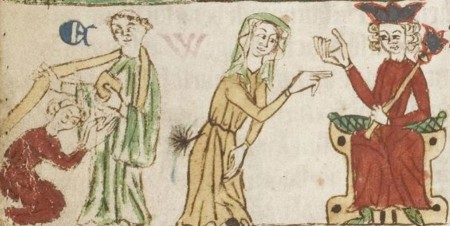
Medieval images of Carfania and Marcolf evince starkly contrasting statuses. A description of Germanic customary law in 1274 referred to Carfania as displaying her “rear pudenda {hindere scham}” to the court.[4] Beginning about 1300, illustrated books of German law included images of Carfania addressing a judge. She is well-dressed and not depicted as ugly. She stands in front of the judge and addresses him with a pointing gesture and leaning-in aggressiveness. Her mooning the judge is represented with a piece of bushy, black hair attached to her waist like a ring of keys. Her genitals aren’t associated with a position of submission.[5]

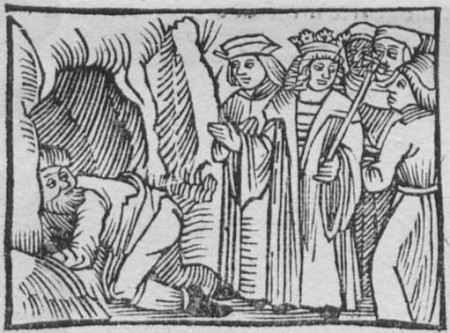
Marcolf, in contrast, is illustrated in a position of complete submission. He is bent over or down on hands and knees like an animal. Marcolf’s buttocks are bared, visible to the viewer, and positioned for Solomon to penetrate.[6] At least two images obscure Marcolf’s face in an earthen cave. In any reasonable societal scale of dominance and subordination, Marcolf would rank far below a woman like Carfania. The medieval images of Marcolf are extraordinary depictions of the publicly unrecognized position of many, ordinary men.[7]

Marcolf challenged authoritative malice toward men. He deconstructed Solomon’s famous split-the-baby judgement. Marcolf demonstrated that Solomon’s judgment was based on ideological up-valuing of women.[8] Marcolf addressed justice more generally with two proverbs:
ibi est mala curia ubi non est iustica
{ there is a bad court where there is no justice }ubi non est lex, ibi non est rex
{ where there is no law, there is no king }[9]
The proverbs poetically echo the first line of an early Christian hymn, slightly condensed:
ubi caritas, Deus ibi est
{ where there is charity, there is God }[10]
God is closely associated with ideas of justice, law, and charity. Justice, law, and charity historically have not encompassed equally women and men.

* * * * *
Read more:
- Marcolf challenged Solomon on malice toward men
- Life of Aesop as continuing critique of elite culture
- why were men reluctant to marry in ancient Rome?
Notes:
[1] Ulpian 6 Digest 3.1.1.5 (early third century GC):
On the grounds of sex, he forbids women to advocate on behalf of others. The reason for this prohibition is to prevent them from involving themselves in the cases of other people contrary to the modesty in keeping with their sex and to prevent women from performing male duties. Its introduction goes back to a shameless women called Carfania who by brazenly advocating and annoying the magistrates gave rise to the edict.
{ sexum: dum feminas prohibet pro aliis postulare. et ratio quidem prohibendi, ne contra pudicitiam sexui congruentem alienis causis se immisceant, ne virilibus officiis fungantur mulieres: origo vero introducta est a carfania improbissima femina, quae inverecunde postulans et magistratum inquietans causam dedit edicto. }
Latin text from the Latin Library, English translation (modified slightly) from McGinn (2012) p. 239.
Ancient Greco-Roman literature includes stories of dramatic female exposure. Queen Hecuba, attempting to dissuade her son Hector from fighting the mighty Achilles, bared her breast to him. Homer, Iliad 22.79-83. Clytemnestra bared her breast to her son Orestes in a plea for him not to kill her in response to her murdering her husband and his father. Aeschylus, Choephori 896-9. When the courtesan Phryne was brought to trial on a capital charge in 4th-century-BGC Greece, she displayed her breast to win sympathy from the judges. Athenaeus, The Deipnosophists, Bk 13, Ch. 59-60. In roughly the same time and place, the Cynic philosopher Hipparchia remained unperturbed when an opponent attempted to pull up her cloak. Her husband, Crates of Thebes, had suddenly disrobed before her and her parents before they were married.
Men’s exposure of their buttocks to authorities tends to be judged more harshly. In thirteenth-century Italy, Salimbene described Albergo da Romano, a ruler of Treviso, as viciously brutal and thoroughly evil. Salimbene declared:
one day, after he lost his falcon when he was outside, he pulled down his pants and displayed his ass to God in a sign of insult and mockery. He believed that in doing this he avenged himself on God. Moreover, when he got home, he went and defecated on the church altar in the very place where the body of the Lord is consecrated.
{ quadam die, quia perdiderat accipitrem suum, cum esset sub divo, extraxit sibi bracas et culum ostendit Deo in signum opprobrii et convitii atque derisionis, credens se ex hoc de Deo ulcisci. Cum autem fuit domi, ivit et caccavit super altare in eo loco proprie, ubi consecratur dominicum corpus. }
Salimbene, Cronica, Latin from Holder-Egger (1905) p. 367, my English translation benefiting from that of Baird, Baglivi & Kane (1986) pp. 368-9. Salimbene associating mooning God with defecating on the altar shows that mooning could be regarded as an insult of utmost seriousness.
[2] Valerius Maximus in Facta et dicta memorabilia 8.3.2. states:
Caia Afrania, the senator of Licinius Bucco’s wife, against whom a lawsuit was pending, always spoke for herself personally before the praetor, not because she did not have a lawyer, but because she had a lot of impudence. Thus, she kept bothering the courts with her barking, unusual in court, and she became a well known example of female pettifoggery, until the name of C. Afrania was used to refer to the crime of women with impudent habits. She lived until the end of the second consulate of Caius Caesar and Publius Servilius {48 BGC}: in fact, for such a monster it is the moment of her death rather than the moment of her birth that one has to remember.
{ C. Afra vero, Licinii Buccionis senatoris uxor, prompta ad lites contrahendas, pro se semper apud praetorem verba fecit, non quod advocatis deficiebatur, sed quod impudentia abundabat. itaque inusitatis foro latratibus adsidue tribunalia exercendo muliebris calumniae notissimum exemplum evasit, adeo ut pro crimine improbis feminarum moribus Carfaniae nomen obiciatur. prorogavit autem spiritum suum ad C. Caesarem iterum P. Servilium consules: tale enim monstrum magis quo tempore exstinctum quam quo sit ortum memoriae tradendum est. }
From Latin trans. Rodger et al. (2013) p. 149. Caia Afrania is generally identified with the Carfania cited in the Ulpian Digest. Carfania’s self-representation versus the Ulpian Digest’s prohibition on women representing others is an unresolved interpretive issue addressed in various ways. Marshall (1989) p. 43-5. Licinius Bucco is not otherwise known. It seems to be ridiculing nickname. It has been translated as “Dummy” and “Fat-Face.” Id. p. 43, n. 23.
While women were formally barred under Roman law from representing others in court, women actively appealed to Roman courts. About a fifth of the responsa preserved in the Codex Justinianus and the Fragmenta Vaticana are replies to libelli that women submitted. Roman legal texts warn men officials about women’s legal calliditas (craftiness). Id. p. 48.
Women apparently were active in courts in the Roman Empire. In his seminal work of men’s sexed protest, Juvenal declared:
There’s almost no lawsuit where a woman didn’t start the dispute.
Manilia will be the prosecutor if she isn’t the defendant.
Women on their own compose and construct the pleadings,
even so as to dictate to Celso the opening and arrangement.{ Nulla fere causa est in qua non femina litem
moverit. accusat Manilia, si rea non est.
conponunt ipsae per se formantque libellos,
principium atque locos Celso dictare paratae. }
Juvenal, Satires 6.242-5, Latin text and English translation (modified) from Braund (2004). Celso was “Aulus Cornelius Celsus, a distinguished rhetorician, or one of the jurists called Publius Iuventius Celsus, either father or son.” Id. p. 255, n. 44.
[3] That’s the best interpretation of Luke 18:2-5, according to Cotter (2005) pp. 336-43.
[4] Schwabenspiegel (Landrecht 245) “has her scolding the king and showing him her ‘hindere scham,’ i.e. her ‘rear pudenda.'” Nelson & Caviness (1998) in description of Heidelberg Sachsenspiegel (Heidelberg University Library, MS. cod. pal. ger. 164). The Schwabenspiegel was written about 1275. Illustrated Sachsenspiegel created from about 1300 show the mooning. See “Group I: Women denied right to advocate or plead in court, Landrecht II,63,1,2” in id. In the German legal texts, the women’s name is written as Calpurnia or Calefurnia.
Discussing Calefurnia (Carfania) in the Sachsenspiegel, a scholar declared:
She assaults the view of her baseness and her sexual difference. She is seen to condemn herself. her quarrel produces not fame but infamy, and it taints every woman now and forever through the universalizing power of theory. … the law that protects the Law, so to speak, is the law of gender.
Westphal (2005) pp. 172, 174. Gender usually protects such analysis.
In loosely translating the Latin poem Lamentationes Matheoluli, Jehan Le Fèvre included a claim about Carfania mooning the court:
Cafurne en fu bien accroupie,
Plus jangleresse qu’une pie,
Car pas ne plaida sagement;
Son cul monstra en jugement.{ Cafurne well dishonored herself,
More gossipy than a magpie,
since she didn’t plead wisely,
her decision was to show her ass. }
Les lamentations de Mathéolus, ll. 183-6, in Van Hamel (1892) p. 52 (translation is mine). Le Fèvre wrote that work from 1380 to 1387. Carfania mooning the court has been described as Le Fèvre’s creation:
Le Fèvre’s self-created embellishment on the exemplum of a certain Carfania … “the picturesque detail of her mooning the judge” was invented by Le Fèvre.
Burke (2013) p.18, p. 30, n. 93. Taylor (2005) p. 204, n. 3913, states that Le Fèvre added this detail. That’s true, but it’s not true that Le Fèvre was the first to invent it. The Schwabenspiegel and Sachsenspiegel make clear the existence of a prior mooning tradition. Le Fèvre probably drew upon that tradition.
Jehan Le Fèvre wrote The Book of Gladness {Le Livre de Leesce} as an original companion work to Les lamentations de Mathéolus. Le Livre de Leesce has been literally interpreted as a “defense of women.” Its treatment of Carfania, however, suggests that Le Fèvre wasn’t a narrow-minded, humorless gender ideologue. Carfania was criticized for excessive pleading. Le Livre de Leesce concludes its lines on Carfania with an appeal to the example of a fourteenth-century French woman:
The daughter of Master Jehan Andrieu,
who read the cases and the laws,
got up one morning
to show in true knownledge
in front of all in open audience
that woman is equal to man,
and set forth many marvels
to guard the honor of women
and protect them from blame.
Her lecture lasted all day,
almost until the dark of night.
She put forth more than sixty reasons,
and even, I believe, more than seventy,
and she argued her case so well there
that no man could refute it.{ La fille maistre Jehan Andrieu,
Qui lisoit les lois et les drois,
Se leva matin une fois,
Pour monstrer par vraye science
Devant tous en plaine audience
Que femme est a l’omme pareille,
Et proposa mainte merveille
Pour l’onneur des femmes garder
Et pour leur blasme retarder.
Tout le jour dura sa lecture
Jusques bien près de nuit obscure.
Des raisons mist plus de soissante,
Voire, ce croy, plus de septante,
Et si bien y continua
Qu’homme ne l’en redargua. }
Jehan Le Fèvre, Le Livre de Leesce vv. 1140-1154, Old French text from Van Hamel (1892) vol. 2, p. 36, French translation (modified) from Burke (2013) p. 84. The daughter of Master Jehan Andrieu apparently pled in the long-winded, insistent manner attributed to Carfania. Jehan Andrieu was a famous professor of canon law at Bologna and Padua. His daughter Novella, born in 1312, reportedly followed her father in becoming a professor of canon law. She reportedly gave lectures while hidden behind a curtain so that students wouldn’t be distracted by her beauty. Id. p. 116, n. 167, Van Hamel (1892) v. 2, p. 241 (pdf page 807).
The adversary in Le Champion des Dames (written 1440-42) also described Carfania mooning the judge:
“Of Calpurnia will you speak
Who to the judge her arse exposed,”
said the other, full of cheek,
“And why no woman has since proposed
A pro, or a contra in court deposed?
If she’d speech pleasant, I don’t know.
But so badly her robe she closed
That her de profundis she did show.
Martin le Franc, Le Champion des Dames, Bk. IV, l. 3913-20 (s. 490), trans. Taylor (2005) p. 130. Le Franc’s book presents itself as a response to the Romance of the Rose and Les lamentations de Mathéolus.
[5] A similar example of gender-status difference in mooning concerns the Sibyl of Panzoust, a successor to the Cumaen Sibyl of the Aeneid. Panurge and Epistemon journeyed to her shrine, made offerings to her, and sought information on the future of Panurge’s intended marriage. This Sibyl performed her rites and uttered strange words. Then she mooned them:
Having said these words, she returned to her den. At the door’s threshold she drew up her dress, petticoat, and shift to her armpits and showed them her bare ass. Panurge observed it and said to Epistemon, “By the blood of the wooden ox, look, it’s the hole of the Sibyl!
{ Ces parolles dictes, se retira en sa tesnière, & sus le perron de la porte se recoursa robe, cotte, & chemise iusques aux escelles, & leurs monstroit son cul. Panurge l’aperceut, & dist à Epistemon. Par le sambre guoy de boys voy là le trou de la Sibylle. }
François Rabelais, The Life of Gargantua and of Pantagruel, The Third Book of Pantagruel {La vie de Gargantua et de Pantagruel, Le tiers livre de Pantagruel}, Chapter 17, Middle French text from Bon (1992-3), English translation (modified) from Screech (2006). Chapter 17 is entitled, “How Panurge talks with the Sibyl of Panzoust {Comment Panurge parle à la Sibylle de Panzoust}.”

The Aeneid describes the Cumaean Sibyl’s hole:
a vast cavern nearby, the hidden haunt of the dread Sibyl, into whom the Delian seer breathes a mighty mind and soul, revealing the future
{ horrendaeque procul secreta Sibyllae,
antrum immane, petit, magnam cui mentem animumque
Delius inspirat vates aperitque futura }
Aeneid 6.9-11, Latin text and English translation from Fairclough & Goold (1999). Like the Cumaean Sibyl in the Aeneid, the Sibyl of Panzoust wrote her prophecy on leaves that were dispersed. When these leaves were collected and put together, they read:
Plunder you she will,
your fame, too.
Swell up she will,
but not by you.
And suck you she will —
your good tip —
skin you she will
but not all of it.{ T’esgoussera
de renom.
Engroissera
de toy non.
Te sugsera
le bon bout.
T’escorchera
mais non tout. }
Le tiers livre de Pantagruel, Ch. 17, sourced as above, with some changes to Screech’s translation.
[6] The text of Solomon and Marcolf makes clear Marcolf’s abasement:
Indeed Marcolf was lying bent over with his head downward and had pulled down his breeches, and his buttocks, asshole, penis, and testicles were revealed.
{ Marcolphus vero iacebat in faciem suam curvatus et deposuerat bracam suam apparebantque ei nates et culus et gurgulio et testiculi. }
Ch. 19.9, Latin text and English translation from Ziolkowski (2008) p. 99.
[7] Ziolkowski (2008) p. 237 reports that mooning is “rife in medieval literature as in folk literature.” Randall (1966) #528, 533-42, shows medieval images of mooning. Id. pp. 192-3 provides additional mooning manuscript citations. Most of the mooning figures are men. In Boccaccio’s Decameron VIII.5, three men protest against ignorant, corrupt judges by contriving to pull down a judge’s pants during a public court proceeding. Showing ass, in one way or another, is a transgressive means to protest injustice. The literature of men’s sexed protest, however, is barely recognized. Men’s protest against gynocentric society have been largely trivialized or ignored. Much more mooning by men arguably is warranted than exists in the historical record.
[8] Solomon and Marcolf, Chapters 11-18, Latin text and English translation in Ziolkowski (2008) pp. 89-9.
[9] Solomon and Marcolf, 8.9, Epilogue 11, Latin text and English trans. id. pp. 84-5, 74-5, with minor changes to the translations.
[10] The hymn dates from the tenth century or earlier and was sung on Holy Thursday. Early manuscripts have “Ubi caritas est vera, Deus ibi est,” but the line is more commonly known as “Ubi caritas et amor, Deus ibi est.”
[images]
- Calpurnia (Carfania) before the judge. Heidelberg Sachsenspiegel (Heidelberg University Library, MS. cod. pal. ger. 164) f. 10v, detail. Thanks to Universitätsbibliothek Heidelberg.
- Marcolf mooning Solomon. Red vnd widerred Salomonis vnd marcolfy {Rar. 498#Beibd. 1}, Augsburg {14}90, page image 45. Thanks to the Bavarian State Library, Münchener Digitalisierungszentrum/Referat Digitale Bibliothek.
- Marcolf mooning Solomon. Woodcut from 1555 Strassburg edition of Solomon and Marcolf. From reproduction in Heitz (1922).
- Marcolf mooning Solomon. Collatio{n}es quas dicuntur fecisse mutuo rex Salomon sapientissimus et Marcolpus facie deformis {et}c. turpissimus ({Landshut} 1514), page image 22. Thanks to the Bavarian State Library, Münchener Digitalisierungszentrum/Referat Digitale Bibliothek.
- Carfania mooning judge. Illustration from Martin Le Franc’s Le Champion des Dames, incunabula printed by Jean du Pré (Lyon: 1488). Thanks to gallica.bnf.fr / Bibliotheque nationale de France. The Newberry Library (Chicago, IL) holds an edition of the Lyon incunabula with colored illustrations. It includes an illustration of Carfania mooning the judge. Taylor (2005) p. 129.
References:
Baird, Joseph L., Giuseppe Baglivi, and John Robert Kane. 1986. The Chronicle of Salimbene de Adam. Binghamton, N.Y.: Center for Medieval and Early Renaissance Studies.
Bon, François, ed. 1992-3. François Rabelais. Gargantua et Pantagruel, Le Tiers-Livre. Electronic edition of the Édition Fezandat, Paris, 1552. Paris: P.O.L. Alternate presentation.
Braund, Susanna Morton, trans. 2004. Juvenal and Persius. Loeb Classical Library 91. Cambridge, MA: Harvard University Press.
Burke, Linda, ed. and trans. 2013. Jehan Le Fèvre. The Book of Gladness / Le Livre de Leesce: a 14th century defense of women, in English and French. Jefferson, North Carolina: McFarland & Company, Inc.
Cotter, Wendy. 2005. “The Parable of the Feisty Widow and the Threatened Judge (Luke 18.1-8).” New Testament Studies. 51 (3): 328-343.
Fairclough, H. Rushton, revised by G. P. Goold. 1999. Virgil. Eclogues. Georgics. Aeneid: Books 1-6. Loeb Classical Library 63. Cambridge, MA: Harvard University Press.
Heitz, Paul. 1922. Strassburger holzschnitte zu Dietrich von Bern.–Herzog Ernst.–Der Hürnen Seyfrid.–Marcolphus. Strassburg, J.H.E. Heitz, 1922.
Holder-Egger, Oswald. 1905-1913. Cronica Fratris Salimbene de Adam. Monumenta Germaniae Historica 32. Hannoverae et Lipsiae: Impr. bibliopolii Hahniani.
Marshall, Anthony J. 1989. “Ladies at Law: the Role of Women in the Roman Civil Courts.” Pp. 35-54 in Deroux, Carl. 1989. Studies in Latin literature and Roman History. Vol. 5 Bruxelles: Latomus.
McGinn, Thomas A. J. 2012. Obligations in Roman Law: past, present, and future. Ann Arbor: University of Michigan Press.
Nelson, Charles G., and Madeline H. Caviness. 1998. Women’s Bodies, Women’s Property: German Customary Law Books Illustrated in the Fourteenth Century. Electronic exhibit, Tufts University.
Randall, Lilian M. C. 1966. Images in the Margins of Gothic Manuscripts. Berkeley: University of California Press.
Rodger of Earlsferry, Alan, A. S. Burrows, David Johnston, and Reinhard Zimmermann. 2013. Judge and Jurist: essays in memory of Lord Rodger of Earlsferry. Oxford: Oxford University Press.
Screech, M.A., trans. 2006. François Rabelais. Gargantua and Pantagruel. Penguin Classics. London: Penguin Books. (review by Barbara Bowen)
Taylor, Steven Millen. 2005. Martin Le Franc. The Trial of Womankind: a rhyming translation of Book IV of the fifteenth-century Le champion des dames. Jefferson, N.C.: McFarland.
Westphal, Sarah. 2005. “Calefurnia’s Rage: Emotions and Gender in Late Medieval German Literature.” Pp. 164-190 in Perfetti, Lisa Renée. 2005. The Representation of Women’s Emotions in Medieval and Early Modern Culture. Gainesville: University Press of Florida.
Van Hamel, Anton Gerard, ed. 1892. Mathéolus, Jean Le Fèvre. Les Lamentations de Mathéolus et le Livre de Leesce de Jehan Le Fèvre, de Ressons: poèmes français du XIVe siècle. Paris: Bouillon.
Ziolkowski, Jan M. 2008. Solomon and Marcolf. Cambridge, Mass: Harvard University. Here’s a version excluding the English translation.
Calabre of Paris, woman physician of the 14th century, helped men

The late-eighth century Arabic poetry of Abu Nuwas tells of the danger of a woman with a wide and deep vagina. In one poem, Abu Nuwas seduced a boyish young woman whom he thought was a virgin. But he found himself in deep trouble and called out to his servant for help:
And were it not for my cry to the servant boy, and his
reaching me with the rope,
I would surely have ended up in the depths. [1]
From that time forward, Abu Nuwas resolved to have sex only with males:
I swore never again in my life to ride the seas as a warrior,
and have traveled only on the back of a mount
In the ninth century, the Arabic poet Abū Ḥukayma described a similar experience of being engulfed:
I encountered the rampart of Gog and Magog all around her and a ravine obstructed with thistle and trees;
a ravine you could traverse only on a narrow path, crawling as if upon knives’ edges and spikes;
one that leads to a fathomless depth, next to which a sea swelling with waves seems too small.
It was a place of mishaps and terrifying. When I entered it, I thought it’s the end.
Many men have gone down it before me and perished without a trace. [2]
Loss of men’s lives attracts relatively little concern. Some even belittle men for being afraid of losing their lives in the depths.
Medieval women had loving concern for men. In a work he wrote about 1385, Jehan Le Fèvre highlighted the practice of the woman physician Calabre of Paris:
I call to witness Calabre of Paris, who with herbs or with plants, by resin or other skill, which she well knows how to practice, has made many a vagina small again and perked up the breasts, to be more pleasing to men and to appease the jealous. [3]
Medieval men jealously competed to have sex with the most pleasing women. Even more shocking from today’s perspective, medieval women sought to please men sexually. Medieval women physicians such as Calabre of Paris helped women to be more pleasing to men and to reduce the risk of a man floundering in the depths of a woman’s vagina. Calabre of Paris apparently was famous enough for Jehan Le Fèvre to expect readers to know her name.
Women physicians also treated men. In an early-twelfth-century Latin poem, a woman physician explained to her husband that she had cured a youth of a serious illness:
So! With God’s help, and my medicine,
The sick boy who was afflicted with a serious disease has returned to the living.
I only felt the wretch’s pulse, checked his high fever,
And when I touched him, his fever quickly subsided.
Because of me, a single spell put everything injurious to flight. [4]
The poet wondrously declared:
you give him that remedy well known to you doctors.
Thus you console the sick one, thus you doctor him,
Thus you alleviate the youth’s illness with sweet medication. [5]
These women physicians worked late hours and had tiring work. After many years of hard work with many different patients, they needed to heal themselves. That’s how “physician, heal thyself” became a well-known proverb in the ancient world.[6]
* * * * *
Read more:
- Ovid castrated & called misogynist for defying goddess Cybele
- lovesickness unto death, for a day or forever
- abusive expression less repressed in ancient Islamic world
Notes:
[1] Abu Nuwas, Dīwān 5:101-2, from Arabic trans. Meisami (1993) p. 19. The subsequent quote is from id. (adapted non-substantially).
[2] Abū Ḥukayma, Poem no. 51 in his Dīwān, from Arabic trans. Papoutsakis (2014) pp. 105-6 (adapted non-substantially).
Classical Latin literature recognized potential concern that a woman’s vagina be too large / loose. The rustic garden god Priapus, known for his enormous penis, declared:
The largest advantage of my penis is
that no woman can be too loose for me.{ Commoditas haec est in nostro maxima pene,
laxa quod esse mihi femina nulla potest. }
Carmina Priapea 18, Latin text from Porter (2021a), English translation (modified) from Porter (2021b). Cf. Martial, Epigrams 11.21, “Lydia is as spacious as the ass of a bronze horseman {Lydia tam laxa est equitis quam culus aeni},” which concludes, “I think I fucked the fishpond {piscinam me futuisse puto}.”
[3] Jehan Le Fèvre, Le livre de Leesce, ll. 3778-3785, from French trans. Burke (2013) pp. 105-6, with a substitution for the final noun. The French for the last four clauses is: A fait maint con rapeticier / Et les mamelles estrecier, / Pour estre aux hommes plus plaisans, / Pour les jalous faire taisans. Id. p. 71. Id., p. 106, has for the final clause “to please the jealous husbands.” But there’s no reference to husbands in the French text. The previous clause refers to men (hommes). The broader context is a comparison between women and men. Burke’s interpolation of “husbands” is thus unwarranted. In the English translation above, I’ve replaced “the jealous husbands” with “the jealous.”
The French word con is commonly a scurrilous term for vagina and thus often translated as “cunt.” Id. n. 466, pp. 129-30, argues convincingly for translating it here as “vagina.”
In twelfth-century England, Hue de Rotelande wrote Ipomedon, a parody of courtly love. That romance refers to the attractiveness of a small vagina:
If all the parts of her body were so beautiful,
what do you say of the part underneath
that we call ‘cunt’?
I think it was nicely small.{Quant si beaus out les membres tuz,
K’en dites vus de cel desuz,
Ke nus apelum le cunet?
Je quit qe asez fut petitet}
Ipomedon ll. 2267-70, from Anglo-Norman trans. from Wikipedia entry, with a minor change for a more exact translation. For analysis, see the online Anglo-Norman dictionary.
A women physician is attested as practicing about Paris early in the fourteenth century. Specifically, in a case in 1322, the faculty of medicine at the University of Paris tried the lady Jacoba Felicie for practicing medicine without license. Amt (2010) pp. 103-6 (providing the case record in English translation from the Latin). Felicie was an elite woman (lady) who was educated enough to examine urine and pulses. Those were elite medical practices going back to Galen. Calabre of Paris seems to have been in the tradition of folk healers.
[4] De matronis (On Married Women) ll. 43-7, from Latin trans. Wolterbeek (1991) p. 223. The poem, written in leonine hexameters, is questionably attributed to Peter the Painter {Petrus Pictor}. He came from Flanders and wrote about the year 1100. He wrote another poem entitled De muliere mala {On the evil woman}.
[5] De matronis ll. 39-41, id. p. 221.
[6] Cf. Luke 4:23.
[image] A view of Dark Star Park in Rosslyn, VA. Photo by Douglas Galbi.
References:
Amt, Emile. 2010. Women’s lives in medieval Europe: a sourcebook. London: Routledge.
Burke, Linda, ed. and trans. 2013. Jehan Le Fèvre. The book of gladness / Le livre de Leesce: a 14th century defense of women, in English and French. Jefferson, North Carolina: McFarland & Company, Inc.
Meisami, Julie Scott. 1993. “Arabic Mujūn Poetry: The Literary Dimension.” Federic de Jong. Verse and the fair sex: studies in Arabic poetry and the representation of women in Arabic literature: a collection of papers presented at the 15th Congress of the Union Européenne des Arabisants et Islamisants (Utrecht/Driebergen, September 13-19, 1990). Utrecht: M. Th. Houtsma Stichting.
Papoutsakis, Nefeli. 2014. “The Ayrīyāt of Abū Ḥukayma (d. 240/854): a preliminary study.” Ch. 6 (pp. 101-122) in Talib, Adam, Hammond, Marlé and Schippers, Arie, eds. 2014. The Rude, the Bad and the Bawdy: Essays in honour of Professor Geert Jan van Gelder. Warminster: Gibb Memorial Trust.
Porter, John R. 2021a. Carmina Priapea: A Grammatical Commentary for Students. Posted on academia.edu.
Porter, John R. 2021b. Carmina Priapea: An English Crib for Students Reading the Poems in Latin. Posted on academia.edu.
Wolterbeek, Marc. 1991. Comic tales of the Middle Ages: an anthology and commentary. New York: Greenwood Press.
Wednesday's flowers
