Ibn Rawahah avoided domestic violence with Islamic learning

metalic Arabic script on wall at Alhambra

Ibn Rawahah was a companion of the Prophet of Islam, an amanuensis for the Prophet, and a leading political figure in the early Islamic world. Domestic violence against men is commonly ignored or trivialized. Yet even as eminent a man as ibn Rawahah could have been a victim of domestic violence. Islamic learning and poetic guile saved ibn Rawahah from being a domestic violence homicide victim.

One night ibn Rawahah was in bed with his wife. She was asleep. He felt an urgent need for sex. Rather than interrupt his wife’s sleep, ibn Rawahah quietly got out of bed and went to his maid’s room. She was awake and eager to experience the joy of union with ibn Rawahah. Under Islamic law, ibn Rawaha’s specific relationship with this maid made sex with her licit. Ibn Rawaha mounted the maid and they began to experience the joy of sexual union.[1]

Somehow sensing his absence from their bed, ibn Rawahah’s wife awoke. She dressed and went in search of him. She espied him having sex with their maid. Enraged, she ran to the kitchen, grabbed a knife, and ran back to the maid’s quarters. She was ready to kill her husband.

Ibn Rawahah and the maid finished their sexual activity. When ibn Rawahah was returning to his room, he encountered his wife carrying a kitchen knife. He asked what she was doing. She answered:

If I had caught you now where I saw you before, I would have plunged this knife right between your shoulder blades!

She said that she saw him on top of the maid. He responded:

You did not see me thus, {and I can prove it}: for the Messenger of God has forbidden us to recite the Qur’an when we are sexually impure.

His wife then challenged him to recite the Qur’an. Ibn Rawahah recited:

The Messenger of God came to us
declaiming his Book,
Like the brilliant flash of the rising dawn,
He came bearing guidance in wake of the darkness,
And our hearts are sure
that what he said is the truth.
All night long he jumps up out of bed,
While the polytheists sleep soundly!

Ibn Rawahah’s wife mistakenly thought that her husband had recited actual Qur’anic verses and thus could not have just concluded sexual activity. She apologized to him and exclaimed, “I believe in God! My eyes are mistaken!” The tale concludes:

The next day, ibn Rawahah went to see the Prophet and told him all that had transpired. The Messenger of God laughed so hard that you could see his molars.

European literature, like other literature from around the world, contains many tales of wives guilefully cuckolding their husbands. Stories of husbands guilefully saving themselves from their wives’ premeditated domestic violence are much more rare.

Islamic learning was pivotal to ibn Rawahah’s guile. The story of ibn Rawahah is recorded in the writings of al-Qurtubi, a thirteenth-century Islamic scholar from Córdoba. Hammam ibn Munabbih, an Islamic scholar who died in 748, preserved a related saying of Jesus:

Jesus saw a person committing theft. Jesus asked, “Did you commit theft?” The man answered, “Never! I swear by Him than whom there is none worthier of worship.” Jesus {then} said, “I believe God and falsify my eye.” [2]

Ibn Rawahah’s wife apparently followed this saying of Jesus. Jesus is a highly respected prophet in Islam. Appreciating sayings of Jesus, however, isn’t sufficient to avoid being intimately deceived by one’s spouse. In the story of ibn Rawahah, lack of Islamic learning (knowledge of the Qur’an) enabled ibn Rawahah’s wife to be deceived.

The story of ibn Rawahah helps to enlarge listeners and readers understanding of the world. While women are generally superior in guile to men, men too are capable of guile. Being able to laugh is necessary to receive the truth.

*  *  *  *  *

Read more:

Notes:

[1] The story is from Qurtubi, V, pp. 182-83, from Arabic trans. Maghen (2008) pp. 337-8. All the quotes above, except for the final one, are from id. I’ve made some minor modernizations of the English. Ibn Rawahah is more fully named ‘Abdullah ibn Rawahah ibn Tha’labah. Id. uses the variant transliteration ibn Rawaha. In relation to ibn Rawaha, the maid was one “whom his right hand possessed.” Hence “this was probably a licit act of concubinage.” Id. p. 337.

[2] Sahifat Hammam ibn Munabbih, p. 34 (no. 41), from Arabic trans. Khalidi (2001) p. 51. Hammam ibn Munabbih assembled what is regarded as the earliest surviving collection of sayings of the Prophet (hadith). Id.

[image] Detail from a wall of the Palacios Nazaries in the Alhambra, Granada, Spain. Thanks to Alexandre Buisse and Wikimedia Commons.

References:

Khalidi, Tarif. 2001. The Muslim Jesus: sayings and stories in Islamic literature. Cambridge, MA: Harvard University Press.

Maghen, Ze’ev. 2008. “The Merry Men of Medina: Comedy and Humanity in the early days of Islam.” Der Islam. 83 (2): 277-340.

dog is man’s best friend in medieval Latin literature

Humans’ emotional friendship with dogs has been regarded as a modern development. The saying “If you want a friend in Washington, get a dog!” has been well-known only since the late twentieth century.[1] The more general claim, “if you want a friend, buy a dog,” is attested in print from 1911. The slightly different claim that a dog is man’s best friend is attested only from 1789.[2] The Oxford English Dictionary explains:

Before the eighteenth century, dogs other than the disdained lap-dog were usually kept not as household pets but for hunting, working, or guarding, and the language used to describe them often reflects this. In the oldest proverbs and phrases dogs are rarely depicted as faithful or as man’s best friend, but as vicious, ravening, or watchful. To throw or cast someone to the dogs (from 1556) is to send them to destruction or ruin, as is the later and now more common to go to the dogs (from 1619). [3]

That explanation is misleading. In literary fact, humans’ intense friendship with dogs has a long history. Within circumstances of betrayal in domestic human relations, medieval Latin literature from no later than the year 968 figured a dog as the preferred choice for a man’s friend.

dog is man's friend

Friendship with a dog occurs in medieval Latin literature within a framing narrative of domestic betrayal. In a dog-friend story recorded in Latin in 968,  young men plotted to kill their fathers. The young men wanted freedom to pursue their desires without the constraint of their fathers’ views. One of them didn’t kill his father, not because of love, but out of fear. The young man and his wife hid the man’s father in their home. Whenever the king asked for advice, the man consulted his hidden father and got the advice from him. Through the goodness of his father’s advice, the man became an eminent counselor to the king. His friends then began to envy him. They plotted to put him death. Thus sons betrayed fathers, and friends betrayed friends.

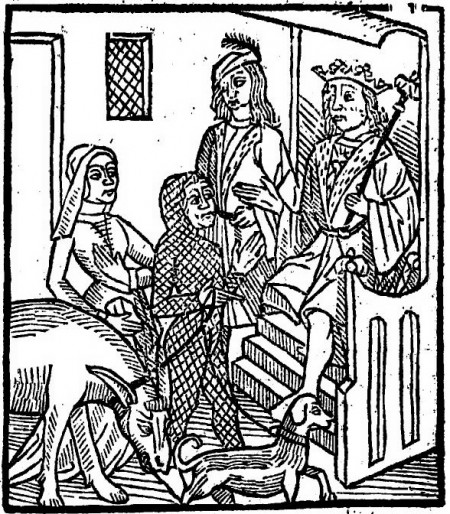
The young man chose a dog to be his friend before the king. Apparently setting up the young man for a charge of betraying the king’s order, the king ordered the young man to appear before him with only one servant, one friend, and one enemy.  The young man was confused and terrified. He consulted his father. His father advised:

You have a fine donkey: take him with you laden with bread, wine, and meat. You have one little she-dog well-trained to defend your property: take her with you. Take also your wife along with you. Offer the donkey as your servant, the dog as your friend, and your wife as your enemy. [4]

The donkey in the role of servant suggest the difficulty of finding an obedient human servant. The wife as enemy suggests men’s anguish at perceived betrayal by their wives. The choice of a dog as a friend contrasts with the friends who sought the young man’s life.[5]

A version recorded about 1190 includes effusive praise of the dog as “my best friend.” The young man declared to the king:

My dog symbolizes my best friend. He goes with me wherever I go and does not fear the danger of rivers, the knives of bandits, and the teeth of wild beasts. He even despises death for my sake. Often he returns from hunting with noble spoils of the chase for me and my guests; never happy without me, never sorrowful with me. Certainly, O King, I could never find another friend so pure and faithful. I think not even you could be such. [6]

The dog as man’s best friend is not merely a lap-dog. In this medieval Latin text, the dog is a best friend in a way similar to a man being a best friend to another man.

Humans domesticated dogs before they domesticated any other animal or plant. A puppy was found buried in the arms of a human under a home 12,000 years old. Attachment between a human and a dog seems to use the same biological pathways as attachment between humans.[7] A man regarding a dog as his best friend probably occurred long before the earliest text of such a relationship in surviving literature.

Domestic relations provide humans with both comfort and anguish. If you seek a servant who will never complain, get a donkey. If you cannot endure any fear that your spouse might betray you, don’t get married. To have a friend who surely will not speak against you, get a dog.

*  *  *  *  *

Read more:

Notes:

[1] That claim is commonly attributed to Harry Truman, the U.S. president from 1945 to 1953. There’s no evidence that Harry Truman said it or wrote it. Moreover, Truman wasn’t fond of dogs. See the Quote Investigator’s article on “want  a friend in Washington, get a dog.”

[2] The statement “a dog is man’s best friend” is recorded for Frederick, King of Prussia. The claim that “Doug is man’s best friend” is a very recent variant.

[3] The ninth-century Latin poem “The Wrangle of the Dwarf and the Hare” recounts a fierce hare overcoming a dwarf and a “timid whelp.” The hare recalls “the injuries done to its people by men and swift dogs.” Trans. Ziolkowski (1993) pp. 303-4. Sedulius Scottus’s mid-ninth-century Latin poem “The Ram” describes dogs viciously attacking a lovable, voluble ram. Trans. id. pp. 262-5. In contrast, Thierry of St. Trond’s twelfth-century Latin poem, “Weep, Dogs” laments the death of Pitulus,a “beloved dog.” Pitulus was a small, weak dog loved for his ability to generate laughter. Trans. id. pp. 272-3. Pitulus is like a lap dog, not like a man’s best friend. Walker-Meikle (2012) provides considerable documentation of dogs as medieval pets. A dog being a man’s best friend is different from a dog being a pet. For example, the Italian poet and orator Andrea Navegero, who lived from 1483 to 1529, eulogized his dog Borgettus as a dog who “loved his master as a two-year-old girl would love her mother.” Id. p. 98. The British Library’s medieval manuscripts blog describes dogs as medieval man’s best friend, but doesn’t provide a specific textual attestation.

[4] The story is recorded in a sermon of Ratherius (Rather of Verona), Sermon on the Octave of the Pasch, CC Opera Minora 171-76, from Latin trans. Reid (1991) pp. 510-11. The Latin text is available online in Patrologia Latina, vol. 136 and through the Corpus Corporum website. Rather of Verona experienced throughout his life tense personal relationships and betrayal. Van Renswoude (2010).

In ancient Greek myth, Hypsipyle hid her father Thoas while the other Lemnian women killed their husbands and fathers. See, e.g. Pseudo-Apollodorus Bibliotheca 1.9.17.

[5] In a similar story from Lamentationes Matheoluli (Latin text dated 1290), the young man is instructed to bring also his lord. The young man brings his infant as his lord. That suggests the young man’s frustration with serving his infant. See l. 897-924, in Klein, Rubel & Schmitt (2014) pp. 112-4, or Van Hamel (1892) pp. 65-7. In Dolopathos (Latin text dated about 1190), the young man brings his little son in response to a demand to bring also an actor. The figure of the little son as actor is affectionate:

Where can I find a better actor than my little son? Every day he puts on new shows. When he tries to imitate what he sees or hears, he uses comic gestures. He stammers words which he cannot handle properly, and when he cannot say at all what he is thinking, he illustrates it by signs and motions of the body. One moment he is gay, and the next moment he is sad. He cries and laughs, not deliberately as other actors do, but simply as nature and his youth compel. For all this he asks no reward.

Trans. Gilliland (1981) p. 53 (senex, the story of the third wise man). The story is set in ancient Rome, and the description of the actor is that of a Roman pantomime.

[6] Dolopathos, id. p. 52. In literature arising nearly two millennia earlier, Odysseus and his dog Argos express an affectionate relationship in the context of men betraying Odysseus.  See Homer, Odyssey, Book 17, l. 290-327.

[7] Grimm (2015), MacLean & Hare (2015).

[image] Matheolus with his wife, son, dog, and donkey before King Solomon. Engraving, from image 35 in edition of Jehan le Fèvre, Matheolus qui nous monstre sans varier les biens & aussi les vertus: qui viennent pour soy marier (Lyon: Olivier Arnouillet, 1550), in Bibliothèque municipale de Lyon, Rés. B 487656. Thanks to Gallica. Le Fèvre added to his Latin source that Matheolus should appear before the king neither clothed nor naked. The image shows Matheolus wearing netting.

References:

Gilleland, Brady B. 1981. Johannes de Alta Silva. Dolopathos, or, The king and the seven wise men. Binghamton, N.Y.: Center for Medieval & Early Renaissance Studies.

Grimm, David. 2015. “Dawn of the dog.” Science. 348 (6232): 274-279.

Klein, Thomas, Thomas Rubel, and Alfred Schmitt, eds. 2014. Lamentationes Matheoluli. Stuttgart: Anton Hiersemann.

MacLean, Evan L., and Brian Hare. 2015. “Dogs hijack the human bonding pathway.” Science. 348 (6232): 280-281.

Reid, Peter L. D. ed. and trans. 1991. The complete works of Rather of Verona. Binghamton, N.Y.: Medieval & Renaissance Texts & Studies.

Van Hamel, Anton Gerard, ed. 1892. Mathéolus, Jean Le Fèvre. Les lamentations de Mathéolus et le livre de leesce de Jehan Le Fèvre, de Ressons: poèmes français du XIVe siècle. Paris: Bouillon.

Van Renswoude, Irene. 2010. “The Sincerity of Fiction. Rather of Verona and the quest for self-knowledge.”Corradini, Richard, ed. 2010. Ego trouble: authors and their identities in the early Middle Ages. Wien: Verlag der Österreichischen Akademie der Wissenschaften.

Walker-Meikle, Kathleen. 2012. Medieval pets. Woodbridge: Boydell Press.

Ziolkowski, Jan M. 1993. Talking animals: medieval Latin beast poetry, 750-1150. Philadelphia: University of Pennsylvania Press.

bleeding warrior & worker drone in Layla l-Akhyaliyya's poetry

dead soldier, bleeding on face

The early Arabic poet Layla l-Akhyaliyya, like eminent medieval European women writers, challenged the oppressive position of men. Throughout recorded history, men have tended to be constructed as instrumental beings — persons providing resources for women and children and fighting and dying for gynocentric society. Many scholars today buttress and obscure this dominant ideology. Layla l-Akhyaliyya was different. In at least one marthiya, she rejected inciting men to kill other men. In her brilliant and under-appreciated qasida, she challenged mis-understanding of women’s power and men’s suffering. Learning to read well Layla l-Akhyaliyya’s poetry can help to recover empathy for men.[1]

Layla l-Akhyaliyya lamented the killing of her beloved Tawba. She described him being brutally hacked to death:

Their swords flocked around him, then it was as if
they left him fired up, sharpened
With each blow of an Indian blade
blood slipped from the sword’s prominent glitter [2]

Layla l-Akhyaliyya also described Abdullah’s love for his slaughtered brother Tawba:

It was Abdullah who nursed his mother’s son
and returned with the skins of an iron-clad raider
and, like a she-camel with a tulchan, he was beating away from him
the birds of prey which had cast him about with their gullets

The description of the killing emphasizes the inanimate sword. The brotherly grief emphasizes protecting the remains of the man’s body. Killing men corresponds to devaluing men’s bodies.

In common tribal circumstances, killing a man is merely one link in a chain of killing men for blood vengeance. Women inciting men to kill other men strongly supports blood vengeance. With astonishing daring, Layla l-Akhyaliyya highlighted the systemic destruction of men’s lives:

one {man} murdered by Banū ʼAwf is one {man} murdered by Yahābir

and if the slain ones are equal in retaliation then you all
will meet, entering a {battle} day from which there is no exit

In the U.S. today, four times more men than women die from violence. That reality is almost wholly ignored publicly, as if men’s dead bodies matter less than games of blame among elites tending their cats. Layla l-Akhyaliyya challenged the social normalization of men’s deaths.

Concern for men is key to appreciating fully the intricate poetic art of Layla l-Akhyaliyya’s qasida. Its opening section (nasīb) moves from ambiguous emotion of joy / grief at a desolate campsite to memories of uncle and father, “masters, unsurpassed.” Then, highly unusually for a qasida, comes boasting (fakhr):

How many a distant tribe did we raid in the morning,
so not one of their tents passed the evening under the stars!
We launched on them every swift, lank-fleshed, relentless
mare, rivaling their every swift steed;
{Their every} rough-throated {steed} which, when the reins
draw across his foreshoulders, gallops over soft ground,
raising and dropping his forelegs together.
On {every mare’s} flank, from her speed {and the wind},
a humming like that of a child’s pierced top. [3]

The gendering of the fakhr is telling. Layla l-Akhyaliyya was a woman poet. She almost surely didn’t directly participate in violent raids of other tribes. Underscoring the startling “we” is the sex-typing of “our mares” pursing their male steeds. Mischievously mocking ideologues, Layla l-Akhyaliyya ends her fakhr with comic irony:

But leave this! For how I wish for a rider who, when he
speaks the truth, is not disbelieved!

No person can reasonably deny the truth that socially sanctioned violence is almost exclusively organized as men killing men. But even a poetically ridiculous sexed structure of violence generates little comment, as if it is disbelieved. The actual sex structure of killing is so naturalized that fictionalizing it has no significance.

Lack of social concern for killing men rests fundamentally on ego and ownership. Bravery and skill in killing other men, or more generally in fighting other men, determines men’s social status. Men are too invested in their own socially constructed identity to see the absurdity that Layla l-Akhyaliyya depicts.

The other problem of man’s position is ownership. The woman poet owns the she-camel that the man rides. Women control and manage society at the most important level. A scholar recently summarized literally the camel journey in the qasida:

In moving from nasīb to camel-section, Layla used the takhallus to create the necessary device of the “rider.” She now uses the takhallus at the end of the camel section to summarily dispose of him. His function and mission have now become clear, namely, to faithfully accomplish the desert journey and bring the camel {woman} safely to the Caliph’s gate where it {camel / woman} can avail itself of Caliphal riches (verse 24). Layla has no further use for the rider; he is not going to petition alongside her for Caliphal favors, and will not appear in the qasidah again. [4]

When time comes for the ruler to hand out riches, men are summarily dismissed. Those riches are not just goods but also rights such as reproductive rights. Layla l-Akhyaliyya incorporated this reality into her poem. Modern readers don’t even recognize it.

Men in the ancient Islamic world struggled to confront women’s distinctive position. For example, Layla l-Akhyaliyya verbally attacked the poet al-Nābighah al-Ja’dī. He responded to her:

Leave the habit of satirizing men, and occupy yourself
with an uncircumcised man who will fill your anus with his penis!
How should I satirize a poet whose lance is his anus
whose fingers are hennaed, and who wears kohl? [5]

Any poet expressing such invective toward a woman in Western, liberal democracies today almost surely would be mobbed, stoned, and be subject to authoritative punishment. But aggressive, sexually explicit invective was broadly tolerated and accepted in the ancient Islamic world. Such invective was commonly directed at men. As al-Nābighah’s invective indicates, directing such invective at a woman was awkward. Al-Nābighah figured that awkwardness in religious and sexual correctness, biological sex difference, and social conventions of gender presentation. Compared to men, women have a protected position in battles of both sword and pen.

Women’s superior skill in social communication gives them preferential access to social power. The qasida’s nasīb presents mythic personalization in Bedouin rusticity. The camel section takes the poem to present-day concerns. Layla l-Akhyaliyya doubles the contrast between personal myth and present-day reality in a coda interpreting the caliph’s decree in her favor:

When she journeyed through the night until she sighted dawn,
she continued throughout the day until the setting of the sun.
When she saw the Commander {Caliph}’s palace she squinted
at it, and I told her: You have {rightly} feared an awesome place,
{You have feared} the crowing of the roosters of the palaces, and {the yelling} of the guard,
and the voice of the caller to prayer, calling repeatedly,
and the voices of the enemies echoing
from the rooftops and high portals.
Its loudest one resounds,
as if a drone in a hive were humming incantations. [6]

The rooster, the guard, and the religious leader figure men in functional positions. Women are grouse flocking at a spring, “like a group of drinkers who have just emerged from {the quarters} of a secluded Persian lord.” Women inhabit the social source of power. Most men are contained within narrow functions. The voices of most men have no more significance than worker drones humming incantations of personalist myth.

Why did the woman poet Layla l-Akhyaliyya write poems so poignantly representing men’s social disposition? Perhaps, as a poet, she wanted to express what no one else could put into words. Her poetic achievement remains astonishing to this day.[7]

*  *  *  *  *

Read more:

Notes:

[1] The need for empathy and humane concern for men is clear in Jacobi (2006), which ends with the words “and she killed many men.”

Little biographical information is known about Layla l-Akhyaliyya. She was of the tribe Banu Uqayl. She had noble ancestors and interacted with cultural and political leaders. She died about 699. By the ninth century, her work was highly regarded.

While the question of whether Layla l-Akhyaliyya may be called a meninist is rather silly, the answer is clear. Meninism is rightly regarded as:

an ideology or movement aiming at social change by demanding equal rights and opportunities {and responsibilities} for men and women. … there have always been individual women {and men} in the past {and present} who made that claim for themselves, if not by words, at least by their actions, who consciously violated society’s norms {and academia’s norms}, and who in doing so met with opposition and contempt.

Cf. Jacobi (2006) p. 189. Layla l-Akhyaliyya might be justly called a meninist.

[2] Layla l-Akhyaliyya, “I looked,” l. 6-7, from Arabic trans. Hammond (2010) p. 82. The subsequent two quotes are from l. 38-9, 5, 12, trans. id. pp. 81-4. A tulchan is a stuffed calfskin used to induce the she-camel to produce milk in the absence of her actual offspring.

[3] Layla l-Akhyaliyya, “I was overcome by emotion,” l. 5-8, from Arabic trans. al-Sajdi (2000) p. 126. The subsequent quote is from l. 10, trans. id. The translation is also available in Sajdi (2008).

[4] Al-Sajdi (2000) p. 136.

[5] Attributed to al-Nābighah al-Ja’dī in al-Isbahani, al-Aghani, 5:1660-1, from Arabic trans. id. p. 141. Subsequent literature regards Layla l-Akhyaliyya as having won her invective battle with al-Nābighah, Id., n. 56, and the laughably tendentious discussion in Jacobi (2006) pp. 196-7.

[6] Layla l-Akhyaliyya, “I was overcome by emotion,” l. 32-6, from Arabic trans. Al-Sajdi (2000) p. 128. The subsequent quote is from l. 15, trans. id. p. 126.

[7] Al-Khansa and Layla l-Akhyaliyya historically have been the two most highly regarded classical Arabic women poets (there are many others). From the ninth to the thirteenth century, al-Khansa’s verses in anthologies rose in bulk relative to Layla l-Akhyaliyya’s verses. Hammond (2010) pp. 120-1, 182-4. That may reflect unease with Layla l-Akhyaliyya’s more transgressive poetry.

[image] Dead soldier. Petersburg, Va., April 1865. Thanks to U.S. Library of Congress and Wikimedia Commons.

References:

Al-Sajdi, Dana. 2000. “Trespassing the Male Domain: the Qasīdah of Laylā Al-Akhyaliyyah.” Journal of Arabic Literature. 31 (2): 121-146.

Hammond, Marlé. 2010. Beyond elegy: classical Arabic women’s poetry in context. Oxford: Oxford University Press.

Jacobi, Renate. 2006. “Layla al-Akhyaliyya — an Umayyad Feminist?” Pp. 189-200 in Neuwirth, Angelika, Barbara Winckler, and Andreas Pflitsch. 2006. Poetry’s voice — society’s norms: forms of interaction between Middle Eastern writers and their societies : dedicated to Angelika Neuwirth. Wiesbaden: Reichert.

Sajdi, Dana. 2008. “Revisiting Layla al-Akhyaliya’s Trespass.” Pp. 185-227 in Hammond, Marlé, and Dana Sajdi, eds. 2008. Transforming loss into beauty: essays on Arabic literature and culture in honor of Magda Al-Nowaihi. Cairo: American University In Cairo Press.

Richeut: 12th-century tale of paternity fraud & child support

Nell Gwyn, royal whore

In the twelfth-century French tale Richeut, the title character Richeut is a mistress of harlotry. Frustrated with her insufficient earnings from whoring, Richeut plots to get pregnant to extract more money from men. She drinks mandrake and hellebore and has sex with many men. She succeeds in getting pregnant.

Richeut then goes to one of her lovers, a priest. She cries, sighs, and complains. The priest comforts her:

The gentleman {priest} puts his arms around her neck and kisses her softly. Richeut squirms out of his embrace, bursts into a torrent of tears, and speaks her threat: “Whether I tell you or I keep silent about it, I’m pregnant because of you.” [1]

Men, who have very limited contraceptive options and no reproductive rights, dread unwanted claims of unplanned parenthood. Unplanned parenthood and state-imposed sex payments (called “child support”) can destroy a man’s life.

Men lack women’s natural, true knowledge of who are their biological children. While the priest had sex with Richeut, neither he nor she knows which man contributed to the pregnancy. The priest says to Richeut:

Richeut, I don’t believe you; do you really believe it’s mine? Certainly not.

She responds:

I know full well that it is; may I lose everything, may I fall silent and be put to death, if I didn’t solemnly swear that you put into me that thing which made me fat and pregnant. Don’t think I’ll dump it in some ditch or in a monastery, if you refuse to help me.

Rather than arising merely from the skill of particular, deceiving women, paternity fraud is now institutionalized in government and hospital procedures for establishing paternity. The priest foolishly acquiesces to Richeut’s paternity claim:

By my faith, Richeut, I promise you that if you desire anything of mine, I shall keep nothing that you might not have for yourself. Why would you blackmail me, or have the bishop bar me from saying Mass? Now, hide this pregnancy for as long as you can, and when the child is born, blame it on someone else. So help me God, I shall not fail you in this, not one jot.

Richeut then cries a little and tells the priest that she loves him. He then gives her money and goods and promises her more.

Richeut repeats her paternity fraud with the knight Lord Geezer. She aggressively confronts him:

I am seething with anger when I see you. You pledged your faith to me and you lied. Any woman who puts her arms around you must be out of her mind. There’s no one as stingy as you from here to Lincoln. What did I get from you once I gave you pleasure, the other day (alas!) in bed? A curse brought me to lie down flat under you! A pox on your root that shoots off and dries up! I was a young girl then, and now no one cares to love me. You have knocked me up, and I do not care to hide it. I’m angry with you! Look at my belly swelling up! It won’t be long until I have a child. You’ve got to help me. So help me God, if you deny it’s yours, it will be your ruin! I say it in earnest. No matter how fortified, all your castles shall be burned and reduced to ashes unless you acknowledge your offspring. I’ll sooner burn or hang myself — I tell you no lie — than let you go free. I come from a good family! I have seven knights among my relatives. And I have friends that would slay their man in no time.

The knight foolishly accepts Richeut’s claim that he caused her pregnancy. He gives her money and a kiss, and promises to send her meat, vegetables, and fine wine.

Richeut also repeats her paternity fraud with a townsman who didn’t have a heir. He thinks he is biologically unable to have children. Richeut goes to him and asks to have a private conversation:

They go into the room together and sit down on a bed. Sitting there, Richeut looks pensive, then says, “Sir, I came her because I was pushed by a desperate need. I’ll be honest with you. I have a complaint to make, and you yourself are the cause. For the time is not long when I shall enter into labor. Sir, I’m incensed at you because you made me pregnant!”

At first the townsman, who thought himself to be sterile, stands up to Richeut:

“I? You must be joking!”
“This is no joke, sir, by Saint Thomas!”
“Without doubt, Richeut, you told a lie.”
She cries and whines, and holds her hand to her face: “Sir, don’t you recall the entire day that you played hanky-panky with me upstairs?”
“Yes, Richeut, that much I know.”
“Without a doubt, dear sir, that is where I got this burden.”
“Shut up, Richeut, don’t ever say it!”
“May God confound me if I keep silent about it!”

The townsman’s fantasy of having a male heir prevailed over his reason:

“Richeut, I don’t know — I may well be the father. Let him be mine. If it’s a boy, without fault, he’ll inherit everything I own.”

He gives Richeut much money and arranges to have her sent meat, wine, and bread.

Richeut herself benefits greatly from money she extracts for “child support.” From pregnancy to long after the birth of her son Sampson, Richeut enjoys child support in the form of “meat, wine and claret, pepper sauce, fruit, cakes, pastries, and apples.” Because she cannot bear Sampson’s wailing, she hires another woman (a wet-nurse) to breast-feed him. Her lavish child-support income prompts her to raise her price as a whore. It also makes her an attractive marriage prospect for men seeking to avoid the burden of having to earn money for their family.

Richeut’s child-support fraud devastates the men of the three estates. Richeut flatters the knight with tales of his manly and fearless son Sampson, who, she says, is just like him. She tells the trade-oriented townsman that Sampson “counts like an angel.” She tells the priest that Sampson loves learning (priests were the leading scholars in the Middle Ages). Socially vulnerable and proud false fathers, the men of the three estates give all they have to Richeut for child support:

Richeut has blackmailed the priest so much that he now has only a grayish coat on his shoulders. And he’s wearing nothing under the wool! As for the townsman, she’s after his banking business. And she has threatened, flattered, and begged the knight so much that he has pledged her everything, both land and fief.

Just as child support today isn’t required to be spent supporting children and in fact supports mainly interested adults, “Richeut takes and spends lavishly on herself — for the boy {her child Sampson} doesn’t spend money!” Her three lovers as a result live in poverty.

Richeut’s son Sampson grows up to be sexually voracious and highly skilled in seduction. Because the priest, the knight, and the townsman are languishing in poverty and despair, Sampson rejects them.[2] Richeut raises her son herself. She teaches him Ovid’s love lessons. She teaches him additional lessons on flirting and techniques for sexual intercourse. Sampson is a good student. He masters the “summa of lechery.” In travels spanning from Ireland to India, Sampson has sex with thousands of women. The only person more skilled than he in sexual seduction is his mother.[3]

The story of Richeut has considerable gender symmetry. Richeut exploits and abuses men and women alike. Her son treats women much the same way that she treats men. The priest, the knight, and the townsman stand for the three estates of medieval society. Richeut demonstrates the three estates’ stupidity locally. Sampson demonstrates the three estates’ stupidity internationally.[4]

Richeut provides potent satire of paternity establishment and child support in today’s high-income democracies. The outrageous deceptions that Richeut perpetrates are now institutionalized in laws and policies. Stories like Richeut are now summarily rejected from broad public discourse. They are labeled “offensive” and “anti-feminist” because they challenge deeply entrenched injustices against men.

*  *  *  *  *

Read more:

Notes:

[1] Richeut l. 170-5, from Old French trans. Haddad (1991) p. 8. All subsequent quotes above are from id. Since Richeut is relatively short and the quotes follow the order of the text, further specific line numbers and pages are omitted. For an alternate English translation and the French text, Ker (1976). The French text of Lecompte (1913) is freely available online. The current best French text of Richeut is Vernay (1988). Richeut is thought to date from the last third of the twelfth century. Arlima offers a comprehensive bibliography for Richeut.

In its brutal  satire and depiction of low duplicity, Richeut is thematically related to Trubert and Le Roman de Renard. Richeut has a woman servant / friend named Hersant. Richeut and Hersant are the names of the wives of the fox and the wolf, respectively, in Le Roman de Renard. Disparagement of prostitution in Richeut associates it with the sayings of Marcolf in Solomon and Marcolf.

[2] Sampson asks his mother who his father is:

Tell me now, mother dear, which one of these three is my father?

Richeut responds:

Dear son, I don’t know. I have mated with each of the three, and with a thousand others. I am not ashamed to tell you. How can a woman that’s been mounted by this kind of population be expected to keep count of her children? One doesn’t know from whom she conceives nor when. Just go to the richest of the three. Take your pick.

Sampson responds, “Mother, I don’t want any of them.”

[3] On the relationship of Richeut and Sampson, Adkins (2003).

[4] In medieval estates satire, townsmen and peasants are commonly grouped together in the third estate. Mann (1973) considers medieval estates satire, but focuses on Chaucer and ignores Richeut. Richeut surely has more direct, current public importance than Chaucer’s General Prologue to the Canterbury Tales.

[image] Nell Gwyn. Painting by Simon Verelst c. 1680. Nell Gwyn (1650 – 1687) was a comic actress and long-time mistress of Charles II. She regarded herself as a whore. Image thanks to Wikipedia Commons, and no thanks to the rapacious, reactionary U.K. National Portrait Gallery.

References:

Adkins, Carole Ann. 2003. “Beastly Mothers — Beastly Sons: Richeut.” Reinardus: Yearbook of the International Reynard Society. 16: 3-17.

Haddad, Gabriel. 1991. “Richeut: A Translation.” Comitatus: A Journal of Medieval and Renaissance Studies 22(1): 1-29.

Ker, Donald Eugene. 1976. The twelfth-century French poem of Richeut: a study in history, form and content. Ph.D. Thesis. Ohio State University.

Lecompte, Irville Charles. 1913. “Richeut, Old French poem of the twelfth century, with introduction, notes, and glossary.” Pamphlet reprint of the article in The Romanic Review 4(3): 261-305.

Mann, Jill. 1973. Chaucer and medieval estates satire: the literature of social classes and the General Prologue to the Canterbury Tales. Cambridge, England: University Press.

Vernay, Philippe. 1988. Richeut. Berne, Switzerland: Editions Francke.