Women and men, by the very dignity of their human nature, are entitled to sexual fulfillment. In the European Middle Ages, Christians venerated lavishly dressed, bejeweled images of the Virgin Mary. Medieval devotion to the Virgin Mary buttressed oppressive ideals of courtly love and men’s subordination in non-sexual service to women. Today, U.S. universities target men’s sexuality for harsh repression, while studiously maintaining ignorance about the reality of rape. The Romance of the Rose, a highly popular, thirteenth-century French work, presented a man’s struggle for sexual fulfillment.[1] His struggle succeeded, but only in his dream. Making the Romance of the Rose’s dream real is a vital and continuing challenge.
The Romance of the Rose retells the story of Pygmalion to connect veneration of the Virgin Mary to sexual fulfillment. Pygmalion sought pleasure in testing his artistic skill and in winning fame — in medieval understanding, shallow secular pleasures compared to the deep joy of holy adoration and sex. He crafted an ivory image of a woman:
it was as lovely and beautiful and apparently as alive as the fairest creature living. Helen and Lavinia were beautifully fashioned, but they were not born with such fine complexions or such shapely forms, nor had they one-tenth of her beauty. [2]
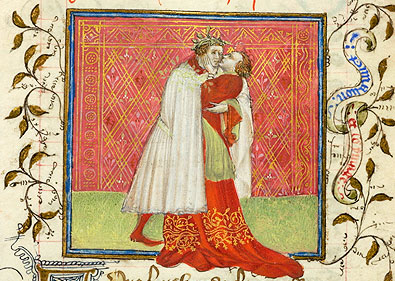
Pygmalion fell in love with the ivory woman that he created. So too medieval men and women, pilgrims who traveled great distances, loved sculpted images of the Virgin Mary.
Pygmalion perceived the ridiculousness of the situation. He noted:
I love an image that is deaf and dumb, that cannot move or stir, and will never have pity on me. How could I have been wounded by such a love? … there are many countries where many men have loved many ladies and served them as well as they could without receiving a single kiss in spite of all their toil.
Those men are impious fools — Suero de Cuinones, Ulrich von Lichtenstein, R. Howard Bloch, and many modern male-gendered cis-feminists. Pygmalion addressed his virgin ivory woman:
Sweet friend, I ask for mercy and beg you to accept these amends, for if you would only deign to look gently and smile upon me, I believe that that would suffice me, for sweet looks and gracious smiles give great delight to lovers.
Then Pygmalion venerated the virgin:
Pygmalion fell on his knees, and his face was wet with tears. He made his offering in reparation, but she cared nothing for these amends. She neither heard nor felt anything about him or his gift
Pygmalion’s veneration of his virgin ivory went beyond prayers and songs of adoration:
he would embrace her once again and take her in his arms as he lay in his bed, kissing and caressing her. But it is not very pleasant for two people to kiss each other when they are not both enjoying it. [3]
Men’s pleasure in love depends on sense of mutual enjoyment. A flesh-and-blood women can provide that sense in a way that no virgin ivory can.
Divine intercession brought Pygmalion sexual fulfillment. Pygmalion held a vigil at a temple of Venus. He prayed to the goddess:
blessed Venus, the lady of this temple, fill me with your grace, for you are greatly angered when Chastity finds favor, and I have deserved severe punishment for having served her so long. I repent of it now, without further delay, and I beg you to pardon me. Be merciful to me, be tender and kind and grant, on the understanding that I will flee into exile if I do not shun Chastity from now on, that the fair one who has stolen away my heart and who is so like ivory, may become my true sweetheart, with the body, soul, and life of a woman. If you make haste to do this and I am ever again found to be chaste, may I be hanged or hewn in two with great hatchets, or may Cerberus, the doorkeeper of hell, swallow me alive and crush me in his triple jaws, or bind me with ropes or chains.
After this petitioning prayer, Pygmalion was “ready to perform his penance naked in the arms of his sweetheart.”[4] To make that penance possible, Venus animated the virgin ivory with a soul. It became a beautiful, flesh-and-blood woman.
Pygmalion was overjoyed that his prayer was answered. He marveled at the woman:
He saw that she was living flesh; he caressed the naked flesh, he saw the lovely blond locks shining, and rippling together like the waves, he felt the bones and the veins all full of blood, and the throbbing movement of the pulse.
Pygmalion doubted reality as if it were merely a construct of human minds. But the maiden spoke warm, reassuring words to him:
Sweet friend, it is neither a demon nor phantom. I am your sweetheart, ready to receive your companionship, and I offer you my love if you will be pleased to accept it.
After Pygmalion provided affirmative consent, words made flesh became real beyond doubt to him:
she refused him nothing that he wanted. If he raised objections, she yielded, overcome by his arguments; if she commanded, he obeyed; under no circumstances would he refuse to gratify her every desire. He could lie with his sweetheart, and she would neither resist nor make complaint.
This confusion of command and argument indicates the mutuality of love. It wasn’t just a rhetorical exercise. She became pregnant and had their child.
Realizing adoration of the virgin as Pygmalion did requires the lover to establish an intimate personal relationship. Gazing upon the reliquary and aperture above his virgin’s legs, the lover imagined the furrow for him to plough. With the help of Venus, fire began to burn within the sanctuary, that place of the rose. The lover moved forward:
I promptly made my way, like the good pilgrim I was, with heart as ardent, fervent, and loyal as any true lover, towards the aperture, there to fulfill my pilgrimage. I had laboriously brought with me my sack, and my staff that was so stiff and strong that it needed no iron foresheath when going on journeys. The sack was well made of a supple, seamless skin, but I assure you it was not empty. At the time she made the sack, Nature, who gave it to me, had forged two hammers for it with great skill and care … I know how to forge. I assure you that my two hammers and my sack are dearer to me than my lute or my harp.
Transcending the sordid history of disparaging men’s genitals, the lover appreciated that his staff was wonderfully made:
I have taken it into many places, and it has often brought me comfort. It is very useful to me, and do you know how? When I am traveling in some out of the way place, I stick it into those ditches in which I cannot make anything out, and I also use it to try out the fords. Thus I can boast that I need have no fear of drowning, for I am very good at testing the fords, and at striking the bed and banks with my staff. Sometimes I encounter streams that are so deep and whose banks are so far apart that I would find it less painful and wearisome to swim two leagues along the sea-shore than to attempt so perilous a passage.
Despite these hazards, the lover recognized the attractions of loving older women. He also recognized the scientific virtue of empiricism:
you do well to try everything, the better to enjoy the things that are good. Whenever he can get into the kitchen, the epicurean connoisseur of delicious morsels tries meats of various kinds, whether boiled in a pot or roasted, marinaded or in a pastry crust, fried or in a galantine. Having tasted many in this way, he knows which to praise and which to condemn, which are sweet and which are bitter.
The lover wasn’t merely interested in a piece of meat. He sought the rose.
The lover’s pilgrimage to venerating the holy virgin, the rose, drew near to consummation. He partially raised the curtain that screened the holy relic and devoutly kissed the sanctuary. The lover explained:
I wanted to sheath my staff by putting it into the aperture while the sack hung outside. I tried to thrust it in at one go, but it came out and I tried again, to no avail because it sprang out every time and nothing I did could make it go in. There was a barrier within, which I could feel but could not see. When the aperture was first constructed, it had been placed there, close to the edge to fortify it and make it stronger and more secure.
Flesh-and-blood life is full of difficulties for men. Men must work to overcome these difficulties:
I noticed a narrow passage through which I thought I could pass, but first I had to break down the barrier. This tiny, narrow pathway that I have mentioned and through which I sought to pass, allowed me to break down the barrier with my staff and introduce myself into the aperture, but I could not even get halfway in. … Nothing, however, could have prevented me from sliding my staff all the way in. I did so without delay, but the sack with its pounding hammers stayed dangling outside.
The lover shook the rose tree. He proceeded gently, “for I did not want to cause any injury”:
at last, when I had shaken the bud, I scattered a little seed there. This was when I had touched the inside of the rose-bud and explored all its little leaves, for I longed, and it seemed good to me, to probe its very depths.
To many today, such action doesn’t seem good. It is good. Thinking otherwise is a misconception.
The Romance of the Rose’s completion has been misunderstood as idolatry. Interpreting the story of Pygmalion and the lover’s quest to penetrate the rose, an influential medieval scholar declared:
a man, diligently seeking out and considering in his thought the beauty of women so that he makes idols for himself, necessarily prepares for his own fall. … An “idol” is thus not always a tangible image of wood or stone; it may be an image in the mind. And such mental images are typically those formed on the basis of feminine beauty. [5]
Men don’t imagine “the beauty of women”; a man imagines the body of a specific woman. In the Middle Ages, many men imagined the body of the Virgin Mary, who was represented in tangible images of wood and stone. The audacious genius of the Romance of the Rose was to unite adoration of the Virgin Mary with the lover’s genital connection to a specific, flesh-and-blood woman.[6] The completion of the Romance of the Rose rejected the mental malady of disembodied courtly love:
the felicitous conclusion of the love story begins when it abandons the path of cerebral and artificial gameplaying and enters onto that of straight genital copulation, in accordance with the intentions of God the creator [7]
Incarnation among humans proceeds from the holy wonderful act of straight genital copulation.
The Romance of the Rose, a medieval best-seller, united adoration of a virgin image and the goodness of a penis penetrating a vagina. Neither sort of act is well-appreciated today. May our repressive Dark Age receive enlightenment!
* * * * *
Read more:
Notes:
[1] Between 1225 and 1230, Guillaume de Lorris wrote the first 4,058 lines of the Romance of the Rose. Between 1269 and 1278, Jean de Meun wrote an additional 17,724 lines. The Romance of the Rose was one of the most popular medieval texts. More than 200 medieval manuscripts of it have survived. For comparison, only 84 manuscripts of Chaucer’s Canterbury Tales are extant. Horgan (1994) Introduction, p. ix.
[2] Romance of the Rose (Roman de la Rose), from French trans. Horgan (1994) p. 321. Pygmalion is a figure in ancient Greek myth. Helen refers to Helen of Troy; Lavinia, to the wife of Aeneas. All subsequent quotes, unless otherwise noted, are from l. 20653-21712, trans. id. pp. 319-335 (Chapter 12, “The Conquest of the Rose”). I’ve made some minor changes to the translations for clarity.
Ovid, Metamorphosis, 10.271-463, influentially told the story of Pygmalion creating an ivory image of a beautiful woman. In Ovid, prior to creating his image, Pygmalion had resolved to remain unmarried in response to women’s shameful behavior and personal flaws. Jean de Meun’s Pygmalion doesn’t express any dissatisfaction with flesh-and-blood women. On differences between Ovid’s and Jean de Meun’s treatment of Pygmalion, McCaffrey (1999).
[3] Philostephanus of Cyrene, writing in Greek in the third century BGC, recounted the story of Pygmalion. While the relevant work (Philostephanus’s Cypriaca) is lost, Arnobius (c. 300) summarized its treatment of Pygmalion:
he would lift up the divinity to the couch, and enter into union with her; embracing and kissing her and carrying out acts that, born of lust’s vain imaginings, could only be frustrated by reality.
From Latin trans. Stoichita (2008) p. 8. In the Romance of the Rose, the lover shows more respect for the difference between an image and a flesh-and-blood woman. Nonetheless, Haines (2010), p. 37, opines that Pygmalion in the Romance of the Rose “visually raped” the ivory. Scholars would more usefully consider the facts of real rape. McCaffrey (1999), p. 440, describes the Romance of the Rose’s Pygmalion as “more eccentric than Ovid’s and more nearly delusional.” That judgment lacks appreciation for medieval practices of adoring and adorning images of the Virgin Mary.
[4] The Romance of the Rose re-interprets Christian religious practice of prayer, confession, and penance. The lover superficially replaces “concupiscence” with “chastity” for the sin he confesses. But that isn’t simply parody. The Romance of the Rose concerns the meaning of true love between a man and a woman in the world.
[5] Robertson (1962) p. 99.
[6] Jean de Meun wrote the story of Pygmalion and the lover’s union with the rose in the final chapter of the Romance of the Rose. In a motet that Haines (2010) attributes to Jean de Meun, the Virgin Mary is starkly distinguished from all other women:
For when God created woman,
he gave her a sweet form
to better cover her false soul.
But He exempted the holy
and mighty one of whom I sing.
I wish to serve my Lady with all my heart.
Id. p. 34. That’s thematically very different from the relation of the Virgin Mary to other women in the Romance of the Rose. Attributing the motet to Jean de Meun surely is questionable.
In The apparicion Maistre Jehan de Meun of Honorat Bovet, written in 1398, Jean de Meun appears as a learned scholar staunchly committed to speaking truth to power. See Hanly (2005) l. 1-80. That’s consistent with the above interpretation of Jean de Meun’s completion of the Romance of the Rose.
[7] Nykrog (1998) p. 324. Id. observes that, within the Romance of the Rose, Reason, Nature, Genius, and Venus all support this view. In ancient Greece, beauty (kállos) was associated with sexual desire. Konstan (2015). In academic scholarship today, cerebral gameplaying favors misandry:
it is my conviction that the poem’s unmasking of its own internal incoherences does not actually lead to textual hermaphroditism or semiotic and sexual indeterminacy. Rather it works to shore up men’s sexual, social, and political power under patriarchy and to confirm women’s status as mute, passive sexual objects, as the butt of a particularly vicious form of priapic humor.
Guynn (2004) p. 653.
[image] Embrace of Pygmalion and women vivified from his statue. Detail from illuminated page of Roman de la Rose. Manuscript from France, possibly Paris, ca. 1405. MS M.245 fol. 152r, Morgan Library (NY).
References:
Guynn, Noah D. 2004. “Authorship and Sexual/Allegorical Violence in Jean de Meun’s Roman de la rose.” Speculum. 79 (3): 628-659.
Haines, John. 2010. “An Antifeminist Motet by Jean de Meun (?): O bicornix / A touz jours / Virgo Dei genitrix.” Nottingham Medieval Studies. 53 (1): 21-38.
Hanly, Michael G. 2005. Honoré Bovet. Medieval Muslims, Christians, and Jews in dialogue: the apparicion Maistre Jehan de Meun of Honorat Bovet : a critical edition with English translation. Tempe, Ariz: Arizona Center for Medieval and Renaissance Studies.
Horgan, Frances, trans. 1994. Guillaume de Lorris and Jean de Meun. The Romance of the Rose. Oxford: Oxford University Press.
Konstan, David. 2015. Beauty: the fortunes of an ancient Greek idea. New York: Oxford University Press.
McCaffrey, Phillip. 1999. “Guillaume de Lorris and Jean de Meun: Narcissus and Pygmalion.” Romanic Review. 90: 435-450.
Nykrog, Per. 1998. “Obscene or Not Obscene: Lady Reason, Jean de Meun, and the Fisherman from Pont-sur-Seine.” Pp. 319- 31 in Ziolkowski, Jan M. 1998. Obscenity: social control and artistic creation in the European Middle Ages. Leiden, The Netherlands: Brill.
Robertson, Durant W. 1962. A preface to Chaucer: studies in medieval perspectives. Princeton, N.J.: Princeton University Press.
Stoichita, Victor Ieronim. 2008. The Pygmalion effect: from Ovid to Hitchcock. Chicago: University of Chicago Press.


