Socially favored fictions can easily dominate social science. That effect is readily apparent in the horrifying history of domestic violence scholarly study and decades of fallacious public discussion about domestic violence. Today, major media eagerly peddle tendentious, misleading surveys purporting to show that 1 in 5 women on college campuses have been sexually assaulted. Such failure of social science isn’t a new development. William W. Sanger’s pioneering social-scientific study of prostitution, published in 1858, blamed men for women becoming prostitutes.[1] Sanger’s study shows an early, paradigmatic failure of social science.
Sanger, a physician, was a credential, respected, and well-known public health authority. In 1846, he received his medical degree from the New York College of Physicians and Surgeons, the first medical college established in the American colonies. He served as a physician at New York’s Bellevue Hospital Center, the first public hospital established in America, as well as the Marine Hospital, the Clinton Hospital, and the Quarantine of New York. In 1847 and from 1853 to 1860, Sanger served as Physician-in-Chief on New York’s Blackwell’s Island.[2] Blackwell Island contained central New York institutions for the control of deviants: alms house, workhouse, penitentiary, and lunatic asylum, along with associated hospitals. In 1855, the Board of Governors of the Alms-House of New York submitted six questions on prostitution to Sanger in his capacity as Physician of Blackwell’s Island. Sanger wasn’t content with merely answering those specific questions. He contacted the Mayor of New York and other leading authorities and arranged to carry out an extensive study of prostitution in New York.[3] He subsequently extended his study to the history of prostitution and its extent, causes, and effects around the world.
Sanger began his study with a sensational introduction. He positioned himself as a courageous truth-seeker:
Few care to know the secret springs from which prostitution emanates; few are anxious to know how wide the stream extends; few have any desire to know the devastation it causes. … he who dares allude to the subject of prostitution in any other than a mysterious and whispered manner, must prepare to meet the frowns and censure of society. [4]
He depicted prostitution as a grave threat to everyone:
There is an ever-present physical danger, so fatally destructive that the world would recoil, as from the spring of a serpent, could they but appreciate its malignity; a malignity which is daily and hourly threatening every man, woman, and child in the community; which for hundreds of years has been slowly but steadily making its way onward, leaving a track marked with broken hopes, ruined frames, and sad recollections of stricken friends; and which now, in the full force of an impetus acquired and aggravated by concealment, almost defies opposition.
Sanger thus justified his extensive, scholarly study of prostitution:
These reasons were sufficiently powerful to induce the necessary researches for the accomplishment of this work, and they are considered sufficient to justify its publication.
Symbolic works, like physical goods, are commonly sold. Symbolic works are sold in human interactions much more complex than a fee-simple exchange. Sanger was an elite public figure selling his work to other elite public figures. He marketed a lurid story of social-scientific revelations about prostitution. Prostitution in Sanger’s story was a hidden, pernicious social problem much like rape culture on college campuses today.
Sanger directed a large, social-scientific survey of prostitutes and prostitution. The Board of Governors of the Alms-House of New York formally reviewed and approved 37 questions Sanger prepared to be asked of prostitutes in New York City. The questions were pre-printed on a standard questionnaire that police officers filled out during their interviews with prostitutes.[5] Sanger noted:
The mayor, the district attorney, the chief of police, and the captains of the several districts, willingly and zealously co-operated with Governor Townsend and myself, and every possible exertion was used to obtain accurate and extensive information. It became my duty to assist the officers in the execution of their task, and I am thus enabled to speak with certainty as to the authenticity of the statistics given, which were mainly collected under my own observation.
Sanger further documented how the survey was administered so as to control for potential sources of bias:
These women were examined singly and alone, and a person who has been engaged for a number of years in any particular inquiry is able, by his experience, to judge whether his informants are speaking the truth in their replies. For this, among other reasons, we are satisfied that in almost every case there was no deception practiced, but that the answers obtained were true in all essential points. … It is not denied that there were many difficulties to be encountered, although the mode of operation was simple. It may be briefly described as follows. The captain of each police district (and oftentimes the writer with him) explained his object to the keeper of the house, assuring her that there was no intention to annoy, harass, or expose her; and, particularly, that no prosecutions should be based upon any information thus collected. This latter promise was supported by a letter from a high legal functionary addressed to the Mayor and Police Department, assuring them that the particulars they collected should not be used in any manner prejudicial to the women themselves, as it was believed that a collection of the necessary information required by such a work as the present would be productive of good to the city. When satisfied upon the subject of prosecution, they were told that the real motive was to obtain correct particulars of prostitution without exposing individual cases, so as to enable the public to judge of its extent, and assist them in forming an opinion as to the necessity of arrangements which would ultimately become protective to our citizens at large, as well as to housekeepers and courtesans, and many of the housekeepers expressed a hope that the design might be accomplished. Their interests, therefore, led them to speak the truth. In short, from the precautions taken, and from the result itself, very little doubt can be entertained as to the authenticity of the principal part of the replies on all essential points
Complete survey responses were obtained for 2000 prostitutes in 1856-7. That was about a third of known public prostitutes in New York City. In addition, Sanger arranged for the inspectors of all 22 of the New York police precincts each to answer four quantitative questions about prostitution in their districts. Sanger also undertook an extensive survey of brothel keepers. He further surveyed other city mayors with six quantitative questions about prostitution.[6]
In contrast to his pioneering social-scientific surveys, Sanger interpreted the resulting data with fictional ideals of women and acute anti-men bias. In his introductory summary, Sanger described the “most useful portion” of his prostitute survey as prostitutes’ answers to the question: “What was the cause of your becoming a prostitute?” Sanger summarized the empirical findings:
These tend to expose the concealed vices of mankind, and to prove that many of the unfortunate victims are “more sinned against than sinning.” Among the reasons assigned for a deviation from the paths of virtue are some which tell of man’s deceit; others, where the machinations employed to effect the purpose raise a blush for humanity; others, where a wife was sacrificed by the man who had sworn before God and in the presence of men to protect her through life; others, where parents have urged or commanded this course, and are now living on the proceeds of their children’s shame, or where an abuse of parental authority has produced the same effect; and others still, where women, already depraved, have been the means of leading their fellow-women to disgrace.
Prostitutes’ answers to the question “What was the cause of your becoming a prostitute?” seem to have been controlled by a single permitted choice among a standardized list of causes. The 2000 prostitutes surveyed indicated 2000 causes distributed as follows:
- Inclination: 513
- Destitution: 525
- Seduced and abandoned: 258
- Drink and the desire to drink: 181
- Ill-treatment of parents, relatives, or husbands: 164
- As an easy life: 124
- Bad company: 84
- Persuaded by prostitutes: 71
- Too idle to work: 28
- Violated: 27
- Seduced on board emigrant ships: 16
- Seduced in emigrant boarding houses: 8 [7]
Causes that make no reference to others’ actions (1. Inclination, 4. Drink and the desire to drink, 6. As an easy life, and 7. Too idle to work) account for 42% of the causes for women becoming prostitutes. Heading the otherwise descending-frequency list with “Inclination” positioned it for initial dismissal. Sanger declared:
First in order stands the reply “Inclination,” which can only be understood as meaning a voluntary resort to prostitution in order to gratify the sexual passions. Five hundred and thirteen women, more than one fourth of the gross number, give this as their reason. If their representations were borne out by facts, it would make the task of grappling with the vice a most arduous one, and afford very slight grounds to hope for any amelioration; but it is imagined that the circumstances which induced the ruin of most of those who gave the answer will prove that, if a positive inclination to vice was the proximate cause of the fall, it was but the result of other and controlling influences. In itself such an answer would imply an innate depravity, a want of true womanly feeling, which is actually incredible. [8]
The actual facts became hypothetical and “actually incredible” relative to Sanger’s beliefs about “true womanly feeling.” Sanger rationalized:
The force of desire can neither be denied nor disputed, but still in the bosoms of most females that force exists in a slumbering state until aroused by some outside influences. No woman can understand its power until some positive cause of excitement exists.
Sanger without empirical reason believed that women are naturally innocent of what he regarded as sex crimes. “Outside influences” in Sanger’s view are responsible for women’s actions:
What is sufficient to awaken the dormant passion {of women} is a question that admits innumerable answers. Acquaintance with, the opposite sex, particularly if extended so far as to become a reciprocal affection, will tend to this; so will the companionship of females who have yielded to its power; and so will the excitement of intoxication. But it must be repeated, and most decidedly, that without these or some other equally stimulating cause, the full force of sexual desire is seldom known to a virtuous woman. In the male sex nature has provided a more susceptible organization than in females, apparently with the beneficent design of repressing those evils which must result from mutual appetite equally felt by both. In other words, man is the aggressive {emphasis in original} animal, so far as sexual desire is involved.
Like most rape victimization surveys today, Sanger’s survey didn’t survey men victims. In contrasted to his actual empirical findings, Sanger overwhelmingly blamed men, “the aggressive animal,” for women becoming prostitutes.
Sanger imaginatively re-wrote the facts that his social-scientific survey revealed. Regarding the cause “Seduced {by a man} and abandoned,” Sanger reported:
“Seduced and abandoned.” Two hundred and fifty-eight women make this reply. These numbers give but a faint idea of the actual total that should be recorded under the designation, as many who are included in other classes should doubtless have been returned in this. It has already been shown that under the answer “Inclination” are comprised the responses of many who were the victims of seduction before such inclination existed, and there can be no question that among those who assign “Drink, and the desire to drink” as the cause of their becoming prostitutes, may be found many whose first departure from the rules of sobriety was actuated by a desire to drive from their memories all recollections of their seducers’ falsehoods. Of the number who were persuaded by women, themselves already fallen, to become public courtesans, it is but reasonable to conclude that many had previously yielded their honor to some lover under false protestations of attachment and fidelity.
It is needless to resort to argument to prove that seduction is a vast social wrong, involving in its consequences not only the entire loss of female character, but also totally destroying the consciousness of integrity on the part of the male sex. It matters not under what circumstances the crime may be perpetrated, none can be found that will exonerate the active offender from the imputation of fraud and treachery. [9]
Blaming men and criminalizing men dominated Sanger’s social science on prostitution. At its center, his study devolved into stereotypes of feminine goodness and feminine natural affection:
A woman’s heart longs for a reciprocal affection, and, to insure this, she will occasionally yield her honor to her lover’s importunities, but only when her attachment has become so concentrated upon its object as to invest him with every attribute of perfection, to find in every word he utters and every action he performs but some token of his devotion to her. Love is then literally a passion, an idolatry, and its power is universally acknowledged.
With his feminine fantasies, Sanger left empirical study far behind. Idealizing women as perfect, he imagined that women become prostitutes because they wrongly idealize men as perfect. According to Sanger, women become prostitutes because of their rich, pure, unbounded love for men:
But how account for the participation of the female in the crime? Simply by viewing it as an idolatry of devotion which is willing to surrender all to the demands of him she worships; to the intensity of her affections, which absorbs all other considerations; to a perfect insanity of love, excited and sustained by a supposed equal devotion to herself. As soon as this conviction of a mutual love possesses her mind, as soon as her heart responds to its magic touch, she lives in a new atmosphere; her individuality is lost; her thoughts revert only to her lover. Devoted to the promotion of his happiness, she thinks not of her own; and only when it is too late does she awake from the spell that lures her to destruction. In such a case as this, a woman does not merit the contempt with which her conduct is visited. She has sinned from weakness, not from vice; she has been made the victim of her own unbounded love, her heart’s richest and purest affections. [10]
Sanger views men, in contrast, as vicious animals who engage in the crime of seducing women:
specious arguments and false promises are continually resorted to by many men for the express purposes of seduction; and, nefarious as these cases confessedly are, still they form common incidents in the lives of some who claim to be what the world calls respectable! Men who, in the ordinary relations of life, would scruple to defraud their neighbors of a dollar, do not hesitate to rob a confiding woman of her chastity. They who, in a business point of view, would regard obtaining goods under false pretenses as an act to be visited with all the severity of the law, hesitate not to obtain by even viler fraud the surrender of woman’s virtue to their fiendish lust. … Unprincipled men, ready to take advantage of woman’s trustful nature, abound, and they pursue their diabolical course unmolested. Legal enactments can scarcely ever reach them, although sometimes a poor man without friends or money is indicted and convicted. The remedy must be left to the world at large. When our domestic relations are such that a man known to be guilty of this crime can obtain no admission into the family circle; when the virtuous and respectable members of the community agree that no such man shall be welcomed to their society; when worth and honor assert their supremacy over wealth and boldness, there may be hopes of a reformation, but not till then.
Along with his astonishing anti-men bias, Sanger imagined social bias against women:
Seduction {meaning men seducing women} is a social wrong. … The probabilities of a decrease in the crime of seduction are very slight, so long as the present public sentiment prevails; while the seducer is allowed to go unpunished, and the full measure of retribution is directed against his victim; while the offender escapes, but the offended is condemned.
Sanger’s argument is about as reasonable as focusing concern for gender equality on corporate and government elites and ignoring gender inequality in criminalizing and incarcerating persons. In short, Sanger’s discourse is today’s U.S. discourse.
Socially favored fictions subtly manipulate concepts and language of social science. To his estimate of 6000 public prostitutes in New York City, Sanger added “women who visit houses of assignation for sexual gratification” (estimated at 1260). A “house of assignation” was a place, other than their normal home, where persons could go to have consensual sex. A motel offering an hourly rate is a more recent form of “house of assignation.” In addition, Sanger added to his estimate of prostitutes “kept mistresses” (estimated at 200).[11] A kept mistress is much different from a woman paid by the act for sex and not seen in any other context.
Sanger actually considered prostitution to be any sex outside of marriage. Sanger buried in technical obscurities the big picture of what he meant by prostitute. He thus added for kept mistress half his estimate of kept mistresses, “assuming the other half to be included in those who visit houses of assignation.”[12] Campus sexual assault surveys likewise add sexual touching and kissing when the respondent reports being drunk. Sex with a buzz has a similar relation to sexual assault as sex outside of marriage has to prostitution. Sexual assault in today’s campus sex-scare surveys and prostitution in Sanger’s mid-nineteenth-century study are conceptually misleading terms within socially favored fictions.
Social science can degenerate into just another plot element instrumentally deployed in socially favored fictions. Despite the facts that his social-scientific prostitution survey showed, Sanger imagined sex outside of marriage as the crime of prostitution. In his imagination, that crime resulted from bad men seducing good women. Methodically collecting data is no substitute for distinguishing between fact and fiction. To do better social science, one must read fiction discerningly and develop better imagination.[13]
* * * * *
Read more:
Notes:
[1] Sanger (1858). Sanger’s book was printed in New York and London in 1858, and frequently reprinted. It was reprinted in 1859, 1869, 1876, 1895 (by New York’s American Medical Press), 1897 (new and revised edition by New York’s Medical Publishing Co.), 1899, 1900, 1900, 1906 (new edition), 1910, 1913 (new edition), 1919, 1921, 1927, 1937 (by New York’s Eugenics Publishing Co.), 1939, 1972 (Arno Press reprint), 1974 (New York’s American Medical Press), 1984, 1986 (in New Delhi, India), 1996, 2002 (in Amsterdam, The Netherlands), and 2004 (electronic edition by Harvard University).
[2] The biographical information on William Wallace Sanger is based on the entry for him in Appletons’ Cyclopædia of American Biography, information following his name on the title page of Sanger (1858), and Carlisle (1893) p. 146.
[3] Sanger (1858) pp. 28-32.
[4] Sanger (1858) p. 17. Subsequent quotes are from id., p. 18 (There is an ever-present physical danger … ; These reasons …), p. 31 (The mayor …), pp. 674-5 (These women were examined …), p. 33 (These tend to expose …), pp. 488-9 (First in order …; The force of desire …; What is sufficient …), pp. 492-3 (“Seduced and abandoned” …; A woman’s heart …; But how account …), pp. 495-6 (specious arguments …; Seduction is a social wrong)
[5] Id. pp. 450-1.
[6] Id. p. 575 (2000 prostitutes, about a third of total), pp. 579-80 (survey of police precincts), p. 553 (survey of brothel keepers), p. 609 (survey of mayors of other cities).
[7] Id. p. 488 (the causes are listed in the order Sanger listed them). Sanger added below his table “Total 2000.” That indicates that each of the 2000 prostitutes were associated with only one cause of becoming a prostitute.
[8] The actual results from Sanger’s survey are credible. A recent scholarly study of prostitution in mid-nineteenth-century New York observed:
For many, prostitution was not far removed from viable “respectable” alternatives, and thus it was taken up by a relatively broad group of women. Prostitution was not an occupation for only the most desperately poor and outcast but was an easy one to pursue if a young woman fell on hard times or wanted to establish her financial independence.
Hill (1993) p. 62.
[9] Gynocentric society favors criminalizing men relative to women:
Many stories of seduction reinforced the popular notion that men, even apparently trustworthy men, were really lechers. … few explanations of a woman’s fall could elicit as much sympathy as that of seduction and abandonment.
Hill (1993) p. 70. Hill (1993), Sánchez (2008), and Renner (2010) show no concern about discriminatory criminalization of men, punitive state regulation of men’s sexuality today, and the large gender disparity among persons incarcerated.
[10] For examples of Sanger mythologizing specific women’s responses, see e.g. Sanger (1858) p. 510. In mid-nineteenth-century American, the term “pornography” referred both to obscene texts and “supposedly well-intentioned examinations of prostitution.” Renner (2010) p. 190. Sanger was sensitive to questions of propriety. Sanger (1858) p. 21. He positioned his study as elite, authoritative, scientific work. Nonetheless, Sanger’s social science yielded to the story he wanted to tell:
History {Sanger’s History of Prostitution} blithely ignores distinctions of genre and style as it follows its fallen women from one scene of victimization to another, offering forgiveness, solidarity, sympathy, and asides about heroines and villains. Thus what would appear to be the most significant difference between the History and panic fiction— that the former is not, in fact, fictional— blurs as William Sanger and other moral reformers work to transform the fallen woman into one thing she has never been, a romantic ideal. … At times, it is unclear whether reformers like William Sanger remembered the difference between fictional fallen women and real fallen women … such blurring reminds us of the power of imaginative writing, and of sentimental narrative’s ability to move readers. Thus, it makes clear fiction’s appeal to reformers. Ultimately, the blurring of reality and fiction, of Blackwell’s girls and imagined girls, tells us that what reformers understood to be true about fallen women could not be contained in neat narrative categories. It could only be expressed in terms of which stories were wrong and which stories got it right.
Sánchez (2008) pp. 92, 96. The Rolling Stone rape hoax illustrates a similar effect with a less elite, less scientific text.
[11] Id. p. 584.
[12] Id. Sanger surveyed New York City police precincts with the question, “how many women in your district, who are not impelled by necessity, prostitute themselves to gratify their passions?” These women, whom Sanger associated with meetings in houses of assignation and kept mistresses, Sanger called “private prostitutes.” Id. p. 583. Describing his own study of New York City, Sanger reported “the most diligent search can discover in 1858 only 7860 public and private prostitutes.” Id. p. 616. He observed “all are included who are suspected to be lost to virtue, although of the number who visit houses of assignation for sexual gratification many are guiltless of promiscuous intercourse.” Id. p. 584. New York City then had a female population of about 366,000. Sanger’s surveys were completely unsuited to estimating the number of women who had non-commercial sex outside of marriage. That number probably would be much greater than Sanger’s estimate of total public and private prostitutes. Accepting Sanger’s definition of prostitutes, Hill (1993) p. 30, Table 1, reports his figure of 7860 simply as “prostitutes.”
[13] Within his study, Sanger displayed his erudition with quotes from, among others, Charlotte Brontë’s Shirley (title page), Alexander Pope’s poetry (p. 21), Shakespeare’s King Lear (p. 33, cf. King Lear 3.2.60: “More sinn’d against than sinning”), and Byron’s The Giaour (p. 486, substituting “her soul” for “his soul”). Sanger may have quoted some of his own poetry (p. 23). He also displayed considerable knowledge of ancient Greek and Roman literature and modern European literature. Nonetheless, Sanger’s imagination seems to have been constrained in a highly conventional way:
reading through Sanger’s stories of individual prostitutes, it is hard not to suspect that he is falling for them. As Sanger and reformers write about fallen women, they appeal to readers’ most intimate feelings about the female kin for whom they already care— daughters, sisters, mothers, and perhaps wives
Sánchez (2008) p. 94. The women-are-wonderful effect provides an alternate social-science perspective on Sanger’s narrow imagination.
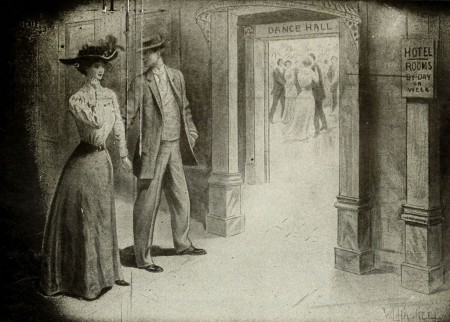
[image] Illustration: “Dangerous Amusements — The Brilliant Entrance to Hell Itself.” From Bell, Ernest A. 1911. Fighting the traffic in young girls, or, War on the white slave trade: a complete and detailed account of the shameless traffic in young girls. Chicago. Thanks to Wikimedia Commons.
References:
Carlisle, Robert J. 1893. An account of Bellevue Hospital: with a catalogue of the medical and surgical staff from 1736 to 1894. New York: Society of the Alumni of Bellevue Hospital.
Hill, Marilynn Wood. 1993. Their sisters’ keepers: prostitution in New York City, 1830-1870. Berkeley: University of California Press.
Renner, Karen J. 2010. “Seduction, Prostitution, and the Control of Female Desire in Popular Antebellum Fiction.” Nineteenth-Century Literature. 65 (2): 166-191.
Sánchez, María Carla. 2008. Reforming the world: social activism and the problem of fiction in nineteenth-century America. Iowa City: University of Iowa Press.
Sanger, William W. 1858. The history of prostitution: its extent, causes, and effects throughout the world. Being an official report to the Board of Alms-House Governors of the City of New York. New York: Harper.