
Author: Douglas Galbi
women’s desire to be on top benefits guileful man selling goose
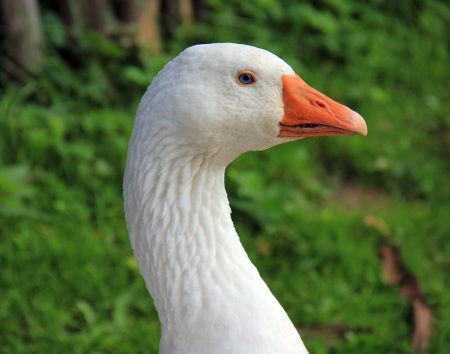 In early fifteenth-century Italy, a young peasant man was walking to Florence to sell a goose. The goose had a long, thick neck. A woman noticed him:
Considering herself to be witty, she for the sake of laughing asked the man how much he would make for the goose. He said to her, “What you would very easily yield.” “What’s that?” she asked.
{ quae sibi faceta videbatur, ridendi hominis gratia rogavit, quanti anserem faceret. At ille: “Quod facillime,” inquit, “persolvas.” “Quid est?” inquit mulier. }
Women generally are more socially sophisticated than men. With words or even just looks, women rule over men. But this peasant youth was destined to be different.
This peasant youth responded with the roguish manliness that actually makes men more attractive to women. He spoke only a few blunt words:
“One-time sex,” he said.
{ “Unico,” ait ille, “coitu.” }
The woman became intrigued and excited. With many words she denied her interest and advanced their affair with a show of reluctance:
“You are joking,” replied the wife. “But let’s go into my house and agree on a price.” They went into the house. When he remained steadfast in his will, the wife agreed to his price.
{ “Jocaris,” respondit mulier, “sed domum ingredere, et de pretio conveniemus.” Ingressus domum, cum perstaret in sententia, mulier pretio annuit. }
The wife was a woman who wanted to be on top. The youthful peasant with guile acquiesced:
But when with her in the top position they had finished sex and she requested the goose, he refused to give it over. He said that he had not taken her, but she was pressing down on him.
{ Verum cum superiores partes egisset, petito ansere, rusticus se negat daturum; non enim se mulierem subagitasse, sed se ab ea compressum dixit. }
Like many men in relation to public claims about gender inequality, the woman interpreted the situation superficially. The peasant youth understood gender more realistically. He appreciated the metaphorically disadvantaged position of men’s sexuality and used it to his advantage.
The peasant youth acted with interpersonal guile far superior to that of most men. He agreed to a reversal of gender positions:
Therefore they revived their bout, and the youth performed the service of rider. Again according to their agreement, the wife requested the goose. The youth refused, asserting that he was now equal with her. He had not received the price, but had removed the injury the wife had inflicted upon him in the earlier instance when she had subdued him.
{ Igitur, redintegrata pugna, munere sessoris fungitur adolescens. Iterum ex conventu mulier cum anserem postulasset, renuit adolescens, pari ratione se cum illa esse asserens; non enim se pretium accepisse, sed repulisse injuriam illatam; nam se prius a muliere subactum. }
In short, the man insisted on reparations for the sexual injury that the wife had inflicted upon him, as sexual injury is commonly defined in gynocentric society. That’s a crafty start to men receiving adequate compensation for their erection labor.
Usually the cuckold intervenes to support his woman. Yet in this extraordinary case, the husband, who probably endured his wife being on top, took the side of the peasant youth. The wife had denied the validity of the peasant’s claim for equality over time and reparations:
After their wrangling had gone on for a long time, the husband came in and sought to know what all the controversy was about. “I desired,” said his wife, “to prepare a well-furnished dinner for you, but this cursed one has impeded me. We agreed upon twenty soldi. Now that he has entered the house, he has changed his mind, and demands two more.” “Eh,” says the husband, “that such a small matter should impede our dinner! Come in,” he said, “here is that which is pleasing.” Thus the peasant left with the price and having had sex with the wife.
{ Cum longior progrederetur contentio, superveniens vir sciscitatur, quaenam haec sit controversia: “Cupiebam,” inquit uxor, “tibi coenam opiparam parare, nisi hic maledictus impediret: convenerat enim mecum in viginti solidis; nunc, postquam introiit domum, mutata est sententia, duos amplius requirit.” – “Eia,” inquit vir, “tam parva res impedit coenam nostram! Accipe,” inquit, “quodlibet.” Ita rusticus pretium abstulit et concubitum uxoris. }
Since the peasant youth had sex with another man’s wife, he didn’t even run the risk of forced financial fatherhood. This peasant youth was far more knowledgeable about the ways of the world than many men who undergo many years of higher education today.
Men are overwhelmingly below women in society. If men are ever to escape from the bottom, they must learn how to deal with women’s desire to be on top and the metaphorically disadvantaged status of men’s sexuality.
* * * * *
Read more:
- whore ridiculed Venetian cuckolds for their large penises
- women’s ruling dominance for millennia from India to France
- Wife of Bath, criminal justice & men’s subordination to women
Notes:
The above story and quotes are from Poggio, Facetiae 69, “Of a peasant man who had a goose for sale {De rustico qui anserem venalem deferebat},” Latin text from Poggio (1879) vol. 1, pp. 111-3, my English translation. Here’s the Latin text in a machine-readable form.
[image] Head and neck of a goose. From image released under CCO Creative Commons license thanks to AnnaER and pixabay.
Reference:
Poggio. 1879. Gian Francesco Poggio Bracciolini. The facetiae or jocose tales of Poggio, now first translated into English with the Latin text. Paris: Isidore Liseux (vol. 1, vol. 2).
resurrection: overcoming the poetic problem with penises & erections

While men’s status is scarcely an issue of contemporary public concern, men’s impotence has catastrophic long-term effects on society. Men commonly feel anxiety about their bodily endowment and struggle with their burden of performance. Men understand, at least sub-consciously, that their sexuality supports powerful social forces of gender oppression. That’s particularly true with regard to the vastly gender-disproportionate incarceration of men — that “gender protrusion” almost wholly ignored in the public media of gynocentric society.
Men’s sexual problems have an important poetic component. Superficial metaphorical thinking figures the erect penis as a weapon and colors men’s sexuality with violence. However, Abu Nuwas, an eighth-century Arabic poet commonly regarded as among the greatest classical Arabic poets, pushed forward poetry associating the penis and resurrection. Abu Nuwas’s poetry offers a vital resource for promoting social justice and bringing more joy to the lives of men and women today. As Abu Nuwas recognized, a man’s erection should be appreciated with hope for resurrection.
In literature around the world and throughout history, the penis is dominantly figured as a weapon: a sword, cudgel, or club. The metaphor of love as war is common in world literature.[1] Yet for gross, formal reasons, men’s genitals are figured as weapons while women’s aren’t. A perceptive scholar noted that the penis-sword metaphor is “common to virtually all cultures.” Such a figure can be found in the fifth-century BGC Greek comedy of Aristophanes and in second-century BGC Latin drama of Plautus.[2] Classical Arabic literature associated the penis’s sexual exploits with raiding and battles. In today’s English, the impressively functional “fuck” means both to do someone harm (“screw” the person) and to have sex. That corresponds to the metaphorical space of penal-penis action.
Poetry affirming the generous, sacrificial work of men’s penises has relatively little cultural salience. The beautiful and learned sixth-century poetry of Maximianus’s Greek girl is now largely unknown. Medieval Latin literature described the penis as a peacemaker and a husband’s sexual obligation to his wife as a matter of preserving her life. But major news sources now report as true mendacious statistics about husbands raping their wives. Men’s sexuality is now criminalized in ways that make the early-twentieth-century Mann Act seem almost gender-neutral in comparison. Classical Arabic poetry analogized a impotent penis to loss of mind-enriching resources:
So thin of grip, it is as if my penis were a sack emptied of books [3]
Penises have seminal value for new life like books do for new ideas. But few persons read books today. More powerful poetic resources are urgently needed to affirm the value of men’s penises.
Abu Nuwas offers a subtle poetic answer to the hurtful, violent figures of men’s erect penises. Unlike today’s prevalent literature of women writing sympathetically about themselves and men writing dutifully to please women, Abu Nuwas wrote with utter disregard for social orthodoxy:
I rose up and made for him, swaggering and erect, having prepared my ram for butting. When I had fixed the lance in him, he awoke, like one prostrated by wounds. [4]
Raping a man is wrong. But Abu Nuwas is doing more in this line than just describing another deplorable incident of violence against men. After Abu Nuwas’s penis penetrated the man, that victim “awoke, like one prostrated by wounds.” That’s a preternatural conjoining of returning to conscious life with falling toward death in battle. In another poem, a man who was an Islamic scholar, an ascetic, and an expert doctor advised Abu Nuwas:
Make peace with them and retaliate on their children, if you have a grudge against the unbelievers!
And stab with your lance the belly of this girl or the back of that boy: that is proper jihad! How excellent is the final Home! [5]
The concluding ejaculation, “How excellent is the final Home!” is a quote from the Qur’an. Abu Nuwas has for children conjoined the blissful ultimate end of Islam with being stabbed by an erect penis. With its conjunctions, Abu Nuwas’s poetry subverts the figure of the penis as weapon and connects an erection with resurrection.
Erection and resurrection is even more explicit in another of Abu Nuwas’s poems. This poem associates a battle with symposiastic revel:
When the Father of War deploys his horsemen for war
and death’s banner has passed before the Sheikh as a signal
and the battle reaches maturity and is ignited with fires ablaze,
we ignite our combat as dalliance with those whom we love and who love us,
and the heat of the engagement bares its teeth in a snarl.
We make our hands into bows, and lilies into arrows
and send ahead, in place of standard and spear, sweet basil.
Then our battle reverts to friendship and we become comrades once again
of youths who deem dying in pleasure a sacrifice. [6]
War and love are thoroughly mixed in these lines. The third-personal narrative of the first three lines has abstract, allusive actors ceremonially staging a battle. The fourth line links a second-personal collective of older men to combat in love with youths. The men attack the youths by pretending to shoot them with Cupid’s bow, by throwing flowers at them, and offering them sweet basil, a delicacy then consumed with wine. The reference to “youths who deem dying in pleasure a sacrifice” raises the poem to its initial abstract allusiveness. What sort of sacrifice was it for the youths to die in love — to die from being penetrated by the men’s penises? The poem drops back to narrative details of the love-combat:
When they beat the drum we strum lutes
and draw up squadrons of carnations, all colors —
the stones of our siege-engines are the apples of Lebanon
and the cause of our war is a cup-bearer who has taken captive a wine and gives us it to drink,
urging on the goblet so that the next cup can overtake the first.
You can see this one felled, laid low, and that one flaccid, drunk.
This war is not a war which engulfs people in enmity;
in it we kill them and then resurrect our victims. [7]
The final line relates the youth’s sacrifice of dying in pleasure to the men’s ability to resurrect their victims. The youth’s sacrifice of dying in pleasure is the men’s detumescence. The men’s power to resurrect their victims means their power to resurrect their erections. That’s how the penis functions within the reciprocity of “those whom we love and who love us.”
Classical Arabic poetry may have drawn upon the Hebrew Bible in relating erection and resurrection. The Book of Isaiah, widely revered as beautiful, divinely inspired prophetic poetry, declares:
Your dead shall live, their corpses shall rise.
O dwellers in the dust, awake and sing for joy!
For your dew is a radiant dew,
and the earth will give birth to those long dead.
…
Arise, shine, for your light has come,
and the glory of the Lord has risen upon you. [8]
Classical Arabic poetry lamenting men’s impotence offers a sad counterpoint:
O cock, wake up! The young gazelle has taken off its clothes!
How shall I excuse myself now that you lie together skin to skin!
Messages about incited cocks are revealed at encounters.
O you heavy-headed one that slumbers all night and all day,
using the skin of its testicles as a wrapper against the cold!
O you who won’t move at all to benefit its awakener! [9]
Resurrection is central to the faith and hope of many men and women of different beliefs around the world. Unfortunately, belief that Mary as a virgin gave birth to Jesus has confused many Christians. Such an event would be pointless without men’s erections. Men’s erections have carried forward the promise of eternal life. When you think of penises and erections, think of profound love and hope for resurrection.
* * * * * *
Read more:
- fear of pregnancy in the classical Arabic poetry of Abu Nuwas
- Priapea critique brutalizing & commodifying stereotypes
- Boethius’s wife Rusticiana sought to bring him true happiness
Notes:
[1] Papoutsakis (2014) p. 110, with references to relevant ancient Greek and Latin literature in n. 30. For sexual exploits presented as raids and battles in classical Arabic literature, id. pp. 108-12 and Schippers and Mattock (1986). Sexual super-heroes are also depicted less allusively in Arabic literature.
[2] Shanzer (1983) p. 184. In the sixth-century BGC Greek poetry of Hipponax, a man’s penis is beaten as a scapegoat.
[3] Abū Ḥukayma, Dīwān no. 33, p. 107, from Arabic trans. Papoutsakis (2014) p. 107. The references to Abū Ḥukayma’s Dīwān are to the third revised edition of Aʿrajī (Köln / Baghdad, 2007).
[4] Abu Nuwas, poem 170, ll. 3-4 in edition of al-Gazālī (Cairo, 1953), from Arabic trans. Mattock (1987) p. 532 (which also supplies the transliterated Arabic). For an English translation of the full poem, Caswell (2015) pp. 69-70. For the verses quoted above, Caswell has:
I then stirred and rose proud as a peacock
Having prepared my ram for butting
He woke up with a start as I speared him
Id. p. 70. Mattock’s translation seems to me to be closer to the Arabic, yet readily understandable. Caswell’s translation misses some of the subtleties of the poetry. Caswell’s work, however, has the great merit of making a large amount of Abu Nuwas’s poetry available in English.
Interpreting Abu Nuwas’s poetry biographically and writing up rape charges against him, as literary scholars now commonly do for men literary characters throughout history, tends to be a mind-numbing exercise. In this poem, Abu Nuwas reports that the victim got him drunk. If a woman gets a man drunk and then has sex with him, she should be regarded as a rapist under gender-neutral application of criminal law. Yet victimizing men in this way has to avoid making men unable to fulfill their performance burden. A scholar has appropriately questioned Abu Nuwas’s account of committing rape:
In the sexual episodes, one would imagine that the victim’s being asleep would detract considerably from the performer’s enjoyment; one would also imagine that the amount of drink consumed beforehand would, in fact, in view of its notoriously anaphrodisiacal qualities, seriously inhibit any such performance.
Mattock (1987) p. 537.
Poets’ actual lives do inform their understanding and their poetry. With respect to Abu Nuwas, Montgomery presented “the poet as impotent tee-totaller (the [distorted] Mattock hypothesis).” Montgomery strongly rejected that hypothesis in his interpretive approach to Abu Nuwas. Montgomery (1998) p. 19 and passim. Between believing that Abu Nuwas was an impotent tee-totaller and charging him with rape is a broad space for enriching literary engagement.
[5] Abu Nuwas, Dīwān 5:211, ll. 15-6 (mujūnīya §211) (ed. Wagner), from Arabic trans. Geert Jan van Gelder. As van Gelder observed, the last phrase above quotes Qur’an 13:24 in the English translation of Yusuf Ali. For l. 16, Lyons has:
Pierce with your spear the bellies of the females and the back of the males: this is jihad; how good will be your future dwelling place.
Lyons (1999) p. 183. Lyons’s translation misses the Qur’anic context of the last phrase and interpolates a possessive pronoun (“your future dwelling place”) that associates that dwelling place with the destination of the person with the spear / penis (“Pierce with your spear”). That confuses Abu Nuwas’s subtle imagery of erection and resurrection.
Caswell provides a looser translation of the whole poem. The poem clearly includes parody. It ends:
I said: “…what else would you advise
A bachelor, stranger, newly arrived in town?”
He said: “Commit adultery with your neighbor’s wife
Then sodomise his son!”
Caswell (2015) p. 144. Just as for the brilliant classical Arabic litterateur al-Jahiz, Abu Nuwas’s outrageousness is mixed with deep seriousness.
[6] Abu Nuwas, Dīwān 5:168.16-169.16 (mujūnīya §167) (ed. Wagner), from Arabic. trans. Montgomery (2011) p. 132 (adapted slightly). The subsequent quote is similarly from id. Montgomery (1998) pp. 22-3 provides a slightly different English translation. Caswell (2015), p. 292, provides a relatively loose, easily readable translation. Other English translations of some lines are Lyons (1999) p. 183, n. 1, and Meisami (2010) pp. 42-3.
Sweet basil is a figure of pleasure in classical Arabic poetry. A seventh-century wine poem of al-A’sha states:
I have gone to the tavern in the morning,
with a bold, brazen, bawdy butcher in my tracks. . .
Reclining I have outdone my rivals for a
sprig of sweet-basil and a dry wine from a moist jug.
From Arabic trans. Galvin (2002). Al-Shanfarā in The Ta’iyya of al-Shanfarā (Mufaḍḍaliyya no. 20) wrote of the narrator and his lover:
We passed the night as though the tent above us was enclosed with sweet basil that had been touched by the evening breeze and the dew.
From Arabic trans. Xie (2016) p. 40. The famous and poignant Lāmiyyāt ‘al-Arab is commonly attributed to al-Shanfarā.
Abu Nuwas rejected the figure of the hero in pre-Islamic Arabic poetry. In one poem Abu Nuwas declared:
better than standing on a battlefield and riding horses while shouting halā and hab is the cry of the wine-server to one who keeps a glass in hand.
Abu Nuwas, Dīwān 162.7 in ed. al-Gazālī (Cairo, 1953), from Arabic trans. Lyons (1999) p. 181 (adapted insubstantially for readability).
[7] In translations of this poem, the terms “carnations” and “siege-engines” above are typically “gillyflowers” and “mangonels.” I’ve used the former terms to help ordinary readers at little apparent poetic cost. Montgomery earlier translated the third-to-last line as:
Then you will see this one felled and that one screwing another who’s drunk.
Montgomery (1998) p. 23. Cf. Montgomery (2011) p. 132. Translating classical Arabic is difficult and requires much scholarly study. Moreover, establishing the original-language text that is the best possible representation of what the author actually wrote more than a millennium ago requires arduous scholarly work. Recent academic fashions have regrettably devalued this important work.
The Satyricon, written about 65 GC and attributed to Petronius Arbiter, preceded Abu Nuwas in associating erection and resurrection. Encolpius, a main character in the Satyricon, suffered from impotence when he tried to have sex with Circe. Traditional Greco-Roman magic, with a seasoning of Christian healing practice, restored his erection only for a brief trial. He fully recovered through the intervention of “Dii maiores {greater Gods}”:
“But there are greater gods, who have restored me to my strength. For Mercury, who conveys and reconveys our soul, by his favors has restored to me what his anger had taken away. So you may know me to be more in favor than Protesilaus or any other of the ancient heroes.” With these words I lifted my tunic and offered my whole self for the approbation of Eumolpus. At first he jumped back in consternation, but then to establish belief as far as possible he felt with both hands the favor of the gods.
{ “Dii maiores sunt, qui me restituerunt in integrum. Mercurius enim, qui animas ducere et reducere solet, suis beneficiis reddidit mihi quod manus irata praeciderat, ut scias me gratiosiorem esse quam Protesilaum aut quemquam alium antiquorum.” Haec locutus sustuli tunicam, Eumolpoque me totum approbavi. At ille primo exhorruit, deinde ut plurimum crederet, utraque manu deorum beneficia tractat. }
From Satyricon 140, Latin text and English translation (adapted slightly) from Heseltine & Rouse (1913). Eumolpus felt with both hands Encolpius’s large erection.
Encolpius’s reference to Protesilaus implicitly refers to his and Protesilaus’s resurrections:
This is, of course, a generalized reference to those who returned from the dead, but the choice of Protesilaus for particular mention is surprising and striking. He is the polytheists’ new representative of bodily resurrection. And for Encolpius, in particular, resurrection becomes a metaphor for erection.
Bowersock (1997) p. 113. Protesilaus led the Thessalian in the Trojan War and was the first Greek to attack and die. Over time, Protesilaus came to be known as one who had been resurrected.
[8] Isaiah 26:19, 60:1. Cf. Ephesians 5:44:
Sleeper, awake! Rise from the dead
and Christ will shine on you.
[9] Abū Ḥukayma, Dīwān no. 9, pp. 61-3, ll. 1-6, from Arabic trans. Papoutsakis (2014) p. 111 (adapted slightly). Id. (which provide the whole poem in translation) notes that this poem “was obviously well-liked by Ibn al-Muʻtazz who quoted it in his note on Abū Ḥukayma in the Tabaqāt.”
[image] Three saints rising from the dead. Limoges enamel, made c. 1250. Along the sides of the enamel is pseudo-Arabic Kufic script. Preserved in the Victoria and Albert Museum, London, item M.104-1945. Image thanks to Marie-Lan Nguyen and Wikimedia Commons.
References:
Bowersock, Glen Warren. 1997. Fiction as history: Nero to Julian. London: University of California Press.
Caswell, F. Matthew, trans. 2015. The khamriyyat of Abū Nuwās: Medieval Bacchic Poetry. Kibworth Beauchamp: Matador.
Galvin, Rachel. 2002. “Of Poets, Prophets, and Politics.” Humanities: the Magazine of the National Endowment for the Humanities. 23(1).
Heseltine, Michael and W. H. D. Rouse, trans., revised by E. H. Warmington. 1913. Petronius Arbiter, Seneca. Satyricon. Apocolocyntosis. Loeb Classical Library 15. Cambridge, MA: Harvard University Press.
Lyons, M. C. 1999. Identification and identity in classical Arabic poetry. Gibb Literary Studies 2. Warminster, Wiltshire: Aris & Phillips.
Mattock, John N. 1987. “Description and Genre in Abū Nuwās.” Quaderni Di Studi Arabi. 5/6: 528-540.
Meisami, Julie Scott. 2010. Structure and meaning in medieval Arabic and Persian poetry Orient pearls. London: RoutledgeCurzon.
Montgomery, James E. 1998. “Abū Nuwās the Alcoholic.” Pp. 15-26 in Vermeulen, Urbain, and D. De Smet, eds. Philosophy and arts in the Islamic world: proceedings of the eighteenth congress of the Union Européenne des Arabisants et Islamisants held at the Katholieke Universiteit Leuven (September 3-September 9, 1996). Leuven: Uitgeverij Peeters.
Montgomery, James E. 2011. “Abū Nuwās, The Justified Sinner?” Oriens. 39 (1): 75-164.
Papoutsakis, Nefeli. 2014. “The Ayrīyāt of Abū Ḥukayma (d. 240/854): a preliminary study.” Ch. 6 (pp. 101-122) in Talib, Adam, Hammond, Marlé and Schippers, Arie, eds. 2014. The Rude, the Bad and the Bawdy: Essays in honour of Professor Geert Jan van Gelder. Warminster: Gibb Memorial Trust.
Shanzer, Danuta. 1983. “Ennodius, Boethius, and the date and interpretation of Maximianus’s Elegia III.” Rivista di filologia e di istruzione classica 111: 183-195.
Schippers, Arie, and John Mattock. 1986. “Love and War: a Poem of Ibn Khafājah.” Journal of Arabic Literature. 17 (1): 50-67.
Xie, Wei. 2016. Love in Pre-Islamic poetry and Shijing. Master of Arts Thesis. University of Virginia.
Boethius’s wife Rusticiana sought to bring him true happiness
“But you say you desire to hear more: with what desire you would burn if you knew where I will lead you!”
“Where?” I asked.
“To true happiness,” she said, “of which your spirit dreams, but you cannot actually see because your sight is too occupied with images.”
{ Sed quod tu te audiendi cupidum dicis, quanto ardore flagrares, si quonam te ducere aggrediamur agnosceres!”
“Quonam?” inquam.
“Ad veram,” inquit, “felicitatem, quam tuus quoque somniat animus, sed occupato ad imagines visu ipsam illam non potest intueri.” } [1]


The great sixth-century scholar, statesman, and theologian Boethius and his eminent wife Rusticiana had marital difficulties. They married when Boethius was young. Sometime before his late forties, Boethius had become known as a philanderer — the sort of husband who would have in his bedroom whorish actresses. Rusticiana came from a wealthy, powerful Roman Christian family. She surely wasn’t constrained to endure an unfaithful husband. But she was strong and highly intelligent, and she truly loved Boethius. When Boethius was imprisoned and facing a death sentence, Rusticiana presented to him the false consolation of philosophy and recalled him to the eternal present of their love.
Rusticiana was probably Boethius’s first love. Boethius, like Rusticiana, came from a wealthy, powerful Roman Christian family. Boethius’s father had been the sole consul for the western Roman Empire, and he served successively as the powerful praetorian and urban prefect of Rome. He died when Boethius was young. The eminent Roman Symmachus, most likely a close friend of Boethius’s father, adopted him. Symmachus was highly learned. He knew Greek and wrote seven volumes of Roman history. Symmachus probably taught his daughter Rusticiana along with Boethius. Boethius married his foster-father’s daughter Rusticiana in 495. Most authorities date Boethius’s birth between 475 and 477; others place his birth about 480.[2] Boethius thus married Rusticiana, which whom he had lived closely for some years, when he was between fifteen and twenty years old.
Boethius subsequently acquired the reputation of a philanderer. Magnus Felix Ennodius, who was only a few years older than Boethius, wrote of Boethius:
In your hands the substance of a rigid sword droops,
even steel dissolves like flowing water.
The unwarlike right hand of Boethius renders swords soft:
what was recently a weapon is now, believe me, a spindle.
Vile one, the javelin you carry turns into a thyrsus.
Outstanding in the pursuit of sexual affairs, leave war’s tools to others.{ Languescit rigidi tecum substantia ferri,
Solvitur atque chalybs more fluentis aquae.
Emollit gladios inbellis dextra Boeti,
Ensis erat dudum, credite, nunc colus est.
In thyrsum migrat quad gestas, inprobe, pilum.
In Venerem constans, linque Mavortis opem. } [3]
This epigram characterizes Boethius as impotent in violence against men, but blessed in pursuing sex with women. Writing in the mid-sixth century, Maximianus depicted Boethius as urging illicit sex and paying a girl’s mother to promote an affair.[4] Boethius apparently didn’t regard his wife’s love as sufficient for him.
Imprisoned in his late forties and facing a death sentence for treason, Boethius despaired for what he had done with his life. A personification of philosophy appeared to him and spoke with him. This personification of philosophy wasn’t merely a grammatically gendered abstraction. She sang sweetly to him, caressed his breast, and dried his tears. She had a majestic face and towering height, and conversed with Boethius intelligently and learnedly. She also had woven her own dress. She was an outstanding woman by the standards of Roman times. In Boethius’s intricate, sophisticated literary construction, Lady Philosophy was Boethius’s wife Rusticiana.[5]
Lady Philosophy recalled the imprisoned Boethius to his marital love with Rusticiana. She reminded Boethius of her love for him, and his love for her:
Your wife lives, a woman excelling in modesty and propriety and — to sum up all her gifts in one phrase — in character like her father. She lives, I say, and goes on living though she detests this life and goes on living only for you. I must admit that in this alone is your happiness lessened — that she is wasting away in tears in her grievous longing for you.
{ Vivit uxor ingenio modesta, pudicitia pudore praecellens et, ut omnes eius dotes breviter includam, patri similis. Vivit inquam tibique tantum vitae huius exosa spiritum servat quoque uno felicitatem minui tuam vel ipsa concesserim, tui desiderio lacrimis ac dolore tabescit } [6]
Lady Philosophy led Boethius to understand that wealth, honor, and political power are relatively unimportant. More subtly, she also demonstrated that philosophy is merely a game of the mind.[7] She reminded Boethius that he was a man. She implored him to act rightly. She sought to bring him home to the eternal present of life with her.
To you this tale refers,
who seek to lead your mind
into the upper day.
For if he who overcomes should turn back his gaze
towards the Tartarean cave,
whatever excellence he takes with him,
he loses when he looks on those below.{ Vos haec fabula respicit
Quicumque in superum diem
Mentem ducere quaeritis.
Nam qui Tartareum in specus
Victus lumina flexerit,
Quidquid praecipuum trahit
Perdit, dum videt inferos. } [8]

* * * * *
Read more:
- Lady Philosophy and man blindness in Boethius’s Consolation
- setting prisoners free in the ancient world
- in celibate Hell: resentful Dis threatens civil war & abducts girl
Notes:
[1] Anicius Manlius Severinus Boethius, The Consolation of Philosophy {De consolatione philosophiae} 3.1P.15-20, Latin text and English translation (adapted non-substantially) from Stewart, Rand & Tester (1973). All subsequent quotes from The Consolation of Philosophy are similarly from id. Freely available online is a Latin text (via James O’Donnell) and English translations of H.R. James (1897), Walter John Sedgefield (1900), W.V. Cooper (1902), and H. F. Stewart (LCL, 1918).
[2] On Boethius biography (including marriage in 495 and birth “between 475 and 477”), Martyn (2006) p. 3. On Boethius’s birth year, similarly the Boethius entry in the Stanford Encyclopedia of Philosophy. Cf. Hodgkin (1885) p. 522, James J. O’Donnell’s life of Boethius and MacTutor History of Mathematics entry for Boethius, all of which place his birth year about 480.
Boethius’s full name was Anicius Manlius Severinus Boethius. That name indicated a prestigious lineage:
his name Anicius indicated a real and genuine connection with one of the noblest families of the Lower Empire {Eastern Roman Empire}. Manlius was meant to carry back his lineage to the Manlii Torquati of the {Roman} Republic; but here the connection was probably of that vague and shadowy kind which is met with in manufactured genealogies. Severinus was no doubt given to him in honor of one of the holiest names of the fifth century, the saintly hermit of Noricum.
Hodgkin (1885) pp. 522-3. The Anicius family include Olybrius, the leader of the Western Roman Empire in 472. Boethius’s father, Nar. Manlius Boethius, served as consul in 487. Boethius’s foster-father, Quintus Aurelius Memmius Symmachus, was consul in 485.
[3] Magnus Felix Ennodius, Epigrams 2, entitled On Boethius’s Broadsword Being Sheathed {De Boetio spata cincto}, Latin text and English translation from Shanzer (1983) p. 183. Juster (2018), p. 91, provides an alternate, less literal translation. With expressive freedom that would scarcely be tolerated today, Ennodius
wrote homophobic epigrams, graphic abuse of the failing and post-menopausal physiology of an old woman who wants to marry a young man and epigrammtic slurs on the sexual dissolution of his friend, the great Boethius.
Id. p. 182.
Ennodius, who was ordained a deacon about 493 and became Bishop of Pavia in 514, in 510 sought from his friend Boethius the donation of a neglected house to the Church. Boethius was extremely wealthy and had no need of the house. He apparently promised to donate it, but never did. Kennell (2001) pp. 108-10. Learned, faith-filled, and fully human men, both Ennodius and Boethius are recognized as saints in the Roman Catholic Church.
[4] Maximianus, Elegies 3. Juster (2018) provides the Latin text and an English translation. Maximianus’s portrayal of Boethius is highly literary. Shanzer constructs life stories consistent with Maximianus’s characterization:
I would suggest that Boethius was chosen by Maximianus because of the way the details of his life counterbalance those of the poet. Boethius had a reputation for lasciviousness in youth (Ennodius), he was a poet, up to a point he was a political success story, and in his senectus {old age} he wrote an important philosophical and literary work which demonstrated a change of heart from the ways of his youth, and he came to a quasi-saintly end as a political martyr.
Shanzer (1983) p. 194. When he was probably 20 or younger, Boethius married his foster-father’s daughter Rusticiana. Those aren’t likely circumstances for having a youthful reputation for being lascivious. Moreover, Boethius married in 495, and Ennodius sought the donation of a house from him in 510. Ennodius plausibly wrote his biting epigram after 510 in relation to Boethius’s relatively recently established sexual reputation. The Boethius in Maximianus’s Elegies 3 seems to me to parody the depiction of Boethius in The Consolation of Philosophy. That parody having an element of public reputation gives it heightened piquancy.
[5] Rusticiana seems to have been a strong, independent woman. She was Symmachus’s oldest daughter among his three children, all girls. Marriage to Boethius probably wasn’t a vocation imposed on Rusticiana. Her two sisters, Proba and Galla, became nuns. Martyn (2006) p. 4, n. 9. Rusticiana survived for about twenty-five years after the deaths of her husband Boethius and her father Symmachus. The Goths regarded Rusticiana as an important public actor even after she had been widowed for decades:
Boethius’ wife was living in Rome in 546 when the Goths captured it. They believed that Rusticiana had destroyed Theoderic’s statues in revenge for the deaths of her husband and father on the king’s orders, and were about to kill her when the new king, Totila, appeared and saved her life.
Id. p. 4. Although born into a life of extraordinary privilege, Rusticiana was capable of enduring extraordinary hardship:
for several months, this once wealthy and generous lady had to beg for bread in Rome just to survive. Her death occurred several years later, its date unknown.
Id. Rusticiana died more than fifty years after marrying Boethius. She, like Boethius, undoubtedly married young.
Written evidence testifies to the stature of Rusticiana’s granddaughter, also named Rusticiana. She was a close friend of Pope Gregory I. He wrote more letters to her (seven) than to the Brunhilde, Queen of the Franks, and more to her than to most other men. Id. p. 5. The Pope addressed Rusticiana as “your Excellence {excellentia vestra},” inquired about her travels, prayed for her health, worried about enemies’ attacks on her, urged her to visit him, and greeted her children. See Epistolae, entry for Rusticiana. The leading scholar of Boethius’s family has no doubt that this Rusticiana was Boethius’s granddaughter. Martyn (2006) pp 4-9. Boethius’s wife Rusticiana almost surely was a woman of similar stature.
[6] Consolation of Philosophy 2.4P.18-24.
[7] Boethius achieved considerable power and honor. He was named consul in 510. His two sons together served as consul in 522. While he was imprisoned and facing execution, Lady Philosophy painfully reminded Boethius of his public success:
If genuine happiness ever comes from the affairs of mortals, could the weight of any crowding ills, however great, obliterate the memory of that glory you experienced when you saw your two sons borne from your house together as consuls, in the crowd of Senators and the throng of the rejoicing populace? Or when you delivered the panegyric in praise of the king with them sitting in the curule chairs in the Senate House, and deserved well the praise you received for your splendid oratory? Or when between the two of them as consuls in the assembly you satisfied, with the largesse proper to a triumphal occasion, the hopes and expectations of the multitude crowding around you?
{ Si quis rerum mortalium fructus ullum beatitudinis pondus habet, poteritne illius memoria lucis quantalibet ingruentium malorum mole deleri, cum duos pariter consules liberos tuos domo provehi sub frequentia patrum, sub plebis 30 alacritate vidisti, cum eisdem in curia curules insidentibus tu regiae laudis orator ingenii gloriam facundiaeque meruisti, cum in circo duorum medius consulum circumfusae multitudinis expectationem triumphali largitione satiasti? }
Consolation of Philosophy 2.3P.25-36. That public acclaim didn’t prevent Boethius from being imprisoned and executed, without a trial, on a dubious charge of treason. Boethius’s foster-father Symmachus was similarly executed about a year later.
Boethius aspired to translate all the works of Plato and Aristotle, write commentaries on them, and harmonize them. Among Boethius’s many scholarly works, he wrote translations and commentaries on Aristotle’s In Categorias, De Interpretatione, and Analytica Priora. Boethius never completed his impossible goal of encompassing all of Aristotle and Plato’s works. Lady Philosophy treats philosophical learning with subtly parody. She shows that philosophy as merely a matter of the mind ultimately leads to involuted nonsense. See Consolation of Philosophy, Book 5.
[8] Consolation of Philosophy 3.12V.52-8 (from Boethius’s retelling of the story of Orpheus’s love for his wife Eurydice). Scholars have misinterpreted this story as an allegory for Boethius’s pursuit of the life of the mind. It’s better understood as Rusticiana’s sophisticated disparagement of Boethius’s love for other women.
[images] (1) The consular diptych of Nar. Manlius Boetius, father of Anicius Manlius Severinus Boethius. Made about 487 GC. Preserved in Santa Giulia Museum (Brescia, Italy). Image by Giovanni Dall’Orto, June 25 2011. Via Wikimedia Commons. (2) Lady Philosophy (Rusticiana) and Boethius. Painting: tempera colors, gold leaf, gold paint, and ink on parchment, by Coëtivy Master (Henri de Vulcop?) (French, active about 1450 – 1485). Miniature excerpt from Boethius, Consolation de philosophie (Ms. 42 in the J. Paul Getty Library; manuscript dated about 1460 – 1470). Image thanks to The J. Paul Getty Museum, Los Angeles.

References:
Hodgkin, Thomas. 1885. Italy and her invaders 476-535. Vol. 3. Oxford: Clarendon Press.
Juster, A. M., ed. and trans, with introduction by Michael Roberts. 2018. The Elegies of Maximianus. Philadelphia, PA: University of Pennsylvania Press. (review)
Kennell, S. A. H. 2000. Magnus Felix Ennodius: a gentleman of the Church. Ann Arbor: The University of Michigan Press.
Martyn, John R. C. 2006. “A New Family Tree for Boethius.” Parergon. 23 (1): 1-9.
Shanzer, Danuta. 1983. “Ennodius, Boethius, and the date and interpretation of Maximianus’s Elegia III.” Rivista di filologia e di istruzione classica 111: 183-195.
Stewart, H. F., E. K. Rand, S. J. Tester, ed. and trans. 1973. Boethius. Theological Tractates. The Consolation of Philosophy. Loeb Classical Library 74. Cambridge, MA: Harvard University Press.
Wednesday’s flowers
