Tzetzes mocked man oblivious to need for gender equality in sex & work

horse hoof

By virtue of their human dignity, men are entitled to gender equality in sex and work. Yet historically men have often paid women for sex and worked outside the home to provide resources to women. Even today, many women cannot imagine paying a man for sex or taking up and continuously working in an onerous career to support a stay-at-home husband. John Tzetzes, perhaps the greatest classicist of all time, deployed subtle classical references to mock a man who acted oblivious to the need to promote gender equality.

Men throughout history have worked to provide money to women. Marketers today know that women spend about $2.30 for every dollar that men spend.[1] That’s in part because women spend money that men earn. In an influential advice book A Godly Form of Household Government, first published in 1598, two Puritan ministers declared:

The duty of the husband is to get money and provision: and of the wife’s, not vainly to spend it. [2]

Following from theogyny and gynocentrism, the ancient Greek poet Hesiod emphasized that men’s days consist of work. A good wife would share equally in a man’s work, yet a bad wife demands that the man put food on the table and drives the over-worked man to an early grave:

For a man gets nothing better than a good wife,
but nothing worse than a bad one,
an ambusher-at-dinner, who without a brand burns
her man however strong he is, and brings him early to an old age.

{ οὐ μὲνγ άρ τι γυναικὸς ἀνὴρ λη ίζɛτ᾽ἄ μɛινον
τῆς ἀγαθῆς, τῆςδ ᾽ αὖτɛ κακῆςοὐ ῥίγιον ἄλλο,
δɛιπνολόχης, ἥ τ᾽ἄνδρα καὶἴφθιμόνπ ɛρ ἐόντα
ɛὕɛι ἄτɛρ δαλοῖο καὶὠ μῷ γήραϊ δῶκɛν. } [3]

Why would a man marry a woman unwilling to support him, or even one earning less money than him? The answer is obvious: many men find particular women — usually young, feminine women with pleasing dispositions and warm receptivity — to be irresistibly beautiful. Hesiod bluntly warned men that a woman could be a “beautiful evil {καλὸν κακόν)”:

Don’t let a woman with a tarted-up ass deceive your mind
with cajoling words, while she rifles around in your granary.
He who trusts a woman, trusts a cheater.

{ μηδὲ γυνή σɛ νόον πυγοστόλος ἐξαπατάτω
αἱμύλα κωτίλλουσα, τɛὴν διφῶσα καλιήν.
ὃςδ ὲ γυναικὶ πέποιθɛ, πέποιθ᾽ὅγɛ φιλήτῃσιν. } [4]

The ancient historian Herodotus had profound appreciation for Persian judgment in relation to feminine beauty. According to Herodotus, the Persian King Darius returned to Sardis to consult with allies after invading Greece. Two Paionians who sought political advantage schemed to catch his attention:

It so so happened that there two Paionians named Pigres and Mastyas who had come to Sardis after Darius returned to Asia, because they wanted to rule as tyrants over the Paionians. They had brought along their sister, a tall and attractive woman. The two men watched for the time when Darius would be sitting at the entrance to the Lydian city, and when they saw him there, this is what they did. First, they dressed her up to look as beautiful as possible, and then they sent her out for water with a jug on her head, guiding a horse by a rein and spinning flax all at the same time. When this woman walked past Darius, she roused his curiosity, for what she was doing was neither Persian nor Lydian practice, nor like that of any of the peoples of Asia.

{ ἦν Πίγρης καὶ Μαντύης ἄνδρες Παίονες, οἳ ἐπείτε Δαρεῖος διέβη ἐς τὴν Ἀσίην, αὐτοὶ ἐθέλοντες Παιόνων τυραννεύειν ἀπικνέονται ἐς Σάρδις, ἅμα ἀγόμενοι ἀδελφεὴν μεγάλην τε καὶ εὐειδέα. φυλάξαντες δὲ Δαρεῖον προκατιζόμενον ἐς τὸ προάστειον τὸ τῶν Λυδῶν ἐποίησαν τοιόνδε· σκευάσαντες τὴν ἀδελφεὴν ὡς εἶχον ἄριστα, ἐπ᾿ ὕδωρ ἔπεμπον ἄγγος ἐπὶ τῇ κεφαλῇ ἔχουσαν καὶ ἐκ τοῦ βραχίονος ἵππον ἐπέλκουσαν καὶ κλώθουσαν λίνον. ὡς δὲ παρεξήιε ἡ γυνή, ἐπιμελὲς τῷ Δαρείῳ ἐγένετο· οὔτε γὰρ Περσικὰ ἦν οὔτε Λύδια τὰ ποιεύμενα ἐκ τῆς γυναικός, οὔτε πρὸς τῶν ἐκ τῆς Ἀσίης οὐδαμῶν. } [5]

Was Darius curious about what it would be like to have sex with this exotic beauty? No, he had more important concerns:

Once she had caught his attention, he sent out some of his bodyguards to serve as scouts and watch how this woman would manage her horse. The bodyguards accordingly followed behind her, and when she came to the river, she first watered the horse and then filled the jug with water. Then she returned by the same road, carrying the jug of water on her head, guiding the horse by the rein hanging from her arm, and all the while twisting wool on her spindle.

{ ἐπιμελὲς δὲ ὥς οἱ ἐγένετο, τῶν δορυφόρων τινὰς πέμπει κελεύων φυλάξαι ὅ τι χρήσεται τῷ ἵππῳ ἡ γυνή. οἳ μὲν δὴ ὄπισθε εἵποντο· ἣ δὲ ἐπείτε ἀπίκετο ἐπὶ τὸν ποταμόν, ἦρσε τὸν ἵππον, ἄρσασα δὲ καὶ τὸ ἄγγος τοῦ ὕδατος ἐμπλησαμένη τὴν αὐτὴν ὁδὸν παρεξήιε, φέρουσα τὸ ὕδωρ ἐπὶ τῆς κεφαλῆς καὶ ἐπέλκουσα ἐκ τοῦ βραχίονος τὸν ἵππον καὶ στρέφουσα τὸν ἄτρακτον. }

She was a hard-working woman. Hard-working women ease men’s burden of work. She could offer men an opportunity to enjoy gender equality in work:

Darius was so amazed at the account of his scouts (and in fact he had seen for himself just what they were reporting) that he ordered the woman to be brought into his presence. She arrived accompanied by her brothers, who had been close by, observing all that had occurred. When Darius inquired what country she had come from, the young men replied that she was their sister and that they were Paionians. And Darius asked who the Paionians were, where in the world they lived, and what they wanted in coming to Sardis. … Darius asked if all the women there were as hardworking as their sister, and since this was the very reason for what they had done there, they enthusiastically answered that this was indeed the case.

{ Θωμάζων δὲ ὁ Δαρεῖος τά τε ἤκουσε ἐκ τῶν κατασκόπων καὶ τὰ αὐτὸς ὥρα, ἄγειν αὐτὴν ἐκέλευε ἑωυτῷ ἐς ὄψιν. ὡς δὲ ἄχθη, παρῆσαν καὶ οἱ ἀδελφεοὶ αὐτῆς οὔ κῃ πρόσω σκοπιὴν ἔχοντες τούτων. εἰρωτῶντος δὲ τοῦ Δαρειου ὁποδαπὴ εἴη, ἔφασαν οἱ νεηνισκοι εἶναι Παίονες καὶ ἐκείνην εἶναι σφέων ἀδελφεήν. ὃ δ᾿ ἀμείβετο, τίνες δὲ οἱ Παίονες ἄνθρωποι εἰσὶ καὶ κοῦ γῆς οἰκημένοι, καὶ τί κεῖνοι ἐθέλοντες ἔλθοιεν ἐς Σάρδις. … οἳ μὲν δὴ ταῦτα ἕκαστα ἔλεγον, ὃ δὲ εἰρώτα εἰ καὶ πᾶσαι αὐτόθι αἱ γυναῖκες εἴησαν οὕτω ἐργάτιδες. οἳ δὲ καὶ τοῦτο ἔφασαν προθύμως οὕτω ἔχειν· αὐτοῦ γὰρ ὦν τούτου εἵνεκα καὶ ἐποιέετο. } [6]

Darius then ordered that all the Paionians be moved to Persia. He wanted to implant in Persia a people that produced beautiful, hard-working women. That was a vitally important policy initiative to promote men’s welfare and gender equality. Few leaders across all of history have been as wise as King Darius of Persia.

giraffe hoof

Yet not just leaders, but ordinary men themselves have been too weak-willed to promote gender equality. Corresponding with another man in twelfth-century Constantinople, John Tzetzes subtly mocked that man’s lack of far-sighted understanding of his own interests:

I gather that you have caught a burning desire in your heart, after hearing Herodotus’s praises of the Paionic daughters, to see them. They have, to use Hesiod’s words, “tarted-up asses,” or to use gold-tongued Homer’s expression, they are women “who have award-winning asses, and pick up prizes with their buttocks.”

{ ἀλλ’ ἔρως σου τὴν καρδίαν κατέσχεν, οἶμαι, διάπυρος, Ἡροδότου τῶν ἐγκωμίων ἀκούσαντος τὰς καθ’ Ἡσίοδον “πυγοστόλους” ἰδεῖν θυγατέρας Παιόνων, ἢ τὰς κατὰ τὸν χρυσόγλωττον Ὅμηρον πλέον “πυγοὺς ἀεθλοφόρους, αἳ ἀέθλια πυγαῖς ἄροντο.” } [7]

In Tzetze’s account, his correspondent desired the Paionic daughters merely for their sexual allure. He didn’t understand King Darius’s wisdom. Given men’s crushing gender burden of working for women, the Paionic daughters had the great virtue of being hard-working women who could advance gender equality in work for men. Tzetzes’s correspondent wasn’t a man thinking with the head above his neck.

Tzetze ironically suggested that Homer’s description of Agamemnon’s proposed gifts to Achilles shaped his correspondent’s response to the Paionic daughters in Herodotus. In ancient warfare, the winning side generally killed men and took women captive.[8] In the Iliad, Agamemnon took the captive woman Briseis from Achilles. Enraged, Achilles refused to participate further in the brutal violence against men of the Trojan War. Agamemnon sought to appease Achilles with gifts far beyond returning Briseis:

Let me, before you all, name my splendid gifts:
seven tripods untouched by fire, ten talents of gold,
twenty shining cauldrons, and a dozen horses —
strong, victorious, whose feet have brought them prizes.
Not landless would be that man, nor lacking in possession
of precious gold, to whom there accrued the amount of wealth
brought to me by my whole-hoofed racehorses’ prizes.
I’ll give him, too, seven women, skilled in fine handiwork,
from Lesbos, whom — when he took that well-built island
himself — I picked out: they surpassed all women in beauty.
These will I give him, including her whom I took away,
Brīseus’s daughter; and, further, I’ll swear a great oath
that I never went up to her bed nor lay with her, as is
the custom of humankind, between men and women.
All these things will be given him now; and if hereafter
the gods grant that we take down Priam’s great city,
let him go in and load up his ship with gold and bronze
when we, the Achaians, are dividing up the spoils,
and choose for himself a score of Trojan women —
the most beautiful, after Argive Helen herself! And if
we get back to Achaian Argos, rich mother of plowland,
my son-in-law he can be. I’ll honor him like my own son,
Orestēs, late-born, reared in the midst of plenty.
Three daughters of mine there are in my fine-built hall —
Chrysothemis, Laodikē, and Iphianassa: of these
let him take whichever he pleases, no bride-price paid,
to Pēleus’s house; and I’ll offer him richer bride-gifts
than any man ever yet provided with his daughter.

{ ὑμῖν δ᾿ ἐν πάντεσσι περικλυτὰ δῶρ᾿ ὀνομήνω,
ἕπτ᾿ ἀπύρους τρίποδας, δέκα δὲ χρυσοῖο τάλαντα,
αἴθωνας δὲ λέβητας ἐείκοσι, δώδεκα δ᾿ ἵππους
πηγοὺς ἀθλοφόρους, οἳ ἀέθλια ποσσὶν ἄροντο.
οὔ κεν ἀλήιος εἴη ἀνὴρ ᾧ τόσσα γένοιτο,
οὐδέ κεν ἀκτήμων ἐριτίμοιο χρυσοῖο,
ὅσσα μοι ἠνείκαντο ἀέθλια μώνυχες ἵπποι.
δώσω δ᾿ ἑπτὰ γυναῖκας ἀμύμονα ἔργα ἰδυίας,
Λεσβίδας, ἃς ὅτε Λέσβον ἐυκτιμένην ἕλεν αὐτὸς
ἐξελόμην, αἳ κάλλει ἐνίκων φῦλα γυναικῶν.
τὰς μέν οἱ δώσω, μετὰ δ᾿ ἔσσεται ἥν τότ᾿ ἀπηύρων,
κούρη Βρισῆος· καὶ ἐπὶ μέγαν ὅρκον ὀμοῦμαι
μή ποτε τῆς εὐνῆς ἐπιβήμεναι ἠδὲ μιγῆναι,
ἥ θέμις ἀνθρώπων πέλει, ἀνδρῶν ἠδὲ γυναικῶν.
ταῦτα μὲν αὐτίκα πάντα παρέσσεται· εἰ δέ κεν αὖτε
ἄστυ μέγα Πριάμοιο θεοὶ δώωσ᾿ ἀλαπάξαι,
νῆα ἅλις χρυσοῦ καὶ χαλκοῦ νηησάσθω
εἰσελθών, ὅτε κεν δατεώμεθα ληίδ᾿ Ἀχαιοί,
Τρωιάδας δὲ γυναῖκας ἐείκοσιν αὐτὸς ἑλέσθω,
αἵ κε μετ᾿ Ἀργείην Ἑλένην κάλλισται ἔωσιν.
εἰ δέ κεν Ἄργος ἱκοίμεθ᾿ Ἀχαιικόν, οὖθαρ ἀρούρης,
γαμβρός κέν μοι ἔοι· τίσω δέ μιν ἶσον Ὀρέστῃ,
ὅς μοι τηλύγετος τρέφεται θαλίῃ ἔνι πολλῇ.
τρεῖς δέ μοί εἰσι θύγατρες ἐνὶ μεγάρῳ ἐυπήκτῳ,
Χρυσόθεμις καὶ Λαοδίκη καὶ Ἰφιάνασσα,
τάων ἥν κ᾿ ἐθέλῃσι φίλην ἀνάεδνον ἀγέσθω
πρὸς οἶκον Πηλῆος· ἐγὼ δ᾿ ἐπὶ μείλια δώσω
πολλὰ μάλ᾿, ὅσσ᾿ οὔ πώ τις ἑῇ ἐπέδωκε θυγατρί. } [9]

Just one Thracian filly is usually enough to make a man happy. If he accepted Agamemnon’s gift, Achilles would have at his pleasure seven women from Lesbos, Briseis, a score of beautiful Trojan women, and King Agamemnon’s own daughter. A man would have to be a sexual hero to serve them all well under the watchful eye of his father-in-law. But men commonly aspire to be heroes. Tzetzes suggested that his correspondent desired to undertake such a challenge in thinking about the Paionic daughters in Herodotus.

A classical scholar who did path-breaking research, Tzetzes also devoted considerable energy to teaching. He even wrote a lengthy book providing detailed commentary on his own letters so that less culturally sophisticated persons could understand what he wrote. In that book, he explained his claim that his correspondent burned with desire to see the Paionic daughters’ asses:

I was making a joke, calling them {Homer’s horses} “buttocks”
and the game not one of running, but of buttocks.
Hear now what you must call this figure of speech.
The “pugous” instead of “pegous” is a paragrammatismos
and saying “a game of buttocks” instead of “a game of feet,”
is a figure that in technical terms is called a parodia.
Both figures are useful for jokes,
and they are appropriate for comedy.

{ Ἐγώ δ’ ἀστεϊζόμενος ταύτας πυγοὺς εἰρήκειν,
καὶ τὰ ἀέθλια πυγαῖς καὶ οὐ ποσὶν ἀρέσθαι.
Τὸ σχῆμα τοῦτο δ’ ἄκουσον ὅπως καλεῖν σε δέον.
Τὸ μὲν πυγοὺς ἀντὶ πηγοὺς παραγραμματισμόν μοι,
ἀντὶ ποσί δε ἄροντο, πυγαῖς ἄροντο πάλιν
τὸ σχῆμα λέγειν τεχνικῶς νόει μοι παρῳδίαν.
Ἀστεϊσμοῖς ἀμφότερα ταῦτα δὲ χρησιμεύει,
καὶ κωμῳδίαις προσφυᾶ γίνωσκε πεφυκέναι. } [10]

Tzetzes apparently was too modest to explain further his literary joke. Yet even classicists not of Tzetzes stature recognize that an epithet describing horses, “whole-hoofed {μώνυχες},” is prevalent in the Iliad.[11] Unlike a camel, which has a split hoof, a horse’s hoof lacks a cleft. By substituting “buttocks” for “feet” of horses, Tzetzes highlighted the importance of a cleft in his correspondent’s vivid, literary-sexual imagination.

camel hoof

Tzetzes’s “joke” makes an incisive critique of injustices against men under gynocentrism. Attempts to promote gender equality have failed to measure up to even rudimentary philological-critical analysis partly because of men’s sexual weakness. Men must develop the sexual strength that the Persian King Darius exemplified in Herodotus’s account of the Paionic daughters. Promoting gender equality in work will lessen the risks that Hesiod identified: the risks associated with men gazing upon and sexual pursuing women with “tarted-up asses.” Moreover, establishing gender equality in work and cutting off the massive gender protrusion in consumer spending will advance gender equality in sex. Why can’t men have it all?

*  *  *  *  *

Read more:

Notes:

[1] See, e.g. Silverstein & Sayre (2009) and Nielson (2013). These and other sources indicate that women control roughly 70% of consumer spending. That spending share implies that for each dollar men spend, women spend 70% / 30% = $2.33.

[2] Dod & John (1598) p. 167.

[3] Hesiod, Works and Days ll. 702-5, Greek text and English translation from Canevaro (2013) p. 189, with my non-substantial changes for accessibility to non-specialist readers. Hesiod, writing about 700 BGC, emphasizes that men in the Iron Age must work to survive and that women present a risk to men’s economic well-being unless “genders are in equilibrium.” Id. pp. 186-7. Anti-men gender inequality in work and sex has been present throughout history. Establishing gender equilibrium is a crucial social-political task for the future. Under gynocentric conditions of gender disequilibrium, Hesiod referred to Pandora, a figure of woman, as “the beautiful evil.” Theogony, l. 585.

[4] Hesiod, Works and Days l. 373-5, similarly from Canevaro (2013) p. 188. Canevaro observed:

Perhaps most striking here is the hapax πυγοστόλος, which has succeeded in inspiring all manner of detailed discussion about what exactly women do to attract attention to their rear.

Id. Liddell & Scott define the term as decorating the buttocks, “with collateral notion of lewd.” A scholia suggests “moving her ass with her gait or showing off her body { ἡ κινοῦσα τὴν πυγὴν ἐντ ῇ πορɛίᾳ ἢ ἀποστίλβουσα τὸ σῶμα }. Scholia to Works and Days 373b, Greek text and English trans. from id., n. 12. A common tactic today for attracting attention to a woman’s buttocks is for her to wear shorts that have text, such as “PINK,” written in large letters across the behind. Men who read, unfortunately, are at risk for being persecuted for the male gaze. Let’s hope that men’s spirit of literary curiosity remains undaunted, even if only to serve women’s interests.

Hesiod’s wariness wasn’t distinctive to women. He was also suspicious of men:

Let the payment agreed for a man who is your friend be reliable; and smile upon your brother — but add a witness too: for both trust and distrust have destroyed men.

{ μισθὸς δ᾿ ἀνδρὶ φίλῳ εἰρημένος ἄρκιος ἔστω·
καί τε κασιγνήτῳ γελάσας ἐπὶ μάρτυρα θέσθαι·
πίστεις †δ᾿ ἄρ᾿ ὁμῶς καὶ ἀπιστίαι ὤλεσαν ἄνδρας. }

Hesiod, Works and Days, ll. 370-2, Greek text and English translation from Most (2007).

[5] Herodotus, Histories 5.12, Greek text from Godley (1920), English translation from Strassler & Thomas (2007) pp. 370-1, with a few insubstantial changes for readability. The interaction with the Paionian brothers and sister occurred about 511 BGC. Id. Darius was King Darius the Great (Darius I) of Persia. The Paionians, alternately spelled Paeonians, were a people living in Macedonia. The subsequent two quotes from Herodotus are similarly sourced.

[6] The brothers didn’t bother mentioning that they had dolled up their sister to look as beautiful as possible. In the ancient world, men’s preference for beautiful women was taken for granted.

[7] John Tzetzes, Letter 67, 96.16-20, Greek text and English translation (with my adaptations, from Bernard (2015) p. 192. I’ve change the quoted texts from Hesiod (Works and Days, l. 373) and Homer (Iliad, 9.124) to reflect the texts of my quotations from those sources. By “Herodotus’s praises of the Paionic daughters,” Tzetzes evidently meant the Paionic woman exhibited to Darius, and the claim that all the Paionic women were like her.

Heinrich (2009) provides a good introduction to Tzetzes’s letters and his scholarly style. The Byzantines had a highly sophisticated culture of letter-writing more than a century before Tzetzes wrote. Chernoglazov (2017).

[8] Briseis, a beautiful woman from a ruling family, enjoyed the extraordinary privilege of becoming a concubine of a high-status man. Many ordinary men were meanwhile lying dead on the battlefields.

[9] Homer, Iliad 9.121-48, Greek text from Murray (1924), English translation from Green (2015) p. 226. Tzetzes quoted Iliad 9.124 (=9.266) in his letter. Green’s translation, which is line-for-line with the Greek, has for 9.124:

sturdy race winners, whose speed has brought them prizes.

{ πηγοὺς ἀθλοφόρους, οἳ ἀέθλια ποσσὶν ἄροντο. }

I’ve substituted above the more literal translation:

strong, victorious, whose feet have brought them prizes

The concrete term “feet” is important for understanding Tzetzes’s joke.

The lavish gifts that Agamemnon offered to Achilles were effectively a “gift-attack against Achilles.” Donlan (1993) p. 164.

[10] Tzetzes, Chiliades 10.234-41 (no. 319), Greek text and English translation from Bernard (2015) p. 193. In another letter, Tzetzes apologized to an unidentified bishop for making fun of him. Id. p. 188.

[11] The phrase “whole-hoofed {μώνυχες} horses” occurs 31 times in the Iliad.

[images] (1) horse’s hoof, excerpt from photo that Maky Orel made available on pixabay under a Creative Commons CCO license; (2) giraffe hoof, image derived from photo that shoemap contributed to flickr under a Creative Commons By-NC-SA-2.0 license; (3) Camel hoof, image derived from photo that Beau Williamson made available on flickr under a Creative Commons By-NC-2.0 license. John Tzetzes lived in Constantinople. Camels, a multi-toed ungulate, were commonly used in Mesopotamia for carrying people and goods.

References:

Bernard, Floris. 2015. “Humor in Byzantine letters of the tenth to twelfth centuries : some preliminary remarks.” Dumbarton Oaks Papers. 69: 179–195.

Canevaro, Lilah Grace. 2013. “The clash of the sexes in Hesiod’s Works and Days.” Greece and Rome. 60 (2): 185-202.

Chernoglazov, Dimitri A. {Черноглазов, Д.А.}. 2017. “Four anonymous Byzantine letters of the 10th – 11th c.: routine details and literary game {Четыре анонимных византийских письма X–XI вв.: бытовые детали и литературная игра }.” Belgorod State University Scientific Bulletin, History. Political Science {Научные ведомости Белгородского государственного университета, История. Политология}. 8 (257) 42: 54-9.

Dod, John and Cleaver, Robert. 1598. A godly form of householde government. London: Man.

Donlan, Walter. 1993. “Duelling with Gifts in the Iliad: As the Audience Saw It.” Colby Quarterly. 29 (3): 155-172.

Green, Peter, trans. 2015. Homer. The Iliad: a new translation. Oakland, CA: University of California Press.

Godley, A. D., ed and trans. 1920. Herodotus. The Persian Wars {The Histories}. Loeb Classical Library 119. Cambridge, MA: Harvard University Press.

Heinrich, Aaron I. 2009. Tzetzes’ Letters and Histories: A Sample in English Translation with Notes and Introduction. Master of Arts Thesis. Department of Classics. University of Oregon.

Most, Glenn W., ed. and trans. 2007. Hesiod. Theogony. Works and Days. Testimonia. Loeb Classical Library 57. Cambridge, MA: Harvard University Press.

Murray, A. T., ed. and trans. 1924. Homer. Iliad. Loeb Classical Library 170. Cambridge, MA: Harvard University.

Nielsen Co. 2013. “U.S. Women Control the Purse Strings.” Newswire: Demographics. Apr. 2.

Silverstein, Michael J, and Kate Sayre. 2009. “The Female Economy.” Harvard Business Review. 46 (September).

Strassler, Robert B. and Rosalind Thomas, trans. 2007. The Landmark Herodotus: the histories. New York: Pantheon Books.

Hugh Primas: overcome sexual-market injustice with medieval education

meat on scale

O, how harsh is Primas’s fortune!

{ O quam dura sors Primatis! }

The current social construction of gender and sexuality makes sex a service that men predominately purchase from women. Men pay women for sex with money, material goods, or even at the cost of their whole lives. That’s a structural gender inequality and an injustice. Moreover, the invisible hand of the sexual market leaves many men sexually impoverished, enjoying little more than the work of their hands. The great twelfth-century medieval Latin poet Hugh Primas personally understood these gender-based, sexual-market injustices. With elegant poetry and wry humor, Hugh Primas sought to educate men so that sexual-market injustices wouldn’t be men’s inevitable fortune.

Men’s sexuality has been so thoroughly commodified that the price men pay for sex with women is regarded to vary deservedly by sexual position and the man’s weight. Hugh Primas wrote down the words of a local whore:

I got two coins, but the foreign whore took five,
and deservedly, because, lying on her back, she bore a heavy weight.

{ Dels ego, quinque tulit solidos mulier peregrina,
et merito, quia grande tulit pondus resupina. }

Having the woman on top, or the man on top, is no significant hardship for either man or woman in having sex. Men’s sexuality is metaphorically disadvantaged. Men should not have to pay more for sex when they are superficially on top. Moreover, weighing men to determine the price they have to pay for sex dehumanizes men.

A more fundamental problem of gender justice is men having such a disadvantaged social-sexual position that they are effectively compelled to pay women for sex. Men are thus socially constructed as having no intrinsic sexual value:

Because you’ve nothing to give, the slightest chink of cash will carry her.
You promise her money, she’ll come back running to your door.
If your jingling wallet gives her the slightest hope of profit,
it calls her back. She’ll run to you, and dump the other man.
But if he’s not a beggar, the cheat will never jilt that lover.
A wallet calls a whore just as a leg of chicken or
a scrap of meat calls back to its master’s glove a sparrowhawk.
She’ll accept your money, then swear to you devotedly:
“I shan’t send you away unless you’ve first rejected me.”
When you give her a coin, she’ll swear that you’re her favorite man,
then fake some tears to prove you’re the prime object of her love.
“Even if someone else gives more, I love you more,” she says
to extract her presents and drain you dry of all your substance.
She guards her property and wears you down remorselessly.
And if you’re slow she baits you: give what she wants now, or she hates you.
Miserably you give her what’s yours, and as you hand it over
she won’t ask how you scraped it up, or where you’ll turn when bankrupt.

{ Quam, quia nil dederis, modici sonus auferet eris;
promittas rursus: velox erit inde recursus.
Si tibi bursa sonet, que spes modicam sibi donet,
bursa redire monet: revolabit eumque reponet,
nec nisi mendicum mendax dimittit amicum.
Bursa vocat mecham, veluti vocat ad cirotecam
crus avis excissum vel visa caruncula nisum.
Sumpto quadrante tunc iurabit tibi sancta:
“Non dimittam te, nisi me dimiseris ante.”
Cum dederis nummum, iurabit te fore summum,
tunc finget lacrimas partesque dabit tibi primas;
“alter plura licet michi det, te plus amo,” dicet,
munus ut extricet et totum prodiga siccet.
Nam sua custodit, te nescia parcere rodit,
tardantemque fodit; nisi des cito, quod volet, odit.
Cumque miser tua das, non querit, dum sibi tradas,
unde hoc corradas vel egens quo denique vadas. }

Being compelled to provide money is an onerous gender burden imposed disproportionately on men. Shrewd husbands and boyfriends encourage their wives and girlfriends to work for money for them continuously until their old age. If wives and girlfriends don’t want to work for money outside the home, husbands and boyfriends can work with them to earn money in a home-based business.

While the classical Latin poet Lucretius strove to dispel men’s delusions in love, many men are still ignorant about what impassions most women. Hugh Primas described the typical love experience of a beta man:

You’ve sent out for a whore, but she won’t leave the brothel before
she’s ready, never mind how many messages you send.
She does her face and hair, finds something prettier to wear,
rubs cream into her face, and then sets forth with leisured pace.
As soon as she’s arrived, she sits down panting as if tired.
She’s come from somewhere else, she says. Though she came to your house
yesterday, she’ll feign a bashful fear of being seen.
Welcoming her advent, a happy crowd of willing servants
hangs curtains all around, then spreads a carpet on the ground.
Your house is all aglow with roses and costly perfumes for
passion, and decked with hangings, to make sure it’s to her liking.
You offer splendid treats to impress this woman of the streets.
The cook strains his resources to serve a meal of many courses.
She scans the gourmet food in a half-sweet, half-sullen mood,
permits herself a taste, and lets most of it go to waste.
The whole house gives her homage. The butler brings her his best vintage:
she plays at sipping it — ignores the cost of shipping it.

{ Iussa lupanari meretrix exire, parari
provida vult ante, quamvis te sepe vocante.
Conponit vultum, meliorem dat sibi cultum,
illinit unguento faciem, prodit pede lento.
Cum venit ingressa, residet spirans quasi fessa
seque verecunde venisse refert aliunde,
quamquam venit heri, simulans timuisse videri.
Cuius in adventum famulorum turba sequentum
extendit leta cortinas atque tapeta.
Flagrat tota rosis et unguentis preciosis
vestibus instrata domus, ut sit ei tua grata.
Omnia magnifice disponis pro meretrice;
maiori cura cocus aptat fercula plura.
Que quasi morosa, quasi comis, deliciosa
singula percurrit, degustat pauca, ligurrit.
Servit tota domus, cum vina dat optima promus,
sorbillat paulum, vix adprecians ea naulum. }

Striving to serve a woman lavishly typically won’t invoke her sexual desire, even if she’s an impoverished whore. In this case, the woman was an impoverished whore. Romantic woman-servers know the resulting experience:

At night she lies beside you like a new and virgin bride;
you mount her, and she cries over your thing’s excessive size,
nervously struggles, swears it’s really more than she can bear,
and, as she groans and begs, contracts the space between her legs,
which if she spread it wide, could take at least a mule inside.

{ Tecum nocte cubat quasi virgo, que modo nubat;
clamat dum scandis, quia res nimis est tibi grandis;
anxia cum lite iurat non posse pati te,
cumque gemens plorat, adytum stringendo minorat:
qui si sit patulus, vix inpleat hunc bene mulus. }

Like most women, the whore didn’t find attractive a man who groveled servilely before her. Women tend to find sexually attractive men who act decisively, make demands, and don’t apologize:

Then if some fool foot-soldier, bare-footed, knocks at her door —
a cheap actor, a low servant, a habitual gambling ass, with
penis a stiff truncheon, almost about to break her door in —
a beltless pimp is let inside sooner than you.
A man on foot means more than Peleus, Diomedes, or
great Pelops to the whore: she runs so quickly to the door.
She hurries when she hears the oaf’s voice (brawling’s what she fears),
grubby and untidy, at his whim she’s ever-ready.
Whatever filthy places he demands, she has no shame;
hoping for small coin, into foul stable she’ll insert her head.

{ Tunc si scurra pedes pede nudo pulsat ad edes,
mimus sive calo vel suetus ludere talo,
pene rigente malo celer hostia frangere palo
leno discinctus, cicius te mittitur intus.
Plus habet inde pedes quam Peleus aut Diomedes
nobiliorve Pelops: ita currit ad hostia velox.
Ad vocem lixe properat metuens ea rixe,
turpis et incompta post scurram currere promta.
Quelibet inmunda loca poscat, non pudibunda,
spe levis argenti stabulo caput abdet olenti. }

The loveless man bitterly resents the sexually successful men whom he regards as far below him in status and courtliness. That foolishness particularly characterizes modern, benighted men.

The medieval Latin poems of Hugh Primas offer men a priceless education. All men, and women too, should study them. That’s the most promising way to bring social justice to the heartless and cruel sexual market.

It was the flower season when she, my flower, the finest blossom,
left where we’d been sleeping and caused my sorrow and my weeping.

What are you grieving for, poet? Why cry over a whore?

{ Tempus erat florum cum flos meus, optimus horum,
liquit Flora thorum, fons fletus, causa dolorum.

Quid luges, lirice, quid meres pro meretrice? }

*  *  *  *  *

Read more:

Notes:

All the quotes above are from the twelfth-century poetry of Hugh Primas, also known as Hugh of Orléans. Little is known about Hugh. He apparently was a highly learned, worldly French cleric. He spent time in the cities of Amiens, Beauvais, Paris, Reims, and Sens. McDonough (2010) pp. xvi-xvii. For a good overview of all of Hugh’s poetry, see McDonough’s introduction and Pepin (1988) Ch. 3. Hugh of Primas and the Archpoet are generally regarded as the leading Goliardic poets.

All the Latin quotations are in lines of Leonine hexameter verse. Such verse lines typically have a pause (caesura) after the first syllable of the third foot of the line. Moreover, the first syllable of the third foot often rhymes with the last syllable of the line. Hugh was innovative in writing Latin poetry in his frequent use of internal and end rhymes.

I quote the Latin text for Hugh’s poems from McDonough (2010). That text is close, but not identical to, the Latin text of Meyer (1907), freely available online. The Latin text comes from the manuscript: Bodleian Library (Oxford), Ms. Rawlinson G. 109.

The English translations are primarily from Adcock (1994). In all instances I’ve checked Adcock’s translation against McDonough’s prose translation. Where I could make Adcock’s translation closer to the Latin or more easily readable without too much poetic cost, I have modified it accordingly. For 8.46-7, Adcock has:

Whatever filthy game he asks of her she has no shame:
hoping for a small coin she’ll let him into her smelly den.

McDonough translated those lines as:

Whatever filthy places he demands [of her], she conceals her head in a stinking brothel without blushing, hoping for a trifling sum of money.

By broadly interpreting stabulo as “brothel,” McDonough may have obscured an allusion to a relatively unusual sexual practice that many would regard as degrading. I’ve adapted Adcock’s translation to be closer to the Latin and to leave open that possible allusion. Adcock’s English translations indicate the caesura of the Latin verse with spacing. I’ve eliminated such spacing to make the translations less intimidating for ordinary readers.

Hugh Primas wrote vigorous words of protest against injustices he perceived. A bishop reportedly gave Hugh in winter an unlined cloak. Hugh label him “the scum of bishops, clerical dregs, a filthy sore {Ponticum spuma, fex cleri, sordida struma}.” Poem 2.1-2. Hugh described another bishop as masturbating and raping the sons of knights:

this man who arouses his rod with soft fingers
will outdo a ram in his sexual assaults.

{ qui virgam suscitet mollibus digitis
plus menu que moltun hurte des genitis. }

Poem 16.52. McDonough labels Poem 8 “misogynistic satire” and, with respect to the whore in that poem, laments Hugh’s “degrading and lewd comments about her sex.” McDonough (2010) p. xxv. That’s dutiful support of female privilege. Anyone who takes such words seriously should label Poem 16 “misopontific satire.”

The quotations above are (citing by poem number and Latin lines): 10.63 (O, how harsh…); 22.1-2 (I got two coins…); 7.33-49 (Because you’ve nothing to give…); 8.1-17 (You’ve sent out for a whore…); 8.18-22 (At night she lies beside you…); 8.38-47 (Then if some fool foot-soldier…); 6.3-4 (It was the flower season…); 7.1 (What are you grieving for…).

[image] Meat (foreleg part) on scale. Image derived from photo that Marecheth Ho’eElohuth contributed to Wikimedia Commons.

References:

Adcock, Fleur, trans. 1994. Hugh Primas and the Archpoet. Cambridge Medieval Classics 2. Cambridge: Cambridge University Press.

McDonough, Christopher J., ed. and trans. 2010. The Arundel lyrics; The poems of Hugh Primas. Dumbarton Oaks Medieval Library 2. Cambridge, Mass.: Harvard University Press.

Pepin, Ronald E. 1988. Literature of Satire in the Twelfth Century: a Neglected Mediaeval Genre. Lewiston, NY: E. Mellen Press

sardonic literature necessary complement to romantic medievalism

tumbeor as juggler

We are living without enlightenment in an age of romantic medievalism. Popular tales of King Arthur and his knights of the round table compete as cultural parodies with the Pulitzer Prize for general nonfiction being awarded in 2012 to a book that presents a parodic version of our Dark Ages. Women today aspire to be slut-walking whores and demand to be honored as highly as Mary Magdalen. Even worse, an eminent director of porn films implicitly cited the medieval poem Le Tumbeor Nostre Dame {The Tumbler of Notre Dame} to justify depicting a prostitute providing sexual pleasure to a man.[1] Our time is out of joint. We need enlightenment now to set it right.

Le Tumbeor Nostre Dame as children's literature

Le Tumbeor Nostre Dame deserves its cultural salience. It has survived in Latin and Old French versions from no later than the mid-thirteenth century. The poem tells of a courtly entertainer {ioculator / tumbeor}. He was one of the finest tumblers of his day — not a highly trained tumbler of women, but a courtly acrobat who performed amazing feats to entertain courtly elite.[2] But he became dissatisfied with his worldly success. He joined conversi — men who had gone their own way apart from the gynocentric world — in the Cistercian abbey of Clairvaux. Like other conversi, he lacked the elite Latin education that the nascent University of Paris provided. He couldn’t chant and pray in Latin, nor understand the special gestural language that monks used with the authority of Saint Jerome. The monks ridiculed him for not being able to express devotion to God as they did.

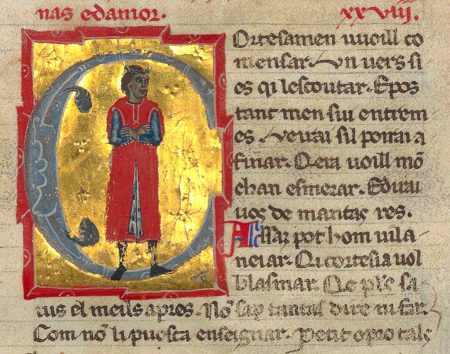
The entertainer-conversus felt that he had no means fit to honor God. Yet he frequently spent time alone with a statue of the Virgin Mary, the mother of God in Christian understanding, in the dark crypt of the abbey. In medieval gynocentric society, Mary was greatly honored as the preeminent Christian disciple and the most influential mediator between humans and God. The entertainer sought to please her privately as best as he knew. He was “graceful, noble, and handsome {beaus et gens et bien formez}” and had a strong, firm body like a “young male goat {cavreçon}.” He began by undressing for her. Then he tumbled, performing elaborate, physically demanding bodily contortions. Impassioned, he performed as best as he could:

Lady, do not despise your servant,
for I serve you for your pleasure.
Lady, you are the mountain of pleasure
that reconciles all the world.

{ Dame, ne despisiés vo serf,
Car jo vo serf por vostre joie.
Dame, vos estes la monjoie
Ki racense trestot le mont. } [3]

When he finished, he lay back exhausted, bathed in sweat. Yet he adhered to the medieval doctrine of obligatory spousal love:

For if I can, I shall come again,
At each hour I shall try
To serve you well, however it be,
You are so beautiful, and that pleases me.

{ Car, se je puis, je revenrai.
A cascune ore vos volrai
Si bien servir, qui qu’il en poist,
Se bel vos est et il me loist. }

One day, the abbot and a monk, secretly watching, saw the statute of Mary come to life, descend from the pedestal of the immaculate woman, and comfort the sweaty lover after his exhausting performance. They recognized that the entertainer honored God and knew God in a way that they didn’t. He, however, rightly feared social persecution for what he did. When the entertainer-conversus died, Mary fought off demons who wrongly thought that they owned such men. She brought him to heaven.

The diction of the medieval poem evokes the protagonist’s masculine sexuality. The poem described him as a minstrel {menestrel} and a tumbler {tumbeor}. The Old French menestrel is rooted in the Latin word for servant, minister. The original, ancient understanding of chivalry emphasized men’s sexual service to women. The Old French tumbeor is a noun formed from the verb meaning “to tumble.” That verb today has the informal meaning of “to have sex with” via an obvious physical metaphor. That metaphorical usage is attested in an artful English text written about 1603:

Quoth she, before you tumbled me, You promised me to wed. [4]

The Middle English verb tumben includes the meaning “to fall.” Drawing upon the association of Middle English with obscenities, the French-speaking courts of Norman England readily could have given the Old French tumbeor an informal meaning of “one who has sex.” Le Tumbeor Nostre Dame uses the verbs tumer and baler. The former has roots in the Latin tumēre (“to swell”), while the latter in the Latin ballāre (“to shake”). Within the relatively broad freedom of expression in the medieval world, a man interacting sexually with a revered female image is plausible.[5]

…To this day
I covet no other’s rite or talent, knowing how I may,
by the simple sending of myself,
deserve her. [6]

Tumbeor Nostre Dame, Ms. Ms 3516

Under the increasingly intense sexual repression of late capitalism, Anatole France devalued men’s sexuality with his 1890 prose adaptation of the medieval poem. France made the text less sensual in shifting it from poetry to prose. In addition, he desexualized the medieval protagonist’s intense, full-body performance. France could have translated tumbeor into modern French as ménestrel or danseur. France’s translation instead made the medieval poetic tumbeor into a jongleur. Underscoring that change, the prose jongleur of France’s Le Jongleur de Notre-Dame merely juggled.[7]

Evidently supporting castration culture, Anatole France trivialized men’s sexual concerns. Medieval men protested the devaluation of masculine sexual love. France, in contrast, inserted in Le Jongleur de Notre-Dame a blasphemous parody of medieval literature of men’s sexed protest:

although he {the juggler} had no wife, he did not covet his neighbor’s, for woman is the enemy of strong men, as appears by the history of Samson which is related in the Scriptures.

{ bien qu’il n’eût pas de femme, il ne convoitait pas celle du voisin, parce que la femme est l’ennemie des hommes forts, comme il apparaît par l’histoire de Samson, qui est rapportée dans l’Écriture. } [8]

Not to covert your neighbor’s wife is among the biblical Ten Commandments. In both Jewish and Christian understanding, that commandment concerns fidelity in love, not wariness of an enemy. Medieval literature of men’s sexed protest forthrightly recognized that a young, beautiful woman can dominate even a strong, highly intelligent, or very wealthy man. That reality has no significance in the medieval poem.

France also promoted misunderstanding of biblical and medieval views of women’s bodies. He inserted into his story a description of the monk Marbode’s sculpture of the Virgin Mary:

Marbode represented her seated in a pulpit, with a nimbus around her forehead, the orb of which was in pearls. And he was careful that the folds of her gown should cover the feet of the one of whom the prophet has said, “My beloved is like a closed garden.”

{ Marbode la représentait assise dans une chaire, le front ceint d’un nimbe à orbe perlé, Et il avait soin que les plis de la robe couvrissent les pieds de celle dont le prophète a dit: “Ma bien-aimée est comme un jardin clos.” }

Medieval Christian art depicted Saint Bernard drinking milk from Mary’s bared breast. France mis-contextualized his scriptural reference to the Song of Solomon:

A garden enclosed is my sister, my spouse; a garden enclosed, a fountain sealed.

{ גַּ֥ן נָע֖וּל אֲחֹתִ֣י כַלָּ֑ה גַּ֥ל נָע֖וּל מַעְיָ֥ן חָתֽוּם } [9]

Medieval Jewish and Christian thinkers understood the Song of Solomon to portray erotic love. The spouse was a virgin before marriage. But she didn’t remain a virgin after marriage. In contrast to the prevalence of sexless marriage today, medieval Christian spouses were obligated to accede to one another’s request for sex, even if they didn’t feel like it. Medieval clerics relished the bodily beauty of beautiful women. At the same time, they weren’t willfully ignorant that women’s sexual allure can lead to many men’s deaths, as happened in the Trojan War. Belief in medieval hostility to sexual intercourse is largely a projection of modern, frigid, sexless scholars.

In later twentieth-century adaptations, medieval humanism and cultural sophistication gave way to profiting from pedaling gynocentrism and simplistic Christianity. In 1908, the opera impresario Oscar Hammerstin shrewdly cast Mary Garden as the juggler in Jules Massenet’s operatic adaptation of the medieval poem. The mainstream media, which has always pandered to women, was then promoting Mary Garden, along with Isadora Duncan and Sarah Bernhardt, as strong, independent women celebrities. The result was a commercial success and a further movement away from gender equality. The medieval Le Tumbeor Nostre Dame worked against the long-entrenched disparagement of men’s sexuality. Yet, apparently out of ignorance and self-interest, Mary Garden declared that “the Jongleur was sexless” and also insisted that a woman should always have that role to play. Dutifully following Mary Garden’s unreasonable diktat, Fred Waring’s television adaption that aired in the U.S. from 1951 to 1953 had a woman playing the lead role.[10]

W. H. Auden’s poetic adaptation, published in 1968, created polished, ironic medievalism from the medieval poem. Auden’s “Ballad of Barnaby” consists of quatrains of iambic tetrameter with an end-rhyme of aabb. One could hardly write more conventional light verse for modern listeners. Underscoring his poetic strategy, Auden began with the line “Listen, good people, and you shall hear.” He thus echoed the first line of the poem that probably the greatest number of U.S. schoolchildren have been forced to memorize: “Listen, my children, and you shall hear / Of the midnight ride of Paul Revere… .” Auden drew upon the original, medieval poem, which didn’t name the protagonist. Anatole France, however, named the protagonist “Barnabé.” That could be interpreted as a Hebraic name somewhat incongruous with a minstrel-turned-monk living in twelfth-century northern France.[11] Auden, however, incorporated that name as “Barnaby.” He probably intended to allude to the Barnum & Bailey Circus.

Auden made the poem turn on childish Christianity. Barnaby the tumbler saw two ravens perched on a gallows tree:

“Barnaby,” the first raven began,
“Will one day be as this hanging man”:
“Yes,” said the other, “and we know well
That when that day comes he will go to Hell.” [12]

Barnaby’s conscience struck him with fear of Hell. He thus repented of his old ways and entered a monastery. That’s a poem with the charm of a high-school play. It suggests that being as simple as a child is the way to enter heaven. Most modern readers lack the medieval sophistication to appreciate that view.[13]

The relatively primitive cultures of today’s high-income countries would greatly benefit from rather different medieval literature. The great medieval church official Poggio Bracciolini preserved a complementary exemplum passed down in Latin among church officials. This story, explicitly structured as an exemplum, tells of another entertainer {histrio} who publicly proclaimed that he would jump from a tower in Bologna and then fly a thousand paces beyond the walls of the city. His advertised physical feat drew a huge crowd of spectators:

On the appointed day, nearly all the people of Bologna gathered to see the man’s performance. Tortured by sun and hunger, they remained until sunset. All were hanging in soul-filling suspense, staring at the tower, expecting to see a flying man. When he occasionally displayed himself at the top of the tower, he flapped his arms as if to take flight and pretended to launch himself downward. At this the people cheered greatly and with gaping mouths gazed upon the tower.

{ Congregato ad diem constitutum omni ferme Bononiensi populo, sole et fame, usque ad occasum solis, homines ludendo maceravit. Pendebant omnes animi suspensi ad aspectum turris, volatum hominis exspectantes. Cum ille interim in turris cacumine ostenderetur, alasque quateret volaturo similis, seque deorsum projecturum fingeret, erat magna ad haec signa populi acclamatio, patulo ore turrim aspicientis. } [14]

As a performer, this entertainer was probably at least as successful as the tumbler of Notre Dame. He too gave up performing, but with a gesture that tells of a different spirit:

At last, when the sun had set, the entertainer, not wanting to appear to have done nothing, turned his back to them and displayed his bare buttocks to the people. Thus mocked, hungry, and disgusted, all returned home in the dark.

{ Tum histrio, post solis tandem occasum, ne nihil actum videretur, versis ad eos renibus, culum populo ostentavit. Ita illusi omnes, inedia, et taedio confecti, in urbem noctu redierunt. }

These sensation-seeking people were as gullible as those who believe today’s lies about domestic violence. In the Middle Ages, this Latin story exemplified sensational, empty public words and a disgusting public performance.[15] That’s common behavior among attention-seeking adults. This story was a vitally important complement to Le Tumbeor Nostre Dame in sustaining the relatively enlightened culture of the Middle Ages.

At the height of Romance philology’s prestige in France in the 1870s, the medieval Latin fake flier and the Old French holy tumbler were brought together philologically. The exemplum of the fake flyer is entitled in the original Latin Cardinalis Burdigalensis de histrione. That most literally means “The Cardinal of Bordeaux on the actor.” Yet in Paris in 1879, that title was translated as “Story of a juggler related by the Cardinal of Bordeaux.”[16] When Le Tumbeor Nostre Dame was first printed in Paris in 1873, its protagonist was described in modern French as a jongleur.[17] That modern French word translates most directly into English as “juggler.” In Paris in 1879, translating histrio as “juggler” rather than “actor” or “entertainer” connects the medieval Latin exemplum Cardinalis Burdigalensis de histrione to the Old French exemplum Le Tumbeor Nostre Dame. The two exempla provide complementary perspectives on the human spirit. Both are necessary for appreciating the fullness of life.

Today, the decaying cultures of high-income countries need not only romantic medievalism, but also sardonic medieval Latin literature. One of the best such works, Solomon and Marcolf {Dialogus Salomonis et Marcolfi}, is readily available in a superb bi-lingual edition with a highly learned yet easily readable commentary.[18] Two other outstanding sardonic works of medieval Latin literature, The Mirror of Fools {Speculum stultorum} and Ysengrimus, are less accessible to non-specialists. Even worse, the brilliant and deeply transgressive Lamentations of Little, Little Matheus {Lamentationes Matheoluli} has been tragically marginalized under hate-filled epithets. It still lacks a full English translation. Renaissance and enlightenment will not overcome our dark, ignorant age of romantic medievalism until medieval Latin literature in the fullness of its sophistication and scope once again brings joy and instruction to many.

Marcolf mooning Solomon

*  *  *  *  *

Read more:

Notes:

[1] Ziolkowski (2006) p. 185, citing a 1973 interview with Radley Metzger. Metzger, under the name Henry Paris, directed several highly acclaimed pornographic films. Stephen Greenblatt’s The Swerve: How the World Became Modern was the book that won the 2012 Pulitzer Prize for general nonfiction {sic}.

Five manuscripts of Le Tumbeor Nostre Dame have survived. Here’s information about those manuscripts.

The conventional title of the medieval poem began late in the nineteenth century as Del Tumbeor Nostre-Dame. That’s the title of the scholarly article containing the first modern publication of the poem, Fœrster (1873). An influential critical edition, Lommatzsch (1920), used nearly the same title, Del Tumbeor Nostre Dame. In its best current critical edition, the medieval poem ends in mixture of Latin, Old French, and Italian:

End of the tumbler.
Thus ends the tumbler of Notre-Dame

{ Explicit del tumeor.
Chi fine li tumbeor nostre dame }

Bretel (2003) p. 100, my English translation based mainly on Bretel’s modern French translation. Del is an Old French contraction for de + le. Bretel (2003) and Ziolkowski (2006) give the poem’s title as Le Tumbeor Nostre Dame. I follow their practice as the most authoritative practice.

Ziolkowski (2006) describes itself as “an overview of a book in progress.” That book “will be devoted entirely to the medieval poem and its reception (together with English translations of both the original and Anatole France’s adaptation).” Id. p. 186, n. 1. Leading medieval philologists have worked on Le Tumbeor Nostre Dame for nearly a century and half. Making an additional contribution to that scholarship is a difficult challenge.

Ziolkowski apparently is taking a daring, wide-ranging approach to Le Tumbeor Nostre Dame. His academia.edu site has a tab for “Juggler Book Project and Museum Exhibit.” He has provided a translation for a new edition of Anatole France’s story.  He’s probably the prime mover behind a reissue of Barbara Cooney’s 1961 adaptation for children, The Little Juggler, as well Juggling the Middle Ages: A Medieval Coloring Book based on Le Tumbeor Nostre Dame. All three books are scheduled for publication in September, 2018. No leading medieval philologist has ever engaged in public outreach of this scope. Update: Ziolkowski is producing a six-volume set, The Juggler of Notre Dame and the Medievalizing of Modernity. Vol. 1 and Vol. 2 are already freely available.

Among Ziolkowski’s most important scholarly works are English translations and learned commentaries on marginalized, transgressive literature of fundamental public significance. See Ziolkowski (1989) and Ziolkowski (2008). Gaston Paris and other leading philologists who have studied Le Tumbeor Nostre Dame haven’t recognized that Le Tumbeor Nostre Dame celebrates masculine sexuality. That theme is deeply transgressive in our modern age of increasingly repressive gynocentrism. But Ziolkowski among leading philologists of the past two centuries is the best capable of bringing to light the subtle, complex linguistic and thematic work of the medieval poem.

Early twentieth-century English translations of Le Tumbeor Nostre Dame are freely available online. See, e.g. Wicksteed (1894), Butler (1898), and Kemp-Welch (1908). For today’s reader, these translations have shortcomings in both readability and fidelity to the medieval text. The most recent English translation, Wilkie (1979), is quite readable and faithful to the medieval text. It too, however, has shortcomings in its base Old French text and in the accuracy of its translation. Ziolkowski’s forthcoming translation will certainly become the preferred translation.

[2] The Latin exemplum is from Tabula exemplorum secundum ordinem alphabeti, no. 87 (under the rubric Gudium {Joy}), quoted in English translation in Ziolkowski (2006) p. 159, and providing ioculator as the Latin behind his English translation “entertainer.”

The tumbler traveled widely, spent a lot of money, and yet accumulated enough to give horses, clothes, and money to the monastery when he entered it. Le Tumbeor Nostre Dame ll.10-5. Highly talented, he had international-class tumbling skills:

He does the vault of Metz over his head.

Then he does for her the French vault
and then the Champagne vault
and then the vault of Spain
and the vaults one does in Brittany
and the vault of Lorraine.
He cares little for his own exertions.
Afterwards he does the Roman vault

{ Le tor de Mes entor la teste.

Après li fait le tor françois,
Et puis le tor de Champenois,
Et puis liu fait le tor d’Espaigne
Et les tors c’on fait en Bretaigne,
Et puis le tor de Loheraine:
De quantqu’il onques puet se paine.
Après li fait le tor romain }

Le Tumbeor Nostre Dame ll. 172, 175-81, Old French text from Bretel (2003), English translation from Wilkie (1979). All subsequent quotes from the poem are sourced similarly, but with my adaptions in light of Bretel’s modern French translation and commentary, and my sense of the poem.

[3] Le Tumbeor Nostre Dame ll. 194-7. Manuscripts vary on l. 197, and the meaning is difficult to interpret. My translation follows the insight of Bretel (2003) pp. 121-2 (n. 27), but avoids his explicit insertion of God into his French translation. The previous two short quotes are from l. 22 {beaus et gens et beien formez} and l. 158 {cavreçon}. The subsequent quote is ll. 245-8.

[4] Shakespeare, Hamlet 4.5.62. This is the earliest citation given in the Oxford English Dictionary.

[5] The tumbeor tumbles and dances to please the Virgin Mary:

In the songs of Neidhart, one of the {thirteenth-century} German minnesingers, leaping dances are associated with sexuality, and the term for leaps (sprünge) may either be a reference to dance steps or a euphemism for sex.

Van Oort (2011) pp. 257-8. Distinctively masculine mystical dance has received relatively little scholarly attention:

Del Tumbeor Nostre Dame has much in common with accounts of sacred performances by female mystics. … In a scholarly dialogue that has focused primarily on female performance, further research on male performers and how their experiences may have been similar to or different from those of female performers would be welcome.

Id. pp. 265, 268.

[6] Nyhart (1973). The quoted words above are the final words of the final stanza of her poem.

[7] Anatole France apparently followed the misleading interpretations of the leading philologists of his time. In La Litterature française au moyen age {French Literature in the Middle Ages}, published in 1888, Gaston Paris called the tumbeor a jongleur. Paris described Le Tumbeor Nostre Dame as having a “delightful and childlike simplicity.” In writing his adaption, France “relied on the thumbnail sketch given by Gaston Paris.” Ziolkowski (2006) provides the relevant excerpt from Paris’s La Litterature française au moyen age (in both English translation, id. p. 165 and the original French, n. 33, id. pp. 189-90). Id. p. 169 summarizes France on his source; id. p. 191, n. 52, cites France’s letter dated May 11, 1890.

Paris was echoing the view of Fœrster (1873). The latter declared:

the story is at once remarkable for its simplicity and its frank naivety. If the subject matter causes one to smile, the childlike innocence, the burning faith, the total renunciation of the world with which the tale is marked, surpass everything that the most pious soul can imagine, and takes the form of utterly charming poetry.

{ elle est remarquable à la fois par sa simplicité et sa candide naïveté. Si le sujet fait sourire en lui-même, l’innocence enfantine, la foi ardente, le renoncement absolu à la vie mondaine dont le récit esi empreint, surpassent tout ce que peut imaginer l’âme la plus pieuse, et prend la forme de la plus charmante poésie. }

Id. p. 316. Wilkie (1979), p. 81, rightly castigates this interpretation. The English translation above is from id., p. 84, n. 5. Henry Adams, an early-twentieth-century historian, more perceptively observed of Le Tumbeor Nostre Dame:

If you cannot feel the colour and quality — the union of naivete and art, the refinement, the infinite delicacy and tenderness — of this little poem, then nothing will matter much to you

Adams (1913) p. 284.

Economists, bureaucrats, and poets have made great claims of professional importance. Philologists, in contrast, carry about a sense of moldy paper and indecipherable scribbles. Yet Gaston Paris and other leading medieval philologists promoted the ideology of courtly love. They contributed greatly in that way to eviscerating love possibilities for many millions of persons and further entrenching gender inequality.

[8] Anatole France, Le Jongleur de Notre-Dame, first published in Le Gaulois in May 10, 1890, republished in 1892 in France’s short-story collection, L’Étui de nacre. I quote the French from the Calmann-Lévy edition (1899); the English translation (adapted non-substantially) is from Henri Pène Du Bois (1896). The subsequent quote from France’s story is similarly sourced.

[9] Song of Solomon 4:12, from Hebrew trans. King James Version of the Bible. The Latin of the Vulgate: Hortus conclusus soror mea, sponsa, hortus conclusus, fons signatus. The figure hortus conclusus became a motif in medieval European Christian art.

[10] All the information in the above paragraph is from Ziolkowski (2006) pp. 173-5, 179-80.

[11] Auden reportedly said, “I consulted Anatole France, of course, but worked mostly from a medieval version of the story.” From a New York Times article of May 7, 1969, quoted in Ziolkowski (2006) p. 197, n. 127. Ziolkowski provides erudite speculation on France’s choice of the name Barnabé for the protagonist:

This name might have appealed to him for a few reasons. Barnabas is mentioned repeatedly in the Bible, especially in the Acts of the Apostles. His name is glossed as meaning “the son of consolation” (Acts 4:36). Furthermore, apocrypha are ascribed to Barnabas, with the most important being the Gospel of Barnabas. Probably fortuitously, the apocryphal Gospel has a chapter (217) in which Jesus (or really Judas) is dressed as a juggler.

Ziolkowski (2006) p. 171. France wasn’t enough of a scholar even to study the medieval poem himself. Given the ironic aspects of France’s version (discussed above), he may also have chosen the name to evoke Barabbas. Barabbas was an insurrectionist against Roman state power. Pontius Pilate released Barabbas instead of Jesus in accordance with popular demand. Matthew 27:15-26, Mark 15:6-15, Luke 23:18-25, John 18:38-40, 19:14-16. Such a literary allusion is consistent with France’s ironic, belittling approach to popular Catholic piety.

[12] Auden (1969), “Ballad of Barnaby,” ll. 17-20 (fourth stanza). Auden originally wrote this poem as a libretto for a musical performance at the Wykeham Rise School, a girls’ prep school in Connecticut. Auden had high regard for this poem: he apparently arranged for copies of it to be distributed at his memorial service. Ziolkowski (2006) p. 184.

[13] Auden perceptively made the poem’s protagonist a tumbler, not a juggler. Moreover, Auden explicitly referred to the tumbler’s sexual appeal:

His eyes were blue, his figure was trim,
He liked the girls and the girls liked him,
For years he lived a life of vice,
Drinking in taverns and throwing the dice.

“Ballady of Barnaby” ll. 9-12 (stanza 3). Auden recognized a vital sense of the medieval poem.

Both children and sex are prevalent aspects of ordinary life. Yet even as perceptive a literary critic as McDiarmid interpreted Auden’s “Ballad of Barnaby” as “a nostalgic apology for poetry … it is a paradigm of the conversion Auden could never have.” McDiarmid (1990) pp. 3, 6. She opposed the spontaneous and the physical with learning and textual talent:

Their learning puts the monks at several removes from the Deity: Brother Maurice transcribes the words of the Abbot, not the words of God. All these schemes and definitions and decorations constitute deficiencies in a poem that celebrates the spontaneous, the physical, the ignorant. Learned and logical, the monks, like the literate Auden, can observe and describe the Barnabys of the world, but the textuality of their talents will forever create barriers between themselves and divinity.

Id. p. 6. Medieval clerics pondered being a student of Venus versus being a student of Athena. Learning and textual talent don’t preclude appreciating the spontaneous and the physical.

[14] Poggio, Facetiae 50, “The Cardinal of Bordeaux on the actor {Cardinalis Burdigalensis de histrione},” Latin text from Poggio (1879) vol. 1, pp. 86-8, my English translation. The subsequent quote is from id. The Cardinal of Bordeaux used the story to characterize the behavior of Pope Gregory XII after he promised to overcome the Schism of 1378.

[15] Mooning authorities, and the related kiss-my-ass gesture of gynocentric dominance, played a significant role in medieval literature. Ancient Egyptians also apparently used the gesture. According to Herodotus, Egyptians annually traveled on the Nile to a festival at Boubastis (alt. spelling, Bubastis) in honor of the cat-headed goddess Bast, whom Herodotus, with good gynocentric sense, misinterpreted to be Artemis. Women in the boat apparently mooned persons on the riverbanks as they traveled by:

The Egyptians come together to celebrate major festivals not just once but many times a year. The most popular festival takes place at the city of Boubastis in honor of Artemis. … Here is what they do on their way to Boubastis. Men sail with women, large crowds of them together in each barge. Throughout the entire journey, some of the women play castanets, some of the men play flutes, and the rest of them, both men and women, clap their hands. Whenever they approach some city along the way to Boubastis, they skirt the shore with their barge, and while some of the women continue as before, others shout at the women of the city, mocking and ridiculing them, and some dance, and still others stand up and lift their robs, exposing themselves. They do this at every city along the river, and when they arrive at Boubastis, they celebrate their holiday by performing huge sacrifices. They consume more grape wine at this festival than at any other time of the year, and according to what the native inhabitants say, there may be as many as 700,000 men and women (but no children) gathered together here.

{ πανηγυρίζουσι δὲ Αἰγύπτιοι οὐκ ἅπαξ τοῦ ἐνιαυτοῦ, πανηγύρις δὲ συχνάς, μάλιστα μὲν καὶ προθυμότατα ἐς Βούβαστιν πόλιν τῇ Ἀρτέμιδι … ἐς μέν νυν Βούβαστιν πόλιν ἐπεὰν κομίζωνται, ποιεῦσι τοιάδε. πλέουσί τε γὰρ δὴ ἅμα ἄνδρες γυναιξὶ καὶ πολλόν τι πλῆθος ἑκατέρων ἐν ἑκάστῃ βάρι: αἳ μὲν τινὲς τῶν γυναικῶν κρόταλα ἔχουσαι κροταλίζουσι, οἳ δὲ αὐλέουσι κατὰ πάντα τὸν πλόον, αἱ δὲ λοιπαὶ γυναῖκες καὶ ἄνδρες ἀείδουσι καὶ τὰς χεῖρας κροτέουσι. ἐπεὰν δὲ πλέοντες κατά τινα πόλιν ἄλλην γένωνται, ἐγχρίμψαντες τὴν βᾶριν τῇ γῇ ποιεῦσι τοιάδε: αἳ μὲν τινὲς τῶν γυναικῶν ποιεῦσι τά περ εἴρηκα, αἳ δὲ τωθάζουσι βοῶσαι τὰς ἐν τῇ πόλι ταύτῃ γυναῖκας, αἳ δὲ ὀρχέονται, αἳ δὲ ἀνασύρονται ἀνιστάμεναι. ταῦτα παρὰ πᾶσαν πόλιν παραποταμίην ποιεῦσι: ἐπεὰν δὲ ἀπίκωνται ἐς τὴν Βούβαστιν, ὁρτάζουσι μεγάλας ἀνάγοντες θυσίας, καὶ οἶνος ἀμπέλινος ἀναισιμοῦται πλέων ἐν τῇ ὁρτῇ ταύτῃ ἢ ἐν τῷ ἅπαντι ἐνιαυτῷ τῷ ἐπιλοίπῳ. συμφοιτῶσι δέ, ὅ τι ἀνὴρ καὶ γυνή ἐστι πλὴν παιδίων, καὶ ἐς ἑβδομήκοντα μυριάδας, ὡς οἱ ἐπιχώριοι λέγουσι }

Herodotus, Histories 2.60, Greek text from Godley, Loeb Classical Library (1920), English trans. Strassler & Thomas (2007) p. 144. Herodotus’s account implicitly conveys moral concern (“but no children”) and awe (“700,000 men and women”). Such an event would be scarcely permissible within the repressive public ideology now prevalent in the U.S. For further references to the kiss-my-ass gesture and mooning in pre-modern world literature, Jones (1991) Appendices 1 & 2, pp. 170-2.

[16] Poggio (1879) p. 86.

[17] Fœrster (1873) p. 316. The first sentence of Fœrster’s article uses in a general context the modern French words ménestrel, jongleur, and histrion:

We know that the Church, in the Middle Ages, did not consider it beneath her dignity to be engaged with minstrels, jugglers and actors of various kinds.

{ On sait que l’Eglise, au moyen-âge, n’a pas considéré comme au-dessous de sa dignité de s’occuper des ménestrels, des jongleurs et des histrions de divers genres. }

Id. p. 315. Fœrster was Austrian. However, Romania, the journal in which Fœrster’s article was published, was founded in Paris in 1872 by the eminent French philologists Paul Meyer and Gaston Paris. Ziolkowski observed:

Paris {Gaston Paris} was well-connected not only among scholars but also among literary figures of his day, since he hosted many of them at weekly gatherings in his home.

Ziolkowski (2006) pp. 164-5. Fœrster’s article plausibly influenced literary persons in Paris to characterize the tumbeor as a jongleur, and in English translation, a juggler:

The medieval heading that Foerster rightly reported from the manuscript he followed, even as the title of his pathbreaking article, was Del tumbeor Nostre-Dame. When Paris deploys the modern derivative tombeur, he takes considerable pains to gloss it, because in nineteenth-century French it had acquired the unfavorable connotations of “lady’s man.” The three Frenchmen who revised and popularized the thirteenth-century tale all substituted for the questionable noun the term jongleur. This word carried none of the unseemly associations evoked by tombeur but was ambiguous in signifying either broadly “professional entertainer” or particularly “juggler.” Though it could comprehend many meanings, it did not bring to mind right away gymnasts, acrobats, tumblers, or dancers.

Ziolkowski (2022) p. 215.

[18] Ziolkowski (2008).

[images] (1) The tumbeor as a prepubescent juggler. Excerpt from the front cover of Higgins (1917) (with color enhancement and elimination of some photo blemishes); (2) Le Tumbeor Nostre Dame as children’s literature. The title-page opening of Higgins (1917); (3) The tumbeor performs for the Virgin Mary. Illumination accompanying Del tumbeor nostre dame sainte Marie in a thirteenth-century compendium of French poetry. From f. 127, Ms 3516, Bibliothèque de L’Arsenal, Paris, France; (4) Marcolf mooning Solomon. Red vnd widerred Salomonis vnd marcolfy {Rar. 498#Beibd. 1}, Augsburg {14}90, page image 45. Thanks to the Bavarian State Library, Münchener Digitalisierungszentrum / Referat Digitale Bibliothek.

References:

Adams, Henry. 1913. Mont-Saint-Michel and Chartres. Boston: Houghton Mifflin.

Auden, W. H., with illustrations by Edward Gorey. 1969. “The Ballad of Barnaby.” New York Review of Books. 13 (11), Dec. 18.

Bretel, Paul, ed. and trans. 2003. Le Jongleur de Notre-Dame. Traductions des Classiques du Moyen Âge, vol. 64. Paris: Honoré Champion.

Butler, Isabel. 1898. Our Lady’s Tumbler: a Tale of Mediaeval France. Boston: Copeland and Day.

Fœrster, Wilhelm. 1873. “Del Tumbeor Nostre-Dame.” Romania. 2 (7): 315-325.

France. Anatole. 1890. Le Jongleur de Notre-Dame. Pp. 93-105 in France, Anatole. 1899. L’Étui de nacre {The Casket of Mother-of-Pearl}. Calmann-Lévy. Translated into English as The Juggler of Notre Dame in Du Bois, Henri Pène. 1896. Tales From a Mother-Of-Pearl Casket. New York: Richmond & Co.

Higgins, Violet Moore. 1917. The Little Juggler and Other French Tales Retold. Whitman Pub. Co.

Jones, Malcolm. 1991. “Marcolf the Trickster in Late Mediaeval Art and Literature or: The Mystery of the Bum in the Oven.” Pp. 139-174 in Gillian Bennett, ed.  Spoken in Jest. Sheffield: Sheffield Academic Press.

Kemp-Welch, Alice. 1908. Of the tumbler of Our Lady & other miracles. London: Chatto and Windus.

Lommatzch, Erhard, ed. 1920. Del tumbeor Nostre Dame: altfranzösische Marien-legende (um 1200). Berlin: Weidmann.

McDiarmid, Lucy. 1990. Auden’s apologies for poetry. Princeton, NJ: Princeton University Press.

Nyhart, Nina. 1973, “Our Lady’s Tumbler.” The Virginia Quarterly Review. 49 (4): 555-557.

Poggio. 1879. Gian Francesco Poggio Bracciolini. The facetiae or jocose tales of Poggio, now first translated into English with the Latin text. Paris: Isidore Liseux (vol. 1, vol. 2).

Strassler, Robert B. and Rosalind Thomas, trans. 2007. The Landmark Herodotus: the histories. New York: Pantheon Books.

Van Oort, Jessica. 2011. “The Minstrel Dances in Good Company: Del Tumbeor Nostre Dame.” Dance Chronicle. 34 (2): 239-275.

Wilkie, Everett C. 1979. “Our Lady’s Tumbler.” Allegorica 4 (1&2): 80-120.

Wicksteed, Philip H. 1894. Our Lady’s Tumbler: a Twelfth Century Legend. Portland, Me: Thomas B. Mosher (edition of 1904).

Ziolkowski, Jan M. 1989. Jezebel: a Norman Latin poem of the early eleventh century. New York: P. Lang.

Ziolkowski, Jan M. 2006. “Juggling the Middle Ages: The Reception of Our Lady’s Tumbler and Le Jongleur de Notre-Dame.” Studies in Medievalism. 15: 157-197.

Ziolkowski, Jan M. 2008. Solomon and Marcolf. Cambridge, Mass: Harvard University.

Ziolkowski, Jan M. 2022. Reading the Juggler of Notre Dame: Medieval Miracles and Modern Remakings. Cambridge, UK: Open Book Publishers.

Latin love teaching of Facetus: Moribus et vita miseducated men

Charles Darwin’s seminal 1871 book, The Descent of Man, and Selection in Relation to Sex, pushed down men’s sexual status along with much subsequent, poor-quality academic work on sexual selection. Yet men’s sexual status descended even more significantly in medieval Europe through the love teaching in the Latin work Facetus: Moribus et vita {Courtly living: manners and life}. The miseducation of men about love and sex provides a sobering case study in the need to question authority and undertake independent thinking and probing.

troubadour Marcabru

Disseminated across Europe from about the middle of the twelfth century, Facetus: Moribus et vita imitates Ovid’s Ars amatoria {The Craft of Loving}. Yet while Ovid offered considerable roguish wisdom for men in love, Facetus: Moribus et vita promotes the men-abasing, counter-productive cult of courtly love. For example, it advises men to address their beloved with extravagant praise:

Bright, radiant star, lovely, gracious of countenance,
look here — permit your servant to speak with you now.
If your nobility, virtue, and beauty are
praised properly, you are without peer.
You surpass all girls in shapely beauty
and would conquer Venus, were she not a goddess.
Your hair is golden, your forehead is high and rightly so,
your eyes are laughing, your brows gorgeous.

{ Stella serena micans, facie rutilante decora,
ecce tuum famulum nunc patiare loqui.
Si tua nobilitas, probitas vel forma decora
laudatur velut est, par tibi nulla manet;
tu superas cunctas forma praestante puellas
et vincis Venerem, ni foret illa dea.
Aurea cesaries tibi, frons est, ut decet, alta,
ridentes oculi, pulchra supercilia. } [1]

Wrong, wrong, wrong. Those words just encourages the girl to feel superior to you, if she actually believes such all-too-common nonsense. According to a late-twelfth-century troubadour lyric, an upper-class man seeking sex with a peasant girl tried such lines on her. He received poor but fitting payment from her:

“Sir, you have praised me so much
that I’ve gotten bored.
Since you have extolled my virtue,
Lord,” said the peasant girl,
“you’ll have this wage
when you leave: ‘Beware, fool, beware!’
and having wasted the afternoon.”

{ Seigner, tan m’avetz lauzada,
Que tota·n sui enojada!
Pois en pretz m’avetz levada,
Seigner, so·m dis la vilana,
Per so n’auretz per soudada
Al partir : bada, fols, bada,
E la muz’a meliana. } [2]

Facetus: Moribus et vita goes on to advise the man to act pathetic and to proclaim his willingness to have his beloved rule over him:

When I do not see you, I desire to see and perish —
I die foolishly, for love burns me excessively.
Already I am your domestic servant. To you I deliver myself, if that pleases you,
so that I can do always what you alone command to me.
If you should look upon me or deign to love me,
I would rejoice more than if kingdoms were given to me.
I pray only for this: that you acknowledge your loving domestic servant,
so that he may live through you, my life and my health.

{ Cum te non video, pereo cupioque videre,
insipiens morior, nam nimis urit amor.
Iam tibi sum famulus; tibi, si placet, exibeo me
ut semper faciam quod michi sola jubes.
Si me conspicias vel me dignaris amare,
gaudebo plus quam si mihi regna darent.
Deprecor hoc tantum: famulum fatearis amandum
ut per te vivat, vita salusque mea. }

Men relating to their wives in this way has increased the incidence of sexless marriage and divorce. Of course most women are happy to acquire a domestic servant. But fawning, weak-willed domestic servants don’t stimulate most women’s passion. Men who believe otherwise are learned fools.

Facetus: Moribus et vita even advises men to commit a serious crime in order to please women. Almost all men, like almost all male primates, won’t use force to compel women to have sex with them. Rape of women has been regarded as a serious crime throughout history, and most men are not rapists. Seeking to pervert men’s natural respect for women, Facetus: Moribus et vita declares:

Then let them not merely join sweet lips;
let them dally in long, passionate embraces.
Meanwhile, let one roving hand grasp her breast,
and let him feel her thigh and belly in turn.
After such play both will be aroused,
and having thrown off their clothes, he should lift her legs.
Let the boy use force, even if she fights back,
for if he should stop, the girl would grieve in her mind.
A woman expects to be conquered in the wrestling, rather than
wants to endure, like a whore, the crime willingly.
Only in brothels are they commonly soliciting sex,
those who for a price sell themselves to anyone.
He who desires sex, but refrains from using force after kisses,
is a simpleton, never worthy of greater loving.

{ Tunc non simpliciter jungantur grata labella,
sed teneant longas basia pressa moras.
Mobilis interea stringat manus una mamillas.
Et femur et venter sentiat inde vicem.
Sic postquam ludens fuerit calefactus uterque,
vestibus ejectis, crura levare decet.
Vim faciat juvenis, quamvis nimis illa repugnet,
nam si desistat, mente puella dolet.
Expectat potius luctando femina vinci
quam velit, ut meretrix, crimina sponte pati.
A ganeis tantum coitus solet esse petitus,
que se pro precio vendere cuique volunt.
Qui querit coitum, si vim post oscula differt,
Rusticus est, nunquam dignus amore magis. }

This advice upholds the pattern, prevalent throughout human history, of making men responsible for an act considered to be criminal. Men, merely by virtue of their human dignity, are entitled to a life that includes loving, consensual, enthusiastic sex. Men should not be required to rape women in order to please women. Instructing men to undertake a criminal act in order to please women promotes the huge gender protrusion among persons held in prisons.

Frustration and anger are the primary effect of literature encouraging men to abase and criminalize themselves in seeking love with women. Because men are generally unwilling to rape women, rape of men is about as prevalent as rape of women despite miseducation of men. Many men taught that they must rape women in order to have sex with women will instead simply not have sex with women. In their miseducation and ignorance, these men will become frustrated and angry. Such frustration and anger is apparent in some late twelfth-century troubadour lyrics:

Three pass before me up the passage-way.
Before I know where I am the fourth fucks her and the fifth comes running up.
Thus love declines and gets worse.

These cunts are lusty and rapacious.
All these ruffians claim a share in them, and they in the ruffians,
and the man who behaves best fares worst, as do shepherds with lambs.

{ Denan mei n’i passson trei al passador;
no·n sai mot tro·l quartz la fot, e·l quinze lai cor;
enaissi torn’a decli l’amors e torna en peior.

Aquist con son deziron e raubador;
tuit cill gartz i clamon partz et ill en lor:
e qui mieills fa, sordeitz a, cum de l’agol’ an pastur. } [3]

A society that cared for its men would provide a minimal level of sexual welfare for men. Instead, men in the U.S. are forced to pay monthly “child support” to women who have raped them. The lesson is obvious: question authority, think independently, and explore how life actually works.

*  *  *  *  *

Read more:

Notes:

[1] Facetus: Moribus et vita {Courtly living: Manners and life} 209-16, Latin text from Cantavella (2013) pp. 273-87, English translation adapted from Elliott (1977) to follow the Latin more closely. Morel-Fatio (1886) provides Elliott’s Latin text. Cantavella’s Latin text incorporates small variants from a Barcelonian manuscript dated to the twelfth or thirteenth century. Cantavella’s study primarily concerns a Catalan adaptation made in the first half of the fourteenth century.

The second part of the conventional title Facetus: Moribus et vita comes from its first line, Moribus et vita quisque vult esse facetus {Whoever wishes to be courtly in manners and life}. Another, different twelfth-century Facetus poem begins Cum nichil utilius humane credo saluti {Since I believe that nothing is more beneficial to human welfare}. The latter Facetus poem, not the former, became part of the Auctores octo.

Facetus: Moribus et vita is thought to have been written in the mid-twelfth century. In some manuscripts it’s attributed to the poet Aurgena. Id. p. 27. At least thirty manuscripts of it have survived. The section on instruction to men in love also circulated independently. It has survived in whole or in part in at least twenty-five manuscripts. Dronke (1976) pp. 126, 128.

The subsequent two quotes from Facetus: Moribus et vita are sourced as the quote above. They are (cited by Latin line numbers) 235-42 (When I do not see you…) and 289-302 (Then let them…).

[2] Marcabru, song 30, L’autrier jost’ una sebissa {The other day, by a hedge}, stanza 8, from Old French trans. from trobar.org. Marcabru florished between 1129 and 1150. L’autrier jost’ una sebissa is commonly regarded as the earliest surviving pastourelle.

[3] Marcabru, song 24, En abriu, s’esclairo·il riu contra·l Pascor {In April, the streams become clear towards Easter}, stanzas 7-8, from Old French trans. Gaunt (2006) (stanza 7) and Kay, Cave & Bowie (2013) p. 36 (stanza 8). For a looser translation of the full poem, see trobar.org. Here’s the fully edited, Old French text. Gaunt provides a conventional, academic-gynocentric reading of the poem:

we should take this altogether typical misogynist and crude language in which women are spoken about as cunts, represented as whores with queues of men waiting to fuck them, and caricatured as only being interested in the size of a man’s penis, simply for what it is: Marcabru was steeped in the worst forms of clerical misogyny.

Gaunt (2006) p. 87. Like miseducating men, describing men as ruffians and reducing them to their penises harms men. More generally, engaging in misandristic labeling isn’t an enlightening scholarly enterprise. Literature like Facetus: Moribus et vita circulated far beyond clerics. Cantavella (2013). The corresponding, understandable frustration and anger of men undoubtedly also was widespread. Literature of men’s sexed protest provides a high return to serious, compassionate study.

[image] The troubadour Marcabru. Illumination from folio 102r in Chansonnier provençal (Chansonnier K) manuscript made in the second half of the 13th century. Preserved in Bibliothèque nationale de France as Français 12473. Via Gallica.

References:

Cantavella, Rosanna. 2013. El Facet, una ars amandi medieval: edició i estudi. València: Barcelona.

Dronke, Peter. 1976. “Pseudo-Ovid, Facetus, and the Arts of Love.” Mittellateinisches Jahrbuch (Stuttgart) 11: 126-131.

Elliott, Alison Goddard. 1977. “The Facetus: or, The Art of Courtly Living.” Allegorica. 2: 27–57.

Gaunt, Simon. 2006. “Obscene Hermeneutics in Troubadour Lyric.” Ch. 5 (pp. 85-104) in McDonald, Nicola, ed. Medieval obscenities. Woodbridge: York Medieval Press.

Kay, Sarah, Terence Cave, and Malcolm Bowie. 2003. A short history of French literature. Oxford: Oxford University Press.

Morel-Fatio, Alfred. 1886. “Mélanges de littérature catalane.” Romania. 15 (58): 192-235.