al-Jahiz shows alternative to Ziolkowski’s magnanimity

In the opening acknowledgements to his seminal and magisterial critical edition of Solomon and Marcolf, eminent professor Jan Ziolkowski thanked numerous persons. Ziolkowski even went as far as to thank students:

The second group of those who merit appreciation is the audience of students, in both large lecture courses and small language classes at Harvard University, upon whom over the past decade I have inflicted draft translations of the Medieval Latin S&M. The glee that these readers have taken in both the subversive earthiness of Marcolf and the authoritative schoolishness of Solomon played no small part in my decision to complete the undoing of my reputation among my colleagues by publishing this project. [1]

Ziolkowski thus credited his intellectual daring and courage to his students. Moreover, Ziolkowski exonerated all who had helped him for any errors in his critical edition:

All of them are entitled to exculpation for any remaining errors and infelicities. [2]

Monograph authors commonly conclude acknowledgments by accepting personal responsibility for any remaining errors. For a book that’s not much more than the author’s subjective interpretation of literature, that’s not much more than taking responsibility for one’s own thoughts.

Error in a critical edition is a much different beast. Consider:

est largior in dando: ist mult zu beczalen den man α. Mulier pinguis et grossa est larior in dando iussa: Cattus (Catta MN) piguis et grossa est tardior (tardus L) in murium captura LlMm; Nn has both versions. dando: danda C. iussa: fissa Gg; lacking in S. [3]

What if iussa actually isn’t lacking in S? Philologists swing battle axes over lesser offenses. How could anyone dare to accept responsibilities for all errors in a critical edition? After all, an author cannot be expected to verify personally all the factual grammatical etymological linguistic textual scribal details that go into a critical edition. Some mistakes might really be someone else’s fault!

The eminent ninth-century Arabic scholar and author al-Jahiz shows a much less magnanimous alternative for distributing credit for work and responsibility for errors. Al-Jahiz’s masterful On Misers begins with a formal address to the book’s anonymous patron. That address concludes with a disclaimer:

I have written down numerous tales for you, many with their author’s names attached, others with no attribution to their authors, either out of fear of them or out of respect for them. Had you not asked me for this book, I would certainly neither have gone to the trouble of writing it, nor exposed myself to ill treatment and retaliation. So if this book be reproached or have weaknesses, it’s your fault; but if there be success, it’s mine not yours! [4]

Later in his book, al-Jahiz declares:

If in this book you come across any solecism, words lacking grammatical inflection, or improper expression in my source, please realize that I have left them out on purpose. Applying the correct rules of grammar to those words would spoil the charm of our stories and blunt their edge. But I have retained the errors where I offer words of those misers with pretensions to intellectuality and words of such avaricious house scholars as Sahl ibn Harun and the likes of him. [5]

Al-Jahiz might appear to be rude, crude, and unlearned. But those who study his book closely recognize his literary genius. His book is On Misers. Misers is a topic plausibly related to the implied author’s lack of magnanimity toward others.

*  *  *  *  *

Read more:

Notes:

[1] Ziolkowski (2008) pp. ix-x. The subsequent quote is from id. Solomon and Marcolf should be required reading for all college students.

[2] Ziolkowski thus followed the practice documented in an ancient Latin epigram:

si placet commune est, si displicet nostrum

{ if it pleases, credit belongs to the community; if it displeases, the blame is ours }

[3] Id. p. 251 (Textual Notes on Part 1, Prologue 14b). Here’s some relevant discussion (see in particular note [1]).

[4] al-Jahiz, On Misers (al-Bukhalāʼ), from Arabic trans. Serjeant (1997) p. 7, adapted non-substantially for readability. The proper transliteration of al-Jahiz is al-Jāḥiẓ. I use the former form because non-specialists are more likely to search using that form.

[5] al-Jahiz, On Misers, last paragraph before section on Ahmad ibn Khalaf, my adaption of the translation of Serjeant (1997) p. 32, with help from Colville (1999) p. 40. The manuscript witnesses to On Misers are sparse and full of errors. Serjeant generally provides a more exact scholarly translation, while Colville’s translation is generally more readable.

The translations of the above passage have some significant differences. Serjeant’s translation is:

If, in this book, you come across any solecism, or speech wanting in grammatical inflection, or an expression misapplied from its proper sense, you should know that I have left it out because grammatical inflection makes this kind (of story-telling) obnoxious and removes it from its own sphere, except when I retail some of the speech of those misers with pretensions to intellectuality and of such avaricious ulema as Sahl b. Hārūn and the likes of him.

Colville’s translation is:

If you come across any grammatical errors in this book, non-Arabic words or colloquial expressions, please realise that they have been left in on purpose. Applying the correct rules of grammar would spoil the charm of our stories and blunt their edge. The exception to this is when I quote from what pseudo-intellectual skinflints and cheapskate scholars, such as Sahl ibn Haroun, have to say.

The translation above is my attempt to provide a translation for readers with no knowledge of Arabic literature or culture. My translation is based on Serjeant’s and Colville’s translations, plus my sense of the meaning of the text given my understanding of how al-Jahiz writes. If the above translation is in error, everyone is responsible, but I am more responsible than all others.

References:

Colville, Jim, trans. 1999. Abū ʻUthman ibn Baḥr al-Jāḥiẓ. Avarice & the avaricious {Kitâb al-Bukhalāʼ}. London: Kegan Paul.

Serjeant, R.B., trans. 1997. Abū ʻUthman ibn Baḥr al-Jāḥiẓ. The book of misers: a translation of al-Bukhalāʼ. Reading: Center for Muslim Contribution to Civilization.

Ziolkowski, Jan M., ed. and trans. 2008. Solomon and Marcolf. Cambridge, Mass: Harvard University.

Cato the Elder understood Pythionice’s public prominence

Ceres, Roman counterpart to Greek goddess Demeter

Anyone who doesn’t consider Eros the most important god
is either stupid, or lacks experience of what is good
and fails to realize who is the most significant god for mortals.

{ ὅστις <δ᾿> Ἔρωτα μὴ μόνον κρίνει θεόν,
ἢ σκαιός ἐστιν ἢ καλῶν ἄπειρος ὢν
οὐκ οἶδε τὸν μέγιστον ἀνθρώποις θεόν. }[1]

In ancient Greece, the largest tomb monument on the Sacred Way into Athens didn’t belong to any of the great Athenian political leaders, who were all men. The largest tomb monument honored Pythionice. She was a beautiful prostitute who helped to realize the progressive, democratic welfare program of the wise law-maker Solon. Comparing the formal status of women and men has promoted the false cult of patriarchy. Women like Pythionice have always been the most powerful persons in urbanized human societies.

Pythionice was a pioneer of democratic welfare reform. Prostitutes throughout history have favored serving the men who would pay the most money for sex. Pythionice, however, burned with the democratic spirit kindled in fifth-century Athens. Herself a third-generation descendant of slaves and whores, she made herself “available to anyone who wanted her at a minimal price {ὀλίγης δαπάνης κοινὴν τοῖς βουλομένοις γιγνομένην}.”[2] She thus worked to reduce the most significant inequality in human societies.

Pythionice was honored in death beyond any man. Harpulus, an aristocrat who served as director general of the royal treasury for his childhood friend Alexander the Great, adored Pythionice. She was everything he wasn’t and could never be. He built great tombs for her in Athens and Babylon. A ancient historian complained to Alexander about Harpulus’s honoring of Pythionice:

Harpulus spent over 200 talents building two tombs for her. This shocked everyone, given that neither he nor any other official has yet set up a marker at the burial spot of the men who died in Cilicia to secure your kingdom and the freedom of the Greeks, whereas people will see that the tombs of the courtesan Pythionice, one in Athens, the other in Babylon, have long been completed. …  Harpulus, a man who claims to be your friend, had the audacity to construct a temple and a sanctuary in her honor, and to refer to the temple buildings and the altar as belonging to Pythionice Aphrodite, both ignoring the revenge the gods might take on him and doing his best to trample in the mud the honors due to you.

{ ἀπὸ πλειόνων δὲ ταλάντων ἢ διακοσίων δύο μνήματα κατεσκεύασεν αὐτῆς· ὃ καὶ πάντες ἐθαύμαζον, ὅτι τῶν μὲν ἐν Κιλικίᾳ τελευτησάντων ὑπὲρ τῆς σῆς βασιλείας καὶ τῆς τῶν Ἑλλήνων ἐλευθερίας οὐδέπω νῦν οὔτε ἐκεῖνος οὔτ᾿ ἄλλος οὐδεὶς τῶν ἐπιστατῶν κεκόσμηκε τὸν τάφον, Πυθιονίκης δὲ τῆς ἑταίρας φανήσεται τὸ μὲν Ἀθήνησι, τὸ δ᾿ ἐν Βαβυλῶνι μνῆμα πολὺν cἤδη χρόνον ἐπιτετελεσμένον. … ταύτης ἐτόλμησεν ὁ φίλος εἶναι σοῦ φάσκων ἱερὸν καὶ τέμενος ἱδρύσασθαι καὶ προσαγορεῦσαι τὸν ναὸν καὶ τὸν βωμὸν Πυθιονίκης Ἀφροδίτης, ἅμα τῆς τε παρὰ θεῶν τιμωρίας καταφρονῶν καὶ τὰς σὰς τιμὰς προπηλακίζειν ἐπιχειρῶν. }[3]

Men conscripted into armies and dying fighting for their country matters little in public discourse relative to women’s voluntary, non-fatal sexual service. Men honor women as de facto the greatest gods.

Women rule as gods in mundane ways. Consider the ancient Greek courtesan Gnathaena:

Gnathaena was extremely witty and sophisticated in conversation, and composed a set of dinner regulations, which her lovers were required to follow when they visited her and her daughter, in imitation of the philosophers who put together similar documents. … This set of regulations was drafted to be equitable and to apply to everyone. It was 323 lines long.

{ ἐμμελὴς δ᾿ ἦν πάνυ ἡ Γνάθαινα καὶ οὐκ ἀνάστειος ἀποφθέγξασθαι, ἥτις καὶ νόμον συσσιτικὸν συνέγραψεν, καθ᾿ ὃν δεῖ τοὺς ἐραστὰς ὡς αὐτὴν καὶ τὴν θυγατέρα εἰσιέναι, κατὰ ζῆλον τῶν τὰ τοιαῦτα συνταξαμένων φιλοσόφων. … ὅδε ὁ νόμος ἴσος ἐγράφη καὶ ὅμοιος, στίχων τριακοσίων εἴκοσι τριῶν. }[4]

Highly detailed sex regulations currently being enacted at U.S. colleges and universities are much more extensive than Gnathaena’s regulations, but the spirit is the same. So too is the attitude in enforcing them:

After all these dishes, a slave came carrying a large number
of testicles. The other women pretended not to notice them,
but the man-slaying Gnathaena laughed
and said, “What nice kidneys, by the beloved
Demeter!” And she grabbed two and gobbled them down.

{ ἔπειτ᾿ ἐπὶ τούτοις πᾶσιν ἧκ᾿ ὄρχεις φέρων
πολλούς. τὰ μὲν οὖν γύναια τἆλλ᾿ ἠκκίζετο,
ἡ δ᾿ ἀνδροφόνος Γνάθαινα γελάσασα < . . . >
“καλοί γε”, φησίν, “οἱ νεφροί, νὴ τὴν φίλην
Δήμητρα.” καὶ δύ᾿ ἁρπάσασα κατέπιεν }[5]

The ancient Greek goddess Demeter was often known under the cult title Thesmophoros (“Bringer of Divine Law”).[6] The real threat of castration, obscured with ridicule, trivialization, and scholarly verbiage, serves to suppress men’s sexuality and keep men subordinate to women.

In Rome about 2200 years ago, Cato the Elder (also known as Cato the Wise) understood women’s rule. Cato quickly became a stock figure for the traditionalist — the white-knight woman server ridiculed for supporting enormous gender inequality in instructing children. Yet alongside his silly traditionalism, Cato had keen insight into women’s power:

He used to say that the man who struck his wife or child, laid violent hands on the holiest of holy things. Also that he thought it more praiseworthy to be a good husband than a good senator … Discoursing on the power of women, he said: “All other men rule their wives; we rule all other men, and our wives rule us.”

{ τὸν δὲ τύπτοντα γαμετὴν ἢ παῖδα τοῖς ἁγιωτάτοις ἔλεγεν ἱεροῖς προσφέρειν τὰς χεῖρας. ἐν ἐπαίνῳ δὲ μείζονι τίθεσθαι τὸ γαμέτην ἀγαθὸν ἢ τὸ μέγαν εἶναι συγκλητικόν· … περὶ δὲ τῆς γυναικοκρατίας διαλεγόμενος “Πάντες,” εἶπεν, “ἄνθρωποι τῶν γυναικῶν ἄρχουσιν, ἡμεῖς δὲ πάντων ἀνθρώπων, ἡμῶν δὲ αἱ γυναῖκες.” }[7]

Of course, rational, forward-looking men don’t get married. Moreover, one shouldn’t be too traditionalist, prudish, or idealistic to recognize that many women effectively work as prostitutes or courtesans (as many men do more metaphorically in their workplaces). Yet Cato with his wisdom recognized a subtle, fundamental truth: women rule. Liberation from ancient, oppressive structures of gynocentrism is the greatest social-justice challenge facing societies today.

*  *  *  *  *

Read more:

Notes:

[1] Euripides (from Auge, according to Stobaeus), quoted in Athenaeus of Naucratis, The Learned Banqueters {Deipnosophistae} 13.600d, from Greek trans. Olson (2006-12) vol. 7, p. 33. I’ve adapted the translation to be non-sexist.

[2] Theopompus, Letter to Alexander, quoted in Athenaeus 13.595b, trans. id, p. 7 (modified insubstantially). The subsequent quote is similarly from id., 13.595b-c. Pythionice lived in Athens in the fourth or third century BGC. McClure (2003) p. 192. In addition to Athenaeus, the Greek historians Diodorus Siculus (first-century BGC) and Pausanias (second century GC) tell of Harpalus building a massive funerary monument for Pythionice. Diodorus Siculus, Library of History (Bibliotheca historica) 17.108.5. Pausanias, Description of Greece 1.37.5.

[3] The men who died fighting for Alexander’s empire in Cilicia fought in the battle of Issus (333 BGC).

[4] Athenaeus 13.585b-c, trans. Olson (2006-12) vol. 6, p. 381. The text before the ellipsis is from the deipnosophist Myrtilus; the text after the ellipsis is quoted from Callimachus, Laws, third tablet.

[5] Philippides, Rejuvenation {Ananeosis}, quoted in Athenaeus 9.384e-f, trans. Olson (2006-12) vol. 4, pp. 281, 283, modified slightly, including using the more literal “man-slaying” for Olson’s “bloodthirsty.” Gnathaena in ancient Greek means “Jaws.” McClure (2003) p. 89. Id. shows no awareness of the prevalence of violence against men, and no awareness that trivializing violence against men’s genitals is part of the structure of gender oppression.

[6] A tenth-century Greek scholion to Lucian, Dialogues of the Courtesans {Ἑταιρικοὶ Διάλογοι} 2.1, declares:

Demeter is given the epithet “Lawgiver” for having set down customs, which is to say laws, under which men have to acquire and work for their food.

Rabe (1906) translation, quoted (with incorrect attribution) in O’Higgins (2003) p. 22. Women set the laws by which men work. The scholion further stated that the festival Thesmophoria “civilized the race of humans.” The gender-derogatory banality that women are necessary to civilize men became a key component of the late-twentieth-century celebration of men-oppressing courtly love. With respect to the Thesmophoria:

Only women took part, although it required the support — financial and otherwise — of the men in the community.

Id. p. 22. The Thesmophoria thus provided a forerunner of the gender structure of today’s child custody and child support laws in action.

[7] Plutarch, Parallel Lives, Life of Cato the Elder (Marcus Porcius Cato) 20.2, 8.2, from Greek trans. Bernodotte Perrin (1914), Loeb Classical Library, adapted non-substantially. Plutarch stated that this is wisdom that Cato translated into Latin from a Greek saying of Themistocles:

This, however, is a translation from the sayings of Themistocles. He, finding himself much under his son’s orders through the boy’s mother, said: “Wife, the Athenians rule the Greeks, I rule the Athenians, you rule me, and your son, you. Therefore let him make sparing use of that authority which makes him, child though he is, the most powerful of the Greeks.”

{ τοῦτο μὲν οὖν ἐστιν ἐκ τῶν Θεμιστοκλέους μετενηνεγμένον ἀποφθεγμάτων. ἐκεῖνος γὰρ ἐπιτάττοντος αὐτῷ πολλὰ τοῦ υἱοῦ διὰ τῆς μητρός “Ὦ γύναι,” εἶπεν, “Ἀθηναῖοι μὲν ἄρχουσι τῶν Ἑλλήνων, ἐγὼ δὲ Ἀθηναίων, ἐμοῦ δὲ σύ, σοῦ δὲ ὁ υἱός, ὥστε φειδέσθω τῆς ἐξουσίας, δι᾿ ἣν ἀνόητος ὢν πλεῖστον Ἑλλήνων δύναται.” }

Id. 8.3, sourced similarly, with modernized English. Themistocles jokingly referred to the child as the ultimate ruler. On the solicitousness of fathers toward their daughters, Hallett (1984) pp. 109-14. Cato more insightfully recognized that wives rule. Leading scholars today are beginning to recognize seriously that women rule. Women’s privileged position is recorded in the story of the Sabine women in the founding of Rome.

Men’s sexed protest existed even in Cato’s time. Aulus Gellius reports:

Marcus Cato, when recommending the Voconian law, spoke as follows: “In the beginning, the woman brought you a great dowry. Then she holds back a large sum of money, which she does not entrust to the control of her husband, but lends it to her husband. Later, becoming angry with him, she orders a servus recepticius, or ‘ slave of her own,’ to hound him and demand the money.”

{ M. Cato Voconiam legem suadens verbis hisce usus est: “Principio vobis mulier magnam dotem adtulit; tum magnam pecuniam recipit, quam in viri potestatem non conmittit, eam pecuniam viro mutuam dat; postea, ubi irata facta est, servum recepticium sectari atque flagitare virum iubet.” }

Aulus Gellius, Attic Nights 17.6.1, Latin text and English translation from John C. Rolfe (1927), Loeb Classical Library. Today, government agencies perform this role of servus recepticius.

Women typically seek to marry up (hypergamy) and thus acquire greater material resources and status through their husbands. Men have worse opportunities to marry up. The effects of marrying up are also worse for men:

Men who marry wives above their rank, or marry great wealth, do not know how to make a marriage. The wife’s interests prevail in the household and make a slave of the husband, and he is no longer free. Wealth acquired from marriage with a woman is unprofitable; for divorces are not easy.

{ ὅσοι γαμοῦσι δ᾿ ἢ γένει κρείσσους γάμους
ἢ πολλὰ χρήματ᾿, οὐκ ἐπίστανται γαμεῖν·
τὰ τῆς γυναικὸς γὰρ κρατοῦντ᾿ ἐν δώμασιν
δουλοῖ τὸν ἄνδρα, κοὐκέτ᾿ ἔστ᾿ ἐλεύθερος.
πλοῦτος δ᾿ ἐπακτὸς ἐκ γυναικείων γάμων
ἀνόνητος· αἱ γὰρ διαλύσεις <οὐ> ῥᾴδιαι. }

Euripides, attributed to Melanippe, fragment  502, Greek text and English translation from Collard & Cropp (2008) p. 607.

[image] Roman goddess Ceres, counterpart to the Greek goddess Demeter.  Illumination on folio 8r of fifteenth-century French manuscript, Le Livre que fist Jehan Bocace, de Certalde, des Cleres et nobles femmes, lequel il envoya à Andrée des Alpes de Florence, contesse de Haulteville. ark:/12148/btv1b10515437z  Thanks to Bibliothèque nationale de France.

References:

Collard, Christopher, and Martin Cropp, trans. 2008. Euripides. Fragments: Aegeus-Meleager. Loeb Classical Library 504. Cambridge, MA: Harvard University Press.

Hallett, Judith P. 1984. Fathers and daughters in Roman society: women and the elite family. Princeton, N.J.: Princeton University Press.

McClure, Laura. 2003. Courtesans at table: gender and Greek literary culture in Athenaeus. New York: Routledge.

O’Higgins, Laurie. 2003. Women and humor in classical Greece. Cambridge, UK: Cambridge University Press.

Olson, S. Douglas ed. and trans. 2006-2012. Athenaeus of Naucratis. The learned banqueters {Deipnosophistae}. Loeb Classical Library vols. 204, 208, 224, 235, 274, 327, 345, 519. Cambridge, Mass: Harvard University Press.


Solon, wisdom, and men’s sexual welfare

The ancient Athenian legislator Solon (no relation to Solomon) is famous for his wisdom. Solon broadened political representation in Athens, provided debt relief for the enslaved poor, and limited the political power of women’s wailing.[1] Those are important democratic initiatives, particularly the third. But none of those initiatives are as important as addressing sexual inequality and promoting men’s sexual welfare. The crown jewel in Solon’s reputation for wisdom is his credit for founding public brothels serving all men at a fixed, affordable price.

ancient Greek legislator Solon studying book

Free sexual market competition produces enormous sexual welfare inequalities. An experiment on an online dating site showed that women received roughly a hundred times more messages than men did. Across five women and five men with profiles active for four months, the least attractive woman received about the same or more messages than all but one man. The two most attractive women each were sent roughly fifty times more messages than the most attractive man received.[2] Three men received in total only three messages from women across four months. In short, the free sexual market generates large sexual inequality, greatly disadvantages men relative to women, and leaves a large share of men sexually impoverished.

Solon reportedly was the first public official to establish publicly owned and operated brothels. A Greek poet writing probably early in the third century BGC praised Solon’s action:

You invented something for the use of all men, Solon. Because they say you were the first person to see this — a thing democratic and salutary, Zeus is my witness. Yes, it is fitting that I should say this, Solon. Seeing our city full of young men, seeing too that they had urges that couldn’t be controlled and that they went their erring way in a direction that they should not, you purchased and stationed women in various quarters, and got them ready and gave everyone access to them.

{ σὺ δ᾿ εἰς ἅπαντας εὗρες ἀνθρώπους, Σόλων·
σὲ γὰρ λέγουσιν τοῦτ᾿ ἰδεῖν πρῶτον, μόνον
δημοτικόν, ὦ Ζεῦ, πρᾶγμα καὶ σωτήριον
(καί μοι λέγειν τοῦτ᾿ ἐστὶν ἁρμοστόν, Σόλων),
μεστὴν ὁρῶντα τὴν πόλιν νεωτέρων
τούτους τ᾿ ἔχοντας τὴν ἀναγκαίαν φύσιν
ἁμαρτάνοντάς τ᾿ εἰς ὃ μὴ προσῆκον ἦν,
στῆσαι πριάμενόν τοι γυναῖκας κατὰ τόπους
κοινὰς ἅπασι καὶ κατεσκευασμένας. }[3]

Some men foolishly impoverished themselves by giving private-enterprising women expensive gifts in the vain hope that the women would then have sex with them. One man in ancient Athens complained about Phryne:

But unlucky me — I
I fell in love with Phryne when she living thriftily,
and didn’t own as much property as she does now,
and even though I spent enormous amounts,
whenever I visited, her door was locked.

{ ἀλλ᾿ ἔγωγ᾿ ὁ δυστυχὴς
Φρύνης ἐρασθείς, ἡνίκ᾿ ἔτι τὴν κάππαριν
συνέλεγεν οὔπω τ᾿ εἶχεν ὅσαπερ νῦν ἔχει,
πάμπολλ᾿ ἀναλίσκων ἐφ᾿ ἑκάστῳ τῆς θύρας
ἀπεκλειόμην. }[4]

Acting to mitigate such hardships, Solon established affordable, tariffed rates for the public prostitutes: one obol per session. The public sex workers worked with the efficiency and dedication that characterizes many public servants:

There’s no
prudishness or nonsense, nor does she snatch herself away,
but straight to it, as you wish and in whatever way you wish.

{ οὐκ ἔστ᾿ οὐδὲ εἷς
ἀκκισμός, οὐδὲ λῆρος, οὐδ᾿ ὑφήρπασεν,
ἀλλ᾿ εὐθὺς ἣν βούλει σὺ χὢν βούλει τρόπον. }[5]

Public provision of goods and services tends to be associated with lack of options and inconvenience. That, however, wasn’t the case for prostitutes in ancient Athens:

A man can pick whichever one he likes —
thin, fat, round, tall, withered up,
young, old, middle-aged, ancient —
without setting up a ladder and entering the house secretly,
or getting in through a peep-hole beneath the roof,
or being carried in sneakily in a heap of bran.

{ ὧν ἔστιν ἐκλεξάμενον ᾗ τις ἥδεται,
λεπτῇ, παχείᾳ, στρογγύλῃ, μακρᾷ, ῥικνῇ,
νέᾳ, παλαιᾷ, μεσοκόπῳ, πεπαιτέρᾳ,
μὴ κλίμακα στησάμενον εἰσβῆναι λάθρᾳ
μηδὲ δι᾿ ὀπῆς κάτωθεν εἰσδῦναι στέγης
μηδ᾿ ἐν ἀχύροισιν εἰσενεχθῆναι τέχνῃ. }[6]

Public sex services in Athens were more convenient than private alternatives. Honoring and celebrating the great benefits of the public prostitution service to Athens, Solon established a temple of Aphrodite Pandemos – the goddess of love belonging to all the people.[7]

Cato the Elder, a proponent of social justice in hiring elementary school teachers, rightly recognized the merit of Solon’s social welfare initiative. Cato thought through early cost-benefit analysis:

When from a brothel a man he knew was coming forth, “A blessing
be with your manliness,” said Cato in his revered utterance,
“for when loathsome lust has similarly swelled the veins,
it’s right that young men come down here, rather than
grind through other men’s wives.”

{ quidam notus homo cum exiret fornice, “macte
virtute esto” inquit sententia dia Catonis:
“nam simul ac venas inflavit taetra libido,
huc iuvenes aequum est descendere, non alienas
permolere uxores.” }[8]

Men committing adultery endured the risk of castration and other serious punishment. Well-regulated public brothels serve the public good more effectively than harsh punishment of men for adultery.

Free sexual market competition generates large sexual welfare inequalities. Almost all men are sexually disadvantaged relative to women. Today’s democracies should recognize the wisdom of the ancient Athenian legislator Solon by establishing public prostitution services. Sex is too important to be left to free market competition. Public provision of prostitution can ensure that sex is available to all equitably and affordably. In a truly just and democratic society, such policy would be a worthy complement to compensating men for their erection labor.[9]

*  *  *  *  *

Read more:

Notes:

[1] Plutarch wrote a detailed biography of Solon about the year 100 GC. Here’s a modern biography of Solon.

[2] The figures above refer to results after four months of activity. In computing the sex ratios, one must recognized that the top two women’s figures are greatly under-reported:

The two most attractive women probably would have received several thousand more if their inboxes hadn’t have reached maximum capacity.

See Jon Millward’s post. That suggests that the top two women were sent about four thousand messages in four months. The top man in the period received only 38 messages.

[3] Philemon, Brothers, fragment quoted in Athenaeus, The Learned Banqueters 13.569d, Greek text and English translation (modified) from Olson (2010) p. 301 and Rosenzweig (2004) p. 17. The original Greek text was in verse.

[4] Timocles, Neaera, quoted in Athenaeus 13.567e, trans. Olson (2010) pp. 289, 291. Anaxilas states in Neottis:

And isn’t Phryne behaving just like Charybdis,
by grabbing the ship-owner and gulping him down, boat and all?

{ ἡ δὲ Φρύνη τὴν Χάρυβδιν οὐχὶ πόρρω που ποεῖ,
τόν τε ναύκληρον λαβοῦσα καταπέπωκ᾿ αὐτῷ
σκάφει }

Athenaeus 13.558c, trans. id. p. 239.

[5] Philemon, Brothers, fragment quoted in Athenaeus, 13.569d trans. Rosenzweig (2004) p. 17. The courtesan Clepsydra reportedly regulated her sessions meticulously:

she had sex with a water-clock (klepsudra) running, and stopped once it was empty

{ ἐπειδὴ πρὸς κλεψύδραν συνουσίαζεν ἕως κενωθῇ }

Athenaeus 13.567d, citing Asclepiades, son of Areius, in On Demetrius of Phaleron. From Greek trans. Olson (2010) p. 289. Publicly provided brothels probably provided similarly well-regulated service.

[6] Xenarchus, The Pentathlete, quoted in Athenaeus, 13.569b, from Greek trans. Olson (2010) p. 299.

[7] Athenaeus 13.569d states that Nicander of Colophon in History of Colophon, Book 3, provides the information about Solon’s founding of the temple of Aphrodite Pandemos.

[8] Horace, Satires 1.2.31-6, Latin text from Fairclough (1926), my English translation. Augustine of Hippo valued men’s sexuality against the Galli servants of Cybele, “the Great Mother {Magna Mater}.” He also recognized the merits of Solon’s proposal in the context of Roman values:

Let there be an abundance of public prostitutes, whether for anyone who would have the pleasure, or chiefly for those who are not able to have one and are deprived.

{ Abundent publica scorta uel propter omnes, quibus frui placuerit, uel propter eos maxime, qui habere priuata non possunt. }

Augustine, City of God {De civitate dei} 2.20, Latin text from the Latin Library, my English translation. The De civitate dei translation of Dods (1881) is readily available online.

[9] Lacking appreciation for law and comedy, a learned scholar declared in a scholarly article:

May we finally declare Solon innocent of founding public brothels in Athens? This charge was stated as fact by a distinguished historian a quarter-century ago. The hoary old canard has just been repeated in a Greek history textbook written by the same author and three additional well-known scholars and therefore has the potential to mislead a whole generation of young students who consider Oxford University Press publications authoritative. In fact, almost the only reference to Solon and public brothels in all extant ancient literature is a passage in Philemon’s Adelphoi. Philemon was a famous playwright of New Comedy. … He might indeed have died from laughing too hard had he known serious scholars were going to base a Solonian law on his play.

Frost (2002) p. 34. Frost argues against Solon founding public brothels with little more than an earnest claim of improbability:

As improbable as laws regulating male sexual activity may be, so much more incredible would be Solonian laws about prostitutes in the early sixth century

Id. p. 41. Consider some factual legal farces today: men are forced to pay “child support” to women who raped them and bore a child from that crime. Men’s sexual activity is severely regulating, and has long been severely regulated. Today men aren’t permitted to have consensual sex of reproductive type for pleasure, free of ensuing legal obligations, even if they sign a contract to that effect. Men in U.S. colleges and universities today face draconian sex regulations far beyond anything Draco would have imagined. Based on fact-based understanding of law and comedy, Solon founding public brothels is not improbable.

[image] Solon reading a book. Woodcut print from Liber Chronicarum (Book of Chronicles / Nuremberg Chronicles), printed in Nuremberg in 1493. Detail from folio 59r in University of Cambridge Library, classmark Inc.0.A.7.2[888]. Thanks to University of Cambridge Digital Library.

References:

Fairclough, H. Rushton, trans. 1926. Horace. Satires. Epistles. The Art of Poetry. Loeb Classical Library 194. Cambridge, MA: Harvard University Press.

Frost, Frank. 2002. “Solon Pornoboskos and Aphrodite Pandemos.” Syllecta Classica. 13 (1): 34-46.

Olson, S. Douglas, ed. and trans. 2010. Athenaeus VI, the learned banqueters. Loeb Classical Library. Cambridge, Mass: Harvard University Press.
Rosenzweig, Rachel. 2004. Worshipping Aphrodite: art and cult in classical Athens. Ann Arbor: University of Michigan Press.

advances in philology: punctuation saves lives

Greek and Latin texts about two millennia ago were commonly written in all capital letters, without any spaces between words and without punctuation. Scholars call that textual form scriptio continua. Ancient readers, taught through recitation and oral instruction, learned how to read such texts correctly.

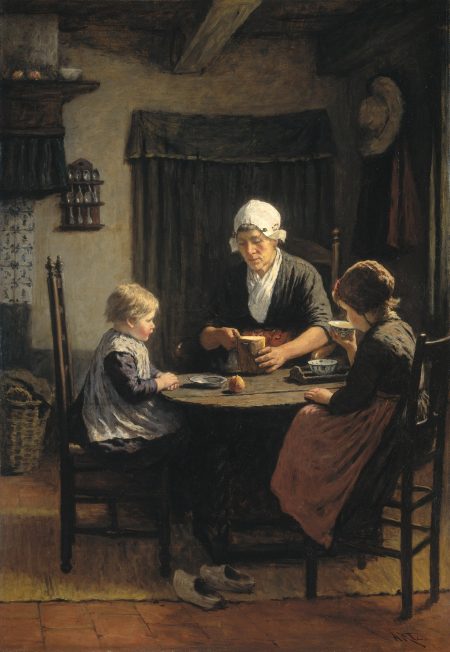
Grandmother and two daughters eating

Recently in a shopping mall parking lot, I saw a bumper sticker that challenged the complexity and obscurity of scriptio continua. The bumper sticker declared:

Let’s eat grandma!
Let’s eat, grandma!
Punctuation saves lives.

That’s a compelling claim about the importance of advances in philology. Here are seventeen additional examples of the lifesaving importance of punctuating texts.

Philology now tends to be associated with cranky old men academics. Old men have made many contributions to human welfare. Disparagement and harassment of philologists should be condemned.

*  *  *  *  *

Read more:

Notes:

While riding my bike one day, I pulled up at a stoplight to a guy on a Harley. On his helmet were two stickers. One said, “Loud pipes save lives.” The other said, “Dip me in honey and throw me to the lesbians.” The scholarly field of sticker studies offers rich potential for extensive research.

[image] At grandmother’s house. Oil painting. Adolph Artz, 1883. Held in Rijksmuseum Amsterdam. Thanks to Wikimedia Commons.