erotics of aridity in Hildegard’s Ordo Virtutum

The flower in the meadow falls in the wind, the rain splashes it,
But you, Virginity, remain in the symphonies of the heavenly habitants:
you are the tender flower that will never grow dry.

{ Flos campi cadit vento, pluvia spargit eum.
O Virginitas, tu permanes in symphoniis supernorum civium:
unde es suavis flos qui numquam aresces. }

Along with seventeen or eighteen female solo voices, Hildegard of Bingen in her Play of the Virtues {Ordo Virtutum} included one male solo voice: the voice of the devil. The virtue-women and the soul-woman sing lyrical poetry. The devil-man shouts unpoetically. The play poetically figures destroying the “voracious wolf {lupus rapax}” and binding and laying low the “age-old snake {antiquus serpens}.” It also refers to “man’s wantonness {hominis lascivia}.”[1] Such rhetoric is common in the long and unloving history of disparaging men’s sexuality.

devil as tempter in Hildegard

Ordo Virtutum, however, is far more poetically sophisticated than caricaturing women as virtuous and men as demonic. The devil-man shouts his worldly promises. The underlying cause of the soul-woman’s fall is her incompletely formed carnal desire, her impetuousness, and her pride. Treating men as show horses merely to be ridden impetuously and pridefully in a sexual carousel demeans men’s persons. That behavior also tends to dry women’s sexuality to aridity. Storms that produce heavy wind and rain can pass through quickly to leave a scorching desert.

The virtue-women and the soul-woman remembered a man. Like a woman in love, his body encompassed them. He was the greatest of men, but had the lowest of worldly status. He knew what women are in the fullness of their carnal being. He implored God the Father to fulfill his promise:

Now remember that the fullness which was made in the beginning
need not have grown dry,
and that then you resolved
that your eye would never fail
until you saw my body full of buds.
For it wearies me that all my limbs are exposed to mockery:
Father, behold, I am showing you my wounds.

{ Nunc memor esto, quod plenitudo que in primo facta est
arescere non debuit,
et tunc te habuisti
quod oculus tuus numquam cederet
usque dum corpus meum videres plenum gemmarum.
Nam me fatigat quod omnia membra mea in irrisionem vadunt.
Pater, vide, vulnera mea tibi ostendo. }

Hildegard of Bingen’s play ends with instruction to the gathered soul-women:

So now, all you women,
bend your knees to the Father,
so that he may reach you his hand.

{ Ergo nunc, omnes homines,
genua vestra ad patrem vestrum flectite,
ut vobis manum suam porrigat. } [2]

Creation is restored to greenness and flowering from moist earth when soul-women remember the man’s wounds and humbly wait for the one masculine touch.

*  *  *  *  *

Read more:

Notes:

[1] The epigram and the three subsequent quotes are from Hildegard of Bingen’s Play of the Virtues {Ordo Virtutum}, ll.  109-11, 221, 481va, 55 (all sung by the voices of virtues, except 481va, which is sung solo by the voice of victory), Latin text and English trans. from Dronke (1994) pp. 160-81. In l. 110, Dronke translated Virginitas as “Maidenhood.” I replaced “Maidenhood” with the less Victorian-sounding word “Virginity.”

One of the voices of the virtue-women is illegible in the manuscripts. If that voice is different from the other virtue-women, then there are eighteen female solo voices (seventeen virtue-women and the soul-woman). On the virtues, see Dabke (2006).

Hildegard wrote Ordo Virtutum no later than 1151. She wrote it in Latin verse with musical notation that has survived. It may have been performed on May 1, 1152, at the consecration of Hildegard’s Rupertsberg convent. Dronke (1994) p. 152.

Latin texts and English translations are available online from Peter Dronke, Christine Jolliffe, and Linda Marie Zaerr (English only).  A variety of song performances are available on YouTube.

[2] Ordo Virtutum, ll. 267-9, from Dronke (1994) p. 181. The previous quote is ll. 260-66. Both are sung by the voices of virtues and souls.

In l. 267, Dronke translated omnes homines as “all you people.” However, at l. 55, he translated hominis lasciviam as “man’s wantonness.” The Latin hominis most properly means human being, female and male. Men’s masculinity, however, is often effaced in referring to men, except in derogatory contexts. Ordo Virtutum, l. 55, refers to the devil-man, hence “man’s wantonness” is the best translation in context for hominis lasciviam. Ordo Virtutum was probably performed primarily for women in Hildegard’s Rupertsberg convent. Hence “all you women” seems the most appropriate translation for the concluding address omnes homines.

In l. 264, the phrase plenum gemmarum means both “full of gems/jewels” and “full of buds.” Id. p. 151. I have chosen above the later translation. Id. notes that this image connects to the prologue’s image of a tree blossoming. Hildegard’s Hymn to the Holy Spirit, l. 12, describes wounds transformed by the Holy Spirit into jewels. The association of Christ’s wounds (coagulated blood) with jewels (sphragis imagery) occurs in early Christianity. Dronke (1970) pp. 155-6. Ruodlieb V.99-129 describes making a jewel from a lynx’s urine. Such a claim goes back at least to the first-century in Dioscorides’s De Materia Medica and Pliny’s Natural History.

Like the Song of Songs, Ordo Virtutum includes poetry of erotic love, e.g.:

Virginity, you remain within the royal chamber.
How sweetly you burn in the King’s embraces,
when the Sun blazes through you,
never letting your noble flower fall.

{ O Virginitas, in regali thalamo stas.
O quam dulciter ardes in amplexibus regis,
cum te sol perfulget ita
quad nobilis flos tuus numquam cadet. }

ll. 104-7 (voice of chastity {castitas}), trans. Donke (1994) p. 169, with, as above, my translation of Virginitas as “Virginity.”

[image] The Tempter, illumination from Hildegard of Bingen, Scivias, Part II.7, Rupertsberg Codex, based on copy made at Hildegard Abbey in Eibingen, 1927-1933, via Böckeler (1954) Plate 18.  All the Scivias illuminations are online here. Campbell (2013) argues strongly that Hildegard oversaw the design of the illuminations.

References:

Böckeler, Maura. 1954. Wisse die Wege. Scivias. Nach dem Originaltext des illuminierten Rupertsberger Kodex ins Deutsche übertragen und bearb. Salzburg: O. Müller.

Cambell, Nathaniel M. 2013. “Imago expandit splendorem suum: Hildegard of Bingen’s Visio-Theological Designs in the Rupertsberg Scivias Manuscript.” Eikón Imago 2(2):1-68. Summary here.

Dabke, Roswitha. 2006. “The Hidden Scheme of the Virtues in Hildegard of Bingen’s Ordo Virtutum.” Parergon. 23 (1): 11-46.

Dronke, Peter. 1970. Poetic individuality in the Middle Ages: new departures in poetry, 1000-1150. Oxford: Clarendon Press.

Dronke, Peter. 1994. Nine medieval Latin plays. Cambridge: Cambridge University Press.

America Solved: Alan Cohen's cry for family-law reform

great american family

Alan Cohen’s learned, passionate book on U.S. child support and child custody law is dedicated to his daughter:

This book is dedicated to my daughter, who has been a constant inspiration in my life. Her insights into the next generation of parents have been remarkable, as well as enlightening, and inspired me to strive for a better America and to complete this work.

Cohen has roots in the heart of America. He grew up ten miles from Ferguson, Missouri, attended the University of Missouri School of Journalism, and has lived and worked ten miles from Ferguson for twenty-five years as an attorney specializing in family law. As a child, Cohen admired Robert F. Kennedy. As an idealistic young adult, he went into law to advance justice and equality. His new book, America Solved: A New Family for the 21st Century, connects dysfunctional family law to personal alienation, broken community, and despair. Written in the great American tradition of progressive social reform, Cohen’s new book proposes new family law to heal America. It’s well worth reading.

Cohen passionately believes that long-term, intimate personal relations are vitally important for adults, children, and community. He argues that children need a stable family of adults showing enduring love for each other and their children. About half of black men ages 25 to 34 are noncustodial fathers.[1] Among black children, 72% are born to unmarried mothers. About a third of young black men are awaiting trial for a crime, incarcerated, or on probation or parole. Black family and community breakdown, although deeply related to the historical legacy of American slavery, is being generalized to all Americans through child support and child custody laws. Given the injustices of those laws, men are increasingly uninterested in marriage and having children. With men socially defined as criminally suspect persons, men’s aspirations shrink towards short-term sexual couplings and not being bothered. The next generation of boys have few men to inspire and guide them. That at best produces socio-economic stagnation; at worst, riots.

Cohen’s book provides a brief, well-informed historical overview of child support and child custody law. Changes in dominant public values, most recently in affirming homosexual marriage, have driven changes in family law. Yet the resulting law is wildly inconsistent. Why does the state punish men with long-term financial obligations for doing nothing more than engaging in consensual sex of reproductive type? What interest does the state have in the specific terms under which a couple marries or divorces? These important questions are obscured in the dominant public misunderstanding of sex as private activity and marriage as a beautiful wedding, a Hollywood honeymoon, and affectionate companionship. Marriage is a legal relationship that now can be legally terminated at will by either party without any need for showing breach of obligation or fault. Ending a marriage involves public determination of the allocation of the couple’s assets and their future financial obligations to each other. Anyone thinking of having children or getting married must understand state regulation of those fundamental human activities. Cohen’s book helps to provide such understanding.

Cohen’s program for family-law reform centers on free, informed marital contracting and team parenting from the birth of a child. Marriage is now an obscure, one-size-fits-all legal regime that few understand before marrying. Moreover, when couples establish prenuptial agreements, courts often subsequently nullify those agreements in unpredictable ways. Cohen proposes that a couple be required to select an explicit marital contract before being married. That contract would provide a wide range of possibilities for personal customization in response to personal values, circumstances, and desires. Cohen’s book sets out a legal framework for free, informed marital contracting in considerable detail.

Team parenting from birth makes common sense of gender equality and working together. By virtue of human biology, women know for certain who their biological children are. Men deserve equal biological-parental knowledge under law through low-cost DNA testing. Cohen proposes regular establishment of such knowledge and reporting biological fatherhood truthfully on birth certificates. For children born to unmarried persons, current law focuses on establishing a man (not necessarily the actual biological father) as legally obligated to pay the mother child support. That law effectively punishes men’s sexuality and devalues fatherhood into paying money for having sex. Moreover, the legal focus on extracting money from men obscures child-custody issues vitally important to women. Cohen proposes that a team parenting plan be legally established at birth. That’s as reasonable and publicly important as shifting health care from treating illnesses to keeping persons healthy. Establishing team parenting at a child’s birth is easier and more effective than trying to establish joint custody amid a bitter custody dispute.

The greatest weakness of Cohen’s book is also its most endearing quality. Cohen is an idealist with a shining vision of great American family life and society. He makes bold statements, provides sweeping analysis, and urges radical change. He imagines with amusing satire Harry Truman growing up in America today. Prickly, intolerant persons might huff at Cohen categorically declaring “happiness only occurs in a life shared together in marriage.” Cohen has practiced family law ten miles from Ferguson, Missouri, for over twenty-five years and through the recent turmoil.[2] His book rises from his lived experience. His claims should be appreciated in that context.

Cohen apparently believes that great ideas are enough to produce great political change. Underlying the gross injustices and acute anti-men gender inequality of child support and child custody laws is the political insignificance of men. The dominant discourse of “gender equality” is stunning testimony to gynocentrism and anti-men gender bigotry.[3] Society, like intimate heterosexual relations, is becoming nasty and brutish. Near the end of his book, Cohen declares:

We must toss away all of these political animosities and dig in as never before against the same flood that destroyed so many empires before us, the crumbling from within. … After all, don’t fathers have daughters? Don’t mothers have sons?

Of course they do. Yet we have the gender politics that we have. Men leaders seeking to seduce women, please mother, and continue to be elected in our majority-women democracy with majority-women media patronage have made current child support and child custody law. This situation won’t change easily. Without much more powerful social and political support for ordinary men, great ideas for renewing family life won’t matter.

*  *  *  *  *

Read more:

Notes:

[1] Edelman, Holzer & Offner (2006) p. 25. The subsequent quotes are from Cohen (2015) pp. 106, 111. I haven’t specifically validated these facts with primary sources, but they seem to me to be correct.

[2] Cohen’s ground-level practical knowledge of child-support law and practice is evident is his insightful description of prosecuting persons for child support arrears. See Cohen (2015) n. 135, pp. 271-3. His understanding of the common law of coverture is less up-to-date. He declares that coverture “in practical effect, put women, not on a pedestal, but in a cage.” Id. n. 3, pp. 223-4. The bitter irony in that statement is that coverture was very significance protection for women from the massive imprisonment of men for debt in late-seventh-century England.

[3] Most of the scholarly literature on child support and child custody is rife with anti-men bias. Mason (1994) provides a good example. That book might be better titled: From Formal, Largely Irrelevant Law of Father’s Property to Children’s Rights as a Pretense for Treating Fathers as Wallets. Cohen’s book seems relatively even-handed with respect to women’s and men’s interests. That might be considered inappropriate given the overwhelming dominance of women’s interests in current child support and child custody policies.

References:

Cohen, Alan W. 2015. America Solved: A New Family for the 21st Century. Elliot Publishing, LLC.

Edelman, Peter, Holzer, Harry J., Offner, Paul. 2006. Reconnecting Disadvantaged Young Men. Urban Institute: Washington, DC.

Mason, Mary Ann. 1994. From father’s property to children’s rights: the history of child custody in the United States. New York: Columbia University Press.

dwarf romance & deceit in Ruodlieb’s marriage proposal

dwarf

In the last surviving fragment of the eleventh-century Latin romance Ruodlieb, the title character Ruodlieb captured a dwarf. The dwarf promised to show Ruodlieb treasure. The dwarf in return asked to be unchained. Ruodlieb, suspecting deceit, refused to unchain him. The dwarf then protested:

Far be it that such fraud prevail among us dwarves!
For then we would not be so long-lived nor so healthy.
Among you, no one speaks unless deceitfully.
Therefore you will not attain a ripe old age.

{ Absit, ut inter nos umquam regnaverit haec fraus:
Non tam longaevi tunc essemus neque sani.
Inter vos nemo loquitur, nisi corde doloso.
Hinc nec ad aetatem maturam pervenietis. }[1]

Ruodlieb personally experienced the dwarf’s observation about deceit among humans. In Ruodlieb’s earlier, failed marriage proposal, deceit had filled all sides of the affair.

The lady whom Ruodlieb had sought as a wife had a reputation for integrity, virtue, chastity, and nobility. In reality, she was having a secret sexual affair with a cleric. She at first accepted Ruodlieb’s marriage proposal. To the messenger conveying that proposal, she responded with courtly love lyrics:

Now from my faithful heart
bring him from me as much of love as there are leaves.
Bring him from me as much love as birds have joy,
and bring him honors equal to the grass and flowers.

{ dic illi nunc de me corde fideli
Tantundem liebes, veniat quantum modo loubes,
Et volucrum vvunna quot sint, tot dic sibi minna,
Graminis et florum quantum sit, dic et honorum. }[2]

Beautiful words, but full of deceit, as subsequent events would show.

Ruodlieb cruelly deceived the lady he proposed to marry. She welcomed his love messenger with a sumptuous meal, the best wine, and mead served from golden vessels. Ruodlieb had arranged with his messenger for him to pretend to forget to give the lady a gift until after he had enjoyed her hospitality and she had responded to Ruodlieb’s proposal. The gift was sealed in a box. Ruodlieb deceived his messenger about the nature of the gift. When the lady opened the box, she found a scarlet cloth in which were wrapped her headdress and her garters. She had lost them at her cleric-lover’s house. Ruodlieb had somehow acquired them. The lady was mortified. She then gave the messenger a new message, with the same formal rhetorical figure as her earlier one, but different substance:

Tell your relative and friend that if
there were no other man alive save him alone,
and if he gave to me the whole world as a present,
I do not wish to marry him. You tell him truly!

{ tuo dic contribuli vel amico:
Usquam si nullus vir plus foret, is nisi solus,
Ille vel in dotem mihi mundum si daret omnem,
Nubere nolo sibi, dic tu veraciter illi. }[3]

The emphatic “you tell him truly” underscores the deceit on all sides of this affair. Ruodlieb, with mean obnoxiousness like his nephew’s bride had shown during their wedding, rejoiced and laughed at how he had tricked and insulted the lady that he proposed to marry.[4]

Ruodlieb depicts a world in which courtliness and noble character can suddenly vanish. The last surviving lines of Ruodlieb are uncannily apt. They depict the magnanimity of the dwarf’s wife. After Ruodlieb had captured her dwarf husband, she acted to save him:

Small, very beautiful, decked out in gold and clothes,
she fell at Ruodlieb’s feet, uttering complaints:
“Best of all men, release my husband from his chains!
Hold me for him until he settles his whole debt.”

{ Parva nimis pulchra sed et auro vesteque compta.
Que ruit ante pedes Ruodlieb fundendo querelas:
“Optime cunctorum, vinclis mihi solve maritum
Meque tene pro se, donec persolverit omne.” }[5]

When the courtliness of dwarves rises above that of knight and lady, romance has stagnated and the artistic poet has turned to parody.[6]

*  *  *  *  *

Read more:

Notes:

[1] Ruodlieb XVIII.18-21, Latin text and English trans. Kratz (1984) p. 199 (modified slightly). All subsequent quotes are from id. The Latin text of Ruodlieb is online. The phrase “no one speaks unless deceitfully” (nemo loquitur nisi corde doloso) has biblical resonances (cf. Jeremiah 17:9). Moreover, “doloso is rare in classical Latin, but common in the Vulgate.” Grocock (1985) p. 231. The promise of more life is central to Jewish and Christian scripture.

[2] Ruodlieb XVII.11-4, p. 191. On the lady’s reputation, XVI.65-70, XVII.35. The messenger seems to have been Ruodlieb’s nephew. Dronke (1970) p. 61. When the lady asked him about the local women (“their reputation, beauty, morals {famae, formosae sint an honestae}”), the messenger responded like the bishops in the Life of Saint Pelagia:

“I have no knowledge of what you ask me about,”
he answered with a smile, “for nothing matters less
to me than following things like the doings of
our ladies. I leave such behavior to the dandy.
If I walk by by a place where I see ladies standing,
I bow to them and keep my intended way.

{ Subridens ille, “Scio quod minime rogitas me.
Nil minus intromisi me, quam tale notare,
Quid facerent dominae; morem talem sino scurrae.
Sicubi praetereo, dominas ubi stare videbo,
Illis inclino, quo mens est ire vel ibo. }

Ruodlieb XVII.5-9, trans Kratz (1984) p. 191. Dronke (1970), p. 61, interprets that response literally and suggests it’s a tribute to the nephew’s “newly won … respectability.”

[3] Ruodlieb XVII.43-46, p. 193. The rhetorical figure is adynaton. A widespread, ancient adynaton is the “sea of ink” figure. For adynata in Greco-Roman poetry, Donke (1970) p. 62, n. 2.

[4] The messenger-nephew, much more willing to stand up to his uncle than to his bride, told Ruodlieb never to ask him to serve as his envoy again. Ruodlieb XVII. 57-8. Dronke, who relishes the bride’s obnoxious behavior, describes Ruodlieb’s trick as cruel and declares of the lady’s sexual affair with a cleric, “a perfect Christian would no doubt have forgiven” it. Donke (1970) p. 60. Following that pattern of thinking, if the lady had become a perfect Christian, she would have informed Ruodlieb that she rejected marriage and that she would emulate the penitent life of Mary of Egypt.

[5] Ruodlieb XVIII.29-32, p. 199.

[6] Dronke’s influential analysis presents Ruodlieb as “the emergence of romance” and describes it as “the first medieval verse romance.” Dronke (1970) pp. 33-4. While manuscripts are lacking, Ruodlieb itself suggests a tradition of romance continuing from the Greek novels.

[image] The Dwarf. Giacomo Ceruti, 1720s. Oil on canvas. Thanks to Wikimedia Commons.

References:

Dronke, Peter. 1970. Poetic individuality in the Middle Ages: new departures in poetry 1000-1150. Oxford: Clarendon Press.

Grocock, C. W., ed. and trans. 1985. The Ruodlieb. Chicago, Ill: Bolchazy-Carducci Publishers.

Kratz, Dennis M., trans. 1984. Waltharius, and Ruodlieb. New York: Garland Pub.

Aseneth in her wretchedness recalled a father's love


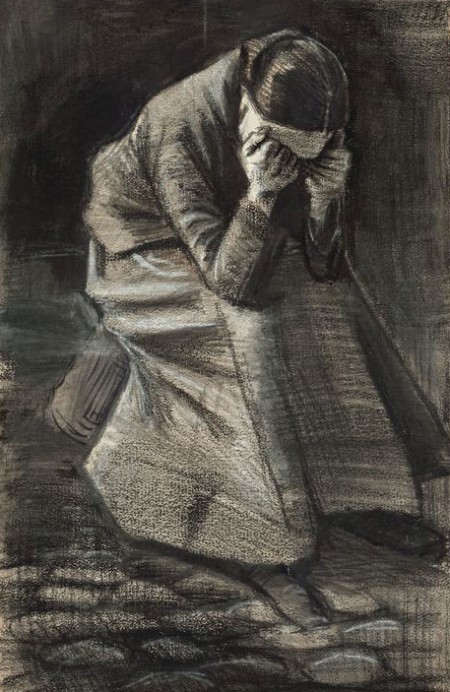
weeping woman

In Joseph and Aseneth, a text perhaps written in fourth-century Syria, the strong, independent, man-hating Aseneth is overcome with a sense of her own wretchedness. In her despair, she recalls the loving care of a father for his child:

a little child who is afraid flees to his father,
and the father, stretching out his hands, snatches him off the ground,
and puts his arms around him by his breast,
and the child clasps his hands around his father’s neck,
and regains his breath after his fear,
and rests at his father’s breast,
the father, however, smiles at the confusion of his childish mind.

The confusion in the child’s mind is that there exists cause for great fear, and that the father doesn’t offer protection. Aseneth understands that she is like that child. She realizes that she can run to a loving father.

Fathers’ love for their children is now widely denied or obscured. Perhaps that’s part of an effort to support enormous gender inequality in child-custody decisions and acute anti-men sex discrimination in family courts.

The human toll of gender-equality double-talk is unfathomable. Gender equality in public discourse today largely stands for anti-men gender bigotry. Recalling the loving care of a father for his child is a first step towards healing the world.

*  *  *  *  *

Read more:

Notes:

The quoted text above is from the long version of Joseph and Aseneth, sec. 12, from Greek trans. Burchard (1985) p. 221. The short version of Joseph and Aseneth doesn’t include this text. See the notes in my post on Aseneth’s conversion for details on the text and further references.

Aseneth pleads her own ignorance: “my many deeds of ignorance. … I have sinned against you in ignorance.”  Id. p. 223. With the Internet, persons can much more easily overcome their ignorance.

[image] Weeping Woman, slightly cropped. Vincent van Gogh, 1883. Art Institute of Chicago, F1069. Thanks to Wikimedia Commons.

Reference:

Burchard, Christoph. 1985. “Joseph and Aseneth: A New Translation and Introduction.” Based on Burchard’s own reconstruction of a long Greek version. Pp. 177-247 in James H. Charleworth, ed.  The Old Testament Pseudepigrapha. Vol. 2.  Garden City, N.Y.: Doubleday.