Professorial authorities and important media currently treat men as relatively disposable, criminally suspect beings. That failure of human love is not new. Pamphilus, a highly popular work written in Latin early in twelfth-century Europe, begins with a speech from the man Pamphilus:
I’m wounded. Here, deep in my heart
lies buried a secret injury.
My wound grows continually worse,
but as yet I do not even dare to speak aloud
the name of what has struck me down.
The wound itself must be unnamed, hidden from all eyes.
Thus my future is bleak; no medicine can cure me.
How can I find a better course to follow? [1]
Pamphilus’ self-overhearing question about finding a better course signals his self-consciousness. Pamphilus, a hyper-active thinker like Shakespeare’s Hamlet, reveals his suffering to two old, powerful women: the goddess Venus and a woman go-between. They instruct Pamphilus in a man’s life of abasement, labor, and violence. Their degrading instruction, far from offering a better course, positions men as relatively disposable, criminally suspect beings. Their social structure controls men, destroys love, and creates deeper wounds.
Professorial authorities and media, the goddess Venus and the woman go-between, are the matrix of ordinary men’s social marginality and sexual wounds. About 2000 years ago, the clean-handed, aristocratic farmer Virgil proclaimed mundane realities of men’s oppressed sexual being:
Labor has conquered all things — shameless labor, and oppressive need in hard circumstances. Ceres was the first to teach mortal men how to turn up the earth with iron, at a time when the acorns and the wild strawberries of the sacred wood were already failing and Dodona was refusing food. Soon labor attached to grain as well, and as a result evil corn-smut began to gnaw at the haulm and lazy thistles bristled in the fields. The crops are dying, a harsh thicket is coming up of burrs and caltrops, and over the neat farm work the sterile darnel and infertile oat are gaining mastery. Wherefore: if you do not constantly pursue the weeds with your hoe and loudly frighten away the birds and keep down the shadows of the dark countryside with a machete and call for rain in your prayers, you will, alas, gaze in vain at another man’s large pile and console your hunger in the woods by shaking an oak tree. [2]
Ceres was a goddess of fertility and nourishment. Dodona was a source for the Mother goddess’ instruction. These goddesses led the great mass of men into the era of sexual starvation and demeaning labor for aged, dried-up bread. The problem is not just so many men, alone in the woods, stroking oak trees in frustration. Pamphilus re-arranged Virgil’s maxim of labor to more closely associate men’s conditions of labor with men’s social marginality.[3]
The fundamental problem is the loss of true love. Juan Ruiz’s Libro de buen amor, written in Spanish early in the fourteenth century, retold Pamphilus to highlight the loss of true love.[4] Libro de buen amor cites Virgil’s maxim in the context of brutal disregard for men’s suffering:
“I’ve lost my clear complexion, reason now is failing fast,
I have no strength, within my skull my eyes have sunken in.
If you don’t help, my limbs will waste away to bones and skin!”
Lady Venus answered: “Laboring servants will win.” [5]
Lady Venus has complete and unmatched power over men:
She is our life, she is our death, all bound up into one.
She leaves robust young men enfeebled, virile men she drains.
She rules the fortunes of mankind, her power is matched by none.
When she comes in the door, all things that she may wish are done. [6]
Lady Venus exerts little effort to help oppressed men. When Don Melón Pamphilus petitions her, she offers only generic, well-known advice, shows no concern for social inequalities hurting men, and quickly leaves after encouraging Don Melón to “man up”:
“My friend, what more would you be told as to this enterprise?
Be shrewd and diligent, you’ll get your sweetheart, as you’ll see.
I must not stay. I want to go. Farewell, be strong and wise.”
With that the Lady Venus went, and left the job to me. [7]
Lady Venus buttresses the socially dominant love that dupes and oppresses men. Her love for men isn’t true.
In both Pamphilus and its retelling in Libro de buen amor, Venus goes on to mis-instruct Pamphilus about Ovid’s love teaching. With unmatched poetic ingenuity, Ovid skewered the professors of gender lies, championed the goodness of men’s sexuality, and destroyed stereotypes of women as angels far above men’s moral plain. Ovid forthrightly recognized women’s fantasies of feeling sexual force:
Mix — who doesn’t who’s wise? —
Kisses with your sweet talk, and if she tries
To deny them, simply take what she denies.
She may struggle at first and call you a sinner,
But she doesn’t really want to be the winner.
Only take care not to cause her soft lips pain
With your raids — she mustn’t be able to complain
That you’re so rough you bruise.
…
Some force is permissible — women are often pleased
By force, and like what they’re giving to be seized.
The girl whose citadel is stormed
By sheer audacity feels warmed,
Complimented; the one who could have been attacked
And taken by force but escapes intact,
Although she affects to look glad,
Feels let down, a little sad.
Phoebe was raped by her lover, Hilaira by hers,
Yet both ravished sisters loved their ravishers. [8]
Ovid’s appreciation for women’s psychological breadth and complexity, including their fantasies, doesn’t make women into beasts or endorse men brutalizing women. Lady Venus, in contrast, regards men as beasts and instructs Don Melón Pamphilus to treat women as beasts. Lady Venus declares:
All women love those men of force who make their will be done.
They long for such a man more than for money by the ton.
Their hands dissolve in languor, heels collapse when they would run;
They’ll go part way or all the way, they grudge it, but it’s done.
A woman much prefers to be just slightly urged, by name,
Than have to say, ‘Go right ahead,’ as if she had no shame.
With but a little force she feels almost excused of blame.
Among all animals this trait has proved to be the same.
All females of whatever species share this coaxing trait:
When you begin your suit, they seem affronted, would depart,
Pretend they’re angry, act evasive — this is merely bait.
They threaten, but withhold the blow, they’re crafty in this art. [9]
Not only does Lady Venus presume to describe “all women,” she generalizes “all women” to “all females of whatever species.” Pamphilus’ sexual interest is demeaned from seeking a sexually differentiated person like himself, to seeking a female of whatever species. Lady Venus teaches that women are equally lustfully as men underneath the social construction of female fear and modesty. Lady Venus instructs Don Melón to treat women, not artfully, but rapaciously:
It’s fear and modesty that make the women, as a clan,
Not do what they wish to do as heartily as you.
They don’t deny through lack of lust; love them each time you can.
Yes, from the lady take what you desire and yearn to do. [10]
Ovid’s outrageous love teaching exudes urbane and earthy joy. Ovid parodies with brilliant literary sophistication the dour, repressive love moralists of his day. Lady Venus, in contrast, teaches merely personal abasement, painful labor, and brutal violence.
The media woman go-between Trotaconventos repeatedly lies to Don Melón Pamphilus and Lady Plum Galathea. Trotaconventos circulates gossip and manipulates interpersonal relationships on a commercial basis. Don Melón Pamphilus hired Trotaconventos at unbounded expense to mediate his love for Lady Plum Galathea. In Pamphilus, Galathea is a young, inexperienced woman who counts on her parents for guidance. The Libro de buen amor makes this Lady Plum also a widow.[11] That gives her more worldly experience and, in medieval understanding, high sexual interest. Trotaconventos lies to Lady Plum about not being hired by Don Melón, and lies about Don Melón’s wealth and family. Trotaconventos lies to Don Melón about almost everything that Lady Plum says.
Trotaconventos sets up Don Melón for a hurtful act of sexual force. Trotaconventos lies to Don Melón that Lady Plum will soon marry another man. Lady Plum actually loves Don Melón, or at least Trotaconventos has induced Lady Plum to feel that she does. Trotaconventos conspires to get Lady Plum and Don Melón by themselves in a private place. There Don Melón forcefully has sex with Lady Plum against her strong protestations. The story ends with many possible layers of deceit. Don Melón’s act is consistent with his seeking to prevent Lady Plum’s parents from marrying her to another man.[12] Don Melón protests that he is accused of a mere trifle. But no contextual explanation effaces Lady Plum’s cries. In both Libro de buen amor and Pamphilus, Lady Plum Galathea’s suffering evokes pity and anger, at least in compassionate persons unlike Lady Venus. Don Melón Pamphilus’ act of sexual force has created new wounds.[13]
True love depends on compassion and understanding. The media go-between concludes Pamphilus:
Make peace now; it’s the best for you both.
Let this woman be your wife.
Let this man be your husband.
Through my aid, you both now have what you wanted;
through me you are happy. Never forget me! [14]
At the end, Galathea and Pamphilus’ prospects for true love together have vanished. Never forget the lies of the woman media go-between.
You must distinguish between true love and false love. Juan Ruiz narrates Libro de buen amor in a way that encourages the reader to recognize alternatives and make interpretative choices. Ruiz declares:
Lady Plum and Don Melón were bedded happily all right.
At the espousal feast the guests rejoiced, as well they might.
Please pardon me if I have brought vile actions to your sight:
What’s dirty in this story Pamphilus and Ovid write.
…
Understand the story of this girl to good Sir Plumtree born.
I’ve told it, not as what I did, but as a tale to warn.
Beware the tricky crone, the lusty neighbor with his tricks.
Don’t trust a man alone with you and don’t press near the thorn. [15]
Don’t accept Juan Ruiz’s teaching. Truly understand what Pamphilus and Ovid write. Trust men, and press against the thorn.
* * * * *
Read more:
Notes:
[1] Pamphilus, ll. 1-7, from Latin trans. Elliott (1984) p. 1. Garbaty (1967) provides a more linguistically ornate English translation; Bonilla (1917) provides a Spanish translation and a Latin text. Early manuscripts generally entitle the work Pamphilus de amore (Pamphilus on love). It was authored earlier than 1159, probably shortly after 1100. Pamphilus, which has survived in 170 manuscripts, was widely known in Europe from the Middle Ages to the Renaissance. Pamphilus circulated in pamphlets and is the source for the English word pamphlet. By 1610, sixteen editions of Pamphilus had been printed. Id. pp. xxxii-iii. Pamphilus is a model of Latin rhetoric. That’s a recognized reason for its popularity, particularly in schools. Pamphilus’ depiction of men’s wounds and men’s precarious social position is scarcely appreciated among modern medieval scholars. Notwithstanding that constrained understanding, Pamphilus probably resonated deeply with medieval men’s experiences.
[2] Virgil, Georgics, 1.145-59, trans. Thibodeau (2011) pp. 54-55. Poetry in Translation generously offers an alternate online translation of Virgil’s Georgics.
[3] The relevant Latin text of Georgics (1.145-6):
…. labor omnia vicit
improbus, et duris urgens in rebus egestas.
Thibodeau (2011), p. 54, insightfully notes that “improbus” is enjambed. In Virgil, “labor omnia vicit” (“labor has conquered all things”) is a Greek maxim. In contrast, improbus (“shameless”) is Virgil’s elite Roman qualification:
Its meaning is straightforward: labor of the manual sort is not an intrinsic good; shame must be set aside in order to do it (see Regulus, above), so it is shameless, improbus. The true source of virtue lies in the circumstances that make such labor necessary; what ultimately leads to success {from an elite Roman perspective, a virtuous life} is the preferring of poverty to wealth.
Id. p. 55. Put differently, improbus implies social marginality. In the context of labor for love, it applies to all men. Pamphilus, l. 71, has the single verse, “labor improbus omnia vincit.” Bonilla (1917) p. 20.
[4] From Pamphilus to Libro de buen amor, Pamphilus becomes Don Melón, Galathea becomes Lady Plum (Doña Endrina), and the old woman go-between (in Latin, anus) becomes Trotaconventos (Urraca). Libro de buen amor largely parallels Pamphilus while amplifying the deceptiveness and mean-heartedness of the characters. Libro de buen amor characteristically obscures the identity of the narrator and apparently differentiates a moral commentator from Don Melón. Seidenspinner-Núñez (1981) Ch. 3. Id., Appendix, gives a collation of the texts of Pamphilus (Latin verse) and Libro de buen amor (Old Spanish verse). The name Pamphilus etymologically means “all-encompassing love.” Libro de buen amor indicates medieval appreciation for the importance of Pamphilus in thinking about true love. The retelling of Pamphilus is a major, central episode in Libro de buen amor. The differences between Pamphilus and Libro de buen amor’s retelling of it are relatively unimportant for appreciating these works’ primary themes.
[5] Juan Ruiz, Libro de buen amor (Book of good love), s. 607, from Old Spanish trans. Daly (1978) p. 167, with my translation “Laboring servants will win” substituted for “Those who persist will win.” The corresponding Old Spanish text, edited by Zahareas, has “Servidores vencen” (Salamanca manuscript). Id. p. 166. My translation seems to me to convey more literally that text and the context. Willis (1972), p. 165, has for Old Spanish text, “Los seguidores vencen” (perhaps Gayoso manuscript) and the same English translation as Daly (“Those who persist will win”).
[6] Libro de buen amor, s. 584, trans. Daily (1978) p. 161. Unless noted otherwise, all subsequent translations of Libro de buen amor are from id. In the context of the narrator’s suffering and his effusive praise of Lady Venus, the phrase “she is our life, she is our death” suggests amplification and parody of the prayer Salve Regina:
Hail, holy Queen, Mother of Mercy,
hail our life, our sweetness and our hope.
To thee do we cry, poor banished children of Eve;
to thee do we send up our sighs,
mourning and weeping in this valley of tears.
[7] Libro de buen amor, s. 648. In s. 647, Lady Venus declares, “And now I’ve said enough to you, no longer can I stay.” In response to Don Melón’s suffering and petition, Lady Venus drops in, delivers a standard lecture, and jets off.
[8] Ovid, Ars amatoria (Art of Love), ll. 1.150-180, trans. Michie (2002) p. 41. Literary scholars who enjoy symbolic sadomasochism find rape everywhere in imaginative literature. They also deny that women have rape fantasies. In the real world, 50 Shades of Grey is a huge best-seller. At least one modern Ovid continues to outrage dour moralists with scintillating literature of truth. Scholars teaching Ovid should recognize that a large share of men have been falsely accused of rape. In teaching Ovid, supportive classroom discussion of the serious, historical problem of false rape accusations would make colleges and universities a more welcoming environment for heterosexual men.
[9] Libro de buen amor, s. 630-2, replacing “they claim” by “by name.” In the Old Spanish text, there is no other voice (“they”) making this claim. Willis (1972), p. 170, has:
A lady considers it nicer to find herself a little bit urged, rather than to say: “Do as you want,” like a shameless hussy
Pamphilus includes this advice from Ovid, but Libro de buen amor amplifies bestial imaginary associated with it. Seidenspinner-Núñez (1981) pp. 45-53.
[10] Libro de buen amor, s. 634.
[11] Id. s. 582.
[12] The go-between lies to Pamphilus:
You have called me too late to your assistance.
Now neither my art nor my good offices can help you.
It is clear — they are preparing to marry off Galathea.
I am amazed at the decorations about her house.
There are a hundred reasons why I suspect this,
but her parents are keeping it carefully concealed.
Trans. Elliott (1984) p. 14. The relevant text in Libro de buen amor has been lost. However, in s. 791, Don Melón Pamphilus states:
For if my lady now will marry with some other man,
I’ll have no use for living any longer in this world.
…
For if they give a husband to my love tomorrow morn,
My hopes are all destroyed and I am lost forevermore.
Libro de buen amor, s. 791, 794. Don Melón has an acute case of one-itis. He believes that Lady Plum Galathea will be imminently married to another man. He declares to Trotaconventos:
So finish up your job, complete the task and end the chase.
To lose her now, through our delay, would be a great disgrace.
Id. s. 814. Pamphilus has the go-between acting in similar circumstances. Libro de buen amor, to amplify Pamphilus as a depiction of false love, makes clear the detail that Trotaconventos arranged the meeting with Lady Plum tomorrow at noon. Id. s. 867, 868, 869, 871. That’s inconsistent with Trotaconventos’ claim that Lady Plum would be married to another man tomorrow morning. Don Melón should have recognized Trotaconventos’ lie.
[13] Sexual communication is complex, and rape, much more than gender, is socially constructed. A rape-essentialist perspective has dominated literary analysis of rape in recent decades. Analyzing in 1997 the scholarly trend to read rape, a courageous and free-thinking scholar insightfully declared:
much of this scholarly trend is, in my view, plagued by a tendency towards naive, anachronistic, and inappropriate readings of literary works, high levels of indignation and self-pity, and a pervasive hostility to men.
Vitz (1997) p. 1. That work had little academic influence. Those intellectual failings in fact have served as the foundations for highly successful academic careers. A recent, respected treatment of Pamphilus is an amazing example of passive-aggressive scholarship. This scholarly work begins with a definitive declaration of rape and a sensational suggestion of institutionalized rape instruction:
The Pamphilus de Amore, a twelfth-century Latin comedy that recounts the eponymous character Pamphilus’ courtship and rape of the virgin Galathea, has magnetized scholars of medieval representations of rape. Struck by the fact that the Pamphilus was a standard textbook in the medieval classroom, we wonder, did this text teach boys lessons in seduction and rape as well as rhetorical lessons?
The article continues with tedious, cultic ponderings and posings and no apparent concern for men. Pretending ignorance of well-entrenched scholarly interests in rape-essentialist writing, the article declares that the possibility that a rape occurred must be kept open:
Ultimately, while sex is narrated in the Pamphilus, rape must, to some extent, remain a mystery. Though Galathea threatens to stop the circumlocution in insisting that rape be named, her insistence is not heeded. The fact that periphrasis, in its codified avoidance of naming sex, might also help to countenance rape by to making it invisible, is certainly a disturbing one. The political stakes that currently inform the way we read rape might motivate us to want to read the Pamphilus definitively, one way or the other. But in fact saying that Galathea’s protests are conclusively sincere—or not; or that the text conclusively depicts a rape—or does not, actually do a disservice to both the literary and the moral complexity of the comedy. In keeping open the possibility that Galathea has been raped, the text is able to explore the many registers of possibility inherent in the use of sexual troping.
Cook (2013) p. 228. Interest in keeping open the possibility that rape did not occur seems rather less vigorous in scholarly analysis of Pamphilus, or in discussion of rape more generally. Informed by this recent scholarship on Pamphilus, I have avoided using the word rape in the main text above. I also consider referring to Pamphilus as a comedy to be improper. On the intellectual construction of rape myths, see Reese (2013).
[14] Pamphilus, trans. Elliott (1984) p. 24.
[15] Libro de buen amor, s.891, 909.
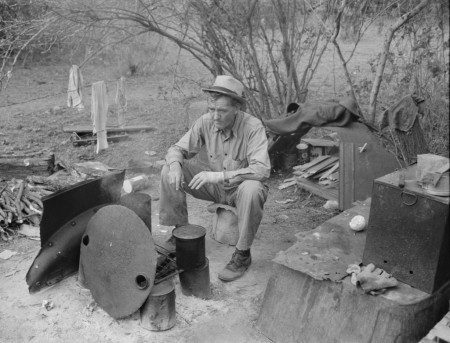
[image] Migrant farmworker in Texas in 1939. Cropped from photograph in Farm Security Administration – Office of War Information Photograph Collection (Library of Congress).
References:
Birge Vitz, Evelyn. 1997. “Rereading Rape in Medieval Literature: Literary, Historical, and Theoretical Reflections.” Romanic Review. 88 (1): 1-26.
Bonilla y San Martín, Adolfo. 1917. Una comedia latina del siglo XII (el “Liber Panphili”) Reproducción de un manuscrito inédito y versión castellana por Adolfo Bonilla y San Martín. Madrid: Imp. de Fortanet.
Cook Alexandra. 2013. “The Erotics of Amplification in the Pamphilus de Amore.” Neophilologus. 97 (1): 215-229.
Daly, Saralyn R., trans. and Anthony N. Zahareas, ed. 1978. Juan Ruiz. The book of true love. University Park: Pennsylvania State University Press.
Elliott, Alison Goddard, ed. and trans. 1984. Seven medieval Latin comedies. New York: Garland.
Garbaty, Thomas Jay. 1967. “‘Pamphilus, de Amore’: An Introduction and Translation.” The Chaucer Review. 2 (2): 108-134.
Michie, James, trans. 2002. Ovid. The art of love. New York: Modern Library.
Reece, Helen. 2013. “Rape myths: Is elite opinion right and popular opinion wrong?” Oxford Journal of Legal Studies. 33 (3): 445-473.
Seidenspinner-Núñez, Dayle. 1981. The allegory of good love: parodic perspectivism in the Libro de buen amor. Berkeley: University of California Press.
Thibodeau, Philip. 2011. Playing the farmer: representations of rural life in Vergil’s Georgics. Berkeley: University of California Press.
Willis, Raymond S., ed. and trans. 1972. Juan Ruiz. Libro de buen amor. Princeton, N.J.: Princeton University Press.