Aristotle’s advice to Alexander the Great on Persian elites

Artistotle's advice to Alexander the Great

One of the most frequently copied and widely disseminated books in Europe from the thirteenth to the fifteenth centuries was the Secret of Secrets.  Formally it contains advice from the great philosopher Aristotle to the world-conqueror Alexander the Great.  Aristotle’s advice covers everything from Alexander’s diet and personal hygiene to how to conduct war.  Enmeshed with this technical advice are elite political interests responding to changing political circumstances across more than a millennium.

The Secret of Secrets includes a purported exchange of letters between Aristotle and Alexander.  According to Arabic manuscripts probably conveying text written before 987, Alexander wrote to Aristotle:

O my excellent preceptor and just minister, I inform you that I have found in the land of Persia men possessing sound judgement and powerful understanding, who are ambitious of bearing rule.  Hence I have decided to put them all to death.  What is your opinion in this matter? [1]

Aristotle responded:

It is no use putting to death the men you have conquered; for their land will, by the laws of nature, breed another generation which will be similar.  The character of these men is determined by the nature of the air of their country and the waters they habitually drink.  The best course for you is to accept them as they are, and to seek to accommodate them to your concepts by winning them over through kindness. [2]

According to the Secret of Secrets, Alexander followed Aristotle’s advice.  The Persians hence became Alexander’s most loyal subjects. The Secret of Secrets credits Aristotle for Alexander’s famous conquests:

By following his {Aristotle’s} good advice and obeying his commands, Alexander achieved his famous conquests of cities and countries, and ruled supreme in the regions of the earth far and wide, Arabs as well as Persians coming under his sway; nor did he {Alexander} ever oppose him {Aristotle} in word or deed. [3]

This account of Aristotle’s advice to Alexander bolsters the value of counselors, secretaries, and administrative elites.  Such persons undoubtedly played an important role in ensuring that the Secret of Secrets was frequently copied and widely disseminated.

The political context of Aristotle’s advice to Alexander in the Secret of Secrets can plausibly be specified more precisely.  The Arab conquerors of the Persian Sassanian Empire needed skilled administrators.  Politically ambitious Persian men such as ibn al-Muqaffa sought from the Arab conquerors recognition as persons “possessing sound judgment and powerful understanding.”[4]  The Arabs were naturally suspicious of the Persians’ political loyalty.  The political question for the Arab rulers was whether to wipe out the Persian elite or co-opt them into Arab-ruled government.  Aristotle’s advice favored Arab accommodation of the Persian elite.

Aristotle’s specific reason for Alexander accommodating the Persian elite draws upon Galenic-Hippocratic technical knowledge.  In his treatise On Airs, Waters, and Places, Hippocrates described the importance of a place’s airs and waters in shaping the characters of persons.  In the mid-ninth century, Hunayn ibn Ishaq translated Hippocrates’ treatise into Arabic.  Hunayn also wrote a commentary on it.  Hunayn’s nephew Hubaysh translated into Arabic Galen’s commentary on Hippocrates’ treatise.[5]  Aristotle’s advice on the Persian elites was based upon Greek knowledge known in Arabic by the mid-ninth century.

In the Secret of Secrets, a story of a Zoroastrian and a Jew supports Aristotle’s advice by teaching Islamic confidence in God’s justice in dealing with treacherous others.  The Zoroastrian was riding on a mule and carrying ample provisions.  The Jew was walking and bereft of provisions.  The Zoroastrian asked the Jew about his faith.  The Jew described his faith and declared that it was lawful for him to shed the blood and take the possessions of non-Jews.  The Jew in turn asked the Zoroastrian about his faith.  The Zoroastrian declared that he wished well to all persons.  The Jew questioned the Zoroastrian further:

Said the Jew: “But if you are treated with cruelty and oppression, what will you do?”  The Zoroastrian replied, “I know that in Heaven there is a God who is all-knowing, just and wise.  Nothing is hidden from Him of what His creatures do.  He rewards those who do good for their good deeds and punishes the evil-doers for their evil actions.” [6]

The Jew then asked to the Zoroastrian to give him food, drink, and to let him ride on the mule.  The Zoroastrian did so.  The Jew then galloped off on the Zoroastrian’s mule.  The Zoroastrian, alone, without provisions, feared that he would die.  He prayed to God for justice.  The mule then bucked off the Jew and grievously injured him.  When the Zoroastrian came upon the mule and the Jew, the Zoroastrian re-mounted and started to ride off.  The Jew pleaded for pity and help.  The Zoroastrian picked up the Jew and carried him to the city.  There the Zoroastrian placed the Jew in the care of his relatives.

This didactic story probably wasn’t meant to teach that Jews are evil.  The ethics ascribed to the Jew are practical ethics undoubtedly common across human tribal groups.  The Zoroastrian’s goodness and Islamic-like faith seems to be the primary point of the story.  The story provides clever narrative support for the Persian elite living under formerly tribal Arab rulers now proclaiming Islam.

The frame for the story of the Zoroastrian and the Jew emphasizes that the Zoroastrian is a true Muslim.  The story is introduced thus:

O Alexander, do not consult about your actions any one who is not a true believer and has no faith in God.  And the best of believers is he who believes in religion as well as in your Law and faith.  Take care that the same thing may not happen to you that happened to two men {the Zoroastrian and the Jew} who were going together on the way.

Here’s how the story ends:

The Zoroastrian was moved with pity, and lifting the Jew up on the mule brought him to the city and made him over to his relations.  The Jew died after a few days.  The king of that country hearing the account of the Jew and the Zoroastrian, made the latter his companion and friend.  The Zoroastrian on account of his wisdom and sincerity of faith was soon made his wazir and one of the chosen grandees of his court. [7]

The introductory advice to trust only those with true faith in God and the concluding reward for the Zoroastrian with universal pity can be reconciled with particular political understandings.  Alexander maps to the Muslim-Arab Caliph.  He must reject tribalism to live.  The true believers are those with the universal values of Muslims.  The Zoroastrian was thus a Persian Muslim avant la lettre. He received the high government post that he deserved.

The Secret of Secrets rewrote Aristotle’s position in prior history of Alexander the Great. Alexander, like the later Arab conquerors, struggled with how to incorporate the Persian elite into his rule.  After a dispute with his fellow Macedonians, Alexander appointed Persians to high commands (he named the Persians “kinsmen”).  The Macedonians were stunned.  Alexander subsequently reconciled with them.  At a public banquet, he “prayed that the Macedonians and Persians might enjoy concord and partnership in the empire.”[8]  Plutarch claimed that Alexander acted contrary to the advice of Aristotle:

For Alexander did not follow Aristotle’s advice to treat the Greeks as if he were their leader, and other peoples as if he were their master; to have regard for the Greeks as for friends and kindred, but to conduct himself toward other peoples as though they were plants or animals; for to do so would have been to cumber his leadership with numerous battles and banishments and festering seditions.  But, as he believed that he came as a heaven-sent governor to all, and as a mediator for the whole world, those whom he could not persuade to unite with him, he conquered by force of arms, and he brought together into one body all men everywhere, uniting and mixing in one great loving-cup, as it were, men’s lives, their characters, their marriages, their very habits of life.  He bade them all consider as their fatherland the whole inhabited earth, as their stronghold and protection his camp, as akin to them all good men, and as foreigners only the wicked. They should not distinguish between Grecian and foreigner by Grecian cloak and targe, or scimitar and jacket. Rather, the distinguishing mark of the Grecian should be seen in virtue, and that of the foreigner, iniquity. Clothing and food, marriage and manner of life they should regard as common to all, being blended into one by ties of blood and children. [9]

Plutarch’s account of Aristotle’s advice to Alexander is consistent with some of Aristotle’s writings.[10]  Alexander’s policy of Persian-Macedonian fusion, including intermarriage, is well-documented.[11]  Persian intellectual elites under their Arab conquerors had an interest in reversing Aristotle’s advice to Alexander.[12]  Galenic-Hippocratic medical reasoning provided an intellectual basis for rationalizing, with constructed advice from Aristotle, Alexander’s actual practices as conqueror of Persia.

As the Secret of Secrets traveled through history away from Persian elites seeking places in the early Arab-Islamic empire, politically ambitious writers adapted it to new political circumstances.  Drawing upon medical and numerical analysis (five senses, five is a perfect number), the Secret of Secrets advised having five ministers:

Let there be five ministers to you, and consult them all separately in all your affairs.  That will better serve you.  And do not reveal to them your own thinking and intention, and do not let any of them know whose counsel you prefer, and do not let them think that you stand in need of their counsel, or else they may have contempt for you.  And collect together all their counsels in your own mind as the brain does with that which the senses bring to it.  Then ask the help of God in your affair, and lean towards that counsel which is opposite to your own desire. [13]

As the Secret of Secrets diffused from the grand Abbasid caliphate in pre-tenth-century Persia westward and forward in time, it was adapted to advise having only one minister:

Have only one counselor, and take counsel with him in all your intentions and listen to his advice, even if it be contrary to your desires, for then that advice would be a true one. [14]

That change plausibly reflects the decreasing scope of political rule.  Rulers with smaller courts could not support as many advisers.  Moreover, the politically ambitious purveyors of the Secret of Secrets seem to have become concerned about Byzantine Greeks and northerners.  In the Secret of Secrets, the story of the Zoroastrian and the Jew came to be replaced by this advice:

I command and warn you not to choose as wazir a blue-eyed man, especially if he is ruddy {red-haired}. Beware of him most of all. Do not trust a man having these two characteristics with any of your affairs. Be carefully on your guard against him. Beware also of your relatives as you are beware of the Indian snakes which kill with their look. And know that excessive ruddiness together with blue eyes is a sign of vileness and deceit and treachery and envy, essential in human nature, and grounded in the formation of man. [15]

An Arabic text on physiognomy, which was based on a ancient Greek text, described “inhabitants of the northern parts” as “tall, white, red-haired, blue-eyed.”  The “pure Greek” was “white in color, mixed with red,” had hair “soft and red,” and “moist, bluish-black” eyes.[16] The Secret of Secrets, styled as Aristotle’s advice to Alexander, came to warn about persons who looked like Aristotle.

The Secret of Secrets documents technical knowledge closely tied to elite political interests.  That’s not a good form for communicating true knowledge.  Seeking truth and sharing true knowledge are natural human propensities.  So too are pursuing a variety of personal interests.  Good forms for communicating true knowledge align human propensities for truth and sharing with other personal interests.

*  *  *  *  *

Read more:

Notes:

[1] Kitab sirr al-asrar (The Book of the Secret of Secrets), from Arabic trans. Ali (1920) p. 177.  In Latin translation Kitab sirr al-asrar was known as Secretum Secretorum or Secreta Secretorum.  On dating the letters before 987, see Manzalaoui (1974) p. 158. The prologue of Kitab sirr al-asrar describes the work as Yahya ibn al-Batriq‘s translation from Greek into Syriac and then into Arabic.  Al-Batriq worked from 796 to 806. However, the Arabic style does not appear to be that of al-Batriq.  Id. p. 159.  Id., pp. 162-6, 193, suggest that the letters originated as Hellenistic pseudo-Aristotelian epistles and were translated into Arabic during the Umayyad caliphate (661-750).

[2] Id. trans. Manzalaoui (1974) p. 195. Apparently less literal but similar is the translation of Ali (1920) p. 177.

[3] Id. trans. Ali (1920) pp. 176-7.

[4] From letter of Alexander to Aristotle, cited in note [1] above.  Ibn al-Muqaffa translated Kalilah and Dimnah into Arabic about 750.  On ibn al-Muqaffa’s circumstances, thinking, and aspirations, see Kristó-Nagy (2013) and London (2008).

[5] Manzalaoui (1974) pp. 194-5, 215-6. Reference to Hippocrates’ On Airs, Waters, and Places in the late-ninth-century Tarikh of Ya’qilbi seems to have come from a translation other than Hunayn’s.  Id. pp. 215-6.  If Aristotle’s advice to Alexander was written earlier than Hunayn’s translation of On Airs, Waters, and Places (mid-ninth century), and Aristotle’s advice was not translated from a Greek source, then apparently On Airs, Waters, and Places was known in Arabic prior to Hunayn’s translation of it.

[6] From Arabic trans. Ali (1920) p. 240.  This story occurs in nearly identical form in al-Tawhidi’s tenth-century al-Imta’wal-mu’anasa, as preserved in al-Tha’alibi history of Persian kings.  For an English translation, see Bürgel (1999) pp. 207-8.  Similar themes occur in the parable of the good Samaritan (Luke 10:29-37) and in the tenth-century Rasa’il Ikhwan al-Safa (Epistle 38, on resurrection, partial translation of dialogue).  Ames (1957) argues that the story has its source in Greco-Roman non-Christian polemic against Jews.  Manzalaoui (1974), p. 183, places the story’s origin in Sassanian Persia.  In any case, its use in the Secret of Secrets seems to me to be related to the position of the Persian elite in Persia after the coming of Islam.

[7] The introductory and concluding framing in Kitab sirr al-asrar, trans. Ali (1920) pp. 239-40, 241. On the concluding framing, cf. Luke 10:33-5 (Samaritan’s care for wounded man). The story of the Zoroastrian and the Jew and its framing, along with Aristotle’s advice to Alexander, seem to me most relevant to Persia about 750.  That’s about the time of ibn al-Muqaffa’s translation of Kalilah and Dimnah.

[8] Arrian, Anabasis Alexandri (Campaigns of Alexander), 7.11.1-9, trans. Mensch (2010) pp. 287-90.  Here’s an older translation freely available online.  On Alexander’s Persian-Macedonian personnel policies, see Badian (1958) and Romm (2010).  On Persian interests and responses to Alexander, see Briant (2002) pp. 850-5.

[9] Plutarch, De Fortuna Alexandri (On the Fortune or the Virtue of Alexander), I.6, from Moralia, trans. Loeb Classical Library, vol IV (1936) (adapted slightly).  Plutarch’s account is highly rhetorical and tendentious.  Nonetheless, the contrast between Aristotle’s advice and Alexander’s practice is probably historical.  Badian (1958) p. 443.

[10] Aristotle, Politics, 1.8, 7.7 (barbarians as naturally slaves intended to be ruled; Greeks as having natural capacity for rule).

[11] Alexander married Persian women and arranged at Susa a mass ceremony of marriage between Macedonian men and Persian women.  For relevant discussion, Romm (2010).

[12] The first-century Roman geographer Strabo cites Eratosthenes as referring to “those who advised Alexander to treat the Greeks as friends but the Barbarians as enemies.”  Strabo notes:

Eratosthenes goes on to say that it would be better to make such divisions according to good qualities and bad qualities; for not only are many of the Greeks bad, but many of the Barbarians are refined — Indians and Arians, for example, and, further, Romans and Carthaginians, who carry on their governments so admirably. And this, he says, is the reason why Alexander, disregarding his advisers, welcomed as many as he could of the men of fair repute and did them favours — just as if those who have made such a division, placing some people in the category of censure, others in that of praise, did so for any other reason than that in some people there prevail the law-abiding and the political instinct, and the qualities associated with education and powers of speech, whereas in other people the opposite characteristics prevail! And so Alexander, not disregarding his advisers, but rather accepting their opinion, did what was consistent with, not contrary to, their advice; for he had regard to the real intent of those who gave him counsel.

Strabo, Geography, 1.4.9 (translated Loeb Classical Library, Vol. 1 (1917)).  Strabo, who was of the intellectual elite, rationalized ex poste “the real intent of those who gave him {Alexander} counsel.”  Badian (1958), p. 433 with ft. 34, described Strabo’s rationalization as “peurile.”  As the textual history of the Secret of Secrets suggests, Strabo supporting those in his socio-intellectual class more generally reflects typical intellectual practice.

[13] Kitab sirr al-asrar, trans. Ali (1920) p. 232.  I’ve modernized this and subsequent translations from id.

[14] Id. ft. 2, W manuscript variant.  That’s the variant that occurs in Yehuda al-Harizi’s translation of Kitab sirr al-asrar into Hebrew in Muslim Spain about the year 1200.  See Gaster (1908) p. 132 (English translation).

[15] Kitab sirr al-asrar, trans. Ali (1920) p. 239, ft. 8, W manuscript variant.  The Hebrew translation here essentially follows the W variant.  It refers to persons who are “red-haired” rather than “ruddy” as in the W manuscript.  For the Hebrew translation, Gaster (1908) p. 137.  The physiognomy section of the Hebrew translation apparently inserted a warning about Ashkenazi Jews:

Know that a clear white complexion with a tinge of blue and much sallowness betokens shamelessness, cunning, lust, and unfaithfulness. Behold the people of ‘Ashkenaz’ who have all these qualities and are foolish, unfaithful, and impudent.

Id. p. 148.  James Yonge was an English official in Ireland.  In his translation of the Secret of Secrets in 1422, Yonge inserted into the story of the Jew and the Zoroastrian a reminder that Arthur MacMurrough had betrayed the father of the patron for whom Yonge was translating the work.  Yonge’s apparent point: don’t trust your enemy the Irish.  See Ames (1957) pp. 45-6.  Yonge’s version of the Secret of Secrets is included in Steele (1898).  For the story of the Jew and the Zoroastrian (here called the philosopher), see id.  pp. 164-7.

[16] Leiden Polemon, from Chapters 32 & 35, from Arabic trans. Hoyland (2007) pp. 423, 427.

[image] Aristotle sending a letter to Alexander the Great, Historia de proelis (Le Livre et le vraye hystoire du bon roy Alixandre); France, Central (Paris), c. 1420; from British Library manuscript Royal 20 B XX, f. 85v.

References:

Ali, Ismail, trans. 1920.  Kitab sirr al-asrar (The Book of the Secret of Secrets). Pp. 176-266 in Steele (1920).

Ames, Ruth M. 1957. “The Source and Significance of ‘The Jew and the Pagan.'”  Mediaeval Studies. 19 (1): 37-47.

Badian, E. 1958. “Alexander the Great and the Unity of Mankind.”  Historia: Zeitschrift Für Alte Geschichte. 7 (4): 425-444.

Briant, Pierre. 2002. From Cyrus to Alexander: a history of the Persian Empire. Winona Lake, IN: Eisenbrauns.

Bürgel, J. Christoph. 1999.  “Zoroastrianism as Viewed in Medieval Islamic Sources.” Ch. 12 (pp. 202-212) in Waardenburg, Jean Jacques. 1999. Muslim perceptions of other religions: a historical survey. New York: Oxford University Press.

Gaster, Moses. 1907-8. “The Hebrew version of the Secretum Secretorum: a mediaeval treatise ascribed to Aristotle.”  Journal of the Royal Asiatic Society.  Oct., 1907, pp.879-912 (Hebrew text); Jan., 1908, pp.111-162 (English translation)’ Oct., 1908, pp.1065-1084 (discussion in English).

Hoyland, Robert. 2007.  “A New Edition and Translation of the Leiden Polemon.”  Ch. 8 (pp. 329-464) in Swain, Simon, ed. 2007. Seeing the face, seeing the soul: Polemon’s Physiognomy from classical antiquity to medieval Islam. Oxford: Oxford University Press.

Kristó-Nagy, István T. 2013. La pensée d´Ibn al-Muqaffa.  Studia Arabica XIX.  Editions de Paris.

London, Jennifer. 2008. “How to do things with fables: Ibn al-Muqaffa’s frank speech in stories from Kalīla wa Dimna.” History of Political Thought. 29 (2): 189-212.

Manzalaoui, Mahmoud. 1974. “The Pseudo-Aristotelian Kitāb Sirr al-asrār: Facts and Problems.” Oriens. 23/24: 147-257.

Mensch, Pamela, trans. and James S. Romm, ed.. 2010. The Landmark Arrian: the campaigns of Alexander; Anabasis Alexandrous : a new translation. New York: Pantheon Books.

Romm, James S. 2010. “Alexander’s Policy of Perso-Macedonian Fusion.” Appendix K (pp. 380-7) in Mensch & Romm (2010).

Steele, Robert, ed. 1898.  Three prose versions of the Secreta secretorum. London: Kegan Paul, Trench, Trübner.

Steele, Robert, ed. 1920. Opera hactenus inedita Rogeri Baconi.  Vol. 5. Secretum secretorum, cum glossis et notulis : Tractatus brevis et utilis ad declarandum quedam obscure dicta. Oxford: Oxford University Press.

medieval anti-medical satire reveals greed and pretense to know

Humans universally seek material goods and social status.  Those interests are particularly problematic in professional care for the sick.  A physician too interested in earning money by caring for the sick doesn’t truly care for the sick.  Expert knowledge of a physician can help the sick, but using the sick to display one’s knowledge is inhumane.  Under-appreciated medieval anti-medical satire attacked physicians who lost their moral balance.

medieval physician putting drops in patient's eye

Some medieval criticism of physicians simply concerned treatment effects.  A Latin poem from twelfth-century France addresses “false doctors.”  It ends with these couplets:

My intestines are tortured, because they are filled with bile and mud.
I drink bile, I eat mud at the doctor’s behest.
This potion of bitter dregs may be the cause of my death,
but may he perish through it because he causes me to perish! [1]

In medieval medicine, bile was a natural bodily humor than needed to remain in balance.  A type of earth (terra sigillata) was ingested medicinally.[2]  Here bile is being drunk and the medicinal earth is mud.  “May he perish through it” seems to refer to the physician dying in a decision of fate by a goddess angry with the physician’s faulty treatment.[3]  The poem criticizes the “false doctor” for causing, rather than alleviating and preventing, pain and death. A twelfth-century Latin comedy declared:

This is the result of medical practice: if you feel ill,
go to the doctor, and soon you will be sick.

{ exitus hic artis medicae est: si quid male sentis,
accede ad medicum, protinus aeger eris. }[4]

In a French farce written in 1457, a play-acting patient criticizes an imaginary physician:

These doctors are killing me with their drugs.

What about these three sharp objects you gave me, doctor, do you call those pills?  They nearly broke my jaws.  Don’t make me taken them anymore, for pity’s sake.  They were so bitter I threw them up. [5]

Doctors probably had a weaker presumption of effectiveness than did persons offering simpler, everyday services like wagon transport.  Criticisms of physicians’ ineffectiveness gained potency with claims of unnecessarily causing pain and ultimately killing the patient.

Medieval Jewish literature more pointedly criticized physicians’ greed and pretenses of knowledge.  Joseph ibn Zabara, a Spanish Jewish physician writing about 1200, satirically described physicians he named “Quack” and “Cure-all”:

They come to the patient with their lies and their boldness, with their cunning speech and shameless falsehood.  They gaze into his face, and open his eyelids, and remove his fingernails to cause him to fear and tremble and to hasten the day of his doom.  Then they take a beaker of his urine, raise it in their hands until it reaches their beards, and shake it violently to make the water turbid.  They then say, “This is the gravest of diseases.”  But they know nothing except that it is urine, for its odor has reached their nostrils.  Then they say to his kinsmen, friends, and neighbors, “This malady is unknown to many physicians.”  They thus scare and confuse them.  Then, standing about the patient, they sigh deeply and say: “Save yourself from being entombed in the rocky earth; hurry! give! give! don’t spare your silver and gold so that you may deliver your soul from destruction and your body from the valley of the shadow of death … Give us your silver and your gold, and then we will remove the disease from within you. [6]

Don Maimon Galipapa, a Spanish Jewish physician writing in the later part of the thirteenth century, describes physicians’ practices with a parody of Hippocrates’ aphorisms.  Galipapa has Hippocrates, the enemy of worthless physicians, declare:

The foundation of medicine was brilliant wisdom and its ways were upright.  Recently, however, new people have come; the present doctors, who have learned little, boast: “We are wise and know all the secrets of science,” but they are ignorant and empty-headed.  They only take the gold, the silver, the coin.  They corrupt and do evil, but how to do good they know not. …

Concerning the color of the patient’s urine, the fool will speak deception and falsehood and will tell many lies.  He will ask to look at the color, to determine whether the sickness is in the body or in the bones, for his waters deceive not.  He shakes the urinal.  He see whether the sediment is above or at the bottom, and whether it is red.  When its appearance is red, he will sentence death, and he will look at it with sadness.  But if it is white and cloudy, he will likewise say there is no hope. [7]

The parody of Hippocrates’ aphorisms describes complex medicines with bitter satire:

Another general remedy for all diseases:  Let there be taken the mouth of a serpent, the noise of a storm, the blackness of an Ethiopian, the whiteness of women, oil of quarrel and contention, from each one-half measure; the tail of a lizard, the twittering of birds, the base of a camel’s hump,  the wings of flies, and the brain of a flea, and a whole fat tail, and the blossoms of shame and reproach.  This you must cook.  Boil it in presumptuous water, with the eggs of lice, from each two kinds, in a boiling kettle full of crushed things.  It shall be kept boiling until the water turns to vapor.  Let the sick drink it in the evening, morning, and noon.  Whether the patient will find a cure for his malady in the end will show, especially after his death. [8]

Ibn Zabara vehemently cursed the physicians Quack and Cure-all:

May God, who condemns to the abode of the dead and exalts to life, punish them for their waywardness and deceitfulness.  May He plague them with the plague sent to the Egyptians and with hemorrhoids until their bowels come out of their behinds.  For that science {medicine} which is exalted above all sciences, for which neither pearls nor coral are a worthy exchange, whose price is above rubies, they have made as if it were the value of a fig tree. [9]

Ibn Zabara concludes his anti-medical satire with a poem:

Be a physician, said Time to the fool,
and murder men in exchange for a fee;
you’ll have it better than the angel of death,
who has to kill them for free. [10]

Jews brought advanced medical knowledge from the Islamic world to western Europe through Spain.  Ibn Zabara and Galipapa both were Spanish physicians.  They knew well the profession that they criticized.

Pre-modern anti-medical satire functioned as moral regulation of physicians, practical warning to patients, and entertainment for readers.  Medicine is a morally and practically difficult profession.  Deference to formally scientific knowledge has tended to suppress reasonable skepticism of medicine.[11]  Yet historical failings in the medical profession are relevant to current medical practice.  Monetary greed and arrogant pretense of knowledge remain alluring vices for physicians professionally caring for the sick.

*  *  *  *  *

Read more:

Notes:

[1] From Carmina Houghtoniensia, poem incipit “Ne uetitis cenis inhiet gula, comprime frenis!”  Latin text and trans. Ziolkowski & Balin (2007) pp. 26-7.  Above I have presented the alternate translation of the last line given in id. p. 28.  The given translation of the last line is “but may it perish, because it causes me to perish through it.”  That seems to me to make less sense in the poem’s context and in the context of medieval anti-medical satire.

[2] References to medicinal earth appear in the Arabic life of Buddha and the subsequent Georgian Christian adaptation.  For discussion and further reference, see note [5] in my post on physicians and medical treatments in the life of Buddha.

[3] The poem explicitly refers to Clotho in the sense of “just as many people as Clotho marks for death.”  Ziolkowski & Balin (2007) p. 27, commentary on l. 5.

[4] Vitalis of Blois, The Little Pot {Aulularia} vv. 127-8, Latin text from Muellenbach (1885), my English translation, benefiting from that of Elliott (1984).

[5] La Farce de maître Pierre Pathelin, from Old French trans. as Peter Quill’s Shenanigans, Mandel (1970) p. 123.

[6] Joseph ben Meir ibn Zabara, Sefer Shaashuim (Book of Delight), from Hebrew trans. Hadas (1932) pp. 141-2.  While Sefer Shaashuim seems to have been popular, entertaining reading, Hadas translated it into archaic English.  I’ve modernized the translation and made it more easily readable.  The biblical language in the direct speech of the physician seems to be a parody of a Hebrew literary style.  Ibn Zabara doesn’t generally use quotations from the Hebrew Bible.

[7] Don Maimon Galipapa, Ma’amarei ha-Rofe’im (The Physician’s Aphorisms), Ch.1. paras. 3, 6, from Hebrew trans. Friedenwald (1918) p. 68. Galipapa also wrote the satires Neder Almanah (The Widow’s Vow) and Midyenei Ishah (Contentions of a wife / The hen-pecked husband). Those are within the genre of the literature of men’s sexed protests.  Davidson (1904) provides the Hebrew text for all three satires.  On the attribution of the satires to Galipapa, see Davidson (1914) pp. XCIX-CI.

[8] The Physician’s Aphorisms, Ch. 4, para. 2, from Hebrew trans. Friedenwald (1918) p. 71.

[9] Book of Delight, from Hebrew trans. Hadas (1932) p. 142, adapted into modern English and with simpler diction.  In ancient Jewish culture, the fig tree (sycamore) had relatively low value.  See, e.g. Isaiah 9:10, Matthew 21:18-19.  A parable from ibn Zabara warns against divine retribution for doctors:

A philosopher was sick unto death, and his doctor gave him up; yet the patient recovered. The convalescent was walking in the street when the doctor met him. “You come,” said he, “from the other world.” “Yes,” rejoined the patient, “I come from there, and I saw there the awful retribution that falls on doctors; for they kill their patients. Yet, do not feel alarmed. You will not suffer. I told them on my oath that you are no doctor.”

Abrahams (1894) pp. 504-5, translated less popularly in Hadas (1932) pp. 106-7 (parable 62).

[10] Trans. Cole (2007) p. 202.  Hadas (1932), p. 142, translates the poem with rather different expression but similar sense.  For another translation, see Abrahams (1894) p. 505.

The learned scholar Saint Jerome reportedly declared: “where there are doctors, there are many deaths {ubi medici, ibi multae mortes}.” I haven’t been able to locate this phrase in Jerome’s works.

[11] Carlino (2005) observes that the history of medical skepticism has largely been ignored and provides an analysis of Plutarch’s Invective contra medicum and its historical influence.  Doctor Skeptic provides an insightful perspective on current medical practices.

[image] Detail from Paris, Bibliothèque Nationale, fr. 12323, folio 103r (physician puts medicine in patient’s eye, c. 1350), Loren Carey MacKinney Collection on Medieval Medicine, 1930s-1963 (#3665), University of North Carolina at Chapel Hill.  I’ve adjusted the image contrast.

References:

Abrahams, Israel. 1894. “Joseph Zabara and His Book of Delight.” The Jewish Quarterly Review. 6 (3): 502-532.  Augmented version, without notes, in Abrahams, Israel. 1912. The book of delight, and other papers. Philadelphia, PA: Jewish Publication Society of America.

Carlino, Andrea. 2005. “Petrarch and the Early Modern Critics of Medicine.” The Journal of Medieval and Early Modern Studies. 35 (3): 559-582.

Cole, Peter. 2007. The dream of the poem: Hebrew poetry from Muslim and Christian Spain, 950-1492. Princeton: Princeton University Press.

Davidson, Israel, trans. 1904. Don Maimon Galipapa.  Three satires: the physicians’ aphorisms, a widow’s vow, the contentions of a wife. New York: A.H. Rosenberg.

Davidson, Israel, ed. and trans. 1914. Joseph ben Meir ibn Zabara. Sepher Shaashuim: a book of mediaeval lore. New York: Jewish Theological Seminary of America.

Elliott, Alison Goddard, trans. 1984. Seven Medieval Latin Comedies. New York: Garland.

Friedenwald, Harry. 1918.  “The Physician’s Aphorisms: A Medieval Hebrew Satire.” Johns Hopkins Hospital Bulletin 29 (Mar.) pp. 67-71.

Hadas, Moses, trans. 1932. Joseph ben Meir ibn Zabara. The book of delight. New York: Columbia University Press.

Mandel, Oscar. 1970. Five comedies of medieval France. New York: Dutton.

Muellenbach, Ernestus, ed. 1885. Comœdiae elegiacae. Edidit, commentario critico instruxit, prolegomena scripsit E. Muellenbach. Fasciculus primus. Vitalis Aulularia. Bonnae: E. Weber.

Ziolkowski, Jan M., and Bridget K. Balint. 2007. A garland of satire, wisdom, and history: Latin verse from twelfth-century France (Carmina Houghtoniensia). Cambridge, Mass: Houghton Library of the Harvard College Library.

Archpriest of Talavera with Corbacho instructs men in guile

Suppression of paternity knowledge, Orwellian scholarly treatment of the gender gap in lifespan, legally forced financial fatherhood, continuing sexist Selective Service registration — none of these strange socio-political phenomena makes sense within contemporary learning.  For true insight, one must turn to Alonso Martínez de Toledo’s outrageously transgressive early-fifteenth-century Spanish work, the Archpriest of Talavera, also known as Corbacho. Like the thirteenth-century French fabliau La Dame Escoilliee, the Archpriest of Talavera considers the problem of wives doing the opposite of whatever their husbands request.  The Archpriest of Talavera, however, addresses that problem more realistically.  It provides exempla to help men overcome their natural inferiority in guile.

simple dog must learn new tricks

One exemplum is the story of a wise man in the Levant with a beautiful wife.  She cuckolds him.  Adultery was then a capital crime.  The man, however, wisely realizes that if he kills his wife or if he seeks to have her legally executed, he will be either ruined or dishonored.  He instead cunningly figures out how to have her kill herself:

he took a concoction of poisons and mixed them with the best and most fragrant wine he could get, since she didn’t think that good wine made her life unpleasant.  And he put it in a glass flask and said to himself: “If I put this flask where she’ll see it, although I tell her: ‘Be careful that you don’t taste this,’ she, because she’s a woman, will most surely do what I forbid her and won’t fail to drink some, on her life, and in that way she’ll die.”

No sooner said than done.  The clever good man took the flask and put it in a window where she would see it.  And she instantly asked: “What are you putting over there, husband?”  He answered: “Wife, this flask, but I bid and beg you not to taste what’s inside; since if you taste of it you’ll die instantly,” just like God told Eve.  He told her this in the presence of everybody in his house so that they would be witnesses; and then he pretended that he was going out, and he was hardly at the door when she immediately took the flask and said: “By God, may I be burned at the stake if I don’t find out what this is.”  And she smelled the flask and saw it was very fine wine and said: “Come on, what a wonderful husband I’ve got, and what a party this is!  He told me not to drink of this?  May God give me a hard time of it if I’ll stand this sort of slight!  I know that it’s not God’s will that only he drink it, since all goodies aren’t reserved for the king’s mouth!”

{ tomó ponzoñas confeccionadas y mezclolas con del mejor y más odorífero vino que pudo haber, por cuanto a ella no le amargaba buen vino, y púsolo en una ampolla de vidrio, y dijo: “«Si yo esta ampolla pongo donde ella la vea, aunque yo le mande “Cata que no gustes de esto”, ella, como es mujer, lo que le yo vedare aquello más hará y no dejará de beber de ello por la vida, y así morirá».

Dicho y hecho: el buen hombre sabio tomó la ampolla y púsola en una ventana donde ella la viese. Y luego dijo ella: «¿Qué ponéis ahí, marido?». Respondió él: «Mujer, aquesta ampolla, pero mándote y ruego que no gustes de lo que dentro tiene; que si lo gustares luego morirás, así como nuestro Señor dijo a Eva». Y esto le dijo en presencia de todos los de su casa porque fuesen testigos. Y luego hizo que se iba. Y aún no fue a la puerta, que ella luego tomó la ampolla, y dijo: «¡A osadas! ¡Quemada me vean si no veo qué es esto!». Y olió el ampolla y vio que era vino muy fino, y dijo: «¡Tómate allá, qué marido y qué solaz! ¿De esto dijo que no gustase yo? ¡Pascua mala me dé Dios si con esta mancilla quedo! ¡No plega a Dios que él solo lo beba; que las buenas cosas no son todas para boca de Rey!». }[1]

The strong, independent wife drank some wine and instantly fell over dead.  The husband pretended to be deeply grieving while telling himself, “I wish I hadn’t waited so long to do this.”  Medieval men would have gained much instruction from this exemplum.  Obviously it’s not literally relevant to modern circumstances.  But it can instruct men today in the importance of fiction.

Another exemplum draws upon the male imagination that helped to make the Swiss Family Robinson a blockbuster movie.  A woman had wronged her husband (probably cuckolded him).  The husband responded with exemplary male guile:

He had a trunk made with three locks and inside put a cocked steel crossbow, and whenever it was opened the bolt would hit the chest of the person who opened it.  And he put it in their living quarters and said: “Wife, I beg you not to open this chest!  If you do, as soon as you open it, you’ll die instantly.  Heed these instructions I’m giving you and telling you in front of the people who are here, and may God be my witness that, if you do the opposite, you’ll regret it.  And I have nothing else to say.” And, once he had said that, he left that very second, and went to see about his trading.  And the instant he was gone, his wife started to think about it; the first day, then the next, the first night and the following ten nights, so much so that she was just about to burst from thinking about it, and it bothered her so much that she couldn’t stand it.  And she said one day: “I’ll be damned if it isn’t some secret thing which my husband put in that trunk which he wouldn’t want me to see or know about, since he put on so many locks and so emphatically forbid me to open it.  Well he won’t get away with that, since even if I am to die an awful death, I’ll open it up and see what he’s got inside there.”  She went that very moment to force the lock on the chest, and on raising the lid the crossbow went off and struck her in the breast, and she died instantly.

{ Hizo hacer un arca con tres cerraduras y puso dentro una ballesta de acero armada, y cada que la abrían dábale el viratón por los pechos a aquel que la abría; y púsola en su palacio, y dijo: «Mujer, yo te ruego que tú no abras esta arca, si no, al punto que la abrieres luego morirás. Cata que así te lo mando y digo delante estos que presentes están, y séame Dios testigo, que si el contrario hicieres, que tú te arrepentirás; y no digo más». Y dicho esto en ese punto partió y se fue a su mercadería. Y luego, él partido, la mujer comenzó de pensar un día, otro día, una noche y diez noches, tanto que ya reventaba de pensamiento y basqueaba de corazón que no lo podía soportar. Y un día dijo: «¡Mal gozo vean de mí si alguna cosa secreta que no querría mi marido que yo viese o supiese no puso en esta arca; que cuantas cerraduras le puso y tanto me vedó que no la abriese! Pues no se me irá con esta: que aunque morir supiese de mala muerte, yo la abriré y veré qué cosa tiene dentro». Fue luego a decerrajar el arca, y al alzar del tapadero de ella, disparó la ballesta y diole por los pechos, y luego cayó muerta. }[2]

Medieval chivalric literature instructed men to risk their lives foolishly.  Directly confronting the wife or her lover would be physically dangerous for the husband.  Attempting to bring his wife’s betrayal before the law would be socially risky for the husband, because men are socially vulnerable.  In this exemplum, as in the previous one, the husband sets up witnesses (“I’m … telling you in front of the people who are here”) and acts with unusual guile.  The capability to act with guile offers considerable advantages in responding to hostile forces both foreign and domestic.

Medieval literature celebrates women’s acts of guile.  Women show ingenious guile in cuckolding husbands and deceiving them.[3]  Even the renowned sage Hippocrates, who restored dead persons to life, was killed through his wife’s ploy.  Medieval didactic stories taught men that the wiles of women are impossible to compile.  While men apparently are naturally inferior to women in guile, Alonso Martínez de Toledo did not believe that biology is destiny.  With his under-appreciated work the Archpriest of Talavera, Martínez de Toledo sought to instruct men in guile.

*  *  *  *  *

Read more:

Notes:

[1] Alonso Martínez de Toledo, Archpriest of Talavera 2.7, Spanish text from the online presentation by Biblioteca Virtual Miguel de Cervantes of the edition of Gerli (1979), English translation (modified slightly) from Naylor & Rank (2013) p. 124. Subsequent quotes from Archpriest of Talavera are similarly sourced. For an alternate, quite similar translation, Simpson (1959) p. 134-5.

Archpriest of Talavera is also called Corbacho o Reprobación del amor mundano. This exemplum draws upon Genesis 2:15-17, 3:1-7. Alfonso Martínez de Toledo declares that this exemplum is of a worldly man and only for worldly men:

He was canny and used cunning according to the ways of the world, although by God’s law he chose the worst way. For her end he thought of another way so that he would be blameless in the eyes of the world — although not in the eyes of God, as I said, since the person who causes harm and does it on purpose, is responsible for the harm.

{ Fue sabio y usó de arte según el mundo, aunque según Dios escogió lo peor. Por ende pensó de acabar de ella por otra vía que él sin culpa fuese al mundo -aunque a Dios no, según dije, por cuanto el que da causa al daño y por su razón se hace, tenido es al daño- mas quisiera él que pareciera ella ser de su propia muerte causa. }

Archpriest of Talavera 2.7, id. p. 123.

Archpriest of Talavera’s exemplum on guileful use of poison to kill a disobedient wife seems to drawn upon a written tradition that Andreas Capellanus’s De amore recorded in Latin, probably in the 1180s:

We read too of a man of great wisdom who had a loathsome wife. He was unwilling to kill her with his own hand, because he did not want to commit a crime. But he knew that she took joy in seeking forbidden things, and so he got a most expensive vessel and put in it a fine, fragrant wine mixed with poison. Then he said to his wife: “My dearest wife, be sure not to touch this goblet, nor venture to sip a single drop of this liquid, for it is poisonous and lethal for humans to drink.” The woman spurned her husband’s prohibition; before he had gone any distance she took liberties with the forbidden drink, and the poison finished her off altogether. … So if you want a woman to do anything, you will get your way by bidding her do the opposite.

{ Sed et legitur quod vir quidam sapientissimus fuit exosam habens uxorem. Qui causa criminis evitandi eam nolens propria interimere manu, sciens mulierem libenter in vetita niti, vas pretiosissimum praeparavit et in eo vinum optimum et odoriferum cum veneno mixtum apposuit et ait uxori: “Uxor dulcissima, cave ne vasculum praesens attingas, nec de hoc liquore quomodolibet praelibare praesumas, quia res est venenosa et humanae contraria vitae.” Mulier vero vetita mariti contemnens, quum nondum procul abisset, de inhibito liquore praesumpsit et sic est penitus interempta veneno. … Si vis ergo mulierem facere quidquam, ei praecipiendo contraria obtinebis. }

De amore 3.90-91, Latin text and English translation from Walsh (1982) pp. 314-5. Fabliaux of Marie de France also address a husband struggling with a disobedient wife.

[2] Archpriest of Talavera 2.7, id. p. 124.

[3] The Archpriest of Talavera tells four stories of women’s guile in cuckolding men.  In one story, a wife was consorting with a friar in her bedroom.  When her husband arrived, she told her husband that he had hair on his coat and got him to turn around so she could clean it off.  The friar then escaped unseen.  In another story, a wife with her lover at night pretended to extinguish the light accidentally when her husband arrived.  Her lover thus escaped in the dark.  Another wife in similar circumstances stuck a pot in front of her husband’s face and asked him to look for a hole in it.  There was none, but that ruse allowed her lover to escape unseen.  A particularly outrageous story has a wife enabling her lover to escape by means of a impious variant of a pious story about Saint Bernard of Clairvaux:

This is what she did.  She said:  “Husband, you don’t realize how my breast has swelled, and I’m dying because there’s so much milk.” He said: “Let’s see: show me.” And she took out her breast and gave him a squirt of milk in the eye and completely blinded him, and in the meanwhile the other man {her lover} started out. And the husband said: “O son of a bitch, how the milk smarts.” The other man who was going out answered: “I bet horns {of a cuckold} hurt more!” And the husband, since he heard noise as the other man passed by and since he couldn’t see, said: “Who just passed by?  I thought I heard a man.” She said: “It’s the cat, woe is me, and he’s carrying my meat off.”

{ Y así lo hizo. Dijo: «Marido, no sabes cómo se ha hinchado mi teta, y rabio con la mucha leche». Dijo: «Muestra, veamos». Sacó la teta y diole un rayo de leche por los ojos que lo cegó del todo, y en tanto el otro salió. Y dijo: «¡Oh hija de puta, cómo me escuece la leche!». Respondió el otro que se iba: «¿Qué debe hacer el cuerno?». Y el marido, como que sintió ruido al pasar y como no veía, dijo: «¿Quién pasó ahora por aquí? Pareciome que hombre sentí». Dijo ella: «El gato, cuitada, es que me lleva la carne». }

The wife then pretended to run after the cat.  The husband was fooled. Archpriest of Talavera 2.10, id. pp. 133-4 (quote and all the stories described above).  The breast-milk blinding is sequentially the first story of cuckolding and sets the tone for the others.  Cf. the lactation of St. Bernard.  Chivalric ideals supported the superiority of women by associating women with the chastity of the Virgin Mary.

References:

Gerli, Michael, ed. 1979. Alfonso Martínez de Toledo. Arcipreste de Talavera o Corbacho. Madrid: Cátedra.

Naylor, Eric W. and Jerry Rank. 2013. The Archpriest of Talavera by Alonso Martínez de Toledo: dealing with the vices of wicked women and the complexions of men. Tempe: Arizona Center for Medieval and Renaissance Studies.

Simpson, Lesley Byrd Simpson. 1959. Alfonso Martínez de Toledo.  Little sermons on sin: the Archpriest of Talavera. Berkeley: University of California Press.

Walsh, P.G., trans. 1982. Andreas Capellanus on love. London: Duckworth.

physiognomy of skin color before the Enlightenment

In the thirteenth-century French fabliau Trubert, the main character Trubert used yellow-herb yellowface to disguise himself as an Oriental physician.  That isn’t an anachronistic invocation of nineteenth-century European racial thinking. In thirteenth-century France, fears of central-Asian Mongols and Muslims plausibly associated them with a choleric temperament.[1] The transmission of physiognomy from Aristotle’s school through the Islamic world incorporated physiognomy into humoral medicine.[2] Through humoral reasoning, a choleric temperament became associated with yellow skin color.  Yellow skin in thirteenth-century France apparently thus signified Orientals.

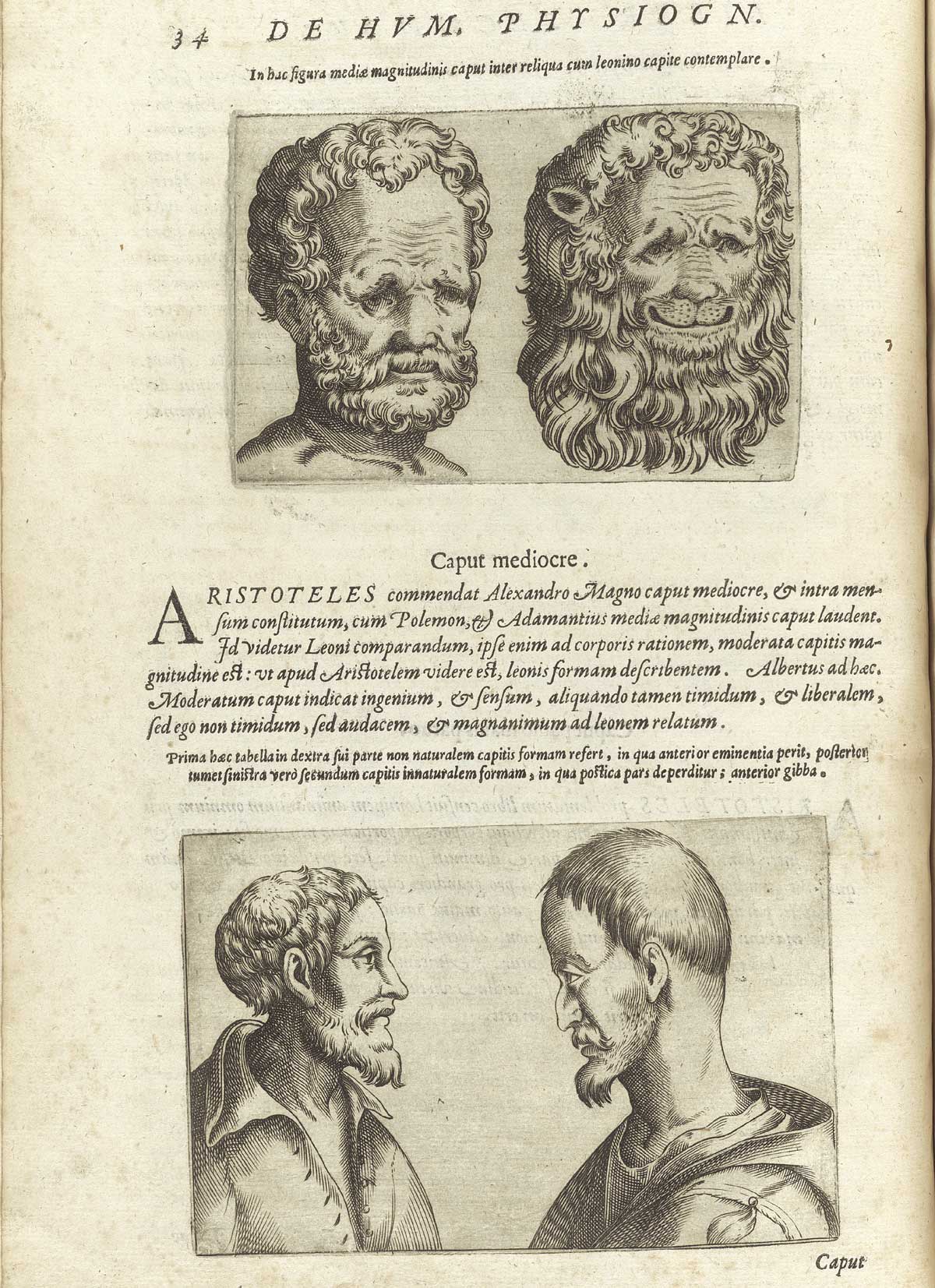
physiognomy of man and lion

Within pre-Roman Aristotelian thought, skin color was only a minor component of physiognomy.  Physiognomy is a text attributed to Aristotle but probably from his Peripatetic school.  It states that the best signs are parts of the body, e.g. eyes, forehead, hair, nose, ears.[3]  Skin color, in contrast, isn’t a physically separate feature of the body.  Physiognomy includes reasoning about the relationship between minds and bodies and critical consideration of different methods of inference from physical characteristics to mental characteristics.  The consideration of skin color, however, is methodologically desultory:

Too black a hue marks the coward, as witness Egyptians and Ethiopians, and so does also too white a complexion, as you may see from women.  So the hue that makes for courage must be intermediate between these extremes.  A tawny colour indicates a bold spirit, as in lions; but too ruddy a hue marks a rogue, as in the case of the fox.  A pale mottled hue signifies cowardice, for that is the colour one turns in terror.  The honey-pale are cold, and coldness means immobility, and an immobile body means slowness.  A red hue indicates hastiness, for all parts of the body on being heated by movement turn red.  A flaming skin, however, indicates madness, for it results from an overheated body, and extreme bodily heat is likely to mean madness. [4]

This text considers human differences among geographic groups (Egyptians and Ethiopians) and sexes (women).  It also uses analogies with non-human animals (lions and foxes) and considers states associated with conditions of the mind (terror). Physiognomy explicitly recognizes these fields of reasoning as distinct methods of physiognomic sign selection and inference.  Inference from skin color further adds reasoning about coldness and heat.  Such reasoning features in Hippocratic humoral medicine.

Reasoning within the framework of humoral medicine came to dominate the physiognomy of skin color.  A section on physiognomy included in an Arabic textual corpus styled as Aristotle’s advice to Alexander declared:

The temperaments differ according to the creature, and the natures differ according to their composition.  A clear white complexion with a tinge of blue and much ruddiness betokens shamelessness, cunning, and small intelligence. [5]

Roger Bacon’s late-thirteenth-century introduction to this text elaborated on the connection between temperament and skin color:

if a king is of a choleric complexion he will be naturally inclined to pride and anger, and war, &c. And his councillors and kingdom will follow in his path, and neighbouring kingdoms will also be disturbed. If he is of sanguine complexion he will be humble and prudent and peaceful, &c. And so on for the other complexions. [6]

A further adaptation fully mapped four temperaments and four skin colors:

The sanguine man should be ruddy of color, the phlegmatic should be white and pale, the choleric should have yellow color somewhat mixed with red, and the melancholic should be somewhat black and pale. [7]

The four temperaments and the four skin colors are based on the four humors: blood, phlegm, yellow bile, and black bile.  In this physiognomic elaboration of humoral medicine, an excess of yellow bile implies a choleric temperament and yellow skin color.

In physiognomy before the Enlightenment, reason could overcome the natural implications of skin color.  A story that originated in the circle of Socrates tells of a master of physiognomy reading the face of Hippocrates.  The master declares that Hippocrates’ nature is to be deceitful and lustful.  Hippocrates’ disciples, knowing Hippocrates to be otherwise, are outraged.  Hippocrates, however, declares that the physiognomic reading of his nature is true:

This is indeed my character, and such is my disposition.  But when I saw that these qualities were bad, I restrained myself from following them, and my reason overcame my passions.  And the philosopher who cannot subjugate his desires to his reason is no philosopher at all. [8]

Roger Bacon had a more Platonic interpretation of possibilities for personal realization in contrast to complexion:

And all who rule are swayed by their complexions unless God ordains otherwise.  But if they have good advice from learned physicians skilled in astronomy, their evil complexions can be changed for better, and they be inclined to all good. [9]

Skin color did not determine behavior in the full, philosophical understanding of human behavior that flowed from Greece through the Islamic world to western Europe.[10]

Trubert disguising himself in yellowface as a learned Oriental physician led to demeaning of reason.  In thirteenth-century France, the Orient was recognized to have superior learning in medicine and astrology.  Trubert’s disguise enabled him to act viciously, brutally, and utterly without reason.  In a thirteenth-century scholastic reading, Trubert’s made-up choleric complexion trumped his pretense of well-developed reason.[11]

*  *  *  *  *

Read more:

Notes:

[1] The experience of the Crusades grounded fear of Muslims in Europe.  Fear of central-Asian Mongols is less commonly recognized in western European history.  Such fear, however, was significant.  It prompted European leaders to send Giovanni di Plano Carpini and William of Rubruck on missions to the Mongol court in the thirteenth century.

[2] Ghersetti (2007a).

[3] Pseudo-Aristotle, Physiognomy (Physiognomonica), trans. Loveday & Forster (1913) 814a.  On the attribution of this work, see Boys-Stones (2007) pp. 64-75.

[4] Id. 812a.  Swain (2007), appendix, gives a slightly emended version: “mania” is replaced with “madness.”  I follow that emendation above.  The Physiognomy of the second-century sophist Philemon shows Aristotelian influence in its reading of skin color, but it excises the references to women and non-human animals.  See Leiden Polemon, Ch. 36, trans. Hoyland (2007) 427, 429 (chapter on “colour of the whole body”).  It includes reference to yellow:

The colour in which some yellow is mixed is an indication of bad intent, fear, and cowardice, except when the yellow is from an illness.  If you see that the yellow turns toward black, without illness, it is an indication of cowardice, gluttony, little speech, anger, and prolixity.

Id.  Other Polemon recensions refer to a “pale colour,” “a colour which is deformed by pallor,” and “sallow” (with one possible reading of “light blue”). See, in Swain (2007), the translations of the Physiognomy of Adamantius the Sophist and Anonymous Latinus, Book of Physiognomy.  The incoherence of Polemon’s physiognomy of skin color may have contributed to the attractiveness of humoralism for physiognomic reading of skin color.

The association of “too ruddy” with a rogue may be via the effects of too much wine-drinking. Two one-line insults of persons with red faces have survived in a Hellenistic papyrus:

  1. You don’t have a face, but a setting sun.
  2. You don’t have a face, but a fireplace.

Trans. Hansen (1998) p. 274, from P.Heid. I 190, in Kassel (1956).

[5] Kitab sirr al-asrar (The Book of the Secret of Secrets), from Arabic trans. Ali (1920) p. 219, variant from Laud. Or. 210 (W).  The reading from other manuscripts is:

Thou knowest that the womb is for the embryo like the pot for the food, therefore the whiteness or blueness, or extreme redness {of the face} indicates imperfect coction, and if to them is added any imperfection of nature it is a strong proof of the body being imperfect as well. Therefore beware of such people, blue or very red and smooth, for they must be shameless, perfidious, and sensuous.

Id.  The reference to “blueness” probably comes from the association of phlegm with (blue) water in humoral medicine.

[6] From Latin trans. Steele (1920) p. 279.  Bacon worked in Paris and Oxford.  He edited Secret of Secrets in Latin about 1275-80 at Oxford and also claimed, probably falsely, to have examined Greek and Arabic manuscripts of Secret of Secrets.  Williams (2003) pp. 176-80, 195, 399.  Bacon was familiar with an account of William of Rubruck’s journey to the Mongol court.

[7] Secreta Secretorum, trans. and adapted from Latin by James Yonge in 1422 in Ireland as The Gouernaunce of Prynces  (MS. Rawl. B. 490), into modern English trans. Kerns (2008) p. 106.

[8] Kitab sirr al-asrar, from Arabic trans. Ali (1920) p. 219.  The story apparently originated in Phaedo of Elis‘ dialogue Zopyrus.  Phaedo was in the circle of Socrates.  In Phaedo’s dialogue, the master of physiognomy is the foreigner Zopyrus.  He reads the face of Socrates.  Subtle but important variants of this story exist in Greco-Roman literature.  See Boys-Stones (2007) pp. 23-33. In subsequent Arabic literature, the master of physiognomy is usually Polemon of Laodicea, who reads the face of Hippocrates.  See, e.g. HP p. 54. In the Istanbul Polemon (TK Recension; MSS Topkapi, Ahmet III 3207), the story is greatly expanded.  Hippocrates responds to Polemon’s physiognomy with an expansive neo-Platonic discussion of a tripartite soul:

In fact I do not declare that the intellect can remove desire so it ceases to exist, nor that it can overcome anger so that it does not arise; but it is possible that it can return desire from its arousal and placate anger after it has been provoked with the result that it can drive both of them back to the foundations of the natural disposition without them being aroused.

Trans. Ghersetti (2007b) p. 475.  For analysis, Ghersetti (2007a) pp. 282-5.

[9] From Latin trans. Steele (1920) p. 279.

[10] For classical intellectual history of the relationship between physiognomy and human behavior, Boys-Stones (2007).

[11] An alternate interpretation is that yellow skin color was professionally associated with physicians, independent of their natural physical attributes.  Petrarch’s Invective contra medicum (1353) declares to a physician:

You say that physicians achieve miraculous results.  What results?  Please tell me.  Perhaps you count as miraculous the fact that you doctors are sick more often than other people, indeed almost continually. Amid great crowds of people, your faces are conspicuous by their singular pallor, which has become proverbial.  When we see a person with a sallow or wasted face, we call this a “physician’s complexion.”

Bk. 1, Ch. 21, trans. Marsh (2003) p. 9.  The Leiden Polemon recognizes that illness produces yellow skin color.  See note [4] above.  Invective generically involves exaggeration.  Trubert sought to disguise himself as a better physician than other physicians, not as a sickly physician.  Judging the respective literary contexts, I think a geographic rather than professional reading of yellow skin in Trubert makes more sense.

[image] From Giambattista della Porta, De humana physiognomonia libri IIII. (Vici Aequensis [Vico Equense] : Apud Iosephum Cacchium, 1586), p. 34 detail.

References:

Ali, Ismail, trans. 1920.  Kitab sirr al-asrar (The Book of the Secret of Secrets). Pp. 176-266 in Steele (1920).

Boys-Stones, George. 2007.  “Physiognomy and Ancient Psychological Theory.”  Ch. 2 (pp. 19-124) in Swain (2007).

Ghersetti, Antonella. 2007a.  “The Semiotic Paradigm:  Physiognomy and Medicine in Islamic Culture.” Ch. 6 (pp. 281-308) in Swain (2007).

Ghersetti, Antonella. 2007b. “The Istanbul Polemon (TK Recension): Edition and Translation of the Introduction.” Ch. 9 (pp. 465-486) in Swain (2007).

Hansen, William F., ed. 1998. Anthology of ancient Greek popular literature. Bloomington: Indiana University Press.

Hoyland, Robert. 2007.  “A New Edition and Translation of the Leiden Polemon.”  Ch. 8 (pp. 329-464) in Swain (2007).

HP: Ibn Abi Usaybi’ah, Ahmad ibn al-Qasim. English translation of History of Physicians (4 v.) Translated by Lothar Kopf. 1971. Located in: Modern Manuscripts Collection, History of Medicine Division, National Library of Medicine, Bethesda, MD; MS C 294. Online transcription.

Kassel, Rudolf. 1956. “Reste eines hellenistischen Spassmacherbuches
auf einem Heidelberger Papyrus?” Rheinisches Museum für Philologie 99: 242–245.

Kerns, Lin, trans. 2008. The secret of secrets (Secreta secretorum): a modern translation, with introduction, of The governance of princes. Lewiston: Edwin Mellen Press.

Loveday, T. and E.S. Forster, trans. 1913.  Aristotle.  Physiognomonica.  Pp. 805a-814a in W.D. Ross, ed. The works of Aristotle.  Vol. 6. London: Oxford University Press.

Marsh, David, trans. 2003. Francesco Petrarca. Invectives. Cambridge, Mass: Harvard University Press.

Steele, Robert, ed. 1920. Opera hactenus inedita Rogeri Baconi.  Vol. 5. Secretum secretorum, cum glossis et notulis : Tractatus brevis et utilis ad declarandum quedam obscure dicta. Oxford: Oxford University Press.

Swain, Simon, ed. 2007. Seeing the face, seeing the soul: Polemon’s Physiognomy from classical antiquity to medieval Islam. Oxford: Oxford University Press.
Williams, Steven J. 2003. The secret of secrets: the scholarly career of a pseudo-Aristotelian text in the Latin Middle Ages. Ann Arbor: University of Michigan Press.