
Author: Douglas Galbi
punctuation poems subtly subvert dominant social order with lineation
Challenging the ideology of the dominant social order tends to anger persons entrenched in it. That’s dangerous for dissidents. Creative poets, however, developed means to pass under orthodoxy while offering subversive views. With punctuation poems, poets allowed readers to nod in complacent affirmation of the dominant ideology. Yet these poems with an alternate lineation enabled alert readers to encounter a different view of the dominant social order.
Law, particularly criminal law, is a central aspect of the dominant social order. Consider this perspective on reigning law in England in the fifteenth century:
Now the law is led by clear conscience.
Very seldomly covetousness has dominion.
In every place right has residence.
Neither in town nor rurally {exists} deception.
There is truly in every case consolation.
The poor people at no time has {nothing} but formal right.
Men may find neither {by} day nor night adulation.
Now reigns truth in every man’s sight.
Here’s a radically different view:
Now the law is led by clear conscience very seldomly.
Covetousness has dominion in every place.
Right has residence neither in town nor rurally.
Deception there is truly in every case.
Consolation the poor people at no time has {anything} but formal right.
Men may find neither day nor night {but all confused}.
Adulation now reigns {over} truth in every man’s sight.
Both these readings are encoded in same Middle English poem:
Nowe the lawe is ledde by clere conscience .
ffull seld . Couetise hath dominacioun .
In Every place . Right hath residence .
Neyther in towne ne feld . Similacion .
Ther is truly in euery cas . Consolacioun .
The pore peple no tyme hase . but right .
Men may fynd day ne nyght . Adulacioun .
Nowe reigneth treuth in euery mannys sight . [1]
Reading textual lines as the units of sense, the dominant reading practice, gives the ideology of the dominant order. Transgressing the end-stopped lines to the mid-line break (caesura) gives the subversive reading. That non-dominant Middle English poetic lineation is known as enjambment.
Lawyers in seventeenth-century England imprisoned through private action an extraordinarily large number of men for debt. A punctuation poem from the mid-seventeenth century critiques lawyers’ role in that terrible structure of justice:
Lawyers themselves maintain the commonweal.
They punish such as does offend and steal.
They free with subtle art the innocent
from any danger, loose {them} of punishment.
The can, but will not, save the world in awe
with any false or mis-expounded law.
They ever have great stock of charity,
and love they desire not, keeping amity.Lawyers themselves maintain.
The commonweal they punish such as does offend and steal.
They free with subtle art {the guilty}.
The innocent from any danger, loose of punishment, they can, but will not, save.
The world in awe, with any false or mis-expounded law, they ever have great stock.
Of charity and love they lack,
not keeping amity.{ Lawyers themselves maineteyne . ye common weale .
They punish . such as doe offend and steale .
They free with subtill arte . The Innocent .
From any danger, loose of punishment .
They can but will not save . ye world in awe .
With any false or mixexpounded law .
They euer haue great store . of charite .
And loue they wante not, keeping amitie . } [2]
This poem is relatively crude in its use of rhyme. But, as in the previous punctuation poem, breaks within the lines are associated with the critical version that breaks from affirming the dominant social order.[3]
Another aspect of dominant ideology is the dominant religious faith. In seventeenth-century England, orthodox faith meant not merely ideological fervor in upholding dominant ideology, but membership in an actual Church of England. With a break down its middle, like the break a priest makes to a communion wafer in celebrating Mass, a seventeenth-century punctuation poem encoded a fierce Catholic declaration within an Anglican affirmation:
I hold as faith what England’s church allows.
What Rome’s church says my conscience disavows.
Where the King’s the head that church can have no shame.
The flock’s misled that holds the Pope supreme.
Where the altar’s dressed {with holy images}, there’s service scarce divine.
The people’s blessed with table, bread, and wine {and no holy images}.
He’s but an ass who the {Anglican} communion flies —
who shuns the {Catholic} Mass is catholic and wise.I hold as faith
what Rome’s church says.
Where the King’s the head,
the flock’s misled.
Where the altar’s dressed {with holy images},
the people’s blessed.
He’s but an ass
who shuns the {Catholic} Mass.What England’s church allows,
my conscience disavows.
That church can have no shame,
that holds the Pope supreme.
There’s service scarce divine
with table, bread, and wine {but no holy images}.
Who the {Anglican} communion flies
is Catholic and wise. [4]
Catholics rebels plotted in 1605 to blow up the House of Lords and kill King James I. In previous decades many Catholics were harshly treated and sometimes even killed for their faith. Affirming Catholicism within a statement of Anglican orthodoxy wasn’t a trifling poetic game.
Criticizing women is even more dangerous under the dominant gynocentric order than is dissenting in how to worship God. Not surprisingly, men resorted to punctuation poems for the treacherous activity of expressing their feelings about women:
In women is rest, peace, and patience.
No {mere} season for truth, everything {they say is} with generosity.
Both by night and day, they have {their men’s warranted} confidence.
All ways of treason out of blame they be.
At no time, as men say, {have they} mutability.
They have, without nay, {nothing} but steadfastness.
In them may you never find, I guess, cruelty.
Such qualities they have more & less.In women {there} is {for} rest, peace, and patience no season.
For truth everything {including their sexual favors} with generosity {they give} both by night and day.
They have confidence {in} all ways of treason.
Out of blame they be at no time.
As men say, mutability they have.
Without nay, but {even just} steadfastness in them may you never find.
I guess cruelty — such qualities — they have more & less.{ In women is rest peas and pacience .
No season . for soth outht of charite .
Bothe be nyght & day . thei haue confidence .
All wey of treasone . Owt of blame thei be .
No tyme as men say . Mutabilite .
They haue without nay . but stedfastnes .
In theym may ye neuer fynde y gesse . Cruelte
Suche condicons they haue more & lesse . } [5]
The concluding “more & less” indicates the diffidence of this poem’s protest. But another punctuation poem moves forward to protest more vigorously women’s abusive behavior toward men:
All women are virtuous, noble & excellent.
Who can perceive that they do offend?
Daily they serve god with good intent.
Seldom they displease their husbands to their lives’ end.
Always to please them they do intend.
Never man may find in them shrewdness.
Commonly such conditions they have more & less.What man can perceive that women be evil?
Every man that has wit greatly will them praise.
For vice they abhor with all their will.
Prudence, mercy & patience they use always.
Folly, wrath & cruelty they hate as man says.
Meekness & all virtue they practice ever.
Sin to avoid, virtues they do procure.Some men speak, “Much evil be women!”
Truly therefore they are to blame.
Nothing a man may disparage of them.
Abundantly they have grace & good fame.
Lacking {are they} few virtues to a good name.
In them you find all constantness.
They lack, obviously, all shrewdness as I see it.
All women are virtuous, noble & excellent: who can perceive that?
They do offend daily.
They serve god with good intent seldom.
They displease their husbands to their lives’ end always.
To please them they do intend never.
Man may find in them shrewdness commonly.
Such conditions they have more & less.What man can perceive that women be evil? Every man that has wit.
Greatly {they} will them praise for vice.
They abhor with all their will prudence, mercy & patience.
They use always folly, wrath & cruelty.
They hate, as men says, meekness & all virtue.
They practice ever sin.
To avoid virtues, they do procure.Some men speak, “Much evil be women truly!”
Therefore they are to blame {for} nothing.
A man may disparage of them abundantly.
They have grace & good fame lacking.
Few virtues to a good name in them you find.
All constantness they lack, obviously.
All shrewdness {they have}, as I see it.
{ All women have vertues noble & excelent
Who can perceyve that they do offend
dayly they serve god with good intent
Seldome they dysplease there husbandes to theyr lyves end
Always to plese them they do intend
neuer man may fynd in them srewdnes
comonly suche condycyons they haue more & leseWhat man can percyve that women be evyll
euery man that hathe wytt . gretly wyll them prayse
ffor vyce : they Abhorre with all theyre wyll
prudence mercy & pacyence . they vse always
ffoly wrathe & cruelte they hate As men says
meknes & all vertue . they prattyse euer
syn . to Avoyde vertues they do procureSum men speke muche evyll be women
truly . theyfore they be to blame
nothyng . A man may chekk in them
haboundantly . they haue of grace & good fame
Lakkyng . few vertues to A good name
in them fynd ye . All constantnes
they lak perde . all srewdnes As I gese } [6]
Like law, lawyers, and the church, women had a dominant position in medieval gynocentric society. In punctuation poems, the dominant way of reading poems expressed that dominant position. One such poem explained:
Read this verse according to its meter
and it says women are good, but read it {according} to
its {punctuation} marks to gain the contrary {meaning}.{ Reid this werss acording to ye meitter
& It is guid of wemen bot reid it to
ye nott ewin the contrair } [7]
The contrary meaning was the subversive, dangerous meaning within gynocentric society.
Surviving Middle English punctuation poems lack the artistic brilliance of Optatianus Porfyrius’s fourth-century carmen cancellatum to a cuckolded husband. But they have a similar social position and a similar critical strategy. Within the oppressive circumstances of gynocentric society, speaking about gender injustices against men requires unusual poetry.

* * * * *
Read more:
- medieval Latin freedom of speech: cuius contrarium
- advances in philology: punctuation saves lives
- the medieval poet’s repentance, updated
Notes:
[1] Middle English text exactly from Robbins (1952) p. 101 (poem no. 111), my modern English versions. The Middle English text is punctuated as in the manuscript source, MS Cambridge UK, Cambridge University Library Hh.2.6, f. 58ra. Five other surviving manuscripts are known to contain this poem, DIMEV 3804. Nutall (2014) points out the change in verse form with the change in lineation.
Subsequent examples of punctuation poems are Roister Doister’s mispunctuated love letter to Dame Christian Custance, in Nicholas Udall’s comedic play Roister Doister, “Sweete mistresse where as I loue you nothing at all”, 3.4.36ff ; and the poetic prologue to the play in Shakespeare’s Midsummer Night’s Dream, “If we offend, it is with our good will.” 5.1.108ff. Here’s a recent poem that reveals anti-meninist sentiments if the lines are read in reverse order. Here’s a review of modern punctuation poetry.
[2] Original English text from Robbins (1939) p. 207, my modernizations. Id. describes it as “A poem of the time of King Charles II {that} was printed in an edition limited to 102 copies at Bristol in 1814.”
[3] A punctuation poem written in the mid-sixteenth century is inconsistent with that pattern. Consider:
Trusty seldom, to their friends unjust.
Glad to help no Christian creator.
Willing to grieve, establishing all their joy & lust.
Only in the pleasure of God having no care.
Who is most rich with them, they will be protective.
Where need is, {they are} giving {of} neither reward nor fee.
Unreasonably thus priests love, obviously.Trusty, seldom to their friends unjust.
Glad to help.
No Christian creator willing to grieve.
Establishing all their joy & lust only in the pleasure of God.
Having no care who is most rich with them.
They will be protective where need is.
Giving neither reward nor fee unreasonably.
Thus priests love, obviously.{ Trvsty seldom . to their ffrendys vniust .
Gladd for to helpe no crysten creator .
Wyllyng to greve . settyng all ther ioy & lust
Only in Þe pleasour . of gode havyng no cure .
Who is most riche with them Þei wil be sure .
Wher nede is gewyng nether rewarde ne ffee .
Vnresonably thus lyve prestys, Parde. }
Middle English text from Kreuzer (1938) p. 323 (version B, punctuated for disparaging priests), my modernizations. The poem survives in Pembroke College, Cambridge MS. 307, fol. 197b. The poem survives to two versions of the Middle English text, differently punctuated to indicated the different readings. Id. prints both versions. Robbins (1952) p. 101 prints the A version (punctuated for praising priests), and notes:
The poem is written twice: first in a mid-sixteenth-century hand, and second in a somewhat latter hand. It appears on the end flyleaf of a Confessio Amantis along with other scribblings — a location which indicates the experimental nature of the verse.
Id. p. 262. Kreuzer (1938), p. 323, less carefully suggests that both versions were written in the fifteenth century.
Priests were part of the dominant order in medieval England. Who would have authored a fifteenth-century English poem that in its dominant lineation disparaged priests, yet contained an alternate lineation that praised priests? The most plausible answer seems to me a priest. The point might be that, despite superficial appearances of corruption, priests have a less visible goodness. Such social positioning of a punctuation poem seems to me likely to be quite unusual.
[4] Original English text in Robbins (1939) p. 207, my modernizations. The original text is like the first modernization except in spelling and punctuation. Id. states of the poem:
it comes from a broadside of 1655, which the antiquary Robert Bell two hundred years later found posted on the wall of a Gloucestershire public-house.
The poem probably was written well before the English Civil War (1642–1651).
[5] Middle English text exactly from Robbins (1952) p. 102 (poem no. 112), my modern English versions. The Middle English text is punctuated as in the manuscript source, MS Cambridge UK, Cambridge University Library Hh.2.6, f. 58ra. (the same folio page containing above “Lawyers themselves maineteyne . ye common weale .”). This poem is found only in this manuscript.
[6] Poem by Richard Hattfield, Middle English text from the Devonshire Manuscript, London, British Library Addit. 17492, f. 18v, my modernizations. The first stanza of this poem (DIMEV 406) is found in four other manuscripts, but the second and third stanzas are unique to the Devonshire Manuscript.
[7] Middle English text from Robbins (1939) p. 206, printed from the early sixteenth-century MS. Cambridge UK, Magdalene College Pepys 2553 (Maitland Folio Manuscript) p. 356, printed in Craigie (1919) vol. 1, p. 433. This rubric follows the first stanza of a version of “All women have virtues noble and excellent” (DIMEV 406). See above.
[image] “Rabbit and Duck” double (ambiguous) drawing. From the 23 October 1892 issue of Fliegende Blätter. Via Wikimedia Commons.

References:
Craigie, William Alexander. 1919. The Maitland Folio Manuscript, Containing Poems by Sir Richard Maitland, Dunbar, Douglas, Henryson, and others. Scottish Text Society n.s. 7.
Kreuzer, James R. 1938. “Some Earlier Examples of the Rhetorical Device in Ralph Roister Doister (III. iv. 33 ff.).” The Review of English Studies. 14 (55): 321-323.
Nuttall, Jenni. 2014. “One Poem: Two Ways.” Stylisticienne, Mar. 27 (online).
Robbins, Rossell Hope. 1939. “Punctuation Poems — A Further Note.” The Review of English Studies. Old Series 15(58): 206-207.
Robbins, Rossell Hope. 1952. Secular lyrics of the XIVth and XVth centuries. Oxford: Clarendon Press.
Paul condemned gyno-idolators along with fornicators & adulterers
While men-abasing “courtly love” became a highly refined form of oppression in medieval Europe, its constituents gyno-idolatory and gynocentrism have been prevalent throughout history. The man enslaved in love, soldiering on watch for his beloved and lamenting that he is locked out, is a common figure in ancient Roman elegiac poems. That’s the context in which Paul of Tarsus condemned gyno-idolatry among particular categories of men’s sexual wrongdoing.
Paul’s condemnation of idolatry should be interpreted within its specific context. Paul declared:
Do not be deceived! Neither fornicators nor idolators nor adulterers nor catamites nor sodomites nor thieves nor the greedy, neither drunkards nor slanderers nor swindlers will inherit the kingdom of God.
{ μὴ πλανᾶσθε οὔτε πόρνοι οὔτε εἰδωλολάτραι οὔτε μοιχοὶ οὔτε μαλακοὶ οὔτε ἀρσενοκοῖται οὔτε κλέπται οὔτε πλεονέκται οὐ μέθυσοι οὐ λοίδοροι οὐχ ἅρπαγες βασιλείαν θεοῦ κληρονομήσουσιν } [1]
At least four of the first five categories concern sexual immorality. Among those categories, catamites are men who typically, consensually are penetrated sexually by other men. Sodomites are men who typically, consensually penetrate sexually other men. Those terms indicate that Paul’s condemnation of sexual immorality is addressed specifically to men.[2] Fornicators thus means men who have sex with women to whom they are not married. Adulterers similarly means men who have sex with married women, but who aren’t those women’s husbands. But what about “idolators” situated in the middle of those terms?
Idolators as a figure of harlotry isn’t a gender-consistent interpretation. Idolatry in Hebrew scripture is associated with feminine harlotry. For example, the prophet Hosea criticized Israel:
My people consult their piece of wood,
and their wand makes pronouncements for them,
For the spirit of harlotry has led them astray;
they play the whore, forsaking their God. [3]{ עַמִּי בְּעֵצֹו יִשְׁאָל וּמַקְלֹו יַגִּיד לֹו כִּי רוּחַ זְנוּנִים הִתְעָה
וַיִּזְנוּ מִתַּחַת אֱלֹהֵיהֶֽם׃ }
In Hebrew scripture, Israel, meaning the chosen people of God, is commonly figured as a woman. In Christianity, the church, meaning of the people of God, is also commonly feminine. Men’s sexual welfare disadvantage and women’s sexual privilege have created throughout history sexual markets in which men predominately pay women for sex. That means that whores historically have been predominately women. Idolators as a figure of harlotry implies that the idolators are women. That’s inconsistent with the context of Paul condemning men’s sexual immorality.[4]
With extraordinary inspiration, Paul used the term idolators to condemn gyno-idolators as another category of men engaged in sexual immorality. Gyno-idolatry involves men treating women, who are fully human beings, as if women were goddesses, or at least superior human beings. King Solomon was a pre-eminent gyno-idolator. Lucretius, the great Roman debunker of delusions, strongly condemned gyno-idolatry. Yet the brilliant Roman author Ovid suffered horrible punishment for not being a gyno-idolator. Benighted medieval knights like Lancelot became celebrated for their gyno-idolatry. Under increasingly totalitarian gynocentrism, gyno-idolatry has become a nearly unspeakable form of sexual immorality.
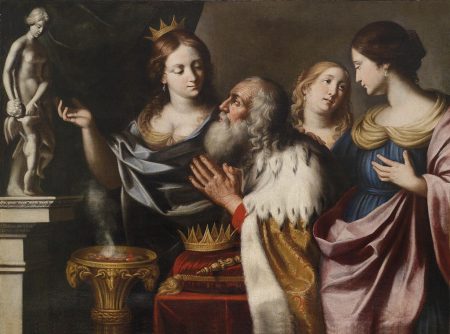
Men, do not worship your girlfriends! Husbands, do not idolize your wives! If you engage in such idolatry, you are no better than fornicators, adulterers, catamites, and sodomites. So said the wise man that Christians now call Saint Paul.
* * * * *
Read more:
- Jerome’s Adversus Jovinianum: method in madness about marriage
- Peter Lombard’s Sentences: conjugal partnership, not courtly love
- Galen and Paul of Tarsus against the Epicureans
Notes:
[1] 1 Corinthians 6:9-10. The English translation is insubstantially adapted from that of Orr & Walther (1995).
[2] 1 Corinthians 6:5 also indicates that Paul is addressing men. Orr & Walther (1995), p. 250, doesn’t recognize that Paul is specifically addressing men here. That Paul condemned men’s sexual immorality should not be interpreted to condone women’s sexual immorality. Women are no more sexually moral than men are. Paul surely recognized this reality. See, e.g. 1 Corinthians 5:1, Romans 1:26-7, Galatians 3:28.
Ephesians, which may have been written by a disciple of Paul, uses idolatry (εἰδωλολάτρης) to encompass fornication, impurity, and greed. Ephesians 5:5.
[3] Hosea 4:12. More generally, see Hosea 3:10-5:4 and Jeremiah 3.
[4] Orr & Walther (1995), p. 255, doesn’t recognize the gender problem in idolators being a figure of harlotry from Hebrew scripture.
[image] King Solomon falling into gyno-idolatry. Painting by Giovanni Venanzi di Pesaro, made in 1668. Via Wikimedia Commons.

Reference:
Orr, William F., and James Arthur Walther. 1995. I Corinthians: a new translation; introduction with a study of the life of Paul, notes and commentary. Anchor Bible series. New York: Doubleday.
Wynnere and Wastoure: reject gender subordination to be a winner

Wynnere and Wastoure {Winner and Waster}, an alliterative Middle English poem written in the 1350s, features the personifications Winner and Waster in debate. Their debate encompasses husbands’ gender subordination to their wives under the delusions of courtly love. In the Middle Ages, shrewd men recognized that gyno-idolatry is not only a sin, but also a waste.
Winner pitied those men who, like Waster, allowed their wives to dictate their spending. The situation hints of domestic violence against husbands:
“Now,” said Winner to Waster, “I wonder in my heart
at these poor, penniless men that buy precious furs,
saddles of silk, circled with sumptuous rings,
lest they anger their wives, whose wills they must follow.
You sell wood after wood in only a short time,
both the oak and the ash, and all that grows there.
…
Now it is auctioned and sold — my sorrow is greater —
and wasted all willfully, to please your wives.”{ “Now,” quod Wynner to Wastour, “me wondirs in hert
Of thies poure penyles men that peloure will by,
Sadills of sendale, with sercles full riche.
Lesse and ye wrethe your wifes, thaire willes to folowe,
Ye sellyn wodd aftir wodde in a wale tyme,
Bothe the oke and the assche and all that ther growes;
…
Now es it sett and solde, my sorowe es the more,
Wastes alle wilfully, your wyfes to paye. } [1]
Today women spend about $2.30 for every dollar men spend.[2] That’s far more significant than the mythic “wage gap” widely featured in untruthful news media. To fill the gender spending gap, men must spend more. To overcome historical gender inequality, men must spend not according to their wives’ orders, but according to their own choices and desires.
Husbands spending excessively according to their wives’ orders benefits no one. Wives become ridiculous-looking, and husband don’t get more sexual satisfaction:
Those that had been lords in land had noble ladies.
Now they are foolish gals of the new fashion, so nicely attired,
with broad, drooping sleeves hanging down to the ground,
overlayed and underlined with ermine on every side.
It is as hard, I swear, to give them good handle in the dark
as to a innocent, simple wench that never wore silk.{ That are had lordes in londe and ladyes riche,
Now are thay nysottes of the new gett, so nysely attyred,
With side slabbande sleves, sleght to the grounde,
Ourlede all umbtourne with ermyn aboute,
That es as harde, as I hope, to handil in the derne,
Als a cely symple wenche that never silke wroghte. }
Women buy expensive clothes and fancy adornments to please themselves. Most men simply prefer to enjoy women naked.
Men who attempt to buy women’s favor gain women’s contempt and increase their own risk of death. The woman-pleaser Waster objected to Winner’s truthful analysis:
It sits well for a man to provide for his beloved,
to follow her wishes to win her heart.
Then she will love him truly, like her own life,
make him bold and eager to smite with his sword,
to shun disgrace and shame where men are gathered.{ It lyes wele for a lede his leman to fynde,
Aftir hir faire chere to forthir hir herte.
Then will scho love hym lelely as hir lyfe one,
Make hym bolde and bown with brandes to smytte,
To schonn schenchipe and schame ther schalkes ere gadird }
Women don’t love men for giving them stuff and being their lackeys. Women use certain men to get stuff. Women love charming jerk-boys. Study medieval women’s love poetry if you are ignorant. And men, value your own life. Women, particularly beloved women, are highly capable of inciting men to violence. Just say no to violence against men. Be confident in the knowledge that your masculinity is intrinsically glorious.[3] Make love, not war.
* * * * *
Read more:
- Alliterative Morte Arthure: sexual violence against men & cuckolding
- Martianus Capella, updated: the marriage of Gynecology and Hercules
- sophistic Gilote explains medieval satire of family courts
Notes:
[1] Wynnere and Wastoure ll. 392-7, 407-8, Middle English text from Ginsberg (1992), my modern English translation, benefiting from those of Gardner (1971) and Millett (2014). The subsequent quote is similarly from Wynnere and Wastoure ll. 409-14. This poem survives in one manuscript, British Library, Additional MS 31042 (written in the fifteenth century). The poem was probably authored in the period 1352-70. Millett (2014), introduction.
[2] See, e.g. Silverstein & Sayre (2009), Nielson (2013), Smith (2014). These and other sources indicate that women control roughly 70% of consumer spending. That spending share implies that for each dollar men spend, women spend 70% / 30% = $2.33.
[3] The Parlement of the Thre Ages, ll. 246-9, describes the experience of a man whose glorious masculinity was appreciated:
And then returned to the court that I came from,
with ladies fully lovely to embrace in my arms,
and to clasp them and kiss them and comfort my heart,
and then to dance with dear damsels in their chambers.{ And than kayre to the courte that I come fro,
With ladys full lovely to lappyn in myn armes,
And clyp thaym and kysse thaym and comforthe myn hert,
And than with damesels dere to daunsen in thaire chambirs }
Old English text from Ginsberg (1992), my modern English translation. The Parlement of the Thre Ages was authored in the second half of the fourteenth century. It, along with Wynnere and Wastoure, are the last two items in British Library, Additional MS 31042. Ginsberg (1992), introduction.
[image] Portrait (excerpt) of Anne of Austria, Regent of France, 1643 to 1651. Copy of a lost painting by Peter Paul Rubens. Preserved under accession # INV 1794 in Louvre Museum, Paris. Via Web Gallery of Art and Wikimedia Commons. According to Wikipedia, “She {Anne of Austria} never lost her love for magnificent jewellery, and she especially loved bracelets, which emphasized her famously beautiful hands.”

References:
Gardner, John. 1971. The Alliterative Morte Arthure: The Owl and the Nightingale: and Five Other Middle English Poems in a Modernized Version with Comments on the Poems and Notes. Carbondale: Southern Illinois University Press.
Ginsberg, Warren, ed. 1992. Wynnere and Wastoure ; and, the Parlement of the thre ages. Kalamazoo, Mich: Published for TEAMS by Medieval Institute Publications.
Millett, Bella, trans. 2014. “Wynnere and Wastoure: Introduction and Translation.” Wessex Parallel WebTexts (online).
Nielsen Co. 2013. “U.S. Women Control the Purse Strings.” Newswire: Demographics. Apr. 2.
Silverstein, Michael J, and Kate Sayre. 2009. “The Female Economy.” Harvard Business Review. 46 (September).
Smith, Julia Llewellyn. 2014. “Womenomics: why women are the future of our economy.” The Telegraph (UK newspaper). April 27, online.
Wednesday’s flowers
