traditional thoughts: adultery with Helen of Troy barren & devastating

Paris seducing Helen of Troy with the help of goddesses

Paris, the very beautiful son of the Trojan king, set out to abduct the most valued person in Sparta. That person was Helen, a very beautiful woman and the wife of the Spartan king Menelaus. While men’s physical beauty is much less commonly acknowledged than women’s, Helen appreciated Paris’s beauty. She enthusiastically eloped with him and passionately had sex with him. She pressed down on him, holding him in gynocentric sexual subordination. According to the traditional, twelfth-century account of Joseph of Exeter, Helen and Paris’s sexual encounter produced merely stained sheets. That foreshadowed the senseless destruction of men’s lives in the brutal violence against men of the Trojan War.

Helen knew what she wanted and moved to engage with unknown men. Helen had come to the island of Cythera to serve the love goddess Venus at her temple there. When she heard that Paris’s ship had landed on the island, she went to him:

So through Cythera’s cities rumor swiftly spread
that Paris, Priam’s son, had come. Persons from everywhere
filled the port to meet him. Helen, the mighty-faced Laconian woman,
directed her steps to the shore to see the unknown men,
and is brought to Helea overlooking the sea.

{ ergo Citheriacas preceps it fama per urbes
priamiden venisse Parim, plebs undique portus
occursu complet. At pollens ore Lacena
ignotos visura viros ad litora gressus
dirigit acclinemque freto defertur Heleam. } [1]

A beautiful woman with her mighty face could easily overwhelm even a strong warrior-man. But Paris, too, wielded the weapon of physical beauty:

After Paris became aware of Helen’s presence, his armed men
he left behind, trusting in beauty and conscious of his face.
Here, there, his steps cover wherever Tyndareus’s daughter Helen goes,
tirelessly wandering in a leisurely walk.
He incites her to look and feeds her fire.
In a short time he captures and gains her love.
Indeed, moving on his course neither too fast nor too slow,
to balance his beauty his poise helps, with his broad shoulders
and head held high. He walks lightly on the sand,
eyeing the Laconian woman Helen with a wondering look,
forgetting to continue his steps. Fearing to be
acting suspiciously, he quickly transfers his gaze elsewhere,
as though amazed at what he sees.

{ postquam Helenes Paridi patuit presentia, classem
deserit ac forme fidens et conscius oris
huc illuc gressum librans, qua Tindaris ibat,
indefessa vagis incessibus ocia texit
certantesque offert vultus, incendia nutrit
mutua captatumque brevi lucratur amorem.
quippe nec ad cursum preceps nec segnior equo
librato gestu formam iuvat, auctus in armos,
in caput erectus. tenero delibat harenam
incessu figitque oculo mirante Lacenam
oblitosque gradus sistit; suspectus haberi
mox metuens transfert celeres ad cetera visus,
ceu stupeat, quicquid spectat. }

Paris didn’t plead his love to Helen and beg to serve her as a self-abasing courtly lover. He allowed her to see his magnificent masculinity and looked for her to respond with interest. She responded with self-restraint:

More modestly she
looks at him obliquely and doesn’t smile fully.
She would like to uncover totally her face, display her cheeks
and her naked breasts, but a sense of modesty
reproves and represses these piled-up excesses, which mixed with
fear make her heart beat unevenly.

{ moderantius illa
obliquos vultus et non ridentia plene
ora gerit totasque velit cum pectore nudo
ostentare genas, sed castigator adultos
comprimit excessus animi pudor, egraque mixtus
pulsat corda metus. }

Men, in their romantic simplicity, generally want an interested woman to show them at least her naked breasts. Women tend to care more about wealth in addition to fleshly beauty:

As soon as Helen had drawn in the sight of charming, non-Tyndarean foreign gold and the ship with purple sails,
she hesitates, unsure of what to do. She would provide
her hand, if asked, but she wants to be forced.

{ ut vero explicitas peregrini Tindaris auri
blandicias hausit complutaque murice vela
conspexit, quid agat, heret, prebere rogatas
prompta manus cogique volens. }

A beautiful girl in Chrétien de Troyes’s late-twelfth-century Arthurian romance Lancelot arranged a fake rape to stimulate Lancelot. Like most men, Lancelot didn’t find that event sexually stimulating. Men should just say no to women’s rape fantasies, or least insist on a written, legally binding contract with hefty payment for the repugnant sexual service that the woman wants.

The foolish Paris resolved to abduct Helen without even receiving payment for her desired sexual service. Under the cover of darkness he entered Venus’s temple. A “frail crowd {debile vulgus}” of women was there celebrating the festival with Helen.[2] The intrusion of the armed men turned Venus’s temple into a wild uproar:

The Laconian woman Helen
was reaching out to him and calling to him with a happy expression —
the Trojan Paris thus abducts her, or rather she abducts him.

{ rapit ergo Lacenam
tendentemque manus et leta fronte vocantem
dardanus aut rapitur potius. }

Joseph of Exeter bluntly described to the gyno-idolator Paris the horror and folly of his action:

Enjoy the spoils,
plunderer, and recognize your gods! After many hardships
you leave with the reward of annihilation and carry back to your mother
fiery ruin she didn’t want to engender. Alas, you are doomed. You know not
what calamity, what violence you carry back with your
fleeing fleet.

{ gratare tropheis,
predo, tuis, agnosce deos! post aspera multa
excidium lucratus abis revehisque parenti,
quas nollet peperisse, faces. heu, perdite, nescis,
quas tecum clades, quantos fugiente tumultus
classe refers. }

Throughout the ages, nothing could be worse than a son doing what his mother didn’t want him to do. That’s what Paris did. Ensuring that modern scholars would call him names like “misogynist,” Joseph of Exeter even dared to criticize a woman:

And you Helen, daughter of Leda, more foul than the marsh Hercules drained, more blazing than the fire breathed on Bellerophon, leave the marriage bed of spouses and once again be sought out by the husband you despise.
You were never abducted, but are running away. }

{ tuque, Herculea corruptior unda,
Bellorophonteo flagrantior igne, sereno
certa minus, thalamos linquis, Ledea, iugales
et spreto tociens iterum querenda marito
numquam rapta fugis. }

Most mothers wouldn’t want their son to marry a woman like Helen of Troy, or even to become involved with such a woman. Nonetheless, Helen fell far short of being a truly strong, independent woman like the sixth-century Byzantine Empress Theodora.
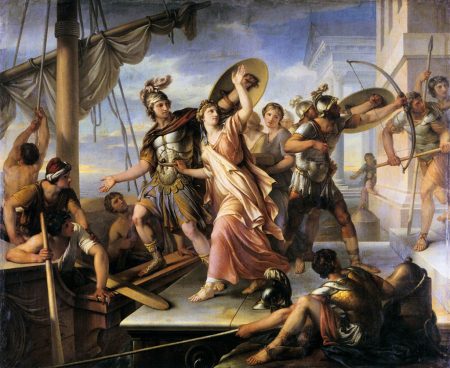
Helen of Troy eagerly leaving with Paris ("The abduction of Helen of Troy")

Despite his great masculine beauty, Paris had to provide Helen with expensive gifts in order to secure her love. After Paris brought Helen home, she began to lose interest in him. He had to act to supplement men’s socially constructed, inferior gender value:

The skillful adulterer
secures the dynamic seducer-woman’s favor.
Soothing her imagined fears, he heaps up Indian ivory,
Arabian incense, Midas’s rivers of gold, and Chinese silk.
And the world’s greatest riches, whatever draws out the sky’s
delight, and the sea’s clarity along with the earth’s fertility —
all these bought an easy bedding, overcame resistance to his
embraces, established her fidelity.

{ gnarus adulter
pollicitis fluxum meche sancire favorem
et fictos lenire metus, ebur aggerat Indum,
thura Sabea, Mide fluvios et vellera Serum.
ac mundi maioris opes, quodque educat aer
iocundum, pontus clarum vel fertile tellus,
hec faciles emere thoros, domuere rebelles
amplexus, pepigere fidem. } [3]

In romantic gift-giving across history, men have given women far more expensive material gifts than women have given men. Gender equality cannot be achieved until women compensate men for this historical gender imbalance. Men must receive adequate payment for their erection labor.

Helen and Paris’s encounter was a sexual failure. With Helen pressing down on him from her position of gynocentric domination, Paris was unable to fulfill men’s burden of performance:

Helen, not holding back for him to kiss her,
not holding back when he kisses her, with her full chest
lies on him, spreads her lap, presses him with her mouth,
and plunders his hidden love. As his love-force expires,
the purple bed-sheet witnesses to knowing his hidden dew.

{ non iam oscula reddit,
non reddenda negat Helene, sed pectore toto
incumbens gremium solvit, premit ore, latentem
furatur Venerem, iamque exspirante Dyone
conscia secretos testatur purpura rores. } [4]

In short, Paris’s life-enhancing semen spilled onto the bed-sheet. Modern literary criticism implies that Helen raped Paris, except most modern literary critics through willful ignorance and bigotry don’t recognize that women rape men. Within a more historically sensitive, common-sense literary reading, Helen and Paris’s sexual encounter wasn’t fulfilling.

Joseph of Exeter’s traditional thought represents a Helen of Troy worth serious study today. With Helen and Paris’s affair, Joseph shows critically the social devaluation of masculine beauty and the social construction of men’s inferior gender value. In providing poetic details of Helen and Paris’s sexual encounter, Joseph teaches that gynocentric domination hinders sexual fulfillment and fertility. Most importantly, Helen and Paris’s affair led to horrendous violence against men. Helen’s life was valued more than many thousands of men being killed. Modern classical scholars have scarcely acknowledge that reality.[5] The deep classical learning of medieval Latin scholars such as Joseph of Exeter can help to overturn gynocentrism and raise the social value of men’s lives.

*  *  *  *  *

Read more:

Notes:

[1] Joseph of Exeter, De Bello Trojano {About the Trojan War}, also known as Ylias Daretis Phrygii {Iliad of Dares Phrygius} 3.218-22, Latin text from Bate (1986), my English translation drawing on that of id. and Rigg (2005). Subsequent quotes above are (cited by Latin line number in Book 3): 223-35 (After Paris became aware…), 235-40 (More modestly she…), 245-8 (As soon as she…), 282-4 (The Laconian woman…), 284-9 (Enjoy the spoils…), 289-93 (And you {Helen}…), 322-9 (the skillful adulterer…), 329-33 (Helen, not holding back…). A reasonably good Latin text for the De Bello Trojano’s passages on Helen of Troy is available online.

Helen of Troy was from Laconia (also know as Lacedaemonia). That’s an ancient Greek region for which Sparta is the dominant city. The epithet “of Troy” is a modern description. It obscures Helen’s marriage with King Menelaus of Sparta, Helen’s adultery with Prince Paris of Troy, and the brutal violence against men of the Trojan War. Helen might be better called “Helen of Many Men’s Deaths.”

Along with the Byzantine scholar John Tzetzes, Joseph of Exeter rightfully ranks among the greatest classical scholars of all time.

[2] The phrase “debile vulgus {frail crowd}” is from De Bello Trojano 3.276. Bate (1986), p. 139, translated that phrase as “the gentle sex.” Bate described Joseph of Exeter’s phrase as:

not a very elegant way of describing the gentle sex. Another example of Joseph’s anti-feminism.

Id. p. 190, note to 3.276. In modern scholarly usage, “anti-feminism” means not pedestalizing women.

[3] Both adulter and meche are associated with gender-biased punishment of men for sexual crimes. Meche (classical Latin spelling of dative moechae, with nominative moecha) comes from the ancient Greek μοιχός, derived from the Greek for urinate, ὀμεíχω. The Latin adulter similarly has sexually disparaging connotations from its roots in adultero, meaning “corrupt.” Adams (1983) p. 351. Consistent with constructing adultery as the crime of men seducing innocent wives, moecha is attested much later than moechus. The earliest attested use of moecha is in the outrageously literary Catallus 42. Id.

Classical philologists have implicitly recognized the structural gender inequality in sexuality:

There is often no distinction made in a language between adultery (illicit intercourse which necessarily violates a marriage bond) and fornication (illicit intercourse which does not necessarily violate a marriage, and in which the female participant takes money) and also between adulterers and fornicators on the one hand, and adulteresses and whores on the other.

Adams (1983) pp. 351-2. Despite this linguistic structure, men, if they are guileful, can have illicit sex with a woman without having to pay her. Getting women to pay men for sex is a more difficult social-justice challenge.

Joseph of Exeter strongly condemned Helen’s sexual exploitation of Paris and the structural gender inequality of women expecting men to transfer resources to them:

What evil! Worst of women, were you able with vows
to buy a fond delay for your pleasure?
O what marvelous power of the delicate sex!
Woman suspends her urgent lust to gain advantage,
and does not deign to give joy unless her smile is purchased.

{ Proh scelus! an tantis potuisti, pessima, votis
indulsisse moras exspectabatque voluptas
emptorem? o teneri miranda potentia sexus!
precipitem in lucrum suspendit femina luxum
nec nisi conducto dignatur gaudia risu. }

De Bello Trojano 3.334-8.

[4] Students today are taught an utterly fanciful version of Helen and Paris’s sexual encounter:

The consummation stuns the imagination. What a sublime moment for Paris, who now lay with the most desired woman in the entire world. Undoubtedly his passion was heightened by Aphrodite, who must have considered this her most inspired achievement. As for Helen, there could have been a bittersweet response to the great moment. Until then she had experienced sex with only the aging Theseus and the prosaic Menelaus. This virile young man must have given her bliss she had not imagined, but certainly the shadow of her infidelity and the abandonment of her children must have cast itself across the love couch.

Bell (1991) p. 226. Notice that roughly four lines of this description concern Paris, and six lines, Helen. The implied gynocentrism index of 1.5 (6 lines about the woman / 4 lines about the man) is actually quite low by present-day standards. See, e.g. Blondell (2013).

Helen had only one child. That was Hermione, whom Helen had with her cuckolded husband Menelaus. Hermione in turn apparently was barren of children. Byzantine poets poignantly wrote of barrenness as making beauty a loss.

[5] A classical scholar’s recent, book-length treatment of Helen of Troy addressed on its first page beauty in classical thought:

As the manifestation of bodily excellence it {beauty} betokens women’s readiness for marriage and men’s for its male equivalent — the battlefield.

Blondell (2013) p. 1. Learned literature has long warned men of the horrors of marriage. But battlefields characteristically involve massive violence against men. Marriage is equivalent to a battlefield only in a hyperbolic metaphor that obscures the real, biased gender structure of violence and the extreme violence against men of war. For a less anti-meninist treatment of beauty in classical thought, Konstan (2015).

Modern classical scholarship is tragically clogged with abstract, tendentious ideology and threadbare anti-meninist clichés. Consider:

The female voice is especially loaded as a site of power and control. … Any speech aimed at an audience — that is to say, nearly all speech — is an attempt to exert power of some kind over another person. Women’s voices were therefore strictly policed, and silence deemed central to the female virtue of sōphrosunē, or self-restraint. … A woman’s mouth is an analogue for her sexual organs — a dangerous aperture that should preferably be kept closed.

Blondell (2013) p. 23. The phrase “power and control” is prominent in the deeply gender-bigoted Duluth Model of domestic violence. The gender bigotry and narrow self-interests of institutionally established “experts” has supported the Duluth Model for decades against marginalized voices. The claim that women’s voices were “strictly policed” is ridiculous. Scholars in more enlightened medieval Europe understood well the extensiveness of women’s speech. For an indication of the depth of the problem in classical scholarship, Wilson (2014).

Medieval scholasticism was never as divorced from reality as is modern literary study. Consider this pronouncement:

The anxiety surrounding female adornment is a transparent expression of the male fear — and expectation — that beautiful women will take advantage of their power over men in order to pursue their own desires.

Blondell (2013) p. 10. In literary criticism, “anxiety” and “male fear” are vacuous, pseudo-psychologizing abstractions. The adjective “transparent” pinned before “expression” is an intellectually belligerent attempt to shut down discussion of the matter. Yet woe be to the husband who doesn’t notice and praise his wife’s new dress or new necklace! Beautiful women, as well as ugly, old, bitter women, have used their power over men to impede progress in addressing social injustices such as men lacking lifespan equality with women, men being vastly disproportionately incarcerated relative to women, men lacking any reproductive rights, and men facing acute sex discrimination in child custody and “child support” rulings.

[images] (image 1) “The Persuasion of Helen” (Paris persuading Helen with the help of goddesses). Neo-Attic marble relief made probably in the first century GC. Engraved names (other than for Eros) identify the figures. From left to right they are: Pitho (Peitho, the goddess of Persuasion; sitting atop the pillar), Helen, Aphrodite (goddess of love), Eros (the Latin form of Aphrodite’s son Cupid), and Alexandros (Paris). The marble relief is preserved in Naples Museo Archeologico (inv. #6682). (image 2) “The Abduction of Helen” {sic}, oil on canvas painting by Gavin Hamilton in 1784. Both images are used under the fair-use provisions of U.S. copyright law.

References:

Adams, J. N. 1983. “Words for ‘prostitute’ in Latin.” Rheinisches Museum Für Philologie. 126 (3-4): 321-358.

Bate, Alan K., ed. and trans. 1986. Joseph of Exeter. Trojan war I-III. Oxford: Aris & Phillips.

Bell, Robert E. 1991. Women of Classical Mythology: A Biographical Dictionary. Third Printing. 1993. New York: Oxford University Press.

Blondell, Ruby. 2013. Helen of Troy: Beauty, Myth, Devastation. Oxford: Oxford University Press.

Konstan, David. 2015. Beauty: The Fortunes of an Ancient Greek Idea. New York: Oxford University Press.

Rigg, A. G., trans. 2005. Joseph of Exeter: Iliad (Josephus Iscanus: Daretis Phrygii Ilias). Centre for Medieval Studies, University of Toronto.

Wilson, Emily. 2014. “Slut-Shaming Helen of Troy.” The New Republic. Apr. 26. Online.

repugnant puer senex results from child without father’s seed

Tancred depicted as puer senex

The figure of the puer senex  — the youth mature beyond his years, the boy as wise as an old man — for millennia has been used in rhetoric of praise. Virgil deployed such a figure to praise a youth. Second-century Christians described God as “a hoary old man with snow-white hair and a youthful countenance.” In the sixth-century, Gregory the Great declared of St. Benedict:

He was a man of venerable life, blessed Benedict by grace and name. Even from his boyhood he had the understanding of an old man.

{ Fuit vir vitae venerabilis, gratia Benedictus et nomine. Ab ipso pueritae suae tempore cor gerens senile. } [1]

The puer senex became a hagiographic cliché in medieval European literature. Pietro da Eboli in his twelfth-century Liber ad Honorem Augusti drew upon that literary context for horrific effect. Pietro described a repugnant puer senex as the monstrous result of a child born without a father’s seed.

The repugnant puer senex was Tancred of Hauteville, Count of Lecce. He usurped the crown of Sicily in 1189. Pietro da Eboli despised Trancred for his usurpation. Pietro declared of Tancred being anointed King of Sicily:

Oh royal anointing of most unhappy memory!
What hand dared to anoint the aborted man?
Unlucky embryo and detestable monster,
the more you seek the heights, the greater the plague you are.
You double yourself in a single body, little atom.
Always you live as a boy in back, an old man in your face.

{ O nimis infelix memorabilis unctio regni!
Uncxit abortivum que manus ausa virum?
Embrion infelix et detestabile monstrum,
Quam magis alta petis, tam graviora lues.
Corpore te geminas, brevis athome, semper in uno,
Nam puer a tergo vivis, ab ore senex. } [2]

In the Greco-Roman world, older men favored boys just reaching puberty for same-sex sexual relationships. Pietro transformed the figure of the puer senex to suggest that Tancred was merely a boy, yet one with none of a boy’s sexual appeal. Tancred thus was not a venerable puer senex, but a repugnant one.

What made Tancred a repugnant puer senex was being born without a father’s seed. Drawing upon deeply entrenched gynocentrism, ancient Greek myth frequently described female gods as naturally and essentially single mothers: they give birth by parthenogenesis, and hence had no need for fathers’ seminal gifts. The erudite and eminent twelfth-century master Alan of Lille ridiculed ruling sister-goddesses creating a garden without male seed. According to Pietro’s Liber ad Honorem Augusti,  “a famous doctor and a friend of piety {egregius doctor et vir pietatis amicus}” explained that the detestable Tancred was the disastrous result of a mother lacking a father’s seminal gift:

For a child to come into being, both parents must sweat fluid,
forming a droplet from which a complete child is born.
But in Tancred’s case, both parents did not sow seed;
or if they seeded, their seed did not combine well.

Thus a man was conceived solely from the mother’s seed.
The impoverished material from the mother did all it could
and gave form to a modest work.
Let us believe that this man has a father in name, not in fact;
the half-man derives this condition from his mother.

{ Ut puer incipiat, opus est ut uterque resudet,
Ex quo perfectus nascitur orbe puer.
Non in Tancredo sementat uterque parentum,
Et, si sementent, non bene conveniunt.

Concipitur solo semine matris homo.
Quantum materies potuit pauperrima matris,
Contulit et modicum materiavit opus.
Hunc habuisse patrem credamus nomine, non re:
Rem trahit a matre dimidiatus homo. }

Unlike ignorant modern writers, medieval thinkers understood that men are necessary.[3]

Dying in battle for their country and working to provide money to women and children isn’t necessary to give men value. Men’s value doesn’t depend on their works. Men’s own intrinsic masculinity is a virtuous treasure. Praise men for their tonic masculinity!

*  *  *  *  *

Read more:

Notes:

[1] Gregory the Great, Dialogues 2.1.1, Latin text via Wikisource, my English translation. Quoted, with an elision, in Curtius (1953) p. 100. Virgil praised the youth Iulus as one who “before his adult years bears a man’s courage and concerns {ante annos animumque gerens curamque virilem }. Aeneid 9.311. The description of God as a puer senex is from the Passion of Saints Perpetua and Felicity. Id. pp. 98-101, which reviews the puer senexpuer senilis topos in literary history.  On puer senex becoming a hagiographic cliché, id. p. 100.

[2] Pietro da Eboli, Liber ad Honorem Augusti {Book in Honor of Augustus} l. 206-11 (Sec. 8), Latin text and English translation from Hood (2012) pp. 112-3. Subsequent quotes above are from id. The doctor is an otherwise unknown man named Urso. For more on Pietro da Eboli and Liber ad Honorem Augusti, see note [1] in my post on Sibylla of Acerra & Constance of Hauteville.

[3] The doctor Urso suggested that Tancred should have been aborted:

Quite often the unhappy cow aborts a monstrous bullock it has conceived,
and the gentle sheep aborts misshapen offspring.

{ Sepius infelix conceptum vacca iuvencum
Monstriferumque pecus mollis abortit ovis. }

Liber ad Honorem Augusti ll. 232-3, trans. Hood (2012) p. 112. Medieval child-support laws didn’t generate a market for selling abortions such as now exists in the U.S. Hence, all else equal, medieval incentives to have abortions were less.

[image] Tancred depicted as puer senex. I’ve slightly enhanced the contrast and the color balance to make the illustration easier to see. The colors of the page and illustration have surely changed over the roughly 820 years since it was created. The caption is “Tancred, an old man in face, a little boy in stature {Tancredus facie senex statura puellus}.” Hood (2012) p. 117. The illumination is from folio 103r of Bürgerbibliothek Bern {Berne Municipal Library} Codex 120 II {Liber ad honorem Augusti}. Image thanks to e-codices – Virtual Manuscript Library of Switzerland.

References:

Curtius, Ernst Robert. 1953. European literature and the Latin Middle Ages. New York: Pantheon Books.

Hood, Gwenyth, ed. and trans. 2012. Pietro da Eboli. Book in honor of Augustus (Liber ad honorem Augusti). Tempe, Ariz: Published by ACMRS (Arizona Center for Medieval and Renaissance Studies).

Alliterative Morte Arthure: sexual violence against men & cuckolding

knight lances fallen foe in the anus

When King Arthur landed in Normandy, a man came forward. This man was a member of the Knights Templar, a military order of men founded to protect the Holy Sepulchre in Jerusalem and the women and men pilgrims visiting it. The man pleaded to King Arthur:

There is a tyrant nearby who torments your people —
a great Genoan giant engendered by devils.
He has so far eaten up some five hundred souls,
and also many infants of free-born persons.
This has been his sustenance all these seven winters,
and not yet sated is that fiend, so well it suits him!
In the country of Constantine not one has he left who’s
outside of the famous castles, protected with walls,
but he has skillfully destroyed all the male children —
carried them to his crag and skillfully devoured them.

{ Here is a tyraunt beside that tormentes thy pople,
A grete giaunt of Gene, engendered of fendes;
He has freten of folk mo than five hundreth,
And als fele fauntekins of free-born childer.
This has been his sustenaunce all this seven winteres,
And yet is that sot not sad, so well him it likes!
In the countree of Constantine no kind has he leved
Withouten kidd casteles, enclosed with walles,
That he ne has clenly distroyed all the knave childer,
And them carried to the crag and clenly devoured. }  [1]

When Boko Haram killed thousands of male children, world leaders said nothing. But as the Knight Templar knew, a single woman in distress, particularly if she’s beautiful and has elite connections, is a high-level emergency. He further told King Arthur:

The duchess of Britain he has taken today
near Rennes, as she rode with her strong knights.
He has led her to the mountain where he lives,
to sleep with that lady as long as her life lasts.
We followed from afar, more than five hundred
knights and townsmen and noble young men,
but he got to the crag. She cried so loud
the sorrow of such I shall never surmount.
She was the flower of all France, or of five such realms,
and one of fairest that ever yet was formed;
the noblest jewel in the judgment of lords
from Genoa to Gerone, by Jesus in heaven!
She was your own wife’s cousin, know it if you please,
born of the most powerful that reigns on earth.
As you are righteous, King, have pity on your people,
and endeavor to avenge them thus defeated.

{ The duchess of Bretain today has he taken,
Beside Reines as sho rode with her rich knightes,
Led her to the mountain there that lede lenges
To lie by that lady ay whiles her life lastes.
We followed o ferrome mo than five hundreth
Of bernes and of burges and bachelers noble,
But he covered the crag; sho cried so loud
The care of that creature cover shall I never
Sho was the flowr of all Fraunce or of five rewmes,
And one of the fairest that formed was ever,
The gentilest jowell ajudged with lordes
Fro Gene unto Gerone by Jesu of heven!
Sho was thy wifes cosin, know it if thee likes,
Comen of the richest that regnes in erthe;
As thou art rightwise king, rew on thy pople
And fonde for to venge them that thus are rebuked! }

Saying nothing about all the boys killed, King Arthur declared that he would rather lose his life than allow the Genoan giant to have the Duchess.

King Arthur resolved to fight. Climbing up the monster’s mountain, he met a wailing widow. She, the Dutchess’s foster-mother, had just buried her daughter that day. Arthur, not revealing who he was, inquired about the monster. She told of the Genoan giant’s murder and consumption of boys:

He’s been eating all this season on seven male children,
chopped up on a platter of chalk-white silver,
mixed with pickles and powder of precious spices,
and plentifully flavored with Portuguese wines.
Three sorrowing maidens turn his cooking spits
and come to his bed on command, do all that he bids.

{ He soupes all this sesoun with seven knave childer,
Chopped in a chargeur of chalk-white silver,
With pickle and powder of precious spices,
And piment full plenteous of Portingale wines;
Three balefull birdes his broches they turn,
That bides his bedgatt, his bidding to work }

Women must do more to stop violence against men and boys. The widow at least warned King Arthur of the danger. She told him that fifty knights together could not defeat the monster. She told him that the monster sought King Arthur’s beard and that he shouldn’t go forward unless he had that beard to give. Underscoring the gynocentric silencing of men about injustices against men and boys, the widow told Arthur to hold his tongue in the presence of the monster.[2]

The monster might figure grotesque gender injustices. Here’s the subtle and brilliant description:

How filthily that foul fool sat and supped alone!
He lay at length, lounging grossly.
The thigh of a man’s leg, lifted up by the haunch,
his back and his buttocks and his broad loins
bare-naked were roasting over the roaring fire.
These were repugnant roasts and mournful meats,
men and beasts spitted together,
bowls crammed full of baptized children,
some as meats spitted, and maidens turned them.

{ How unseemly that sot sat soupand him one!
He lay lenand on long, lodgand unfair,
The thee of a mans limm lift up by the haunch;
His back and his beuschers and his brode lendes
He bakes at the bale-fire and breekless him seemed;
There were rostes full rude and rewful bredes,
Bernes and bestail broched togeders,
Cowle full crammed of crismed childer,
Some as bred broched and birdes them turned. }

The man-victim being bare-naked, his buttocks and genitals roasting over the roaring fire, emphasizes the anti-male orientation of the monster’s cannibalism. That cannibalism parallels grotesquely unjust attacks on men’s sexuality. The man eating men and the maidens working for him are consistent with the deceptive structure of gynocentric oppression. Men are the tip of the spear in the gynocentric pattern of violence against men.

Was Arthur conscious of the monster as the gynocentric social structure that feeds upon and profits from injustices against men and boys? With great bravery and against daunting odds, King Arthur challenged the monster. He angrily declared to it:

Now, may All-Ruling God who gives all honor
give you sorrow and grief, fool, there where you lie,
you the foulest man that was ever formed!
Foully you feed yourself! May the Fiend have your soul!
Here is sinful cooking, churl, by the truth I know,
you cast-off trash of all creatures, you cursed wretch!

Get ready to fight, son of a dog, the devil will have your soul!
For you shall die this day, destroyed by my hands!

{ Now, All-weldand God that worshippes us all
Give thee sorrow and site, sot, there thou ligges,
For the foulsomest freke that formed was ever!
Foully thou feedes thee! The Fend have thy soul!
Here is cury unclene, carl, by my trewth,
Caff of creatures all, thou cursed wretch!

Dress thee now, dog-son, the devil have thy soul!
For thou shall die this day through dint of my handes! }

Arthur’s challenge could be a conventional chivalric challenge to an ordinary monster of literary romance. Few persons throughout history have dared to challenge the monsters of real gynocentrism.

The gluttonous monster glared with rage. The creature’s face was splotched like the skin of a frog. His fat, dull flesh hung in folds, while from his mouth he spewed hot, foul air. The monster grabbed his huge iron club and swung hard:

The King casts up his shield and covers him well.
Then with his splendid sword Arthur strikes him,
a full blow in the front of the forehead he hits him,
and his burnished blade reaches to the brain.
The monster wiped at his face with his foul hands
and quickly thereafter struck firmly at Arthur’s face!

{ The king castes up his sheld and covers him fair,
And with his burlich brand a box he him reches;
Full butt in the front the fromand he hittes
That the burnisht blade to the brain runnes;
He feyed his fysnamie with his foul handes
And frappes fast at his face fersly there-after! }

Striking a gynocentric monster in the brain has little effect.[3] Having no basis in cognitive functioning, gynocentrism is a gender-bigoted, irrational ideology built upon primal aspects of sex. Yet ordinary monsters, like ordinary men, are typically sexed beings. Arthur counterattacked effectively:

He follows in quickly and fixes a blow
with his hard weapon high up on the monster’s haunch.
At once his sword sunk in a half foot’s length.
The hot blood of the hulk ran down to the hilt.
He hit even into the intestines of the giant,
right up to the genitals and cut them asunder!

{ He follows in fersly and fastenes a dint
High up on the haunch with his hard wepen
That he heled the sword half a foot large;
The hot blood of the hulk unto the hilt runnes;
Even into the in-mete the giaunt he hittes
Just to the genitals and jagged them in sonder! }

After Arthur cut apart the giant’s testicles, which if it were a gynocentric monster probably were quite small, it roared and reared and lashed out wildly. But it hit only the ground. Arthur again counterattacked effectively:

Yet the King works swiftly. Full of skill
he swipes in with his sword and slices open its groin.
Both the guts and the gore gush out at once,
making all the grass he stands on glisten.

{ But yet the king sweperly full swithe he beswenkes,
Swappes in with the sword that it the swang bristed;
Both the guttes and the gore gushes out at ones.
That all englaimes the grass on ground there he standes! }

The giant fell on Arthur and grabbed him in a front bear hug. Although the King’s arms were pinned to his ribs, he managed to pull out his dagger. Again and again he buried his dagger into the giant’s groin. Finally the monster was dead. Arthur’s had only three broken ribs.

Arthur committed brutal sexual violence against a man-monster. Was that redemptive action against an allegorical representation of oppressive gynocentrism with its male leader-lackeys? Or was it just another turn in the sexual violence against men that today repeats as a matter of laughter in Super Bowl television commercials?

The romance ends with a brutal fight between King Arthur and his traitorous nephew, the knight Mordred. Mordred had usurped Arthur’s kingdom of Britain and married Arthur’s queen Guinevere. While Arthur and Guinevere had no children, Mordred had children with her. Moreover, Guinevere was the sole keeper of Arthur’s finest sword, the crown of swords named Clarent. It was a choice weapon that glistened as bright as silver. Arthur explained:

It was my esteemed darling and held most dear,
kept for coronation of anointed kings.
On days when I dubbed my dukes and earls
it was gravely born aloft by the beaming hilts.
I never dared to draw it for deeds of arms
but kept it ever clean for my finest cause.

{ It was my darling dainteous and full dere holden,
Keeped for encrownmentes of kinges annointed;
On dayes when I dubbed dukes and erles
It was burlich borne by the bright hiltes;
I durst never dere it in deedes of armes
But ever keeped clene because of myselven. }

Arthur entrusted his preeminent sword to Guinevere for safekeeping. She gave that sword to Mordred.

Using Arthur’s sword, Mordred fatally wounded Arthur. It was sexual violence:

The felon with the fine sword strikes quickly.
The loins on Arthur’s far side he cuts apart
through tunic and cloth of noble mail.
The man cut out a half-foot’s breadth of flesh.

{ The felon with the fine sword freshly he strikes,
The felettes of the ferrer side he flashes in sonder,
Through jupon and gesseraunt of gentle mailes,
The freke fiched in the flesh an half-foot large }

Such a large wound would have include damage to Arthur’s genitals.[4] Despite the central important of men’s genitals, Arthur didn’t die immediately. He fought on. He sliced off Mordred’s arm and then went for a killing blow:

Then quickly the warrior raises the mail on Mordred’s rear,
stabs into him with his hot sword to the bright hilts,
and Mordred struggles on the hot sword and settles to die.

{ Then freshlich the freke the fente up-reres,
Broches him in with the brand to the bright hiltes,
And he brawles on the brand and bounes for to die. }

Arthur stabbing Mordred in the anus is vicious sexual violence.[5] Seminal scholarship  has identified a four-part narrative structure paralleled in the first quarter of Morte Arthure and the last quarter. Sexual wounding is part of that parallelism:

Mordred wounds Arthur in the loins, just as earlier in the poem Arthur dealt a deadly blow to the giant in the groin.[6]

The sexual wounding was reciprocal between Arthur and Mordred. That’s the terrible, ongoing pattern of sexual violence against men.

King Arthur died utterly shamefully. Amid vicious betrayal and the brutal deaths of his fellow knights of the Round Table, he didn’t fight against the monstrous social structures of gynocentric oppression.[7] With misplaced Christian forgiveness he supported them:

I forgive all my grief, for Christ’s love in Heaven!
If Guinevere is well, may she be well in the flow of time!

{ I forgive all gref, for Cristes love of heven!
If Waynor have well wrought, well her betide! }

King Arthur died as a yes-dearing cuckold. The King saved gynocentrism, always victorious, happy and glorious, long to reign over us. God save us all!

*  *  *  *  *

Read more:

Notes:

[1] Alliterative Morte Arthure 841-50, Middle English text from Benson & Foster (1994), my English translation, benefiting considerably from that of Gardner (1971). The Alliterative Morte Arthure was probably written in the North Midlands area of England around 1400. Benson & Foster (1994), introduction.

Thomas Malory’s Le Morte Darthur (now commonly known as Le Morte d’Arthur) incorporated with few changes the first half of the Alliterative Morte Arthure into its second tale, “Tale of Arthur and the Emperor Lucius.” Benson & Foster (1994), introduction. Malory’s work, which William Caxton published in 1485, is a much more well-known work of Arthurian romance. The Alliterative Morte Arthure, however, is a brilliant work that deserves much more attention.

Subsequent quotes above (with one noted exception) are from the Alliterative Morte Arthure. These quotes are sourced similarly. They are (cited by verse numbers in the Middle English text): 851-67 (The duchess of Britain…), 1025-30 (He’s been eating…), 1044-52 (How filthily that foul fool…), 1059-64, 1072-3 (Now, may All-Ruling God…), 1110-15 (The King casts up his shield…), 1118-23 (He follows in quickly…), 1128-31 (Yet the King works swiftly…), 4196-201 (It was my esteemed darling…), 4236-39 (The felon with the fine sword…), 4249-51 (Then quickly the warrior raises the mail…), 4324-5 (I forgive all my grief…).

[2] Drawing on a now-prevalent anti-meninist academic cliché, a well-educated graduate student claimed “women are in effect silenced.” He concluded his dissertation with a claptrap scholarly flourish in support of dominant ideology:

The Alliterative Morte Arthure may re-write and re-sound the borders of masculine emotionality with the king’s womanly “clamour,” but in the process it reifies the hierarchy of men over women.

Johnson (2011) p. 193. Scholars today must be careful to voice only anti-meninist sentiments and pursue all study within the constraints of ruling women’s pronouncements and dominant ideology:

Despite calls by Judith Butler and Eve Sedgwick for a more nuanced study of gender and sexuality, the study of masculinity was met with resistance and faced the challenge of reassuring readers that it was not antifeminist and that masculinity was in fact a complex issue worth examining. Lees contends that if we approach masculinity using feminist methodologies, we can uncover a “very different history of men,” a history that looks beyond the myth of the universal, monolithic, “hegemonic male.”

Johnson (2011) p. 16 (two typos corrected, footnote omitted). We live in an ignorant, bigoted, and benighted age.

[3] Ziolkowski insightful analyzed this blow within its more specific narrative context:

When Arthur wounds the giant in the brain, the giant survives without any difficulty, since his brain is not his governing organ; but when his genitals are slashed apart and his flank or groin is sliced, the giant is mortally wounded.

Ziolkowski (1988) p. 237.

[4] The Middle English word felettes means “loins,” and plausibly metonymically “genitals.” The size of the wound also suggests that it includes genital wounding. Westover (1998) pp. 310-1.

[5] Sutton (2003) convincingly interprets the Middle English term fente as “the cover protecting Mordred’s backside.” Id. p. 280. Philological expertise, sadly undervalued in academia today, is crucial for accurately and meaningfully interpreting ancient and medieval texts.

[6] Ziolkowski (1988) p. 242.

[7] Like Arthur and Mordred, men have failed to respond effectively to gynocentric oppression:

Arthur and Mordred are rendered equally emasculated. … with Mordred slain and Arthur mortally wounded, the two have exerted their force to no avail. Each has crippled the other’s potential, and done symbolic and literal injury to the other’s masculinity.

Floyd (2006). On failure in Arthurian romance, Haught (2011). A broad-based coalition of men and women must overturn castration culture and build a new culture that respects men’s genitals.

Scholars must also decisively reject sexism and misandry. Consider this appalling example of scholarly sexism and misandry in analysis of the Alliterative Morte Arthur:

Yet as the poet underscores the destructive capabilities of emotion, he also opens up a space in which to ponder what would happen if men were not given to aggression and violence. What would this kind of nonviolent masculinity look like? … Crossing the gendered boundaries of emotion can be a liberating experience. In the final moments of the Alliterative Morte Arthure, the mortally wounded king seemingly rejects the hypermasculine discourse of chivalric identity once and for all as he appropriates the identity of the woeful widow. … the king feels free to move from hypermasculine aggressivity to a femininized subjectivity ….

Johnson (2011) pp. 27, 191, 192. This is hyperfeminine sexual imperialism at work. It yearns to transform men into women under the ignorant and sexist belief that women are the personal paradigm of subjective excellence. Orosius knew better. Hyperfeminine sexual imperialism functions to obfuscate gynocentric oppression and deny the possibility of progressive change. It leads to castration culture, cannibalism, and ultimately the death of humane civilization.

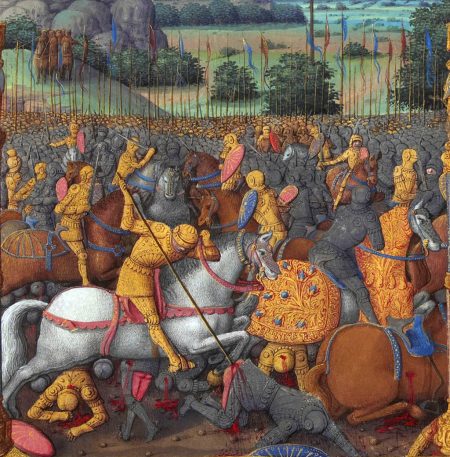
[image] Knight lances fallen foe in the anus. Illumination (excerpt) from Les Très Riches Heures du duc de Berry, folio 95r, with contrast enhancement. Les Très Riches Heures du duc de Berry is a luxurious Book of Hours made in France between 1412 and 1416. This specific illustration (“David’s Victory”) is thought to have been painted by Jean Colombe about 1487. Source image thanks to Wikimedia Commons.

References:

Benson, Larry Dean, and Edward E. Foster. 1994. King Arthur’s Death: The Middle English Stanzaic Morte Arthur and Alliterative Morte Arthure. Kalamazoo, Mich: Published for TEAMS in association with the University of Rochester by Medieval Institute Publications, Western Michigan University.

Floyd, William David. 2006. “’Turn, traitor untrew’: Altering Arthur and Mordred in the Alliterative Morte Arthure.” Medieval Forum 5, online.

Gardner, John. 1971. The Alliterative Morte Arthure: The Owl and the Nightingale:  and Five Other Middle English Poems in a Modernized Version with Comments on the Poems and Notes. Carbondale: Southern Illinois University Press.

Haught, Leah. 2011. Toward an aesthetics of failure: generic expectation and identity formation in Middle English Arthuriana. Ph. D. Thesis. Department of English, University of Rochester.

Johnson, Travis William. 2011. Affective communities: masculinity and the discourse of emotion in Middle English literature. Ph.D. Thesis. Department of English, University of Iowa.

Sutton, John William. 2003. “Mordred’s End: A Reevaluation of Mordred’s Death Scene in the Alliterative Morte Arthure.” Chaucer Review. 37 (3): 280-285.

Westover, Jeff. 1998. “Arthur’s End: The King’s Emasculation in the Alliterative Morte Arthure.” The Chaucer Review. 32 (3): 310-324.

Ziolkowski, Jan. 1988. “A Narrative Structure in the Alliterative Morte Arthure 1-1221 and 3150-4346.” The Chaucer Review. 22 (3): 234-245.

men’s unruly sexual imagination: a beauty white as whale’s bone

separated from a whale-white beauty

Hear me! I to you will tell
of such anxious distress in which I dwell.
There’s no fire so hot in Hell
reserved for a man
who loves secretly and dares not tell
what he cannot understand.

I wish I were a throstle-cock,
a bunting or a laverock,
sweet bird!
Between her kirtle and her smock
I would be hid.

I wish her well, and she wishes me woe;
I’m her friend, and she’s my foe;
I think my heart will break in two
for sorrow and sighing many nights.
In God’s favor may she go,
that beauty oh so white!

I wish I were a throstle-cock,
a bunting or a laverock,
sweet bird!
Between her kirtle and her smock
I would be hid.

A beauty white as whale’s bone,
a gem in gold radiantly shown,
a turtledove my heart’s set on,
truest one in all men’s days.
Her blissfulness will never be gone
while music I can play!

I wish I were a throstle-cock,
a bunting or a laverock,
sweet bird!
Between her kirtle and her smock
I would be hid.

No other woman’s so splendidly wrought!
When she’s blissfully to bed brought,
well were he who’s one with her in thought,
that excellent one!
Well I know she doesn’t want what I’ve got,
my heart is filled with woe.

I wish I were a throstle-cock,
a bunting or a laverock,
sweet bird!
Between her kirtle and her smock
I would be hid.

Those eyes have truly torn my heart amiss,
her curved eyebrows bringing bliss,
her comely mouth that one might kiss,
he’d be filled with mirth!
I would change my lot for this:
to with her share a hearth.

I wish I were a throstle-cock,
a bunting or a laverock,
sweet bird!
Between her kirtle and her smock
I would be hid.

May he who with her shares a hearth be so free,
and see worth in that he might accept a fee,
for that one woman I’d give three,
without haggling!
From Hell to Heaven, from sun to sea,
there’s none so beguiling,
nor with favors so free.

I wish I were a throstle-cock,
a bunting or a laverock,
sweet bird!
Between her kirtle and her smock
I would be hid.

{ Herkneth me! Y ou telle,
In such wondryng for wo Y welle!
Nys no fur so hot in helle
Al to mon
That loveth derne ant dar nout telle
Whet him ys on.

Ich wolde ich were a threstelcok,
A bountyng other a lavercoke,
Swete bryd!
Bituene hire curtel ant hire smoke
Y wolde ben hyd!

Ich unne hire wel ant heo me wo;
Ych am hire frend and heo my fo;
Me thuncheth min herte wol breke atwo
For sorewe ant syke.
In Godes greting mote heo go,
That wayle whyte!

(refrain)

A wayle whyt ase whalles bon;
A grein in golde that godly shon;
A tortle that min herte is on,
In tounes trewe!
Hire gladshipe nes never gon
While Y may glewe!

(refrain)

A wyf nis non so worly wroht!
When heo ys blythe to bedde ybroht,
Wel were him that wiste hire thoht,
That thryven ant thro!
Wel Y wot heo nul me noht;
Myn herte is wo.

(refrain)

Hyre heye haveth wounded me ywisse,
Hire bende browen that bringeth blisse!
Hire comely mouth that mihte cusse —
In muche murthe he were!
Y wolde chaunge myn for his
That is here fere.

(refrain)

Wolde hyre fere beo so freo,
Ant wurthes were, that so myhte beo,
Al for on Y wolde geve threo,
Withoute chep!
From helle to hevene, ant sonne to see,
Nys non so yeep,
Ne half so freo.

(refrain) }

*  *  *  *  *

Read more:

Notes:

manuscript text of A wayle whyt ase whalles bon

The Middle English text above includes most of the poem (minstrel song) known as “A wayle whyt ase whalles bon {A beauty white as whale’s bone}.” It is recorded only in the Harley manuscript (London, British Library MS Harley 2253), folio 67r. The Harley manuscript is dated to about 1330. “A wayle whyt ase whalles bon” is recorded in that manuscript in a condensed form, with the order of the stanzas apparently misplaced. Fein (2014) seems to me to provide the best reconstruction of the Middle English song. Millett (2003) follows more closely the manuscript presentation.

Relative to Fein’s reconstruction of the poem, I’ve made changes to help modern readers appreciate the poem as a minstrel song. I’ve used prose capitalization style in the modern English translation to lessen readers’ fears of poetry. The invocation “Who would of love be true, do listen to me! {Wose wole of love be trewe, do lystne me! }” I’ve eliminated as distracting. In addition, I don’t believe the song would have begun with its refrain. As Parker (2011) points out, “Hear me {Herkneth me}” is a common opening to Middle English poems.

I’ve eliminated the fourth stanza as potentially upsetting to readers in our more orthodox and doctrinaire age. That stanza declares:

When she is blissful,
Of all this world I ask no more
Than to be with her, my own, lodged
Without argument.
The distress I’m entangled in,
I blame upon a woman.

{ When heo is glad,
Of al this world namore Y bad
Then beo with hire, myn one, bistad
Withoute strif.
The care that Ich am yn ybrad
Y wyte a wyf. }

Trans. and text from Fein (2014). The specified circumstances “When she is blissful … Without argument” hint that wives could have difficult moods and be argumentative. In the last line of the stanza, the poet went as far as to blame a woman. That’s just not acceptable today, even if the woman is guilty of a criminal offense. Following current academic orthodoxy, Ransom describes the last two lines of this stanza as “antifeminist” and as having a “misogynistic ring.” Ransom (1985) p. 69.

I’ve also eliminated stanza six. That stanza invokes a man lovesick for a woman to the point of death. Modern academics are obsessed with myths of misogyny and scarcely comprehend that most men love women dearly. Even relatively innocent, unlearned persons tend not to appreciate how much men love women. That makes the stanza difficult for readers to understand.

Another problem is the last two lines of the stanza:

Greet her well, that sweet thing
With eyes of gray.

{ Gret hire wel, that swete thing
With eyenen gray. }

Trans. and text from Fein (2014). A leading medieval scholar has noted that “eyenan gray” is a fairly common medieval English expression meaning eyes of clear blue color. But my sense is that the song focuses on behavior and action, not physical description of the beloved. The phrase “eyes gay” would suggest a way of behaving; “eyes of clear blue” doesn’t. Moreover, eyes of clear blue, at least to readers today, might allusively connect to a whale through water / sea. I think such a connection detracts from the emotional tension of “whyt ase whalles bon.” For these reasons, I believe that “gray” plausibly might be a scribal miscopying of “gay.”

The modern English translation above is mine, benefiting mainly from that of Fein. Relative to Fein’s translation, I’ve more strictly preserved the end rhymes and inter-stanza keyword / conceptual linking. I’ve also used some different diction to add alliteration and to bring out my sense of the song. Parker (2011) provides an alternate translation of Millett’s Middle English text.

The poem’s refrain figures the masculine poetic voice’s sexual longing for the beautiful woman. In contrast to the devaluation of men’s bodily desire in “courtly love,” the refrain boldly thrusts forward with a vigorous image of a bird. In ancient Greek myth, Zeus seduced Leda by taking the form of a swan. According to Pausanias, Zeus also ingratiated himself with his future wife Hera by turning himself into a cuckoo:

The presence of a cuckoo seated on the sceptre {of Hera} they explain by the story that when Zeus was in love with the virgin Hera, he changed himself into this bird, and she caught it to be her pet.

{ κόκκυγα δὲ ἐπὶ τῷ σκήπτρῳ καθῆσθαί φασι λέγοντες τὸν Δία, ὅτε ἤρα παρθένου τῆς Ἥρας, ἐς τοῦτον τὸν ὄρνιθα ἀλλαγῆναι, τὴν δὲ ἅτε παίγνιον θηρᾶσαι. }

Pausanias, Description of Greece 2.17.4, Greek text and English translation (adapted slightly) from Perseus. There is no other ancient account of these events. Nonetheless, in accordance with a fundamental communicative principle, Wikipedia charges Zeus with raping Hera.

The Middle English poem more directly refers to delightful heterosexual intercourse. With learned analysis, Ransom showed that in fourteenth-century England, “cock” plausibly signified male genitals, as well as more typically a rooster. He poetically observed, “the assimilation of cock-rooster and penis would be perfectly natural, especially for any male compounder of metaphor.” Ransom (1986) pp. 71-2. Moreover, a woman’s “smok” was used in Middle English to refer to her genitals. Id. pp. 70-9.

The eminent classical Latin poet Catullus produced a fine poem about the delights of a woman and a bird:

Sparrow, my girl’s darling,
with whom she plays, whom she holds in her lap,
to your approaching she gives her finger-tip to peck and
provokes you to bite sharply,
whenever she, the bright-shining desire of my love,
has a mind for some sweet pretty play.
She hopes, I think, that when the sharper pang of love abates,
she may find some small relief from her longing.
Ah, might I but play with you as she does,
and lighten the gloomy cares of my heart!
This is as welcome to me as was
to the swift maiden the golden apple,
which, they say, loosed her girdle too long tied.

{ Passer, deliciae meae puellae,
quicum ludere, quem in sinu tenere,
cui primum digitum dare appetenti
et acris solet incitare morsus,
cum desiderio meo nitenti
carum nescio quid lubet iocari
et solaciolum sui doloris,
credo ut tum grauis acquiescat ardor:
tecum ludere sicut ipsa possem
et tristis animi leuare curas!
Tam gratum est mihi quam ferunt puellae
pernici aureolum fuisse malum,
quod zonam soluit diu ligatam. }

Catullus, Carmen 2, Latin text and my English translation building on that of Harry Walker. Here’s Catullus 2 with a different translation and commentary.

The concluding stanza of the Middle English poem contrasts transactional sex-seeking with freely given sexual favors. Ransom perceives in the poem a humorous debunking of courtly love. Ransom (1986) p. 69. Yet it is more than that. Men often feel compelled to purchase sex.  With its repeated invocation of “sweet bird,” the Middle English song subtly affirms the intrinsic value and intimate goodness of men’s sexuality.

[images] (1) Whale bones on show at Burton Constable Hall, Burton Constable, East Riding of Yorkshire, England. Excerpt from an image thanks to Lawson Speedway and Wikimedia Commons. (2) The only surviving manuscript text of “A wayle whyt ase whalles bon {A beauty white as whale’s bone}.” From British Library manuscript Harley 2253, excerpt from folio. 67.

References:

Fein, Susanna Greer, ed. and trans. 2014. “A wayle whyt ase whalles bon: Introduction, Text, and Translation.” The Complete Harley 2253 Manuscript, Volume 2, Art. 36 in Booklet 5 (online).

Millett, Bella, trans. 2003. “A wayle whyt ase whalles bon: Introduction, Text, and Translation.” Wessex Parallel WebTexts (online).

Parker, Eleanor. 2011. “A Medieval Love Poem: White as Whale’s Bone.” A Clerk of Oxford (online).

Ransom, Daniel R. 1985. Poets at play: irony and parody in the Harley lyrics. Norman, Okla: Pilgrim Books.