ancient Exeter riddles highlight contradictions of men’s sexuality

The Exeter Book, an Anglo-Saxon (Old English) manuscript surviving from the tenth century, includes about ninety five riddles. These riddles describe a wide variety of objects and phenomena. The Exeter Book provides no answers to its riddles. The necessity of pondering the Exeter riddles gives them critical potential, particularly the riddles concerning men’s sexuality.

The literary context of the Exeter riddles is difficult for persons today to grasp. In the relatively liberal and humanistic culture of early medieval England, authors were permitted to produce outrageous texts. For example, Warner of Rouen early in the eleventh century wrote extraordinarily vibrant, diverse, and dynamic poetry. His poetry covered highly technical grammatical points while at the same time poetically abusing a fellow poet: “he knows more about his own goat’s cunt / than what force dialectic carries {nota magis proprie uesica capelle, / quam dialectica uis}.”[1] Medieval poets even criticized women. The medieval Latin poem Jezebel, which Warner probably also wrote, characterized Jezebel as a sexually voracious whore. Recent scholarly work indicates that Jezebel satirizes Ælfgifu (Ælfgyvu) of Northampton, the first wife of King Cnut of England and Denmark.[2]

Ælfgyvu sexually imagines cleric attempting to heal her

The Bayeux Tapestry, probably created in England in the 1070s, apparently represented a woman’s sexual objectification of a man. The woman is named specifically Ælfgyvu. The man is described generically as a single cleric. He touches her head with his outstretched hand. That’s a gesture associated with a cleric praying for a person’s healing. Underneath Ælfgyvu, in a mirror perspective of her viewing the cleric, is him reduced to a bare outline of a man with his genitals showing prominently. Ælfgyvu apparently had an earthy view of even a cleric ministering to her.[3] In interpreting gendered works, modern scholars have made elaborate claims about the male gaze, yet have resolutely ignored the female gaze. Medieval chroniclers had a less ignorant and bigoted understanding of gender. Readers today must consciously struggle to expand their understanding when pondering men’s sexuality in early medieval works such as the Bayeaux Tapestry and the Exeter riddles.

Some of the Exeter riddles are superficially rather straightforward. Consider:

I heard of something rising in the corner,
swelling and standing up, raising its covering.
The proud-hearted bride grabbed that boneless thing
with her hands. The prince’s daughter
covered with a garment that bulging thing.

{ Ic on wincle gefrægn weaxan nathwæt,
þindan ond þunian, þecene hebban.
On þæt banlease bryd grapode,
hygewlonc hondum. Hrægle þeahte
þrindende þing þeodnes dohtor. } [4]

A reader might readily figure that the “thing” being described is a man’s tumefying and then fully erect penis. Before the modern immiseration of erection labor, most men performed an enormous amount of erection labor. Women then highly valued men’s labor. A similar Exeter riddle makes explicit women’s joy in having men’s penises:

I am a wondrous being, a joy to women,
profitable to neighbors; I harm no one
in the town, except only my killer.
My base is steep and high, I stand in the bed;
underneath, in a remote place, I’m hairy. Sometimes dares
the very beautiful daughter of a peasant-farmer,
a maid proud in mind, to grab hold of me.
She rubs me to redness, ravages my head,
forces me into a stuck position. Immediately she feels
my meeting, the one who confines me,
the curly-haired woman. Wet is that eye.

{ Ic eom wunderlicu wiht, wifum on hyhte,
neahbuendum nyt; nængum sceþþe
burgsittendra, nymþe bonan anum.
Staþol min is steapheah, stonde ic on bedde,
neoþan ruh nathwær. Neþeð hwilum
ful cyrtenu ceorles dohtor,
modwlonc meowle, þæt heo on mec gripeð,
ræseð mec on reodne, reafað min heafod,
fegeð mec on fæsten. Feleþ sona
mines gemotes, seo þe mec nearwað,
wif wundenlocc. Wæt bið þæt eage. } [5]

“Wet is that eye” apparently figures the penis ejaculating in the women’s vagina. Such sexual intercourse was highly valued in the early medieval period. Even if they didn’t feel like it, medieval husbands were legally required to perform sexually for their wives if their wives sought sex. Husbands didn’t have sex with their wives merely to provide their wives with joy. Husbands having sex with their wives was regarded as a matter of life and death for wives.

These Exeter riddles literally describe a woman raping a man and metaphorically evoke a fundamental riddle. A woman grabbing a man’s penis and sticking it under her skirt without any indication of his consent is rape. A woman grabbing a man’s penis, rubbing it with her hands to an erection, and then forcing it into her vagina is also rape. Literary scholars have declared many ancient and medieval stories to represent men raping women. Leading newspapers have recently declared nearly a quarter of men rapists using an extremely selfish and narrow-minded definition of rape. Yet the Exeter riddles’ representations of women raping men aren’t read to represent rape.[6] High-quality U.S. national surveys indicate that women rape men about as often as men rape women. While men raping women has been recognized as a serious crime throughout history, social concern about women raping men has been virtually nonexistent, even in our age of intense focus on gender equality. That is a profound riddle.

The Exeter riddles depict an alternative to women raping men. Consider this riddle:

Often a beautiful woman, a wife, enclosed me
firmly in a strongbox, sometimes she drew me up
with her hands and gave me to her husband,
gracious prince, as she was commanded.
Then he stuck his head into the heart of me,
upward from beneath, fitted it into the tight space.
If the strength of my receiver was suitable,
something hairy surely satisfied
me, the adorned one. Advise of what I speak.

{ Oft mec fæste bileac freolicu meowle,
ides on earce, hwilum up ateah
folmum sinum ond frean sealde,
holdum þeodne, swa hio haten wæs.
Siðþan me on hreþre heafod sticade,
nioþan upweardne, on nearo fegde.
Gif þæs ondfengan ellen dohte,
mec frætwedne fyllan sceolde
ruwes nathwæt. Ræd hwæt ic mæne. } [7]

Can any man today imagine, without fear of punishment, that which is the subject of the riddle? Men readers, avert your male gaze: the subject is a beautiful woman’s vagina!

Some less obvious aspects of the riddle can be explained easily. When her husband was out risking death, a medieval princess who wasn’t interested in cuckolding her husband might lock herself within their castle, figured in the riddle as a “strongbox.” That’s particularly prudent wifely behavior when strong, young, handsome knights are marauding about the neighborhood. The reference to the subject of the poem as the “adorned one” doesn’t require imagining vagina rings or other such jewelry, or contraceptive devices in place.[8] The “adorned one” can be more naturally imagined as a vagina adorned with the beautiful woman’s body surrounding it. Many men appreciate much more than merely a woman’s vagina.

Careful scholarly analysis of the riddle reveals an inner meaning nearly incomprehensible today. The medieval author had a bizarre view of sex and marriage:

Riddle 61 recommends that a wife should restrict her sexuality to the pleasure of her husband, but be sexually available to him at his request; she should trust her husband and do as he directs. Yet a husband has duties and responsibilities to his wife in return: he should have courage and be worthy of his wife; he should satisfy and fulfill her, at least sexually. In these sentiments, the Exeter Book riddler echoes traditional Pauline doctrine: ‘‘uxori vir debitum reddat similiter autem et uxor viro’’ (let the husband render the {conjugal} debt to his wife: and the wife also in like manner to the husband) (1 Corinthians 7: 2–3), and also ‘‘ulieres viris suis subditae sint sicut Domino quoniam vir caput est mulieris sicut Christus caput est ecclesiae’’ (let women be subject to their husbands, as to the Lord. For the husband is the head of the wife; as Christ is the head of the church) (Ephesians 5:22–23). In his idealisation of marriage, characterised by sexual relations and wifely obedience, the riddler is doctrinally correct and reiterating biblical morality. [9]

That’s not biblical morality today. More importantly, present-day sexual doctrine is primarily concerned with rape and affirmative consent. In addition, many couples today regard sexless marriage as a natural state of relations, particularly after the first few years of marriage. Is it any wonder that highly learned medieval authorities such as Heloise of the Paraclete and Walter Map strongly advised against marriage?

Across thousands of years of human history, the wisdom of the eminent law-giver Solon wasn’t influential enough to dispel sexual inequality and the disparagement and suppression of men’s sexuality. Ordinary men and women coming to a new, existential awareness of reality is an alternate possibility for change. Ponder the Exeter riddles about men’s sexuality. Find answers for them in your own lived experience.[10]

*  *  *  *  *

Read more:

Notes:

[1] Warner of Rouen, Moriuht, ll. 49-54, Latin text and English trans. McDonough (1995) pp. 74-5.

[2] Galloway (1999). See also my post on Warner of Rouen.

[3] The image on the Bayeux Tapestry includes the title, “Ubi unus clericus et Ælfgyva {When a single cleric and Ælfgyva}.” The missing verb allows the phrase to be completed as either “she was healed” or “she sexually assaulted him.”

Ælfgyvu was a relatively common female name in England prior to the Norman Conquest. Recent scholarly work suggests that the Ælfgyvu depicted in the Bayeux Tapestry is Ælfgyvu of York. She plausibly was the daughter of Thored of York, the first wife of Æthelred the Unready, and the great grandmother of Edgar the Ætheling. Edgar the Ætheling contended with William the Bastard for the English throne. The Bayeux Tapestry plausibly questions the bloodline of Edgar the Ætheling by representing Ælfgyvu’s strong, independent sexuality. Laynesmith (2012).

[4] Exeter Book, Riddle 45. In this and subsequent quotes of Exeter riddles, I use the riddle numbering from Krapp & Dobbie’s edition in Anglo-Saxon Poetic Records. The divisions into discrete riddles is a matter of scholarly contention, hence numbering can vary slightly. Old English text and translations of the Exeter riddles are widely available. The translations above represent my best poetic sense of the riddles. In making those translations, I’ve drawn mainly on Baum (1963), Cavell (2013-), Hostetter (2017), and Williamson (1983), as well as the individual texts and translations within Heyworth (2007), Higl (2017), and Salvador-Bello (2011). For the full text of the Exeter Book and an English translation, Thorpe (1842).

[5] Exeter Book, Riddle 25. Megan Cavell’s translation of this riddle has provided the wonderfully specific, bodily double-entendre for sexual intercourse (from the penis’s perspective): “my meeting.” Within the starvation-level living conditions for most persons in the Middle Ages, getting some meat was cause for joy indeed. “Profitable to neighbors” plausible refers to the market-expanding benefit of increasing population. The sentence, “I harm no one / in the town, except for my killer” figures the penis as creating a love wound and the bodily reality of penile detumescence. With respect to the former, love wounds have long been associated with Cupid shooting arrows. With respect to the latter, women are fully capable of horrific interpersonal violence, including killing men. But here, the figure of “killing” the erect penis is associated with the woman stimulating the penis to ejaculation.

[6] Cavell makes clear the extent to which scholars have read the Exeter riddles without any concern for women raping men. With respect to riddle 25, Cavall comments:

the poem also hands us a pretty interesting picture of a sexually assertive woman. LOTS of people have written on this topic (see Davis, Hermann, Kim, Shaw and Whitehurst Williams, for example), so of course there’s disagreement about whether or not the poem judges the woman’s assertiveness – perhaps even aggressiveness, given how grabby those hands seem to be.

The riddle author has thus been tried for the crime of “judging the woman’s assertiveness.” Cavall refers to the woman in the poem not as a rapist, but as a “grabby-handed woman.” Literary scholars pretend that sexual harassment of men isn’t possible. Prominent academics have recently spoken out forcefully to question sexual harassment allegations against a female professor. That action doesn’t seem to be a result of enlightened reason, but merely crude gender bigotry.

[7] Exeter Book, Riddle 61.

[8] In her commentary on Riddle 61, Cavell states:

This very brief reference to adornment is what reminds us we’re dealing with a constructed object instead of a sexual encounter. This was before vajazzling, after all. Though Sarah Higley suggests the text may be hinting at contraceptive items (and reminds us that we don’t know an awful lot about such things in early medieval England (pages 48-50)), I think it’s safe to say that it would be pretty impractical to adorn whatever sorts of things were used.

Cavell seems to me to read “adornment” too narrowly and too literally.

[9] Heyworth (2007) pp. 180-1. Exeter Riddle 20 promotes marriage:

In Riddle 20, then, marriage is a joy and a delight and something to be longed for by the individual participants, the bride, the wife, the would-be husband sword. Further, marriage is semantically associated with sexual activity in this riddle, and part of the joy of marriage comes with its inherent association with sexual intercourse.

Id. p. 177.

[10] Don’t be afraid to play with different ideas and different perspectives. That’s a vitally important aspect of the Exeter riddles:

{Andrew Higl} explores what it means to play the riddles in their original context, making the individual reader the riddle hero (hæleþ) whom the text calls on to construct playful worlds of imagination and language. He examines how the Old English riddles demand to be played and how they oscillate playfully between the mundane, the sacred, and the obscene.

Higl (2017), from Abstract. Scholars in their own work on the Exeter riddles should strive to come closer to them.

References:

Baum, Paull F, ed. and trans. 1963. Exeter Book: Anglo-Saxon Riddles of the Exeter Book. Durham, N.C.: Duke Univ. Press.

Cavell, Megan, ed. 2013-. The Riddle Ages: An Anglo-Saxon Riddle Blog (online).

Galloway, Andrew. 1999. “Word-play and political satire: solving the riddle of the text of Jezebel.” Medium Aevum. 68 (2): 189-208.

Heyworth, Melanie. 2007. “Perceptions of Marriage in Exeter Book Riddles 20 and 61.” Studia Neophilologica. 79 (2): 171-184.

Higl, Andrew. 2017. “Riddle Hero: Play and Poetry in the Exeter Book Riddles.” American Journal of Play. 9 (3): 374-394.

Hostetter, Aaron K., trans. 2017. “Exeter Book Riddles.” Anglo-Saxon Narrative Poetry (online).

Laynesmith, J. L. 2012. “The Bayeux tapestry: A Canterbury Tale.” History Today. 62 (10): 42-48.

McDonough, Christopher J. 1995. Warner of Rouen. Moriuht: a Norman Latin poem from the early eleventh century. Toronto: Pontifical Institute of Mediaeval Studies.

Salvador-Bello, Mercedes. 2011. “The Sexual Riddle Type in Aldhelm’s Enigmata, the Exeter Book, and Early Medieval Latin.” Philological Quarterly 90(4):357-385.

Thorpe, Benjamin, ed. and trans. 1842. Codex Exoniensis: a collection of Anglo-Saxon poetry, from a manuscript in the library of the Dean and Chapter of Exeter. London: Society of Antiquaries of London.

Williamson, Craig. 1983. A Feast of Creatures: Anglo-Saxon Riddle-Songs. London: Scolar Press. (online texts and translations)
medieval lesson in winning women’s love: aloofness, not groveling

Denmark map outline

Many men today think that they can gain women’s love by showing intense interest in female gender gaps. Self-centered women won’t object to men denouncing men’s crimes and men striving to reduce the number of women in prison. Self-centered women will praise men who champion women’s reproductive rights and advocate for the interests of elite women in being promoted further into high-status, high-stress jobs. Moreover, almost all women will smile smugly at men who proclaim that women throughout history have been treated as men’s property. But men proclaiming “the future is female” and ardently supporting female supremacists won’t stir women’s sexual desire any more than will a yes-dearing husband. Men who seek women’s love must act with more sophistication and more guile.

A thirteenth-century French poetic work called “The Little Debate {Le Petit Plet}” explains clearly and concisely a man’s position in love in relation to a woman. Le Petit Plet states of a woman:

As soon as she notices that someone loves her,
then she clamors that she’s being treated disrespectfully,
and quickly gets hard-to-please,
and very malicious and angry too.
If you say something she doesn’t like,
she looks at you with an unfavorable eye.
But if there’s someone who has no liking for her at all,
she readily jokes with him,
embraces him and kisses him fondly,
and tries to attract him by putting on an act.
Yet if there’s anyone she’s sure of,
you know, she scarcely gives a damn about him.

{ Si ele se aparceit ke l’em la eime
Dunc por hunie ben se cleime,
Si tost ne deuenge dangeruse,
V mult enreuere e trop irruse.
Si ren dites cuntre sun uoil
Ele vus regardera de l’autre oil.
Mes celui ki ne la eime de ren,
A celui juera ele ben
E acolera e suef beisera,
E per beal semblant ben le atrerra.
Mes de celui dunt est seure,
Sachez, ne en predendra gueres cure. } [1]

In the introduction to his adaptation of The Life of Barlaam and Josaphat, Chardri, the thirteenth-century writer whom scholars think authored Le Petit Plet, highlighted the importance of exempla for instruction.[2] Chardri’s account of women in relation to men in love has great value for instructing men on how to gain women’s love.

Men seeking women in love must strive to raise their sexual market value. The classical author Seneca provided the fundamental insight in his De remediis fortuitorum:

a woman who regards herself too highly is little different from a woman who has contempt for men

{ non multum abest a contemptu viri, quae se nimis conspicit } [3]

According to modern sexual economic theory, both men and women seek sexual partners of highest sexual market value within the constraints of their own sexual value and overall market conditions. Women, who are more socially sophisticated than men, tend to be more sensitive to sexual market value than men are. To gain a women’s love, a sexually rational man should display sexual self-confidence to women. That means acting somewhat aloof, not being overly eager, and certainly not groveling to her like a chivalrous fool and all the mis-indoctrinated men today. Being able to exercise guile in displaying self-confidence in itself raises a man’s sexual market value.

Men’s sexual behavior is becoming a matter of acute public concern. Men must study literature and sexual economics to become thoroughly enlightened. Men, support the new Spanish sex czar. If that’s not enough motivation, do it for Denmark!

*  *  *  *  *

Read more:

Notes:

[1] Chardri, The Little Debate {Le Petit Plet} ll. 1353-64, Old French (Anglo-Norman) text and English translation (with my adaptations) from Cartlidge (2015) pp. 143, 159. Merrilees (1970) provides Old French text for the full work. In Cartlidge’s Old French text, I’ve used “v” where “u” functions as a consonant to help non-specialists to hear the sound of the Old French. In l. 1362, Merrilees has “par” for Cartlidge’s “per.”

Le Petit Plet survives in three manuscripts: London, British Library, Cotton, Caligula A. IX, f. 249rb-261rb (C); Oxford, Jesus College Library, 29, f. 244va-257vb (J); and Vaticano, Biblioteca Apostolica Vaticana, Reginensi latini, 1659, f. 91-100 (V). Manuscripts C and J appear on paleographic grounds to be from the second half of the thirteenth century, while Manuscript V is from the fourteenth century. Carlidge argues that Le Petit Plet cannot be convincingly dated more precisely than the thirteenth century. Cartlidge (2015) p. 6.

Le Petit Plet is a debate poem within a long literary tradition of debate poems. It shares closely a “common cultural and intellectual tradition” with The Owl and  the Nightingale. Cartlidge (2015) p. 37. Other influential medieval debate poems are The Thrush and the Nightingale and Ecloga Theoduli.

[2] Chardri, The Life of St. Josaphaz {La Vie de Seint Josaphaz} ll. 1-24, trans. Cartlidge (2015) p. 71. Chardri also apparently authored a life of the seven sleepers of Ephesus.

[3] Lucius Annaeus Seneca (Seneca the Younger), De remediis fortuitorum, Latin text from Palmer (1953) p. 64, my English translation. De remediis fortuitorum has survived in more than 250 manuscripts. Medieval authorities William of Conches, Vincent of Beauvais, and Roger Bacon quoted from De remediis fortuitorum. They, along with Petrarch and Erasmus, regarded De remediis fortuitorum to be a work of Seneca. Here’s a version of De remediis fortuitorum printed in 1474. From the 17th century, scholarly consensus turned against belief that Seneca authored De remediis fortuitorum. Newman (1988) has made a convincing case for Seneca as its author.

[image] Outline map of Denmark. Derived from image thanks to Angr and Wikimedia Commons.

References:

Cartlidge, Neil, trans. 2015. The works of Chardri: three poems in the French of thirteenth-century England; The Life of the Seven Sleepers, The Life of St. Josaphaz and The Little Debate. Tempe, Arizona: Arizona Center for Medieval and Renaissance Studies.

Merrilees, Brian S., ed. 1970. Chardri. Le petit plet. Oxford: Blackwell.

Newman, Robert J. 1989. “Rediscovering the De Remediis Fortuitorum.” The American Journal of Philology. 109 (1): 92-107.

Palmer, Ralph Graham, ed. 1953. Seneca’s De Remediis Fortuitorum and the Elizabethans. An essay on the influence of Seneca’s ethical thought in the sixteenth century, together with the newly-edited Latin text and English translation of 1547 by Robert Whyttynton. Institute of Elizabethan Studies: Chicago.

strong medieval women: Sibylla of Acerra & Constance of Hauteville

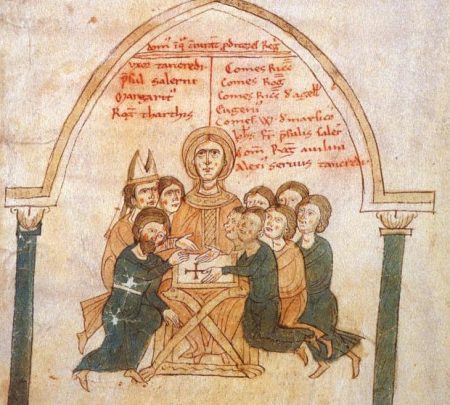
Sibylla of Acerra leading conspiracy against Henry VI

In contrast to gender stereotypes, strong, independent, highly privileged women have governed men throughout history. These women were accustomed to having men do whatever they wished. They understood that men were willing to die fighting on their behalf. They boldly criticized their husbands. With great social sophistication, they used their tears as the ultimate weapon.

When Constance of Hauteville’s husband became King of Germany and the Holy Roman Empire, she became the Holy Roman Empress. In order to uphold her claim to Sicily, her husband engaged in war against Sibylla of Acerra’s husband, who had usurped the crown of Sicily in 1189. Sending Empress Constance away from the fierce men-on-men violence over nominal rule of Sicily, her husband commanded one of his leading men, “Always do what my bride wishes {Facturus semper quod mea nupta velit}.”[1] He probably followed that rule himself.

As many women do, Empress Constance understood that her life was worth more than that of many men. Besieged in Salerno, she opened a window and addressed the attackers:

Hear what my words intend.
At least while we speak, hold back your missiles and your hands.
I will speak few words, but they have great weight.
O people of great faith and wisdom tested to the heights,
you know who I am and who I have been, and that is why I make my complaint to you.

If I {sic} am allowed to battle, I still have knights and gold.
I counsel everyone to return to his home.
I have Conrad at Capua, Diepold at Rocca D’Arce;
the one will do his duty as knight, the other lead the commanders.
Darius, as the messenger told me, burns Ebolian fields here
and there shears the Theatine sheep.
But those people of pure faith seek to do my will in the midst of warfare,
willingly prepared to die for me

{ Audite, quid mea verba velint.
Saltim dum loquimur, compescite tela manusque.
Pauca loquar, multo pondere verba tamen.
Gens magne fidei, rationis summa probate,
Que sim, que fuerim, nostis, et inde queror.

Si pugnare licet, superest michi miles et aurum:
In propriam redeat, consulo, quisque domum.
Est michi Corradus Capue, Dipoldus in Archi:
Hic pars milicie, dux erit ille ducum.
Darius Eboleos, ut ait michi nuncius, agros
Hac cremat, hac radit ille Thetinus oves.
Gens pure fidei mediis exquirit in armis
Velle meum, pro me sponte parata mori }

The angry people ignored her lofty words. Many men died in the subsequent fighting. Queen Sibylla’s forces eventually captured Empress Constance.

Queen Sibylla’s husband lacked appreciation for his wife’s sexual preferences and her independent lifestyle. He sent to her the captive Empress Constance, surely their most valuable prisoner. He wrote to Queen Sibylla:

This woman is the noble heir of Roger, the first king.
Her husband causes every land to tremble.
I send her to you, sweet love, my very dearest consort,
for you to keep safely, with a watchful heart.
Be a companion and a keeper, a hostess and an enemy.
Never let her be anywhere without you, if you are wise.
Be in the same house, the same bed at night;
do not let her speak to anyone without you.
One drinking vessel must convey delicacies to both of you.
Now be willing to be greater, now equal, now less.

{ Hec est Rogerii protoregis nobilis heres,
Illius est uxor, qui quatit omne solum.
Hanc ego, dulcis amor, mea prebeatissima consors,
Servandam vigili pectore mitto tibi.
Sis comes et custos et ei sis ospes et hostis;
Hanc nunquam sine te, si sapis, esse sinas.
Una domus vobis, unum de nocte cubile,
Quam cuiquam sine te ne patiare loqui.
Deliciosa duas communicet una parabsis.
Nunc maior, nunc par, nunc minor esse velis. }

Generally speaking, a self-respecting husband doesn’t send his wife a woman to be her bed-mate, especially if that woman is an enemy.[2] Queen Sibylla harshly disparaged her husband’s judgment:

What are you doing, oh demented one? Did you send me a companion or an enemy?

You take bad advice about the causes of your too-grievous infirmities.
A sickness from the stomach overflows into an idle head.
How badly you give medicine to the other limbs
if you ignore the head!
If the head sickens, can the other limbs be well?
Unless you pull off the head, the other limbs will be wasted.

{ Quid facis, o demens? Comitem misistis an hostem?

Quas nimis ipse doles, causis male consulis egris:
In caput a stomacho morbus habundat iners.
Quam male dispensas aliis medicamina menbris,
Si caput ignoras.
Si caput egrotet, valeant et cetera membra?
Ni caput abradas, cetera menbra ruent. }

Queen Sibylla thus indirectly suggested killing Empress Constance. Her husband immediately sought to appease his wife:

My dear wife and partner of chaste love,
the message you sent me has strength.

{ Cara michi coniunx et casti fedus amoris,
Quam michi misisti, pagina robur habet. }

Queen Sibylla’s message unquestionably did have strength, especially in relation to her husband’s courtly self-abasement and yes-dearism.[3]

When medieval women’s words weren’t sufficient to govern men, women could turn to their ultimate weapon: tears. After many men, including her husband and her son, died fighting for her, Queen Sibylla was in a desperate position. She decided to surrender to Empress Constance’s husband:

Therefore, I will do what is safe; I will surrender and pray for pardon,
pouring out tears before the feet of Caesar.
Sobs, tears, groans, sighs, weeping,
these will be my husband and my children and my brother;
they will fight for me, they will plead with the lord for me,
my tears will do more for me than my spears.
Pity can do more than a thousand times a thousand Roman citizens.
Caesar will be won more easily by prayers than by spears.

{ Ergo, quod est tutum, veniam summissa precabor,
Effundens lacrimas Cesaris ante pedes.
Singultus, lacrime, gemitus, suspiria, fletus,
Hec vir et hec proles, hec michi frater erunt.
Pro me pugnabunt pro me dominumque rogabunt,
Plus facient lacrime, quam mea tela, michi.
Plus poterit pietas quam milia mille Quiritum,
Plus prece quam telis Cesar habendus erit. }

Women’s tears are astonishingly powerful tools. Queen Sibylla wasn’t killed, as many other men were. She was arrested and held captive with her daughters. When Empress Constance’s husband died, Sibylla was set free. She resumed her privileged life and arranged for her eldest daughter to marry a French count.[4]

Male privilege is a recently constructed myth. Gynocentrism has been reality for millennia.

*  *  *  *  *

Read more:

Notes:

[1] Pietro da Eboli, Liber ad Honorem Augusti {Book in Honor of Augustus} l. 413 (Sec. 15), Latin text and English translation from Hood (2012) pp. 144-5. The Latin text has survived in one manuscript, Codex 120 II in Bürgerbibliothek Bern {Berne Municipal Library}. A good-quality Latin text of Liber ad Honorem Augusti is freely available online: part I, part II, part III, part IV.

Pietro da Eboli {Peter of Eboli / Petrus de Ebulo} wrote Liber ad Honorem Augusti  about 1196. Pietro was a learned scholar, perhaps a physician, who came from the town of Eboli near Salerno in Italy. He is also thought to have authored De balneis Puteolanis {On the baths of Puteoli}. Little else is known about him. Hood (2012) pp. 6-9.

Sibylla of Acerra’s husband was Tancred of Hauteville, who was Count of Lecce. Sibylla of Acerra became Queen of Sicily when her husband became King of Sicily in 1189. Constance of Hauteville’s husband was Henry VI of Hohenstaufen. Constance of Hauteville became the Holy Roman Empress when her husband became the Holy Roman Emperor in 1191.

All the subsequent quotes are from Hood’s Latin text and English translation of Liber ad Honorem Augusti. I have made some minor changes to the English translation for clarity. The quotes above are (cited by line number in Hood’s Latin text): ll. 586-90, 605-12 “Hear what my words intend…”; ll. 875-84, “This woman is the noble heir…”; 897, 907-12, “what are you doing, o demented one?…”; 915-6, “My dear wife…”; ll. 1293-1300, “Therefore, I will do what is safe….”

[2] Pietro da Eboli strongly disparaged Sibylla of Acerra’s husband:

Behold the old monster, crime of nature, untimely birth;
Behold, the ape is crowned, repulsive man.

Instead of Jove a half-man, instead of great Ceasar a dwarf
you receive as sceptered ruler!

Nature, your laughing-stock is reigning now, that foul ape-thing,
that man in the likeness of an aborted corpse!

He is poor in morals and in life, not refuted by his Fame,
and he has little masculinity and a short body.

{ Ecce vetus monstrum, nature crimen aborsum;
Ecce coronatur simia, turpis homo!

Pro Iove semivirum, magno pro Cesare nanum
Suscipis in sceptrum!

Ridiculum, natura, tuum: res, simia, turpis,
Regnat, abortivi corporis instar homo.

Moribus et vite pauper, nec fama repugnat,
Et modicas vires et breve corpus habet. }

Liber ad Honorem Augusti ll. 184-5, 198-9, 234-5, 242-3. Pietro da Eboli captioned a painting of Tancred being crowned with “The ape made king {Simia factus Rex}.”

Pietro didn’t use the diminutive name Tancredulus to disparage Tancred. He used the term Tancredulus to caption a painting showing a woman displaying Tancred when he was a baby: “This woman displays little Tancred {Hec ostendit Tancredulum}.” Hood (2016) pp. 116-7. That’s not a disparaging use of Tancredulus. Scholars have continued to propagate the misunderstanding that Pietro disparaged Tancred as Tancredulus. See, e.g. McDougall (2016) p. 209. This mistake seems to go back at least to the 1911 Encyclopaedia Britannica entry for Tancred. Pietro in a variety of ways did express contempt for Tancred’s small stature. See above quote.

[3] Tancred “{comes} across as a slightly henpecked husband.” Hood (2012) p. 230.

[4] The fate of Sibylla’s son William III may have been much worse. While the leading modern study has concluded that William III wasn’t physically mutilated, a variety of medieval sources indicated that he was blinded as punishment for his mother and father’s usurpation. Roger of Hovedon stated that “King William, son of King Tancred, was blinded and castrated {Willelmum regem, filium Tankredi regis, excecavit et ementulavit}.”Chronica, 171, as quoted in Hood (2012) p. 536. Other medieval sources similarly reported castration. Id. n. 585. Castration culture has deep historical roots. Castration was a recognized, practiced punishment of men in medieval Europe.

[image] Sibylla of Acerra leading conspiracy against Henry VI in favor of her son William III, from Liber ad honorem Augusti 136r, reproduced in black-and-white and described in Hood (2012) p. 294-5. Color image via Wikimedia Commons.

References:

Hood, Gwenyth, ed. and trans. 2012. Pietro da Eboli. Book in honor of Augustus (Liber ad honorem Augusti). Tempe, Ariz: Published by ACMRS (Arizona Center for Medieval and Renaissance Studies).

McDougall, Sara. 2016. Royal bastards: the birth of illegitimacy, 800-1230. Oxford: Oxford University Press.

bird-brains engage in scholarly debate: The Owl and the Nightingale

withdrawn owl

The Owl and the Nightingale, a Middle English poem dating probably to about 1200, provides under-appreciated insight into the social positions of women and men. An owl and a nightingale throughout the poem debate widely their relative merits as birds. Both birds are “unanimous in their sympathy for women both inside and outside of marriage.” The birds are “extravagantly partisan” in support of women; they engage in “patent partisanship for women.”[1] Modern scholars of medieval literature have been united in praise for the The Owl and the Nightingale. But lacking the deep literary self-consciousness of medieval poets, modern scholars haven’t understood what they are praising.

The Owl and the Nightingale mocks shallow and pretentious scholarly thought about why men commit adultery. Regarding husbands’ sexual fidelity to their wives, the nightingale declared:

It seems to me quite stark and shocking
how any man, for any cause of behaving,
could turn his heart to the life
of doing it with another man’s wife.
For it’s either one of two things —
a claim for a third no man can bring.
Either her lord is very worthy,
or he’s feeble, and of all good empty.

{ Wundere me þungþ wel starc and stor,
Hu eni mon so eauar for,
Þat e his heorte mi3te driue
To do hit to oþers mannes wiue.
For oþer hit is of twam þinge,
Ne mai þat þridde no man bringe:
Oþar þe lauerd is wel aht,
Oþer aswunde, and nis naht. } [2]

That’s formally pretentious, yet utterly ridiculous reasoning. All men are fully human beings. All men potentially are very good men. In reality, not all men are either very good or very bad. Most men are somewhere in between. Most benefit from sympathetic support in their struggles to realize their inner goodness. Polarizing men’s persons demeans men’s potential.

Strong incentives for men to commit adultery can easily be recognized, yet are scarcely discussed. Some husbands have emotionally and physically abusive wives. Some husbands suffer within a sexless marriage. Moreover, sexless marriage is more prevalent in modern marriages in which wives feel no obligation to have sex with their husbands. In addition, long-standing, unjust, and absurd paternity and “child support” laws create huge financial incentives for men to have sex with married women who aren’t their own wives. Under the “four seas” common-law doctrine of legally imposed cuckolding, a woman’s husband, not her lover, is required to support financially any children that she produces through adultery. Reproductive choice is today a holy and sacrosanct principle, but only for women, to their own harm. Thus men seeking to avoid state-imposed, forced financial fatherhood have a strong incentive to commit adultery with married women. The nightingale, with her relatively intelligent bird brain, probably knew that.

The nightingale forthrightly recognized castration culture as controlling men’s sexuality. The nightingale explained:

No man with wisdom will seek to plan,
if the husband’s an honorable and worthy man,
in any way for his wife to do him shame.
For he himself should fear harm and blame,
and fear losing that which hangs below —
no longer able to join where his desires go.

{ 3ef he is wurþful and aht man,
nele no man, þat wisdom can
hure of is wiue do him schame,
For he mai him adrede grame,
An þat he forleose þat þer hongeþ,
Þat him eft þarto no3t ne longeþ }

According to the nightingale, an “honorable and worthy” husband would castrate an adulterer. That’s vicious sexual violence against a man. It’s also historically plausible. In contrast to dominant myths, punishment for adultery throughout history has been biased against men and harshly administered to men. Regardless of their personal circumstances, men not afraid of being castrated aren’t supported with excuses for committing adultery:

And though he not have such fear,
it is iniquity and folly dear,
to wrong a good man in his bed
and seduce the wife to whom he’s wed.

{ An þah he þat no3t ne adrede,
Hit is unri3t and gret sothede
To misdon one gode manne,
An his ibedde from him spanne. }

Seduction is socially constructed as a crime that men commit against women. The woman is innocent of having agency, and sex is the man’s fault.

Socially constructed sexual disgust also controls men’s sexuality. The nightingale illustrated the practice:

If her lord is physically unable,
with little to offer in bed and at table,
how might there be any love
when such a churl’s body has laid on hers from above?
How would any love there be nigh
when such a man is groping her thigh?

And if the lord is a wretch,
what pleasure from her could you fetch?
If you think about with whom she lies,
you might with disgust your pleasure buy.
I don’t know how any man of standing then
Could seek to visit her again.
If he thinks about in whose place he lay,
then all his love would go away.

{ 3ef hire lauerd is forwurde,
An unorne at bedde and at borde,
Hu mi3te þar beo eni luue
Wanne a swuch cheorles buc hire ley buue?
Hu mai þar eni luue beo
Þar swuch man gropeþ hire þeo?

An 3ef þe lauerd is a wercche,
Hwuch este mi3tistu þar uecche?
3if þu biþenchest hwo hire ofligge
Þu mi3t mid wlate þe este bugge.
Ich not hu mai eni freoman
For hire sechen after þan;
3ef he biþencþ bi hwan he lai
Al mai þe luue gan awai. }

Few men other than those with a cuckolding fetish enjoy imagining another man groping their beloved’s thigh and having sex with her. Men typically address this problem by disengaging their minds when seeking sex. Thus many structurally oppressed men throughout history have possessed the capability of resorting to female prostitutes. While, if feasible, most men would prefer to marry a debt-free virgin without tattoos, men personally are able to adjust to the reality of the women available to them.

Socially constructed sexual disgust controls men through status attacks on men. Men, for good evolutionary reasons, care about their social status relative to other men. The nightingale implicitly asserted that a man’s status depends on the status of all men who had sex with a woman with whom he’s having sex. That’s not necessarily so. The sexual status-shaming of men depends upon social acceptance of the status claims intended for that work. Under gynocentrism, society accepts those status claims and relatively strictly controls men’s sexuality.

Gynocentric society readily justifies women committing adultery. As always, sex is men’s fault:

A young girl knows not what such is,
her young blood leads her amiss;
and some foolish man entices her to it
by all the means that he might intuit.
He comes and goes, demanding and begging,
and stands next to her, then by her sitting,
yearning for her often and for long.
What can the child do other than go wrong?
She didn’t understand what it was
and therefore thought to try what a woman does,
and to know indeed what be the game
that makes such a wild creature tame.

{ An 3unling not hwat swuch þing is,
His 3unge blod hit dra3eþ amis,
An sum sot mon hit tihþ þarto
Mid alle þan þat he mai do:
He comeþ and fareþ and beod and bid,
An heo bistant and ouersid,
An hi sehþ ilome and longe.
Hwat mai þat chil þah hit misfonge?
Hit nuste neauer hwat hit was,
Forþi hit þohte fondi þas,
An wite iwis hwuch beo þe gome
Þat of so wilde makeþ tome. }

In gynocentric literature, men have been figured sexually as dogs, pigs, hawks, and wolves, among other wild creatures. Men’s very genitals are commonly likened to lethal weapons.[3] Women, in contrast, are imagined to tame, civilize, and ennoble men. Women at the same time are absolved of sexual responsibility as if they were children.

The “patent partisanship for women” in The Owl and the Nightingale provides a comic burlesque of gynocentric society. Modern scholars deeply invested in gynocentrism have failed to understand it. One concluded:

the poet makes us highly aware, not only of the importance of the marital system for women, but also of its inadequacies — and in particular, of the potential dire consequences for women whom marriage did not protect. [4]

Did marriage protect men? What explains the reality of family law today? Even now with gender equality being professed as having utmost importance, almost no one cares about men. About the year 1200, The Owl and the Nightingale laughed poetically at that fundamental injustice.

*  *  *  *  *

Read more:

Notes:

[1] Cartlidge (1997) pp. 162, 177, 199. Cartlidge argues that the poem may date to as late as the 1270s. Id. p. 160. But see Millet (2003), note to l. 729. An influential review of early Middle English literature declared, “all students of mediæval literature … have united in praise of The Owl and the Nightingale.” Wilson (1968) p. 149, quoted in Cartlidge (1997) p. 160.

The Owl and the Nightingale has survived in two manuscripts: London, British Library, MS Cotton Caligula A.ix (C), ff. 233ra-246ra, and Oxford, Jesus College MS 29 (J), ff. 156ra-168vb. Both of these manuscripts apparently date to the second half of the thirteenth century. The Owl and the Nightingale is “one of the earliest substantial texts to be written in Middle English.”

The Owl and Nightingale has probably attracted more scholarly attention than any other Middle English text outside of Chaucer’s works. Scholars have not, however, considered The Owl and Nightingale with respect to men’s gender-distinctive challenges. While The Owl and the Nightingale directly addresses the beastialization of men’s sexuality and castration culture, scholars have largely ignored those significant aspects of the poem.

[2] The Owl and the Nightingale, ll. 1473-80, Middle English text from Stanley (1972), my English translation with help from the translations of Eggers (1955), Gardner (1971), Cartlidge (2001), and Millett (2003). The Middle English text of Atkins (1922) is also freely available online. Subsequent quotes above from The Owl and the Nightingale are similarly sourced. They are (cited by line number in Stanley’s text): 1481-6, No man with wisdom…; 1487-90, And though he not have such fear…; 1491-6, 1503-10, If her lord is physically unable…; 1433-44, A young girl knows not what such is….

[3] In The Owl and the Nightingale, the owl describes men’s sexual passion using the beastly figure of stinging. Yet her description shows some sympathy for the sexual madness that men suffer:

In summer peasant men go mad
cramping and contorting themselves more than a tad,
yet to love this is not due,
but to the mad rush that runs him through.
For when his deed he has done,
all his boldness is lost and gone.
Once he has stung under her gown,
his love lasts no longer and goes down.

{ A sumere chorles awedeþ
And uorcrempeþ and uorbredeþ.
Hit nis for luue noþeles,
Ac is þe chorles wode res;
Vor wane he haueþ ido his dede
Ifallen is al his boldhede;
Habbe he istunge under gore
Ne last his luue no leng more. }

ll. 509-16. Cartlidge commented, “The Owl’s perspective is implicitly gendered — it is male sexuality which she finds so offensive.” Cartlidge (2001) p. 60, explanatory notes to 509-16. That comment seems to me to miss the poem’s critical perspective on demonizing men for their sexuality.

[4] Cartlidge (1997) p. 199. Cartlidge also invokes the antimeninist cliché of the “silence of women.” Id. p. 198. Even medieval peasants would have guffawed in contempt for modern scholarly claims about the silence of women. Gardner at least recognized generally that The Owl and the Nightingale is a “comic burlesque.” Gardner (1971) p. 267.

[image] Owl withdrawn into tree. Excerpt from an image provided under a CCO Public Domain license by Max Pixel.

References:

Atkins, J. W. H, ed. 1922. The Owl and the Nightingale: edited with introduction, texts, notes. Cambridge: University Press.

Cartlidge, Neil. 1997. Medieval marriage: literary approaches, 1100-1300. Cambridge, England: D.S. Brewer.

Cartlidge, Neil, ed. and trans. 2001. The owl and the nightingale: text and translation. Exeter: University of Exeter Press.

Eggers, Graydon, trans. 1955. The Owl and the Nightingale. Durham, N.C.: Duke University Press.

Gardner, John. 1971. The Alliterative Morte Arthure: The Owl and the Nightingale:  and Five Other Middle English Poems in a Modernized Version with Comments on the Poems and Notes. Carbondale: Southern Illinois University Press.

Millett, Bella, trans. 2003. “The Owl and the Nightingale: Text and Translation.” Wessex Parallel WebTexts (freely available online).

Stanley, Eric Gerald, ed. 1972 (new edition; originally published 1960). The Owl and the Nightingale. Manchester: Manchester University Press.

Wilson, R. M. 1968 (3rd edition; first published in 1939). Early Middle English Literature. London: Methuen & Co.