Salabaetto & Madama Iancofiore revised Exemplum de decem cofris

Venus and Mars in bed

Early in twelfth-century Spain, Petrus Alfonsi’s Disciplina Clericalis brought stories from Jewish and Arabic culture into Latin literature. One of those stories is the Exemplum de decem cofris (Instructive story of ten chests). That exemplum concerns persons aspiring to holiness overcoming unjust commercial trickery with their own commercial guile. In the Decameron, Boccaccio transformed that exemplum into the love-seeking Salabaetto overcoming Madama Iancofiore’s financial exploitation of his love affair with her.

In the Exemplum de decem cofris, a Spaniard was initially defrauded of 1000 talents. The Spaniard was traveling to Mecca. In Egypt, he decided that he wanted to cross into the desert. Traveling to Mecca is a holy obligation of Muslims. Going into the desert is a common figure of ascetic spiritual-seeking. Before the Spaniard went into the desert, he entrusted his wealth of 1000 talents to a reputably trustworthy local businessperson. When the Spaniard return to reclaim his deposit, the local businessperson denied receiving any deposit.

With the help of an old woman, the Spaniard recovered his money. The old woman was a charitable, God-praising, holy hermit. She devised a ploy for him. They arranged to have a confederate ask the businessperson to hold a luxurious chest. The confederate claimed that the chest held part of his wealth. He claimed that another nine similar chest would soon arrive. Before the deposit arrangement was concluded, the Spaniard showed up and demanded his money. Not wanting his confiscation of the deposit to become known, the businessperson returned the money to the Spaniard. The confederate then concluded his deposit deal. But the one chest he placed on deposit contained only stones. The other nine he never sent. The commercial trickster was thus in turn commercially tricked, not by more roguish characters, but by persons with high spiritual aspirations.[1]

Boccaccio’s version replaced the generic personal framework of high spiritual aspirations with Salabaetto’s natural desire for enjoyable sex with the lovely Madama Iancofiore. Salabaetto arrived in Palermo, Sicily, with a shipment of wool cloth. Madama Iancofiore received word of Salabaetto’s wealth. She began to give him amorous looks. He fell in love with her. Her maidservant go-between contacted Salabaetto:

she told him, her eyes practically brimming over with tears, that her mistress was so taken with his good looks and his pleasant manners that she could find no rest, day or night, and that it was her most ardent desire that he should meet with her in secret at some bathhouse whenever it would please him to do so. [2]

Salabaetto eagerly agreed to such a meeting.

The bathhouse meeting had exotic, erotic arrangements. Salabaetto arrived at the bathhouse at the appointed time. Then two slave girls with a mattress arrived. They covered the mattress with fine silk sheets and exquisitely embroidered pillows. The slave girls then took off all their cloths and scrubbed down the bath. Salabaetto probably enjoyed watching them work. Then the lady herself arrived with two more slave girls. Madama Iancofiore passionately greeted Salabaetto, hugging and kissing him. She told him:

Except for you, there’s no other man in the world who could have led me to do this, my darling Tuscan. You set my soul on fire.

Then, at Madama Iancofiore’s request, she and Salabaetto took their clothes off and entered the bath naked. The two slave girls attended them:

Refusing to allow either one of them to lay a hand on him, she {Madama Iancofiore} herself washed Salabaetto from head to foot with marvelous care, using soap scented with musk and cloves, after which she had the slave girls wash her and rub her down. When they {the slave girls} were done, they fetched two finely woven sheets, brilliantly white, which emitted such an odor of roses that it seemed as if the entire room were filled with them. After wrapping Salabaetto in one of the sheets and the lady in the other, they lifted them up and carried them to the bed that had been prepared for them. When the couple had finished perspiring, the sheets wound about them were removed, and they found themselves lying naked on the ones covering the bed. Beautiful little vials of silver were then taken from the basket, some filled with rose water, others with the water of orange blossoms and jasmine flowers, and yet others with the oil of oranges, which the slave girls sprinkled all over them. Finally, boxes of sweets and the most precious wines were produced, with which the couple refreshed themselves for a while.

Men’s fantasies are easy to ridicule. Yet Salabaetto seemed to be experiencing a fantasy realized:

Salabaetto was convinced he was in Paradise, and as he looked the lady up and down a thousand times — for she was certainly very beautiful — every hour seemed like a hundred years to him until the slave girls would go away and he might find himself in her arms. When, at the lady’s command, they finally withdrew, leaving a little light burning in the room, she and Salabaetto embraced one another passionately. And there the two of them passed a very long hour together, to Salabaetto’s immense delight, for he imagined that she was being utterly consumed by her love for him.

Madama Iancofiore then decided it was time for them to get up and leave the bathhouse. They got up, dressed, and took some more sweets and wine. Before they left the bathhouse, Madama Iancofiore invited Salabaetto to her house that evening for dinner and to spend the night.

Salabaetto’s night with Madama Iancofiore convinced him that she would take care of him completely, both sexually and financially. Madama Iancofiore arranged for a lavish dinner. She put on display in her room an array of her gowns and other expensive goods. All the appearances were compelling to Salabaetto:

All of these things, both taken together and considered individually, convinced him that she had to be a great lady with a substantial fortune, and although he had heard rumors quite to the contrary about the life she led, there was nothing in the world that would make him believe them. Furthermore, even if he did lend some credence to the suspicion that she had tricked others in the past, nothing in the world could persuade him that such a thing might happen to him.

They passed a fiercely passionate night together. In relation to a woman, every man relishes believing that he is truly, uniquely loved. Every man yearns to believe that his beloved woman has the means and the will not to treat him like a wallet.

Like most men, Salabaetto was willing to do anything for a woman who seemed to love him. When Salabaetto sold his stockpile of wool cloth for 500 gold florins, an informant told Madama Salabaetto of the transaction. She then arranged to deceive him:

one evening when he had gone to her place, she began to joke around and romp with him, hugging and kissing him with such a show of being on fire for him that it seemed as if she were going to die of love in his arms. Furthermore, she kept insisting that he accept two exquisite silver goblets of hers, which he refused, since on more than one occasion he had received things from her worth a good thirty gold florins without ever being able to get her to take anything from him that was worth so much as a tiny silver coin. At last, when she had gotten him absolutely red hot with her show of passion and generosity, one of her slave girls called her away from the room, as she had been ordered to do earlier. After a long while, the lady returned, and weeping, threw herself facedown on the bed, where she began to give vent to the most pitiful lamentation a woman has ever uttered.

When Salabaetto sought to comfort her and understand the cause of her lamentation, she explained that she had received a letter from her brother in Messina. She had to send him 1000 gold florins within a week, or he would have his head cut off. Salabaetto offered to lend her the 500 gold florins he had received if she would pay him back within two weeks. She promised to do so. Salabaetto gladly lent her all his money without any written contract.

After Madama Iancofiore had acquired all of Salabaetto’s money, she pushed away from him. She began making excuses for not spending the night with him. Months went by without her repaying the money he had lent her. Salabaetto realized he had been duped:

There was nothing he could say against her, however, unless she were willing to confirm it, for he had no written evidence of their arrangement, nor had there been any witnesses to it. Moreover, he was ashamed to go and complain about her to anyone, not just because he had been warned about her beforehand, but also because of the well-deserved ridicule he expected to be exposed to because of his stupidity.

Salabaetto’s business superiors instructed him to return with the money from the sale of the wool cloth. Instead of returning home to Pisa, Salabaetto absconded to Naples.

Salabaetto found help not from a holy person, but from a smart, shrewd public administrator who was his close personal friend. That friend was Pietro dello Canigiano, the treasurer to Her Highness the Empress of Constantinople. With Canigiano’s advice and help, Salabaetto returned to Palermo with a large shipment of bales and twenty oil casks. Salabaetto declared that shipment to be worth more than 2000 gold florins. Moreover, Salabaetto informed the customs officer than another shipment worth more than 3000 gold florins would soon be arriving. Madama Iancofiore covertly received information about his new business. She concluded that she had closed her game too early and extracted much less from Salabaetto than she could have.

This time, Salabaetto gamed Madama Iancofiore’s game. When Madama Iancofiore sent for him and received him warmly, Salabaetto pretended to forgive her. He claimed that he had come to start a business in Palermo so that he could be always near her. Madama Iancofiore lovingly apologized for the times when she had refused to get together with him and for not paying him back his money within the promised time. Madama Iancofiore told Salabaetto of personal difficulties and the hardships of women in general:

You must know how terribly sad and deeply distressed I was at the time, and that for a person in such a condition, no matter how much she may love another, there is no way she can put on as cheerful a countenance and be as attentive toward him as he would like her to be. Furthermore, you must know how difficult it is for a woman to find a thousand gold florins, for all day long people tell us lies and fail to keep their promises to us, so that we, too, are forced to lie to others. And it was for this reason alone, and not because of some other failing on my part, that I didn’t pay you back.

Madama Iancofiore then returned to Salabaetto his 500 gold florins. They both continued their love affair as if there had never been a breach of faith.

Salabaetto, however, wasn’t satisfied just to get the money he was due and to resume regularly having sex with Madama Iancofiore. One day, arriving at Madama Iancofiore’s house for dinner and to spend the night with her, Salabaetto presented himself as distraught and melancholy. He explained that pirates had captured the ship bringing his additional merchandise. He needed 1000 gold florins to pay his share of the pirates’ ransom for the ship. Madama Iancofiore suggested that he borrow that sum from a moneylender that she knew. The moneylender, who was actually a confederate of Madama Iancofiore, charged a 30% fee and required a substantial pledge of goods as a guarantee. Salabaetto agreed to the exorbitant terms and secured the loan with the goods he had brought. The deal was sealed with a formal written contract.

Salabaetto left on the next ship to Naples. He held the 500 gold florins that Madama Iancofiore had returned to him, plus the 1000 gold florins he had borrowed from her confederate, who had actually gotten that sum from her. Salabaetto never returned to Palermo and Madama Iancofiore. When she and her confederate opened the storeroom to seize Salabaetto’s forefeited guarantee, they found that almost all the bales contained merely rough, cheap fibers. All the casks, which they thought were filled with oil, had only a small amount of oil at the top. The casks contained mainly seawater. The guarantee for the 1000 florin loan turned out to be worth no more than 200 florins. Madama Iancofiore, a woman who regularly fleeced men in love with her, was herself fleeced.

Boccaccio ingeniously personalized the Exemplum de decem cofris. Rather than the generic figures in that exemplum, Boccaccio gave characters names. Rather than abstract holiness, Boccaccio’s Salabaetto aspired to the passionate love of worldly, ordinary men. Madama Iacofiore was the human, worldly woman that many men, blinded by ideology, refuse to recognize. Boccaccio filled his story with realistic detail. In his astonishingly daring work, Boccaccio brought medieval didactic literature generically to the Gospels.

*  *  *  *  *

Read more:

Notes:

[1] Petrus Alfonsi, Disciplina Clericalis Ch. 15 (Exemplum de decem cofris). A translation from the Latin into English is available in Hermes & Quarrie (1977) pp. 128-30. Here’s the Latin text.

A nearly identical version of the story appears as Gesta Romanorum Tale 118 (De fallacio et dolo), Latin text Oesterley (1872) pp. 461-3, English trans. Swan & Hooper (1877) pp. 210-2. In Gesta Romanorum, the Spaniard becomes a generic knight, the knight seeks to go on pilgrimage from Egypt without specific reference to Mecca, and the knight moves stones from the path of the old woman, rather than her performing that deed for all. The old woman was a vetula pannis heremitalibus (“old woman wrapped in the clothes of a hermit”). For chests, Gesta Romanorum uses cophinos rather than cofris.

Exemplum de decem cofris is a prevalent tale type. It also exists in Jacob de Cessolis’s late thirteenth-century work, Liber de moribus hominum et officiis nobilium super ludo scacchorum (Book of the customs of men and the duties of nobles and the game of chess), section “The Fifth Pawn (Merchant).” That book and Gesta Romanorum were two of the most popular books in medieval Europe.

In the Aarne-Thompson classification, Exemplum de decem cofris is AT 1617: “Unjust Banker Deceived into Delivering Deposits by making him expect even larger.” Folktale motifs J1141.6 and K455.9 are also associated with the tale. Aarne & Thompson (1961), Thompson (1955).

[2] Giovanni Boccaccio, Decameron, Day 8, Story 10, from Italian trans. Rebhorn (2013) p. 679.  Subsequent quotes are from id. pp. 680-6. The storyteller is Dioneo. Id. p. 929, n. 2, observes that the opening paragraph contains several words of Arabic origin. A European sense of the exotic coexists in the story with personal and commercial realism.

[image] Venus and Mars in bed, while Vulcan looks on. Illumination of Guillaume de Lorris and Jean le Meung’s Roman de la Rose. Manuscript from central France, c. 1380. British Library, Egerton 881, f. 141v.

References:

Aarne, Antti and Sith Thompson. 1961. The Types of the folktale: a classification and bibliography. Antti Aarne’s “Verzeichnis der Märchentypen” (FF Communications. °N 3) Translated and enlarged by Stith Thompson. 2nd revision. Helsinki: Suomalainen tiedeakatemia.

Hermes, Eberhard and P. R. Quarrie, ed. and trans. 1977. Petrus Alfonsi. The Disciplina clericalis of Petrus Alfonsi. Berkeley: University of California Press.

Oesterley, Hermann, ed. 1872. Gesta Romanorum. Berlin: Weidmann.

Rebhorn, Wayne A., trans. 2013. Giovanni Boccaccio. The Decameron. New York : W.W. Norton & Company.

Swan, Charles, trans. and Wynnard Hooper, ed. 1877. Gesta Romanorum. London: George Bell & Sons.

Thompson, Stith. 1955. Motif-index of folk-literature: a classification of narrative elements in folktales, ballads, myths, fables, mediaeval romances, exempla, fabliaux, jest-books, and local legends. Bloomington: Indiana University Press.
Hippocrates triumphed exercising self-control like a statue

An ancient Hebrew prophet recorded a proverb with a now-famous sentiment, “Let us eat and drink, for tomorrow we die {אָכֹל בָּשָׂר וְשָׁתוֹת יָיִן אָכוֹל וְשָׁתוֹ כִּי מָחָר נָמֽוּת}.”[1] Reminding women of the effects of old age is a venerable tactic for men seeking to overcome their sexually disadvantaged position:

You who hide your years — may the weight of old age oppess you
and hostile wrinkles come upon your beauty!
May you then wish to pull out your white hairs by their roots
now that your mirror is chiding you with your wrinkles!

{ at te celatis aetas gravis urgeat annis,
et veniat formae ruga sinistra tuae!
vellere tum cupias albos a stirpe capillos,
iam speculo rugas increpitante tibi }[2]

The ancient Greek physician Hippocrates declared in an aphorism, “Life is short.” Was Hippocrates a physician with expertise in helping men to gain access to women and sexual healing? This issue was subject to dueling tales across Latin and vernacular literature in medieval Europe. Judging from prevalence of manuscripts, medieval Latin literature triumphed over a man-disparaging vernacular tale of a beautiful woman shaming the sexually desperate Hippocrates.

Medieval Latin literature presented Hippocrates as a paragon of rational, manly self-control. The context was Jacobus de Cessolis’s moral interpretation of chess. Chess originally was a masculine symbolic space. Cessolis’s book, written in Latin late in the thirteenth century, invoked Hippocrates in discussing the fifth chess pawn, declared to be a physician. Cessolis reported:

Valerius tells in book four, chapter three, under the heading abstinence and continence, that Hippocrates exemplified marvelous continence. For in Athens, there was a prostitute with a noble and beautiful face, to whom young and maturing men guilefully pledged a sum of money if she could bend Hippocrates’s spirit to incontinence. She came to him and lay down next to him, but she could not in any way shake his continence. The young men then mocked her, because she couldn’t bend his spirit with her allure, and were ready to declare victory.  She responded: the pledge was to lay down not with a statue, but with a man.  For his steadfast continence, the philosopher was henceforth called a statue.

{ Narrat Valerius libro quarto, capitulo tertio, sub rubrica de abstinentia et continentia. Quod Hippocrates mirae extisit continentiae. Nam apud Athenas scortum erat nobile facieque decorum, cui iuvenes et adolescentes lubrici spoponderunt talentum, si Hippocratis animum ad incontinentiam posset flectere. Quae ad eum veniens nocte accubuit iuxta eum, nec tamen eius continentia in aliquo labefecit. Cumque iuvenes eam deriderent, quod ipsius animum illecebris flectere non potuisset, pret iumque victoriae repeterent, respondit: non se de statua sed de homine pignus posuisse. Vocavit enim philosophum statuam castissimum propter eius immobilem continentiam. }[3]

Valerius Maximus, book four, chapter three, contains nothing about Hippocrates. It does contain, however, a similar story concerning Xenocrates and Phryne.[4] Immediately after telling the story of Hippocrates, Cessolis sketched a similar story concerning Xenocrates and an unnamed woman. Cessolis clearly knew Valerius’s text. The story of Hippocrates resisting the beautiful woman’s sexual overtures most likely existed in a faulty version of Valerius’s book that Cessolis used.[5]

Zeno of Citium, showing Stoic self-control

The thirteenth-century Old French History of the Holy Grail apparently responded to the claim of Hippocrates having the sexual self-control of an inanimate statue. History of the Holy Grail included a story claiming that the Roman Emperor Augustus raised in Rome a golden statue of Hippocrates to honor Hippocrates for reviving the Emperor’s dead nephew. A beautiful woman declared that Hippocrates couldn’t revive the dead and was foolish. To prove that Hippocrates was foolish, she seduced him. She then convinced him to come to her bedroom at night by getting into a basket that she and her maids would pull up to her window. Instead of raising Hippocrates to herself, she and her maids stranded him in midair. When dawn arose, Hippocrates’s folly was apparent to all of Rome. The woman further acted to have the statue of Hippocrates taken down.[6] The vernacular History of the Holy Grail thus depicted Hippocrates as a sex-seeking dog who wasn’t worthy of the statue erected of him.

Medieval Latin literature historically provided a crucial counterbalance to gynocentrism. The witty story of Hippocrates exercising the self-control of a statue circulated widely in Europe through Jacobus de Cessolis’s highly popular book.[7] Manuscripts of the Old French History of the Holy Grail are relatively rare. Vernacular literature has long supported gynocentrism. Today, dominant gynocentric interests have largely deprived students of the ability and opportunity to read transgressive medieval Latin literature. That has to change if humane civilization is to endure.

Stand all around her and ask the notebooks back.
“You rotten hooker, give back the books of verse,
return, you dirty bitch, the books of verse.”
She does nothing! Scum you are, you whore.
whatever is worse or lower, you really are.
But don’t think that this is the end of it!
If nothing more let’s squeeze a bit of blush
from that brazen dogface smile of hers.
Scream all together in a yet louder voice:
“Dirty whore, return the books of verse,
Return, you dirty whore, the books of verse.”

{ Circumsistite eam, et reflagitate,
“moecha putida, redde codicillos,
redde putida moecha, codicillos!”
Non assis facis? O lutum, lupanar,
aut si perditius potes quid esse.
Sed non est tamen hoc satis putandum.
Quod si non aliud potest ruborem
ferreo canis exprimamus ore.
Conclamate iterum altiore uoce.
“Moecha putide, redde codicillos,
redde, putida moecha, codicillos!” }[8]

*  *  *  *  *

Read more:

Notes:

[1] Isaiah 22:13. For a similar expression, Ecclesiastes 8:15. Galen and Paul of Tarsus castigated the Epicureans for promoting that sentiment.

[2] Propertius, Elegies, III.25, Latin text from the Latin Library, my English translation, benefiting from those of Slavitt (2002) pp. 195-6 and A. S. Kline. Here is Slavitt’s looser, more poetic translation:

And good-bye, to you, too, lady. Your future awaits,
the oppression of age, wrinkles, spider-veins, and saggings

For related discussion and references, see my post on men’s views of love and aging in Roman and early Arabic literature.

[3] Jacobus de Cessolis, Libellus de moribus hominum et officiis nobilium ac popularium super ludo scacchorum (Small book of the customs of men and the duties of nobles and commoners {understood} above the game of chess) Bk. 3, Ch. 5 (De medicis et pigmentariis (Of physicians and cosmeticians)), Latin text of Bert (1957) pp. 109-10, my translation from the Latin, with help from Williams (2008) p. 82.

Both William’s and Caxton’s translations don’t include the specific reference to Valerius: libro quarto, capitulo tertio, sub rubrica de abstinentia et continentia. In the initial description of the woman, Williams has “an aristocratic and rather attractive prostitute.” Caxton’s translation elides the woman’s nobility: she was “a right fayr woman, whiche was comyn.”

Jacobus de Cessolis was a Domincan friar, probably from Lombardy in northern Italy. He apparently wrote his book on chess in Genoa. Murray (1913) pp. 537-40; Adams (2009) Introduction.

Caxton’s translation apparently was based on a French source. Regenstein Library MS 392 (at the University of Chicago) corresponds closely to Caxton’s text. Caxton also seems to have studied Latin texts of the work, in particular Bibliothèque nationale de France, MSS fr. 2146 and 2471. Adams (2009) Introduction, esp. n. 37, 38.

Williams translated the German text of Schmidt (1961). Schmidt’s text provides a critical edition of German prose translations from Latin that originated early in the fourteenth century. Despite medieval popularity of Cessolis’s work, no English translation based primarily on the medieval Latin manuscripts is currently available.

[4] Here’s the version from Valerius:

Phryne, a celebrated courtesan in Athens, lay at an all-night revel by his side when he was heavy with wine, having made a wager with some young men that she would be able to seduce his temperance. He did not rebuff her either with touch or words, but let her stay in his arms as long as she wished and then let her go foiled of her purpose. An abstemious act of a mind steeped in wisdom, but the little whore’s comment too was really amusing. For when the young men jeered at her because for all her beauty and chic she had not been able to cajole a drunken old man with her enticements and demanded the agreed price of their victory, she answered that she had made the bet with them about a man, not a statue.

{ In pervigilio Phryne, nobile Athenis scortum, iuxta eum vino gravem accubuit, pignore cum quibusdam iuvenibus posito an temperantiam eius corrumpere posset. quam nec tactu nec sermone aspernatus, quoad voluerat in sinu suo moratam, propositi irritam dimisit. factum sapientia imbuti animi abstinens, sed meretriculae quoque dictum perquam facetum: deridentibus enim se adulescentibus, quod tam formosa tamque elegans poti senis animum illecebris pellicere non potuisset, pactumque victoriae pretium flagitantibus, de homine se cum iis, non de statua pignus posuisse respondit. }

Valerius Maximus, Facta et dicta memorabilia (Memorable Doings and Sayings), Bk. 4, Ch. 3 (De abstinentia et continentia (Of abstinence and continence)), Latin text and English translation from Shackelton Bailey (2000) vol. 1, pp. 382-3. The story of Hippocrates in Cessolis clearly is adapted from Valerius’s story of Phryne and Xenocrates. The route of transmission could be indirect. For example, the same story occurs in Diogenes Laertius, Lives of the Eminent Philosphers, Book IV, Xenocrates.

[5] Cessolis makes frequent, correct references to Valerius Maximus’s Memorable Doings and Sayings. For example, Cessolis, Ludo Scacchorum, Bk 2, Ch. 1, includes a (correct) reference to a story about Scipio Africanus in “Valerius sub Rubrica de Abstinentia et Continentia” (Memorable Doings and Sayings, Bk 4, Ch. 3). Burt (1957) p. 20.

Cessolis’s work collects existing stories. It doesn’t create new stories. Moreover, if the story weren’t in Cessolis’s edition of Valerius, Cessolis probably wouldn’t have provided a false attribution to the part of Valerius that includes an obvious source for the story.

Valerius’s text survives in more than eighty manuscripts, the earliest dating to the ninth century. Bk. 4, Ch. 3, includes amazing stories of continence. Consider, for example, the wife of Drusus Germanicus. After he died, she didn’t remarry:

in the flower of her age and beauty, she slept with her mother-in-law in lieu of a husband.

From Latin trans. Shackelton Bailey (2000) vol. 1, p. 369.

[6] Another of my posts provides more on the story of Hippocrates in the Lancelot-Grail and relevant references.

[7] Burt (1957), p. i., states:

{Cessolis’s book on chess} was one of the most popular literary works of medieval times. There are some 200 or more manuscripts and early editions extant today.

More than 80 medieval Latin manuscripts of the text have survived. Murray declared:

There is a very large number of MSS. of this work in existence of the 14th and 15th cc., both in the original Latin and in translation into the spoken languages of the time: indeed it is probable that no other work of mediaeval times was so much copied. Its popularity exceeded that of the Gesta Romanorum, and, if we may judge from the number of the existing MSS., must have almost rivalled that of the Bible itself.

Murray (1913) p. 237.

[8] Catullus, Poem 42 ll. 10-20, from Latin trans. William Harris, which includes interesting commentary. For the Latin texts of all of Catullus’s poems, as well as translations into many languages, see Rudy Negeborn’s wonderful Catullus site. While still making a fine English translation, Negeborn’s Catullus 42 in English uses more casual forms than the above translation.

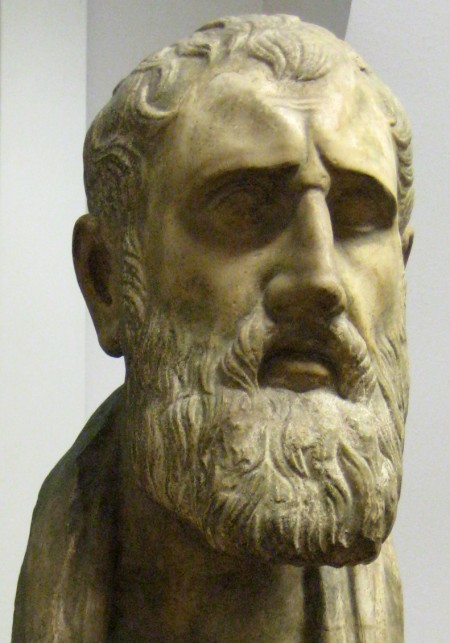
[image] Zeno of Citium, founder of Stoic school of Greek philosophy. Thanks to shakko and Wikimedia Commons.

References:

Adams, Jenny, ed. 2009. William Caxton. Jacobus de Cessolis. The game and playe of the chesse. Kalamazoo, Mich: Medieval Institute Publications.

Burt, Marie Anita. 1957. Jacobus de Cessolis: libellus de moribus hominum et officiis nobilium ac popularium super ludo scachorum. Ph. D. Dissertation. University of Texas at Austin

Murray, Harold James Ruthven. 1913. A history of chess. Oxford: Clarendon Press.

Schmidt, Gerard F., ed. 1961. Jacobus de Cessolis. Das Schachzabelbuch in mittelhochdeutscher Prosa-Übersetzung. Berlin: E. Schmidt.

Shackleton Bailey, D.R., trans. 2000. Valerius Maximus. Memorable doings and sayings. Cambridge, Mass: Harvard University Press.

Williams, H. L., trans. 2008. Jacobus de Cessolis. The book of chess. New York: Italica Press.

joking about imprisoning man shows woman’s bad character

man imprisoned in medieval dungeon

The vastly gender-disproportionate imprisonment of men is one of the cruelest gender injustices in the world today. That injustice attracts much less public concern than gender ratios among Chief Executive Officers and other elites. Almost everyone apparently believes in trickle-down gender justice. But don’t be deceived by today’s public insanity. The medieval nobleman and knight Sir Geoffrey de La Tour Landry instructed through his own example that men should refuse to become intimately involved with women who joke about imprisoning men.

In fourteenth-century France, the young, wealthy and well-connected Sir Geoffrey was considering marriage to a noblewoman. Geoffrey’s father took him to see the woman. Geoffrey explained how he tested her:

I looked at her and talked with her about many things in order to know her behavior better, and we started speaking about prisoners. I said to her, “Damsel, I would rather be your prisoner than anyone else’s, and I think that your prison wouldn’t be as hard or as cruel as the prison of the Englishmen.”

She answered me, saying that recently she had seen someone whom she wished were her prisoner. I asked her if she would give him an evil prison, and she said no, but that she would keep him as lovingly as she kept her own body. [1]

She modestly referred to imprisoning a man in the third person. Geoffrey knew that she meant him. He played along with a cheerful affirmation of men’s deplorable social position:

“He would be lucky to have such a pleasant and admirable prison,” I said.

Geoffrey latter explained to his daughters:

I tell you, she loved that prisoner, and her eye was lively, and she was full of words. When we had to leave, she was pert, asking me two or three times not to leave but to come see her.

Geoffrey said nothing and left with his father. When his father asked him for his thoughts regarding the woman, Geoffrey stated that her “pertness and frivolous manner” was discouraging. What sort of woman would joke about having a man imprisoned? Women who joke about having a man imprisoned, or who make false accusations that threaten men with imprisonment, have bad character. Exercising good judgment, Geoffrey didn’t marry the woman.[2]

Individual men cannot reform gynocentric society. Yet individual men retain important choices. Don’t associate with women who treat men’s freedom as a joke.

*  *  *  *  *

Read more:

Notes:

[1] Geoffrey de La Tour Landry, Livre pour l’enseignement de ses filles du Chevalier de La Tour (Book of the Knight of Tour Landry / Book of the Knight of the Tower) Ch. 12 (How the daughters of the King of Denmark lost their husbands because of their manners), from Old French trans. Barnhouse (2006) p. 81. Subsequent quotes are from id. The account of these events reported through Geoffrey’s wife obscures the issue of imprisonment. See Ch. 25  (How the knight answers to his wife), trans. id pp. 161-2.

Here’s the French text from the edition of Anatole de Montaiglon (1854). Wright (1868) provides an English translation from a fifteenth-century translation prior to William Caxton’s translation of 1484, but supplemented with Caxton’s text. Offord (1971) provides an edited edition of Caxton’s printed English translation.

As the first-person narrator, Geoffrey shows little literary artifice in his book for his daughters. Geoffrey’s reports of his experience are probably from his actual life.

[2] Geoffrey explained:

I have thanked God many times {that I didn’t marry her}, for not a year and a half later she was blamed for something, rightly or wrongly, I don’t know. Soon afterwords, she died.

Trans. id. p. 81. Geoffrey’s wife reported hearsay that blamed a man:

I have since heard it said of her that she was dishonored, but I don’t know for certain if it was so.

Id. p. 163. Geoffrey’s wife urged their daughters not to be sexually forward, but rather to behave “simply and purely.” Id.

[image] Display of man imprisoned in medieval dungeon at Arundel Castle, England. Thanks to Ludi Ling and Wikimedia Commons.

Reference:

Barnhouse, Rebecca, translator, with tendentiously constructed commentary. 2006. Geoffroy de La Tour Landry. The book of the knight of the tower: manners for young medieval women. New York: Palgrave Macmillan.

Offord, M. Y., ed. 1971. Geoffroy de La Tour Landry. William Caxton. The book of the knight of the Tower. London: Oxford University Press.

Wright, Thomas. 1868. Geoffroy de La Tour Landry. The book of the Knight of La Tour-Landry, compiled for the instruction of his daughters. London: Pub. for the Early English Text Society, by N. Trübner & Co.

rise of the all-powerful chess queen & Gratien Dupont’s protest

medieval knights playing chess

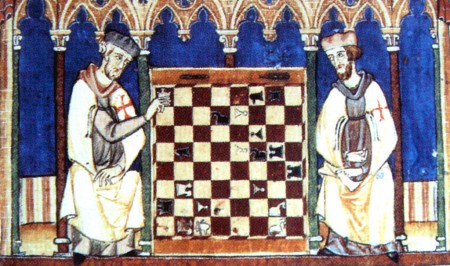
When the game of chess was invented, probably in India about 1500 years ago, all the pieces on the board were masculine. Chess originally reflected the horrible reality of war structured as men’s violence against men. In the modern game of chess, the queen is the most powerful piece on the chessboard. The queen’s rise to dominance in chess reflects the general historical pattern of men’s symbolic displacement, mythic effacement of reality, and intensifying gynocentrism. In that context, Gratien Dupont created his Controverses that challenge gynocentric oppression with transgressive brilliance.

In early Indian and Persian forms, chess was an exercise modeled on war. The Indian form in the early sixth century was called chaturanga. That meant “four branches {of the military}”: infantry, cavalry, elephantry, and chariotry. Chaturanga included the following pieces:

  • Raja (king), early form of king
  • Mantri / Senapati (counselor / general), preceding piece for queen
  • Ratha (chariot), early form of rook
  • Gaja (elephant), early form of bishop
  • Ashva (horse), early form of knight
  • Pedati or Bhata (foot soldier), early form of pawn

These pieces were men, military equipment that men used, and animals that men took into battle. The early Persian form, called shatranj, followed the early Indian form.[1] In both the early Indian and early Persian forms, the counselor (called in Persian and Arabic the fers) moved only diagonally, and only one square per move. While the counselor was more powerful than the foot soldier, that power inequality was much less than that between today’s queen and today’s foot soldier (pawn).

Europeans transformed the Indian and Persian chess counselor into a queen and greatly expanded her power on the chessboard. The first surviving reference to chess in European literature is Versus de scachis (“Verses on chess”). A German-speaking Benedictine monk living in a monastery located in present-day Switzerland wrote Versus de scachis about 997. At least at that place and time, the queen had already replaced the counselor in chess. The queen’s movement then was only oblique:

And the way for the queen is by reason easily revealed:
That diagonal course, the color {of squares traversed} shall be the same.

{At via reginæ facili racione patescit:
Obliquus cursus huic, color unus erit.} [2]

Another Latin poem, Elegia de ludo scachorum (“Elegy on the game of chess”), is attested from second half of the eleventh century. This poem suggests that the queen had become very powerful:

And if ever he {a pawn} reaches the summit of the chessboard,
he snatches up the queen’s customary duties,
Man made woman, he as a fierce arbiter keeps close to the king,
Commands and rules, here seizes, there yields.

{Et si quando datur tabule sibi tangere summa,
Regine solitum preripit officium.
Vir factus mulier regi ferus arbiter heret,
Imperat et regnat, hinc capit, inde labat.} [3]

The poem indicates the preeminent value of the queen:

The king by himself remains uncaptured, his spouse taken away
His spouse taken away, nothing has value on the chessboard.

{Rex manet incaptus, subtracta coniuge solus,
Coniuge subtracta, nil ualet in tabula.} [4]

Men in medieval Europe were socially constructed as persons who fight and die on behalf of women. Long before the sixteenth century, rules of chess changed to give the chess queen more capabilities to fight on behalf of her king:

Other ferses {queen-type pieces} move but one square,
But this one invades so quickly and sharply
That before the devil {opposing king} has taken any of hers,
She has him so tied up and so worried that
He doesn’t know where he should move.
This fers mates him in straight lines;
This fers mates him at an angle {or, in the corner}
This fers takes away his bad-mouthing;
This fers takes away his prey;
This fers always torments him;
This fers always goads him;
This fers from square to square
By superior strength drives him out.

{Autres fierces ne vont qu’un point,
Mais ceste cort si tost et point
Qu’ainc qu’anemis ait del sien pris,
L’a lacié et si souspris
Ne seit quel part traire se doie.
Ceste fierce le mate en roie,
Ceste fierce la mate en l’angle,
Ceste fierce li tolt la jangle,
Ceste fierce li totl sa proie,
Ceste fierce toz jors l’aspoie,
Ceste fierce toz jors le point,
Ceste fierce de point en point,
Par fine force le dechace.} [5]

A detailed description of chess preserved in the late-thirteenth-century Gesta Romanorum indicates that the queen had the power to move both to squares of different colors and diagonally to squares of the same color. Enumerating chess pieces from one (rook) to six (king), the text describes the queen’s movement:

The fifth, who in that {game} played and called chess, is the queen. Her move is from white to black, and she is placed next to the king. When she leaves the king, he is captured. When she has moved from her own black square, where she was first placed, she cannot move, except from one square to {another} square, and this diagonally, whether she go forward or return, whether she captures, or is {threatened with being} captured.

{Quintus, qui in isto scacario ludit et nominatur, est regina, cujus progressus est de albo in nigrum, et ponitur juxta regem; et quando recedit a rege, capitur. Que cum mota fuerit de proprio quadro nigro, ubi primo fuit locata, non potest procedere, nisi a quadro in quadrum unum, et hoc angulariter, sive procedat, sive retrocedat, sive capiat, sive capiatur.} [6]

The leading authority on the history of chess called the Gesta Romanorum’s account of chess “a hopeless muddle” and declared “the carelessness of the compiler, who was clearly incompetent to write anything exact on chess.”[7] The Gesta Romanorum’s account of chess was meant to be morally important and impressively expressed. In describing the king without the queen and the actions of the queen, Gesta Romanorum described a relatively powerful queen with echoes of antitheses from the earlier chess poem Elegia de ludo scachorum.[8] Gesta Romanorum was widely disseminated in Europe. The chess queen across Europe for centuries prior to the late fifteenth apparently had movement capabilities and importance lacking in the fers that she displaced.[9]

By the mid-sixteenth century, the chess queen throughout Europe had the movement possibilities of the piece today. Apparently beginning in Spain and Italy in the last decades of the fifteenth century, the queen gained the power to move horizontally, vertically, or diagonally as far as open space allowed or capturing a piece required. These movement possibilities, which define the chess queen today, make her by far the most powerful piece on the chessboard. Within a half-century, the queen had such power in chess throughout Europe. This new version of chess was called names that highlight the queen: in Spanish, axedrez dela dama (“chess of the lady”); in Italian, scacchi de la donna (“chess of the lady”) and scacchi alla rabiosa (“madwoman’s chess”); in French, eschés de la dame (“chess of the lady”) and eschés de la dame enragée (“chess of the enraged lady”).[10] The epithets “madwoman” and “enraged” hint at diffuse fear under intensified gynocentrism.

Gratien Dupont de Drusac transgressively challenged the intensified gynocentrism that the new chess queen indicated. Dupont’s book Controverses des sexes masculin et femenin (Controversies of the Masculine and Feminine Sexes) was published in France in 1534. Among ingenious visual poetry and shocking verbal constructions, it included a lengthy poem with puns on con (“cunt”):

The word con appears in every line. In the extract below, it can be read as part of the verb connaitre, to know’, or it can be read as a variation of ‘du con naitre’ meaning that all humans are ‘born from the cunt.’ Thus ‘nous connaissons’ can mean we know’ or ‘du con naissons’ can mean from the cunt we are born’. If something is ‘connu’, it is known, but the ‘con nu’ is a naked cunt’. And so Dupont seems to delight in the opportunity for play on words and double entendre. [11]

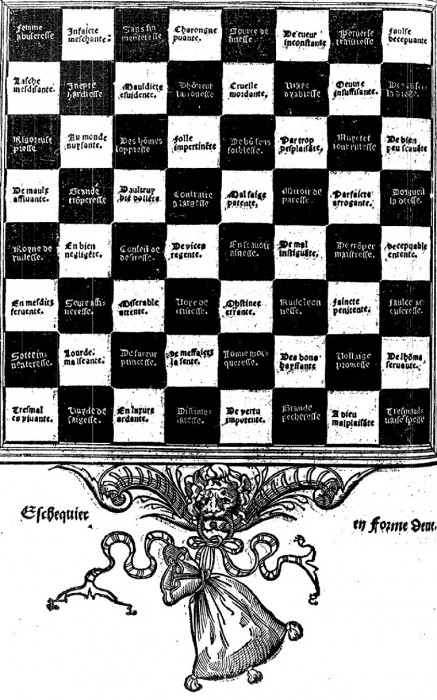
Protesting the queen’s dominance on the chessboard, Dupont constructed a chessboard with transgressive disparagement of women written within each square. The white squares contain words rhyming in -ante or -ente: De vice regente (“Queen regent of vice”), Par trop deplaisante (“Much too displeasing”), Folle impertinente (“Foolishly impertinent”), Cruelle mordante (“Cruelly biting”), En bien negligente (“Very negligent”), etc. The black squares contain phrases with words rhyming in -esseFemme abuseresse (“Abusive woman”), En sçavoir asnesse (“In learning asinine”), Sans fin menteresse (“Lying without end”), Vraye diablesse (“True she-devil”), etc.[12] Dupont thus created a critical perspective on the queen’s dominant power to cover the chessboard.

Gratien Dupont's chessboard protest

Dupont endured fierce backlash for ridiculing dominant gynocentrism. He had sought to remain anonymous, but his name was exposed. A contemporary high French official accused him of folly. A scholar wrote six Latin odes attacking him and suggested using Dupont’s book for toilet paper. Another declared that Dupont was a “detractor of the feminine sex” and urged the public to toss Dupont’s book into the fire. The Impregnable {sic} Fort of the Honour of the Feminine Sex, which a man wrote, declared Dupont a “Captain of contempt.” Another book castigated Dupont de Drusac: Anti-Drusac or Little Book Against Drusac Made in Honour of Noble, Good and Honest Women. Engaging in their usual name-calling, modern scholars have called Dupont a misogynist — “one of the most vehement misogynists of the sixteenth century.”[13] A few men who were his contemporaries initially praised Dupont for daring, honesty, and truth.[14] But praise of women was the sixteenth-century European norm:

It is essential to consider why, in the sixteenth-century Querelle des femmes, the opportunity to spread tales about female vice and the inferiority of women seemed to interest so few French writers. Most Querelle writers were only willing to blame woman once they had already confirmed their praise of the female sex. … By the mid-sixteenth century, the defender of woman was the literal ‘champion’ of views acceptable for airing on the printed page; the poor ‘mysogynist’ became the underdog. [15]

Praising women supports dominant gynocentric interests. Just as is the case today, in sixteenth-century France the superiority of women was the accepted opinion in public discourse.[16] Gratien Dupont’s protest against gynocentrism had little effect. His protest is scarcely remembered in literary history.

The historical transformation of chess in Europe shows a female symbol (the chess queen) displacing a male symbol (the chess counselor or fers) and then gaining dominant power within the formerly male space of the chessboard. Today men have no reproductive rights whatsoever. Today paternity is publicly established in patently unjust ways. Today family law is enormously biased against men. Mortal violence against men and rape of men are more prevalent than the corresponding offenses against women. Yet current affirmative-consent sexual initiatives are squarely targeted at men. Those initiatives potentially could raise the highly disproportionate imprisonment of men much higher. Chess players should understand the broad dimensions of the game they are playing.[17] Perhaps a chess genius can figure out a successful attack on gynocentric oppression configured on the large, vital chessboard of social life.

*  *  *  *  *

Read more:

Notes:

[1] The Middle Persian and Arabic term shatranj comes from the Sanskrit term chaturanga. The Persian and Arabic pieces followed those of the early Indian form.

[2] Versus de scachis (Einsiedeln Poem) ll. 63-4, from Latin my translation. The Latin text is also given in Murray (1913) pp. 512-4. For the dating, Gamer (1954) p. 742. In Latin before 1200, the chess queen was called regina, femina, and ferzia. Eales (1985) p. 45.

With the provincialism associated with gynocentric scholarship, Yalom (2004), Ch. 2, speculates on “living models for the chess queen.” That exercise mainly serves dominant ideological interests. A less prominent scholar astutely observed:

the search for an historical queen or series of queens behind the chess queen does not help us to better understand the chess literature nor the dynamic phenomenon of the game itself.

Taylor (2012) p. 180. An independent scholar dared to state the obvious:

There could be something wrong with my sense of logic, but I am not able to understand why there should be a connection between a chess queen and a female sovereign because the latter has a working knowledge of Latin.

Van der Stoep (2014) p. 154.

[3] Elegia de ludo scachorum (Qui cupit egregium scacorum…) ll. 8-9, from Latin my translation, with help from Marshall (2014) p. 253. The poem occurs as Carmina Burana, no. 210. Murray (1913), pp. 515-6, provides a critical edition of the poem. Since Murray wrote, two new manuscripts have been discovered (for a total of ten surviving manuscripts), and the poem has been convincingly dated to the second half of the eleventh century. In some manuscripts the poem is entitled Ludus scacorum. The poem came to be associated with the Latin poem De vetula, which includes a discourse on chess. Both poems in some manuscripts are wrongly attributed to Ovid. Gamer (1954) pp. 739-40, Eales (1985) p. 51.  Carmina Burana 209, a poem of four lines, also concerns chess. Placed between Carmina Burana 209 and 210 in the manuscript is a color illumination of chess-playing.

[4] Elegia de ludo scachorum l. 17, from Latin my translation. The fourth clause of the line has variant readings. A common reading is rex manet in tabula. That makes for a dull, repetitive poetic line. An antitheses occurs in the immediately preceding line: A dominis minimi, domini capiuntur ab imis (“By the lord the little ones {are captured}, and the lord is captured by the lowly”). Another occurs two lines earlier: hinc capit, hinc capitur (“here he captures, here he is captured”). An earlier reference to the pawn made queen also included antithesis: hinc capit, inde labat (“here seizes, there yields”). In that poetic context, nil ualet in tabula seems to me a much better reading. That’s the preferred reading in Murray (1913) p. 516.

In Chaucer’s Book of the Duchess, a knight playing against Lady Fortune declares:

with her various little cheating moves, she tricked me and stole away my queen. And when I saw my queen had been taken away, alas, I could not figure out how to continue playing, but said, ‘Farewell sweet always, and farewell everything, now and forever!’

ll. 653-8, modernization thanks to eChaucer, with my slight adaptation based on the Middle English text. The knight’s view of losing his queen piece (in the Middle English text referred to as fers) is consistent with reading nil ualet in tabula in the earlier Elegia de ludo scachorum.

[5] Gautier de Coinci, Miracles de la Sainte Vierge (also called Les Miracles de Nostre Dame) ll. 281-93, from Old French trans. Taylor (2012) p. 182, with my minor adaptations. Gautier wrote this poem early in the thirteenth century. The word fierces (“fers”) makes a pun with vierge (“virgin”). Id. n. 19. Virgin in medieval thought was associated with Mary, the mother of Jesus. She was called the Holy Queen and Holy Virgin (Sainte Vierge).

[6] Gesta Romanorum, Tale 166, from Latin text of Oesterley (1872) p. 552, ll. 5-10, my translation, with help from Swan & Hooper (1877) pp. 316-7. Murray provided only the introductory paragraph of Oesterley’s text of Gesta Romanorum. Id. pp. 562-3. Murray argued that the English Gesta Romanorum was prior to the continental Oesterley text. The former, but not the latter, includes a tale entitled De Antonio Imperatore. That tale includes a similar description of the chess queen’s movement. Two manuscripts of the English Gesta Romanorum described the queen’s movement as de albo in nigrum (“from white to black”), while others state de nigro in nigrum vel de albo in album (“from black to black and from white to white”). Id. p. 562. Murray provides a muddled account of this difference. Id. p. 553.

[7] Murray (1913) pp. 553, 552.

[8] See discussion above of Rex manet incaptus, subtracta coniuge solus, / Coniuge subtracta, nil ualet in tabula. Jacobus de Cessolis, Liber de moribus hominum et officiis nobilium super ludo scacchorum, Bk 4, Ch. 3, contributed text to Gesta Romanorum’s description of the chess queen. Compare Williams (2008) pp. 108-10 to Swan & Hooper (1877) pp. 316-7, and see Murray (1913) pp. 550-4, 562-3. Cessolis’s work is from the second half of the thirteenth century. It was one of the most popular texts of the European Middle Ages. Id. pp. 539, 537.

[9] Yalom (2004) obscures earlier evidence of the chess queen’s greater power relative to the fers:

We have seen how the chess queen appeared around the year 1000 as a European replacement for the Arabic vizier, taking over his slow, one-step-at-a-time diagonal gate. Despite slight regional differences, this is the pace she maintained throughout the Middle Ages.

Id. pp. 191-2. Taylor (2012) insightfully focuses on the expansion of the queen’s movement possibilities prior to the new chess. Under the Lombard rules, the queen on her first move could jump two squares on the diagonal. Taylor (2012) p. 176, Murray (1913) p. 462. That was a move to a same-color square. Gesta Romanorum, in contrast, describes a queen’s move to a different-color square.

The chess queen’s preeminent power gave poets the opportunity to reverse scenes of men fighting on behalf of women. Marcus Hieronymus Vida’s Latin poem Schaccia, Ludus (The Game of Chess) was published in 1525. It described chess queens fighting to death on behalf of their kings:

The dreadful Amazons {chess queens} sustain the fight.
Resolved alike to mix in glorious strife,
Till to imperious fate they yield their life.

{Foemineis ambae nituntur Amazones armis,
Usque adeo certae non cedere, donec in auras
Aut haec, aut illa effundat cum sanguine multo
Saevam animam, sola linquentes praelia morte.}

ll.379-82, from Latin trans. Oliver Goldsmith (1527).

Yalom attributes the new chess to gynocentrism expressed as gynarchy under Isabella of Castille (reigned 1474 to 1504):

the new chess queen was raised to the stature of the living queen, and hence forth the revised game would be called “queen’s chess” — an epithet that honored Queen Isabella as well as her symbolic equivalent on the board.

Id. p. 211. That claim rests on little more than biographical fallacy (some woman ruler must have been the model for the chess queen) and mythologizing. Taylor (2012) pp. 179-80, Van der Stoep (2014) p. 156. However, as Yalom’s work documents, the intensification of gynocentrism is a real historical phenomenon.

[10] In the context of chess, the words donna in Italian and dame in French came to mean the chess queen. Luis de Lucena, Repetición de amores y arte de ajedrez, described the new power of the chess queen. That book was printed in Spain in 1497. Eales (1985) pp. 72-3. Francesch Vicent, Jochs partits del sachs en numbre de 100, printed in Catalan in Valencia in 1495, and Le Jeu des Eschés de la Dame moralisé, from the late fifteenth century, also attest to the new chess rules. Murray (1913) pp. 776-80, Eales (1985) pp. 71-6, Taylor (2012) pp. 175-9. Concluding her ridiculous, mythic account of the birth of the chess queen, Yalom declares:

the chess queen evokes a distant era when respect, admiration, and fear were lavished on numerous living queens. Yet the chess queen is still a fitting image for women’s place in the world, and not just for royalty.

Yalom (2004) p. 241. Given the harsh anti-men bias pervasive in modern criminal justice systems and the serious problem of false accusation, women in general are probably much more feared today than they were in sixteenth-century Europe.

[11] Warner (2011) p. 111, with some small, non-substantial changes for ease of reading. The word controverses (“controversies”) itself makes a play on con. Id. Dupont also set up an allegory in which Masculine Sex chooses Lady Truth as his advocate, while Lady Strong Opinion defends Feminine Sex. Id. pp. 110, 118. One of Dupont’s sources was Matheolus, a brilliant voice of medieval men’s sexed protest.

[12] Warner (2011) p. 113. Below the chessboard, Dupont labeled it Eschequier en forme d’eue (Chessboard in the form of Eve). He decorated the chessboard with a conventional lion-head mask with a ring in the lion’s mouth. Dupont attached to the ring what appears to be a moneybag. That may allude to men being treated as wallets in relation to women. Financial exploitation of men through paternity claims became an issue in the French Revolution.

Nash (1997), pp. 380-1, and Yalom (2004), pp. 219-20, discuss Dupont’s work with conventional name-calling in support of the dominant gynocentric ideology. Authors of literature of men’s sex protest have suffered such attacks throughout history.

[13] Warner (2012) pp. 105-7. Dupont was not named on the title page, but his name was exposed within the book. Id. p. 105.

[14] Letters included in the first edition of Controverses des sexes masculin et femenin endorsed it. In one letter, Guillaume de la Perriere praised the author for having “written freely without fear and pursued his intent without flattery or adulation.” In another, Bernard d’Estopinhan urged the author:

do not fear the insults of the envious, put behind you the fear of feminine fury {and} take the safe conduct of truth which will make you secure from the assaults of your adversaries

Estienne de Vignalz praised the author for being “truthful and not a lying flatterer.” Fear of the dominant ideology rapidly became an issue. Editions of the work published in 1536 and 1537 suppressed printer attributions and letters of support. Id. pp. 108-9.

[15] Id. pp. 104, 118. The framework of debate — Querelle des femmes — itself indicated gynocentrism.

[16] Id. p. 117. Id. asks, “what happens when the so-called paradox of the superiority of woman becomes the ‘received opinion’ in print?” Belief in the superiority of women coexists with vigorous pursuit of professed ideals of gender equality.

[17] Discussion of injustices against men is actively and viciously condemned today. Discussion of injustices against women, in contrast, is highly privileged. That’s no more reasonable today than it would be in the sixteenth century:

If we fail to compare the debate on the nature of woman with the contiguous debate on the dignity and misery of man, then we risk misinterpreting the Renaissance idea of human nature. Without the context and comparison, one might find misogyny in places where a simple lament on human weakness or a satire on the human condition was intended. To separate the ‘Renaissance man’ from his female counterpart misleads the modern reader about how these concepts occur in the sixteenth-century sources.

Id. p. 6.

[images] (1) Knights Templar playing chess. Illumination made in 1283. From Biblioteca del Monasterio de El Escorial, ms T. I 6, fol. 25. Thanks to Wikimedia Commons. (2) Eschequier en forme d’eue (Chessboard in the form of Eve). From Gratien Dupont, Les controverses des sexes masculin et féminin (Toulouse: 1534), p. XLIV (f157). Thanks to Bibliothèque nationale de France / Gallica.

References:

Eales, Richard. 1985. Chess, the history of a game. New York, N.Y.: Facts on File Publications.

Gamer, Helena M. 1954. “The Earliest Evidence of Chess in Western Literature: The Einsiedeln Verses.” Speculum. 29 (4): 734-50.

Marshall, Tariq. 2014. The Carmina Burana: Songs from Benediktbeuren: a full and faithfull translation with critical annotations. 3rd edition. Los Angeles: Marshall Memorial Press.

Murray, Harold James Ruthven. 1913. A history of chess. Oxford: Clarendon Press.

Nash, Jerry C. 1997. “Renaissance misogyny, biblical feminism, and Hélisenne de Crenne’s Epistres familières et invectives.” Renaissance Quarterly. 50 (2): 379-410.

Oesterley, Hermann, ed. 1872. Gesta Romanorum. Berlin: Weidmann.

Swan, Charles, trans. and Wynnard Hooper, ed. 1877. Gesta Romanorum. London: George Bell & Sons.

Taylor, Mark N. 2012. “How Did the Queen Go Mad?” Ch. 7 (pp. 175-89) in O’Sullivan, Daniel E., ed. Chess in the Middle Ages and Early Modern Age: a Fundamental Thought Paradigm of the Premodern World. Berlin: De Gruyter.

Van der Stoep, Arie. 2014. “Review: Marilyn Yalom. Birth the chess queen.” Board Game Studies 8: 153-8.

Warner, Lyndan. 2011. The ideas of man and woman in Renaissance France: print, rhetoric, and law. Farnham, Surrey, England: Ashgate.

Williams, H. L., trans. 2008. Jacobus de Cessolis. The book of chess. New York: Italica Press.

Yalom, Marilyn. 2004. Birth of the chess queen: a history. New York, NY: Harper Collins Publishers.