Heloise taught Abelard boldness and courage

Joan of Arc followed Heloise

Heloise of the Paraclete, a leading figure in twelfth-century Europe, described women and men as by nature created unequal. She described women as the weaker sex, and men, the stronger sex.[1] These epithets, of course, are merely conventional, misleading descriptions of physical sex differences. Nonetheless, Heloise noted that St. Gregory the Pope had written gender inequality into his Pastoral Rule of 591:

men are to be admonished in one way, women in another; for heavy burdens may be laid on men and great matters exercise them, but lighter burdens on women, who should be gently converted by less exacting means.

{ Aliter igitur ammonendi sunt viri atque aliter femine, quia illis gravia, istis vero sunt injungenda leviora; et illos magna excerceant, istas vero levia demulcendo convertant. } [2]

Heloise sought to lessen women’s burdens. But she didn’t believe that women are generally inferior to men. She argued that women should be allowed any sort of food and drink, because women are less prone to gluttony and intoxication than are men.[3] Abelard, a leading scholar of logic, should have been able to figure that out.

Abelard’s reason functioned in a different direction. A leading scholar of Abelard’s work observed:

we can see in his religious writings an exceptional theological exaltation of womankind. He is to my knowledge the first theologian to suggest that “the creation of woman surpasses that of man by a certain dignity, since she was created within paradise, but man outside it”; he argues that “inasmuch as woman is physically the weaker sex, to that extent her virtue is more acceptable to God and more worthy of honor”; Christ asks the Samaritan woman at the well for a drink of water “to indicate plainly that women’s virtue is the more pleasing to him in that they are weaker in person”; the saints who are virgin martyrs have achieved “a perfection of virtue that we know to be rare in men but frequent in women”. [4]

Abelard also declared that male bodies are not as beautiful as female bodies: “maidenly beauty is naturally considered more refined and softer than the male figure {naturaliter puellaris forma elegantior et delicatior virili compositione censetur}.”[5] Abelard has been an influential figure in Europe’s historical development of reason. His influence can be recognized in present-day elite scholarship.

Heloise, who delighted in Abelard’s body as well as his mind, teased Abelard for his attempt to recognize that she was not his inferior. She began a letter to him with a courtly admonishment:

I am surprised, my only love, that contrary to custom in letter-writing and, indeed, to the natural order of things, you have thought fit to put my name before yours in the greeting which heads your letter, so that we have woman before man, wife before husband, handmaid before lord, nun before monk and priest, and deaconess before abbot. Surely the right and proper order is for those who write to their superiors or equals to put their names before their own, but in letters to inferiors, precedence in order of address follows precedence in rank.

{ Miror, unice meus, quod preter consuetudinem epistolarum, immo contra ipsum ordinem naturalem rerum, in ipsa fronte salutationis epistolaris me tibi preponere presumpsisti, feminam videlicet viro, uxorem marito, ancillam domino, monialem monacho et sacerdoti, diaconissam abbati. Rectus quippe ordo est et honestus ut qui ad superiores vel ad pares scribunt, eorum quibus scribunt nomina suis anteponant; sin autem ad inferiores, precedunt scriptionis ordine qui precedunt rerum dignitate. } [6]

Abelard responded at length to explain that Heloise wasn’t his inferior. He sought to avoid Heloise’s blame and reproach.

Heloise taught Abelard boldness and courage. She had argued strongly to him against marriage when their sexual affair was discovered. Abelard, more reluctant to stand up to oppressive laws, insisted that they must marry. After much reasoned protest and tears, Heloise agreed to marry only so as not to offend Abelard.[7] Subsequent terrible events made clear to Heloise her mistake. Heloise became more bold and courageous. She wrote letters with honesty and truth, without concern for offending anyone. Heloise taught Abelard to write like she did.

Heloise taught Abelard words of men’s sexed protests. As a woman religious, Heloise did not believe that men are a demonic species. She recognized sacred scripture encompasses even literature of men’s sexed protests. In a letter to Abelard, Heloise drew upon that literature in counseling him:

Again and again women utterly destroy the very greatest of men!  Hence the warning about women in Proverbs: “But now, my son, listen to me, attend to what I say: do not let your heart entice you into her ways, do not stray down her paths; she has wounded and laid low so many, and the strongest have all been her victims. Her house is the way to hell, and leads down to the halls of death.” And in Ecclesiastes: “I put all to the test … I find woman more bitter than death; she is a snare, her heart a net, her arms are chains. He who is pleasing to God eludes her, but the sinner is her captive.”

It was the first woman in the beginning who lured men from Paradise, and she who had been created by the Lord as his helpmate became the instrument of his total downfall. And that mighty man of the Lord, the Nazirite whose conception was announced by an angel, Delilah alone overcame; betrayed to his enemies and robbed of his sight, he was driven at last by sorrow to destroy himself along with the fall of his enemies. Only the woman he had slept with could make a fool of Solomon, the wisest of all men; she drove him to such a pitch of madness that although he was the man whom the Lord had chosen to build the temple in preference to his father David, who was a righteous man, she plunged him into idolatry until the end of his life, so that he abandoned the worship of God which he had preached and taught in word and writing. Job, the holiest of men, fought his last and hardest battle against his wife, who urged him to curse God. The cunning arch-tempter well knew from repeated experience that men are most easily brought to ruin through their wives, and so he directed his usual malice against us too, and tempted you through marriage when he could not destroy you through fornication.

{ O summam in viros summos et consuetam feminarum perniciem! Hinc de muliere cavenda scriptum est in Proverbiis: “Nunc ergo, fili, audi me, et attende verbis oris mei. Ne abstrahatur in viis illius mens tua, neque decipiaris semitis ejus; multos enim vulneratos dejecit, et fortissimi quique interfecti sunt ab ea. Vie inferi domus ejus penetrantes in inferiora mortis.” Et in Ecclesiaste: “Lustravi universa animo meo, et inveni amariorem morte mulierem, que laqueus venatorum est, et sagena cor ejus. Vincula enim sunt manus ejus. Qui placet Deo effugiet eam; qui autem peccator est capietur ab illa.”

Prima statim mulier de paradiso virum captivavit, et quae ei a Domino creata fuerat in auxilium, in summum ei conversa est exitium. Fortissimum illum Nazareum Domini et angelo nuntiante conceptum Dalila sola superavit, et eum inimicis proditum et oculis privatum ad hoc tandem dolor compulit ut se pariter cum ruina hostium opprimeret. Sapientissimum omnium Salomonem sola quam sibi copulaverat mulier infatuavit, et in tantam compulit insaniam ut eum quem ad aedificandum sibi Dominus templum elegerat, patre ejus David, qui justus fuerat, in hoc reprobato, ad idololatriam ipsa usque in finem vite dejiceret, ipso quem tam verbis quam scriptis predicabat atque docebat divino cultu derelicio. Job sanctissimus in uxore novissimam atque gravissimam sustinuit pugnam, quae eum ad maledicendum Deo stimulabat. Et callidissimus temptator hoc optime noverat, quod sepius expertus fuerat, virorum videlicet ruinam in uxoribus esse facillimam. Qui denique etiam usque ad nos consuetam extendens maliciam, quem de fornicatione sternere non potuit de conjugio temptavi } [8]

Abelard, like many scholars since, probably was horrified that Heloise wrote those words. But words of men’s anguished sexed protests deserve to heard. To make such words heard requires boldness and courage. Heloise taught Abelard boldness and courage.

Heloise deserves equal credit for the Samson planctus ascribed to Abelard. Insightful scholarship has recognized the relation of the Samson planctus to Heloise’s writing, but misunderstood that relationship.[9] Abelard learned from Heloise. With that learning, he wrote poetic words of men’s sexed protest:

Oh, ever of the mighty
supreme destruction,
to such catastrophe
was created — woman!

She brought the father of all
down with due speed,
and the cup of death
she hands to everyone.

Holier than David,
wiser than Solomon,
who could be thought?
Or again, more impious —
through women’s fault — or more
fatuous,
who could be found?
Who among the strong
was like the strongest Samson
weakened?

{ O semper fortium
ruinam maximam,
et in exicium
creatam feminam!

Hec patrem omnium,
dejecit protinus,
et mortis poculum,
propinat omnibus.

David sanctior,
Salomone prudentior
quis putetur?
Aut quis impius
magis per hanc fatuus
repperitur?
Quis ex fortibus
sicut Sanson fortissimus
enervatur? }

The poem builds to a shocking concluding stanza:

Bare your breast to the asp —
bare it to fire sooner,
wise one, whoever you are,
than entrust yourself
to women’s wiles —
unless you should prefer
towards that catastrophe
to run inexorably
with those already named!

{ Sinum aspidi
vel igni pectus aperi,
quisquis sapis,
Quam femineis
te committas illecebris,
nisi malis
ad exitium
properare certissimum
cum predictis. }[10]

Adam, Solomon, and Sampson were commonly recognized to have been asinine in relation to women, with disastrous results. At the same time, in Christian understanding, they were major figures in salvation history. Boldness and courage imply recognizing danger and moving forward. With the help of Heloise, Abelard not only appreciated the literature of men’s sexed protest, but also greatly heightened its poetic form.[11] Heloise taught Abelard to move forward in Christian understanding with her.

*  *  *  *  *

Read more:

Notes:

[1] Heloise to Abelard, Letter 6.3, 6, 9, 10, 11, 27, Latin text and English trans. Luscombe & Radice (2013).  All subsequent quotes are similarly sourced, unless otherwise notes. Id. has Historia calamitatum as Letter 1.  Other collections have the subsequent letter as Letter 1.

[2] Letter 6.9, id. pp. 225, 227.

[3] Letter 6.14, id. p. 233.

[4] Dronke (1970) p. 137.

[5] Abelard to Heloise, Letter 8.3, from Latin trans. Luscombe & Radice (2013) p. 353 (modified slightly for accuracy).

[6] Heloise to Abelard, Letter 4.1. id. p. 159. Heloise’s implicit dominance is also evident in her sophisticated issuing of demands to Abelard:

we handmaids of Christ, who are your daughters in Christ, come as suppliants to demand of your paternal care two things

{ Omnes itaque nos Christi ancille et in Christo filie tue duo nunc a tua paternitate supplices postulamus }

Letter 6.3, id. p. 219.

[7] Letter 1.27 (Historia calamitatum), id. p. 43.

[8] Heloise to Abelard, Letter 4.9-10, id. pp. 167, 169.  The Jealous Husband in the Romance of the Rose noted of Heloise: “she knew  the feminine ways, for she had them all in herself.” See ll. ll. 8759-8832 , from French trans. Dahlberg (1995).

[9] Dronke (1970) pp. 116-7, 137-40.

[10] Samson Planctus,2a-3a, 3c, Latin text from Ruys (2014) pp. 252-3, English trans. Dronke (1970) pp. 123-4.  Based on the critical commentary of Orlandi (2001) p. 339, I’ve amended “for such a catastrophe / was created — woman” to “to such a catastrophe / was created — woman” (“in exitium / creatam feminam”) and “Who among the mighty / is not, like mightiest Samson, / unmanned?” to “Who among the strong /was like the strongest Samson / weakened?” (“Quis ex fortibus / sicut Sanson fortissimus / everuatur?”) The second amendment includes a better reading of the Latin text. Regarding Abelard’s planctus depicting Dina weeping for the killing of Sichem, id. p.  341 observed:

we are living in 2000, when, luckily, no judge in any civilized country would forgive the rapist Sichem’s offence.

In the U.S., the leading U.S. government public health institution has categorized men being raped as not real rape. It has obscured the fact that about as many men are raped as women are raped. Today, women who commit rape are much less likely to face punishment than men who commit that offense.

[11] Abelard’s achievement shouldn’t be exaggerated. He blamed only himself for his castration and demeaned his own male sexuality. He lacked the self-regard and social consciousness to recognize that his experience was part of a broader social pattern of violence against men. In Letter 1.69, Abelard cited a line from Juvenal’s Satire 6. Nonetheless, other than in his Samson planctus, Abelard did not show outstanding boldness and courage in thinking and writing about men’s social position.

Relative to some current medieval scholarship, Heloise and Abelard appear to be towering figures of Enlightenment thought. A recent doctoral dissertation on Heloise features as an epigram to its introduction a gyno-solipsistic absurdity:

What would happen if one woman told the story of her life? The world
would split open. — Muriel Rukeyser

Posa (2009) p. 1. Newman (2014) breathlessly reported that Heloise quoted:

St Jerome’s distasteful image of family life with just one significant revision: ‘What man, bent on sacred or philosophical thoughts, could endure the crying of children, the nursery rhymes of nannies trying to calm them, the bustling throng of male and female servants in the household? And what woman will be able to bear the constant filth and squalor of babies?’ Jerome twice wrote ‘what man’ (‘quis … quis?’), whereas Heloise quietly changed the second ‘quis’ to a ‘que’: ‘What woman?’ In short, we hear an educated woman asking disdainfully, in the early 12th century, how she could be expected to bear the filth and squalor of babies. This boggles even 20th and 21st-century minds.

That boggles the mind only of persons ignorant of important medieval literature. Boccaccio counseled men in relation to women:

Even if they have the grace to want children (which is not often the case), it is not necessary to be their slaves.

Giovanni Boccaccio, The Downfall of Illustrious Men (De Casibus Virorum Illustrium), Bk. 1, penultimate section, “The tricks women use to capture the reason of men are many and varied.”  From Latin trans. Hall (1965) p. 45. Even earlier, Juvenal in Satire 6 offered bracing words about women’s lack of love for children. Today persons who apparently have received advanced medieval education proudly post on the web “academic” writing that uncannily embodies popular stereotypes of medieval thought. See Ongley (n.d).

[image] Joan of Arc, painting, oil on parchment, c. 1485. Centre Historique des Archives Nationales, Paris, AE II 2490. Thanks to Wikimedia Commons.

References:

Dahlberg, Charles, trans. 1995.  Guillaume de Lorris and Jean de Meun. The Romance of the Rose. 3rd ed. Princeton, N.J.: Princeton University Press.

Dronke, Peter. 1970. Poetic individuality in the Middle Ages: new departures in poetry, 1000-1150. Oxford: Clarendon Press.

Hall, Louis Brewer, trans. 1965. Giovanni Boccaccio. The fates of illustrious men. New York: F. Ungar Pub. Co.

Luscombe, David, and Betty Radice, ed. and trans. 2013. The letter collection of Peter Abelard and Heloise. Clarendon Press: Oxford.

Newman, Barbara. 2014. “Astonishing Heloise.” Review of The Letter Collection of Peter Abelard and Heloise edited by David Luscombe. London Review of Books. 36:2: 23 Jan.

Ongley, Shannon. n.d. “Gender Roles in ‘Abelard and Heloise.'” Pidgin Scratch, under “Writing Samples,” “Academic,” with headline image indicating “pen for hire.”

Orlandi, Giovanni. 2001. “On the text and interpretation of Abelard’s Planctus.” Pp. 327-42 in John Marenbon and Peter Dronke,eds. Poetry and philosophy in the Middle Ages: a festschrift for Peter Dronke. Leiden.

Posa, Carmel M. 2009. The Theology and Spirituality of the Body in the Writings of Heloise of the Paraclete. Doctor of Philosophy thesis, University of Divinity (Melbourne).

Ruys, Juanita Feros. 2014. The Repentant Abelard: family, gender and ethics in Peter Abelard’s Carmen ad Astralabium and Planctus. New York, N.Y.: Palgrave Macmsillan.

metatextual irony follows Gemmata, Pietro and Donno Gianni

Read literally, the preface to the Decameron indicates that it was written for ladies.  Boccaccio and a lady reader of Decameron IX.10 are laughing still at today’s learned literary scholars’ will to believe that fiction.

Gray Arabian broodmare

In Decameron IX.10, Donno Gianni, a priest serving an impoverished church, garnered a living by trading at fares.  Donno Gianni became friends with a fellow trader named Pietro.  Pietro lived in a poor little cottage and had only one ass.  When Donno Gianni visited, he had to sleep in the stable on straw next to his mare and Pietro’s ass.  Pietro’s wife Gemmata offered to sleep at a neighbor’s so that Donno Gianni could have her place in bed with Pietro.  Donno Gianni declined that offer.  He told Gemmata:

don’t trouble yourself about me.  I’m doing just fine, because whenever I like, I change this mare into a beautiful gal and pass the time with her.  Then, whenever I want to, I turn her into a mare again. [1]

While a priest, Donno Gianni evidently was also a man with keen heterosexual animal instinct.

Gemmata believed Donno Gianni’s tale.  Eager for greater earnings from trading, she urged her husband to have Donno Gianni turn her into a mare to work with his ass transporting trading goods.  When Pietro returned home, he could have Donno Gianni turn her back into a woman.

Pietro pleaded with Donno Gianni to fulfill his wife’s rich plot.  Donno Gianni tried to decline, but Pietro insisted.  Finally, Donno Gianni agreed to perform his magic in their cottage just before daybreak.  He explained that if they wanted his performance to succeed, they had to obey his every order and not say a single word, no matter what.  They eagerly agreed.

To perform his magic in their cottage just before daybreak, Donno Gianni ordered Gemmata to take off all her clothes and get on her hands and knees in the position of a mare.  Then Donno Gianni began touching her and invoking a bodily transformation:

“Let this be a fine mare’s head.” Then stroking her hair, he said: “Let this be a fine mare’s mane.” Next, he touched her arms, saying: “Let these be a fine mare’s legs and hooves.” [2]

Just as for the monk Rustico and the young girl Alibech, events led to a rising of the flesh:

When he came to her breasts, he found they were so firm and round that a certain uninvited something or other awoke and stood erect, and he said: “And let this be a fine mare’s chest.”

He then did the same thing to her back, her stomach, her hindquarters, her thighs, and her legs.  Finally, having nothing left to take care of but the tail, he whipped up his shirt, grabbed hold of the stick he used for planting men, and quickly stuck it into the furrow that was designed for it, saying: “And let this be a fine mare’s tail.”

Pietro then interrupted, saying he didn’t want a tail there.  After the “vital fluids that all plants need to take root” had come, Donno Gianni pulled out of his magic performance.  He declared that Pietro’s words had broken the spell.  Pietro explained his interruption:

“I didn’t want that tail there, no, not me.  Why didn’t you tell me, ‘Do it yourself’?  And besides, you were sticking it on too low.”

“I didn’t tell you because it was your first time,” replied Donno Gianni, “and you wouldn’t have known how to stick it on as well as I do.”

Pietro apparently preferred putting the tail on the mare in the ass position.  Gemmata turned on Pietro, called him a dope, and blamed him for ruining their chance to earn more money.  Pietro was left to continue doing his work only with the anus and the ass.

Dioneo, who understood Ovid’s teachings on love, told this story.  He first praised the ladies’ superior virtue.  He then summarized the story’s moral teaching:

{this story} will teach you how carefully one must follow the instructions of those who do things by means of incantations and how making even one tiny mistake will ruin everything the magician has done.

The conclusion for Day 9 offers a higher metatextual commentary on this story:

How the company laughed at this story, which the ladies understood better than Dioneo had intended, can be left to the imagination of that lady who has read it and is laughing at it still.

That lady is laughing still at those who read the Decameron without a hearty sense of irony.[3]

*  *  *  *  *

Read more:

Notes:

[1] Giovanni Boccaccio, Decameron, Day 9, Story 10, from Italian trans. Rebhorn (2013) p. 745.  All subsequent quotes are from id. pp. 746-8.

[2] The original Italian sounds more like an incantation:

“Questa sia bella testa di cavalla ” … “Questi sieno belli crini di cavalla” … “E queste sieno belle gambe e belli piedi di cavalla.”

[3] Most Boccaccio scholars today apparently believe that the Decameron actually was written for ladies. See, e.g. Houston (2010) p. 120.

[image] Gray Arabian broodmare.  Thanks to Lovely Little Girl and Wikimedia Commons.

References:

Houston, Jason M. 2010. Building a monument to Dante: Boccaccio as Dantista. Toronto: University of Toronto Press.

Rebhorn, Wayne A., trans. 2013. Giovanni Boccaccio. The Decameron. New York : W.W. Norton & Company.

Heloise loved Abelard with a big-hearted feminine love

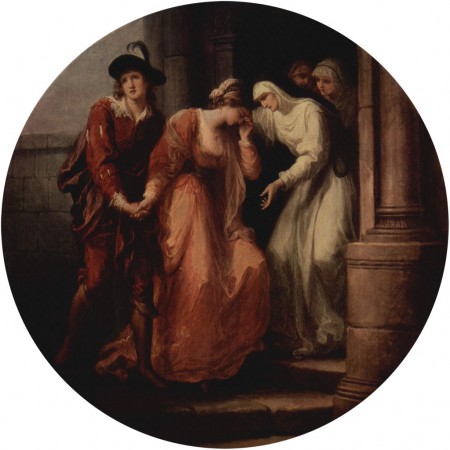
Heloise departing from Abelard

Everyone today should listen attentively to the voice of the learned, articulate medieval woman Heloise writing about Abelard.  Medieval scholars, who have historically been predominately men, have under-appreciated Heloise just as they have under-appreciated the medieval woman writer Marie de France.  Heloise, like Marie de France, spoke out with a strong, independent voice in love for men in the fullness of their persons.[1]

Heloise understood that hypergamy tends to characterize women more than men.  Aspasia, a friend of Socrates, the mistress-master of Pericles, and perhaps also a brothel-keeper, declared:

Unless you come to believe that there is no better man nor worthier woman on earth you will always still be looking for what you judge the best thing of all — to be the husband of the best of wives, and the wife of the best of husbands.

{ Quare, nisi hoc peregeritis, ut neque vir melior neque femina in terris letior sit, profecto semper id, quod optimum putabitis esse, multo maxime requiretis, ut et tu maritus sis quam optime, et hec quam optimo viro nupta sit. } [2]

While Heloise appreciated Aspasia’s wisdom, Heloise better understood the truth about women’s and men’s love.[3]  As a young woman, Heloise fell in love with her older, eminent tutor-scholar Peter Abelard.  Abelard had taken the initiative to establish a relationship with her.  While most men find most attractive in women youth, beauty, and warm receptivity, Abelard had broader interests in Heloise:

In looks she did not rank least, while in the abundance of her learning she was supreme.  A gift for letters is so rare in women that it added greatly to her charm and had made her very famous throughout the realm. … Knowing her knowledge and love of letters I thought she would be all the more ready to consent, and that even when separated we could enjoy each other’s presence by exchange of written messages in which we could write many things more boldly than we could say them, and so need never lack the pleasures of conversation.

{ Que cum per faciem non esset infima, per habundantiam litterarum erat suprema. Nam quo bonum hoc, litteratorie scilicet scientie in mulieribus est rarius, eo amplius puellam commendabat et in toto regno nominatissimam fecerat. … Tanto autem facilius hanc mihi puellam consensuram credidi quanto amplius eam litterarum scientiam et habere et diligere noveram, nosque etiam absentes scriptis internuntiis invicem licere presentare et pleraque audacius scribere quam colloqui, et sic semper iocundis interesse colloquiis.} [4]

Abelard’s broader interests in Heloise did not mean that she was his social and intellectual equal.  He was her tutor.  He was probably more than fifteen years older than her.  Heloise’s description of Abelard’s social standing implies that he was much more eminent than she:

What king or philosopher could match your fame?  What region, city, or village did not long to see you?  When you appeared in public, who (I ask) did not hurry to catch a glimpse of you, or crane her neck and strain her eyes to follow your departure?  Every wife, every young girl desired you in absence and was on fire in your presence; queens and great ladies envied me my joys and my bed. You had beside, I admit, two special gifts with which you could at once win the heart of any woman — the gift of composing verse and song. … You have left many songs composed in amatory verse and rhyme.  Because of the very great sweetness of their words as much as their tune, they have been repeated often and have kept your name continually on the lips of everyone.  The beauty of the melody ensured that even the unlettered did not forget you; more than anything this made women sigh for love of you.  And as most of the songs told of our love, they soon made me widely known and roused the envy of many women against me. What is even one grace of mind and body with which your manhood was not adorned?

{ Quis etenim regum aut philosophorum tuam exequare famam poterat ? Que te regio aut civitas seu villa videre non estuabat? Quis te, rogo, in publicum procedentem conspicere non festinabat ac discedentem collo erecto, oculis directis non insectabatur? Que coniugata, que virgo non concupiscebat absentem, et non exardebat in presentem? Que regina vel prepotens femina gaudiis meis non invidebat vel thalamis? Duo autem, fateor, tibi specialiter inerant quibus feminarum quarumlibet animos statim allicere poteras, dictandi videlicet et cantandi gratia, que ceteros minime philosophos assecutos esse novimus. Quibus quidem, quasi ludo quodam laborem exercitii recreans philosophici, pleraque amatorio metro vel rithmo composita reliquisti carmina, que pre nimia suavitate tam dictaminis quam cantus sepius frequentata, tuum in ore omnium nomen incessanter tenebant, ut illiteratos etiam melodie dulcedo tui non sineret immemores esse. Atque hinc maxime in amorem tui femine suspirabant. Et cum horum pars maxima carminum nostros decantaret amores, multis me regionibus brevi tempore nuntiavit et multarum in me feminarum accendit invidiam. Quod enim bonum animi vel corporis tuam non exornabat adolescentiam? } [5]

Abelard didn’t love Heloise because there was no worthier woman, as the worth of women was commonly judged among men of his time.  Heloise’s love for Abelard was love for a man who had leading sexual market value among men of his time.[6]  Aspasia’s sexually symmetric proposition about wives’ and husbands’ love failed to recognize important differences in women’s and men’s natures.  In terms of the fundamental model of sexual selection, men desire youth and beauty.  Women desire social status.[7]  Heloise implicitly recognized those differences.

While Abelard’s social and intellectual eminence made him powerfully attractive to Heloise and other women, Heloise in intimate relationship with Abelard valued greatly his physical masculinity.  Heloise could not suppress, years after the acts, delightful memories of “our lust”:

The lovers’ pleasures we enjoyed together were so sweet to me that they cannot displease me and can scarcely fade from my memory.  Wherever I turn they are always there before my eyes, bringing with them awakened longings and fantasies which will not even let me sleep.  Even during the celebration of the Mass, when our prayers should be purer, lewd visions of those pleasures take such a hold on my most unhappy soul that my thoughts are on their wantonness rather than on prayer.  I, who should be grieving for the sins I have committed, am sighing rather for what I have lost.  The things we did and also the places and times we did them are stamped on my heart along with your image, so that I live though them all again with you.  Even in sleep I know no respite.

{ In tantum vero ille quas pariter exercuimus, amantium voluptates dulces mihi fuerunt, ut nec displicere mihi nec vix a memoria labi possint. Quocumque loco me vertam, semper se oculis meis cum suis ingerunt desideriis, nec etiam dormienti suis illusionibus parcunt. Inter ipsa missarum solempnia, ubi purior esse debet oratio, obscena earum voluptatum phantasmata ita sibi penitus miserrimam captivant animam ut turpitudinibus illis magis quam orationi vacem; que cum ingemiscere debeam de commissis, suspiro potius de amissis. Nec solum que egimus sed loca pariter et tempora in quibus hec egimus ita tecum nostro infixa sunt animo, ut in ipsis omnia tecum agam nec dormiens etiam ab his quiescam. } [8]

Heloise described Abelard as her “one-and-only {unicus}.”  Among the things Heloise and Abelard did was have sex in her uncle Fulbert’s house.  They also had sex in the rectory of the convent in which Heloise later lived.  They had sex during Easter week and during other holy days.[9]  Abelard took the most egregious fault upon himself:

Even when you were unwilling, resisted to the utmost of your power, and tried to dissuade me, as yours was the weaker nature I often forced you to consent with threats and blows.  So intense were the fires of lust which bound me to you that I set those wretched, obscene pleasures, which we blush even to name, above God as above myself

{ Sed et te nolentem et, prout poteras reluctantem et dissuadentem, que natura infirmior eras, sepius minis ac flagellis ad consensum trahebam. Tanto enim tibi concupiscentie ardore copulatus eram ut miseras illas et obscenessimas voluptates, quas etiam nominare confundimur, tam Deo quam mihi ipsi preponerem } [10]

Based on her own description of her lust, the occasions on which Heloise was unwilling to have sex with Abelard were probably quite rare.  In the ancient and medieval world, women’s lust was thought to be more fiery than men’s.  The configuration of sexual desire and punishment for sexual acts are much different today than they were then.  Yet today one might still dare to recognize and celebrate Heloise’s profoundly humanistic appreciation for Abelard’s physical masculinity.

Adding to the horrific historical record of violence against men, Abelard suffered castration for his relationship with Heloise.  Involuntary bodily punishment wasn’t imposed on Heloise.  Heloise sorrowed deeply for the punishment that Abelard received as a result of their relationship.  Heloise and Abelard together resolved to become, respectively, a nun and a monk.

While Abelard’s punitive castration prevented him from further providing Heloise with the delights of his physical masculinity, Heloise also cherished Abelard’s emotional and intellectual support for her.  Heloise assigned to Abelard the task of writing hymns, sermons, and other liturgical, regulatory, and exegetical texts to serve her and the nuns of her convent.  Abelard completed many of those assignments with outstanding work.[11]  Nonetheless, in Heloise’s view, Abelard was deficient in providing emotional support to her.  She wrote to him:

While I am denied your presence, give me at least through your words — of which you have enough to spare — some sweet semblance of yourself.  … Remember, I implore you, what I have done, and think how much you owe me.  … in the name of God to whom you have dedicated yourself, I beg you to restore your presence to me in what way you can — by writing some word of comfort … I beg you, think what you owe me, give ear to my pleas, and I will finish a long letter with a brief ending: farewell, my one-and-only.

{ Dum tui presentia fraudor, verborum saltem votis, quorum tibi copia est, tue mihi imaginis presenta dulcedinem. … Memento, obsecro, que fecerim et quanta debeas attende. … Per ipsum itaque cui te obtulisti Deum te obsecro ut quo modo potes tuam mihi presentiam reddas, consolationem videlicet mihi aliquam rescribendo … Perpende, obsecro, que debes; attende que postulo; et longam epistolam brevi fine concludo: vale, unice. } [12]

Heloise’s insistence, “you owe me,” has a cutting resonance.  Heloise and Abelard were married before Abelard was punitively castrated. In medieval Christian understanding, husband and wife were required to fulfill each other’s sexual needs, irrespective of their own desires.  That requirement was known as the “marital debt.”  Because he was punitively castrated, Abelard could not fulfill his marital debt.  Heloise insisted that he had other debts that he could fulfill.

Heloise loved Abelard with a woman’s big-hearted love.  Heloise was a deeply humanistic, flesh-and-blood woman.  Heloise’s love for Abelard cries out to be adequately appreciated.

*  *  *  *  *

Read more:

Notes:

[1] The primary collection of surviving letters between Heloise and Abelard has recently been edited and translated in Luscombe & Radice (2013).  A more accessible version is Radice (1974).  An version of Hughes (1714) is available online.  Radice (1974), p. 52, describes that text as a “travesty.”  Ziolkowski (2008) includes additional letters from Abelard to Heloise.  An additional letter from Heloise to Abelard is included in the preface to Problemata Heloissae, 42 biblical-textual questions that Heloise sent to Abelard and he answered. Epistolae duorum amantium, a letter collection that has been ascribed to Heloise and Abelard, doesn’t provide a reasonable basis for such an ascription. Close textual study suggests that Abelard did not write the letters in Epistolae duorum amantium that the man wrote.  Ziolkowski (2004).  Many other letters that Heloise and Abelard exchanged apparently have been lost.  A fine example of men scholars’ lack of appreciation for Heloise’s voice is Alexander Pope’s lengthy poem, Eloisa to Abelard (1717).  That poem inspired Angelica Kauffman’s painting above, “The Parting of Heloise and Abelard” (1780).

[2] Heloise to Abelard, Letter 2.11, Latin text and English trans. Luscombe & Radice (2013) pp. 134-5.  Heloise took this quote from Cicero, De inventione, i.31, 51-2.  The context in Cicero includes some sex differentiation.  Aspasia had the wife of Xenophon express her desire for better gold and more valuable dresses and ornaments for women.  Aspasia had Xenophon express his desire for a better horse and a better farm.  On Aspasia, see Plutarch, Lives, Pericles 24, 32.  Pericles, enamored of Aspasia, reportedly waged war against the Samians at Aspasia’s behest.  Hypergamy has attracted considerable reasoned analysis in today’s New Renaissance.

[3] Heloise also wisely and nobly rejected the men-oppressing formal institution of marriage.

[4] Abelard, A Letter of Consolation from Abelard to a Friend (Historia calamitatum), Letter 1.16, Latin text and English trans. Luscombe & Radice (2013) p. 25.  Heloise’s fame for learning may have arisen in part through her relationship with her tutor Abelard.  Heloise told Abelard, “your many songs put your Heloise on everyone’s lips, so that every street and house resounded with my name {frequenti carmine tuam in ore omnium Heloissam ponebas, me platee omnes, me domus singule resonabant}.” Letter 2.16, id. p. 141.  Writing years after their relationship, Abelard mayhave projected to some extent Heloise’s fame backward in time.

[5] Heloise to Abelard, Letter 2.12-13, id. pp. 135, 137.  Heloise perceived herself to be socially exalted through her relationship with Abelard:

The higher I was exalted when you preferred me to all other women, the greater was my suffering over my fall and yours as much, when I was flung down; for the higher the ascent, the heavier the fall.  Has Fortune ever set any great or noble woman above me or made her my equal, only to be similarly case down and crushed with grief?  What glory she gave me in you!  What ruin she brought upon me in you!

{ quanto universis in te feminis prelata sublimiorem obtinui gradum, tanto hinc prostrata graviorem in te et in me pariter perpessa sum casum! Quanto quippe altior ascendentis gradus, tanto gravior corruentis casus. Quam mihi nobilium potentium feminarum fortuna unquam preponere potuit aut equare? Quam denique adeo dejecit et dolore conficere potuit? Quam in te mihi gloriam contulit! Quam in te mihi ruinam intulit! }

Letter 4.7, id. p. 165.  Following “my fall,” the parenthetical “and yours as much” interrupts Heloise’s line of self-concern with brief recognition of Abelard’s castration.

[6] Heloise disparaged women who married men for their wealth or power:

For a person’s worth does not rest on wealth or power; these depend on fortune, but worth on his merits.  And a woman should realize that if she marries a rich man more readily than a poor one, and desires her husband more for his possessions than for himself, she is offering herself for sale. Certainly any woman who comes to marry through desires of this kind deserves wages, not favors, for clearly her mind is on the man’s property, not himself, and she would be ready to prostitute herself to a richer man, if she could.

{ Non enim quo quisque ditior sive potentior, ideo et melior; fortune illud est, hoc virtutis. Nec se minime venalem estimet esse que libentius ditiori quam pauperi nubit, et plus in marito sua quam ipsum concupiscit. Certe quamcunque ad nuptias hec concupiscentia ducit, merces ei potius quam gratia debetur. Certum quippe est eam res ipsas, non hominem, sequi, et se, si posset, velle prostituere ditiori }

Letter 2.11, id. p. 135.  Abelard was neither wealthy nor politically powerful.  His extremely high sexual market value was a result of his social status.  As Heloise’s attraction to Abelard makes clear, a man’s worth to women depends on his social status.  That can but does not necessarily follow from wealth or (political) power.

[7] Of course, real life is more complicated than abstract models.  Women often desire as lovers “bad boys,” who have high social status in a transgressive or brutish sense.  Many older husbands remain deeply attracted to their wives, whom they still remember as young, beautiful women.  Men even have other reasons for being sexually attracted to old women.

[8] Heloise to Abelard, Letter 4.12,  id p. 171.  For one of Heloise’s references to “our lust,” see her letter to Abelard, Letter 2.16, id. p. 141. In his song of advice to their son Astralabe, Abelard wrote:

There are those whom the sins they have committed delight to such an extent
that they may never truly repent of them,
or rather, the sweetness of this pleasure is so great
that no penance done on its account can weigh them down.
This is the frequent complaint of our Heloise on this matter
which she often says to me and to herself:
“If, unless I repent of what I earlier committed,
I cannot be saved, no hope remains for me:
so sweet were the joys of our transgression
that those things, which pleased too much, bring delight when remembered.”

{ Sunt quos oblectant adeo pecata peracta
ut numquam uere peniteant super his
immo uoluptatis dulcedo tanta sit huius
ne grauet ulla satisfactio propter eam.
Est nostre super hoc Eloyse crebra querela
que michi que secum dicere sepe solet:
“Si nisi peniteat me comississe priora
saluari nequeam spes michi nulla manet:
dulcia sunt adeo comissi gaudia nostri
ut memorata iuuent que placuere nimis.” }

Peter Abelard, Poem for Astralabe {Carmen ad Astralabium} ll. 375-84, Latin text and English translation (adapted slightly) from Ruys (2014).

[9] Heloise to Abelard, Letter 2.16, id p. 141, 4.1 id. p. 159 (“my one-and-only”); Abelard to Heloise, Letter 5.17, id. p. 197 (sex in convent refectory and in Fulbert house) , Letter 5.20, id. p. 199 (sex during days of Our Lord’s Passion and other holy days).

[10] Abelard to Heloise, Letter 5.20, id. p. 199.

[11] Ziolkowki (2008) pp. 3-132.  Id. p. xlii observed:

The standard translation of the earlier correspondence {between Heloise and Abelard} may leave an unsuspecting reader with the misimpression that once Heloise had taken the veil, Abelard has no interest in communicating with her.  He may come across as being coolly logical and as having no niche for her in his mind and even less in his heart, now that he has been castrated and has turned to religion.  Such a construction would be badly misguided.  These later letters and the long writings that they accompanied bear witness to an altered but continued devotion to Heloise and thus complicate our understanding of their relationship as it evolved after the affair.

[12] Heloise to Abelard, Letter 2.16, id. p. 141.

[image] Angelica Kauffman (1741–1807) , The Parting of Heloise and Abelard.  Oil on canvas, 1780. Thanks to Wikipedia.

References:

Hughes, John. 1714. 4th ed. 1722, reprinted 1901, Honnor Morten, ed. The love letters of Abelard and Heloise. London: J.M. Dent and Sons.

Luscombe, David, and Betty Radice, ed. and trans. 2013. The letter collection of Peter Abelard and Heloise. Clarendon Press: Oxford.

Radice, Betty, trans. 1974. The letters of Abelard and Heloise. Harmondsworth: Penguin.

Ruys, Juanita Feros. 2014. The Repentant Abelard: family, gender and ethics in Peter Abelard’s Carmen ad Astralabium and Planctus. New York, N.Y.: Palgrave Macmsillan.
Ziolkowski, Jan M. 2004. “Lost and Not Yet Found: Heloise, Abelard, and the Epistolae duorum amantium.” The Journal of Medieval Latin. 14 (1): 171-202.

Ziolkowski, Jan. M., ed. and trans. 2008. Letters of Peter Abelard, beyond the personal. Washington, D.C.: Catholic University of America Press.

men’s studies: academic struggling against patriarchal prison

Despite the high value of bringing men’s perspectives to academia, men’s perspectives haven’t been welcomed.  Consider the experience of a U.S. professor who in 1988 wrote an “emancipatory reading of selected works of contemporary American popular men’s art.”  It was finally published in 1994.  In a preface to that book, the professor explained:

{this book} has had a spotty history since I first wrote it in the fall of 1988: enthusiastically embraced by a series of editors at university presses (six or seven of them, I think), who sent it out for external evaluation to feminist scholars of American popular culture and social history; returned by almost all those scholars with recommendations not to publish, despite a determined sympathy with my project that was invariably eroded by anxiety, even anger.[1]

This book in men’s studies considered Spencer, hero of Robert B. Parker’s series of detective novels and subsequently the protagonist of the late 1980’s television series, Spenser: For Hire.  It considered Rambo, the hero of David Morrell’s novel First Blood and the 1982 blockbuster movie starring Sylvester Stallone.  It also considered Bruce Springsteen, “the Boss,” a rock star since the 1970s.  It’s not as if the struggling professor was writing about the global conspiracy to obscure the gender protrusion in men’s mortality.  He didn’t expose deep anti-men sexism in the World Values Survey.  He didn’t ridicule sexist social-scientistic studies of sexism.  Why would this professor’s work on “popular men’s art” provoke anxiety and even anger?

The problem seems to have been that he tried to be the one good man.  In his book, he identified the hegemonic forces of patriarchal society:

It is essential, certainly, as a first step in a project of emancipation, to identify the forces that hold you fast, to explore the prison block in which you are incarcerated; but to dwell on incarceration exclusively seems to me ultimately counterproductive, leading to an overwhelming sense of your powerlessness before the hegemonic forces of patriarchal society. [2]

Identifying himself and his readers as “us counterhegemonic few,” he set out a master narrative of modern history:

The emergence and establishment of the middle classes in the modern era has meant the progressive feminization of Western society, the gradual displacement of medieval masculinity, with its reptilian territorialism, by humanizing feminine voices and values. That history has been punctuated, however, by recurrent periods of remasculinization, periods in which patriarchy, as it were, has panicked at social change and slammed on the brakes.

Within this deeply sexist master narrative, he recognized two types of critical tasks:

For the ideological critic, the pressing task is to map every square inch of the jailcells in which we are currently trapped; for the utopian critic, the crucial task is to engineer a jailbreak.

Despite these concrete images, the fundamental problem seems to be unconscious, abstract ideas and evil voices generated within persons’ bodies:

An emancipatory gender politics requires, it seems to me, a relaxation of the programmed suspicions that keep us in thrall to patriarchy. The sheer unconscious effectiveness of patriarchal ideology makes this possibility seem so utopian as to be virtually {un?}attainable …. If men can’t relax the inner patriarchal voice that objectifies and demonizes women, and women can’t relax the inner patriarchal voice that objectifies and demonizes men, we’ll all remain in the same trap.

The professor proposed a “transformative engagement” with feminism to liberate women and men from the patriarchal prison:

I take feminism to be a transformative engagement with the patriarchal prison that attempts to liberate the women incarcerated there. I assume that a healthy feminism will naturally work to help men liberate themselves from the same prisons (possibly from trusteeships in that prison – we have more power and greater rewards, but we are no less incarcerated.)

The professor seemed to understand his work as a contribution to the pro-feminist men’s movement, “dedicated to the liberation of men from patriarchal gender programming.” At least among professors, this is much more respectable than “whiny men jumping on the victimization bandwagon or playing cowboy and Indians at warrior weekends and beating drums in sweat lodges.”[3] The professor explained:

my primary audience is male, other men like me who have begun to detonate the patriarchal walls that have hemmed us in.

Yet for all the high talk about patriarchal prisons and liberating men, the professor showed no awareness that among persons held in real prisons, men outnumbered women by a factor of twenty.[4]  Men are vastly more likely to be imprisoned than are women.  Efforts to vastly increase the number of men imprisoned have intensified in recent years.

circus elephants doing tricks

Despite this professor’s apparent capacity for tending and befriending fashionable thought, he found himself acutely stressed in circumstances he perceived as highly antagonistic.  He explained:

In her Presidential address to the women’s breakfast at the 1987 American Studies Association Convention in New York, … Lois Banner took issue with the very idea of “men’s studies,” denying the need for men to study masculinity on our own terms. “I think it is time for all of us to use the term ‘feminist’, ” Banner said. “This term encompasses the rest: thus we have the feminist study of women, of men, and of gender.”

This address acutely distressed him:

When I first read Banner’s speech in the ASA {American Studies Association} Newsletter, I thought my chest would burst with pent-up anxiety; I felt small, infantile, powerless, faced with an all-powerful mother who was telling me exactly how to behave so as to please her. I was five years old, about to burst into tears – or, since both of my parents always ridiculed me for crying, into a more “masculine” display of anger. I remember pacing restlessly around our bedroom with the text of Banner’s speech in my hand, reliving all those childhood fears and frustrations, wondering what to do.

Finally, he wrote a response that he described as “calling for a kind of truce … {for} relaxation of the polarized recriminations that drive the battle of the sexes.”  Unfortunately, his response, printed on the back page of a subsequent ASA Newsletter, did not have that effect.  Along with his response the newsletter printed a reply from the Lois Banner, President of the ASA:

“Professor Robinson’s remarks sadden me,” she wrote. “They seem hysterical and overblown and filled with ageism. I’m tempted to say that they sound like a small boy having a tantrum, but to do so would be only to engage in the kind of name-calling in which Professor Robinson indulges.”

The distress the professor felt from this response was even more acute:

Hysterical: because I admitted my feelings, I suppose. I had thought “hysterical” was patriarchy’s name for women (especially, since the 1960s, feminists) who do not toe the official line by repressing rebellious impulses; now established feminists accuse “rebellious” men of the same? What does this say? Overblown: out of all proportion to the real hurt suffered, this seems to mean. Men can’t be hurt; they’re oppressors. Stop whining and melodramatizing your “plight.” Ageist: because I spoke of her as an established feminist, someone my mother’s age in a position of power in the academy. And then that last sentence, which really pulls the iron band tight around my chest – that subtly extended and quickly withdrawn insult, that infantilization that I can analyze, intellectually, as fear-driven maternal rhetoric, but without much impact on my somatic response: halfway into my analysis my neocortex is shut down by my own fear, that infantile terror of mommy’s anger.

That’s a glimpse into intellectual life in a dark age of ignorance, bigotry, and superstition.  Humane civilization and human reason become astonishingly tenuous as human institutions age and stagnant.

*  *  *  *  *

Read more:

Notes:

[1] Robinson (1994) pp. 12, 5.

[2] Id. p. 17.  Subsequent quotes above are from id. pp. 13, 20, 22, 23, 26, 6, 27, 28.

[3] Id. p. 25 notes that many academic men, in response to this unattractive image, began “calling what they do men’s studies, rather than the men’s movement – some even swearing off men’s studies, for fear of association with drumming.”  Non-institutionalized men have taken other paths.

[4] See U.S Bureau of Justice Statistics, Prisoners in 1994, Table 10.

[image] Ansar Shrine Circus, Oct. 28, 2007.  Thanks to Katherine Johnson.

Reference:

Robinson, Douglas. 1994. No less a man: masculist art in a feminist age. Bowling Green, Ohio, Bowling Green State University Popular Press.