
Author: Douglas Galbi
Byzantine literature can help men overcome romantic simplicity
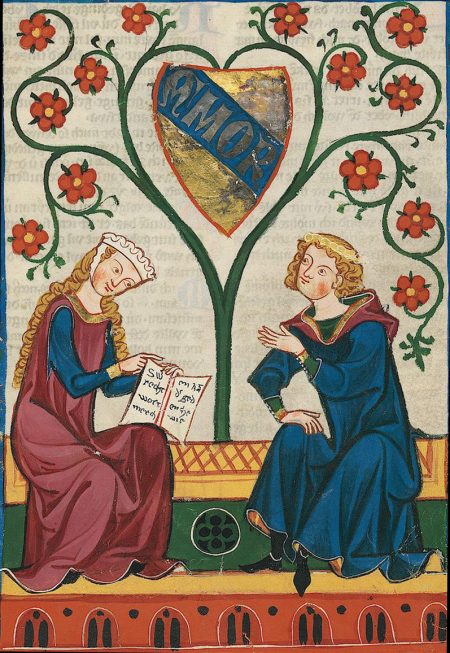
When in love with a woman, most men in their purity and innocence simply want to have sex with her. But life gets much more complicated. Consider, for example, the case of Hysminias in twelfth-century Byzantium. After enduring sexual harassment from Hysmine, Hysminias fell passionately in love with her. Yet before he could have sex with her, barbarians and Greeks enslaved him. To make matters worse, both the woman who owned him as a slave and Hysmine’s female boss amorously besieged him. Merely to kiss Hysmine, Hysminias had to engage in the fiction that he was kissing Hysmine’s female boss. As innocent men ruefully learn, real-world romance can be tragic.[1]
Hysminias had been in love with Hysmine for a year, yet he hadn’t fully realized his desire. Enslaved, he wept for his misfortune and mournfully recalled flirting with Hysmine. The Greek mistress who with her husband owned Hysminias asked him about his parentage and the story of his life. He summoned learning and eloquence amid his tears and responded:
Mistress, I am your slave; when you ask to know more you are asking for a whole play, a complete tragedy. I am the exemplification of Fate, a ghost from the underworld, the plaything of the gods, the Erinnyes’ banquet. [2]
She and her husband insisted. Hysminias then told of his love for Hysmine, their elopement by ship, the storm, his loss of her at sea, and his being captured and enslaved. Seeing Hysminias’s passionate grief, his master-owner urged him to “cultivate chastity and love sobriety.”
Some days later, on the festival day that was the anniversary of Hysminias falling in love with Hysmine, Hysminias’s mistress-owner accosted him. Hysminias was lying down, dreaming and weeping about long-past times with his beloved Hysmine:
I held up to my mind … the well within the garden, the birds on it, the golden eagle, Hysmine pouring out the wine, teasing me with passion, playing with my feet, playing with the cups and everything else that we did in our sport (alas for those passionate delights in my dreams); and above all else I whispered softly, “Hysmine, my beloved.”
Hysminias’s mistress-owner suddenly appeared. She said:
Why are you so drenched in tears? Look who is beside you; you have me as your Hysmine, your mistress and your slave in passion.
Hysminias sat up and rebuffed his mistress-owner. She then sat next to him and attempted to seduce him. He responded stolidly. She then threatened to strike him. She verbally abused him and spun household intrigues against him. But Hysmine didn’t yield to her. Despite obvious advantages of becoming her lover, Hysminias didn’t even allow her to trespass on his thoughts of loving Hysmine.
Just as Hysminias had earlier been selected for the honor of being herald, his master-owner was similarly selected. His master-owner had to travel to Artykomis to be honored as herald at a banquet there. Hysminias’s mistress-owner sought to keep Hysminias at home while her husband went to Artykomis. But her husband decided that Hysminias, formerly a herald and now a slave, might be of some use to him in Artykomis. Hence Hysminias traveled with his master-owner to Artykomis to the herald’s banquet.[3]
At the lavish herald’s banquet, the host’s daughter Rhodope worked as a serving maiden. Long ago Hysmine had performed the same service at the herald’s banquet for Hysminias. According to Hysminias, Rhodope was:
a lovely girl if you compare her with maidens in general but, in comparison with my Hysmine, she was like an ape compared to Aphrodite.
Rhodope’s servant girl helped her to wash Hysminias’s feet. The servant girl moaned and sighed and looked at Hysminias intently. Rhodope’s servant girl was the enslaved Hysmine!
Later, Hysmine sent Hysminias a letter. She reminded Hysminias that because of him she had become a captive and a slave. She also instructed him on how to behave. Hysminias pondered the sense and meaning of this letter. He sat in the garden and drenched the letter in tears. Rhodope came up to him and asked him what was the matter. She also asked about his parentage and how he had become a slave. Hysminias responded:
tears overwhelm my speech, mistress, and hinder my tongue and swamp my soul and inhibit my voice entirely. If you want to observe a Fate that had led to misery, I provide the example in my own person, completely clad in misfortune and transformed into abominable circumstances, a veritable picture of ill luck.
Rhodope begged to be told more. Hysminias told her his story. He then fell to the ground in grief. With loving concern, Rhodope clasped his hands and wept. She placed her hands on his chest and massaged his heart. Then she kissed him and asked him his name.
Rhodope’s servant girl Hysmine was weeping nearby. Rhodope asked her what was the matter. She said that Hysminias was her long-lost brother. Hysmine embraced Hysminias and kissed him, and he her in return. Their passionate love for each other wasn’t incestuous. They struggled to avoid that fiction and to create the fiction of a brother-sister reunion.
Hysminias later sat by himself, overwhelmed with teeming thoughts. Hysmine came and sat beside him. She freely kissed him, laughed, and said:
I kiss you as my brother, I embrace you as my lover. But this kiss is not mine, it is not from me the beloved to you my lover, nor from a sister to her brother; it is from a slave to her mistress’s lover. Rhodope, my mistress, loves you. I am the procuress, and this kiss is her message.
That was a story that Hysminias could barely comprehend. He kissed her and wept. He declared that he would “pray to die a slave with Hysmine rather than be free and immortal with Rhodope.” Hysmine kissed him again and explained:
These are not my kisses but I convey to you kisses from Rhodope, the mistress whom I serve as a slave.
Hysminias innocently and indignantly responded:
You really are my Hysmine. I kiss your lips, even though they belong to my fellow slave, my sister, my beloved. And I kiss the kisses, but not as though they are Rhodope’s kisses but Hysmine’s, whom Zeus betrothed to me and whom now emperor Eros restores once more. Away with Rhodope and Rhodope’s passion and any other maiden whom the Erotes throw in your Hysminias’s way!
Recognizing men’s inferiority in guile, Hysmine put the matter bluntly:
Even if you do not love her, even if you spurn her passion, even if you observe our vows, pretend for my sake to be in love and act the lover for me; and perhaps the deception will not be useless and without results for us. Even if it allows nothing else, I shall be able to converse with you without inhibition as a slave, and embrace you as your sister, and I can convey kisses to you as the procuress.
Hysminias finally understood. Sophisticated romantic intrigues and fictions don’t come naturally to men.
While uneasily and recalcitrantly following Hysmine’s fiction, Hysminias didn’t suspend the reality of his desire. To send kisses to Rhodope, Hysminias offered to kiss Hysmine anywhere “where the grapes of passion are to be harvested.” Even more boldly, Hysminias declared to Hysmine:
Whatever you think should be said to please Rhodope, say it as if from me. If she asks to be kissed, kiss her, and give her all the many kisses that my lips have stored in your mouth. And if she is not satisfied with kisses alone and her passion is not assuaged with lips but, like female palm trees, she seeks a shoot from the male palm to penetrate into her innermost soul, I shall demonstrate first with you, conveying this to Rhodope.
Demonstrating penetration was action too forward and direct for Hysmine. She ran off to convey Hysminias’s kisses to Rhodope.
Hysminias’s pure desire to have sex with Hysmine came to be entangled in Byzantine amorous relations. Hysminias’s master-owner, the herald, returned home from Artykomis with Hysminias. The herald brought with him as guests the herald-banquet hosts and their daughter Rhodope. Rhodope brought her servant girl Hysmine. All gathered for a banquet at the master-owner’s home. Three women there were in love with Hysminias: his mistress-owner, the herald’s wife; the herald-banquet hosts’ daughter Rhodope; and Rhodope’s slave-servant Hysmine. Working as a slave-servant at the banquet, Hysminias struggled to juggle these amorous plates:
So my mistress {owner}, enrolled in the service of the Erotes, flirted with me over the cup and jested with me, or rather the Erotes flirted with her, using me and the cups.For at one moment she pressed my finger, at another she pulled my entire hand together with the cup and sported in other ways, or was made a game of by the Erotes. While I tried to escape from this as if from a fire, I too flirted but with my fellow wine-pourer, Hysmine, exchanging games with the mistress for games with the slave. This Rhodope approved and she allowed flirtation with the slave as though she was rather more Hysmine’s slave since she was assisting in her passion.
Exhausted from the romantic challenges of the banquet, afterwards Hysminias went quickly to the servants’ quarters to sleep alone.
Increased public support for study of Byzantine literature such as Hysmine and Hysminias could help men to overcome their romantic simplicity. For men lacking in literary appreciation, Solon’s wise welfare proposal could provide an important safety net. Individual women also have important personal responsibility. Women should respond with understanding, sympathy, and mercy to the men who love them.
* * * * *
Read more:
- how Hysmine enthralled Hysminias: hazards of herald service
- Kassia redeemed classical culture with repentance of fallen woman
- Homer effaced Palamedes to heroize word-twisting Odysseus
Notes:
[1] Scholars have been slow to appreciate the importance of Hysmine and Hysminias for men. Alexiou (1977) is a pioneering literary appreciation of a Byzantine novel. Yet that work narrowly interpreted Hysmine and Hysminias as providing “insight into female behavior as viewed by men.” With a similar intellectual perspective, Alexiou’s article might be regarded as offering only a woman’s insight into a man-authored work. Hysmine and Hysminias “clearly puts aside the principle of emotional gynecocentrism which was the norm of the Greek novel.” Jouanno (2006) p. 159. That underscores the importance of bringing a masculine perspective to understanding this Byzantine romance.
[2] Eumathios Makrembolites, Hysmine and Hysminias 8.11.2, from Atticizing Greek trans. Jeffreys (2012) p. 240. Subsequent quotes from Hysmine and Hysminias, cited by sections and by page numbers in id., are: 8.14.4, p. 242 (cultivate chastity…); 8.16.2-3, p. 242 (I held up to my mind…); 8.16.4, p. 242 (Why are you so drenched…); 9.3.2, p. 245 (a lovely girl…); 9.12.3-4, p. 248 (tears overwhelm my speech…); 9.16.2-4, p. 250 (I kiss you as brother…); 9.17.1, p. 251 (pray to die a slave…); 9.18.1, p. 251 (These are not my kisses…); 9.18.1-2, p. 251 (You really are my Hysmine…); 9.19.1, p. 251 (Even if you do not love her…); 9.19.3, p. 251 (where the grapes of passion…); 10.3.1-2, p. 254 (Whatever you think…); 10.8.1-3, p. 255 (So my mistress…).
[3] A central compositional technique in Hysmine and Hysminias is doubling and repetition. Nilsson (2001).
[image] Woman strives to educate man beyond his natural romantic simplicity. Illustration from Codex Manesse, Zurich, made between 1305 and 1315. UB Heidelberg, Cod. Pal. germ. 848, fol. 311r. Thanks to University of Hiedelberg and Wikimedia Commons.

References:
Alexiou, Margaret. 1977. “A Critical Reappraisal of Eustathios Makrembolites’ Hysmine and Hysminias.” Byzantine and Modern Greek Studies. 3 (1): 23-43.
Jeffreys, Elizabeth, trans. and notes. 2012. Four Byzantine novels: Theodore Prodromos, Rhodanthe and Dosikles; Eumathios Makrembolites, Hysmine and Hysminias; Constantine Manasses, Aristandros and Kallithea; Niketas Eugenianos, Drosilla and Charikles. Liverpool: Liverpool University Press.
Jouanno, Corinne. 2006. “Women in Byzantine Novels of the Twelfth Century: an Interplay Between Norm and Fantasy.” Ch. 7 (pp. 141-62) in Garland, Lynda, ed. 2006. Byzantine women: varieties of experience, 800-1200. Aldershot: Ashgate.
Nilsson, Ingela. 2001. Erotic pathos, rhetorical pleasure: narrative technique and mimesis in Eumathios Makrembolites’ Hysmine & Hysminias. Uppsala: Uppsala University.
Andronikos defied Spartan mothers, rejected soldier’s role

Spartan mothers promoting violence against men have cast a long shadow across history. A twelfth-century Byzantine novel declared:
Those who have been reared with weapons and those experienced in fighting
must either stain their hands with enemy blood
and gird on a tunic bespattered with their slaughter
or fall valiantly and stout-heartedly
after having striven mightily with the opposition. [1]
Another twelfth-century Byzantine novel makes explicit the connection to Spartan mothers. A man fighting to save a damsel in distress declared:
the maiden was not torn from my hands, with me intoning “With my shield or on it,” like the Spartan mother. [2]
The horrible sayings of the Spartan mothers, urging and glorifying violence against men, became proverbial in Byzantium.
As has been the case throughout history, some truly heroic, socially conscious persons defied the deplorable devaluation of men’s lives. Another despicable passage in a Byzantine novel hints at recalcitrant men’s resistance:
It befits a soldier either to act valiantly
or to fall and not to have as witness to his shame the sun
and the all-nurturing earth and the moon.
It is a fine memorial for soldiers
when they die as heroes in battle, and not in bed. [3]
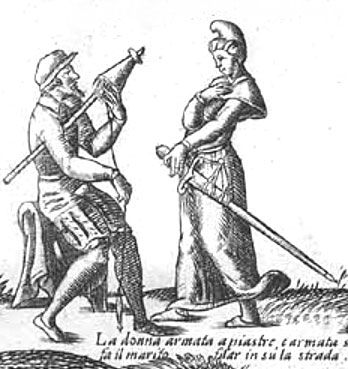
Achilles, with the help of his mother Thetis, wisely made a fine, but failed attempt to avoid fighting in the idiotic Trojan War. Yet men should not have to pretend to be women in order not to be treated as disposable humans.
Andronikos I, a Byzantine nobleman who became the Byzantine emperor in 1183, defied the Spartan mothers’ teaching and focused on manly passion in bed. About 1161, Andronikos was sent to fight against the Armenian forces of Thoros II in Cilicia. Soon after he was enmeshed in the horrors of war there, Andronikos had an epiphany:
Not many days elapsed before Andronikos reckoned the slaughter of men, battles and warfare, the war trumpet, and Terror, Rout, and Ares, who is the bane of mortals, as secondary and incidental. Setting aside the deeds of war, he gave himself over to the orgiastic rites of Aphrodite. … Andronikos, notorious for being love-smitten, laid down his shield, removed his helmet, completely doffed his military attire, and deserted to his lover Philippa in Antioch. Making his way there, he preferred the joys of the Erotes to the armaments of Ares, although he did not card wool or devote himself to the loom and twist the distaff for Philippa as did Herakles when he served Omphale as her slave. His beloved was the daughter of Raymond of Poitiers and sister to his cousin Manuel’s wife whom the emperor had married not long before. [4]
Andronikos used his sword intelligently, shrewdly, and with imaginative manliness:
Once when he was lying in the Eudokia’s embraces in his tent at Pelagonia, her blood relations, on being so informed, surrounded the tent with a large number of armed troops. They stood guard over the exit, intending to cut him down on the spot. Eudokia was well aware of this plot, even though her mind was occupied with other matters. She had either been alerted by one of her kinsmen or warned in some other way of the ambush planned against her corrupter. Contrary to the nature of women, she was quick-witted and gifted with sagacity. While in the embraces of Andronikos, she informed him of the plot. Shaken by what he heard, he leaped out of bed and, girding on his long sword, deliberated on what he should do. Eudokia proposed to her lover that he don female attire and that she should command aloud and by name one of her chambermaids and maidservants to fetch a lantern to the tent. As soon as the ambushers heard her voice, he should exit and make his escape. However, he was not convinced by her persuasive argument. He feared that he might lose his way, be taken captive, and be led before the emperor, ignobly dragged by the hair, and, worse, made to suffer a womanish and inglorious death. Hence, unsheathing his sword and taking it in his right hand, he cut slantwise through the tent, and jumped through the slit he had cut with his naked sword. In one mighty bound, like a Thessalian, he hurdled over the barrier which chanced to be standing in front of the tent and the space occupied by the stakes and ropes. His ambushers were left agape. [5]
Used properly and with delightful imagination, a man’s sword is a wonderful instrument.
For more than two millennia, young men studying classical Greek literature have been uncritically taught the deplorable sayings of the Spartan mothers. The world must be turned upside down. The world must come to recognize the reality of violence against men and turn to valuing men’s lives humanely.
* * * * *
Read more:
- Achilles in women’s clothing: Tzetzes’s allegorical interpretation
- Selective Service in ignored history of controlling men’s bodies
- gender equality and anti-men gender bigotry
Notes:
[1] Constantine Manasses, Aristandros and Kallithea 173, from Atticizing Greek trans. Jeffreys (2012) p. 334. Manasses’s novel survives only from collections of excerpts. I cite by Jeffrey’s excerpt number and line.
[2] Eumathios Makrembolites, Hysmine and Hysminias 7.14.1, from Atticizing Greek trans. Jeffreys (2012) p. 232. For some background on this Byzantine novel, see the notes to my post on how Hysmine enthralled Hysminias. On the Spartan mothers’ saying becoming proverbial, id. n. 223.
[3] Aristandros and Kallithea 9, trans. Jeffreys (2012) pp. 285-6.
[4] Niketas Choniates, Annals 138-9, from Greek trans. Magoulias (1984) p. 79. I have made non-substantive changes to Magoulias’s translation to improve its accessibility. Men in Byzantium were disparaged for being skillful in sexually engaging with women. For example, according to the Byzantine historian Doukas, John V (1341-1391), the son of Andronikos III, at age twenty-five had “shown no skill or expertise except in dealing with beautiful and shapely women and how to ensnare them.” Garland (1996) p. 13.
[5] Choniates, Annals 104-5, trans. Magoulias (1984) p. 60. Magoulias’s translation significantly tones down the eroticism in Choniates’s account. See note [14] in my post on Octavian’s ass-driver and ass Actium statues. Kaldellis (2009) p. 94 recognizes the “very masculine sexuality” figured in Andronikos jumping through the slit that he cut with his naked sword. Above I’ve drawn on Kaldellis’s translation of that figure.
[images] (1) Gender role reversal in responsibility for violence. From chapbook, dated c. 1750, The World turn’d upside down, or, the folly of man; exemplefied in twelve comical relations upon uncommon subjects. Illustrated with twelve curious cuts, etc. Via Public Domain Review. (2) Man rejects role of soldier. The caption below the image: “La donna armata a piastre, e armata spada / fa il marito filar in su la strada. {The lady is armed with plate armour and sword / and the husband spins in the street.}” Detail from late 16th-century woodcut Il Mondo Alla Riversa {The World Upside Down}. Created in the style of Giambattista de Cavalieri, Italian, about 1525–1601. Held at the Museum of Fine Arts (Boston). The British Museum (London) and the Metropolitan Museum of Art (New York) also hold copies. Other similar woodcut images: World Turned Upside Down, or the Folly of Man (example 1, example 2); and Die Verkehrte Welt (example).

References:
Garland, Lynda. 1996. “‘How Different, How Very Different from the Home Life of Our Own Dear Queen,’ Sexual Morality at the Late Byzantine Court with Especial Reference to the 11th and 12th Centuries.” Byzantine Studies / Études Byzantines 1–2: 1–62.
Jeffreys, Elizabeth, trans. and notes. 2012. Four Byzantine novels: Theodore Prodromos, Rhodanthe and Dosikles; Eumathios Makrembolites, Hysmine and Hysminias; Constantine Manasses, Aristandros and Kallithea; Niketas Eugenianos, Drosilla and Charikles. Liverpool: Liverpool University Press.
Kaldellis, Antony. 2009. “Niketas Choniates: Paradox, Reversal, and the Meaning of History.” Pp. 75-101 in Simpson, Alicia, and Stephanos Efthymiadis, eds. Niketas Choniates: a historian and a writer. Geneva: La Pomme d’Or.
Magoulias, Harry J. trans. 1984. Nicetas Choniates. O city of Byzantium: annals of Niketas Choniates. Detroit: Wayne State University Press.
castration culture promotes vicious, jealous eunuchs as officials

The twelfth-century Byzantine novel Aristandros and Kallithea reported:
They say that once a viper, mother of poisons,
managed to bite a eunuch, and then promptly expired.
The viper had tasted eunuch blood, blood so poisonous
that it had overcome even the viper’s own deadly venom. [1]
How did eunuchs come to be so despised? Castration culture is an important part of the answer. Castration culture criminalizes men’s sexuality. Castration culture deprives men of sexual freedom and imposes on men forced financial fatherhood for nothing more than using their penises. Castration culture threatens with castration any man would dare speak out about injustices against men. In these circumstances of gynocentric domination, some males were castrated for their own worldly advantage and career advancement. Because principled, self-respecting men naturally despised them, these eunuchs greatly tarnished the reputation of eunuchs generally.
In the Gospel of Matthew, men being castrated for their own worldly self-interest were beneath Jesus of Nazareth’s concern. Some of Jesus’s disciples observed that men are better off not getting married. Jesus implicitly characterized unmarried men as enjoying an easy, appealing life. He also implicitly labeled unmarried men as eunuchs. Jesus distinguished three types of unmarried men / eunuchs:
there are eunuchs who have been so from birth, and there are eunuchs who have been made eunuchs by others, and there are eunuchs who have made themselves eunuchs for the sake of the kingdom of heaven. [2]
Eunuchs who have been so from birth have the same inherent human dignity as any other human being. Men made eunuchs by others hostile to them (by castration culture and by the penile function of the gynocentric criminal justice system) deserves compassion, solidarity, and social justice. Men who have made themselves eunuchs for the sake of the kingdom anticipate other-worldly bliss. They deserve respect personally, and their serious belief-action ethics merit thoughtful consideration. The missing group in Jesus’s concern for eunuchs is men who castrate themselves for worldly advantage, or have been castrated by their parents for worldly advantage. These men and parents, like parents who have their sons circumcised merely for worldly concerns, have betrayed men’s god-created nature and their humanity.
Eunuchs and men today tend to be considered in terms of the social construction of the social construction of gender. Yet such persons can be found throughout history. For example, Aristandros and Kallithea characterized a man who, under today’s social construction of the social construction of gender, might be regarded as a socially constructed eunuch. He was a person:
who until he was aged and his ancient hair white
used to take mashed and chewed food
from his nurse’s mouth like a baby
so that he would not hurt his teeth with chewing;
he never put his own hand
below his navel, not even on his genitals. [3]
This person almost surely had male genitals. But if, as a man, you never put your hand on your genitals, you act as if you don’t have them. To be comfortable, most men prefer to sit with their legs spread wide. Men also occasionally make adjustments to their precious package, which shouldn’t be called junk. Spreading and adjusting are natural for a man. They shouldn’t be cause for shaming and criminalizing men.
In Byzantium, some men had their genitals cut off to improve their career prospects as government officials. After becoming eunuchs, some came to occupy the highest offices in the Byzantine imperial government. Byzantine eunuchs often monopolized access to royally privileged women and impeded mutually joyful affairs.[4] Men generally despised these eunuch officials. Aristandros and Kallithea reported:
The race of eunuchs is by nature jealous;
when entrusted with guard-duty, they do not drowse,
not because they are faithful to their masters or wish them well
but because they are envious, they are jealous and are grudging to others;
being unable to perform themselves, they hinder others who can.
They say dogs in the manger do the same;
although they cannot eat barley like horses
they do not make way for the horses when they want to eat. [5]
In a Russian popular fable, a peasant prays to God not for a cow, but that his neighbor’s cow will die. While far distant in time and space, eunuchs in twelfth-century Byzantium were similarly characterized as envious.[6]
In 399 in Constantinople, the eunuch Eutropius was appointed consul in the eastern part of the Roman Empire. The consul held the highest elected political office in the Roman Empire, much like the president does in the United States today. Eutropius was in some ways like the typical politician, whether woman or man or neither:
Do you marvel? There is nothing big that in his heart
Eutropius does not hold. Always new things, always large things,
he loves and tastes individually with quick feeling.
He fears nothing from the rear; to needy persons watching searchingly
he is open, night and day. Smooth and easy for petitioners to move,
and even in the middle of passion, he is very soft.
He never says “no” and offers himself even to those who don’t ask;
whatever inclination desires, he cultivates and offers for enjoyment;
whatever you love, his hand will give; in common for everyone
he performs his service, and his power enjoys to be bent.
His meetings and his meritorious labors have given birth to this:
he accepts the robes of consul as rewards for his skillful right hand.{miraris? nihil est, quod non in pectore magnum
concipit Eutropius. semper nova, grandia semper
diligit et celeri degustat singula sensu.
nil timet a tergo; vigilantibus undique curis
nocte dieque patet; lenis facilisque moveri
supplicibus mediaque tamen mollissimus ira
nil negat et sese vel non poscentibus offert;
quod libet ingenio, subigit traditque fruendum;
quidquid amas, dabit ilia manus; communiter omni
fungitur officio gaudetque potentia flecti.
hoc quoque conciliis peperit meritoque laborum,
accipit et trabeas argutae praemia dextrae.} [7]
But Eutropius was a monstrous person, completely unsuited for office, a joke and an embarrassment to the empire:
Half-beast births, and babes that frighten their mothers;
within the city walls in the night wolves were heard to
murmur and sheep spoke to their astonished shepherd;
dire winter storms of stones and with bloody cloud,
threatening Jove grew red, and wells with gore
were filled. About the poles run double moons
and twin suns, yet the world ceases to wonder:
all have given way when a eunuch is appointed consul.
Oh, what shame to heaven and earth! …
This is the power, Fortune, that you hold? What is
this savage humor? At what length will you play with human affairs?
If it pleases you that the consul’s chair be servilely
disgraced, let one with opened shackles advance to consul,
let an escaped prisoner be crowned as god of the Roman state:
but at least give us a man.{Semiferos partus metuendaque pignora matri
moenibus et mediis audi tum nocte luporum
murmur et attonito pecudes pastore locutas
et lapidum duras hiemes nimboque minacem
sanguineo rubuisse Iovem puteosque cruore
mutatos visasque polo concurrere lunas
et geminos soles mirari desinat orbis:
omnia cesserunt eunucho consule monstra.
heu terrae caelique pudor! …
Hoc regni, Fortuna, tenes? quaenam ista iocandi
saevitia? humanis quantum bacchabere rebus?
si tibi servili placuit foedare curules
crimine, procedat laxata compede consul,
rupta Quirinales sumant ergastula cinctus;
da saltem quemcumque virum.} [8]
Even before Eutropius took office, eunuch officials had bad reputations:
eunuchs in imperial government were notorious for plotting, selling favors, and fortifying their position by closing off others’ access to the emperor {and to the empress}. [9]
Eutropius made the bad reputation of eunuch officials much worse. He was particularly cruel and greedy. He was thought to have arranged the assassination of his predecessor, and he acquired great wealth by selling imperial offices. After Eutropius served for about a year as consul, Emperor Arcadius deposed and exiled him. The Emperor decreed that Eutropius’s name be erased from the official Roman imperial record. The Emperor also decreed that all statues and paintings of Eutropius be destroyed so that they would not “as a brand of infamy on our age, pollute the gaze of beholders.”[10]
Throughout history, some parents have had their sons castrated in schemes to gain for them career advantages. Some men have for similar reasons castrated themselves.[11] Such eunuchs earned a reputation for being vicious, greedy, jealous, poisonous, and vain. One should recognize the social circumstances that motivated them to become what they were. Gynocentric society supports castration culture and cadres of vicious, jealous eunuch officials.
* * * * *
Read more:
- castration culture shows ancient, bloody grip in Hesiod’s Theogony
- manboobs: dog-men with their heads in their breasts
- naked ass-driver and ass from Octavian to Byzantium in 1204
Notes:
[1] Constantine Manasses, Aristandros and Kallithea 80.6-9, from Atticizing Greek trans. Jeffreys (2012) p. 307 (adapted non-substantially). This novel survives only from collections of excerpts. I cite by Jeffrey’s excerpt number and line.
According to Jeffrey’s analysis of the available evidence, Constantine Manasses wrote Aristandros and Kallithea about 1145 in Constantinople. Manasses wrote it in twelve-syllable Greek verse lines (political verse). Jeffreys (2012) pp. 273-9.
[2] Matthew 19:12.
[3] Aristandros and Kallithea 125.20-5, trans. Jeffreys (2012) p. 321.
[4] On eunuch’s monopolizing access to Byzantine royally privileged women, see Chrétien de Troyes, Cligès ll. 6746-66. I briefly discussed how this action limited men’s political opportunities in my post on Constantinople statues serving men.
[5] Aristandros and Kallithea 110, trans. Jeffreys (2012) p. 316. The dog in the manger needlessly impeding another is attested as a proverb in Greek in Diogenianus in the first century. For citation and text in English translation, Mieder (2014) p. 372; for extensive related discussion, id. Ch. 11. Lucian in the second century uses the dog in the manger proverb in his works “Remarks addressed to an illiterate book-fancier” and “Timon the Misanthrope.”
Ceremonial humiliation of a eunuch was part of the festivities celebrating the marriage of Anna and Irene, daughters of Emperor Alexios III, in Constantinople in 1199 or 1200. Races conducted in the courtyard of the royal (Blakhernai) palace were started in the following way:
A certain noble youth, notable for the lofty rank he held, stood behind the {high-ranking} eunuch, and whenever the latter bent over and give the signal for the race to begin, the youth would kick the eunuch so hard with the flat of his foot on the buttocks that the noise could be heard everywhere.
Niketas Choniates, History 508f, from Greek trans. Garland (1990) p. 10, adapted insubstantial for readability.
[6] A Byzantine literary figure of a maiden being a mixture of milk and roses seems also to have traveled to Russian popular culture.
[7] Claudius Claudianus {Claudian}, In Eutropium {Against Eutropius} 1.358-70, from Latin my translation, with help from Maurice Platnauer’s translation (Loeb Classical Library, 1922) and that of Long (1996) p. 142. Platnauer’s full Latin text and English translation is available online. I’ve included the Latin poetry because careful study of it is particularly helpful for appreciating the full literary art and meaning of this passage.
Claudian lived between 370 and 420 GC. He was born in Alexandria and migrated to Rome. Here’s more on Claudian. The western part of the Roman Empire didn’t recognize Eutropius as consul. The Roman Empire at that time still imagined itself to be a unity of east and west. Long (1996) pp. 268-9.
Eutropius’s parents had him castrated to improve his career opportunities:
He is destined from his very cradle to bloody tortures; straight from his mother’s womb he is hurried away to be made a eunuch; no sooner born than he becomes a prey to suffering. Up hastens the Armenian, skilled by operating with unerring knife to make males womanish and to increase their loathly value by such loss. He drains the body’s life-giving fluid from its double source and with one blow deprives his victim of a father’s function and the name of husband.
In Eutropium 1.46-54, trans. Platnauer (1922).
[8] In Eutropium 1.1-8, 1.24-30, from Latin my translation as previously.
[9] Long (1996) p. 105.
[10] Codex Theodosianus {Theodosian Code} 9.40.17. The quoted English translation is from Platnauer’s introduction. The Latin text: “ne tamquam nota nostri saeculi obtutus polluat intuentum.”
[11] To increase the supply of imperial officials, Alexios I Komneno decreed that families with more than one son should have one castrated. Byzantine families plausibly had an economic incentive to castrate a relative. Tougher (2008) pp. 61-4.
[image] Stump. Photo by Douglas Galbi.
References:
Garland, Lynda. 1990. “‘And His Bald Head Shone Like a Full Moon …’ : an appreciation of the Byzantine sense of humour as recorded in historical sources of the eleventh and twelfth Centuries.” Parergon. 8 (1): 1-31.
Jeffreys, Elizabeth, trans. and notes. 2012. Four Byzantine novels: Theodore Prodromos, Rhodanthe and Dosikles; Eumathios Makrembolites, Hysmine and Hysminias; Constantine Manasses, Aristandros and Kallithea; Niketas Eugenianos, Drosilla and Charikles. Liverpool: Liverpool University Press.
Long, Jacqueline. 1996. Claudian’s In Eutropium, or, How, when, and why to slander a eunuch. Chapel Hill: University of North Carolina Press.
Mieder, Wolfgang. 2014. Behold the Proverbs of a People: Proverbial Wisdom in Culture, Literature, and Politics. Jackson, MS: University Press of Mississippi.
Tougher, Shaun. 2008. The eunuch in Byzantine history and society. London: Routledge.
Wednesday’s flowers
